

So, what does it really mean to be an international development consultant?
A consultant is a specialist on a mission. Organizations tackling massive global challenges like poverty, public health, or climate change can’t have every expert they need on full-time staff. They operate like a movie studio that needs a specific stunt driver for one complex scene. They don’t hire the driver for the whole production; they bring them in for that specific, high-stakes job.
That’s you, the consultant. You’re the specialist brought in to solve a specific problem within a clear timeframe.
What a Development Consultant Really Does
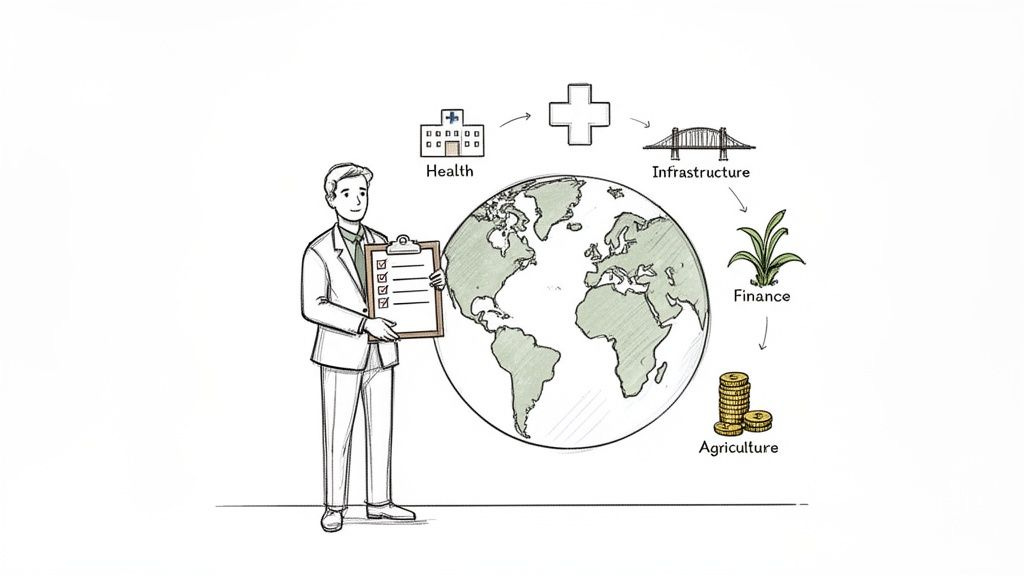
Development consulting is about filling a critical expertise gap. When the World Bank needs a financial model for a new port in Vietnam or a UN agency needs to evaluate a vaccination campaign in Nigeria, they don’t post a permanent job. They hire a consultant.
Your role is temporary and laser-focused. You’re an external expert hired to deliver a specific result. This is all laid out in a contract called the Terms of Reference (ToR). The ToR is your mission brief. It tells you exactly what needs to be done, what the final product looks like, and how long you have to do it.
A Massively Growing Global Market
The demand for specialized advice is enormous and growing every year. Development consulting is a key piece of the global management consulting industry, which grew from $1.06 trillion in 2025 to $1.11 trillion in 2026. It’s on track to surpass $1.4 trillion by 2030.
This growth is driven by a relentless push for efficiency and an urgent need for deep expertise in areas like climate resilience, digital transformation, and sustainable finance. You can get a deeper look at these global consulting market trends and their drivers.
This huge market means a steady stream of projects for independent experts. The work gives you a level of freedom and variety that’s almost impossible to find in a traditional staff role. You might spend three months designing a water sanitation project in Southeast Asia, then pivot to evaluating a renewable energy initiative in East Africa for your next gig.
A consultant’s value is bringing an outside perspective and a specific, hard-to-find skill set to solve a client’s problem efficiently. You’re paid for your expertise and your ability to deliver results.
The Key Players Hiring Consultants
The international development world can feel complicated, but a few key types of organizations dominate the hiring landscape. Figuring out who they are and what they do is the first step to finding your niche.
These are the main clients you’ll work for, either directly or indirectly. The table below breaks down the major players and what they typically look for in a consultant.
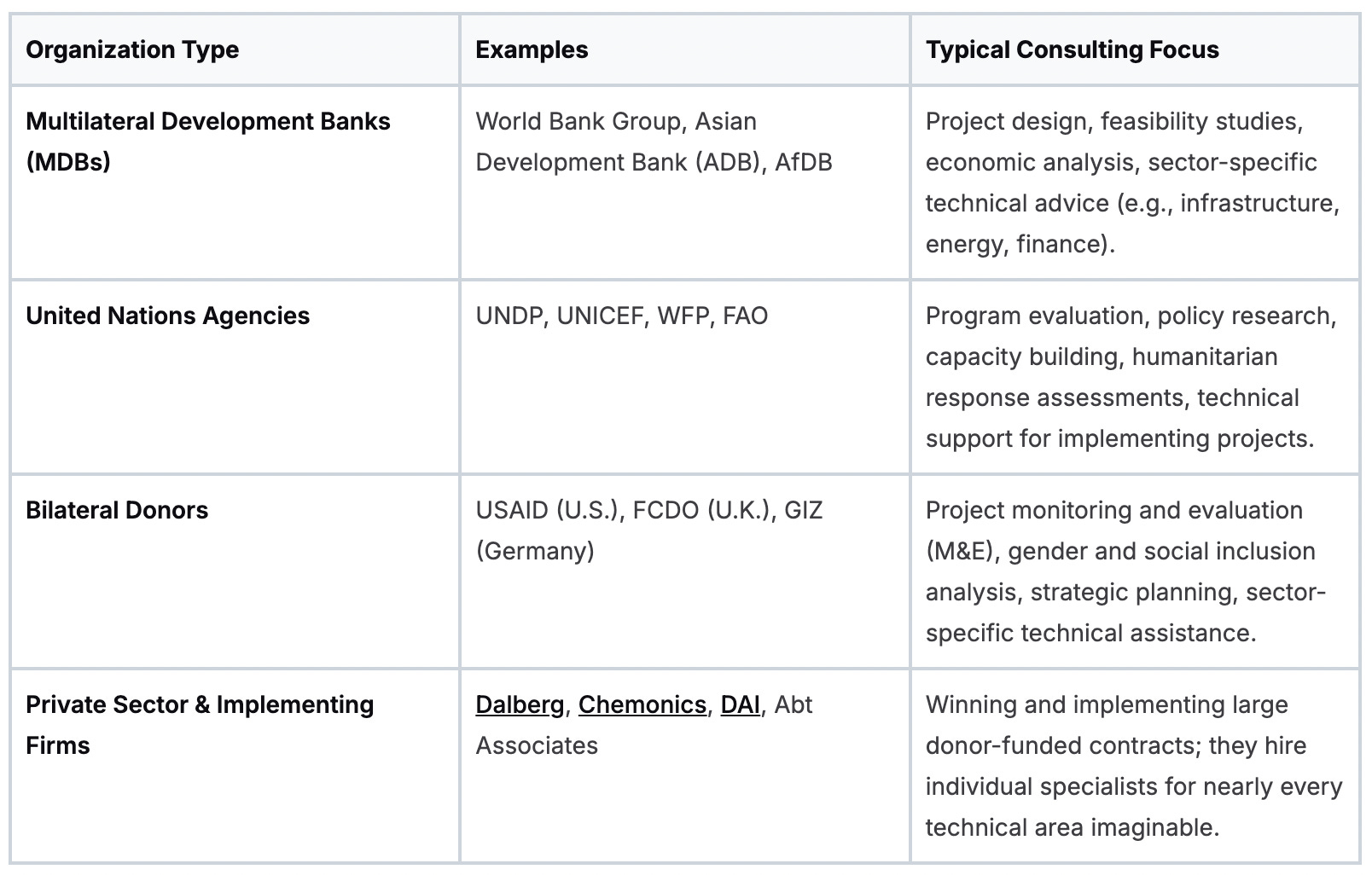
The work ranges from high-level strategic advice for a bank’s board to hands-on technical support for a project on the ground. Understanding which type of organization best fits your skills is crucial to positioning yourself successfully.
Mapping the Development Consulting Ecosystem
Before you can win a contract, you need a map of the territory. International development is a complex web of players, each with its own culture, rulebook, and reasons for hiring people like you.
Money flows from the top (the funders), gets managed in the middle (the implementers), and trickles down to individual experts and firms who do the specialized work. Your first job is to figure out where you fit in this food chain.
The Big Funders: MDBs and Bilateral Donors
The real money, the kind that funds massive, multi-year projects, comes from Multilateral Development Banks (MDBs) and bilateral donors. These clients have the deepest pockets and the most ambitious agendas.
Multilateral Development Banks (MDBs): These are the heavyweights like the World Bank Group, the Asian Development Bank (ADB), and the African Development Bank (AfDB). Owned by multiple countries, they finance huge infrastructure, economic policy, and social sector projects. They hire consultants directly for all sorts of high-level work, from designing a project to providing top-tier policy advice.
Bilateral Donors: These are the development arms of individual governments, operating as part of their foreign policy. You’ve heard of the big ones: the U.S. Agency for International Development (USAID), the UK’s Foreign, Commonwealth & Development Office (FCDO), and Germany’s GIZ. They bring in consultants for strategic planning, project oversight, and often to conduct monitoring and evaluation (M&E) to ensure their taxpayer money is making a difference.
The MDBs and major bilaterals are where you’ll find the most strategic, high-value consulting gigs. They set the tone for the entire industry. Getting on their radar is the long game for any serious development consultant.
The Implementers: UN Agencies, NGOs, and Private Firms
While funders hold the purse strings, a whole other category of organizations does the on-the-ground work. These are the implementers. They win the big contracts and grants, then hire specialists to get the job done.
United Nations (UN) Agencies like the UNDP, UNICEF, and the World Food Programme (WFP) are massive implementers. They run programs on everything from humanitarian relief to governance reform and constantly look for consultants with specific technical skills or evaluation experience.
Then you have the Non-Governmental Organizations (NGOs). This includes everyone from giants like The Gates Foundation down to small, specialized non-profits. They also implement donor-funded projects and frequently bring in outside experts for niche skills.
Finally, there’s the massive world of private sector consulting firms. Companies like Dalberg, Chemonics, and DAI were built to win and execute large donor contracts. These firms are perpetually hunting for talent to staff their projects, making them one of the most common entry points into the field.
This activity isn’t spread out evenly. Consulting demand is booming in certain parts of the world. The Asia-Pacific region, for example, is set to make up 23.20% of the global management consulting market, hitting a value of $77.6 billion in 2025. This tells you that countries like China and India are hotbeds for advisory work right now. You can learn more by exploring the regional dynamics of the global consulting industry.
Finding Opportunities and Understanding Contracts
Alright, let’s talk about getting hired and paid. Success as a development consultant means building a sustainable pipeline of work. You’re running a business of one.
Opportunities are everywhere, but they don’t just fall into your lap. You’ll get work in two main ways: securing individual contracts directly with an organization, or joining a large consulting firm that bids on massive, multi-million dollar projects. To build a career, you need to understand both routes.
The development world is an ecosystem. This map shows how the money flows.
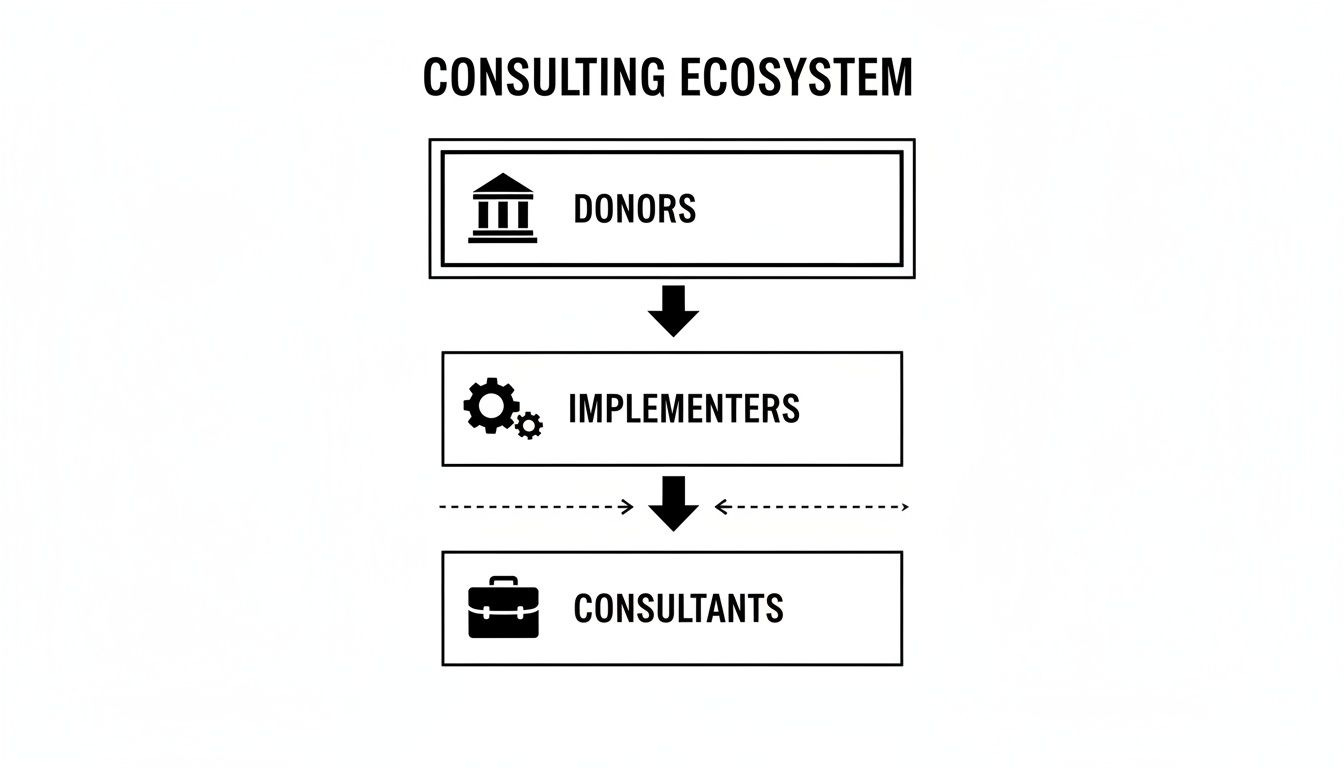
It’s simple when you break it down. Donors (like the World Bank or USAID) hold the purse strings. They fund the implementers (big NGOs and private firms), who then hire specialists like you to get the actual work done. Your job is to make yourself visible and valuable to those implementers and, eventually, the donors themselves.
Hunting for Opportunities
Your standard LinkedIn or Indeed search will come up dry. The real action happens on specialized procurement portals and insider job boards. You have to know where to look.
Official Procurement Portals: This is ground zero. MDBs and UN agencies are required to post their consulting opportunities publicly. You should be scanning the World Bank’s procurement portal, the UN Global Marketplace, and the sites for regional banks like the ADB and AfDB weekly.
Specialized Job Boards: Platforms like Devex are non-negotiable. They are the central nervous system of the development industry, pulling in thousands of gigs from every corner of the sector.
Your Network: This is the hidden job market. A huge number of contracts are filled through referrals before they ever get posted publicly. Your former bosses, colleagues, and clients are your most powerful source for leads. A good reputation gets around fast.
When you’re starting, your single most important goal is to get your name onto the official expert rosters of the MDBs and UN agencies. This puts you directly in the line of sight of program managers who need to hire pre-vetted specialists.
Decoding Contract Types
Not all gigs are the same. Contracts vary wildly in length, scope, and pay. Understanding the difference is key to managing your time and income.
Below is a quick breakdown of the most common types of consulting contracts you’ll encounter.
Consultancy Contract Types at a Glance
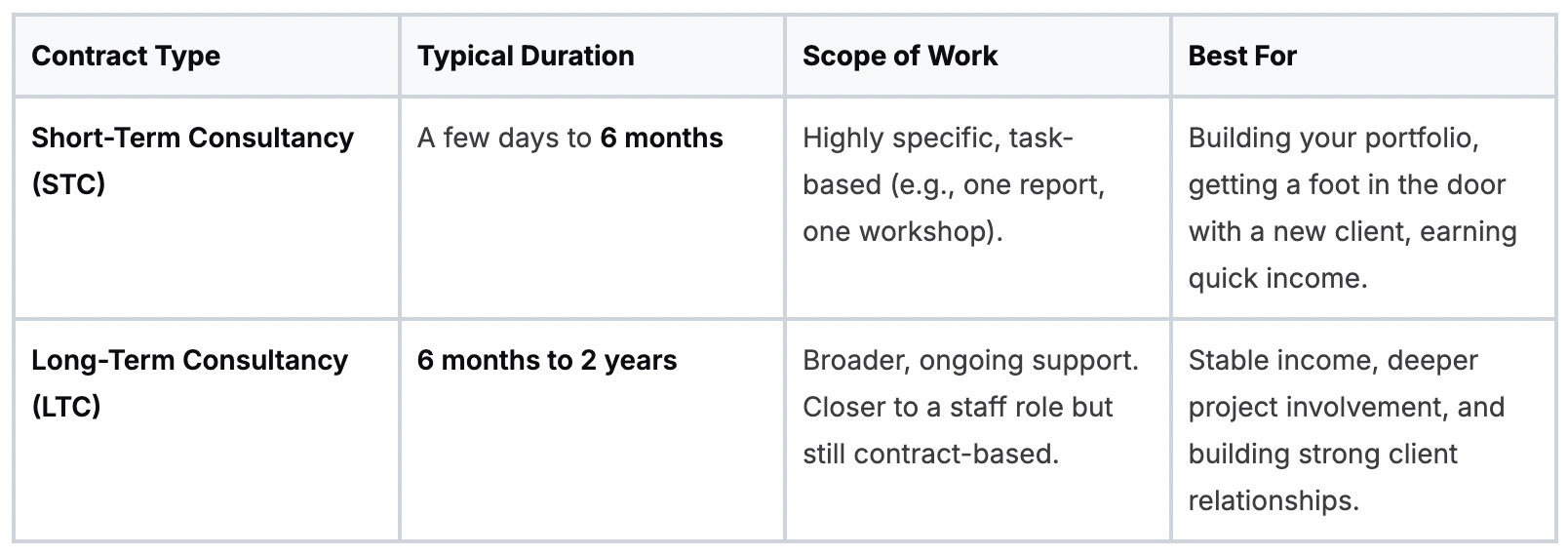
STCs are sprints: quick, focused projects perfect for racking up experience and clients. LTCs are marathons. They offer more stability and let you become deeply embedded in a project team. A healthy consulting career often has a mix of both.
How to Read a Terms of Reference (ToR)
The Terms of Reference (ToR) is your mission brief. It’s the single most important document in the application process because it tells you exactly what the client’s problem is and what they expect you to deliver.
Learning to dissect a ToR in minutes is a survival skill. Don’t waste time on gigs that aren’t a perfect fit.
When a ToR lands in your inbox, scan for these four things immediately:
The Objective: What’s the core problem they’re trying to solve? Can you state it in one sentence?
The Scope of Work: What are the specific, day-to-day tasks you’ll be doing?
The Deliverables: What tangible things do you have to produce? A final report? A dataset? A training manual?
The Qualifications: Does your CV perfectly mirror the skills and years of experience they’re demanding? Be honest.
If you can’t give a confident “yes” to all of the above, move on. The winning application will be from someone who is a direct match. If you are a great fit, your job is to craft an Expression of Interest (EOI) that screams it. If you’re new to this, check out our guide on how to write a Statement of Interest that gets you noticed.
The Essential Skills of a Development Consultant
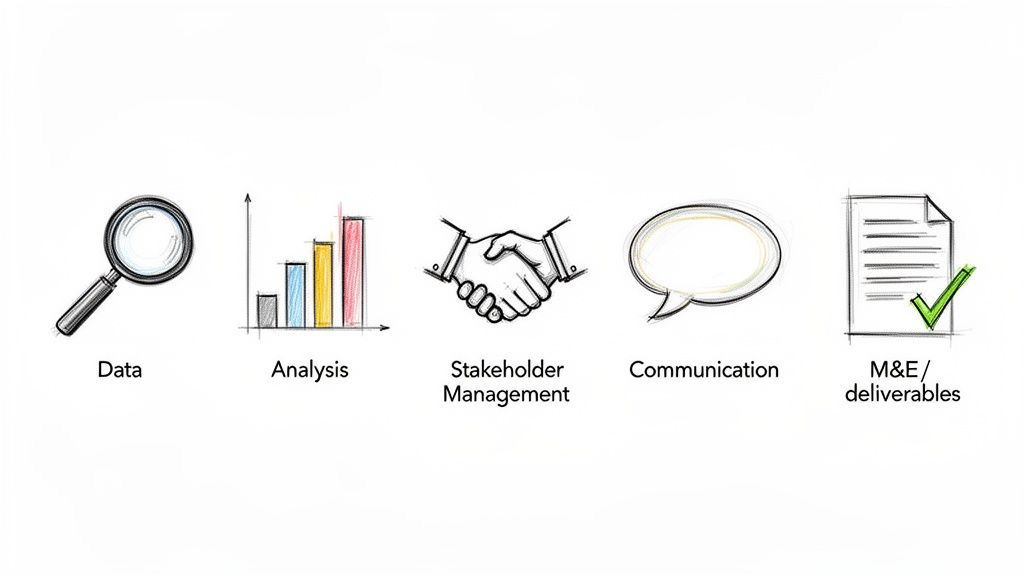
Succeeding as a development consultant requires a specific, battle-tested mix of hard technical skills and razor-sharp soft skills. Clients bring you in to solve a problem they can’t fix themselves, so you need to arrive with the right tools.
Think of your skills as your product. The more in-demand they are, the more valuable you become. This section breaks down the core competencies you need to build and highlight in every application.
In-Demand Technical Expertise
Technical skills are your ticket to the game. They are the non-negotiables that prove you can do the work laid out in the Terms of Reference. Without them, your CV won’t make it past the first look.
Quantitative and Qualitative Data Analysis: You have to be comfortable with data. This means everything from designing surveys and running statistical models to conducting key informant interviews and turning qualitative feedback into clear, evidence-based insights.
Monitoring and Evaluation (M&E): Donors need to know if their money is making a real difference. Expertise in M&E frameworks, from designing performance indicators to leading final project evaluations, is one of the most consistently sought-after skills in the industry.
Sector-Specific Knowledge: You can’t be a generalist forever. Deep knowledge in a high-demand niche like climate finance, public health systems, digital governance, or agricultural supply chains makes you the go-to expert they have to hire.
These abilities are the foundation of your value. They prove to a client that you can step in on day one and start producing concrete results.
Your technical skills get you the interview. Your soft skills get you the contract and the next one after that. Don’t make the mistake of focusing on one at the expense of the other.
This is especially true as development work becomes more digital and globalized. For instance, the Asia-Pacific region is now the fastest-growing market for consulting services, with a projected compound annual growth rate of 6.92% through 2031. This boom is fueled by massive digital infrastructure projects and e-government initiatives in countries like India and Singapore, creating huge opportunities for consultants with the right technical skills. You can dig into more consulting service market trends on Mordor Intelligence.
The Soft Skills That Close the Deal
Technical ability alone is never enough. International development consulting is a people-first business. How you communicate, negotiate, and manage relationships is what separates a good consultant from a great one who gets hired again and again.
Impactful Writing: Your main job is often to produce a written report. You must write clearly, concisely, and persuasively for a busy, high-level audience. Forget academic prose; think sharp policy briefs and executive summaries.
Stakeholder Management: You’ll navigate a complex web of relationships with government officials, donor reps, local community leaders, and project staff. Your ability to listen, build trust, and manage competing expectations is critical.
Cross-Cultural Communication: Working across different cultures is a given. You need the self-awareness to adapt your communication style and the humility to listen far more than you speak.
Your Deliverables Are Your Track Record
Ultimately, clients hire you to produce something tangible. Your career is built on a portfolio of real-world outputs that prove your worth. Understanding the typical deliverables is key to framing your experience correctly.
Inception Report: This is your opening move. It’s a document you write at the start of an assignment that lays out your detailed work plan, methodology, and timeline. It shows the client you’ve grasped their problem and have a clear plan to solve it.
Literature Review or Desk Study: Before any fieldwork begins, you’ll often be asked to synthesize all existing research, data, and project documents to build a solid evidence base for your work.
Final Report with Recommendations: This is the main event. It’s a comprehensive document that details your findings, analysis, and a set of clear, actionable recommendations for the client.
Policy Brief or Presentation Deck: Senior decision-makers rarely read 100-page reports. Your ability to distill key findings into a punchy brief or a sharp presentation is what drives impact and makes you look good.
Mastering the M&E components of these deliverables is especially valuable. If you want to dive deeper, check out our guide on what results-based management means in practice for development projects.
How to Win Your First Consulting Contract

Finding the right opportunity is one thing; winning it is a different game entirely. You need to stop thinking like an applicant and start acting like the obvious solution to your client’s problem.
Landing your first international development consulting contract isn’t some dark art. It’s a process. And it’s a process you can learn and master. Let’s break it down.
Tailor Your CV Like a Surgeon
Your generic, one-size-fits-all CV is headed for the recycling bin. Every single application requires a CV that is surgically tailored to the Terms of Reference (ToR). The person screening these is swamped, and they’re simply pattern-matching. Your job is to make their job easy.
Go through the ToR line-by-line and mirror its language, priorities, and keywords. If the client asks for 10 years of experience in “public financial management,” the first line on your CV better say something like, “Over a decade of hands-on experience in Public Financial Management reform.”
Use this checklist for every CV you send out:
Show Results, Don’t Just List Responsibilities: Nobody cares that you “managed a budget.” They care about what you accomplished. Instead of “Managed project budget,” write “Successfully managed a $1.5M project budget, delivering the project 10% under budget and ahead of schedule.” Quantify everything.
Keywords Are Your Ticket In: Systematically pull the exact technical terms and jargon from the ToR and weave them into your experience. This is non-negotiable for getting past automated and human screens.
Reorder for Relevance: Your most relevant experience goes to the top. Full stop. If the contract is for a water and sanitation project in East Africa, your previous work on a similar project in Kenya goes on page one, even if it wasn’t your last job.
This isn’t about being dishonest. It’s about strategically framing your genuine experience so the client sees you as the perfect, low-risk fit.
Write an Expression of Interest That Sells
The Expression of Interest (EOI) is your sales pitch. It’s your chance to connect the dots for the client, showing them you understand their specific problem and you’re the right person to fix it. Keep it concise, sharp, and focused on them.
A killer EOI has a simple, effective structure:
The Opener: State the consultancy you’re applying for and immediately declare why you’re the perfect fit. “I am writing to express my strong interest in the Climate Finance Specialist role. With 12 years of experience in structuring blended finance deals that directly aligns with the project’s objectives, I am confident I can deliver the outcomes you require.”
The Hook: In a couple of paragraphs, prove you get it. Reference the project background from the ToR and show you’ve thought about their challenge.
The Proof: This is where you map your specific achievements and skills directly to their stated qualifications. Use a bulleted list to make it dead simple for them to skim and see the match.
The Close: Reiterate your enthusiasm and state your availability. Keep it professional, confident, and to the point.
A good EOI shows you’ve done your homework and aren’t just carpet-bombing applications. If you want a deeper dive, our guide on how to write a winning consulting proposal breaks down the structure in more detail.
Ace the Interview
Consulting interviews are about your problem-solving process. Expect technical questions and case-study scenarios designed to see how you think on your feet. They want to see your brain in action.
They’ll often throw you a real-world curveball related to the project. For instance, “We have conflicting data sets from the Ministry of Finance and our own field surveys on household income. How would you proceed?”
There’s no single magic answer. They’re testing your methodology. Talk them through your steps. Explain how you’d validate the data, which stakeholders you’d consult, what analytical frameworks you’d apply, and what similar situations you’ve handled before.
Your primary job in the interview is to de-risk yourself as a candidate. Show them you’ve seen this movie before and you have a reliable, structured way to get to the end credits.
Negotiate Your Fee with Confidence
Talking about money feels awkward for a lot of people, but in consulting, it’s just part of the business. Do not lowball yourself. Your daily rate is a direct signal of your expertise and the value you bring.
Rates vary wildly based on the client, your specific niche, and project complexity. The UN pays differently than the World Bank, which pays differently than a private firm. Do your homework. Ask colleagues, scan job boards for similar roles, and try to get a feel for the client’s typical pay bands.
Junior Consultant (3-5 years): $300 – $500 per day
Mid-Career Expert (5-12 years): $600 – $900 per day
Senior Advisor (12+ years): $1,000 – $1,500+ per day
When asked for your rate, state it confidently. It’s the start of a negotiation. Be prepared to justify it based on your track record and the going market rate for your unique skill set. Your goal is to be the best value, not the cheapest option.
Alright, you have the lay of the land. You know what development consulting is, who the big players are, and what it takes to get noticed.
Now comes the hard part: turning that knowledge into a contract. The path from aspiring consultant to paid expert is paved with persistent, focused effort. You have the map; it’s time to start walking the trail every single day.
Where the Real Work Lives
To land high-value contracts, you have to go where clients post them. This means making the official procurement portals a part of your daily or weekly routine. This isn’t optional; it’s the absolute core of the job hunt.
World Bank: The main event for individual consultants is the World Bank’s procurement portal. If you’re serious about this career, this site needs to be one of your most-visited bookmarks.
United Nations: The UN Global Marketplace (UNGM) is the mothership for procurement across the entire UN system. Get your profile registered and polished here. It’s your ticket to being seen by dozens of agencies at once.
Regional Development Banks: Don’t sleep on the regional MDBs. The Asian Development Bank (ADB), African Development Bank (AfDB), and Inter-American Development Bank (IDB) each have their own dedicated portals, and they are constantly humming with new opportunities.
Get Smart and Get Connected
Chasing job postings isn’t enough. You need to immerse yourself in the world your future clients inhabit. Reading what they read and joining the communities where they talk shop keeps you ahead of the game.
Think of it as your own personal intelligence-gathering operation. When you understand the current debates, funding trends, and a donor’s latest strategic priorities, you can position yourself for opportunities that haven’t even been written yet.
Success in this field is about being a well-informed strategist who understands the broader ecosystem. Knowing what clients are thinking before they write the ToR gives you a powerful advantage.
Start weaving these resources into your professional life:
Essential Reading: Publications like Devex are the industry’s daily newspaper, covering everything from project announcements to insider career advice. Our own MDB jobs newsletter cuts through the noise, bringing curated MDB and UN consulting opportunities straight to your inbox.
Digital Handshakes: Get active in professional groups on LinkedIn. Follow the key organizations and the influential experts in your sector. This creates a live feed of industry news and helps you build the digital presence that recruiters will inevitably check.
Breaking into this field isn’t magic. It’s about a focused strategy, a deep understanding of the players, and a stubborn refusal to give up. The work is out there, waiting for experts who know where to look and how to prove their worth. Use these tools, be persistent, and you will find your opening.
Frequently Asked Questions
Let’s tackle some of the biggest questions that come up when people look into international development consulting. The industry can feel opaque from the outside, so let’s clear a few things up.
How Much Do International Development Consultants Get Paid?
Let’s get to the question everyone wants to know: what’s the pay like? Your fee is almost always calculated as a daily rate, and it boils down to your client, your experience, and how niche your skills are.
Here’s a rough breakdown of what you can expect:
Junior consultants with a few solid years under their belt typically start in the $300-$500 per day range.
Mid-career experts who have a proven track record in a specific area can comfortably command $600-$900 per day.
Top-tier senior advisors, the ones with deep, sought-after expertise, can earn $1,000-$1,500 per day and sometimes more, especially for high-stakes projects with MDBs or private firms.
A quick word of advice: big players like the World Bank generally have higher pay scales than smaller NGOs. Do your homework on the client’s typical rates before you negotiate your fee.
Do I Need A PhD to Be a Consultant?
In short, no. A PhD is not a requirement to become a consultant.
It’s a huge plus for very technical or research-heavy roles, particularly in academic-leaning corners of the development world like the World Bank’s research group. But the vast majority of successful consultants have a Master’s degree paired with years of practical, in-the-field experience.
Clients are hiring you to solve a specific problem. Your proven ability to deliver results is almost always more valuable than the letters after your name. Focus on building a portfolio of successful projects and tangible deliverables.
What Is the Difference Between a Consultant and a Staff Member?
This is a critical distinction. Understanding it is fundamental to navigating the industry. It all comes down to your employment status and role.
A staff member is a permanent employee. They’re on the payroll, have a long-term position, and get a salary and benefits like health insurance and paid leave. Their responsibilities are generally broad and tied to the organization’s ongoing work.
A consultant is an independent expert brought in on a temporary basis for a specific assignment. Your entire mission is laid out in the Terms of Reference (ToR), which spells out your exact tasks, deliverables, and timeline. You’re paid a daily fee for your expertise, you handle your own taxes, and you don’t receive employee benefits.
At MDB jobs, we cut through the noise and bring the best MDB and UN opportunities directly to you. Our newsletter delivers curated staff and consulting roles, plus deep-dive career guides to help you land your next contract. Check out MDB jobs and subscribe to get started.