

Most advice on United Nations careers is stuck in a different market. It tells you to polish your Personal History Profile, learn the competency framework, and apply broadly. That advice is incomplete now.
The primary constraint is no longer access to a giant pool of vacancies. The key constraint is finding the parts of the UN system that are still hiring, understanding which contract types remain viable, and aiming at roles where your profile closely matches current demand. If you treat all UN jobs as one market, you’ll waste months.
The good news is that United Nations job opportunities haven’t disappeared. They’ve shifted. The candidates who adapt to that shift still get interviews. The ones who keep spraying generic applications across every agency usually don’t.
The Real State of UN Hiring in 2026
If you’re hearing that UN hiring feels tighter, that’s because it is. Recent data reported by Devex shows that UN job postings fell 43.3% versus the same period in 2024, with long-term consulting roles falling nearly 67% and full-time staff positions dropping by more than 44%. The remaining openings are increasingly short-term contracts, according to Devex reporting on the drop in UN job postings.
That changes the game.
A few years ago, broad application volume could still produce results for some candidates. In a leaner market, broad application volume mostly produces rejection emails or silence. Agencies are under pressure. Hiring teams want candidates who can solve an immediate problem, fit the exact contract type, and step in fast.
What this means for your search
You need to assume three things from the start:
Openings are fewer: each vacancy attracts more attention, especially international posts.
Short contracts matter more: consultancy and temporary assignments can be the live entry point even if your end goal is staff status.
Specificity wins: close alignment with the vacancy matters more than polished general motivation.
Practical rule: Stop asking, “How do I get a UN job?” Ask, “Which agencies, functions, and contract types are still moving, and where do I fit cleanly?”
What stops working first
Candidates usually fail in one of these ways:
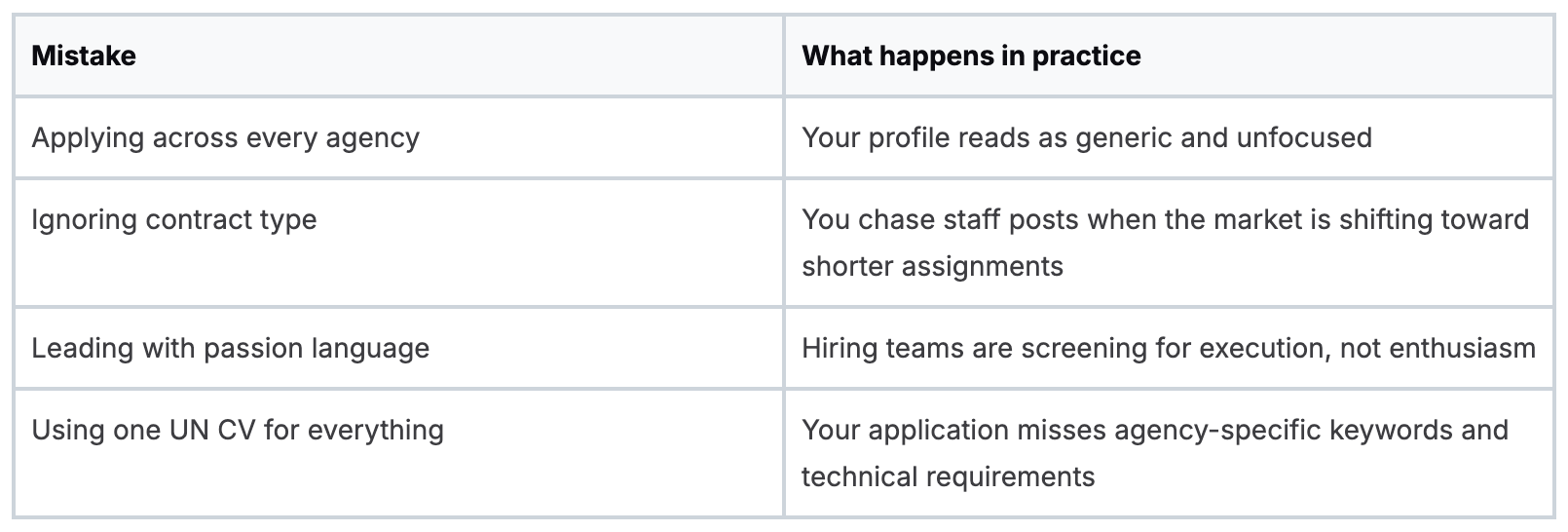
The market is still active. It just isn’t forgiving. Treat it like a professional labor market under budget pressure, because that’s exactly what it is.
Understanding the UN System as a Job Market
Treat the UN as a labor market, not a single employer. That shift matters because each part of the system hires for different reasons, on different timelines, and under different budget constraints.
Candidates who miss this usually run a broad search, mix unrelated vacancy types, and end up with a scattered application history. The stronger approach is narrower. Pick the part of the system that matches your function, level, and mobility, then learn how that employer hires.
The UN system includes the Secretariat, funds and programmes, specialized agencies, peace operations, and a large outer ring of consultancies, rosters, and project-based appointments. These institutions share some standards, but they do not operate like one HR department. UNICEF, UNDP, WFP, WHO, and the Secretariat may all recruit for similar themes, yet the hiring culture, approval chain, and speed can be very different.
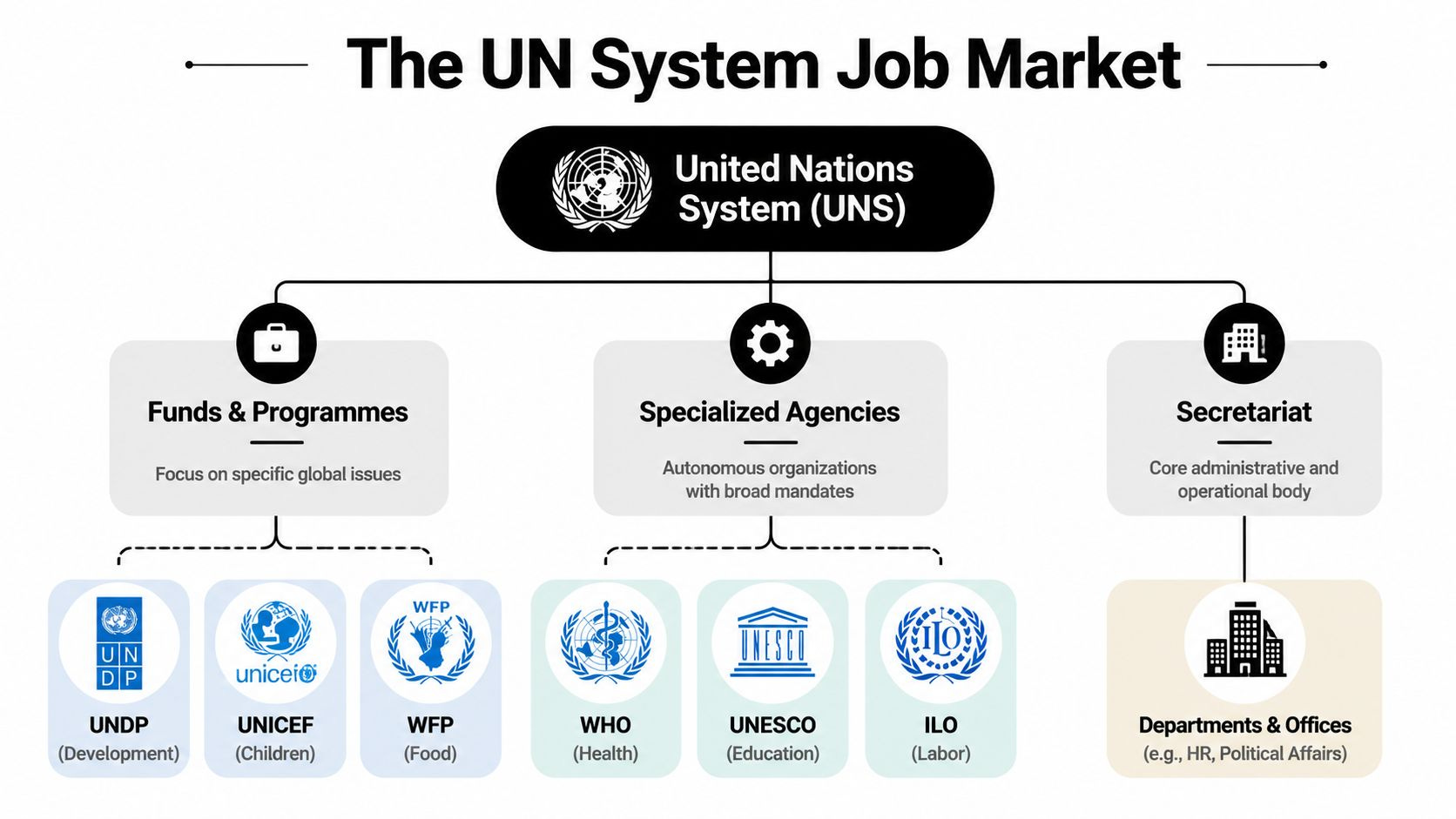
The parts of the system that matter to job seekers
For job search purposes, focus on three clusters.
Secretariat roles: These are the posts many candidates picture first. They cover political affairs, coordination, administration, legal work, communications, operations, and technical support, often with more formal process and longer timelines.
Funds and programmes: Agencies such as UNDP, UNICEF, UNFPA, and WFP tend to have stronger country footprints and more program delivery roles. In the current market, this is often where operational hiring remains more visible.
Specialized agencies: Organizations such as WHO, FAO, ILO, and UNESCO recruit against sector expertise first. If your profile is built around health, labor, education, agriculture, or another defined technical field, this is often a better fit than applying broadly across the system.
That distinction is even more important after the recent budget pressure across the system. Some teams have cut back on international staff posts but still need short-term technical support, country-level delivery capacity, and narrowly defined specialists. Finance is a good example. Agencies still need budgeting, audit, grants, and fiduciary oversight skills, which is why a focused guide to UN finance jobs in 2026 is more useful than a generic UN careers search.
How serious candidates should read this market
The UN is not built for generalists unless they already bring institutional credibility. Hiring managers usually look for one of four things.
Recognized functional expertise, such as procurement, HR, finance, monitoring and evaluation, partnerships, supply chain, or data analysis.
Sector depth, such as public health, education, protection, climate, food security, or governance.
Field experience, especially in hardship duty stations, fragile settings, or emergency operations.
Large-system discipline, meaning candidates who know how to work with compliance, donor rules, reporting chains, and slow administrative processes.
This is why many mid-career professionals perform better than early-career applicants in open competition. The market rewards evidence that you can deliver inside a bureaucratic system without much hand-holding.
One more point gets overlooked. The UN also organizes work through career streams and talent pipelines rather than a single catch-all career path. The UN Careers portal reflects that structure. Searching by function and entity is usually more productive than searching by the word “UN” and scrolling through everything.
A clear professional story carries weight here. “Procurement officer with donor-funded health programme experience in East Africa” is a marketable profile. “International development professional seeking to make an impact” is not.
Decoding UN Job Categories and Contracts
A UN vacancy title tells only part of the story. The contract type usually tells you more.
Candidates often fixate on grade level and ignore the employment model. That’s a mistake. A staff post, a consultancy, and a national role can sit next to each other in search results and have completely different implications for benefits, security, mobility, and career progression.
The categories you need to recognize fast
Here’s the short version:
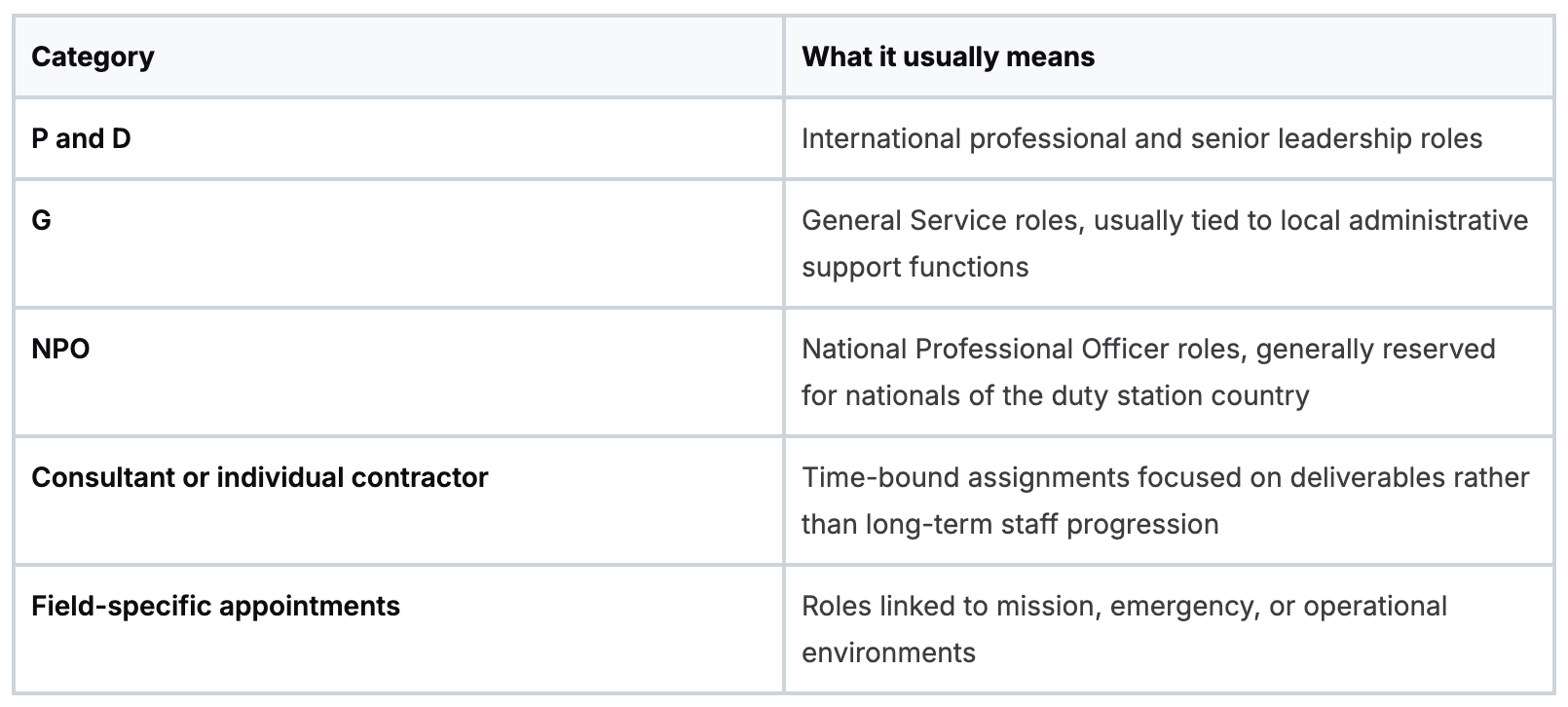
The labels matter because they shape eligibility. They also shape your realistic route in.
Staff versus consultancy is the real divide
If your long-term goal is a classic UN career, staff contracts still matter most. They usually offer the stronger institutional path, clearer progression, and fuller benefits package. They also tend to be harder to win, slower to process, and more rigid on formal eligibility.
Consultancies work differently. The organization is buying a service, a piece of expertise, or short-term delivery capacity. That can be frustrating if you want stability. It can also be the fastest way in if you already have a usable niche.
Here’s a simple way to look at it:
Staff post: the agency is hiring a person into the institution
Consultancy: the agency is hiring an outcome, and you are attached to that outcome
That distinction changes how you present yourself. Staff applications reward institutional fit and career coherence. Consultancy applications reward immediate relevance, technical proof, and low onboarding risk.
How to choose what to pursue
Use this filter before you apply:
If you need stability: prioritize staff posts and national professional roles where eligible.
If you’re changing sectors: shorter contracts can be a practical bridge.
If you already have specialist expertise: consultancies may be your quickest route to interviews.
If you’re in finance or budget work: it helps to understand how multilateral employers package these roles across institutions, and this guide to finance jobs in the UN is useful for that comparison.
The biggest time-waster is chasing prestigious job titles while ignoring contract reality. Read the terms first. Then decide whether the role fits your life and career strategy.
Where to Find UN Opportunities Now
The official portal is only one part of the search. In 2026, after budget pressure pushed agencies to slow some staff hiring and rely more heavily on targeted short-term recruitment, good candidates miss opportunities because they search too narrowly, not because vacancies disappeared.

The hiring volume has shifted across agencies, offices, and contract types. Some teams post on their own career pages first. Some country offices circulate openings locally before they show up in broader searches. Some functions, especially procurement, monitoring and evaluation, partnerships, data, and emergency operations, stay visible even when other hiring slows.
That changes the search method. Checking one general portal once a week is too passive.
The channels worth checking
Use a layered search system.
Official agency career sites: start with the agencies that hire your profile most often. You will see the language they use, the grade levels they prefer, and whether they are posting staff jobs, consultancies, or roster calls.
UN system portals and talent pools: these still matter for formal applications, roster visibility, and alerts.
Specialized aggregators: useful for scanning multiple organizations in one sitting and spotting patterns by function, duty station, and contract type.
Country office pages: often overlooked, especially by applicants chasing headquarters jobs.
Niche newsletters and function-specific feeds: useful for consultants, remote applicants, and technical specialists.
If remote or hybrid roles are part of your strategy, this guide to remote UN jobs and related multilateral roles is a useful filter. It helps separate genuine distributed opportunities from roles that still expect local presence.
A search routine that works
Random browsing wastes time. A repeatable routine gets results.
Choose a short target list
Pick 8 to 12 organizations where your background fits their mandate and hiring pattern.Search by function first
Job families produce better results than broad location terms. Use phrases such as “programme management,” “monitoring and evaluation,” “partnerships,” “procurement,” “budget,” or “data analyst.”Run separate searches for staff posts and consultancies
They move on different timelines and reward different applicant profiles.Save keywords and alerts
Rebuilding searches manually every day is pointless. Set alerts and review them at fixed times.Track where roles cluster
After two weeks, patterns show up. You will see which agencies are still hiring in your niche and which ones are posting aspirationally with little movement.
Search discipline matters. Candidates who hear back are usually the ones who find a strong-fit vacancy early, before the applicant pile gets too deep.
Where overlooked opportunities tend to sit
They are usually sitting in plain sight on agency pages, regional office sites, and specialist boards that general “UN jobs” searches rank poorly. This is especially true for field-facing functions and time-sensitive consultancies.
There is a trade-off here. The more prestigious and centralized the portal, the heavier the competition. The more specific the source, the better your odds of finding a role where your profile is one of twenty serious matches instead of one of eight hundred weak ones.
That is the search strategy that fits the current UN market. Broader awareness, tighter targeting, and faster response.
The Unwritten Rules of Eligibility and Nationality
Nationality matters in UN hiring. Anyone who tells you otherwise is giving you a sanitized version of the process.
This doesn’t mean you should give up if you aren’t from a donor country or a heavily represented hiring nationality. It means you need to understand which pathways are structurally open, which are constrained, and which are tied to funding arrangements you can’t change.
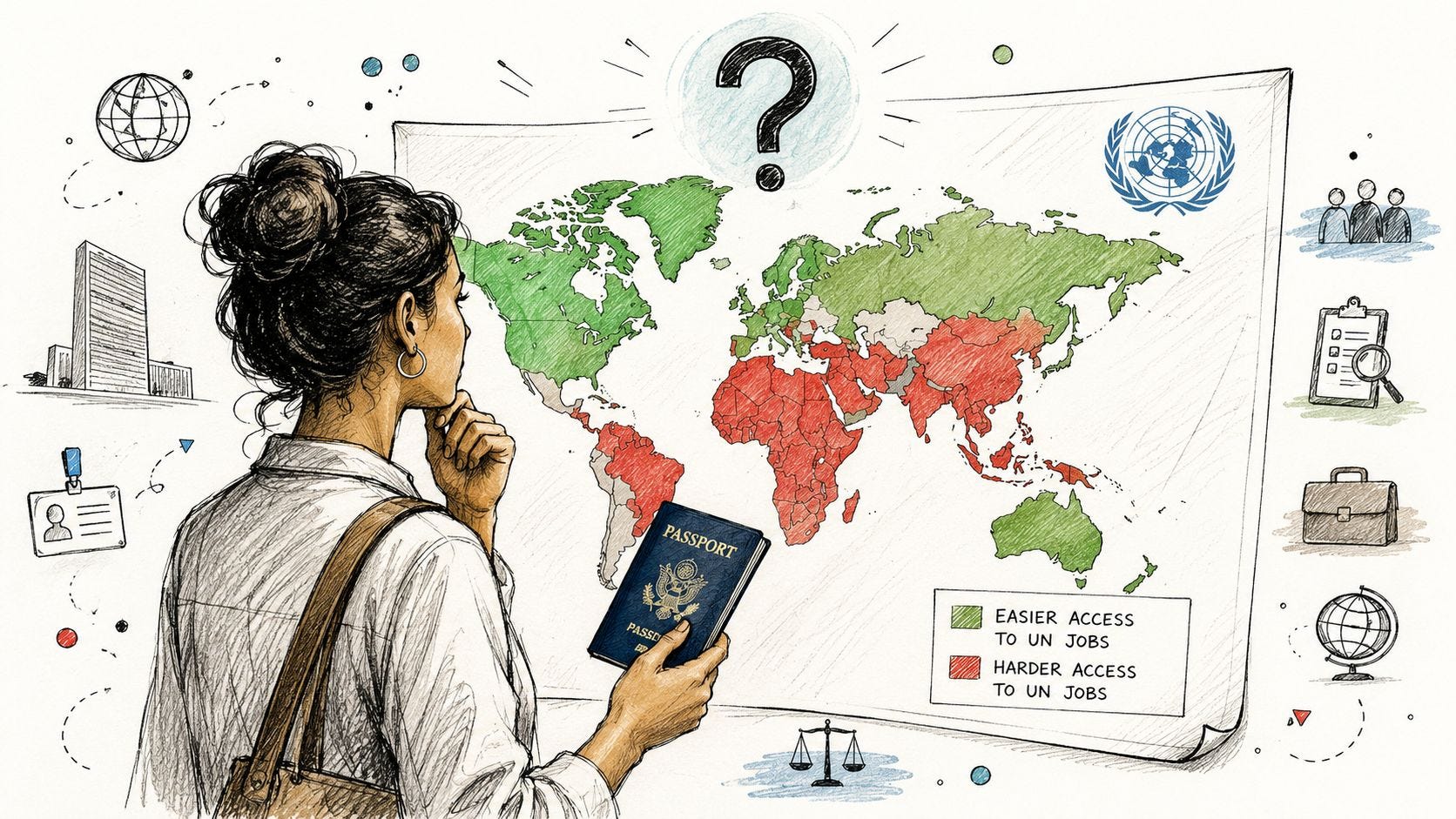
UN sources explicitly tell applicants to check the organization’s un- and under-represented list, and they also note that many entry paths such as the JPO program are linked to donor-country funding and citizenship, as stated on the UN careers guidance on representation and entry routes.
What this means in practice
There are really three different realities here.
First, some vacancies are open in a broad way, especially where technical fit dominates the decision. Second, some routes are formally open but structurally uneven because nationality balancing is in the background. Third, some pathways are effectively limited by citizenship and financing design from the start.
If you’re targeting the Junior Professional Officer route, check eligibility early. Don’t build your whole strategy around a program that your nationality may exclude.
How to think about your options
Use a realistic screen:
International staff tracks: competitive for everyone, but representation can matter depending on the organization and post.
JPO pathways: often strongest for candidates whose governments fund those positions.
National roles: strong option if you’re applying in your own country and have local expertise.
Consultancies: often less tied to nationality balancing and more tied to demonstrated subject-matter value.
That last category matters more than many applicants realize. When agencies need a specialist for a defined output, they often focus on whether you can do the work quickly and well.
If nationality narrows one path, shift to another path that values expertise more heavily than representation mechanics.
The rule most people learn too late
Don’t confuse formal eligibility with practical accessibility.
A vacancy can say you’re eligible. That doesn’t mean the route is equally open to every applicant. If your nationality is not favored by a funding stream or representation logic, your strategy needs to lean harder on specialist roles, national positions where relevant, and contract types where delivery matters more than pipeline design.
For candidates exploring structured entry routes, this guide to the UN Young Professionals path is worth reading alongside official eligibility criteria so you can separate aspiration from actual fit.
Crafting an Application That Beats the Algorithm
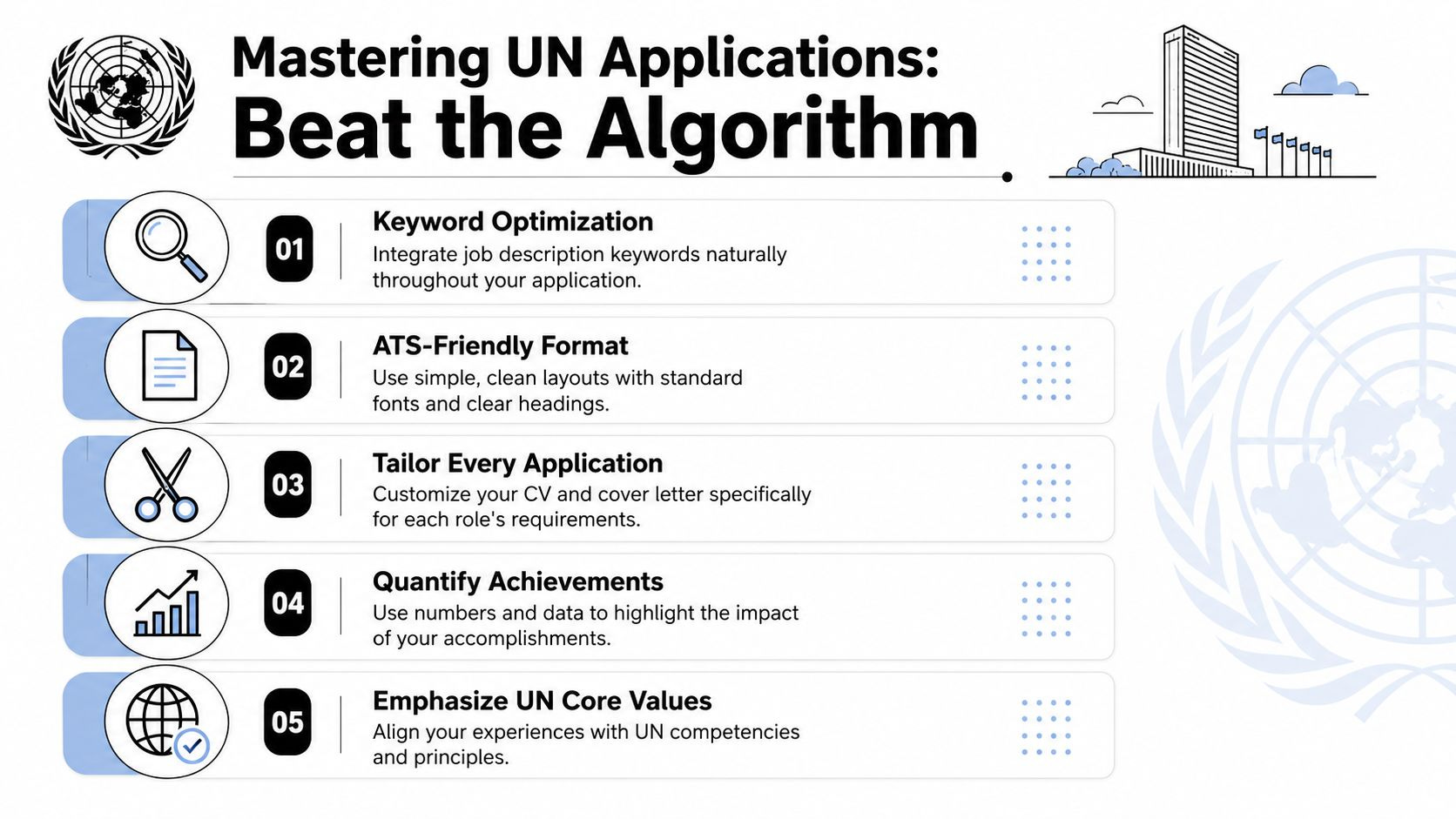
A lot of UN applications fail before a hiring manager forms an opinion. They fail at the screening stage because the profile reads as broad, vague, or disconnected from the vacancy language.
That problem is getting worse as more technical roles enter the system. Recent UN postings increasingly require a Master’s degree, at least 5 years of experience, and proficiency in tools such as Power BI, Tableau, SQL, Python, or R, according to this UN-linked data role listing on Impactpool. Even outside formal data jobs, the hiring logic has shifted toward evidence, reporting, dashboards, and measurable outputs.
What hiring teams are actually looking for
For technical and analytical roles, job descriptions increasingly signal capability across the full data lifecycle, including collection, wrangling, analysis, visualization, deployment, monitoring, and reporting, as reflected in this UN job description emphasizing data workflow collaboration.
That means your application should show more than education and generic research experience.
Use evidence like:
Named tools: Power BI, Qlik, Tableau, SQL, Python, R, Git
Named outputs: dashboards, statistical reports, cleaned datasets, monitoring frameworks, donor reports
Named business value: better reporting quality, stronger database integrity, faster analysis cycles, clearer management decisions
What to change in your CV and PHP
Most applicants undersell themselves by describing duties instead of outputs.
Compare these two approaches:
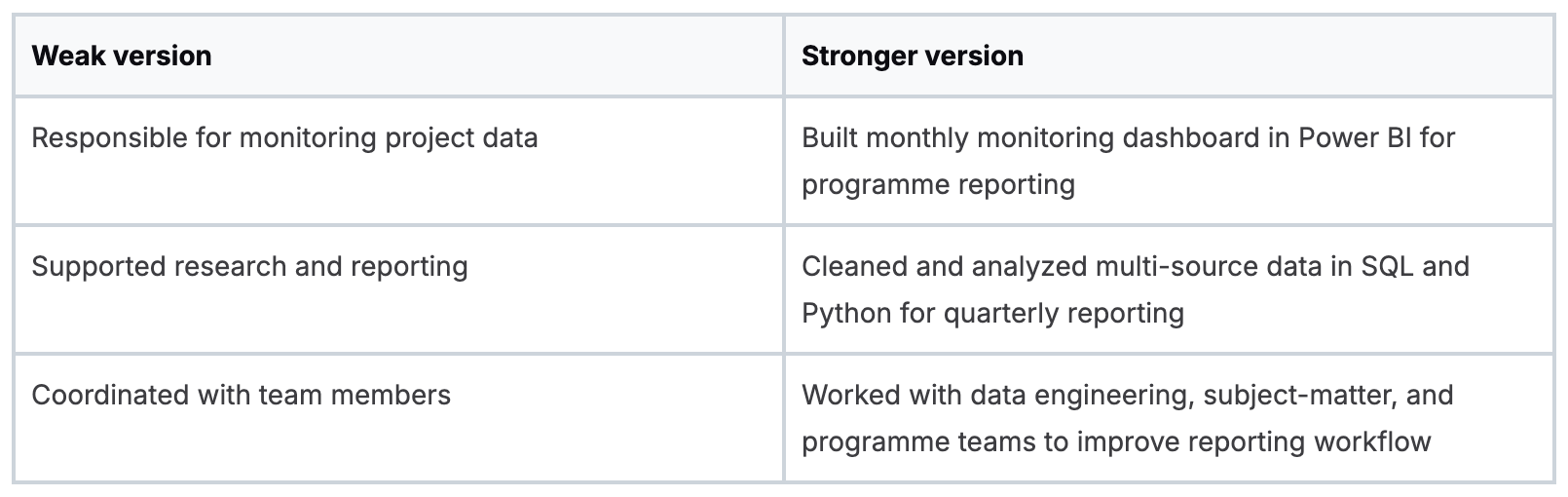
The stronger version works because it mirrors how the jobs are written. It gives the screening system keywords and gives the human reviewer confidence.
The details that raise your odds
Match the vacancy language closely: If the posting says “progressively responsible experience,” reflect progression clearly in your work history.
Keep formatting plain: complex templates often create problems in online systems.
Show portfolio proof where relevant: dashboards, code samples, writing samples, or reproducible analysis can help in technical tracks.
Tailor every submission: one strong application beats ten recycled ones.
Hiring managers don’t need another candidate who cares about the mission. They need one who can prove they can handle the workload described in the vacancy notice.
If your profile isn’t data-heavy, the same principle still applies. Translate your work into clear outputs, systems, and outcomes. The more concrete your record, the better your odds of getting through.
Frequently Asked Questions on UN Careers
Do I need a Master’s degree
For some roles, yes. For others, no. The right question is whether the vacancy requires it and whether your experience substitutes cleanly. In practice, advanced degrees show up frequently in professional posts, especially technical ones. If a role asks for a Master’s and your profile doesn’t offer a recognized equivalent path, don’t assume motivation will bridge the gap.
How much experience do I need
More than many applicants expect. The UN labor market skews toward established professionals, and the hiring profile discussed earlier reflects that. If you’re early career, focus on roles with narrower technical demands, national positions, internships where eligible, or contract work that builds a credible specialization.
Are competency-based interviews really that rigid
Usually, yes. You need structured examples. Strong answers are specific, relevant, and tied to your actual role in the situation. Weak answers drift into theory, team language with no clear personal contribution, or long backstory.
A good preparation method is simple:
Pick the core competencies from the vacancy
Match each one to a concrete work example
State the problem, your action, and the result
Keep your answer tight and evidence-based
How long does the process take
Often longer than candidates want. Timelines vary by agency, role, and contract type. Staff recruitment can move slowly. Consultancies can move faster when the need is urgent. Build your search assuming delay, and never stop applying because one process looks promising.
Are United Nations job opportunities still worth pursuing
Yes, if you approach them as a serious, segmented market. No, if you’re expecting one portal, one CV, and one motivational statement to carry you through. The people who get traction usually understand contract types, nationality constraints, agency differences, and the current shift toward technical and short-term hiring.
If you want a steady way to track multilateral openings beyond the UN alone, Multilateral Development Bank Jobs publishes full-time MDB roles, consultant opportunities across MDBs and the UN, and longer guides on hiring trends, nationality rules, and career paths across institutions like the World Bank, ADB, AfDB, IMF, and AIIB.