


You’re probably looking at UN finance roles for one of two reasons. Either you want work with a mission attached to it, or you’re tired of doing technically solid finance work that never gets anywhere near a real-world outcome. Fair enough. The UN system attracts both kinds of candidates.
It also confuses both kinds.
A common perception is that finance jobs in UN organizations mean accounting, invoice processing, and routine compliance. That’s too narrow. The system hires finance people to help decide what gets funded, how resources are allocated, where cost pressures are building, and whether a programme can deliver what it promised. That’s a very different job from closing the books in a private company.
The hard part is that UN hiring doesn’t reward vague ambition. It rewards fit, patience, and a realistic strategy. If you target the wrong duty stations, insist on only one contract type, or package your experience in generic corporate language, you’ll burn months and get nowhere. The candidates who break in usually understand the machinery before they start applying.
The Real Deal on UN Finance Careers
UN finance work sits closer to operations than many candidates expect. Your spreadsheets connect to procurement plans, staffing tables, donor restrictions, field budgets, and programme delivery calendars. If a country office can’t explain its resource requirements clearly, or a mission can’t defend a cost estimate, finance becomes the bottleneck fast.
That’s why the official UN finance talent pipeline emphasizes cost estimates, budget proposals, resource requirements, budget submissions, and financial controls in its role description on the UN Careers finance talent pipeline page. That same page also points to the wider system’s financial coordination environment, which matters because the UN runs inside a large reporting structure rather than a single-agency finance shop.
What the work feels like in practice
A lot of the day-to-day pressure comes from translation. You’re translating programme ambition into budget language. You’re translating donor or institutional rules into spending choices. You’re translating messy field realities into something a headquarters reviewer can approve.
That means strong candidates usually bring a mix of judgment and discipline:
Budget judgment that can distinguish a real operational need from an inflated ask
Control discipline that keeps spending aligned with rules and approved plans
Communication skill that lets non-finance colleagues understand the implications of their choices
Tolerance for complexity because multi-entity systems create layers of approval, reporting, and timing issues
Practical rule: If you only enjoy technical accounting and want minimal operational interaction, many UN finance roles will feel frustrating.
What hiring managers actually care about
They care whether you can keep money moving without losing control of it. They care whether you can support managers who are under pressure to deliver a mandate in difficult environments. They care whether you understand that finance in this system is part governance, part planning, and part risk control.
That’s why finance jobs in UN settings appeal to people who like structured problem-solving with public impact. The mission matters, but mission language won’t carry you. Managers still want someone who can read a budget narrative, spot a weak assumption, reconcile competing priorities, and hold the line when spending drifts.
The Spectrum of UN Finance Roles
The labels vary across agencies, funds, programmes, and missions. The underlying functions are more stable. Once you understand the function, you can read vacancy notices much faster.
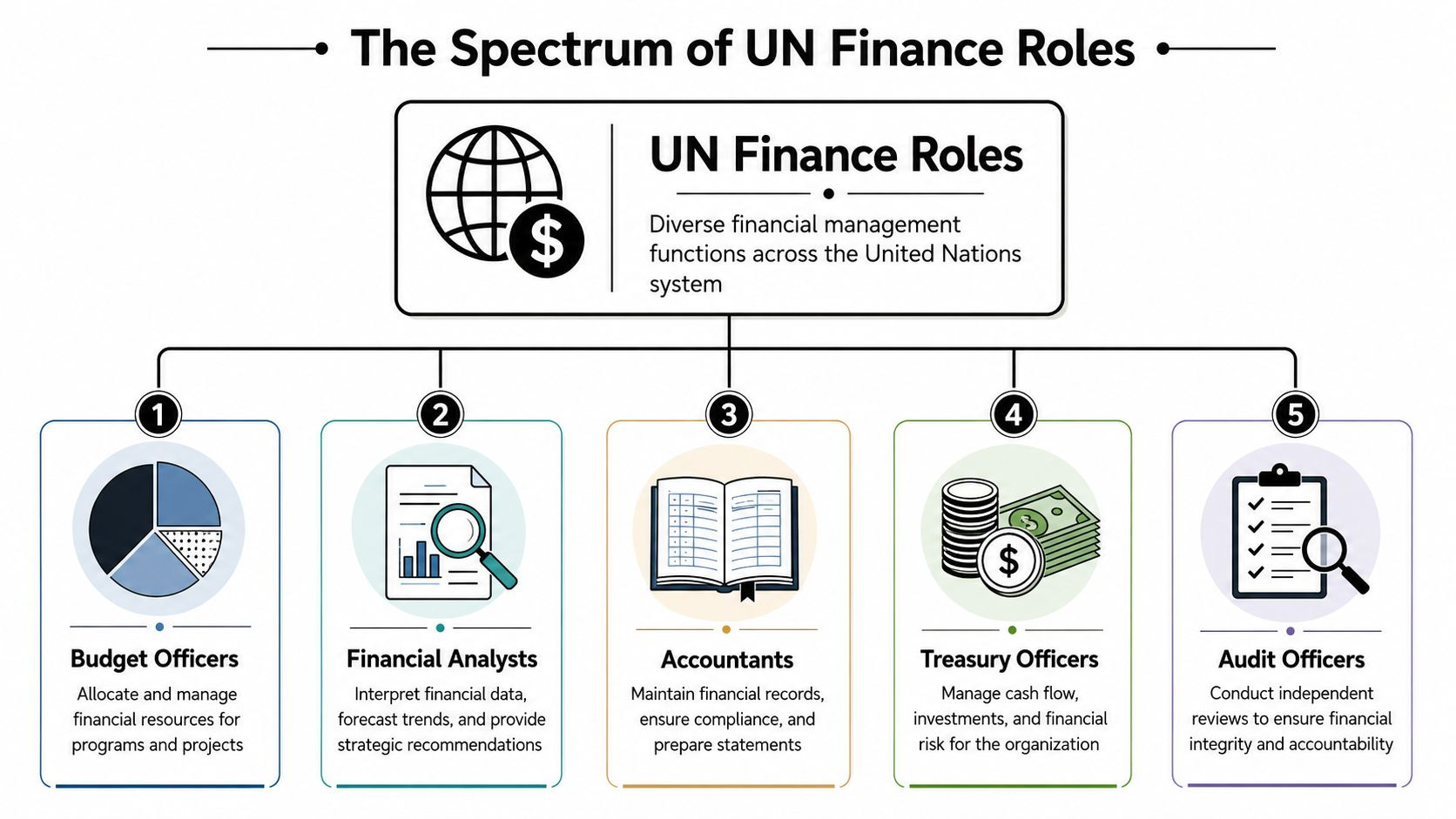
Budget and resource management roles
These are the core planning jobs. They sit close to programme managers and leadership teams because they shape what the organization can afford to do.
A budget-focused officer usually spends time on:
Cost estimates for planned activities or staffing
Resource requirement reviews with managers who want funding for new or expanded work
Budget submissions that need to align with internal rules and review cycles
Variance analysis when actual spending starts to drift from plan
Many outsiders misunderstand UN finance. They assume finance equals bookkeeping. In reality, much of the influence sits in budget formulation and resource allocation. If you’ve worked in FP&A, grant finance, public budgeting, or project controls, this lane often fits well.
Financial management and accounting roles
These roles keep the financial architecture sound. They cover the mechanics and integrity of reporting, close processes, reconciliations, and compliance with the accounting framework used by the organization.
Typical work includes:
General ledger oversight and transaction review
Period-end and year-end close coordination
Financial statement preparation
Policy application across country offices or business units
Audit support when external or internal reviewers come in
These roles suit candidates who are detail-heavy, policy-aware, and comfortable living inside ERP systems. They matter a lot, but they’re usually less entry-friendly for people whose background is broad corporate analysis with limited reporting depth.
Treasury, cash, and risk roles
Some finance professionals want the sharper end of liquidity, exposure, and institutional risk. That work exists across the broader multilateral ecosystem and increasingly values quantitative skill.
The clearest signal comes from a World Bank Financial Officer and Data Science Officer profile, which calls for a master’s degree in a quantitative field, at least 6 years of experience, and advanced use of tools including R/RStudio, Python, SQL, Matlab, QuantLib, clustering, regression, and Excel Power Query on the World Bank role profile via UNjobnet. That tells you where advanced finance roles are heading.
The technical bar rises sharply once a role touches treasury, risk, asset-liability management, or model validation.
Audit and oversight roles
Audit teams are a different breed. They’re less interested in whether a budget line was elegant and more interested in whether controls worked, approvals were appropriate, and evidence supports the transaction trail.
If you come from internal audit, compliance testing, or forensic-style review work, these jobs can be a strong match. They also tend to reward candidates who write clearly and can challenge colleagues without blowing up working relationships.
Here’s a simple way to sort yourself:
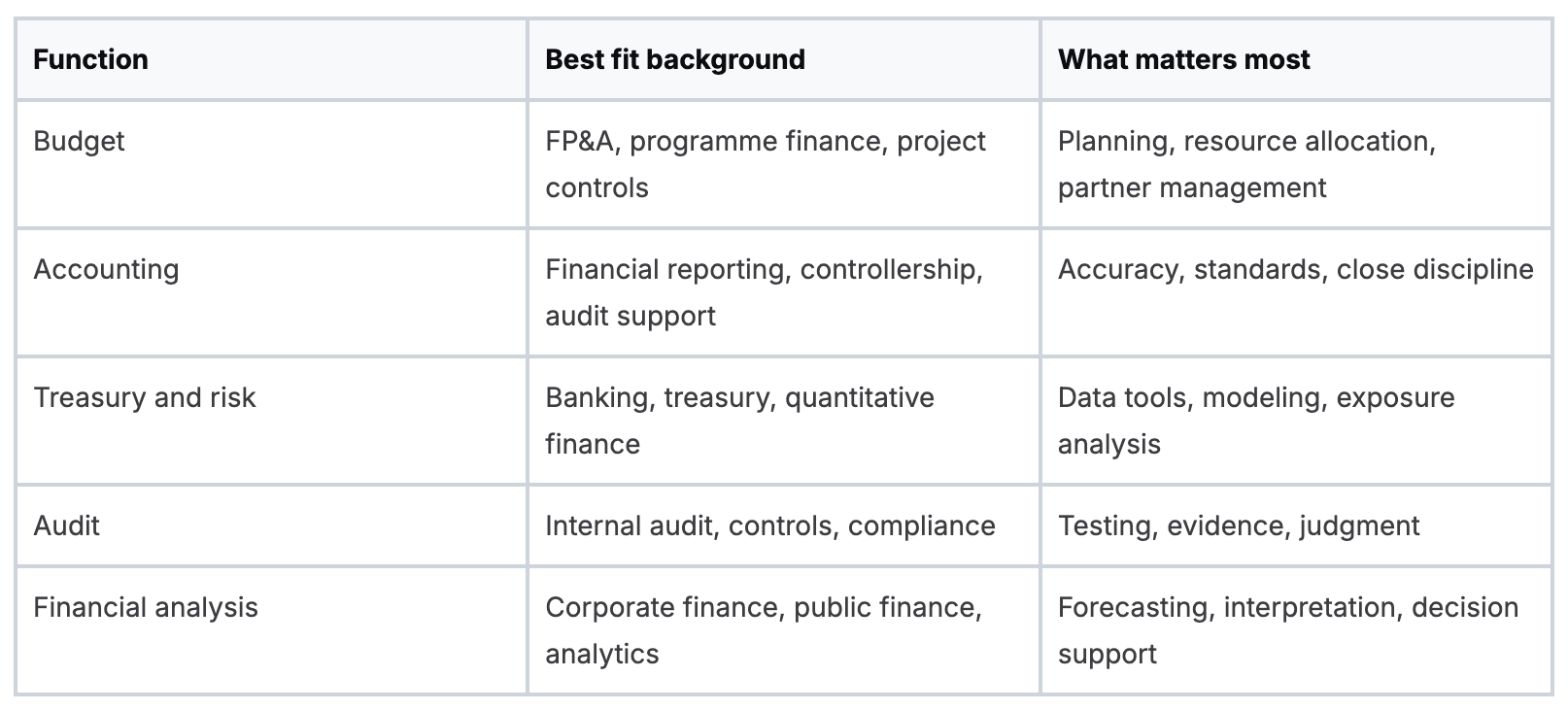
Decoding UN Grades and Salaries
Many candidates lose sight of what’s important here. They fixate on a job title, then discover too late that the grade, contract category, and duty station truly drive the overall calculation.
The first distinction is staff category. Professional roles usually sit in the P-level structure. General Service roles sit in the G-level structure and are usually tied to local recruitment. If you’re aiming for internationally recruited finance positions, you’ll spend most of your time assessing P-level vacancies.
How to read the grade ladder
A practical way to think about the ladder is scope and independence. Lower professional grades support, analyze, and execute. Mid-level grades manage larger portfolios and advise managers with more authority. Senior grades own bigger budget envelopes, supervise staff, and handle tougher stakeholder environments.
Here’s the shorthand many candidates use when screening jobs:
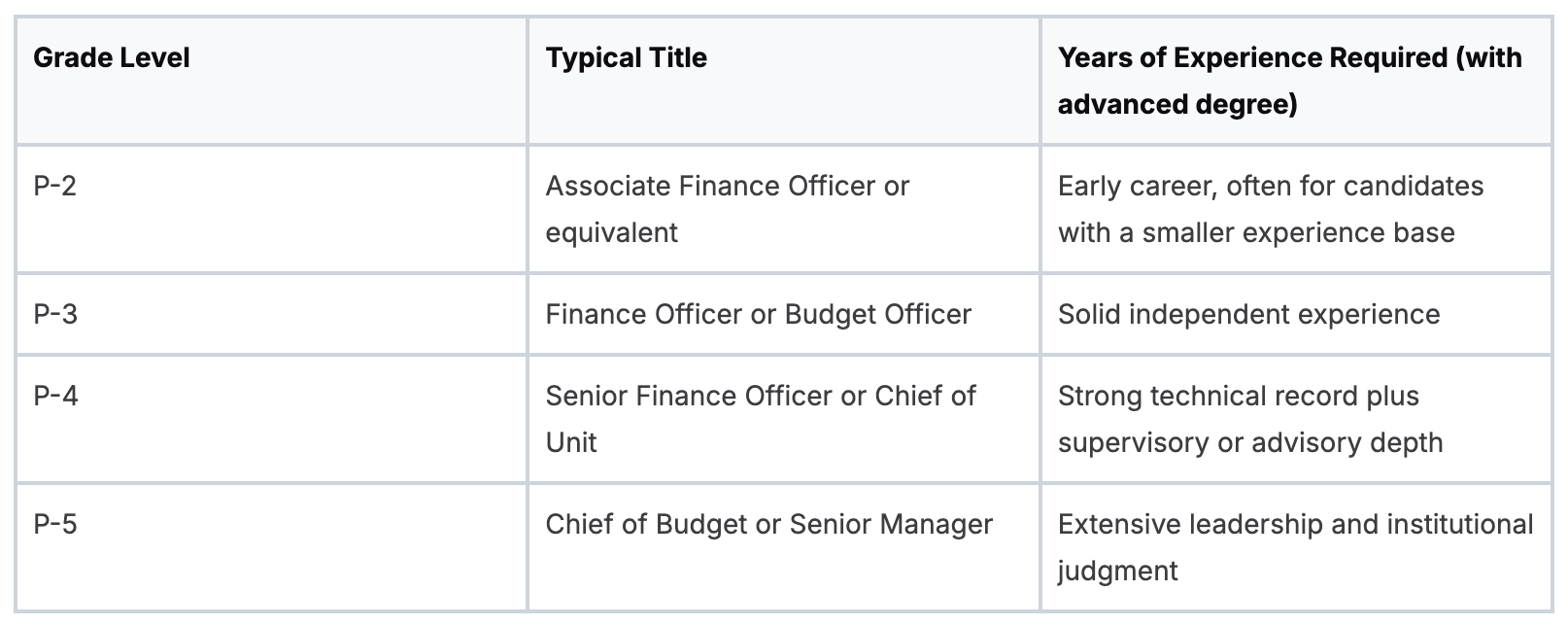
Vacancy notices give the exact requirement. Treat the grade as a signal about the level of ownership expected, not just prestige.
The salary question candidates ask badly
A common question is, “What does a UN finance job pay?” That’s too blunt. The right question is whether the total package makes sense for your grade, family situation, and duty station.
For a benchmark outside the UN system, the U.S. Bureau of Labor Statistics reports that the median annual wage for financial and investment analysts was $101,350 in May 2024, and financial risk specialists earned $106,000, while employment for financial analysts is projected to grow 6% from 2024 to 2034 with about 29,900 openings per year on average on the BLS financial analysts occupational outlook page. That gives you a useful market reference for the analytical skill set UN employers often want.
The UN side is harder to compare cleanly because compensation depends on base salary, duty station adjustment, contract terms, and benefits. You need to evaluate the whole package, especially if you’re comparing it with private-sector offers.
Benefits matter more than outsiders think
Health coverage, pension participation, and education-related benefits can materially affect your decision. So can leave policies and mobility implications. If you haven’t worked in international organizations before, read a practical breakdown of UN staff benefits and allowances before you decide a role is financially attractive or weak.
A P-level offer that looks modest on first pass can make more sense once you price in benefits, tax treatment, and location. The reverse is also true.
Where to Actually Find UN Finance Openings
Most candidates waste time by searching one portal, one city, and one contract type. That’s the slowest way into the system.
A better search starts with geography. Finance jobs in UN organizations are distributed across duty stations, and the realistic entry points often sit outside the obvious headquarters hubs. Vacancy aggregators show finance opportunities spread across locations and contract types, including consultant and short-term arrangements, on pages like this UN Talent finance listings view. That matters because access often improves when you stop chasing only permanent headquarters roles.
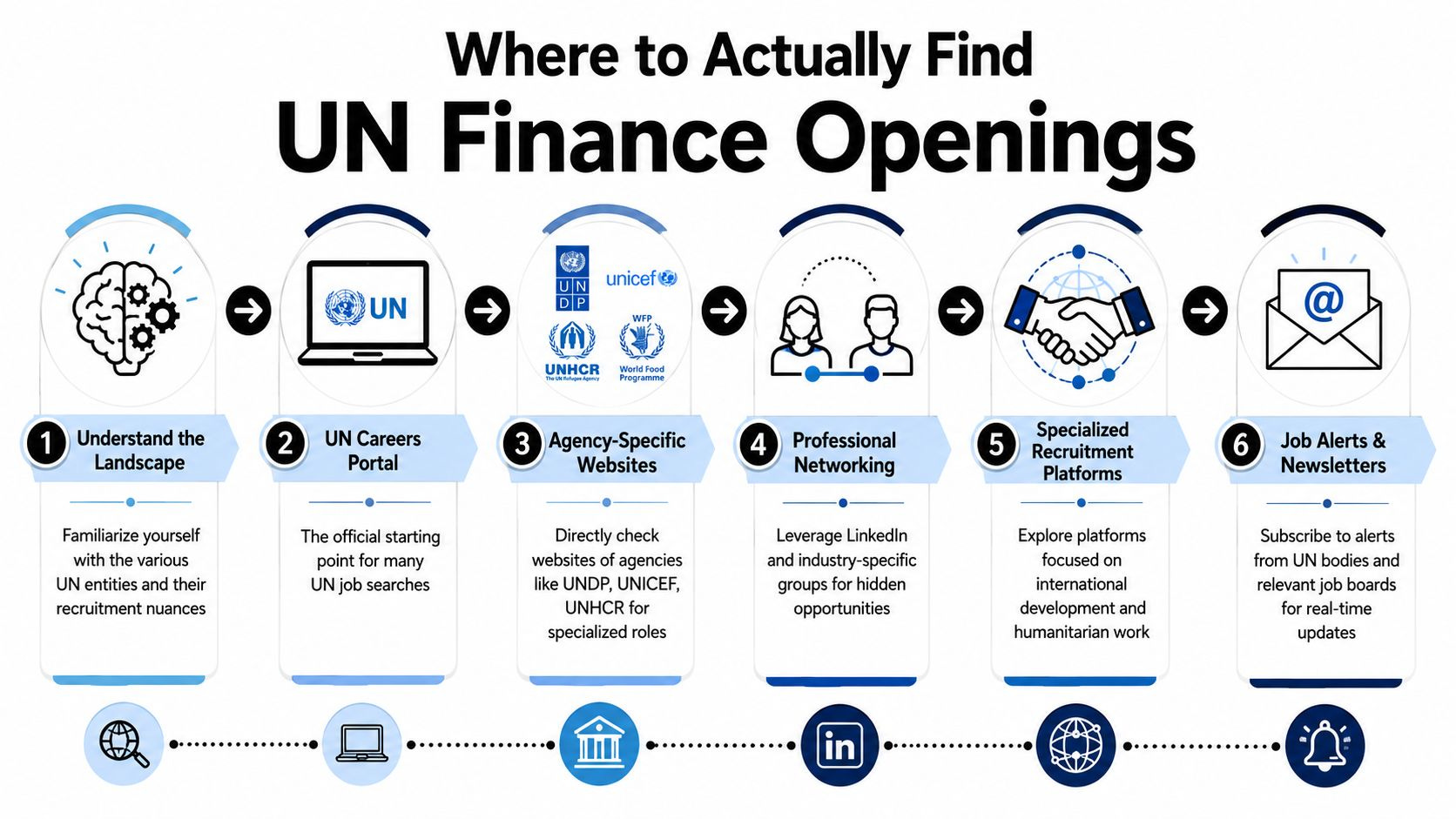
Search by function first, then by geography
Start with the type of finance work you can credibly do now. Budget. Financial management. Treasury support. Audit. Grant finance. Then look for where those functions cluster.
What usually works:
Regional and field duty stations where agencies need operational finance support tied to live programmes
Programme-linked consultant assignments that cover reporting, budget monitoring, or donor finance tasks
Agency-specific recruitment pages where finance roles may appear before candidates notice them on broader boards
What usually doesn’t:
Applying only in New York and Geneva
Ignoring short-term or non-staff contracts
Treating all UN entities as one employer with one recruitment channel
Contract type changes your odds
Permanent staff roles attract heavy competition and often favor candidates who already understand the system. Consultant contracts, temporary appointments, and fixed-term roles tied to specific programmes can be more realistic ways in.
That doesn’t mean they’re easy. It means the comparison pool is often narrower and the hiring need is sometimes more immediate. If a team needs budget support for a defined workstream, they may value directly relevant experience over a perfect institutional pedigree.
Candidates who stay flexible on contract type usually see more openings that match their actual profile.
Build a search stack, not a single bookmark
Use several channels at once:
Official career portals for core staff vacancies
Agency websites for entity-specific hiring
Aggregator platforms that help you spot patterns in location and contract type
Professional networks where teams sometimes signal upcoming needs before the post closes
Curated listings such as this guide to UN job opportunities, which can help you track openings across institutions without relying on one portal
The practical move is simple. Set alerts for functions you fit, add a wider set of duty stations, and include consultant and temporary categories in your filters. That one shift opens a different market.
Essential Qualifications and Skills They Want
Hiring managers read for evidence, not aspiration. They want proof that you can handle financial complexity in an institutional environment where rules matter and the context changes quickly.

The credentials that clear the first screen
Most finance vacancies start with a degree requirement in finance, accounting, economics, business administration, or a related field. For specialized roles, the acceptable fields can widen into quantitative disciplines. Certifications can help, especially when the role leans toward reporting, accounting policy, investment analysis, or audit.
The mistake candidates make is assuming credentials alone will carry them. They won’t. They get you past an initial filter. Your actual work history decides the rest.
A strong profile usually shows some combination of:
Budget preparation and monitoring
Financial analysis for management decisions
ERP fluency and comfort working in structured systems
Reporting accuracy under deadlines
Stakeholder handling with non-finance colleagues
Policy discipline when procedures constrain what teams want to do
Data skills are no longer optional in many tracks
The multilateral finance market has moved toward heavier analytical and technical expectations, especially in senior or more specialized roles. As noted earlier in the role profile cited above, one World Bank finance opening explicitly asked for quantitative graduate training and advanced tools including R/RStudio, Python, and SQL. That’s a strong signal for candidates who still present themselves as Excel-only finance professionals.
You don’t need to become a full-time data scientist for every finance role. You do need to show that you can work with data beyond basic spreadsheet hygiene.
Useful signals include:
Building repeatable analysis workflows
Cleaning and validating messy financial data
Using SQL or scripting tools for extraction and checks
Explaining model outputs to decision-makers
Working across finance and IT without getting lost in either camp
What separates shortlisted candidates
Shortlisted candidates usually know how to frame their experience in institutional terms. They don’t say, “Managed budgets.” They say they prepared cost estimates, supported resource planning, monitored utilization, flagged variances, and maintained controls under formal procedures.
That sounds like a small language shift. It isn’t. It tells the panel you understand the operating environment.
Nailing the Application and Interview
UN applications punish lazy translation. If you paste a polished corporate CV into the system and call it a day, you’ll look generic.
The panel wants evidence that matches the vacancy line by line. Your job is to make that evidence impossible to miss.
Write for screening, not for admiration
The application form often carries more weight than candidates expect. Every field matters. Dates need to align. Reporting lines need to make sense. Duties need to mirror the vacancy language accurately and specifically.
Use this approach:
Match the function words in the post. If the role emphasizes budget formulation, don’t hide that work under a vague “financial planning” label.
Name the tools you used. SAP, Oracle-based ERP environments, advanced Excel, Power Query, SQL, reporting platforms.
Show scale qualitatively if you can’t cite numbers. Large portfolio, multi-country environment, donor-funded programme, cross-functional review process.
Separate ownership from support so the panel knows what you personally handled.
Your cover letter needs operational logic
A good cover letter is short, direct, and built around fit. It should connect your background to the function, the operating context, and the level of the role. It should not read like a generic statement about wanting to make a difference.
A stronger structure looks like this:
Your finance niche and years of relevant progression
The operating environments you’ve worked in
The exact tasks that align with the vacancy
Why that combination fits this post
If your letter could be sent unchanged to a bank, a consulting firm, and a UN agency, it’s too generic.
Competency interviews reward specificity
These interviews are often less forgiving than private-sector conversations. The panel wants examples with clear actions, not broad claims about your style.
Use STAR, but use it tightly:
Situation with just enough context
Task that defines your responsibility
Action focused on what you did, not what the team did
Result stated carefully and truthfully
Prepare examples around:
handling a budget variance
pushing back on a weak spending request
improving a reporting process
resolving a control issue
working with difficult non-finance stakeholders
managing deadlines with incomplete information
If you need a practical framework, this guide on how to pass a competency-based interview is worth reviewing before you rehearse.
The interview mistake that sinks good candidates
They answer from a private-sector lens only. They talk about speed, efficiency, and commercial outcomes without showing that they understand governance, procedure, accountability, and public-purpose constraints.
In UN finance, “good” doesn’t mean fast at any cost. It means sound judgment inside a rule-bound environment. Frame your examples accordingly.
Sample Career Paths in UN Finance
Career paths in this space rarely move in a straight line. They zig across agencies, duty stations, and contract types. The people who last usually build depth in one finance lane, then broaden their operating experience.
Path one through field finance into senior budget work
A candidate starts in a field-facing finance support role or an associate-level budget position. The work is operational, deadline-heavy, and close to programme delivery. After building credibility in resource planning and budget monitoring, that person moves into a finance officer role with more independence and a wider portfolio.
Later, they shift to a regional bureau or headquarters function where the work becomes more policy-heavy and politically sensitive. By that stage, they’re supervising staff, defending submissions, and advising leadership rather than just producing analysis.
Path two through accounting and controls
Another candidate begins with financial reporting, reconciliation, and compliance-heavy work. They become the person teams trust when a process is messy and an audit trail needs to hold up. That profile can move into senior financial management roles, internal oversight, or organization-wide policy functions.
This path suits people who like disciplined systems more than frontline programme negotiations. It can be less visible early on, but it builds strong institutional credibility.
Path three through quantitative and specialized finance
A third path comes from treasury, risk, banking, or advanced analytics. These professionals enter through more technical roles and build careers around financial modeling, exposure management, or data-intensive finance functions. Their progression depends less on broad administration and more on scarce technical expertise.
The strongest long-term careers usually combine one clear technical strength with experience in more than one duty station or organizational setting.
A final point. You do not need a perfect lifelong plan before you enter. You need a believable first move. In finance jobs in UN organizations, the first move often comes from being flexible on location, open on contract type, and precise about the function you can already do well.
If you want a cleaner way to track roles across the multilateral market, Multilateral Development Bank Jobs publishes staff listings, consultant opportunities, and practical career guides covering the UN and major development institutions. It’s a useful option if you want finance roles gathered in one place without relying on a single employer portal.