

You’re probably doing what most smart candidates do at the start. You’ve built a list of NGOs, bookmarked a few UN careers pages, maybe looked at World Bank openings, and started firing off applications that feel strong in isolation but disappear into the void.
That approach wastes time.
The market for international development jobs abroad is real, broad, and active, but it doesn’t reward generic enthusiasm. A 2023 analysis of the DevelopmentAid job board found more than 86,000 job posts across seven key sectors and over 163,000 vacancies overall for experts and consultants (DevelopmentAid analysis of hiring sectors in 2023). The opportunity is there. The confusion comes from how the sector hires.
Thinking Beyond a Simple Job Search
A common approach to searching this field is as if the only decision is where to apply. That’s too shallow. The better question is how you want to work.
A lot of guidance on international development jobs abroad still frames the search around NGOs or government agencies. The field is broader than that. Development consultancies, social enterprises, and technical-assistance contracts are all serious entry points, and that changes the core career decision from “Which organization hires?” to “Which contract model fits my background and risk tolerance?” (VERGE career guidance on finding a job in international development).
That distinction matters because the hiring logic is different in each model. A staff role rewards fit, internal mobility, and patience. A consultant role rewards specialization, availability, and proof that you can deliver without hand-holding. A contractor role rewards bid-aligned experience and the ability to slot into a project fast.
The three career models that shape your search
Here’s the practical split most candidates miss:
Staff track
You’re hired into an organization. The institution invests in you, expects a longer runway, and often screens hard for cultural fit, formal qualifications, and experience that maps neatly to the role.Consultant route
You’re hired for expertise. Teams bring you in because they need a product, an analysis, a mission, an evaluation, a financing note, a procurement package, or implementation support.Project-based contract world
You work through implementing firms, technical-assistance providers, or consortia. The project defines the role. Funding cycles, bids, and donor priorities drive hiring.
Practical rule: Pick your contract model first. Then target employers that use that model heavily.
Candidates often lose months through misdirected applications. They apply to permanent staff roles with a freelance profile. Or they chase consultancies when they seek a stable employer with training and promotion ladders. Both are valid paths. They require different documents, different networking, and different expectations.
What works and what doesn’t
What works is choosing a lane for the next stage of your career. Not forever. For the next two years.
What doesn’t work is trying to look equally suited for every path at once. A CV that says “open to anything in global development” signals that you haven’t done the sorting. Hiring managers won’t do that work for you.
If you’re early career, your first decision isn’t “Which big-name institution should I join?” It’s whether you’re building toward a structured institutional career, a specialist consulting profile, or a project-delivery career that moves across organizations.
That choice shapes everything else.
Understand the Development Employer Ecosystem
Your target employer matters, but the bigger question is how that employer hires. Two candidates can both want to work in education, climate, or governance abroad and need completely different job-search strategies because one is pursuing a staff career, while the other is better positioned for consulting or project-based contracts.
The field is broad, but hiring patterns are not random. The London School of Economics notes that international development includes international NGOs, development consultancies, and international organisations such as UNICEF, UNDP, UNHCR, the Asian Development Bank, and the World Bank Group. It also notes that NGOs are the largest sub-sector, and that French, Spanish, Arabic, and Portuguese are especially valued in field roles (LSE careers guide to international development).
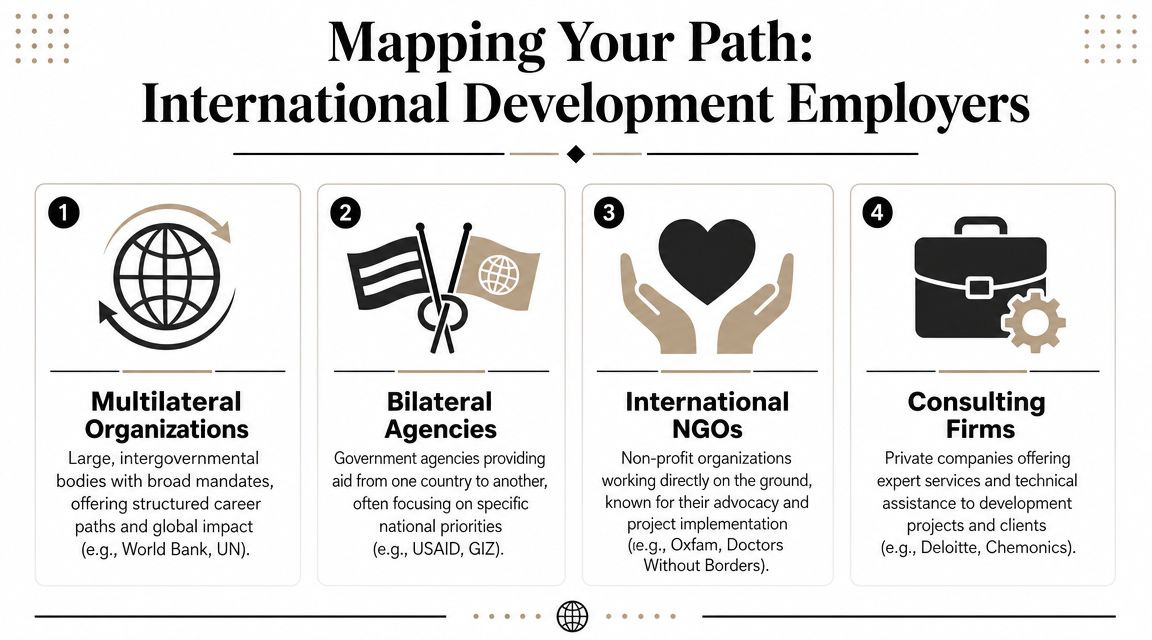
The practical question is simple. Which employers regularly hire people like you, under the contract model you prefer?
Multilateral organizations
World Bank institutions, regional development banks, UN agencies, and similar bodies usually hire through formal staff roles, fixed-term appointments, and rosters for short-term consultants. That distinction matters. A strong candidate for a staff operations role may be a weak candidate for a consultant roster, and the reverse is also true.
Typical work includes policy analysis, lending operations, project supervision, procurement, safeguards, economics, monitoring, and sector advisory work. The upside is a clear system, strong brand value, and mobility across countries or regions. The trade-off is slower recruitment, rigid requirements, and heavy competition from candidates who already understand institutional processes.
Track role families, not just organizations. If you want multilateral work, monitor openings across institutions that hire for the same profiles. A useful reference point is this roundup of international development group jobs, which follows vacancies across major multilateral employers.
Bilateral agencies
Bilateral donors sit in an awkward middle ground. Some roles look like civil service careers. Others are project-funded advisory jobs tied to embassy priorities, procurement vehicles, or country-program budgets.
This route suits candidates who can work comfortably inside government systems and shifting policy priorities. Pay and influence can be strong. Access is narrower. Citizenship rules, security screening, language expectations, and domestic hiring regulations often shape who gets in and how fast.
Read the contract terms carefully. A policy adviser role at a bilateral agency is not the same career proposition as a field program role with an NGO, even if both sit in the same country office.
International NGOs
INGOs are where many people build real operating judgment. Country teams need people who can manage grants, supervise partners, handle donor compliance, solve field problems, and keep programs moving when the context gets messy.
For staff-track candidates, NGOs can offer faster responsibility than multilaterals. For consultants, they can offer evaluation, research, safeguarding, training, and technical-advisory assignments. For project contractors, they can provide country-level implementation roles with immediate exposure to delivery.
The trade-off is inconsistency. Some NGOs are disciplined, well-managed employers with good systems and serious technical depth. Others depend on one donor, run thin teams, or vary sharply by country office. A polished headquarters brand does not guarantee a well-run field operation.
In NGO hiring, implementation credibility carries weight. Evidence that you managed a difficult rollout, handled local counterparts well, or kept donor requirements on track often beats broad statements about passion for development.
Consulting firms and technical-assistance contractors
This is the part of the field many applicants misunderstand. A large share of development work is delivered through consulting firms, project implementers, and technical-assistance consortia. They hire for bids, live projects, surge support, and specialist inputs.
These employers often separate into three tracks. Core staff who win and manage business. Long-term project staff embedded in donor-funded programs. Short-term consultants brought in for specific deliverables.
Each track rewards a different profile. Core staff need business development, project management, and donor literacy. Long-term project hires need country experience, implementation discipline, and stakeholder management. Short-term consultants need a clearly defined technical offer that matches scopes of work.
Specificity wins here. “Development professional” is too vague to place on a bid or a project team. “Monitoring, evaluation, and learning manager with USAID reporting experience in East Africa” is useful. “Public financial management specialist with French and PEFA exposure” is useful.
Employer type changes how you position yourself
The same CV can perform well with one employer and fail with another because the buyer is different.
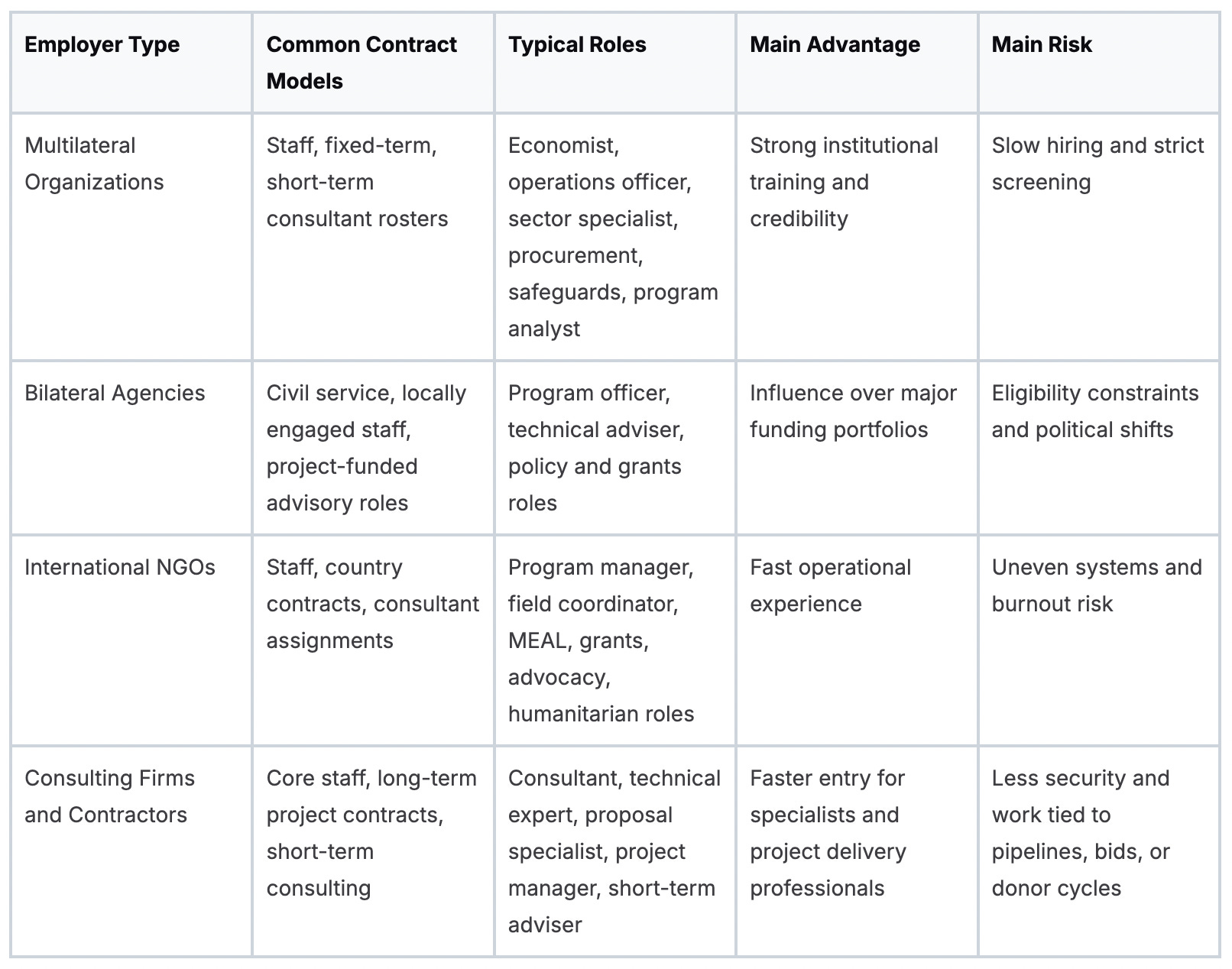
Multilaterals look for documented competencies, clean alignment with the grade and role family, and evidence that you can work inside a formal system. Bilateral agencies often screen for policy fit, eligibility, and trust in regulated environments. NGOs want operators who can deliver in imperfect conditions. Contractors want people they can place into funded work or competitive bids with minimal ambiguity.
Here is the comparison that matters:
Choose Your Entry Point Young Professional or Direct Hire
A candidate finishes a master’s degree, targets the World Bank YPP, spends nine months on one application cycle, and gets nowhere. Another takes a one-year project role with a contractor, moves onto a short-term consultancy, then converts that experience into a fixed-term post. Both wanted an international development job abroad. They were pursuing different career paths.
That distinction matters more than many applicants realize.

The choice is not only young professional program versus direct hire. It is also staff versus consultant versus contractor. Those models shape how you are assessed, how quickly you can enter, how stable the work is, and what kind of credibility you build.
Structured programs suit future institutional staff
Young professional programs, fellowships, and graduate-entry schemes are designed for people an institution wants to train over time. They work best for candidates with a strong academic record, clear sector focus, and enough early experience to show judgment, not just promise.
Choose this route if you want a career inside one system. Multilaterals and some bilateral agencies use these programs to build future operations officers, economists, policy specialists, and program managers. The upside is real. Training is better, internal mobility is stronger, and the brand travels well.
The trade-off is also real. These programs are slow, narrow, and highly filtered. A good candidate can still lose because the cohort is tiny, the timing is wrong, or another applicant fits the institution’s current priorities more closely.
For candidates assessing that option, this guide to World Bank jobs for fresh graduates is a useful reference point.
Direct hire is not one path
Direct hire covers several different markets, and applicants hurt themselves when they treat them as one pool.
If you are applying for a staff role, the employer is hiring for continuity. They want evidence that you can manage internal systems, coordinate across functions, and stay effective after the excitement of deployment wears off.
If you are applying for a consultancy, the employer is buying expertise or delivery against a defined scope. They care less about your long-term institutional fit and more about whether you can produce the output with limited supervision.
If you are applying through a contractor or implementing firm, the employer is often hiring against funded work, a proposal pipeline, or a donor deadline. That means speed and relevance matter a lot. A candidate with the right country, donor, or technical experience can beat a stronger generalist every time.
When each entry point makes sense
Structured programs make sense when your profile already signals a coherent long-term fit. They are strongest for people aiming at policy, lending, strategy, or institution-heavy operational work.
Direct staff applications make sense when you already have relevant experience and can show immediate value inside a team.
Consulting works well for specialists, independent operators, and people building a reputation through deliverables. It can get you into strong institutions faster. It can also leave you stitching together contracts and handling your own business development between assignments.
Contractor roles are often the best bridge for professionals who have technical skills but lack a major development brand on their CV. I have seen people enter through procurement support, MEL, finance, grants, engineering, health systems, or proposal work, then move into NGO or multilateral roles once they had donor-facing experience.
How to choose well
Use a simple test.
Choose a structured program if you can tell a clear story about why one institution should invest in you for the long term.
Choose direct staff roles if your record already shows execution, coordination, and enough maturity to take ownership quickly.
Choose consulting or contractor routes if your edge is specialist expertise, delivery under deadlines, or field experience that can be deployed into live work.
Many candidates should pursue more than one route, but not with the same application. A YPP file should show trajectory, intellectual discipline, and institutional fit. A staff application should show operational value. A consultancy application should show outputs, sectors, clients, and how fast you can deliver.
That is the unwritten rule. Employers are not only asking, “Should we hire this person?” They are asking, “Under what contract model would this person be useful to us right now?”
Craft an Application That Gets Noticed
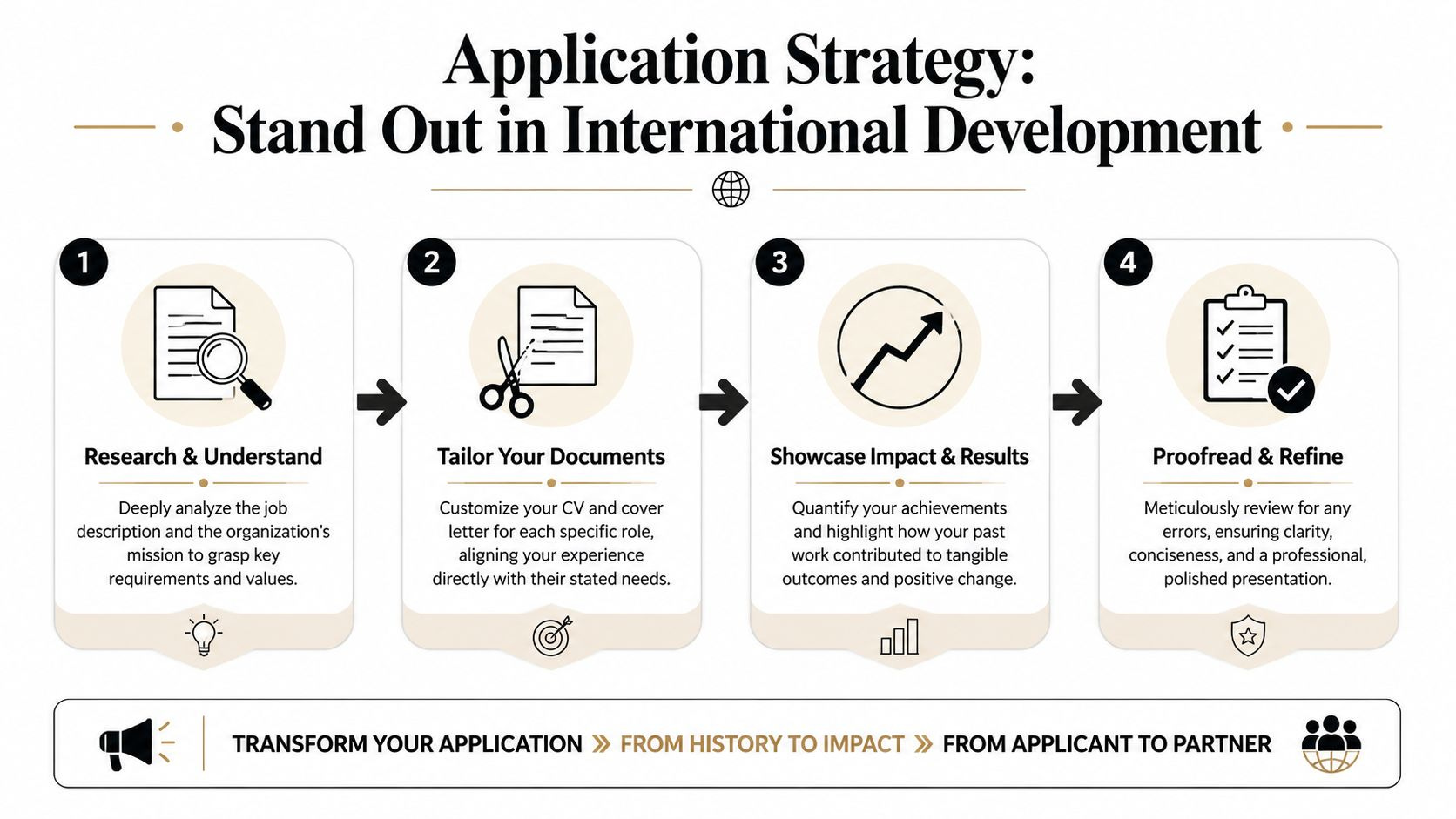
Most applications fail before a human seriously considers them. That’s usually not because the candidate is weak. It’s because the application reads like a biography instead of a match document.
Your CV is a sales document for one job. Your cover letter is a short argument for fit. If either one tries to tell your whole life story, you’ve already lost.
Start with the vacancy, not your background
Read the posting three times. On the first pass, identify the formal requirements. On the second, mark the verbs. Designed, managed, analyzed, coordinated, advised, drafted, supervised. On the third, note the context. Country office, headquarters, fragile setting, donor reporting, stakeholder coordination, public sector reform, health systems, climate finance.
Then rewrite your CV around those needs.
Use the exact language of the role where it truthfully matches your experience. If the vacancy asks for stakeholder engagement and you’ve managed ministry counterparts, say that. If it asks for project implementation and you’ve coordinated field delivery, say that. Don’t hide relevant experience under vague wording.
Show outcomes clearly
The brief behind this article suggested quantified STAR-style writing. That principle is right. The discipline matters. The number only belongs if you can verify it from your own record.
Strong bullets usually do four things:
Name the function
“Managed donor-funded education program implementation...”Clarify the environment
“…across country office and local partner teams...”State your action
“…coordinating reporting, partner communication, and work planning...”End with the result
“…delivering submissions on time and strengthening funder confidence.”
If you don’t have hard numbers, use concrete operational results. On time. Approved. Launched. Submitted. Adopted. Expanded. Standardized. Those are still results.
Generic bullets describe duties. Strong bullets show what changed because you were there.
Build separate versions for separate paths
Candidates damage their odds by keeping one “master CV” and calling it customized. Real customization means changing emphasis, sequencing, and language.
A staff-role CV should foreground continuity, promotions, stakeholder management, and institutional contribution.
A consultant CV should foreground expertise, scope of assignments, technical outputs, sectors, countries, and languages.
A contractor-facing CV should foreground donor alignment, project delivery, proposal-relevant keywords, and practical implementation history.
Handle portals like a system, not a form
UN and multilateral portals can be tedious. Treat them as part of the assessment. Copy your polished material carefully, but adapt it to the fields they screen.
A few rules help:
Mirror the vacancy language carefully so automated filters can recognize your fit.
Keep role titles understandable if your former organization used internal naming that outsiders won’t decode.
Complete every relevant field because incomplete portal profiles often undercut otherwise strong applications.
Save a role-specific version of your CV and cover letter for each submission. You’ll need it later in interviews.
Poor applications are usually too broad, too passive, or too proud of irrelevant prestige. Good ones feel obvious. The reviewer can see, in under a minute, why you belong in the longlist.
Network and Ace the Competency-Based Interview
Relationships matter in this sector because development work is collaborative, political, and operational. People hire for trust as much as skill. That doesn’t mean networking is about asking strangers for jobs. It means building informed professional relationships before you need them.
The best networking approach is simple. Ask for insight, not rescue.
Conduct informational interviews properly
A strong outreach note is short and specific. Mention the person’s role, one reason you’re reaching out, and one focused request for a brief conversation. You are not asking them to review your life. You are asking for informed perspective.
Good questions sound like this:
Career-path question
What experience mattered most when you moved into this kind of role?Hiring-pattern question
What do strong candidates usually show that weaker ones miss?Market question
Where do you see the most practical entry points right now for someone with my background?Reality-check question
What would you stop doing if you were running my search?
Bad networking asks people to find openings for you before they know you. Good networking gives them a reason to remember you as someone thoughtful and prepared.
After the conversation, send a thank-you note and act on at least one piece of advice. If you reconnect later, mention what you changed. That’s how a one-off chat becomes a relationship.
Prepare for evidence-based interviews
Competency-based interviews are straightforward once you stop trying to impress and start trying to prove. The panel wants evidence from your past behavior.
That means your preparation should revolve around stories, not opinions.
Build a bank of examples for the competencies these employers care about most:
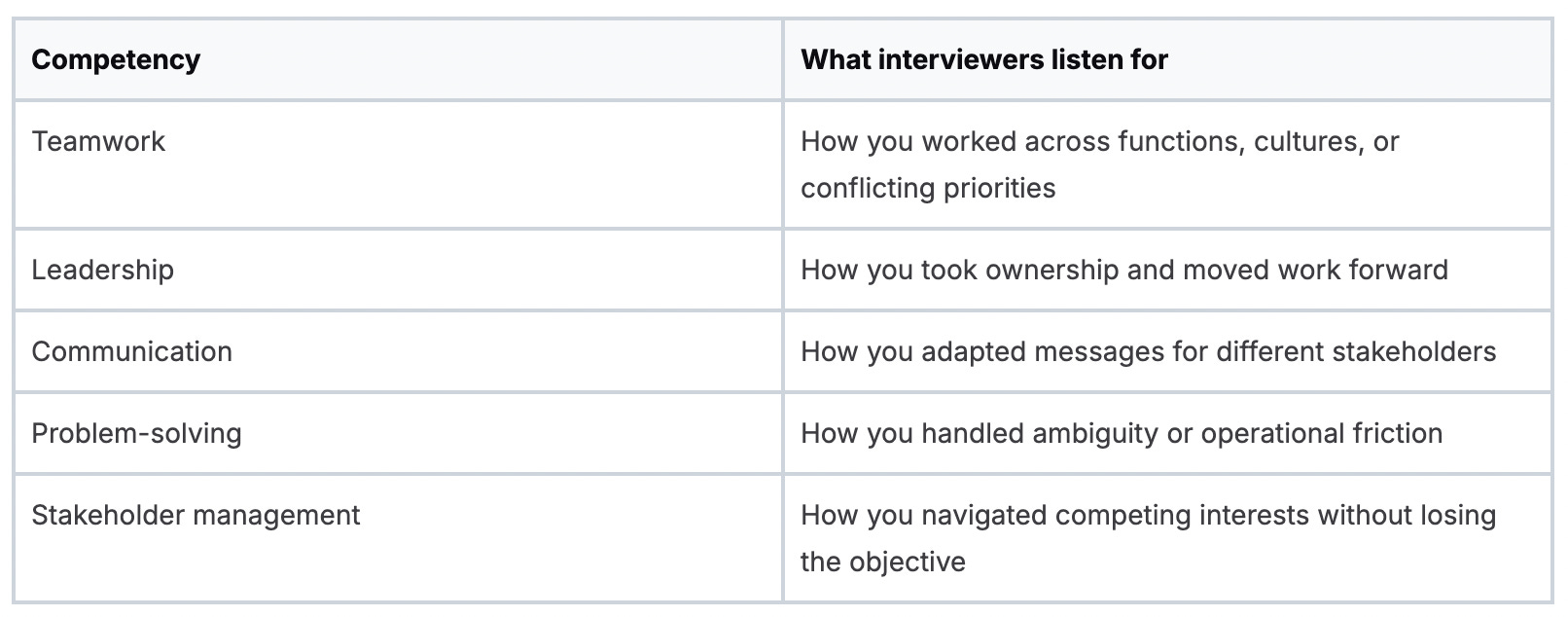
For each story, prepare the sequence clearly: context, challenge, your action, the result, and what you learned. Keep it tight. Rambling kills strong examples.
A practical reference for this format is this guide on how to pass a competency-based interview.
“Tell me about a time” means “show me evidence.” Answer with a real case, not a philosophy.
Common mistakes in development interviews
Three show up constantly.
First, candidates describe team achievements without clarifying their own role. Panels can’t score ambiguity.
Second, they sanitize conflict. Real development work involves difficult stakeholders, fragile timelines, and imperfect information. If every story ends in smooth consensus, it sounds rehearsed.
Third, they skip the result. Even in mission-driven roles, outcomes matter. What changed after your action?
A good answer sounds operational. It includes people, constraints, judgment, and consequences. That’s what convinces interviewers you can work abroad in real institutional settings, not just talk about them.
Your Action Plan for Landing a Role
A candidate spends six weeks applying to every role that looks relevant, then wonders why nothing converts. The problem usually is not effort. It is that staff jobs, consultant rosters, and project contracts are hired differently, screened differently, and rewarded differently. Treat them as separate career paths, because they are.
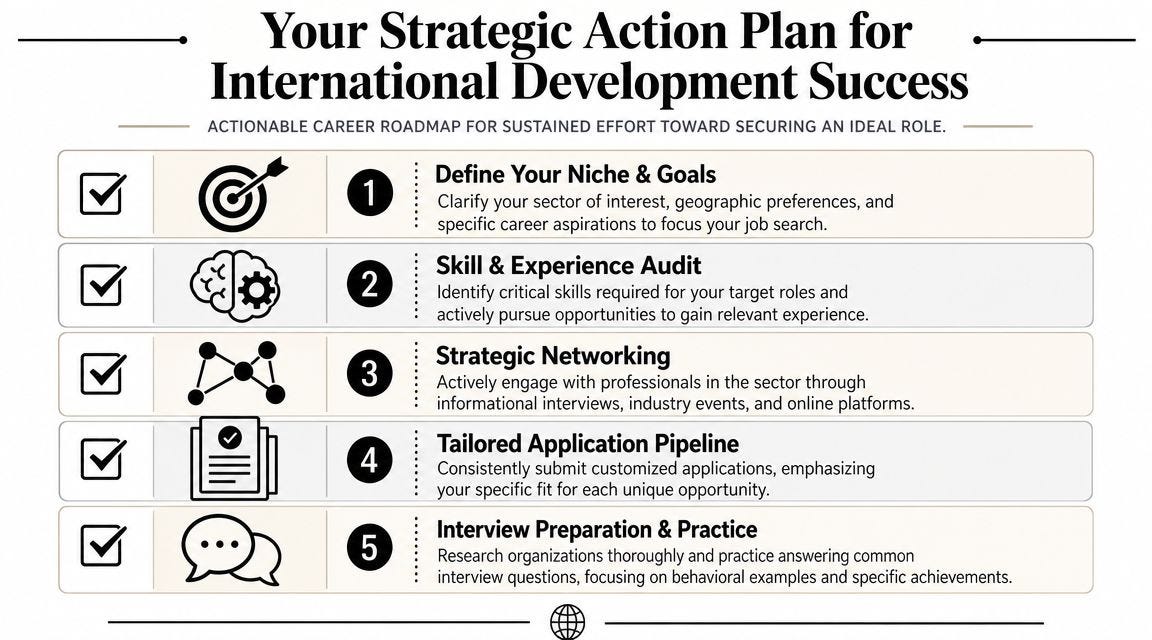
A practical 90-day reset
Start by choosing the employment model you want first.
If you are targeting staff roles, build for institutional fit, progression, and patience. Hiring is slower, panels care about competencies and internal alignment, and your application needs to show that you can operate inside systems, not just deliver output.
If you are targeting consulting work, sell a defined service. Managers hire consultants to solve a problem quickly, fill a technical gap, or deliver a product under time pressure. Your CV should read like proof that you can do that with limited hand-holding.
If you are targeting project-based contracts, show availability, field readiness, and execution. These roles often move faster and can be the practical route into a country office or implementation team, but they can also mean less security and more frequent re-entry into the market.
Then narrow the market. Pick one sector, one function, and one geographic logic. That could be education delivery in East Africa, public financial management in fragile settings, or health systems work where French is an actual hiring advantage, not a line on your CV.
After that, rebuild your materials around the path you chose. A staff CV, a consultant profile, and a contractor application should not look identical. Candidates lose ground here by sending one generic document into three different hiring systems.
Build a real pipeline
A serious search needs a weekly operating rhythm.
Use one tracker and keep it current:
List every opening in one spreadsheet or board.
Label the hiring model. Staff, consultant, or contract.
Record deadlines and stage so nothing slips.
Note relevant contacts by institution, team, or country office.
Tailor your submission to the hiring model before you apply.
Review results every week and adjust based on what is not converting.
Weak patterns become evident quickly if you bother to look. If staff applications get interviews but consultant bids do not, your profile may signal institutional competence more clearly than technical specialization. If short-term contracts move but fixed-term jobs do not, you may need stronger evidence of progression, leadership, or language depth.
Focus on credibility signals
Early-career candidates often chase prestige before they have a clear professional use case. Hiring managers usually do the opposite. They ask a simpler question: where can this person create value with limited ramp-up time?
For staff roles, credibility often comes from progression, internal coordination, and evidence that you can work through bureaucracy without stalling. For consultants, credibility comes from a sharp niche, clean deliverables, and a track record that reduces perceived risk. For contractors, credibility comes from reliability, deployment readiness, and the ability to keep operations moving in imperfect conditions.
Career advantage comes from specificity.
That specificity might be field experience, a language that is usable on the job, a technical specialty that teams buy externally, or a pattern of assignments that shows you can handle implementation pressure. Prestige helps at the margin. Clear evidence gets people hired.
Development careers abroad rarely look tidy from the inside. Good people piece them together through fellowships, home-office roles, surge support, short contracts, and consultant assignments before the pattern becomes obvious. That is normal. The question is whether each step builds a stronger case for the next one.
Keep the search focused. Keep separate materials for separate hiring models. Keep choosing moves that add signal, not just motion.
If you want a steady way to monitor openings across multilaterals and related institutions, Multilateral Development Bank Jobs publishes recurring listings for staff roles, consultant opportunities, and practical career guides tied to this market.