

If you’re targeting a career at the Asian Development Bank, you need to know what you can expect to earn. The ADB salary scale is competitive and structured to attract top global talent, with gross annual salaries ranging from $108,000 for entry-level roles to over $588,000 for senior management.
Your exact figure depends on your experience, grade level, and the specific role you land.
ADB International Staff Salary Structure Explained
Understanding the ADB salary scale is a crucial step when you’re weighing a career move. The bank uses a transparent grading system for its international staff, with each grade tied to a specific pay band. This isn’t a black box; the structure is designed to be clear and competitive with other major development banks.
The chart below gives you a quick snapshot of the midpoint salaries you can expect at different career points.
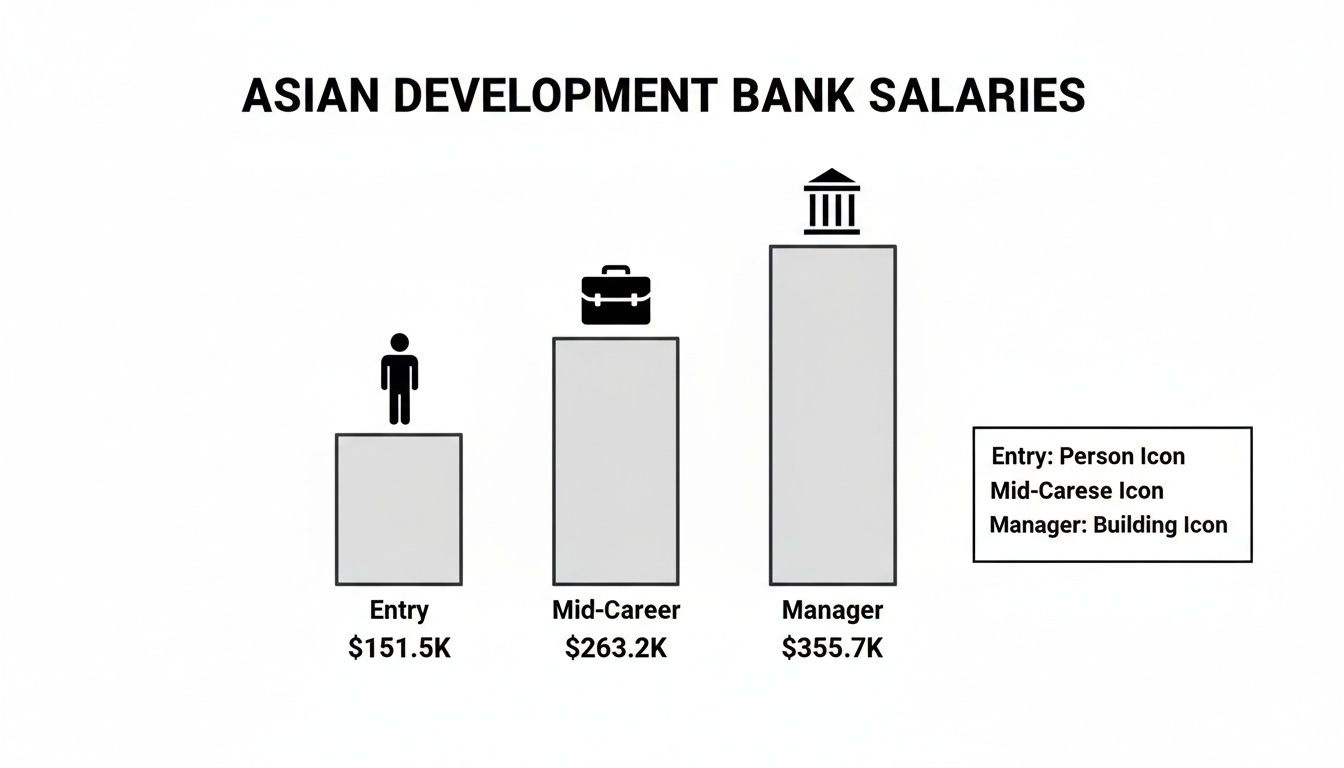
Compensation climbs significantly as you move from an entry-level professional to a mid-career expert and into management. This jump reflects the growing responsibility and expertise the Bank expects from its senior staff.
International Salary Grades
The ADB organizes its international staff positions into two main tracks: technical and managerial. This is a standard setup for a multilateral development bank.
Technical roles fall into grades TI1 through TI4.
Managerial roles are graded from M1 to M3.
Each grade has its own salary range, with a minimum, a midpoint, and a maximum. This structure allows for salary growth within your grade based on your performance and time on the job. We cover these grades in more detail in our complete guide to the Asian Development Bank.
The 2026 Salary Bands
The bank regularly adjusts its pay scales to stay competitive in the global market. To give you a concrete idea of the numbers, here’s a projection of the gross annual salary bands for international staff, based on a typical 2% annual increase from the official 2025 figures.
The table below lays out the full international salary structure for a projected 2026, showing the minimum, midpoint, and maximum you can expect at each grade.
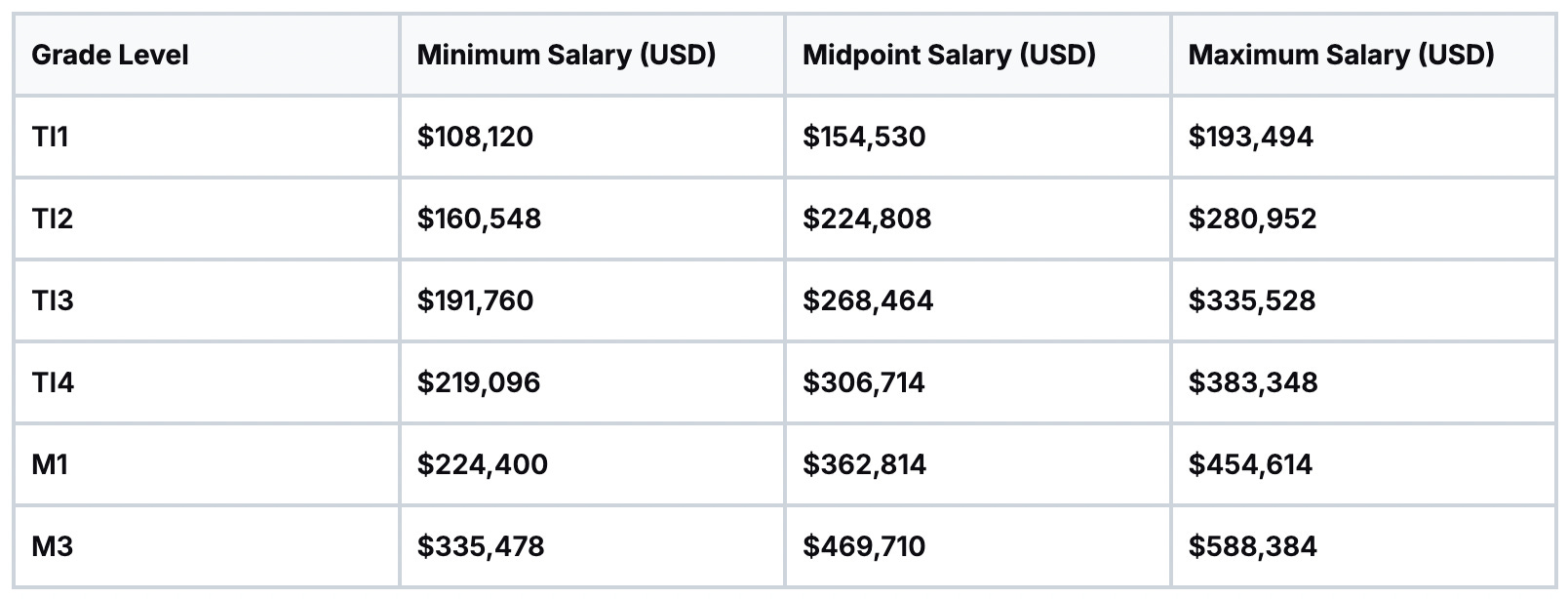
As you can see, an entry-level **TI1** position starts around **$108,120** and can go up to **$193,494**, while a senior managerial role at **M3** has a potential ceiling of over **$588,000**. These figures are all gross annual salaries quoted in US dollars. You can check the official summary of the previous [2025 salary adjustments on Scribd](https://www.scribd.com/document/934016143/Adb-International-Staff-Salary-Structure-2025) to see the source data.
How Local Staff Compensation Works
If you’re applying for a role in one of the ADB’s field offices, you need to know that the local staff salary structure is completely separate from the international scale. This system is built for a different purpose.
The Asian Development Bank’s operations depend heavily on its talented national officers and administrative staff in resident missions across Asia and the Pacific. The system is designed to be competitive right where you live.
International staff are paid in USD, but local staff salaries are always denominated in the local currency of the duty station. This is a critical distinction. The entire framework is designed to compete head-on with the top employers in that specific country’s job market, ensuring the ADB can attract and keep the best local talent.
Local Salary Grades and Market Benchmarking
The ADB uses a distinct set of grade levels for local staff, categorized as Administrative Staff (AS) and National Staff (NS). These grades are pegged to the complexity and responsibility of the role within that country office.
To set these salaries, the bank benchmarks its pay scales against the local market. It analyzes compensation data from comparable organizations in that city or country, from top private sector firms to other international bodies.
This means an ADB salary in Manila is designed to be competitive against the best employers in the Philippines, while a salary in New Delhi holds its own against leading organizations in India. This is how the bank stays attractive across its massive operational footprint.
The core principle is “equal pay for work of equal value,” understood within a local context. The ADB provides a competitive career path that stacks up against the best opportunities in your home country.
For instance, local staff are the backbone of the bank’s on-the-ground project implementation. Their pay reflects this. For the TL1 grade, salaries range from 2,271,000 to 3,747,000 in local currency units, with a midpoint of 3,009,000. These figures, often in Philippine Pesos or an equivalent currency, show how the scale is adjusted for cost-of-living and market rates in each mission.
You can dive into the official numbers yourself in the ADB’s local staff salary structure documentation.
The Annual Review Process That Keeps ADB Competitive
The Asian Development Bank salary scale is a living document. The bank uses a rigorous annual review to ensure its compensation packages are sharp enough to attract and keep the best people in the development world.
This is a structured, data-driven system. It’s the mechanism that keeps the ADB in the same league as other Multilateral Development Banks (MDBs) and the private sector. Think of it as a deliberate strategy to stay at the top of the food chain for international development employers.
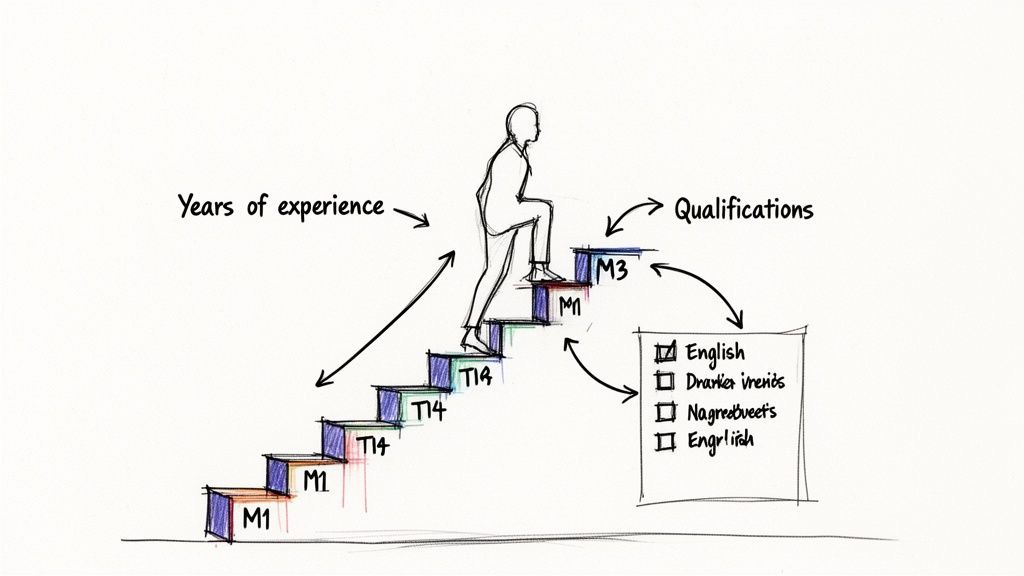
The bank’s compensation philosophy is clear: target a specific, high percentile of the market median. This is about making sure the ADB salary scale is attractive enough to prevent a brain drain to competitors.
How The Annual Review Works
The process is methodical and unfolds in two main stages.
Market Assessment: The bank’s HR team dives deep into market pay movements. They gather extensive data on what similar organizations are paying. This is a detailed benchmarking exercise.
Salary Structure Adjustment: Armed with that data, the bank’s leadership proposes specific tweaks to the salary structure. These proposals go straight to the Board of Directors for approval for the coming year.
This two-step process ensures that any changes to the pay scale are grounded in solid market data.
Benchmarking Against Key Comparators
Who does the ADB measure itself against? The bank looks at a hand-picked group of comparator organizations to keep its salaries on point. This group includes:
Other MDBs: This is the most direct comparison. The ADB keeps a close watch on pay structures at institutions like the World Bank Group, the International Monetary Fund (IMF), and other regional players like the African Development Bank and the Asian Infrastructure Investment Bank (AIIB).
The Public Sector: The bank benchmarks against compensation in the public sectors of key member countries. The United States public sector serves as a primary benchmark for international staff salaries.
The Private Sector: To compete for talent with specialized skills in finance, tech, and project management, the ADB includes select private sector organizations in its analysis.
The goal is to find a strategic balance. The ADB wants its salaries to be competitive, but it isn’t aiming to be the absolute highest payer. It maintains a strong, sustainable compensation package that attracts the right people for the right reasons.
You can see the bank’s strategic response to global talent wars in the numbers. For instance, the 2025 review for international staff aimed to keep salaries competitive at 96.7%–98.9% of the market medians across different job types. That precision shows how seriously they take the data.
Since the 2020 Comprehensive Benefits Review, salary midpoints have seen compounded increases of roughly 15–20%, a direct result of these comparator analyses. The fact that the M3 manager maximum salary hit $460,500 was a direct response to these market shifts. You can dig into the specifics in the Board’s annual review of salary and benefits.
The Total Compensation Package: Beyond Base Salary
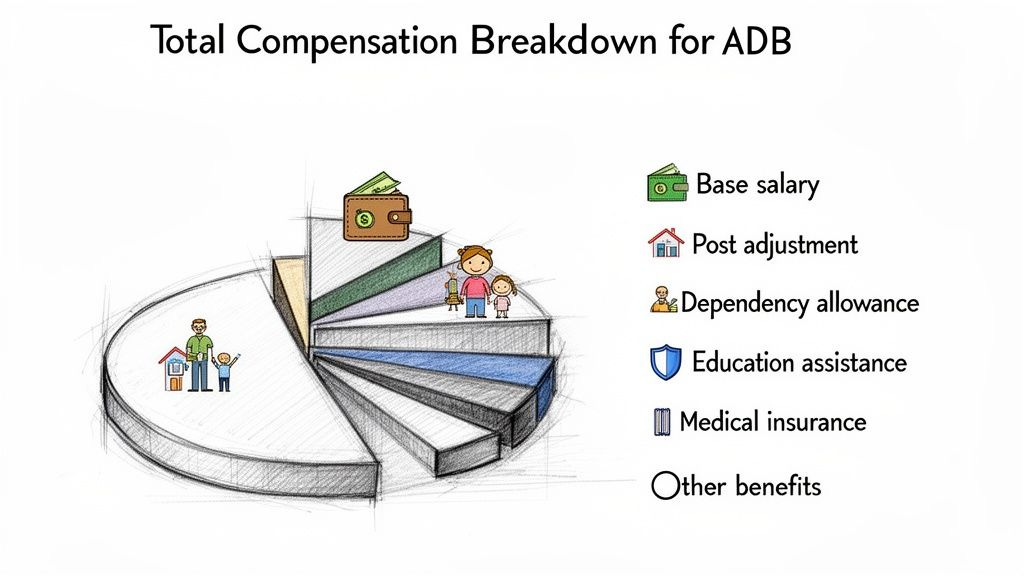
Looking at the ADB salary scale alone is a rookie mistake. Your base salary is only the starting point. The real value is in the total compensation package, which dramatically boosts your earnings and quality of life, especially for international staff moving to Manila.
To figure out what an offer is really worth, you have to look beyond the gross annual salary. The mix of allowances and benefits is what makes an international posting genuinely attractive. It separates a good offer from a great one.
Key Financial Allowances
Several allowances add a serious amount of cash to your take-home pay. These are core parts of your compensation, structured to eliminate the financial friction of living and working abroad.
The biggest one is the post adjustment. This is an extra payment for international staff based at the Manila headquarters. It equalizes your purchasing power, making sure your salary goes just as far in the Philippines as it would in a high-cost city like Washington D.C. or Geneva. The post adjustment can add a huge percentage to your base pay and it changes based on regular cost-of-living reviews.
On top of that, the ADB offers other critical financial supports:
Dependency Allowance: You get a specific allowance for a dependent spouse and for each eligible child. This is direct financial support for your family.
Education Assistance: For staff with kids, the ADB gives you grants to help cover education costs, from primary school through university. This is a massive financial win, especially when you see the price tags on international schools.
Relocation Benefits: When you’re first hired, the bank gives you a package covering travel, a shipping allowance, and a settlement grant to help you get set up in your new home.
These allowances are not afterthoughts. They remove financial roadblocks so you can hit the ground running. Depending on your family situation, these benefits can easily increase the value of your compensation package by 30% to 50% over your base salary.
Insurance and Retirement Benefits
Beyond the direct cash, the ADB’s benefits package provides a powerful safety net. The Bank’s insurance and retirement plans are a cornerstone of the whole deal and are extremely competitive.
The Medical Insurance Plan (MIP) is a major highlight. It gives you worldwide coverage for you and your dependents, paying for a huge range of medical, dental, and vision care. The bank heavily subsidizes the premiums, making it a high-value benefit that buys you peace of mind.
Your long-term financial security is a top priority. The ADB’s retirement plan is a defined benefit pension, which is almost unheard of today. The bank contributes a significant amount for you, building a secure nest egg for your life after the Bank.
Finally, the ADB provides other essential coverage like group life insurance and disability insurance. When you add it all up, the base salary from the pay scale is just one piece of a much larger and more valuable financial picture.
How to Place Yourself on the ADB Salary Scale
Knowing the Asian Development Bank salary scale is step one. The real question is, where do you fit on it?
Your starting salary isn’t pulled out of a hat. The ADB’s HR department uses a clear, structured method to place candidates. Understanding their logic gives you a huge advantage when you get an offer. It all comes down to your qualifications, relevant professional experience, and the specific demands of the job.
Aligning Your Experience with ADB Grades
The ADB has a specific way of counting your years of relevant experience. This is about how much of your work directly maps to the role you’re targeting.
A relevant PhD often counts as three years of experience right off the bat. A relevant Master’s degree typically counts as two. Your professional work history is then added on top. The bank looks for a direct, logical connection between your past jobs and the responsibilities of the new position. This is why a generic resume won’t cut it.
Here’s a general guide for mapping your experience to the international staff grades. Use this framework for a realistic self-assessment.
TI1 (Entry-Level Professional): For early-career professionals. You’ll almost always need a relevant Master’s degree plus at least 3-5 years of solid professional experience.
TI2 (Professional): The next step up. Candidates here usually have a Master’s or PhD and around 5-8 years of directly relevant experience.
TI3 (Senior Professional): At this level, you’re expected to be a seasoned expert. The bank looks for a minimum of 8-12 years of experience with a proven track record.
TI4 (Lead Professional): For specialists with deep expertise and leadership qualities. You’ll need 12+ years of high-level experience to even be considered.
M1-M3 (Management): These roles are for experienced leaders with extensive management track records, usually 15+ years, in fields directly related to the ADB’s work.
What to Expect at the Offer Stage
When the ADB extends an offer, they will have already placed you at a specific grade and step. For example, you might be offered a position at Grade TI3, Step 4. This placement is their calculated assessment of your experience against their internal benchmarks.
Your starting salary is almost always placed within the first half of the grade’s salary band. The bank needs to leave room for your future salary growth through annual performance-based increases. Don’t expect to come in at the top of the band.
Negotiation is possible, but you need to be strategic. The ADB rarely negotiates the grade level, as this is tied to the job’s defined responsibilities. You can sometimes negotiate your step within that grade.
To do this, you need a strong, evidence-based case. Simply asking for more money won’t work. You must prove that your unique skills or extensive, highly relevant experience were undervalued in their initial placement. For more guidance on this part of the process, check our article on how to get a job at the Asian Development Bank. Use this knowledge to build your case and enter the conversation with confidence.
Comparing ADB Salaries to Other MDBs
When an offer from the Asian Development Bank lands, you’ll want to see how it stacks up against its peers. The world of Multilateral Development Banks (MDBs) is small and they all compete for the same top-tier global talent. The ADB salary scale is strong, but there are key differences in compensation philosophy between the major players.
Understanding these nuances is critical. An offer from the ADB is about the entire package, not just the base salary. It’s about how that package holds up against what you might get from the World Bank Group or the International Monetary Fund (IMF) in Washington D.C.
General Competitiveness
On a pure salary basis, the ADB, World Bank, and IMF are all in the same ballpark. They have to be. These institutions constantly benchmark against each other to prevent poaching and ensure their offers are attractive enough to pull talent from across the globe. You won’t find one bank paying dramatically less than the others for a similar role.
The real difference is geography and the cost of living adjustments.
World Bank and IMF: Both are headquartered in Washington D.C., an expensive city. Their salary scales are built to be highly competitive in that specific high-cost market.
Asian Development Bank: Based in Manila, its base salaries are already competitive. The post adjustment for international staff truly levels the playing field, giving your purchasing power a significant boost.
In practice, while the gross salary figures might look different on paper, your actual lifestyle and savings potential can end up being quite similar once all allowances are factored in.
Philosophical Differences in Compensation
Each MDB takes a slightly different angle on its total compensation package. The ADB is well-known for its strong, straightforward benefits designed to support a high quality of life for expatriates moving to Manila. The World Bank and IMF structure their packages for a different cost and policy environment.
The table below gives you a high-level look at these philosophical differences. This isn’t about which one is “better,” but which approach clicks with your personal and financial priorities. For a more detailed breakdown, you can check our deeper comparison of World Bank vs IMF vs ADB careers.
MDB Compensation Philosophy Comparison
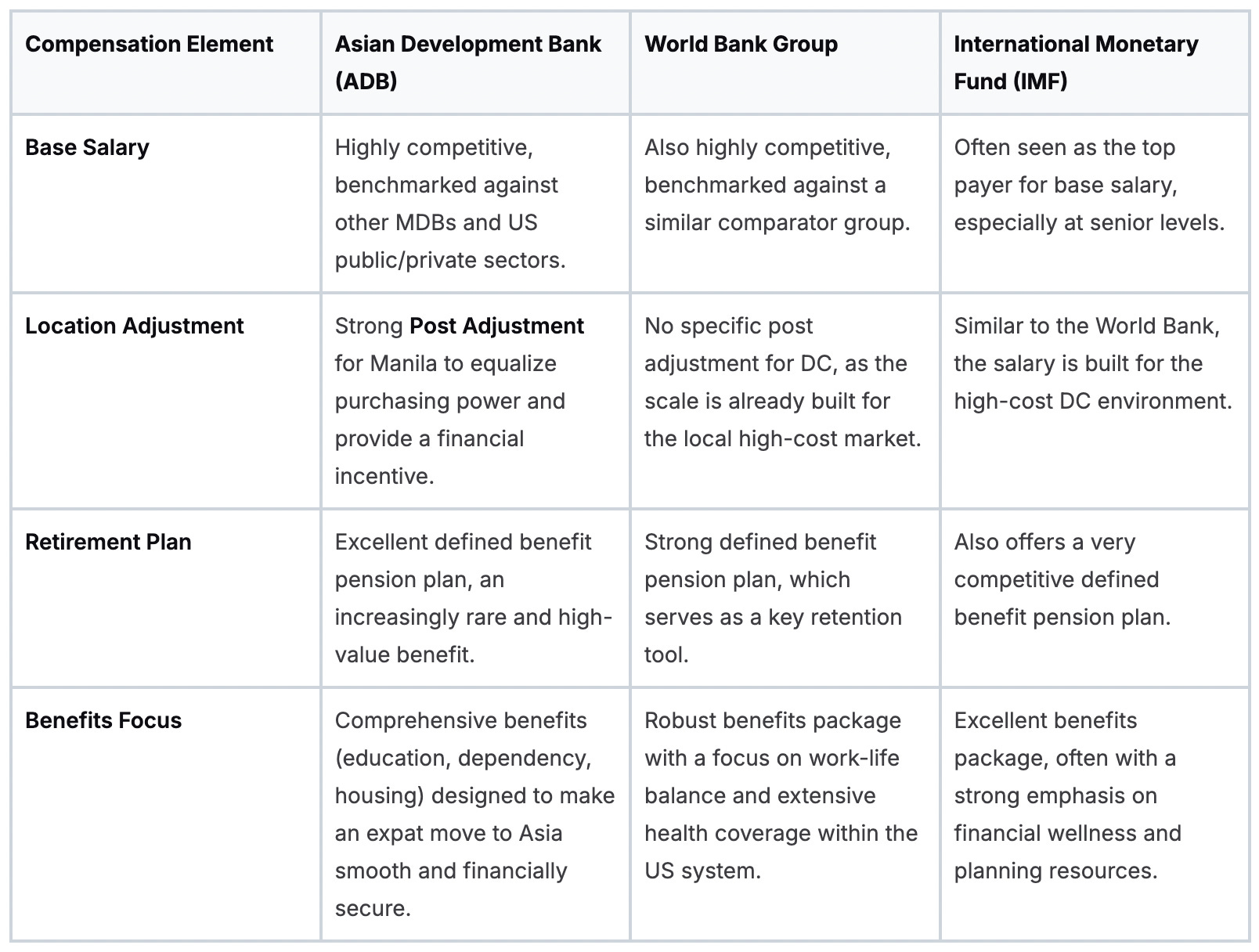
The “best” offer depends entirely on you and your circumstances. An ADB package might give you superior savings potential thanks to Manila’s lower cost of living combined with a generous post adjustment. A World Bank or IMF offer, however, puts you right in the middle of the policy ecosystem of Washington D.C.
When you’re comparing offers, you have to look beyond the base salary. Calculate the real-world value of the allowances, weigh the security of the pension plan, and consider the lifestyle each location offers. An ADB offer is structured to make a career in Asia highly rewarding.
Frequently Asked Questions About ADB Compensation
Looking at the ADB salary scale is a good first step, but those numbers always bring up more questions. Let’s get straight to the most common queries candidates have about what ADB compensation looks like in the real world.
Here are the direct answers you need, based on how the system actually works.
Are ADB Salaries Tax-Free?
For most international staff, the answer is a straightforward yes. Your ADB salary is exempt from income tax in both the Philippines and your home country. This is a standard perk for employees of major international organizations, baked into the bank’s founding agreements.
There’s one huge exception: United States citizens and permanent residents. If you’re an American, you are still required to file and pay US federal and state income taxes on your ADB earnings.
To make up for this, the ADB provides a tax allowance to its American staff. This is an additional payment designed to reimburse you for the taxes you owe, putting your net, take-home pay on par with colleagues from other member countries.
How Are Annual Salary Increases Determined?
Your salary isn’t fixed; it grows each year. Your annual raise comes from two things: a bank-wide adjustment and your own performance.
First, the ADB reviews its entire salary structure every year to keep up with market rates and inflation. This usually results in a general, across-the-board percentage lift for all pay bands.
Second, your individual performance drives your salary growth within your grade. ADB uses a performance review system to evaluate your work against annual goals. A strong performance review earns you a merit-based increase, which means you move up one or more steps inside your grade level. This is how you progress from the bottom of your pay band toward the maximum.
What Is the Post Adjustment and How Does It Work?
The post adjustment is a massive, non-taxable allowance paid to international staff based at the Manila headquarters. Its purpose is to equalize your purchasing power. You can think of it as a cost-of-living allowance that ensures your salary goes just as far in the Philippines as it would in a benchmark city like Washington D.C.
This is not a small amount. It’s calculated as a percentage of your base salary and is regularly updated based on cost-of-living surveys run by the United Nations.
For instance, if the post adjustment is set at 55% and your base salary is $120,000, you would get an extra $66,000 per year. This is paid out monthly with your salary and dramatically increases your overall take-home pay. It’s a critical part of your total compensation.
Can You Negotiate Your Starting Salary?
Yes, but you have to know the rules of the game. The ADB will place you at a specific grade and step based on its assessment of your skills and experience. You absolutely cannot negotiate your grade level; that’s determined by the job’s defined responsibilities.
What you can sometimes negotiate is your step within that grade. If you have a solid case that your unique expertise or deep, directly relevant experience wasn’t fully captured in their initial offer, you can argue for a higher step placement. This requires a compelling, evidence-based argument. Simply asking for more money won’t get you anywhere.
Finding and landing a role at a top MDB requires staying on top of current opportunities and understanding the system. At Multilateral Development Bank Jobs, we do the hard work for you, delivering curated job lists and insider guides directly to your inbox. Get full-time staff listings, consultant opportunities, and deep-dive career guides to fast-track your MDB job search. Check out the publication at
https://mdbjobs.com.