

You’re probably doing some version of this right now. Refreshing ReliefWeb, checking LinkedIn, scanning MDB career pages, and wondering why strong applications keep disappearing into silence.
That frustration is rational. The international development job search has changed. Generic advice hasn’t caught up. Many articles still tell you to network more, tailor your resume, and stay persistent. Fine. None of that explains why one candidate with a weaker background gets traction while another with stronger credentials gets screened out before a human ever reads the CV.
MDB hiring runs on formal criteria, internal politics, and a few unwritten rules that matter more than people admit. Your passport can matter. Your contract history can matter. The exact way you describe analytical work can matter. If you understand those rules, you stop treating the search like a volume game and start treating it like a placement strategy.
Navigating the 2026 International Development Job Market
The market is tight. You need to be precise.
In 2025, international development vacancies fell by 22.5%, dropping to 106,000 open roles, while Project Management and Monitoring and Evaluation remained strong with nearly 26,000 jobs posted according to DevelopmentAid’s review of top hiring sectors in international development in 2025.

That single fact changes how you should search. When the market contracts, broad application volume gets weaker returns. More applicants chase fewer openings, and weak-fit applications die faster.
Where the demand still sits
The contraction wasn’t uniform. Operational and technical functions kept moving.
A few areas stood out in the verified market data:
Project Management and M&E: nearly 26,000 roles. That tells you institutions still need people who can implement programs, track delivery, and report results.
Financial Services and Audit: active hiring remained visible, especially in regions where development finance operations continue to require oversight.
Administration: steady demand continued for core delivery functions such as procurement, finance support, and project administration.
If you’re searching for policy-heavy roles with vague mandates, expect a crowded field. If you can position yourself around delivery, analytics, controls, or implementation support, you’re closer to where hiring managers still get approval to recruit.
Practical rule: Follow budget pressure. When funding tightens, institutions protect roles tied to implementation, fiduciary control, reporting, and measurable results.
What stops working in a weaker market
The old instinct is to compensate with more applications. That usually backfires.
What doesn’t work:
Applying across unrelated functions: MDB recruiters can spot a candidate throwing applications at anything with “development” in the title.
Leading with mission language alone: every candidate cares about impact. Committees shortlist people who can execute.
Ignoring operational roles: many candidates hold out for economist or policy titles while bypassing the officer, specialist, analyst, and coordinator roles that build the exact track record MDBs value later.
The smarter move is narrower. Build your search around roles that institutions still have to fill even during funding stress. For many candidates, that means reframing their background around implementation, evidence, finance, procurement support, or project performance.
This is the first mental shift in an effective international development job search. The market is harder, but it’s not random. The hiring pain is concentrated, and so is the opportunity.
Finding High-Impact Roles Beyond the Main Job Boards
Many candidates overuse public boards and underuse targeted channels. That’s why they stay busy without getting closer.
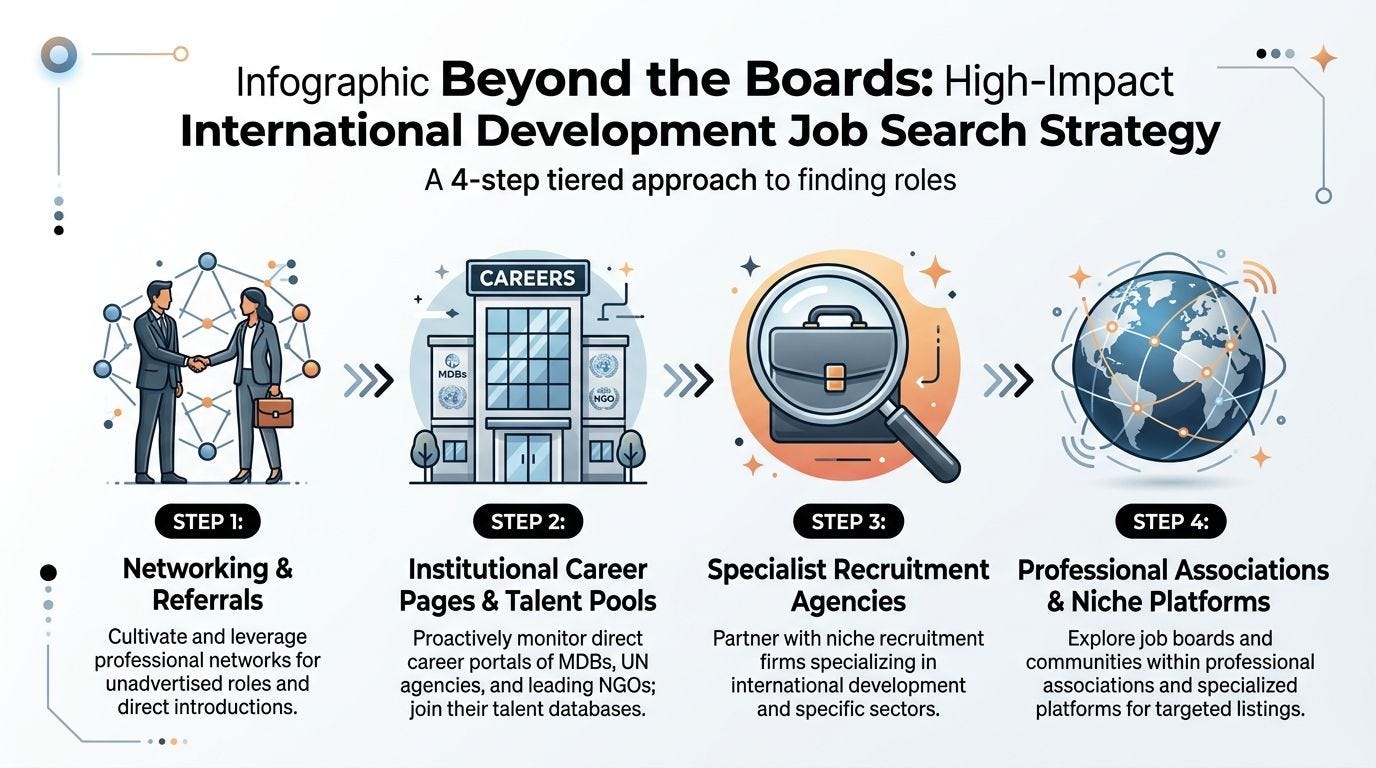
The practical search model is simple. Use broad platforms for discovery, then move quickly to narrower sources where competition is thinner and fit matters more.
Build a short target list
A focused search beats a scattered one. One expert recommendation cited by the Foreign Policy Association is to narrow your search to five to 10 well targeted organizations, while also noting that ReliefWeb often has over a thousand openings and that DevNetJobs.org includes member-only jobs with short closing dates in its model, as explained in this guide to finding a job in international development.
That advice holds up in practice because MDB hiring is role-specific. Committees want direct relevance, not broad enthusiasm.
Start with a target list such as:
A small cluster of MDBs: World Bank, ADB, AfDB, IDB, EBRD, AIIB, IMF, depending on your eligibility and background.
A few adjacent institutions: UN agencies, development finance institutions, or large implementers that build transferable experience.
One or two realistic stretch targets: institutions where your profile is not perfect but still credible.
Five to 10 organizations is enough to go deep. Anything larger usually turns into shallow applications.
Use a tiered search system
Here’s the structure that works.
Tier one gets you visibility
Public boards help you map the market.
Use them to identify hiring patterns, recurring titles, and closing dates. ReliefWeb is especially useful for seeing how roles are phrased and which functions keep appearing. LinkedIn matters too, mainly because recruiters use it to cross-check profiles and because some openings surface there first through staff sharing them.
This tier is for reconnaissance, not blind application volume.
Tier two gets you access
The better opportunities often sit behind smaller audiences.
DevNetJobs.org is useful because it includes restricted-circulation and member-only listings. Those jobs can close fast, and that matters. Short-deadline postings often draw a narrower applicant pool, which helps candidates who are ready to move quickly.
You should also watch direct institutional career pages. Many MDBs keep talent pools, consultant rosters, and vacancy pages that don’t always get equal distribution on the big boards.
Tier three gets you relevance
Direct career pages outperform generic boards when you already know your lane.
Search by titles close to your actual profile:
Analyst
Specialist
Officer
Associate
Program Manager
Monitoring and Evaluation
Procurement
Financial Management
Results
Operations
That title discipline matters. Candidates waste a lot of time chasing prestige labels while overlooking roles they’re qualified for.
Apply where your last two roles make immediate sense to a recruiter. That’s the threshold for serious consideration.
One weekly workflow that keeps you sane
A disciplined international development job search needs rhythm.
Try this:
Scan broad platforms once or twice a week for new listings and recurring titles.
Check your target institutions directly and save vacancies by fit, not by aspiration.
Track deadlines and eligibility notes in one document.
Customize only for strong matches where your background clearly overlaps.
Follow institution staff and recruiters on LinkedIn for vacancy resharing and hiring cues.
One additional option is Multilateral Development Bank Jobs, which publishes MDB staff listings and consultancy roundups in a recurring format. That’s useful if you want one place to monitor openings across several banks without checking every site manually.
What works is concentration. What fails is browser-tab chaos masquerading as effort.
The Unwritten Rules of MDB Nationality and Eligibility
Most development hiring advice still sells a meritocracy story. MDBs don’t operate that way.
They use formal eligibility rules, nationality balancing, member-country considerations, and in some cases residency-related constraints that can block a candidate before technical quality even becomes relevant.
Your passport can change the outcome
This is the part many candidates learn too late.
According to the verified guidance provided for this article, many MDBs enforce nationality quotas, with some reserving 40-60% of professional roles for nationals of developing member countries. That changes the search immediately. A candidate from an overrepresented nationality may face a structural disadvantage even with a stronger CV.
That doesn’t mean merit disappears. It means merit gets filtered through institutional representation rules.
If you want a practical starting point, review eligibility by bank before investing weeks into applications. This guide on which MDBs am I eligible to apply is useful because it matches the question many candidates should ask first, not last.
How this plays out in real screening
Recruitment committees usually won’t spell this out in a rejection note. You’ll just see patterns.
Typical patterns include:
A role is technically open, but the shortlist favors underrepresented member-country nationals
Young professional pipelines apply nationality filters more tightly than standard vacancies
Consultant hiring offers more room for managers to prioritize immediate technical needs
Country office and regional roles may strongly favor local or regional candidates
Candidates misread these outcomes all the time. They assume their application package was weak when the bigger issue was institutional eligibility.
MDB hiring is political in the small-p sense. Representation, shareholder balance, and member-country legitimacy shape recruitment decisions.
What to do if your nationality is a disadvantage
You still have options, but they need to be strategic.
Consultant rosters are often the cleanest entry point
Consultant and short-term contract routes can be more accessible than permanent staff tracks. Managers use them to solve immediate delivery problems. That gives technically credible candidates a way to build internal references, institutional familiarity, and visible outputs.
Once you’ve worked inside the system, later applications read differently. You’re no longer an outsider claiming relevance. You’re someone who has already delivered.
Target the banks where your profile is structurally stronger
Not every MDB will evaluate your candidacy the same way.
Some banks place heavier practical weight on specific member-country priorities, regional representation, field experience, or borrowing-country ties. Your search gets better when you stop treating all MDBs as interchangeable.
Look at:
Whether you’re a national of a borrowing member country
Whether the role is based in headquarters or in a regional office
Whether the vacancy is staff, consultant, or talent-pool based
Whether the bank has a history of recruiting for your technical niche
Use YPPs carefully
Young Professional Programs can be a strong route for candidates who clearly meet the eligibility rules and fit the pipeline profile. They’re weaker as a speculative bet for people who already sit outside the likely filter.
For some applicants, YPP is the obvious primary route. For others, it’s a distraction from a more realistic consultant-first strategy.
Eligibility should shape your whole search
Many candidates treat eligibility as a final check. That’s backwards.
Use it at the start:
Before you write a cover letter
Before you tailor a CV
Before you spend time networking around one institution
Before you build your medium-term plan
If your current target bank is structurally hard to access, move early. Aim at a neighboring institution, a contractor role, or a related function that can bridge you in later.
A serious international development job search starts with fit, then proof, then timing. Eligibility sits inside fit. Ignore that, and you’ll keep losing time on roles you were never likely to win.
Crafting Your CV for MDB Recruitment Committees
MDB committees do not read your CV the way NGOs often do. They scan for technical relevance, delivery evidence, and signs that you can operate inside a structured institution.
That means your CV has one job. It must make a clear case that you can handle analytical work, operational complexity, and formal reporting requirements.
Quant skills change how recruiters read you
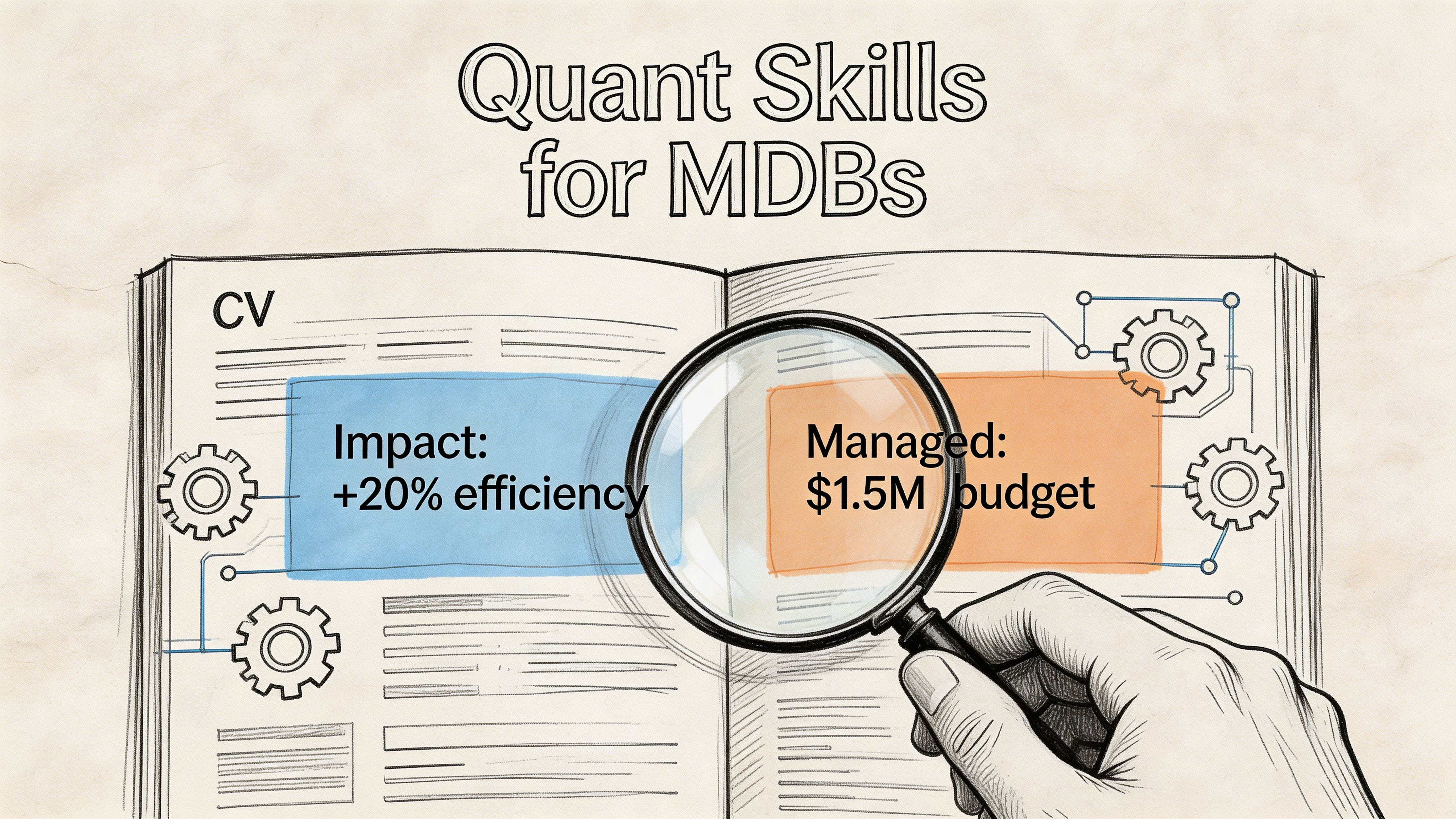
For MDB roles, proficiency with Stata, R, or Python is described as “a massive plus” in the verified guidance from MDB Jobs, which also notes that economics and development economics degrees are often treated as the gold standard and that early roles involving primary data collection become especially valuable later. That framing comes from this guide on landing international development roles at MDBs.
The practical takeaway is clear. You don’t need to pretend you’re a senior econometrician if you’re not. You do need to show that you can handle data, interpret evidence, and work comfortably with structured analysis.
If you want to strengthen that side of your profile, this resource on how to improve analytical skills is a useful next step.
What committees look for on the page
They usually want evidence in four areas.
Analytical credibility
Show the tools, datasets, methods, and outputs.
Good signals include:
Survey design
Primary data collection
Data cleaning
Dashboard or reporting support
Results measurement
Quantitative analysis
Impact assessment
Quality assurance
Even if your role was junior, analytical exposure matters. Committees often prefer grounded technical experience over inflated strategy language.
Institutional discipline
MDBs are process-heavy. Your CV should reflect that you can work with procedures, reviews, and formal deliverables.
Include work related to:
Procurement support
Donor reporting
Logframe or results framework use
Monitoring plans
Compliance review
Budget tracking
Interdepartmental coordination
Sector alignment
Use the language of the role you want. If the vacancy emphasizes M&E, don’t bury your M&E work under generic program text.
The wording should mirror the function accurately. Not mechanically, but closely.
Clear progression
Recruiters want to see increasing complexity. Even lateral titles can show growth if responsibilities expanded from data collection to analysis, from analysis to reporting, or from reporting to team coordination.
Committees reward evidence of competence. They ignore decorative language fast.
Rewrite weak bullets into MDB-ready bullets
At this point, many otherwise good candidates lose.
Weak bullet:
Supported project activities across multiple teams
Better bullet:
Coordinated implementation tracking across country teams, consolidated reporting inputs, and supported results monitoring for project milestones
Weak bullet:
Helped with research and evaluation tasks
Better bullet:
Supported primary data collection, cleaned field inputs, and contributed to analysis used in monitoring and evaluation reporting
Weak bullet:
Worked with stakeholders to improve programming
Better bullet:
Synthesized partner feedback and program data into recommendations for implementation adjustments and performance reporting
Notice the difference. The stronger versions name the work. They show systems, evidence, and outputs.
What to cut from your CV
A lot of content feels impressive but weakens an MDB application.
Cut or reduce:
Long personal summaries full of motivation language
Soft skills listed without proof
Every training you’ve ever attended
Unrelated volunteer items that take space from technical work
Generic phrases like “team player” or “dynamic professional”
Replace them with role-specific evidence.
Why M&E language matters even outside M&E roles
Monitoring and Evaluation Specialist is identified in the verified data as the fastest-growing job in international development, with Program Manager second. That matters even if you’re not applying directly into M&E.
The skill language travels well across MDB hiring. Terms tied to results, evidence, accountability, and implementation quality show up in operations, program management, finance, and sector roles too.
So if your background includes anything resembling performance tracking, indicator reporting, field verification, beneficiary data, audit support, or learning loops, bring it forward. Don’t leave it buried under broad program descriptions.
An MDB-ready CV reads like a technical argument. It tells the committee, in plain terms, that you can work with evidence and deliver inside a formal system.
Choosing Your Path Young Professional Programs vs Consultant Gigs
Many individuals discuss MDB entry as if permanent staff hiring is the main gate. It usually isn’t.
For many candidates, the primary choice is between a structured early-career pipeline and a shorter, less secure contract path that can still get you inside fast.
The two most common routes are Young Professional Programs and consultant or contractor roles. They lead to different careers early on, and the trade-offs are real.
The decision starts with your current profile
If you fit a YPP window cleanly, it can be a strong route. If you don’t, forcing the issue wastes time.
Consultant roles suit candidates who already have usable technical skills and can tolerate uncertainty while building internal credibility. That path is especially relevant because the verified data identifies M&E Specialist as the fastest-growing role and Program Manager as second, with those skills transferring well into MDB positions and with entry often happening through short-term multilateral contracts that can convert to permanent roles, as noted in this overview of fastest-growing jobs in international development.
For candidates considering junior World Bank pathways specifically, the World Bank Junior Professional Associate guide is worth reviewing.
YPP vs Consultant Path Comparison
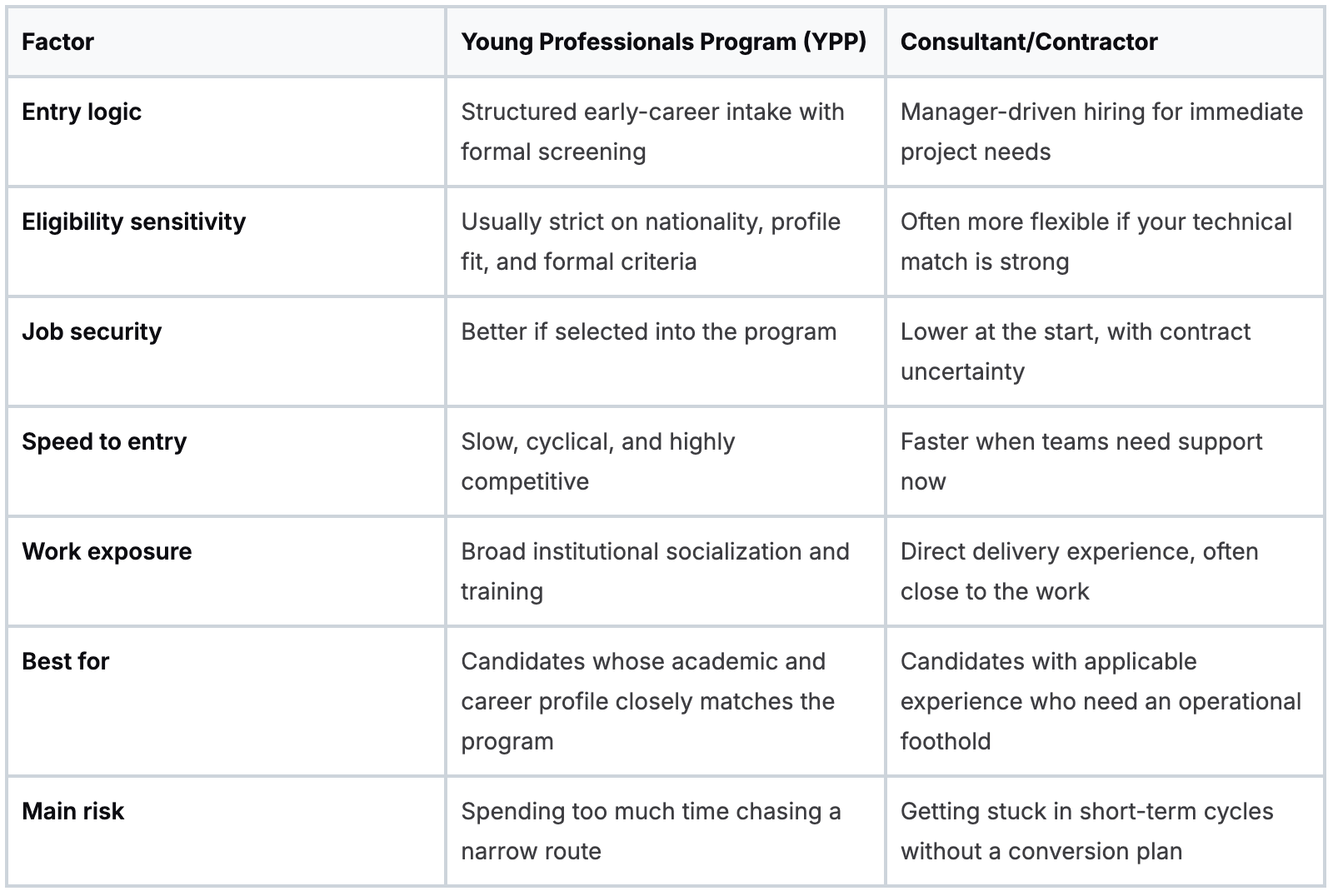
When YPP makes sense
YPP is a strong option if several things are already true.
Your profile fits the formal eligibility rules
Your academic background aligns with what the bank values
You can show clear analytical strength
You’re still early enough in your career for a developmental pipeline to make sense
YPPs can create long-term internal mobility early. The downside is obvious. They’re selective, slow, and unforgiving on fit.
When consultancy is the smarter move
Consultancy works better than many candidates assume.
It gives you:
Immediate institutional exposure
Access to team references
A chance to produce visible work
A way around some of the tighter screening logic used in staff competitions
The risk is drift. If you go the consultant route, treat each contract as a stepping stone with a purpose. Build toward a recognizable niche such as M&E, operations, financial management, results, safeguards, or sector analysis.
The consultant route works when you use it to accumulate proof, not when you treat it as a holding pattern.
A practical rule for choosing
Pick the path that matches your current standing.
Choose YPP if you already match the profile institutions want to groom. Choose consultancy if you need to earn institutional credibility through delivery. Some candidates should pursue both, but not with equal effort.
The strongest international development job search strategy is rarely glamorous. It’s usually the route that gets you closest to decision-makers, deliverables, and internal references in the shortest credible time.
Mastering the MDB Interview and Networking Process
MDB interviews are formal, layered, and usually less forgiving than nonprofit interviews. A warm personality helps. It won’t rescue a weak answer.
You need to sound like someone who understands programs as systems. That means explaining what you did, how it was measured, where the risks sat, and what changed because of the work.
How to answer like an MDB candidate
Use a simple structure for most questions:
State the context
Name your responsibility
Explain the analytical or operational challenge
Describe what you did
Close with the result or lesson
That format works for competency questions and technical prompts.
For example, if they ask about stakeholder management, don’t give a generic teamwork story. Explain the project setting, the actors involved, the reporting or delivery tension, and how you aligned implementation without losing accountability.
What strong answers sound like
They usually include language tied to:
Implementation
Results
Data quality
Risk
Coordination
Reporting
Operational constraints
Evidence-based decision-making
Weak candidates describe effort. Strong candidates describe decisions.
If your answer has no evidence, no trade-off, and no operational detail, it won’t sound credible in an MDB panel.
Prepare for technical depth
Some interviews stay competency-based. Others move into technical discussion fast.
Be ready to speak clearly about:
How you monitored progress
How you handled incomplete or messy data
How you supported reporting or analysis
How you managed competing stakeholder demands
What you’d improve in a project design or implementation process
If your CV mentions M&E, data analysis, finance, procurement, or results frameworks, expect follow-up. Panels often probe the exact point you hoped they’d just admire from a distance.
Networking without sounding needy
Good networking in this space is restrained. You are not asking for a job. You are asking for signal.
A workable LinkedIn message:
Hello [Name], I’m exploring MDB roles in [function] and noticed your background in [institution or team]. My experience is in [brief, relevant area]. I’d value a short conversation to better understand how your team approaches hiring and what profiles tend to stand out.
That works because it is specific, respectful, and easy to ignore without offense.
For informational conversations, ask practical questions:
What backgrounds tend to get shortlisted in your unit?
Which technical skills carry the most weight?
Do consultant hires often feed into longer-term opportunities?
How should candidates think about location or nationality constraints?
Skip questions that force the other person to solve your career for you.
Following up the right way
Follow-up matters. Pressure does not.
After a conversation:
Send a short thank-you note
Reference one useful point from the discussion
Do not immediately ask for referrals unless they opened that door
After an interview:
Send a concise thank-you
Reinforce your fit in one sentence
Leave it there unless the process timeline passes
A useful post-interview line:
Thank you for the conversation. I appreciated the discussion around implementation challenges in [topic]. The role aligns closely with my experience in [relevant area], and I’d be glad to provide anything further if helpful.
That’s enough. Persistent nudging rarely changes MDB decisions and can make you look inexperienced.
Your International Development Job Search Checklist
Use this as a working filter, not as inspiration.
Pick five to 10 target institutions and stop scattering applications.
Check nationality and eligibility rules first before investing time in a role.
Search by function, not prestige. Analyst, specialist, officer, M&E, operations, procurement, and results roles often provide the strongest entry.
Rewrite your CV around evidence and delivery. Show tools, analysis, reporting, coordination, and measurable responsibility.
Bring quantitative work forward if you’ve touched data, surveys, monitoring, or evaluation.
Choose your entry route deliberately. YPP for strong profile fit. Consultancy for faster operational access.
Prepare interview answers around context, action, and evidence.
Network for intelligence, not favors.
Treat every application as a placement decision. Fit beats volume.
The international development job search gets easier when you stop chasing the official story and start working with the actual one.
If you want a more efficient way to track openings across major banks, Multilateral Development Bank Jobs curates staff roles, consultant opportunities, and practical guides focused specifically on MDB hiring. It’s built for candidates who want to spend less time hunting and more time applying strategically.