

When people talk about international development jobs, they often think of charity. That’s a mistake. This is a professional field focused on creating sustainable, measurable improvements in people’s lives.
This work tackles the root causes of poverty, inequality, and instability through structured, data-driven projects. It’s about building lasting systems for healthcare, education, and economic growth, not temporary aid.
Understanding the International Development Landscape
A career in development is a commitment to solving the world’s most complex problems. The core mission is to promote sustainable progress in developing countries.
This means financing a new power grid, reforming a country’s education policy, improving agricultural techniques, or ensuring communities have clean water. The field is driven by results and operates within a well-defined ecosystem of major players.
The Four Pillars of the Development Ecosystem
To find your place, you first need to understand the main players and what they do. Each type of organization approaches problems differently, which changes the kind of work you’ll do, the scale of your impact, and your career path.
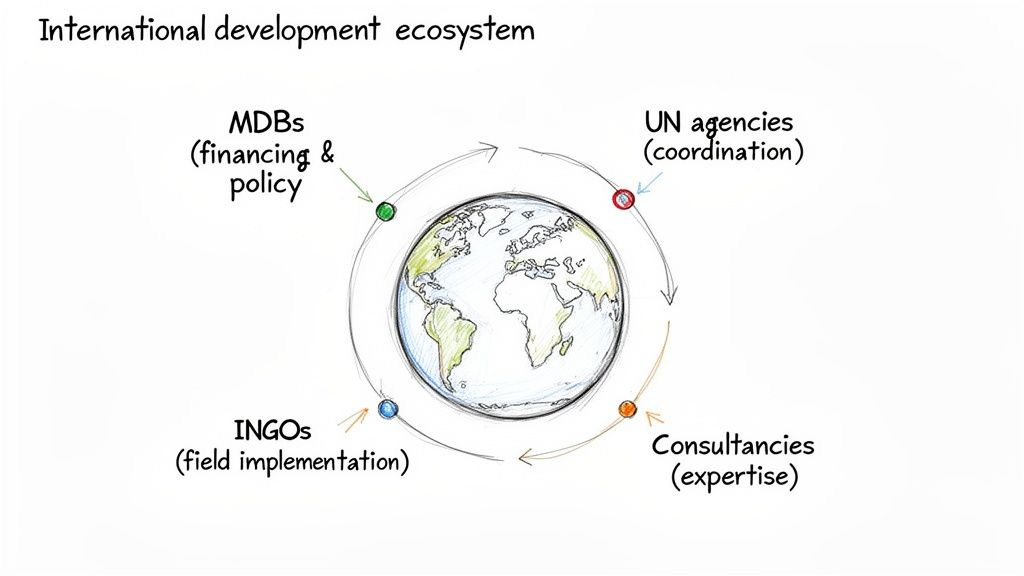
The ecosystem is built on four main pillars:
Multilateral Development Banks (MDBs): These are the big financiers. Organizations like the World Bank and the Asian Development Bank provide massive loans and grants to governments for huge infrastructure and policy projects.
United Nations (UN) Agencies: The UN system acts as a global coordinator and standard-setter. Agencies like UNICEF, UNDP, and the World Food Programme lead international responses to humanitarian crises and align countries on long-term development goals.
International Non-Governmental Organizations (INGOs): Groups like Oxfam and Doctors Without Borders are the hands-on implementers. They run projects directly on the ground, working with local communities to deliver services and build skills.
Private Sector Consultancies: These are the hired guns. Firms that provide specialized technical expertise to the other players. They’re brought in to design, manage, and evaluate projects, offering targeted skills to solve specific problems.
This structure is more than organizational trivia. Knowing the difference between an MDB and an INGO is fundamental. One sets national policy from a headquarters; the other implements a village-level program in the field. Your skills, goals, and work style determine where you fit.
How the Players Work Together
These organizations don’t operate in silos. They form a complex network where money, policy, and action flow between them. It’s a constant exchange of collaboration and contracting.
Here’s how a typical project might work. An MDB like the World Bank finances a government’s plan to improve rural sanitation. The government then hires a private consultancy to design the technical parts of the project. Finally, one or more INGOs are contracted to carry out the implementation and community training on the ground.
Understanding this dynamic is crucial for your job search. It shows how a policy specialist at a development bank and a field officer for an INGO both work toward the same goal from different positions.
Your career can involve moving between these pillars, using experience from one to get a job in another. This framework is your map for navigating international development jobs.
A Deep Dive Into Your Future Employer
Choosing an employer in international development is like picking a vehicle for a long trip. A massive truck, like a Multilateral Development Bank, can move mountains but is clumsy on narrow roads. A nimble motorcycle, like a small NGO, zips down those paths but can’t haul heavy cargo.
They all get you somewhere, but the wrong one for your goals will leave you stuck and frustrated. Your career satisfaction depends on matching your personality, risk tolerance, and definition of impact with the right organization. This is about the day-to-day reality of the job, not just the mission statement.
Let’s look at the main players.
The Big Four: A Quick Comparison
Before we go deep, let’s get a high-level view. Each type of organization plays a distinct role, and understanding their core function is the first step to figuring out where you fit.
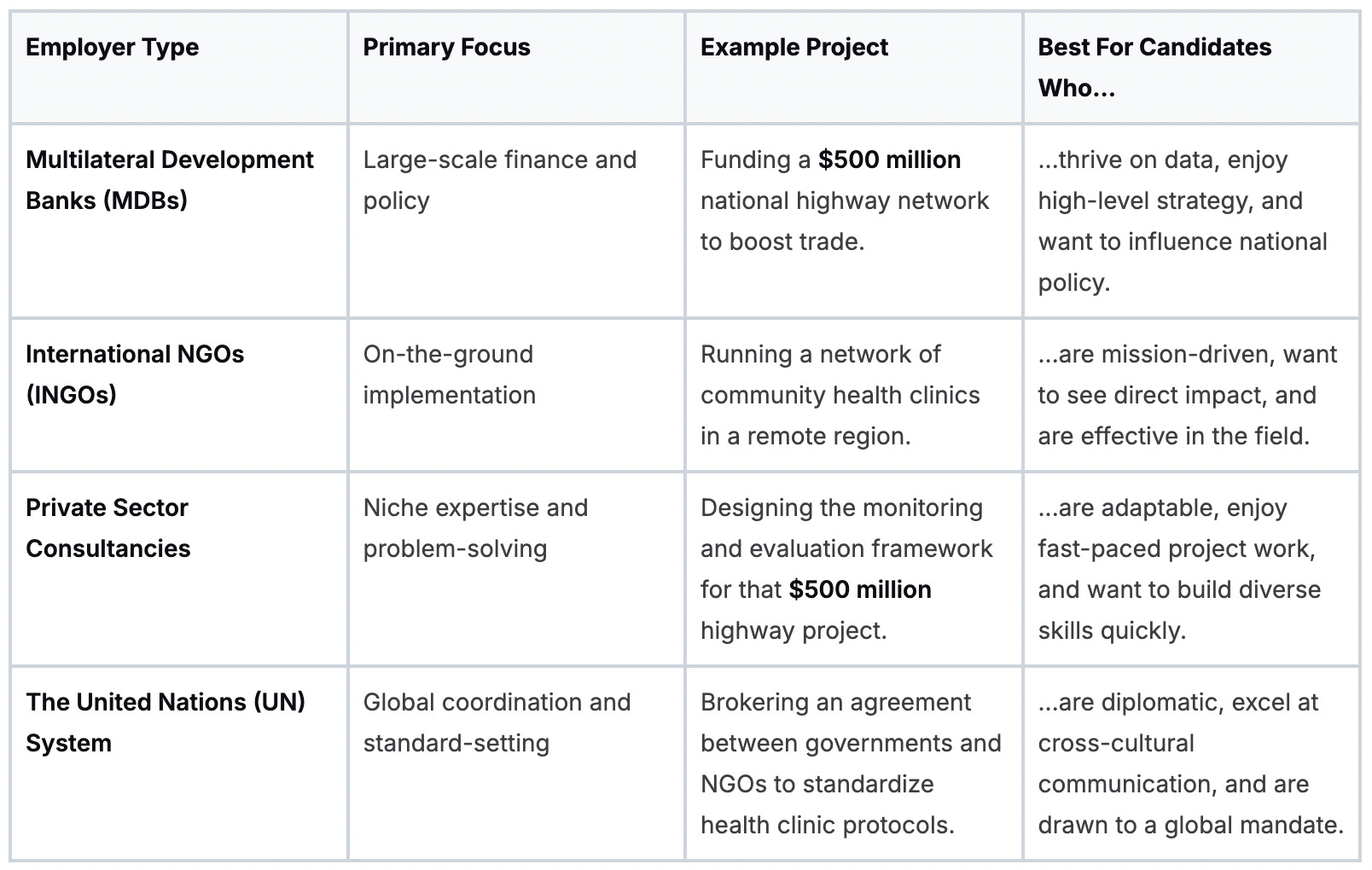
The table below breaks down the primary employer types, their focus, and who they’re best for.
Key Employers in International Development
Now that you have the lay of the land, let’s zoom in on what it’s really like to work for each.
Multilateral Development Banks (MDBs)
MDBs like the World Bank and the regional development banks (AfDB, ADB, IDB) are the heavyweights. They are the financial architects of development, lending billions to governments for massive infrastructure projects, sweeping policy reforms, and economic stabilization programs.
Working here means your projects can impact millions of people. The culture is a hybrid of academia and investment banking. It’s intensely analytical, evidence-based, and highly professional. Deep technical expertise is the currency of the realm.
The upside is undeniable: top-tier compensation, often tax-free for expats, unparalleled job stability, and the chance to work on projects with enormous scope. The trade-off is that the bureaucracy can be glacial, and you’re often several layers removed from the work on the ground. This is a world of policy papers and loan agreements, not hands-on implementation. For an idea of how MDBs hire, check out our 2026 World Bank Hiring Playbook & Timelines.
International Non-Governmental Organizations (INGOs)
If MDBs are the architects, INGOs are the builders. Organizations like Save the Children, Mercy Corps, and Oxfam are on the ground, running programs that directly serve communities. Their work is tangible. You can see and touch it. They build the schools, run the health clinics, and distribute the aid.
The culture is passionate, mission-driven, and usually informal. You’ll be surrounded by incredibly dedicated people, but you’ll also face the realities of shoestring budgets and tough field conditions. The work is rewarding but can be incredibly demanding.
The choice here is clear: INGOs offer proximity to impact. You see the results of your work firsthand. In return, you accept lower pay, less job security, and a much faster, sometimes chaotic, operational pace.
Private Sector Consultancies
Consulting firms are the sector’s special forces. They are highly skilled teams brought in to solve specific problems. They are hired by MDBs, UN agencies, and even large INGOs to provide niche expertise for a particular project or phase. This could be anything from designing a monitoring framework to conducting a feasibility study for a new dam.
Life at a consultancy is fast-paced and project-based. You’ll work on a wide variety of topics in different countries, often on tight deadlines. It’s a fantastic way to build a diverse portfolio of skills in a short amount of time.
You’ll get competitive salaries and a chance to bypass the red tape of public institutions. But work-life balance can be a serious challenge, and your job security is tied to the firm’s ability to win new contracts.
The United Nations System
The UN is a universe unto itself. Agencies like UNDP, UNICEF, and the World Food Programme (WFP) each have a distinct mandate, culture, and way of operating. The work is a unique hybrid, blending the high-level policy focus of MDBs with the on-the-ground presence of INGOs.
A key role for the UN is coordination and normative work: setting global standards and convening governments, civil society, and other players. To succeed here, you need serious diplomatic chops and sharp cross-cultural communication skills. The hiring process is notoriously competitive and can move at a snail’s pace, but the global mandate and reach are unmatched.
Common Roles and Realistic Salary Expectations
Alright, let’s get down to brass tacks. “International development” doesn’t tell you what you’ll be doing day-to-day. Vague titles on a job board won’t help you build a career. We need to look at the core roles that make this sector tick.
Getting a handle on these jobs is your first step. We also need to talk about money. You have to know what you can realistically earn to figure out if this path works for you long-term.
First, where are the jobs? This chart gives you a rough idea of how opportunities are split across the main employer types.
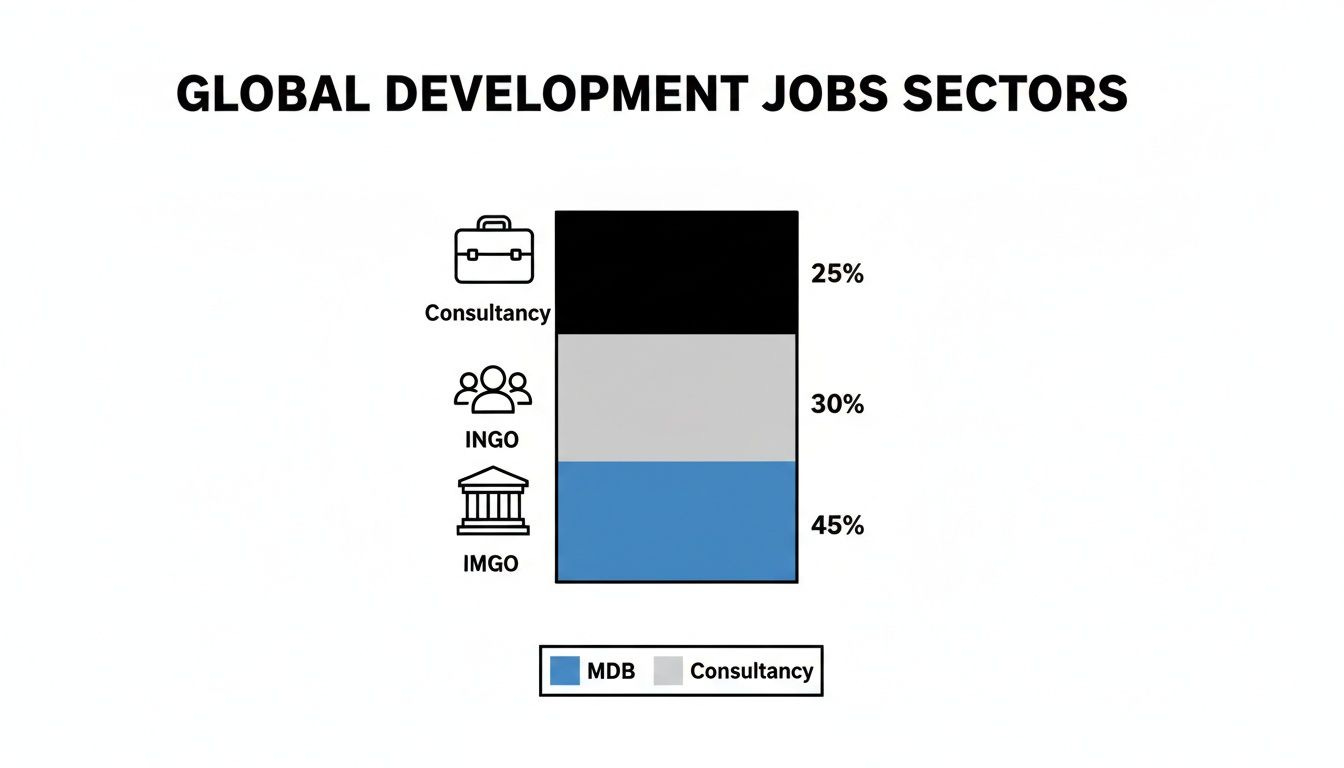
As you can see, the big players, Intergovernmental Organizations (IMGOs) like the UN and the MDBs, make up the biggest slice of the pie, with INGOs and private consultancies close behind.
Key Roles in The Sector
Job titles can get creative, but most professional roles in this field boil down to a few key functions. Each one needs a different mindset, so finding your fit is about matching your natural strengths to what the job demands.
Program Manager: This is your project’s CEO. The Program Manager is on the hook for everything: planning, budgeting, managing the team, and putting out fires. It’s an operations-heavy role for people who are hyper-organized, can lead a team, and think on their feet. You’ll spend your days wrangling teams, chasing deadlines, and keeping donors happy.
Monitoring & Evaluation (M&E) Specialist: M&E specialists are the truth-tellers. Their job is to answer one question: is what we’re doing actually working? They build the systems to track progress, crunch the numbers, and figure out if a project is having a real impact. If you’re an analytical thinker who loves data, this is your world.
Sector Specialist / Technical Advisor: These are the deep subject matter experts. Your title could be Senior Health Advisor, Climate Finance Specialist, or Education Economist. They bring the specific technical know-how to ensure projects are smart, effective, and based on sound evidence. This path almost always requires a master’s degree or PhD and years of specialized experience.
Communications Officer: This person is the storyteller. They turn complex project work into compelling stories for websites, annual reports, and social media. The goal is to show donors, partners, and the public what the organization is achieving. You need to be a sharp writer, a strategic thinker, and a pro at making dense information easy to understand.
Think carefully here. The role you pick sets your entire career trajectory. An M&E Specialist builds a data-driven career, while a Program Manager is on a path to operational leadership. Figure out which one gets you closer to your long-term ambitions.
Understanding Salary Realities
Let’s be clear: pay in international development is all over the map. Your salary will swing wildly based on three things: your employer, your location (HQ vs. a field office), and your years of experience.
The MDBs and the UN are famous for paying the highest salaries, which are often tax-free for international staff. Private consulting firms can also be lucrative. INGOs almost always pay less, especially for roles based in the field. This is a fundamental trade-off in the sector: do you want to be closer to the work on the ground, or do you want a bigger paycheck?
A junior officer at a large INGO in a developing country might start at $45,000. A mid-career technical specialist at World Bank headquarters in D.C. could easily be earning $150,000 or more. For a deep dive into the numbers at the Bank, check out our World Bank Salary Guide.
To give you a clearer picture, here’s a table with some ballpark salary ranges you can expect across the different types of organizations.
Sample International Development Salary Ranges 2026
The figures below are estimates to show the massive difference in earning potential depending on where you work. These are for roles based in headquarters or major regional hubs.
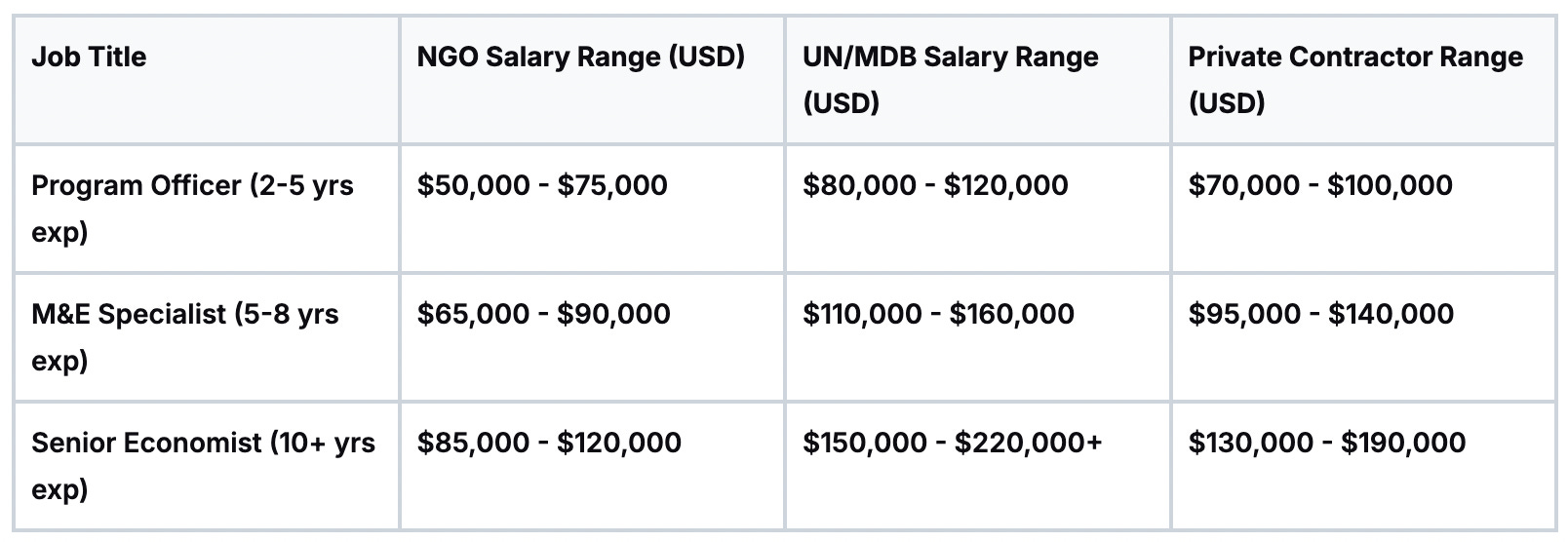
These numbers tell a clear story. Your choice of organization is the single biggest lever you can pull to influence your salary. Be brutally honest with yourself about your financial needs. It’s a non-negotiable part of building a sustainable career in this field.
The Skills and Credentials That Get You Hired
Let’s get one thing straight: passion doesn’t get you a top-tier international development job. Passion gets you an informational interview, but qualifications land you the contract.
Employers are looking for a specific blend of education, hard skills, and proof you can deliver in tough, complex environments. Think of your CV as a checklist. To be competitive for the big leagues like MDBs, the UN, and top-tier NGOs, you need to tick the right boxes.
The Non-Negotiable Academic Foundation
I’ll be blunt: for most professional roles in this field, a master’s degree is the price of admission. There are exceptions, but a bachelor’s degree alone will likely cap you at administrative or support-level positions. These organizations want to see you’ve gone deep into a specialized field.
The degrees that consistently open doors are:
International Relations / Public Policy: These give you the broad analytical framework and policy understanding that underpins development work.
Economics / Development Economics: This is the gold standard for many roles at the MDBs and in policy shops. It signals serious quantitative and analytical rigor.
Public Health (MPH): An absolute must-have if you’re aiming for a career in global health programming or policy.
Sector-Specific Degrees: A master’s in a niche like agricultural science, environmental management, or education can make you a standout candidate for highly specialized technical advisor roles.
Your advanced degree isn’t just a piece of paper. It tells employers you have the theoretical grounding and analytical discipline needed for high-stakes work. It proves you can think in systems and grapple with the messy, interconnected problems that define global development.
Hard Skills That Open Doors
Beyond your degree, employers are hunting for tangible, practical skills. These are the tools you’ll use daily to run projects, make sense of data, and prove that what you’re doing works.
Here are the skills that pop up in job descriptions again and again:
Project Management: You have to know your way around budgets, timelines, and teams. A certification like PMP is nice, but a track record of successfully leading a project from start to finish on your CV is even better.
Monitoring & Evaluation (M&E): This one is huge. Development organizations are obsessed with results, and M&E is how they measure and prove their impact. Knowing how to design a logical framework and track indicators is non-negotiable. If you’re new to the topic, we have a great article on what is Results-Based Management.
Quantitative and Qualitative Data Analysis: Can you wrangle a messy dataset in Stata or R? Can you design and interpret a series of focus group discussions? You need to be comfortable with data, whether it comes in the form of numbers or narratives.
Language Fluency: English is the baseline. Professional fluency in a second UN language, French, Spanish, Arabic, Russian, or Chinese, is a massive advantage. It can be the single factor that gets you the job over another equally qualified candidate.
Field experience is the ultimate credential. It’s the one thing you can’t learn in a classroom. Time spent working in a developing country proves your adaptability, resilience, and understanding of on-the-ground realities. For most operational roles, a resume without it is a non-starter.
Navigating Special Programs and Requirements
The most prestigious organizations have unique entry points and hiring quirks you must understand to have a realistic shot.
Take the World Bank’s Young Professionals Program (YPP). This is a direct pipeline to a career at the Bank, and it’s brutally competitive. The timelines are rigid, with applications typically running from September to November and tests in January. Successful candidates often have PhDs, multiple languages, and several years of high-level experience.
Nationality also plays a surprisingly big role. MDBs and the UN often have nationality restrictions or diversity targets to ensure broad representation from their member countries. Since the 2023 Marrakesh statement, MDBs have been accelerating reforms. They’re now boasting incredibly low default rates of under 1% on loans, making them even more attractive to risk-savvy professionals, while pushing to boost diversity hires by as much as 25% from underrepresented regions. You can discover more insights about these financial innovations at Fitch Ratings.
This means your passport can sometimes be as important as your PhD. It’s not always about finding the single “best” candidate in the world; it’s about finding the best candidate who also helps the organization meet its critical diversity mandates. Understanding these unwritten rules is a huge part of a smart job search strategy.
Your Step-By-Step Job Search and Application Plan
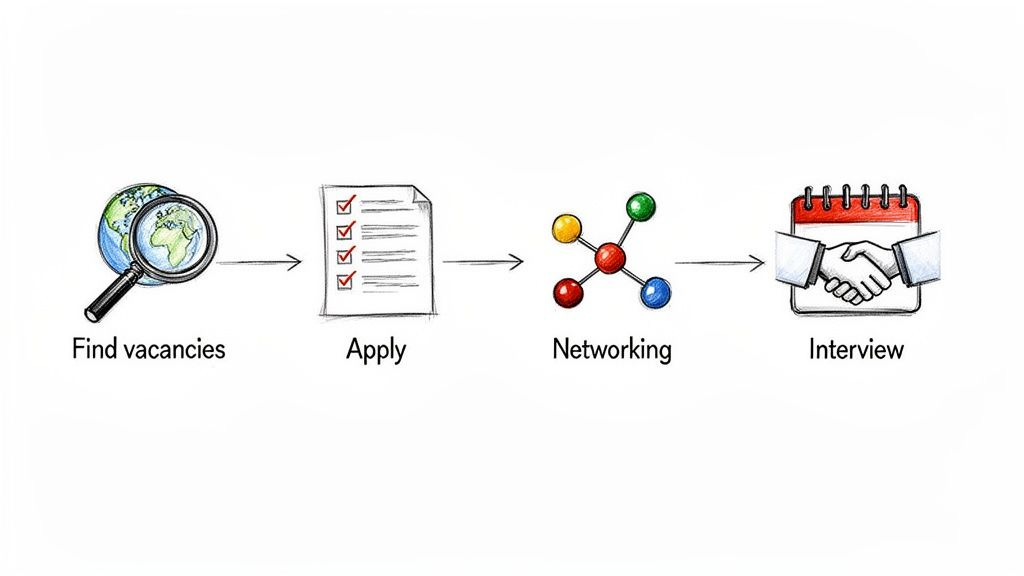
Passion gets you into this field, but a smart strategy gets you hired. Landing a top-tier international development job doesn’t happen by accident. It requires a disciplined, proactive plan for finding the right roles, tailoring your application until it’s razor-sharp, and building the professional relationships that open doors.
Think of this as your playbook for turning ambition into an application that hiring managers notice.
Finding the Right Vacancies
The first mistake most people make is looking in the wrong places. Forget the giant, general job boards. They’re mostly a waste of time for a field this specialized. You need to be targeted.
Start by going straight to the source. Every MDB, UN agency, and major INGO has its own careers portal. Bookmark the ones on your target list and check them weekly. This is the only way to see legitimate, current openings.
Next, lean on niche job boards that do the heavy lifting for you by pulling opportunities from dozens of sources into one place. A well-curated newsletter can be your secret weapon, dropping a focused list of staff and consultant roles into your inbox. This targeted approach saves you countless hours of searching and makes sure you never miss a critical opportunity.
Crafting a Winning CV and Cover Letter
Your application has one job: to prove you can solve the employer’s problems. That means every document must be meticulously tailored. Sending a generic CV is the fastest way to get your application tossed in the virtual trash bin.
Your CV needs to speak the language of development. Use terms like “project cycle management,” “results-based frameworks,” and “stakeholder engagement.” More importantly, you must quantify your achievements. Don’t say you “managed a project.” Say you “managed a $1.2 million project that improved access to clean water for 15,000 people.“ One is vague; the other is undeniable proof of impact.
The cover letter is where you connect the dots. It is not a summary of your CV. It’s your chance to tell a short, compelling story about why your specific skills make you the perfect fit for this specific role. Pick two or three key requirements from the job description and give concrete examples of how you’ve delivered on them in the past. This shows you’ve done your homework and understand what they need.
Mastering the Interview Process
International development interviews test your technical knowledge and your ability to handle yourself. Expect a multi-stage process that will probe your expertise and your character under pressure.
You’ll almost always face two types of interviews:
Technical Interviews: This is where they verify your subject matter expertise. If you’re an economist, they’ll ask about econometric models. If you’re an M&E specialist, they might ask you to critique a logical framework. There’s no faking it here. You have to know your craft inside and out.
Behavioral Interviews: These are the “Tell me about a time when...” questions. Think: “Describe a situation where a project was failing” or “Tell me about a conflict you had with a colleague.” They want to see how you think, solve problems, and work with others. Prepare stories that show your resilience, cross-cultural communication skills, and good judgment.
The secret is simple: preparation. For every point on your CV, have a story ready to back it up. This is what separates a good candidate from a hired one.
The Power of Professional Networking
In this field, networking is a core part of a successful job search. Many of the best roles, especially consulting gigs, are filled through professional connections long before they’re ever advertised publicly.
Effective networking is about building genuine relationships, not just collecting contacts on LinkedIn.
Reach out to people working in organizations or roles that interest you and ask for an informational interview. Ask smart questions about their work, their career path, and the challenges they face. Show genuine curiosity.
Then, follow up. Stay in touch. Offer value where you can, maybe by sharing an interesting article or making a helpful introduction for them. This is a long-term investment that builds a network of professional allies who will think of you when the right opportunity comes along. It’s an investment that pays dividends for your entire career.
Building Your Career Roadmap at Any Stage
There’s no single, secret path into an international development job. Your strategy depends entirely on where you’re starting. The moves you make as a student are different from those of a mid-career professional looking to switch fields.
Let’s break down the game plan for each stage.
For Students and Recent Graduates
Your entire focus should be on building credibility from the ground up. You need to get the non-negotiable experiences on your CV that will make a hiring manager take a second look.
Get the Right Internships: Aim for internships at the big names: MDBs, UN agencies, or major INGOs. Even a short contract gives you instant brand recognition and, more importantly, a network.
Build Essential Skills: Become fluent in data analysis tools and master at least one project management framework. You also need to get one other official UN language to a professional level. It’s no longer a “nice-to-have.”
Get Field Experience: You have to find a way to get your boots on the ground. Volunteer, take a junior role with a local NGO, or find a research fellowship that takes you out of a headquarters city. This proves you understand the reality of development work, not just the theory.
For Mid-Career Professionals
Your biggest challenge is translation. You already have a decade or more of valuable skills from the private sector or another field. Now you need to reframe them in the language of development.
Show how your background in finance, logistics, or project management directly solves the problems that development projects face every day. Talk about managing complex budgets, leading diverse teams, and hitting targets under pressure. Your track record is your best asset, but only if you present it in a way they understand.
Don’t just list your corporate job titles and hope they connect the dots. They won’t. Rewrite your CV from scratch, explicitly mirroring the language and priorities you see in development job descriptions.
And the timing is good. The job market at the big multilateral development banks is picking up, with real demand expected through 2026. Payrolls are growing at 1.3% year-over-year, and with pay bumps for job-changers hitting 6.7%, these roles are attracting serious talent. The World Bank alone gets over 100,000 applications a year for its positions. You can dig into the 2026 employment landscape at Bank of America to see the broader trends.
The Big Questions (Answered)
When you start getting serious about a career in development, a few big questions always come up. Getting straight answers can save you a ton of time and help you sidestep common pitfalls.
Do I Need a Master’s Degree?
Let’s get this one out of the way: for most professional roles at the MDBs, the UN, and the big INGOs, the answer is yes. A master’s degree in a relevant field like International Relations, Public Policy, or Economics is the baseline. It’s what gets your resume past the first screen for policy, program management, or specialist jobs.
You might find some administrative or entry-level gigs with just a bachelor’s. But trying to climb the ladder in these institutions without an advanced degree is an uphill battle. Think of it as the price of admission for a long-term, substantive career track.
How Important Is Field Experience?
It’s everything. Field experience is the currency of credibility in this sector. It shows you can handle the complexities of working on the ground, outside the comfort of a headquarters office. For any operational role, it’s a dealbreaker.
Even for HQ-based policy jobs, a CV with zero time spent in a developing country is a huge red flag. It signals all theory and no practice. You have to be proactive about getting this experience, whether through internships, volunteer work, or junior field positions. It’s an essential building block for your career.
Can I Earn a High Salary?
You absolutely can, but it all comes down to where you work. The MDBs and certain UN agencies offer salaries that are highly competitive with the private sector, and for international staff, they’re often tax-free. Private consulting firms in the development space also pay extremely well.
On the other hand, salaries at most NGOs, especially for roles based in the field, are significantly lower. You can build a financially secure career, but your earning potential is directly tied to the type of institution you work for.
What Skills Are Most in Demand?
Beyond your specific area of expertise, a few cross-cutting skills will make any recruiter sit up and take notice. There’s a huge appetite for candidates who have proven skills in:
Data Analysis: You need to be comfortable with numbers. Proficiency with tools like Stata, R, or Python for quantitative work is a massive plus.
Monitoring and Evaluation (M&E): The ability to measure whether a project is working is a skill that is always in high demand. If you can design and implement frameworks that track impact, you’ll be a hot commodity.
Climate Finance: This is one of the fastest-growing areas in development. Expertise in sustainable infrastructure, green bonds, and climate adaptation financing is needed everywhere.
Language Fluency: Professional working proficiency in a second UN language, especially French, Spanish, or Arabic, is a game-changer. It can easily be the factor that sets your application apart from the rest.
At Multilateral Development Bank Jobs, we cut through the noise. Our weekly newsletter delivers curated full-time staff and consultant opportunities from over 30 MDBs and UN agencies directly to your inbox, along with insider guides to fast-track your career. Subscribe to stop searching and start applying.
https://mdbjobs.com