

Finding a way into the international development world is less about a vague passion for “doing good” and more about smart, strategic positioning in a ridiculously competitive market.
First, A Reality Check on the Development Job Market
Let’s be direct. The market for entry level international development jobs is brutal right now. Anyone telling you otherwise isn’t doing you any favors. Global economic slowdowns and shifting donor priorities mean there are far fewer roles and way more qualified people fighting for them.
This isn’t to scare you off. It’s to give you a realistic game plan. Understanding why it’s so tough is the first step to building a job search strategy that actually gets you noticed.
The Job Market Squeeze
The entire entry-level job market has taken a nosedive. A global analysis from Randstad showed that entry-level job postings have plummeted by a staggering 29% since the start of 2024.
The situation in the UK is particularly intense, with an estimated 1.2 million graduates all competing for just under 17,000 entry-level spots. That’s a ratio of about 70 candidates for every single job. This pressure cooker environment is felt across all sectors, and international development is no exception.
The development sector has been hit especially hard by funding reductions, which translates directly into fewer jobs. For a deeper look, check out our analysis on how recent funding cuts impact development hiring.
The blunt truth is that passion alone won’t get you hired. Success comes from understanding the market’s current state and positioning yourself as the solution to an organization’s specific, urgent problems.
Pinpointing Your Target Employers
With competition this fierce, a scattergun approach is a waste of time. You need to focus your energy where you have a real chance of success. Your first move should be to understand the main employer types and figure out where you fit best. Each has its own culture, hiring process, and entry points.
To get you thinking strategically, here’s a quick breakdown of the major players.
Key Employers in International Development
This table compares the primary organizations offering entry-level opportunities in the development sector.
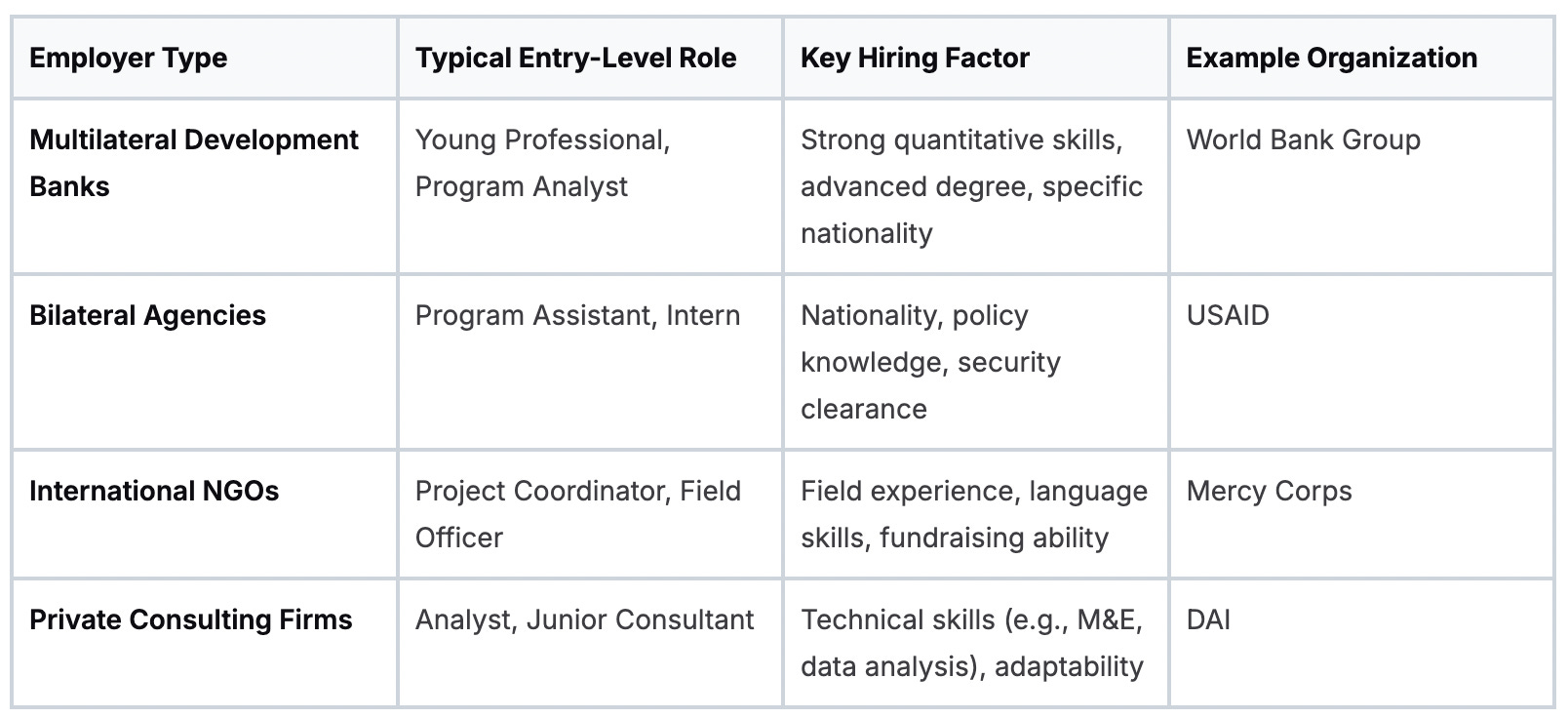
Think of this as your starting map. Deciding whether you’re a better fit for a quantitative role at the World Bank or a field-based position with an NGO is the first critical decision in focusing your search.
Finding Where the Real Opportunities Are
It’s easy to feel like you’re shouting into the void when you’re just starting out. The job market is tight. We all know that. But knowing where to look—where the actual, tangible jobs are—is what separates a frustrating search from a successful one.
Let’s be honest, the numbers for 2025 weren’t pretty. The development sector saw a major downturn, with total job postings dropping by 22.5%, from over 138,000 down to just 106,000. That data comes straight from a 2025 analysis by DevelopmentAid.org, and it paints a stark picture.
The squeeze is real.
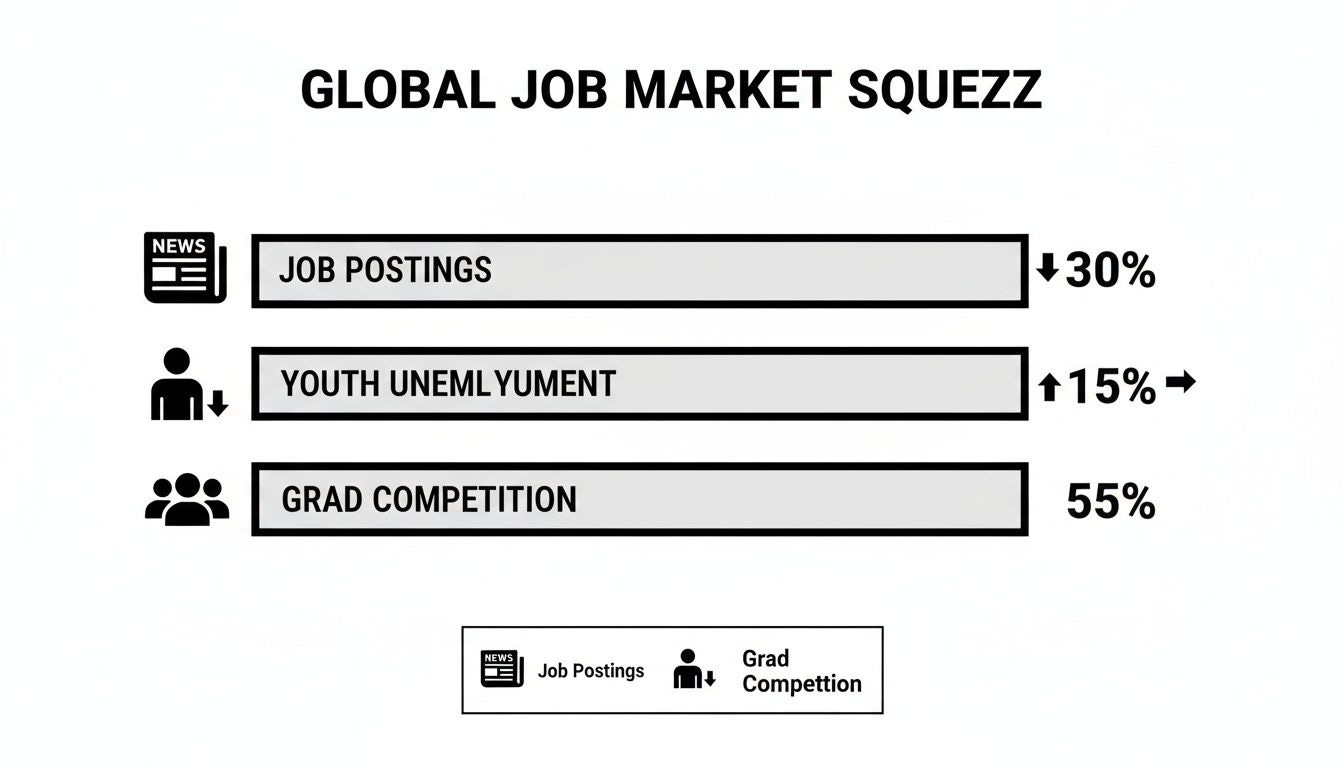
Fewer jobs and more people competing for them means you can’t afford to be generic. You need a strategy.
Follow the Money to In-Demand Sectors
Here’s the thing about budget cuts: organizations don’t slash everything equally. They have to protect their core operational functions. The hiring data shows exactly where that protection is happening.
The most resilient area by a long shot is Project Management, Monitoring, and Evaluation (M&E). This single category accounted for a staggering 25,996 job postings in 2025. That’s almost a quarter of every single job posted in development that year.
Why? Because donors demand results, and organizations must prove they’re delivering. M&E is a non-negotiable part of the business model.
Your ability to track a project timeline, manage a budget, or analyze survey data is infinitely more valuable to a hiring manager right now than a general passion for the cause. You need to be the practical, operational solution to their problems.
If you have any quantitative skills, experience coordinating projects (even small ones), or any background in data, you need to put that front and center on your resume. This is what gets you noticed today.
To give you a clearer picture of where the demand is, here’s a breakdown of the top hiring sectors based on 2025 job data.
Top Hiring Sectors and Geographic Focus in 2025
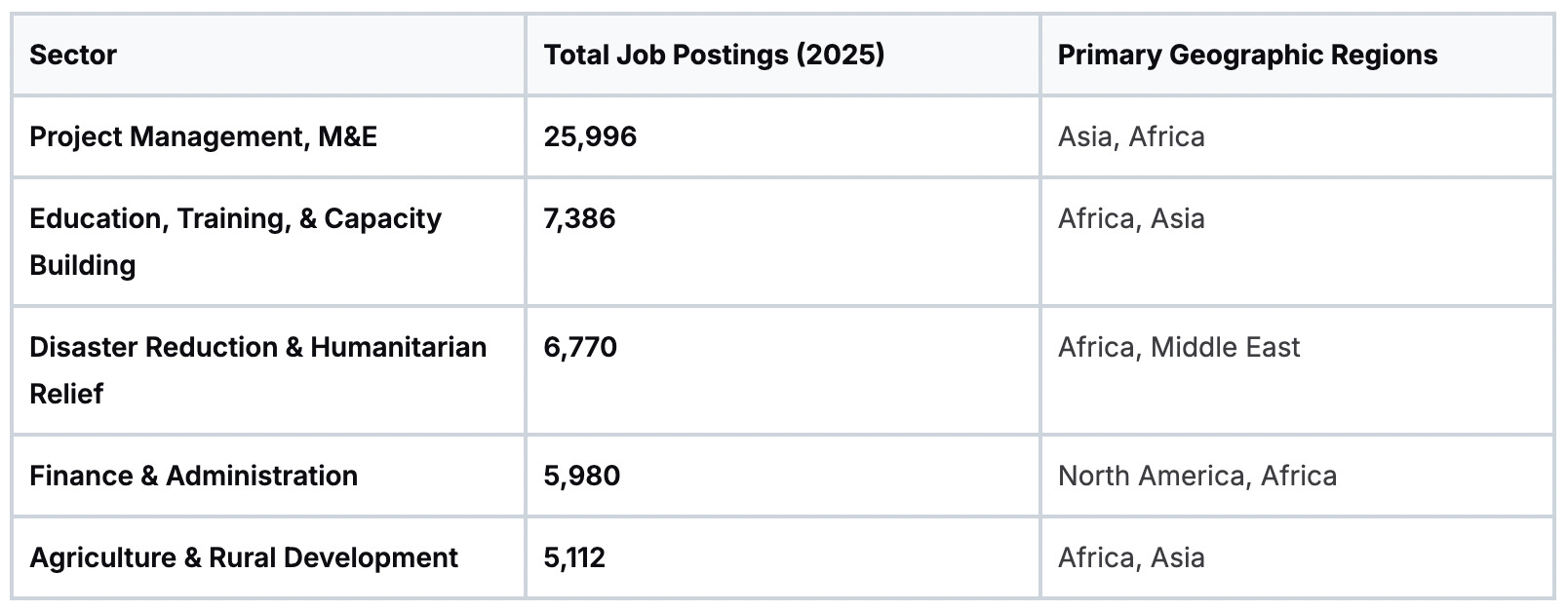
The data tells a clear story. While roles in advocacy or policy exist, the vast majority of entry-level international development jobs are in the technical delivery of projects. Focus your energy where the demand actually is.
Pinpoint Your Geographic Search
Just like sectors, job opportunities are heavily concentrated by region. Sending applications to offices in London or Geneva when the hiring is happening in Nairobi and Manila is a classic rookie mistake.
The data shows a clear pattern: Asia had the most job postings, followed closely by Africa, and then North America (mostly for HQ and support roles).
A search focused on country offices or regional hubs in Asia and Africa will give you a much higher hit rate than one focused on Europe or Latin America, at least based on current trends.
Think about it this way: a candidate with M&E skills looking for a role with an agricultural NGO has a far better chance targeting jobs in Southeast Asia or East Africa than applying to headquarters in Europe. The work is in the field, and so are the jobs. This is how you find the opportunities that others miss.
Building the Skills and Qualifications That Matter

Your degree might get your CV past the initial HR screen. But in a field this flooded with qualified people, your practical skills land you the job. Hiring managers are looking for people who can hit the ground running and solve problems on day one, not someone who needs months of hand-holding.
Passion for the mission is the bare minimum. Everyone applying has it. It’s not a differentiator. To stand out, you need to prove you have the specific hard and soft skills that keep projects on track, especially when you’re managing things from thousands of miles away.
Here’s a breakdown of what those skills are and how you can build them even if you don’t have a formal development job on your resume yet.
The Hard Skills That Get You Past the First Cut
Think of technical competence as the first major hurdle. When a recruiter is sifting through hundreds of applications for entry-level roles in project management, M&E, or finance, they are pattern-matching. They’re looking for keywords and qualifications that map directly to the job description. You absolutely have to show up with these.
Quantitative and Data Skills: This is non-negotiable, especially for Monitoring and Evaluation (M&E) roles. You need to be genuinely comfortable with data. That means proven experience with statistical software like Stata, R, or SPSS, plus advanced Excel skills. Don’t be surprised if they give you a technical test to prove it.
Project Management Frameworks: You have to understand how development projects are designed and executed. Knowing methodologies like the logical framework approach (logframe) is standard. Earning a certification like the PMP (Project Management Professional) or PRINCE2 is a massive advantage. It tells them you already speak the language of budgets, timelines, and deliverables.
Language Proficiency: This is a powerful tie-breaker. Professional working proficiency in a language like French, Spanish, or Arabic can instantly move your application to the top of the pile. It’s a clear signal that you can integrate with local teams, liaise with government partners, and operate effectively in the field.
If you don’t have these skills yet, start with your university coursework. Take electives in statistics, econometrics, or program evaluation. Beyond that, targeted online courses and certifications from reputable platforms are your best bet.
Forget about vague claims of being “detail-oriented.” Show them. A CV that mentions “analyzed survey data for 500 households using Stata for a graduate thesis” is infinitely more powerful than “strong analytical skills.”
How to Build Skills Without a Job
This is the classic chicken-and-egg problem: you need experience to get a job, but you need a job to get experience. The trick is to reframe what “experience” actually means.
Hiring managers are looking for evidence of your skills, not just a list of former employers. You can build that evidence through strategic activities that don’t require a full-time role.
Here’s how to do it:
Strategic Volunteering: Find a small, local NGO and offer to solve a specific problem for them. Don’t just offer to “help out.” Propose managing their social media analytics, helping write a grant proposal, or organizing data from a community survey. These create concrete, resume-worthy accomplishments.
Targeted Academic Projects: Use your capstone or thesis as a dry run for a real development project. Pick a topic that forces you to conduct a literature review, collect and analyze data, and write a final report. On your CV, frame this as a “Research Project” or “Data Analysis Project,” not just a school assignment.
Freelance for Experience: Offer your skills on a freelance basis. Even a small-scale, paid project, like building a simple database for a local charity or translating documents, proves your ability to deliver work professionally.
The entire goal is to generate specific examples and results you can talk about. “Managed a volunteer-led fundraising campaign that raised $2,500“ is a concrete data point that proves project management and financial skills.
The Soft Skills That Get You Hired
In development work, so-called “soft skills” are actually hard requirements. Your ability to adapt, communicate across cultures, and handle intense pressure is just as critical as your technical know-how. This is what gets vetted heavily in the interview.
Recruiters are looking for resilience and a low-maintenance attitude. They need to know that you can handle a canceled flight, a difficult government official, or a busted project timeline without having a meltdown. They need to trust that you can be sent to a remote duty station and thrive.
They figure this out by asking behavioral questions. Expect to be asked about a time you faced a major setback, dealt with a difficult team member, or had to adapt to a completely new environment. What they’re listening for is your ability to tell a clear, calm, and solutions-focused story. This is where your maturity and practical intelligence will either shine through or sink your chances.
How to Actually Find an Entry-Level Job
Throwing applications into the void is the fastest way to burn out. To land one of the few entry-level international development jobs, you need to stop the scattergun approach and get strategic.
Different types of organizations have entirely different hiring ecosystems. You have to learn the unspoken rules for each one and play their game. This is about understanding the specific portals, role types, and bureaucratic hurdles for each major employer.
The Giants: Multilateral Development Banks and the UN
These are the behemoths of the development world, and they run on rigid, formal hiring systems. Forget about sending a cold email to a hiring manager and hoping for the best. It won’t work. Your entire focus here should be on their official career portals.
Multilateral Development Banks (MDBs): For organizations like the World Bank, Asian Development Bank (ADB), or African Development Bank (AfDB), their individual job sites are the only way in. They almost never post on general job boards. You’ll want to hunt for roles like “Program Analyst,” “Research Assistant,” or specific, named internships. Brace yourself for a long, bureaucratic application process.
The United Nations System: The main hub for UN gigs is the UN Jobs portal. That said, many agencies like IOM or UNICEF also run their own career pages which are often more current. The real key is understanding the difference between staff posts (P-levels, G-levels), consultancies, and internships. For most people starting out, consultancies are the most realistic entry point.
These systems are heavily automated. Your application has to be perfectly loaded with the keywords and qualifications from the job description just to get past the first filter and be seen by a human.
Nationality is a huge, non-negotiable dealbreaker for many MDB and UN jobs. These organizations use a quota system to maintain geographic representation among their staff. If a role is restricted to nationals of certain member countries, no amount of talent or experience will get you around that filter. It’s the first thing you should check.
Navigating the NGO and Private Contractor Market
While the MDBs and UN exist in their own universe, the NGO and private contractor space is much more fragmented. This is where a couple of specialized job boards become your best friends. You’ll probably spend most of your search time on these two platforms.
Devex: This is the king of job boards for mid-to-senior level roles, but it also features a solid stream of entry-level positions. You’ll find a lot of project support and business development roles at major NGOs and consulting firms here. Their free membership is okay, but the paid “Career Account” gives you a real leg up by letting you see and apply to jobs earlier.
ReliefWeb: Managed by the UN’s own Office for the Coordination of Humanitarian Affairs (OCHA), ReliefWeb is the go-to source for jobs in humanitarian aid, disaster response, and field operations. If you’re aiming for emergency contexts or want to work with organizations like Mercy Corps or the IRC, this should be your primary destination. It’s completely free and incredibly comprehensive.
The trick to using these platforms is mastering their filters. Zero in on roles by filtering for “entry-level,” specific countries you’re willing to work in, and sectors that match your skills, like M&E or global health. Then, set up daily email alerts. You want to be one of the first people to apply.
The Shortcut: Young Professional Programs
For many aspiring development professionals, the Young Professional Program (YPP) is the single most important pathway into a permanent staff role at an MDB or the UN. These are brutally competitive, multi-year programs designed to groom the organization’s future leaders. The World Bank YPP is the most famous, but the ADB, AfDB, and others have their own versions.
Here’s the deal with YPPs:
Intense Applications: Applying to a YPP is a marathon, not a sprint. Expect to write multiple in-depth essays, provide excruciatingly detailed academic and professional histories, and chase down letters of recommendation. The whole process can easily eat up six months of your life.
Strict Requirements: They are not messing around. You typically need a Master’s degree or PhD, several years of relevant work experience (internships often count), and you absolutely must be under a specific age (usually around 32).
Nationality Rules Apply: Just like with regular staff jobs, YPPs are subject to strict nationality restrictions. Always, always check the eligibility criteria before you even think about starting an application.
Getting into a YPP is incredibly difficult, but the career payoff is enormous. It puts you on an accelerated track to a senior position. If you meet the criteria, dedicating a few months to a YPP application is one of the highest-impact things you can do. Our comprehensive breakdown offers more insider advice if you’re serious about this route; you can learn more in our practical guide to landing MDB jobs.
Nailing the Application: How to Get a Human to Actually Read Your CV
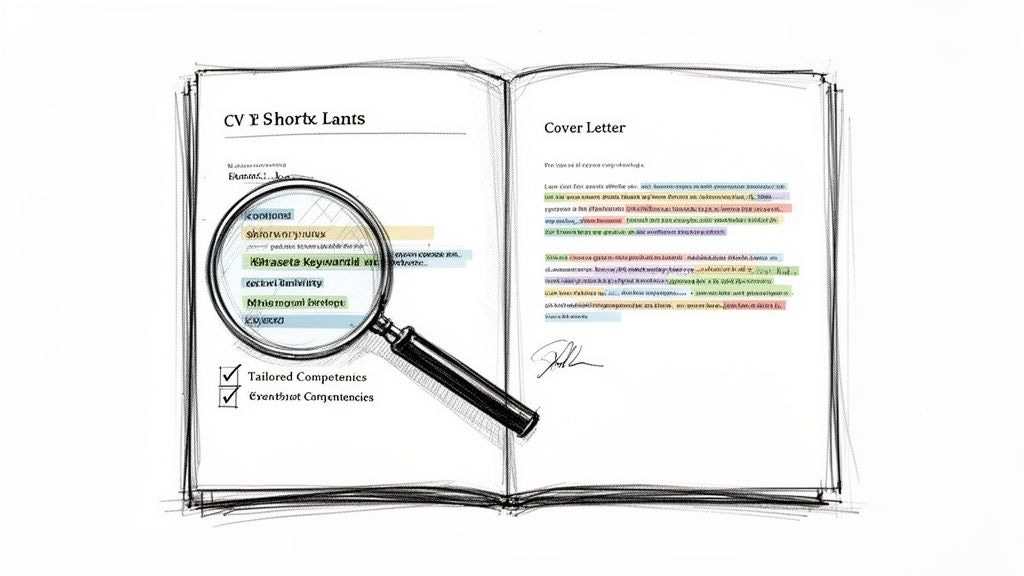
Let’s be brutally honest. Your CV and cover letter have one job: to convince a busy, skeptical hiring manager that you’re the best person to solve their problem. A generic, untailored application is a complete waste of everyone’s time. It gets you deleted before a human even sees your name.
You have to treat every single application like a targeted mission. This means dissecting the job description, mirroring its language, and proving that you have the exact skills they’re desperate for.
Decode the Job Description Like a Pro
Before you write a single word, print out the job description and grab a highlighter. Your goal is to pull out the core competencies and keywords that the hiring manager or their Applicant Tracking System (ATS) will be scanning for.
Look for specific duties and required qualifications. Pay very close attention to action verbs like “analyze,” “manage,” “coordinate,” and “report.” These are the exact terms their screening software is programmed to find.
Your CV and cover letter must be saturated with these keywords. If the job asks for “experience with M&E frameworks,” your CV better have a bullet point that says, “Applied M&E frameworks to...” This is about translating your experience into their language.
Frame Your Experience as Projects, Not Duties
Most people hunting for entry-level roles don’t have a long list of fancy job titles. That’s fine. You get around this by framing all your experience—academic, volunteer, and part-time work—as concrete projects with measurable results.
Stop listing responsibilities. Start showcasing your achievements.
Weak Framing: “Responsible for data entry for a university research project.”
Strong Framing: “Managed and cleaned a dataset of 500+ survey responses for a quantitative research project on food security, ensuring data integrity for statistical analysis in Stata.”
The second example proves you can handle data, names the software, and shows you understand the why behind the task. This is how you demonstrate real project management skills, even if the “project” was your graduate thesis.
You have to stop thinking of yourself as a student and start presenting yourself as a junior professional. Every relevant piece of experience, paid or unpaid, is a project. Describe the objective, the actions you took, and the result.
Build a “Master CV” for Speed and Precision
You’ll be applying to dozens, maybe hundreds, of jobs. Writing a new CV from scratch every time is a path to burnout. The smarter approach is to create a “master CV” that might be four or five pages long. This document is your private library of every project, skill, and accomplishment you have.
For each new application, you’ll copy this master document and then ruthlessly cut it down to two pages. Delete everything that isn’t directly relevant to the specific role. This strategy ensures every CV you send is hyper-tailored but takes you 30 minutes to adapt, not three hours.
Write a Cover Letter That Connects the Dots
Your cover letter is not a fluffy, paragraph-form version of your CV. Its job is to tell a compelling story that connects your experience to the organization’s needs. Use it to explain why you are the perfect fit.
A truly effective cover letter does three things:
Shows you get them: Reference a specific project, report, or recent initiative from the organization. This proves you’ve done your homework and aren’t just spamming applications.
Highlights your key value: Pick two or three top requirements from the job description and tell a short story for each one, demonstrating how you’ve successfully used those skills.
Explains your “why”: Articulate why you want to work on their specific mission, connecting it back to your personal and professional journey.
Writing a powerful cover letter or statement of interest is a non-negotiable skill. For a deeper dive, check out our guide on how to write a statement of interest that gets noticed.
Adapt to Different Application Formats
Finally, you need to recognize that not all applications are created equal. A standard two-page CV is perfect for most NGOs and private contractors.
The UN system, however, has its own unique beast: the Personal History Profile (P11). This is a long, incredibly detailed online form that demands you document your entire academic and professional history. It can take hours to fill out correctly.
Do it once, save all your answers in a Word document, and then adapt it for future UN applications. Failing to complete the P11 properly is an automatic disqualification, no matter how qualified you are.
Alright, let’s talk about your actual career path. Landing that first entry-level international development job is a huge win, but it’s just the starting line. The smartest people I know in this field are already thinking about their next move on day one.
A well-trodden and incredibly effective path is the internship-to-consultant-to-staff trajectory. This isn’t just a sequence of jobs; it’s a strategy.
You start with an internship to get your foot in the door and learn how an organization actually works. From there, your goal is to land a short-term consultancy. This is where you get to take on more responsibility and prove your technical skills on a real project. If you crush it as a consultant, you become the number one candidate for a permanent, full-time staff role when one opens up.
Think of it as the world’s longest job interview. Every contract is a new chance to build trust and show the hiring managers you’re a reliable, low-risk bet for a permanent spot on the team.
A Cautious Look Toward 2026
After a brutal 2025, the development job market is finally showing some early, cautious signs of life as we head into 2026. While the funding crunch isn’t over, specific opportunities for newcomers are starting to reappear.
Most notably, organizations are kicking off hiring for their fundraising and resource mobilization teams to rebuild their financial buffers. Crucially for you, major international NGOs are also starting to reinstate the internship programs that were frozen during the crisis. As recruitment specialists will tell you, these internships are the critical entry points for anyone trying to break into the sector.
Your goal isn’t just to find any job. It’s to find the right first job that plugs you into that internship-to-consultant-to-staff pipeline. A strategic internship is far better than a dead-end admin role, even if the pay is lower.
Your 30-60-90 Day Action Plan
Good advice is useless without action. To keep from getting overwhelmed, you need a structured plan. Here’s a concrete checklist to get your job search moving over the next three months.
Your First 30 Days: Foundation and Focus
This is all about prep work. You’re building your toolkit and figuring out exactly what you’re aiming for.
Deconstruct 10 Job Descriptions: Find 10 recent entry-level postings you’d actually be excited about. Print them out. Get a highlighter and mark up every single required skill, qualification, and duty. This becomes the DNA of your CV.
Build Your “Master CV”: Create one comprehensive document that lists every project, skill, and achievement from your academic, volunteer, and work life. Make sure you frame everything using the keywords you just pulled from those job descriptions.
Identify 5 Target Organizations: Based on your skills and what genuinely interests you, pick five organizations you’d realistically kill to work for. Follow them on LinkedIn, read their latest annual report, and get to know their flagship projects.
Your Next 30 Days: Execution and Networking
With your foundation solid, it’s time to start applying and making connections. The name of the game is momentum.
Set Up Job Alerts: Create daily email alerts on Devex, ReliefWeb, and the career portals of your 5 target organizations. Get specific with your filters: “entry-level,” “internship,” and your target countries.
Submit 5 Tailored Applications: Using your Master CV, create and submit five high-quality, perfectly tailored applications. Do not mass-apply. Each application should be a masterpiece of customization for that specific role.
Conduct 3 Informational Interviews: Hunt down alumni from your university or search LinkedIn for people working at your target organizations. Reach out and ask for a 15-minute chat—not for a job, but for their advice and insights.
The Final 30 Days: Refinement and Persistence
This last month is about learning from what is and isn’t working, expanding your reach, and staying resilient. This is a marathon, not a sprint.
Analyze and Refine: Look back at your applications. Which ones got a response? Which ones were met with silence? Try to spot a pattern and tweak your CV and cover letter approach based on what’s getting traction.
Double Your Applications: Your process should be faster now. Aim to submit another 10 tailored applications this month.
Follow Up Strategically: If you see an organization repost a job you already applied for, it’s okay to send a polite, brief follow-up to the HR contact (if one is listed). Reiterate your interest and attach your updated CV.
This structured plan is what moves you from passively reading articles to actively hunting for a job. It’s a deliberate, methodical process designed to give you the best possible shot at breaking into this challenging but incredibly rewarding field.
Finding the right role in this competitive field requires insider knowledge. At Multilateral Development Bank Jobs, we provide curated job lists and expert guides to help you land a career at the World Bank, ADB, AfDB, and beyond. Sign up to get full-time staff jobs, consultant opportunities, and deep-dive career guides delivered to your inbox every week. Start your strategic job search with us today.