

International youth development jobs exist because the labor-market gap is large, persistent, and expensive for institutions to ignore. The International Labour Organization projected that global unemployment would stay around 4.9% in 2026, or roughly 186 million people out of work, according to ILO findings summarized by UN News. Youth continued to face much steeper barriers to work, especially in lower-income countries where transitions from school to decent employment remain weak.
That is why this field keeps attracting funding, and why competition for jobs is sharper than many candidates expect.
Early-career applicants often treat youth development as a broad NGO interest area. In practice, hiring managers in the UN system, the World Bank, regional development banks, and large international NGOs usually recruit for functions first and themes second. They need people who can run monitoring systems, manage partner relationships, design labor-market programs, support digital delivery, write donor-facing results, and handle implementation under real budget and reporting pressure.
That distinction matters. A candidate who says “I care about youth” sounds generic. A candidate who can show experience in MERL, public-private partnerships, TVET, digital inclusion, enterprise support, or results-based project management is easier to place against funded roles.
This guide focuses on the actual entry routes into major international organizations, and on the skills those institutions are paying for right now.
Why Youth Development Careers Matter More Than Ever
Roughly 186 million people were projected to be out of work globally in 2026, as noted earlier. Young people face the sharper edge of that problem, especially in lower-income countries where the path from school to decent work is weak, uneven, and often disconnected from employer demand.
For job seekers, that is more than a social issue. It is a funding signal.
Large international organizations do not invest in youth development because the theme sounds positive. They fund it because youth outcomes sit inside several high-priority portfolios at once, and poor results carry economic and political costs. A weak school-to-work transition affects labor markets, social protection systems, migration pressures, private sector growth, and public trust.
Why employers keep funding this work
Youth development stays funded because it serves multiple institutional mandates at the same time:
Jobs and growth: teams in private sector development, skills, enterprise support, and labor-market programming often target young people directly.
Social inclusion: youth exclusion shows up inside gender, disability, rural poverty, and fragile-context portfolios.
Political stability: governments and donors pay close attention to youth frustration, especially where underemployment and exclusion feed unrest or mistrust.
Human capital: education, TVET, and labor teams all face the same question. Did training lead to income, employment, or better transitions?
This has a direct impact on your job search: youth work is rarely contained in a single “youth” unit.
That is one of the biggest blind spots I see in early-career applicants. They search for job titles with “youth” in them and miss the roles that are being recruited and funded. In practice, many of the strongest entry points sit in education, livelihoods, social protection, digital inclusion, private sector development, and results management teams. The theme is youth. The contract is often written around function.
Practical rule: Apply to problems, not labels. Many strong youth roles will not include “youth” in the title.
What this means for your career strategy
This field attracts candidates with strong motivation. Motivation helps, but it does not get shortlisted on its own.
Major employers such as the UN, World Bank, and regional development banks hire against operational need. They need staff and consultants who can support implementation, manage partner relationships, track outputs and outcomes, write donor-facing updates, clean data, coordinate with government counterparts, and keep projects moving under tight reporting cycles. That is why candidates with usable skills in MERL, digital delivery, partnerships, TVET, labor-market programming, or results-based management tend to move faster.
The practical takeaway is simple. Choose a clear entry point and get good at work that institutions are already paying for. Ambition helps. Specificity gets interviews.
The Real Work of International Youth Development
The field is broader than most job seekers expect. If you say you want to work in youth development, that could mean livelihoods, education reform, adolescent health, civic engagement, digital skilling, entrepreneurship, or recovery programming in fragile settings.
This is the functional map I use when coaching candidates.
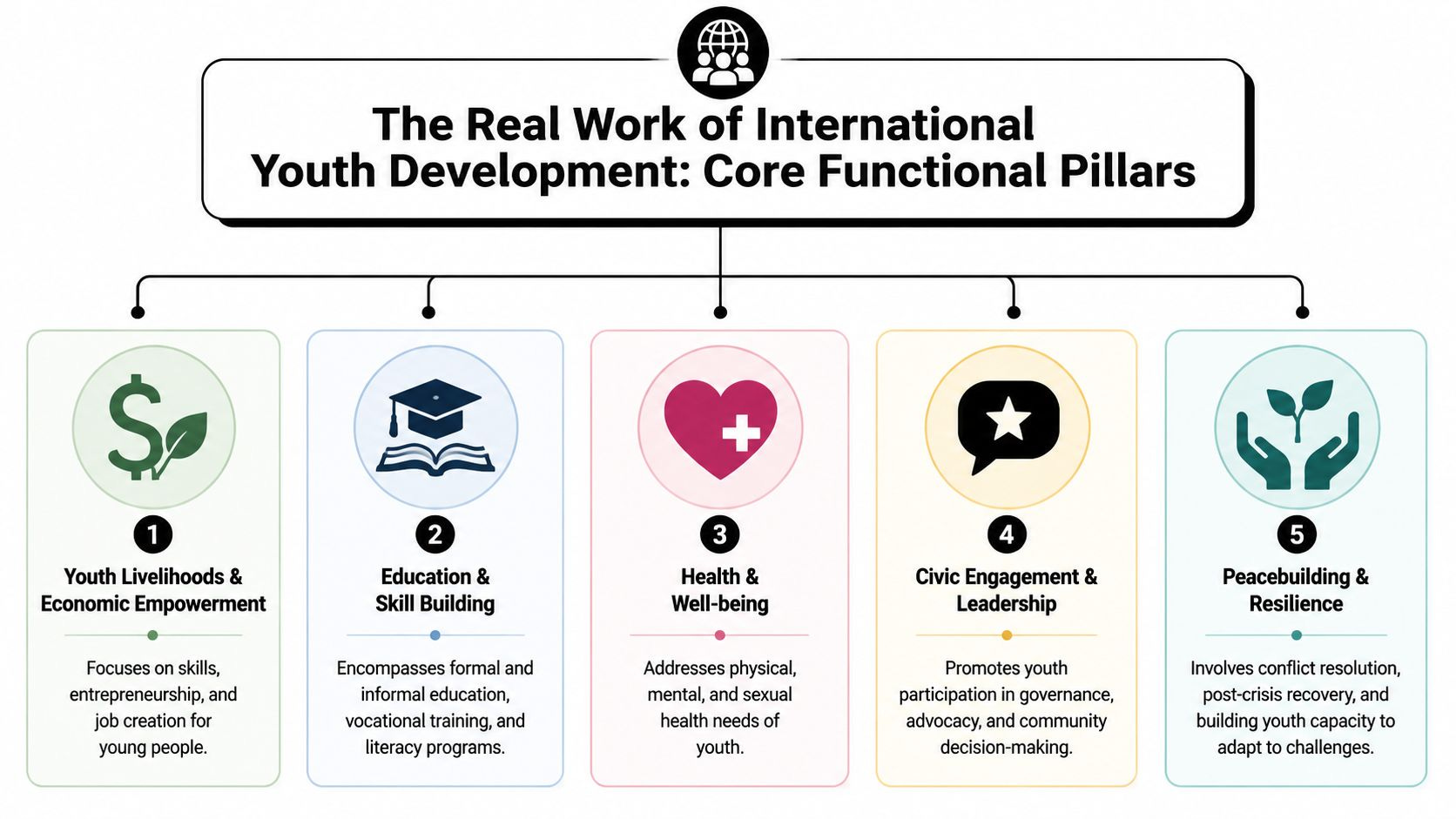
The five pillars you actually see in practice
Youth livelihoods and economic opportunity covers employability, entrepreneurship, financial inclusion, labor-market transitions, and support to micro and small enterprises led by young people.
Education and skill building includes formal education, TVET, digital learning, second-chance education, foundational skills, and workforce readiness.
Health and well-being can mean adolescent sexual and reproductive health, mental health, psychosocial support, violence prevention, or school health programming.
Civic engagement and leadership focuses on participation, accountability, youth councils, social cohesion, advocacy, and inclusion in decision-making.
Peacebuilding and resilience shows up in conflict-affected settings, displacement contexts, climate adaptation work, and community recovery efforts involving young people.
The job is cross-functional now
Current vacancy patterns show why many candidates struggle. Employers aren’t just hiring topic specialists. They want staff who can operate across functions. Roles listed through major international recruitment platforms include titles such as Youth Participation Adviser, Youth Entrepreneurship and Digital Technologies, Youth Livelihoods & Economic Opportunities, and Youth Program Specialist, as seen in current youth-focused openings on Impactpool.
That tells you something important. Employers increasingly expect a blend of:
Youth content knowledge
MERL capability
Partnership management
Program delivery discipline
Comfort with digital tools and platforms
A candidate who says, “I’m passionate about helping youth develop skills and leadership,” sounds replaceable. A candidate who says, “I’ve managed partner reporting, built indicator trackers, supported proposal development, and worked with youth-serving organizations on digital training delivery,” sounds hireable.
The market rewards people who can translate youth strategy into implementation mechanics.
Major Employers and Their Different Playbooks
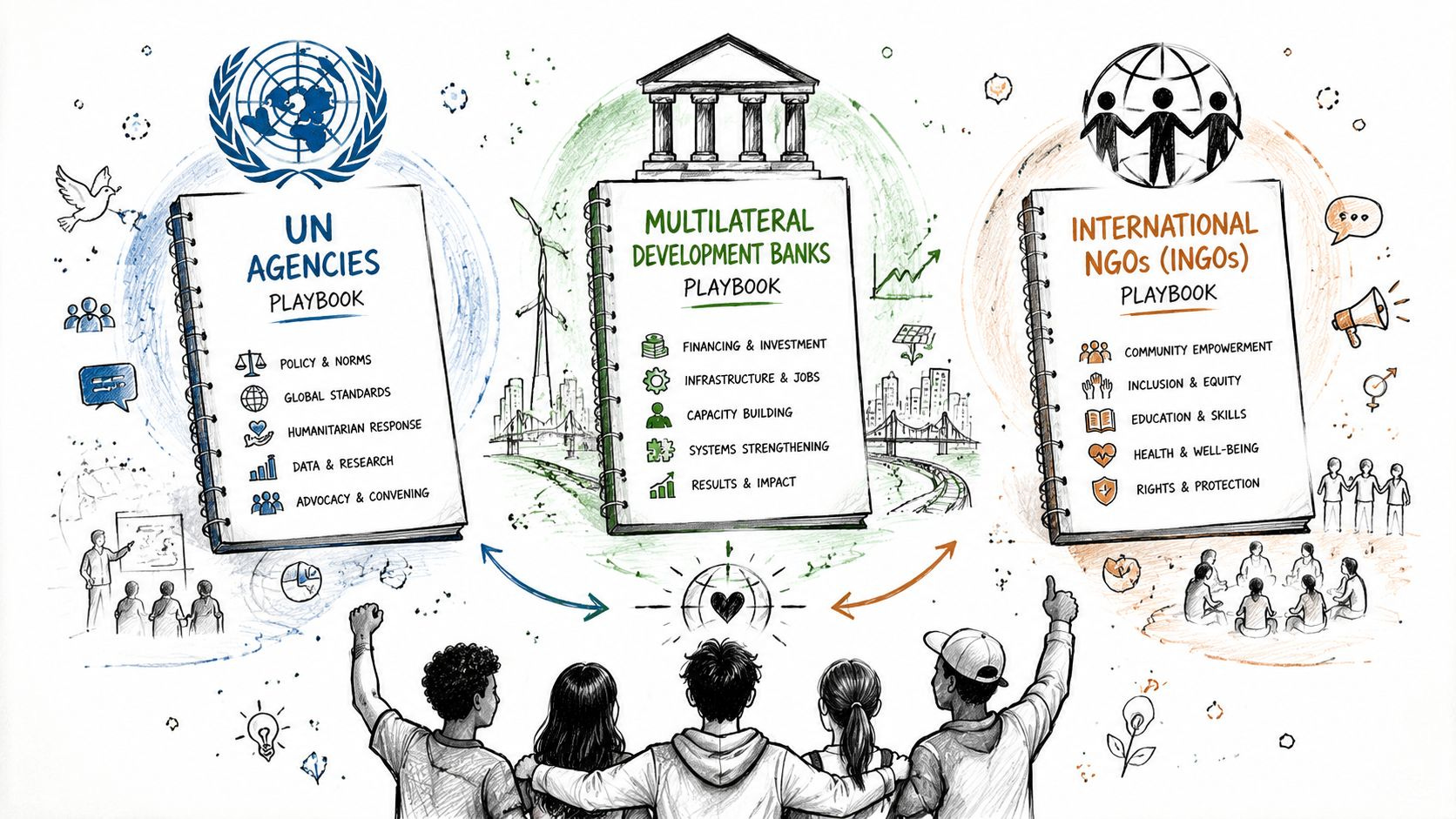
The biggest mistake candidates make is treating the UN, development banks, and NGOs as interchangeable employers. They aren’t. They use different language, hire for different kinds of evidence, and reward different professional instincts.
UN agencies
UN agencies tend to sit closer to policy frameworks, coordination, standards, and government engagement. In youth development, that often means national strategies, system strengthening, technical assistance, and convening. UNICEF, UNDP, ILO, UNFPA, and UNV all touch youth work, but in different ways.
A good fit for the UN usually looks like this:
You write well and can handle formal review processes.
You understand intergovernmental language and diplomacy.
You can support policy dialogue, reporting, and coordination across stakeholders.
UN hiring often favors candidates who can combine field awareness with institutional patience. If you hate slow process, this environment can wear you down quickly.
Multilateral development banks
MDBs work through financing, policy reform, economic analysis, and large programs tied to government systems. Youth issues are often embedded in education, jobs, social protection, or private-sector projects rather than housed in a visible youth unit.
That distinction matters because banks often care more about the structure of the problem than the rhetoric around it. In Latin America and the Caribbean, for example, job quality remains a central issue. Employment rose by 4.4 million between 2024 and 2025, but 51.1% of employment in 2025 was informal, and youth unemployment stood at 11.9%, versus 4.3% for adults, according to the World Economic Forum summary of ILO regional findings. That is exactly the kind of labor-market context banks care about when designing youth employment operations.
If you’re exploring bank careers, it helps to study how institutions differ. A profile of European Investment Bank careers gives a useful example of how MDB hiring logic differs from NGO hiring logic.
Large INGOs
INGOs are usually closer to implementation. They manage field teams, delivery partners, donor reporting, and operational headaches. That’s where you learn fast if you want hands-on experience with rollout, adaptation, and grant compliance.
A strong INGO fit usually means you’re comfortable with:
messy implementation realities
donor deadlines
partner capacity gaps
operational trade-offs between ideal design and what a local team can realistically deliver
If you want to build execution muscle early in your career, INGOs can be the fastest training ground.
Decoding Roles Contracts and Pay Scales
Contract type shapes your life more than most candidates realize. The title matters, but the contract tells you how much security you have, how portable the role is, what benefits come with it, and how the institution really values the function.
You don’t need a perfect contract at the start. You do need to understand the trade-offs.
The main paths
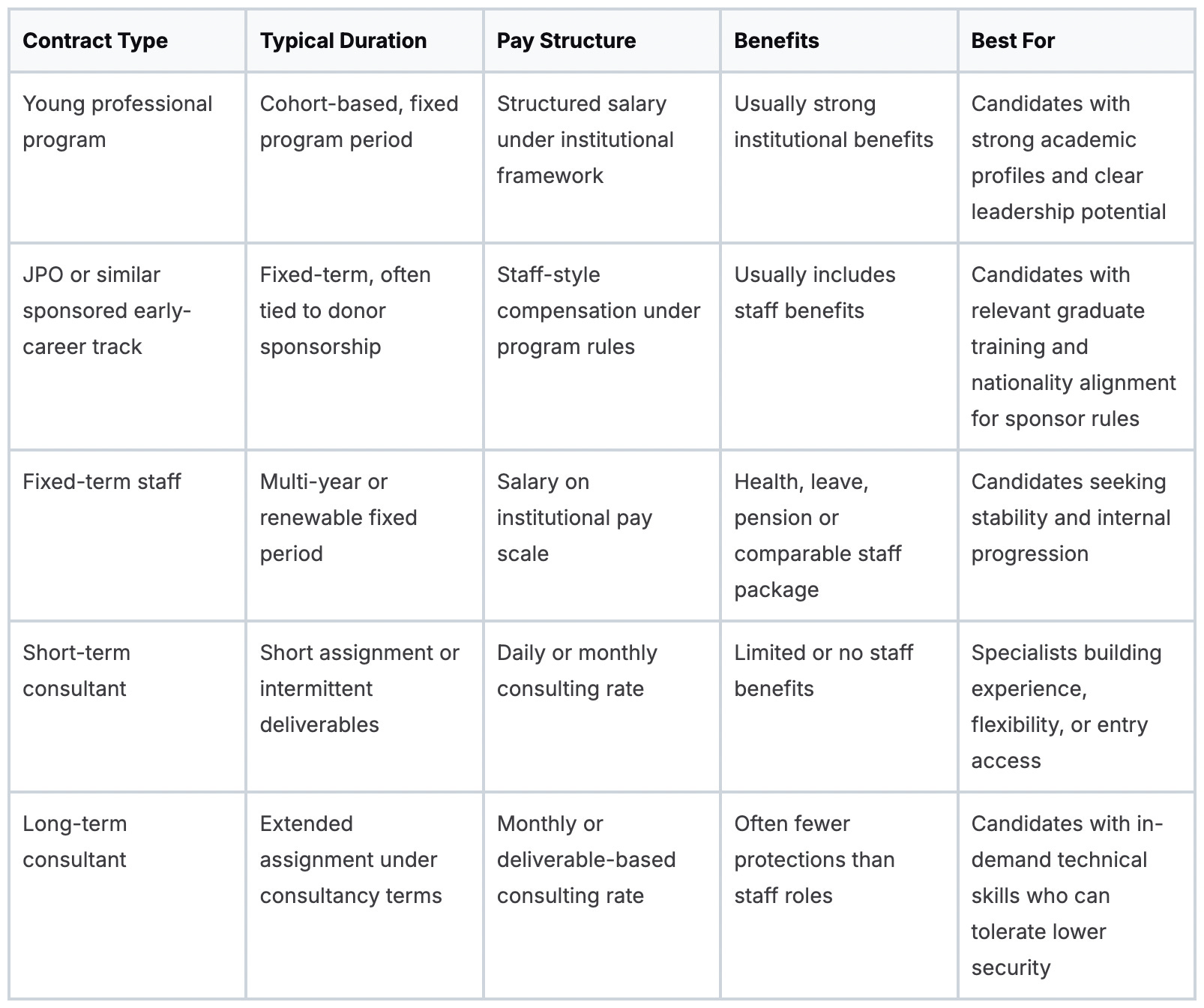
Early-career entrants usually encounter a mix of structured entry programs, fixed-term staff roles, and consulting arrangements. Young professional programs and similar feeder schemes can accelerate entry, but they’re highly competitive and usually demand a polished profile. Fixed-term staff roles offer clearer progression and stronger benefits. Consulting can get you in the door faster, but it often comes with less stability.
Here is the basic comparison I use.
The trade-offs that matter
Staff roles usually win on predictability. Consultant roles often win on speed of entry and flexibility. That doesn’t make one better. It depends on your stage and constraints.
A few realities matter:
Consulting can be strategic: It helps you build institution-specific credibility and references.
Staff contracts carry process burden: Internal approvals, mobility expectations, and bureaucracy are real.
Entry programs are narrow funnels: They are excellent if you’re competitive for them, but a poor sole strategy.
Titles can mislead: A consultant with strong exposure can be better positioned than a junior staff member stuck in a narrow support role.
Choose the contract that gives you the strongest next move, not the one with the best label.
The In-Demand Skills That Get You Hired
Passion doesn’t get screened. Skills do.
The strongest applicants for international youth development jobs show a clear technical spine. That usually means they can work with data, support design, manage processes, and communicate evidence in a way that senior staff and donors trust.
Data literacy is a hiring signal
Youth employment work depends on interpretation, not just enthusiasm. The UN’s youth development indicators guidance makes this clear. Technical teams use the youth unemployment rate alongside the employment-to-population ratio because unemployment alone can mislead. That combination helps teams judge whether joblessness is being driven by weak demand, low participation, low skills, or structural barriers, as explained in the UN guidance on youth development indicators.
That point lands directly in hiring. If you can read labor-market indicators, question weak assumptions, and explain what the data implies for program design, you stand out immediately.
For candidates who need to sharpen this muscle, practical guidance on how to improve analytical skills is worth studying.
The skill stack that travels across institutions
The most portable skills in this field are not mysterious:
MERL: indicator frameworks, logframes, data quality checks, survey support, learning products
Project management: work planning, partner follow-up, risk tracking, deliverable management
Proposal and business development: drafting concept notes, donor mapping, budget narrative support
Partnerships: coordinating with ministries, NGOs, firms, youth-led groups, and consultants
Digital fluency: online learning tools, digital outreach, data collection platforms, and basic reporting systems
Then come the filters that often decide close competitions:
Strong writing
Professional French, Spanish, or Arabic in relevant markets
A graduate degree that matches the role
Evidence that you’ve turned analysis into decisions
What hiring managers usually ignore
They largely ignore vague motivation statements. They also discount resumes that list every youth issue under the sun. Breadth without proof reads as drift.
A better profile is narrower and stronger. Show one or two substantive lanes, then back them with outputs, tools, and responsibilities.
Hiring managers remember candidates who can explain what they measured, what they changed, and why it mattered.
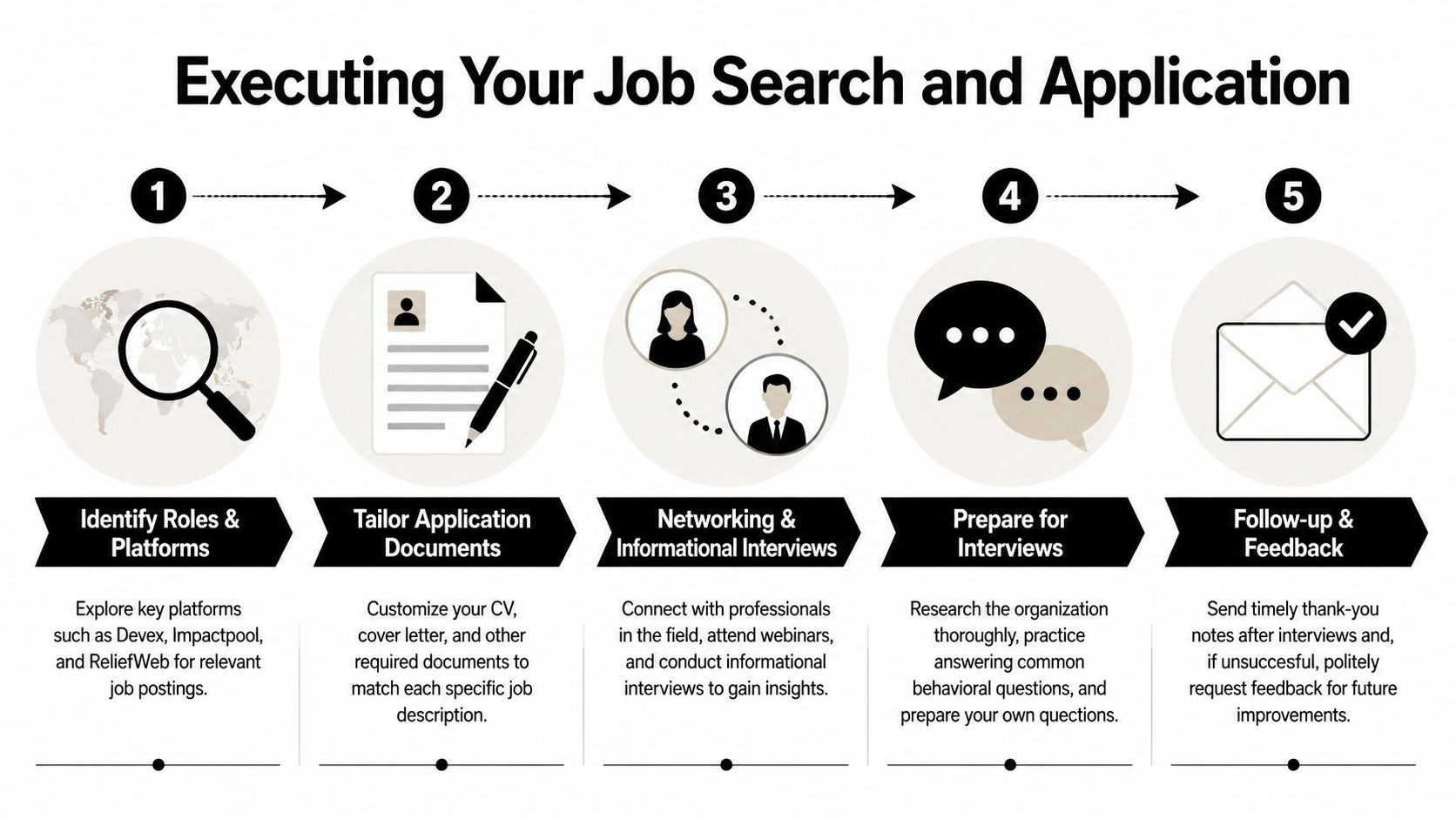
Executing Your Job Search and Application
A disciplined search beats a wide one. Most candidates waste time on roles they were never likely to get, then tell themselves the market is impossible. The market is difficult. It isn’t random.
Find openings where this field actually recruits
General job sites won’t surface much of the serious market. Use specialized platforms and go directly to institutional career portals. Impactpool, ReliefWeb, Devex, UNICEF, UNDP, the World Bank, regional development banks, and major INGOs should all be in your weekly routine.
Then narrow. Don’t track everything. Track the subset of organizations where your profile makes sense.
Use a simple system:
Build a target list: Pick a small set of institutions by mandate and fit.
Study recurring job language: Note repeated requirements, software, and competencies.
Save vacancy language: Hiring managers tell you what they value. Use their wording carefully and accurately.
Watch for consulting pipelines: Many institutions hire repeatedly from consultant rosters and known profiles.
Tailor like a professional
A good application mirrors the vacancy without sounding copied. That means your CV, cover letter, and any profile form should foreground the exact experience the role asks for.
Your CV should do three things fast:
Match the function: show MERL, operations, partnerships, analysis, or policy support clearly
Name the setting: ministry counterpart, donor-funded project, NGO consortium, field office, headquarters unit
Show outputs: reports, dashboards, partner coordination, training support, proposal inputs, research products
Cover letters should be short and selective. Pick two or three pieces of evidence that align tightly with the role. Don’t retell your resume.
Interview for competence, not charm
Most international employers use competency-based interviews. Your stories need structure. STAR works because it forces discipline: situation, task, action, result.
Prepare examples around:
managing competing deadlines
working across cultures and functions
solving a delivery problem
handling a difficult stakeholder
improving a process or piece of analysis
If your examples are fuzzy, your candidacy will feel fuzzy too.
Your Action Plan for Breaking In
You do not need a perfect background to enter this field. You need a credible direction, proof of useful skills, and a search process that reflects how these institutions really hire.
A sharp 30-day plan
Start with decisions, not applications.
Choose your employer lane: UN, MDB, or INGO. Pick the one that fits your temperament and current strengths.
Pull five target vacancies: Use them as your benchmark for skills, language, and experience gaps.
Audit your profile: Look for missing pieces in MERL, analysis, partnerships, writing, or operations.
Rebuild your CV around functions: Most candidates organize by employer history. Better candidates organize around relevance.
Create a weekly search rhythm: Search, track, tailor, submit, follow up.
What usually works
Candidates break in faster when they stop chasing prestige and start building adjacency. That might mean accepting a partner-facing project role before a policy title, or taking a consultancy that gives you stronger institutional exposure.
A practical sequence often looks like this:
local or national implementation role
regional coordination or technical support role
consultancy or fixed-term role with a major institution
more specialized or senior international post
That path isn’t glamorous. It is reliable.
Resources worth using well
Keep your resource list tight and active:
Impactpool for international organization vacancies
ReliefWeb for humanitarian and NGO roles
Devex for broad development recruitment coverage
Direct institutional portals for UN agencies, MDBs, and large INGOs
Professional networking and informational calls with people already in your target function
If you’re targeting structured bank entry routes, a practical explainer on the UN Young Professionals pathway and related entry strategy can help you assess whether that route fits your profile or whether you should focus elsewhere.
The field needs serious people. If you can build one useful specialty, prove that you can deliver, and aim your applications at the right institutions, you give yourself a real shot. That is how most careers in international youth development jobs begin.
If you want a focused stream of opportunities and practical guidance on how major development institutions hire, Multilateral Development Bank Jobs is a strong place to start. It tracks roles across leading MDBs, shares consultant openings, and publishes detailed career guides that help you move from browsing vacancies to competing for them well.