

You’re probably looking at a messy set of options right now. Investment banking. Asset management. Treasury. IMF. World Bank. Regional development banks. Consultant rosters. Graduate programs. Maybe a corporate finance seat in a multinational as the practical fallback.
That confusion is normal. International finance career opportunities sit inside several different systems, and each one rewards a different profile. The mistake is treating them like one market. They aren’t. A candidate who looks strong for an MDB operations role may look unfocused for a private equity analyst seat. A great corporate banker can still struggle in a development finance interview if they can’t connect numbers to policy and implementation.
The upside is that the field is large and still growing. In the United States, financial analyst roles are projected to grow by 8% from 2022 to 2032, creating about 27,400 openings each year, according to 365 Financial Analyst’s finance jobs overview. That doesn’t tell you where to go. It does confirm that betting on finance skills is rational.
Your Guide to a Global Finance Career

Individuals often start with the wrong question. They ask, “How do I get into international finance?” That’s too broad to be useful.
Ask better questions:
Which institution type fits my temperament? Some roles reward speed and aggression. Others reward patience, writing, and stakeholder management.
What kind of finance work do I want to do? Deals, macro analysis, project appraisal, sovereign risk, treasury, compliance, or operations all demand different preparation.
What constraints apply to me? Nationality, language, location flexibility, and prior sector experience matter more than many candidates admit.
That’s where careers get clearer.
A lot of ambitious candidates chase prestige labels instead of job design. They say they want the World Bank, but what they really want is cross-border work with a saner lifestyle than deal teams. Or they say they want investment banking, when what they enjoy is country risk and policy analysis. If you don’t separate brand from function, you’ll waste a year preparing for the wrong lane.
Practical rule: Pick the ecosystem first, then the role family, then the application strategy.
International finance gives you several valid paths. The private sector can pay more and move faster. MDBs and IFIs can give you deeper exposure to sovereigns, infrastructure, climate, regulation, and development outcomes. Corporate international finance offers stability and broad operational training. None of these paths is automatically superior. They just optimize for different things.
The Landscape of International Finance Institutions
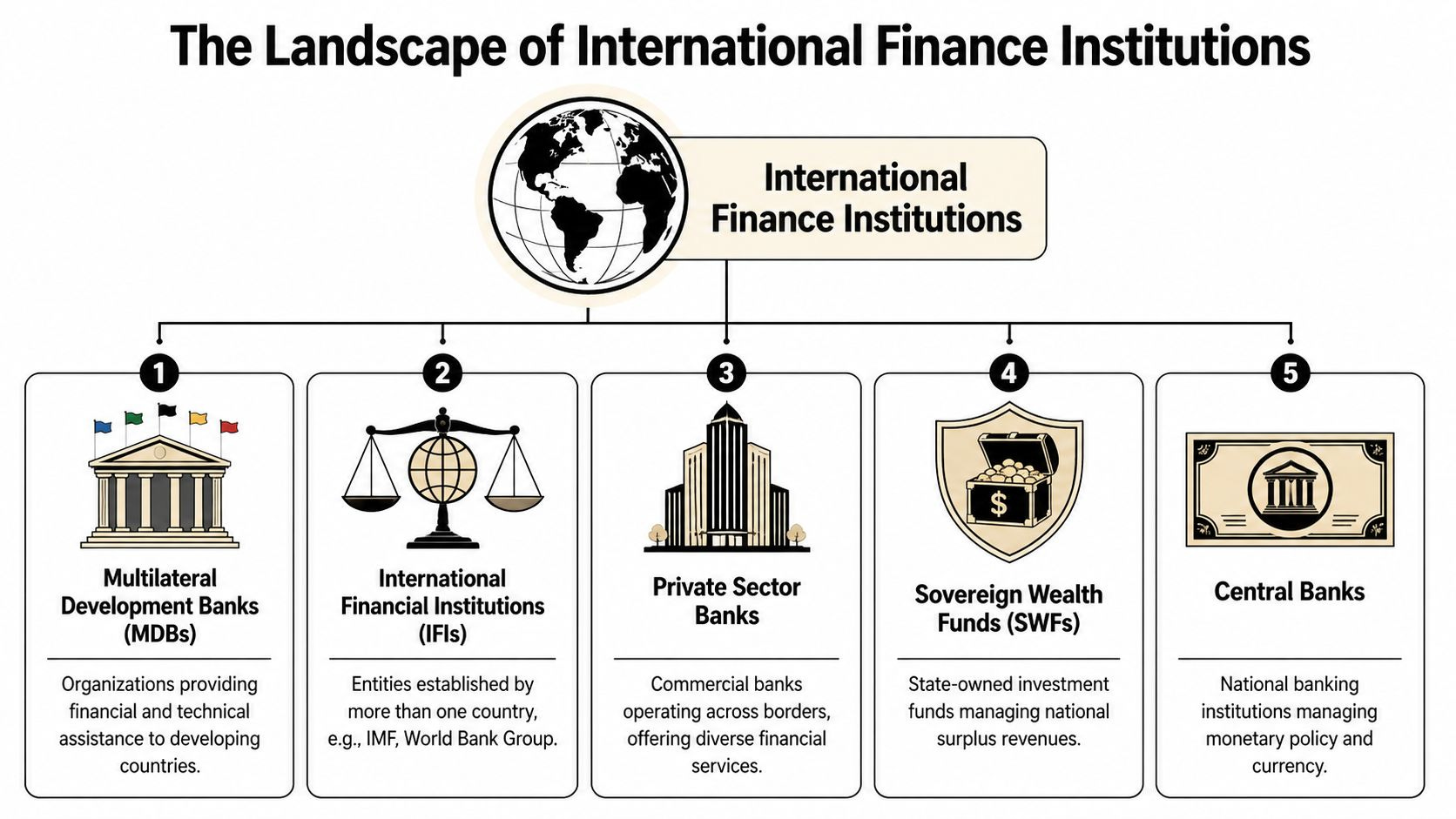
The five ecosystems that matter
The cleanest way to understand international finance is to split it into institutional families.
Multilateral Development Banks finance development projects and policy programs. Work here often sits close to sovereign borrowers, infrastructure, financial sector reform, public-private investment, and implementation.
International Financial Institutions such as the IMF sit closer to macroeconomic stability, surveillance, debt sustainability, and country programs. The work is analytical, policy-heavy, and often more economist-driven.
Private sector banks and investment firms focus on returns, transactions, markets, and client revenue. The pace is faster. Accountability is immediate. Promotion usually tracks output very directly.
Sovereign wealth funds manage state capital with a long-horizon investment mandate. Roles can resemble institutional asset management, but the politics and governance structure differ from private funds.
Central banks attract people interested in monetary policy, reserves management, financial stability, and banking system oversight. These roles often blend economics, markets, and regulation.
International finance career paths at a glance
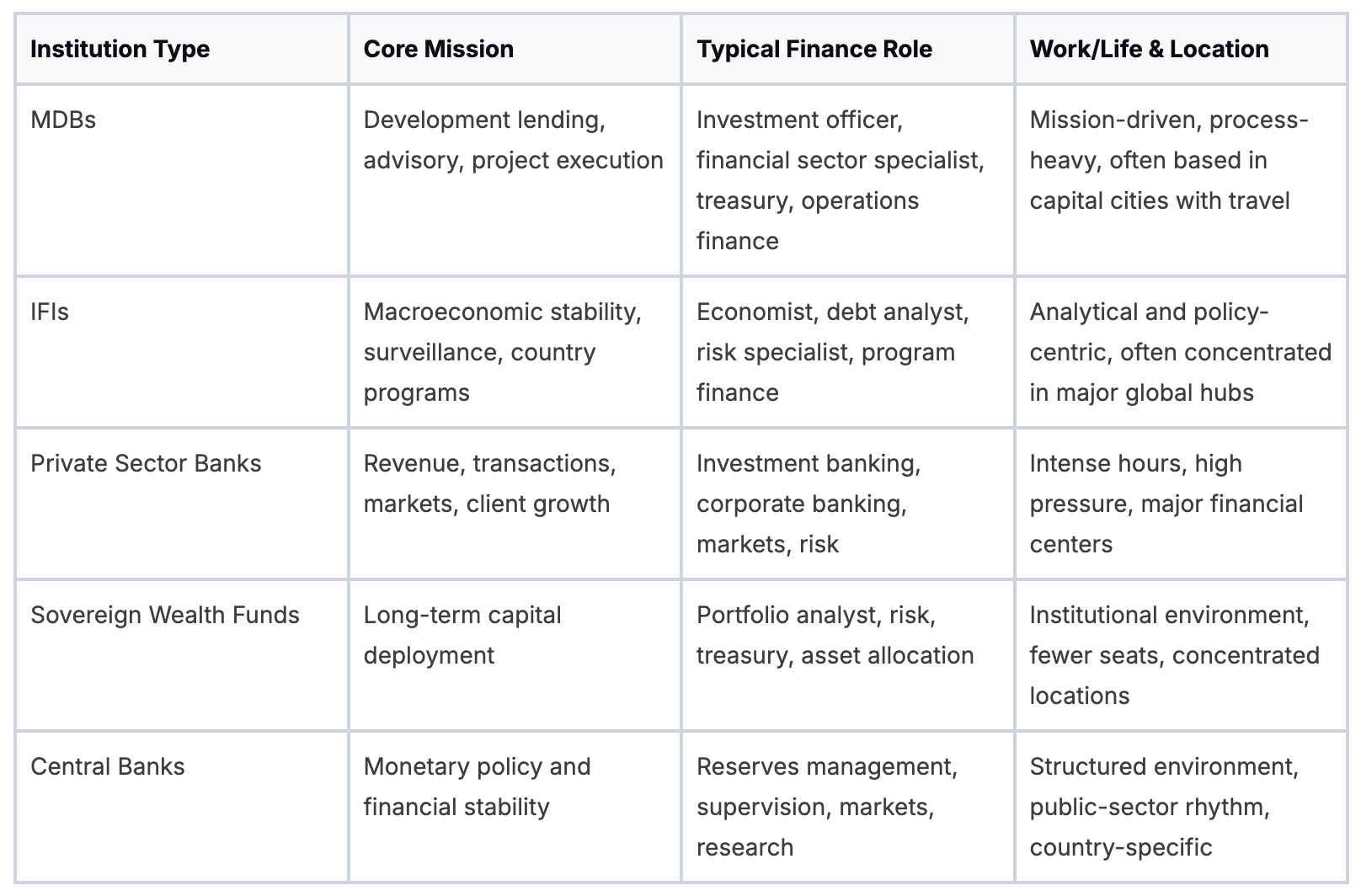
There’s overlap, but don’t overstate it. Moving from one ecosystem to another is possible. It is not frictionless.
What each world rewards
MDBs and IFIs care about technical ability, but they also care whether you can work through committees, country counterparts, and internal review layers. Private sector firms care whether you can execute, model, pitch, and survive pressure. Central banks care about rigor and institutional judgment.
That’s why generic “global finance” advice usually fails. It blurs work that is fundamentally different.
If you want a narrower look at one MDB specifically, the European Investment Bank careers guide is useful because it shows how a development-oriented institution still has distinct tracks in finance, operations, and support functions.
The institution’s mandate shapes your day more than the job title does.
Required Skills and Credentials for Success
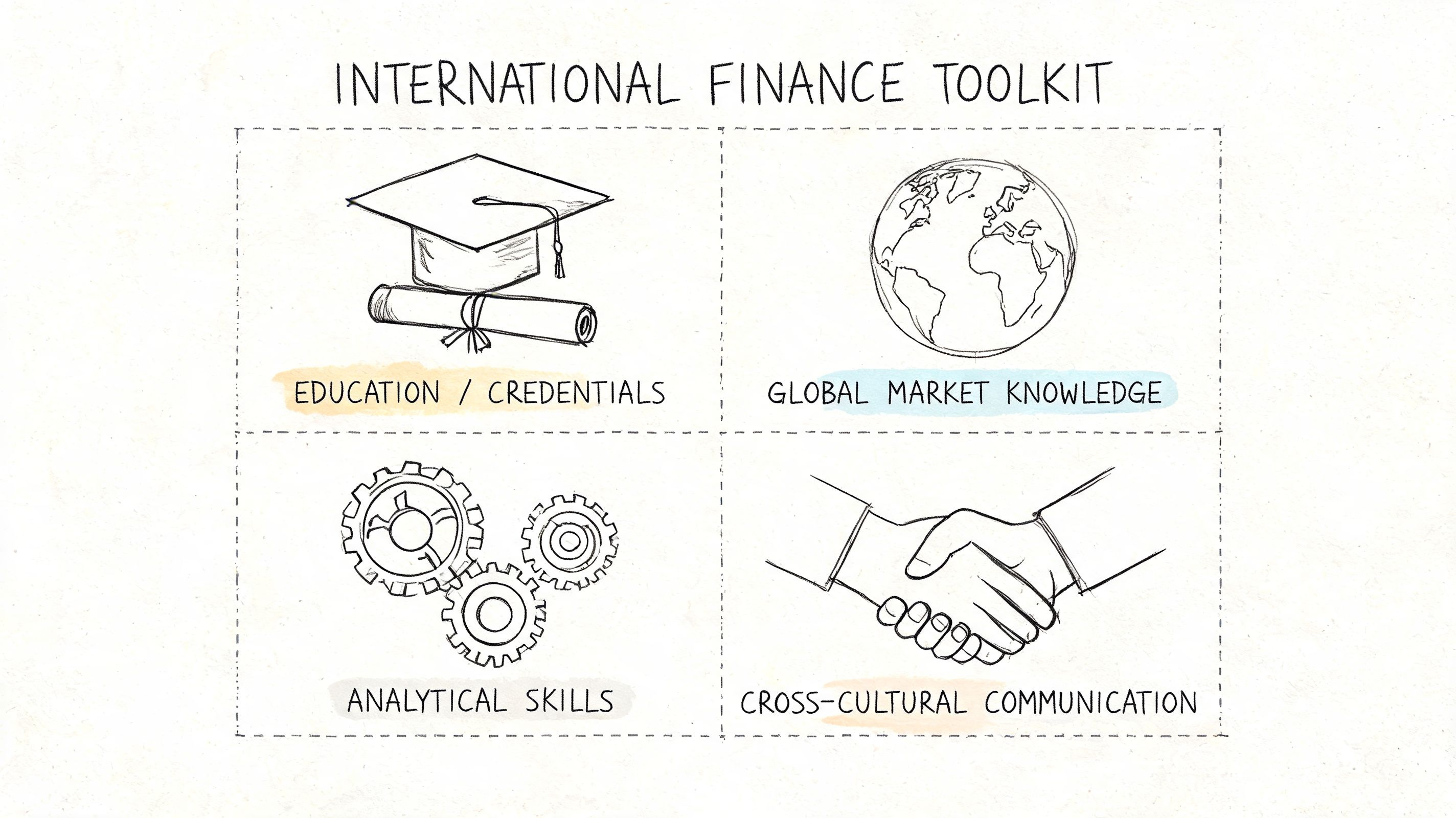
The ticket to play
For many international finance roles, especially in MDBs and IFIs, strong academics still matter. Advanced degrees are often the baseline for technical tracks. In development finance, economics, finance, public policy, statistics, and related quantitative fields are the common lanes.
That said, credentials alone don’t get you hired. They get you screened in.
A lot of candidates overinvest in brand-name degrees and underinvest in demonstrable tools. If you say you want cross-border finance work, I expect evidence that you can analyze a project, build a model, clean messy data, write a clear note, and defend your conclusion.
The skills that actually separate candidates
The market is shifting toward technical fluency. In the 2025 CFA Institute Graduate Outlook Survey, 37% of students said finance is the most promising career path, and 40% said AI competencies would significantly improve their job prospects, ahead of foreign language proficiency, according to the CFA Institute’s survey release.
That tracks with what hiring teams are doing. They still want core finance judgment. They also want people who can work with data and modern tools.
Here’s the practical stack:
Financial analysis: Valuation, credit thinking, project finance logic, and risk assessment.
Quant tools: Excel is mandatory. R, Stata, or Python are increasingly useful depending on role.
Writing under constraints: You need to turn technical work into short, decision-ready memos.
Cross-border communication: Country teams, regulators, bankers, and donors do not speak the same institutional language.
AI literacy: You don’t need to posture as an AI expert. You do need to understand where AI helps with research, workflow, and analysis, and where it creates sloppiness.
The candidates who break through can explain their toolkit with precision. They don’t say “strong analytical skills.” They say they built loan models, cleaned panel data, reviewed financial statements, or translated research into investment or policy recommendations.
For a practical breakdown of that last piece, this guide on how to improve analytical skills is useful because it focuses on trainable habits rather than empty résumé language.
If your CV lists technical skills, be ready to prove them in writing tests, case interviews, or live discussion.
What doesn’t work
Three things routinely hurt otherwise solid applicants:
Overweighting languages while underweighting analytics
Listing software without work samples or substantive examples
Presenting coursework as if it equals execution experience
Languages help. They rarely compensate for weak finance fundamentals. Hiring teams forgive a missing language faster than they forgive weak analysis.
Major Entry Routes into Global Finance
The entry route you choose shapes your first five years. During this period, candidates either accelerate or drift.
Young professional tracks
The prestige route is obvious. Young Professional Programs and similar early-career pipelines can put you on a strong institutional track fast. They also come with brutal competition, narrow eligibility windows, and a tendency to attract applicants who confuse aspiration with readiness.
These programs work well for candidates who already have the academic profile, a coherent story, and evidence of international or development-relevant work. They work poorly for people applying because the brand is famous.
If you’re still early, look at feeder roles too, including the World Bank Junior Professional Associate path. It’s a more grounded route for candidates who need recognized institutional experience before aiming higher.
Direct hire from the private sector or public sector
Mid-career hiring is less glamorous and often more realistic. MDBs and related institutions bring in people with banking, consulting, regulatory, treasury, infrastructure, sovereign, and public finance backgrounds.
This route works when your prior experience maps clearly to a live institutional need. It fails when candidates assume “finance is finance” and ignore context. A complex debt financing background can help. It won’t automatically translate into development finance unless you can connect it to country risk, project viability, policy constraints, or public-sector stakeholders.
Internships and consultant rosters
This is the part most generic guides undersell. Consultants and interns are a major part of the MDB ecosystem. At organizations like the IIF and regional development banks, consultants can fill 20% to 30% of short-term roles, and post-COVID World Bank consultant postings for specialized skills rose 15% year over year, according to the Institute of International Finance careers information.
That matters because consultant work is often the side door.
Use it strategically:
Internships: Strong for graduate students who need institutional signaling and references.
Short-term consulting: Better for experienced candidates who already have technical skills and need a foot in the system.
Roster applications: Tedious, but worth it if you can respond quickly when a project opens.
Specialized niche roles: Debt, climate finance, financial sector reform, project appraisal, and data-heavy assignments can be easier to target than broad “finance” roles.
One practical option for tracking openings is Multilateral Development Bank Jobs, which publishes recurring listings across MDB staff roles and consultant opportunities. That’s useful when you need broad visibility across institutions rather than checking each site manually.
Consultant work won’t always give you a straight line to permanency. It will give you references, institutional vocabulary, and evidence that you can operate inside the system.
The trade-off is real. You get access and experience, but often with less certainty and less structural support than formal staff tracks.
Navigating Country and Nationality Constraints
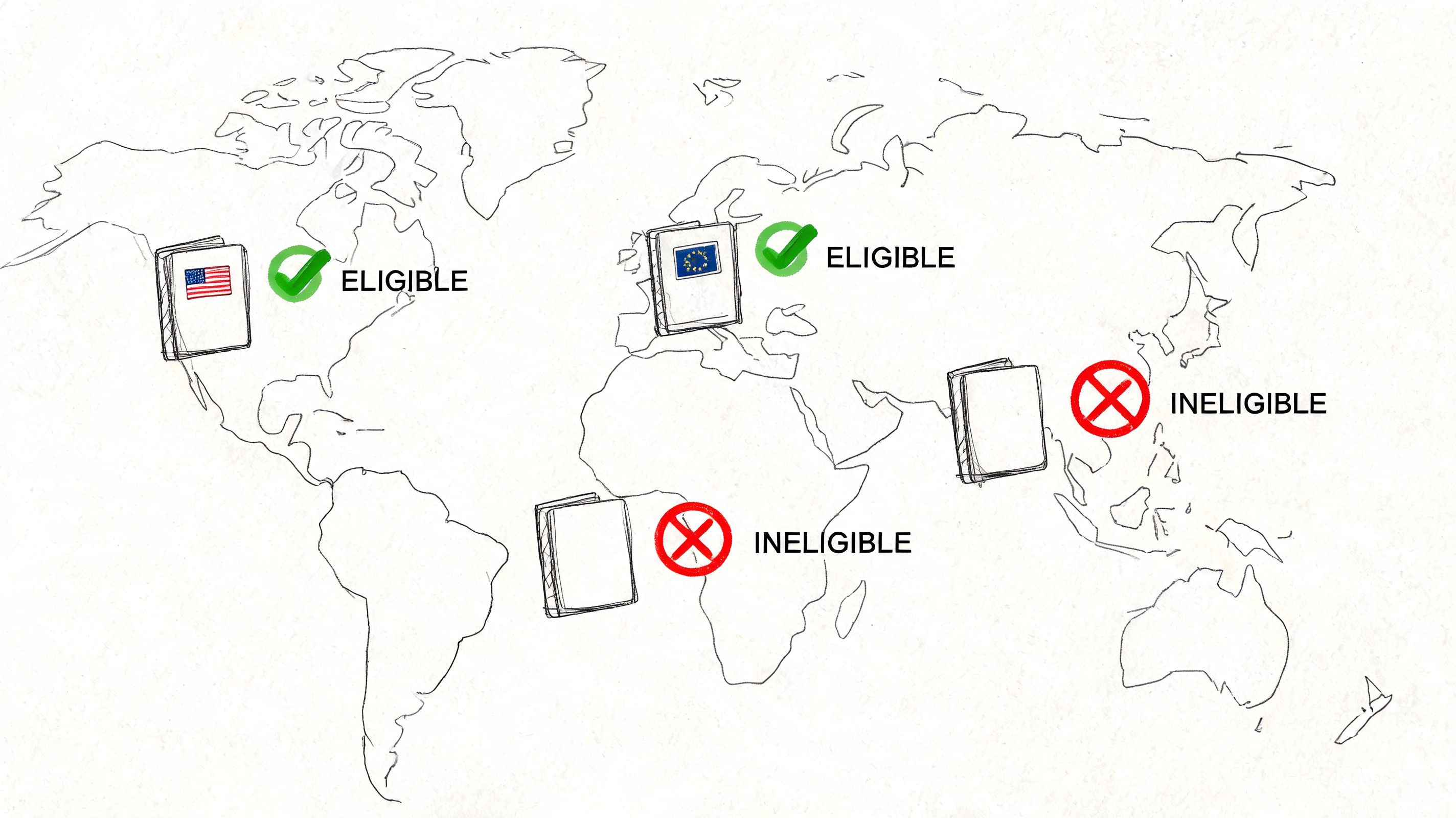
This topic makes people uncomfortable, mostly because they want hiring to be cleanly meritocratic. In MDBs and related institutions, it isn’t that simple.
Nationality is not a side issue
Nationality heavily influences MDB hiring. Despite 189 member countries, World Bank professional staff are disproportionately from G7 nations, and Young Professionals Programs often target underrepresented nationalities, as noted in Trainy’s discussion of finance roles in global organizations.
That’s not administrative trivia. It affects eligibility, competition, and timing.
If you come from an underrepresented country, that can help in certain programs. It does not remove the need for a strong profile. If you come from an overrepresented country, your margin for error gets thinner. You need sharper positioning and often a more specialized value proposition.
How to respond strategically
Don’t complain about the rules. Work with them.
Check eligibility early: Before preparing for a program, confirm whether nationality affects access.
Adjust institution mix: If one institution is structurally difficult, target regional banks, consultant tracks, or adjacent organizations.
Build a specific niche: Overrepresented candidates need clearer differentiation. Debt, financial sector reform, infrastructure finance, and risk can help.
Use location and language wisely: Regional exposure and country experience often strengthen your credibility far more than generic international ambition.
Some candidates waste months applying to pathways that were structurally unlikely from the start. Others ignore regional institutions because they’re fixated on a single logo. That’s bad strategy.
A realistic application plan beats a prestigious fantasy every time.
The hard truth is that international finance career opportunities are global, but they are not equally accessible in the same way to every passport holder. Once you accept that, your planning gets better.
Compensation, Lifestyle, and Locations
People ask about salary first. Fair enough. But compensation without context is how smart candidates end up in roles they hate.
Pay matters, but package matters too
For a benchmark role, financial analysts earned a median annual salary of $101,350 in May 2024, and MDB compensation packages are described as competitive and often include distinct benefits, according to the World Bank careers path overview.
That benchmark is helpful. It is not enough on its own.
MDB and IFI packages can be attractive because the total equation may include benefits that change the value of the role. Private sector compensation can climb faster, especially in revenue-linked seats, but the trade-off usually shows up in intensity, volatility, and how much control you have over your time.
The day-to-day trade-offs
Here’s the practical comparison.
Private sector finance You’ll usually move faster, get clearer performance signals, and face harder commercial pressure. The upside is faster skill compounding if you’re in a strong team. The downside is obvious. Hours can be rough, and your job may become your entire personality if you let it.
MDBs and IFIs The work often feels more substantive if you care about countries, systems, regulation, and development outcomes. You’ll also deal with more process, more internal review, and slower decision cycles. Some people call that bureaucracy. Sometimes it is. Sometimes it’s what serious institutional work requires.
Corporate international finance This can be a strong middle path. You get cross-border exposure, treasury or FP&A discipline, and a more predictable operating rhythm than high finance. The trade-off is that the work may feel narrower if you want sovereign or development exposure.
Where you live shapes the experience
Location is not cosmetic. It changes your network, your cost base, and your optionality.
A Washington-based MDB role feels different from a New York banking role. A regional development bank posting can put you closer to field realities and farther from major financial center prestige. Some candidates underestimate how much they value being close to deal flow. Others underestimate how much they value working on problems with public consequence.
There’s no clean winner here. There’s only fit.
Your Concrete Next Steps for an MDB Career
If you want development finance, stop consuming vague career content and start building a targeted campaign.
Step 1
Pick a lane with discipline. Choose a role family before you spray applications. Financial sector specialist, investment officer, economist, treasury, debt, risk, or operations finance all require different stories. Review live vacancies and note the recurring requirements, software, writing expectations, and sector language.
Step 2
Rebuild your materials around evidence. Your CV should show transactions, analysis, implementation, or policy work in plain terms. Your cover letter should connect your background to the institution’s mandate, not just your admiration for it. If you’ve worked on sovereigns, banks, infrastructure, regulation, or emerging markets, make that concrete.
Step 3
Use side doors without apology. Apply to staff roles, but also track consultant rosters, internships, and junior programs. A temporary assignment that gives you direct institutional exposure can be far more valuable than another year of generic adjacent work. Keep a simple tracker with deadlines, eligibility notes, contact points, and writing test requirements.
A few operating rules matter:
Target fewer institutions better: Precision beats volume.
Prepare for writing tests: A lot of candidates are weaker on concise written analysis than they think.
Study the mandate: Every serious interview will test whether you understand what the institution does.
Stay patient: These processes can move slowly, and silence between stages is normal.
International finance career opportunities reward ambition. They reward accuracy more.
If you want a practical way to monitor openings across institutions without checking dozens of career pages one by one, Multilateral Development Bank Jobs is a useful place to start. It tracks full-time roles, consultant openings, and career guidance focused on MDB hiring realities.