

You’re probably in one of three spots right now. You want work that matters and you’re tired of jobs that feel detached from real-world outcomes. You already work in policy, consulting, government, or an NGO and want to move into a bigger platform. Or you’ve been applying to international development officer jobs and getting silence back.
That silence usually isn’t about your ambition. It’s about fit, signaling, and how this market works.
International development officer roles sit at the intersection of policy, finance, operations, partnerships, and delivery. In practice, that can mean drafting country strategy inputs, managing trust-funded activities, reviewing procurement and safeguard issues, coordinating with ministries, writing board materials, or cleaning up weak project reporting before it becomes a problem. The job title varies. The underlying work is consistent. Institutions need people who can move between analysis and execution without drama.
The hard part is that the hiring process is opaque, especially at multilateral development banks. Official job descriptions tell you the minimums. They rarely tell you what gets shortlisted, why one consultant converts to staff and another doesn’t, or how much institutional fit matters when the panel is choosing between several technically qualified people.
Your Path to a Global Impact Career
The appeal of this field is obvious. You get a career tied to public purpose, international exposure, and serious institutions. You also get bureaucracy, long hiring cycles, and competition from candidates with excellent degrees, multiple languages, and field experience. Both sides are true.
An International Development Officer is usually hired to help design, implement, monitor, and improve development programs. At an MDB, that often means working inside systems that are heavily structured. You’ll deal with results frameworks, procurement rules, country dialogue, supervision missions, and financing instruments. At a UN agency or INGO, the same title may lean more toward programme management, grants, partnerships, or field coordination.
What separates strong candidates from the rest is simple. They understand the operating model of the employer they’re targeting.
What serious candidates get right
They pick a lane early: General interest in “global impact” doesn’t get you hired. A credible lane does. Think health systems, climate finance, public financial management, education, governance, social protection, private sector development, or monitoring and evaluation.
They build evidence, not just credentials: Degrees help. Recruiters still want proof that you’ve managed stakeholders, handled messy delivery conditions, and written clearly under pressure.
They target institutions that match their profile: MDBs, UN agencies, and INGOs hire differently. You need a strategy for each one.
Practical rule: The strongest applications read like the institution could plug the candidate into live operations next month.
That’s the standard. If your CV reads like a smart observer of development rather than an operator inside it, you won’t make many shortlists.
The Modern Development Officer Role
The old version of this career was broad and vaguely defined. The current version is more specialized, more technical, and more accountable for results.
In 2023, the international development job market saw over 163,000 vacancies posted, with high-demand sectors including Macroeconomy and Public Fiscal Management, Health, and Environment, according to DevelopmentAid’s review of hiring sectors in international development. That matters because it reveals where employers are spending and hiring, not where candidates merely hope to land.

What the work looks like on the ground
A development officer’s day is usually split across several modes of work:
Operational delivery: tracking milestones, reviewing implementation issues, coordinating with government counterparts, and pushing consultants or vendors to deliver usable outputs
Analytical support: preparing briefs, sector notes, concept notes, portfolio reviews, and internal decision materials
Relationship management: handling counterparts, donors, internal legal and procurement teams, and sector specialists who all have different incentives
Results reporting: making sure activities are linked to measurable outputs and that reporting survives internal scrutiny
A lot of people underestimate the last part. Institutions care about whether a project can be defended on paper as much as whether it sounds good in meetings. That’s why experience with frameworks like results-based management in MDB work is useful. You need to understand how objectives, indicators, risks, and implementation arrangements fit together.
The skills recruiters actually notice
The market has moved. Employers still value economics, public policy, international relations, and sector expertise. They also want people who can handle data, systems, and evidence without outsourcing all the technical thinking.
Here’s the shift that many candidates miss:
Technical fluency matters: data handling, analysis, and presentation are increasingly part of mainstream development roles
Writing matters more than people admit: weak writing kills otherwise strong candidates, especially in banks and UN agencies
Judgment matters most: panels look for candidates who can work in ambiguity without escalating every routine issue
Seniority follows scope and trust
At junior levels, you support delivery. You do the background work, prepare drafts, chase inputs, and keep systems current. At mid-level, you own workstreams and become the person others rely on when a project hits friction. At senior levels, you shape pipelines, negotiate with governments, and protect institutional credibility.
A promotion in this field usually follows one thing: people trust you with higher-stakes judgment.
That’s the unwritten ladder. Titles matter, but trust is what moves careers.
Key Employers and Their Hiring Rules
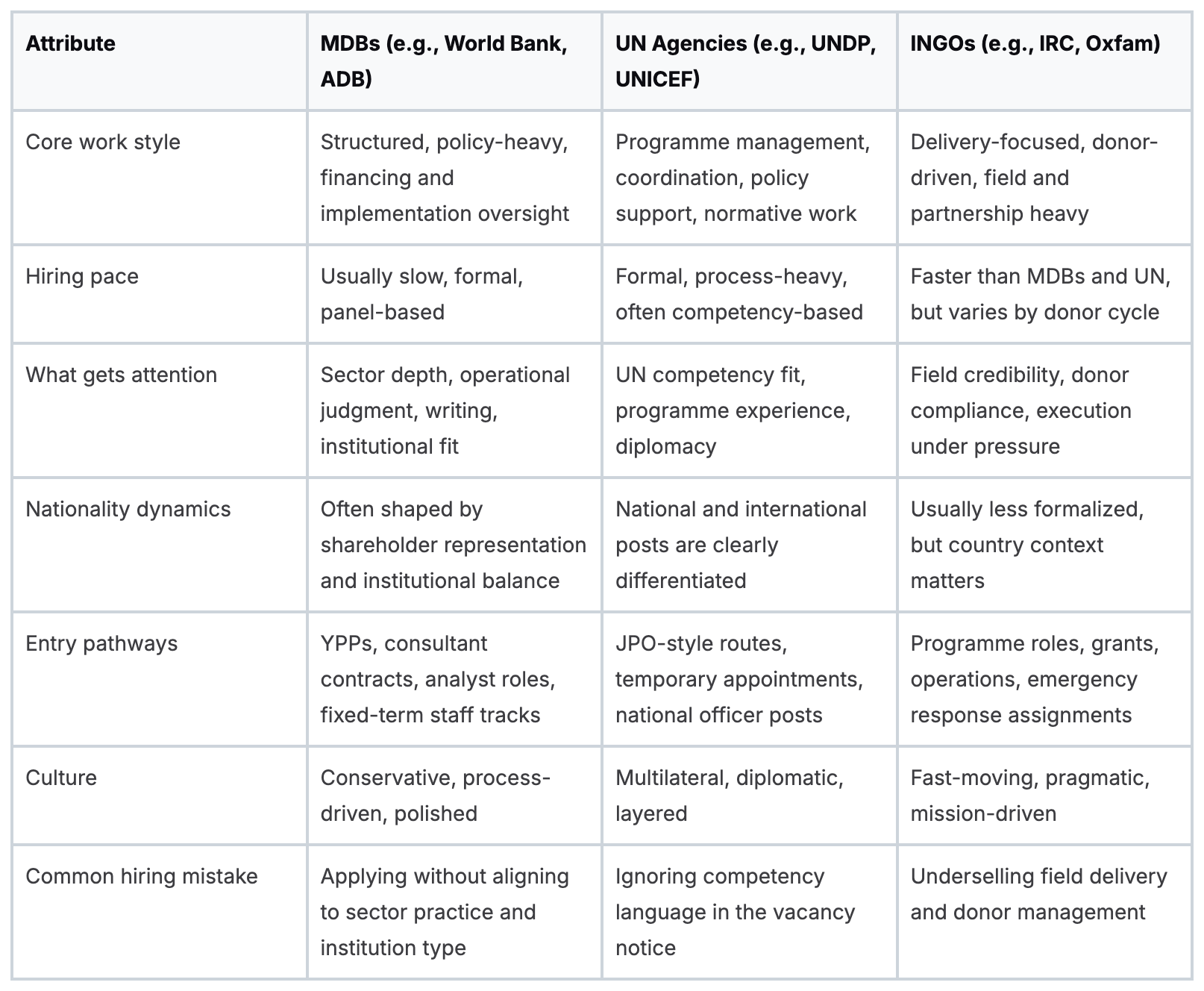
Candidates talk about “international development” as if it’s one market. It isn’t. MDBs, UN agencies, and INGOs may work on similar issues, but they hire for different operating environments.
International Development Employer Comparison
The MDB rules nobody tells you early enough
At a multilateral development bank, formal requirements are only part of the screen. The unwritten filters are just as important.
First, nationality can matter. Not always in a crude or explicit way, but institutions balance representation, member country interests, and internal diversity across teams. If you’re from a shareholder country with strong institutional representation, that can help. If you’re not, you need an even clearer value proposition in your sector or region.
Second, consultant work is often a primary proving ground. Teams use consultants to test reliability, writing quality, responsiveness, and fit under actual workload. Many staff careers start that way.
Third, hiring managers prefer candidates who already understand how a bank operates. Someone who knows project cycles, board sensitivities, fiduciary controls, and country engagement mechanics is less risky than someone with a generic public policy background.
Where each employer type fits best
If you want to work close to sovereign lending, infrastructure, macroeconomics, or public systems reform, target MDBs.
If you want a career with stronger programme coordination, agency mandates, and multilateral diplomacy, target the UN.
If you want speed, implementation intensity, and closer proximity to communities and donors, target INGOs.
None of these paths is better on its own. They reward different strengths. Trouble starts when candidates chase prestige instead of fit.
Finding Openings and Crafting Your Application
You see a vacancy on Friday, the deadline is Monday, and by the time you tailor your materials the hiring manager already has a shortlist in mind. That happens often in MDB recruitment, especially for consultant rosters, short-term assignments, and roles that were informally scoped before they were posted.
The search process needs to match that reality. Candidates who wait for one alert stream or one institutional portal miss a large share of the market. Bank hiring is fragmented, and the best entry points are not always the most visible ones.

Where serious candidates look
Use a search system, not a casual browse. Good candidates track four channels at once:
Official career portals: World Bank, regional development banks, UN agencies, and major INGOs
Specialist job boards: sites focused on development, humanitarian, and policy hiring
Curated digests: newsletters and sector roundups that pull together openings across institutions
Consultant pipelines: team-led consultant hiring, which often moves faster than fixed-term staff recruitment
For MDBs, consultant openings matter more than many applicants realize. A short assignment can do three things at once. It gets you inside the workflow, gives a manager evidence on your drafting and responsiveness, and puts your name in circulation before the next staff requisition opens. That is one of the more common staff pathways, even though institutions rarely advertise it that way.
How to write an MDB-ready application
A standard NGO, ministry, or think tank CV often underperforms in MDB processes because it describes activity rather than operational value. Hiring managers are scanning for evidence that you can work inside a lending or technical assistance machine, not just that you care about development.
Three signals carry the most weight:
Sector fit: public finance, transport, health systems, climate, private sector development, or another clearly defined practice area
Operational proof: projects prepared, supervision handled, analytic products delivered, procurement supported, reform dialogue managed
Institutional fluency: language that shows you understand results frameworks, fiduciary constraints, government counterparts, and approval processes
Your CV should make those signals obvious in under a minute.
What to change right now
Lead with a specific profile: “Social protection specialist with government delivery and donor-financed operations experience” tells the reviewer far more than “international development professional.”
Write bullets around outputs and decisions: note what you analyzed, drafted, negotiated, improved, or delivered
Mirror vacancy language carefully: use the bank’s technical terms where they match your real experience
Name systems and processes plainly: procurement plans, implementation support, results monitoring, budget execution, portfolio reviews, data tools, inter-ministerial coordination
Technical fluency helps, even in roles that are not branded as data jobs. Indeed’s roundup of international development program officer roles shows how often employers ask for Python, SQL, Tableau, or Power BI alongside policy and coordination skills. In practice, these tools help candidates handle portfolio analysis, reporting, and decision support work that sits behind many officer roles.
For early-career applicants, the gap is usually not motivation. It is translation. Universities train for subject knowledge. MDB screening looks for evidence that you can convert that knowledge into memos, project inputs, client-facing analysis, and clean execution. If that is your position, this guide to World Bank jobs for fresh graduates lays out what entry-level screens tend to reward.
Strong applications reduce interpretation risk. HR can map your profile to the requisition quickly, and the hiring manager can picture where you would sit in the team.
What doesn’t work
Long personal statements rarely help. Neither does broad passion language about changing the world. Panels and screeners respond better to concrete proof.
Cut the filler. Drop the conference laundry list unless it produced a paper, policy note, transaction, or reform output that matters to the role. Replace generic phrases like “stakeholder engagement” with specifics such as “coordinated line ministries on tariff reform” or “managed consultations with municipal utilities and the finance ministry.”
A good MDB application feels precise, literate, and operational. It reads like someone who already understands how the institution works.
Acing the MDB Interview and Assessment
Getting the interview means the institution already believes you could do the job. The panel is now testing whether you can do it there, under their constraints, with their people.
MDB interviews usually reward calm, structured candidates. They don’t reward the most charismatic speaker in the room. They reward the person who answers the exact question, uses evidence well, and shows they understand the machinery of development operations.
What the panel is really testing
The interview often runs on two tracks at once.
One track is competency. Can you handle teamwork, conflict, client pressure, shifting deadlines, and cross-unit coordination?
The other track is technical judgment. Can you think through a project problem in a way that reflects institutional reality?
A common technical prompt in program officer interviews is to explain how you would scope a project that integrates diverse data sources into analytical models. Success depends on showing that you can translate stakeholder needs into technical specifications and prototype solutions using data science techniques, as described in this UN Global Pulse program officer vacancy summary.
A better way to answer technical questions
Don’t jump straight into tools. Start with the operating problem.
A solid structure looks like this:
Define the use case: what decision needs better evidence
Identify stakeholders: who owns the data, who consumes the output, who signs off
Clarify constraints: data quality, permissions, timelines, policy risk, implementation capacity
Design the workflow: integration, cleaning, analysis, validation, and reporting
Close with adoption: how the model or output gets used in live decision-making
That last point separates practitioners from theorists. MDBs care about usable solutions, not clever prototypes that never survive internal review.
YPP versus consultant pathway
These are the two routes candidates ask about most.
Young Professionals Programs suit candidates with strong academics, polished profiles, and broad mobility. They offer structured entry and visibility, but competition is brutal and timing matters.
Consultant-to-staff transitions are less glamorous and often more realistic. Teams get to see how you write, how you manage comments, whether you’re reliable under pressure, and whether counterparts trust you. That’s powerful.
Here’s the trade-off:
YPP route: faster status, stronger brand signal, less control over timing
Consultant route: slower and less secure, but often better for proving fit in real operations
The consultant path works when you act like staff before you’re staff. You solve problems, protect quality, and make your manager’s life easier.
The assessment mistake that keeps showing up
Candidates prepare polished stories and still fail because their examples are too generic. “I led a cross-functional initiative” means nothing without context, tension, action, and outcome.
Use a tight competency format. Situation. Task. Action. Result. Then add one sentence on what you learned or what you’d do differently.
If you need a sharper framework, this guide on how to pass a competency-based interview is useful because it focuses on the style these institutions prefer.
Salaries, Benefits, and Your Career Trajectory
You get an offer, the salary looks strong, and then the real comparison starts. At MDBs and similar institutions, the difference between a good offer and a mediocre one often sits in appointment type, benefits, and post assignment, not just the base number.
For international development officers in the United States, average annual pay is around $109,221, according to Indeed’s international development officer job market page. For Europe, that same source indicates experienced professionals can earn up to 75,000 euros.
That headline number still does not tell you enough.
In multilateral hiring, two candidates can do similar work and receive meaningfully different packages because one is on an international appointment and the other is locally hired. The tax treatment may differ. The pension may differ. Education support, home leave, relocation assistance, and mobility provisions may exist for one contract and not the other. Candidates who only compare net monthly pay miss a large part of the economics.
Why the package matters more than the base salary
The stronger institutions usually offer value in four places:
Health coverage: often broader and more predictable than private-sector plans, especially for staff with dependents
Pension arrangements: one of the biggest long-term advantages if you stay in the system for several years
Mobility support: relocation, settling-in support, or assignment benefits can materially change the value of a post
Family benefits: some employers provide education support, dependent allowances, or related benefits tied to duty station and contract class
Read the offer letter line by line. HR language can look technical, but small distinctions carry real financial consequences. “International appointment” versus “local appointment” is one of them. Short-term consultant versus fixed-term staff is another. I have seen candidates chase a higher day rate on a consultancy and give up pension contributions, leave, and internal mobility that mattered more over three to five years.
What a realistic career arc looks like
MDB careers rarely follow a clean ladder. A common path is analyst or associate work, then consulting or project-based contracts, then a staff appointment after a team has seen your judgment, writing, and client handling in live operations. Once you are inside, the paths split fast. Some people stay close to lending operations. Others move into sector specialist roles, country management support, trust fund administration, results measurement, or people management.
The people who keep progressing usually build three assets over time:
A clear sector identity
Credible country or regional exposure
Fluency with internal processes and approval systems
That last point gets underestimated. External candidates focus on technical expertise. Hiring managers also look for people who can move work through review, handle comments from legal and procurement, and keep a project on track when counterpart timelines slip. That is why consultant experience inside an MDB can compound into better staff odds later, even if the title looks less impressive at the start.
A good early career move is not always the most prestigious one. It is the one that gives you recognizable institutional experience, stronger references, and access to the next hiring gate.
Your Action Plan for Landing the Job
You don’t need a dramatic career reinvention. You need a disciplined campaign.
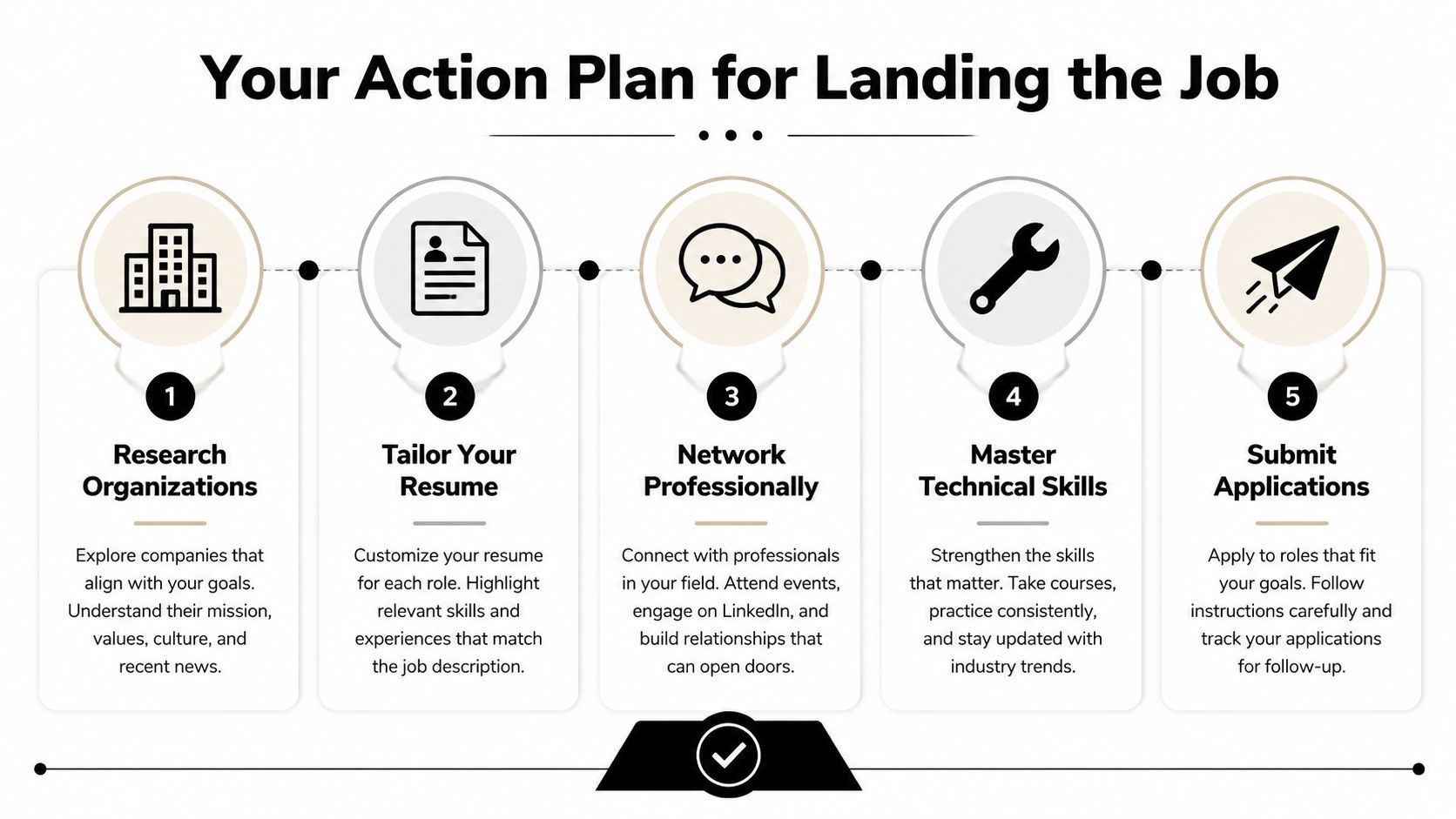
Five moves that actually change your odds
Choose your target lane
Pick one primary sector and one secondary one. If your profile is broad, your application will read as unfocused.Rebuild your CV around proof
Strip out academic padding, vague summaries, and duty-based bullets. Replace them with work that shows judgment, delivery, coordination, and writing quality.Track openings consistently
Set a routine for checking bank, UN, and INGO listings. Consultant roles deserve equal attention because they often create the bridge to staff hiring.Upgrade your technical toolkit
If your target roles touch analysis, learn the tools the market now expects. If your target roles are more operational, sharpen reporting, monitoring, and stakeholder management.Prepare your interview stories before you’re invited
Build examples for conflict, leadership, failure, analysis, client management, and delivery under pressure. Good candidates do this early. Weak candidates scramble after the invitation arrives.
The short version
Get specific
Target the right institutions
Write like an operator
Treat consultant work as a strategic entry point
Prepare for panel interviews with discipline
International development officer jobs go to candidates who look ready for the institution they’re applying to. That is the actual standard.
If you want a practical way to monitor openings across major banks and stay close to how this market hires, take a look at Multilateral Development Bank Jobs. It’s built for candidates targeting roles at institutions like the World Bank, ADB, AfDB, IMF, AIIB, and other MDBs, with curated staff listings, consultant opportunities, and detailed guides on the hiring rules that usually stay unwritten.