

1,187 organizations in the greater Washington metro work in international development and relief, according to Cause IQ’s DC-area directory. That single number changes how you should think about international development jobs washington dc.
This is not a normal city job market. It’s an ecosystem. People move between implementers, funders, think tanks, contractors, advocacy groups, and multilaterals. Hiring managers often know each other. Recruiters scan for signals that tell them you understand how this town works. If you approach DC like a generic nonprofit search, you’ll waste months.
The upside is obvious. The market is deep, specialized, and full of adjacent entry points. The downside is just as real. Competition is sharp, job titles are inconsistent, and plenty of strong candidates lose out because they apply too broadly, pitch themselves too vaguely, or miss the unspoken rules.
That’s the part most guides skip. They give you links. You need a strategy.
Why DC is the Center of the Development World
Washington’s power in development comes from density.
In one city, you have donor headquarters, implementing partners, consulting firms, advocacy groups, research institutions, embassies, and multilateral offices operating in the same professional circle. That changes hiring in ways applicants often miss. Roles are connected. Reputations travel. A short conversation at an event can shape who gets an interview three weeks later.
DC hiring is rarely isolated. A proposal manager at a contractor may have worked at an NGO before that. A program officer at a foundation may know the hiring team at a think tank. A technical specialist interviewing you may care less about your stated passion than whether you understand donor expectations, can write clearly, and know how decisions move through institutions.
Density changes the hiring market
In smaller markets, international development jobs are scattered across a few employers and a few functions. In DC, the field clusters around funding, policy, operations, compliance, research, and business development. That creates more entry points, but it also raises the bar. Employers compare candidates against people who already know USAID rules, have touched donor reporting, or can speak credibly about how headquarters supports field programs.
That is the primary trade-off. DC offers more ways in, but it also exposes weak positioning fast.
I have seen strong candidates stall because they targeted only one title, usually the most visible one. They applied for program officer roles, ignored grants, contracts, MEL, and proposal work, and then wondered why nothing moved. In DC, adjacent experience often beats idealistic alignment. Getting inside the system matters because once you have institutional credibility, lateral movement becomes much easier.
Practical rule: Your first DC role should build signal. It does not need to be your final niche.
What that means for your search
Treat Washington as an interconnected hiring market, not a pile of job boards. The candidate who understands who hires, how they hire, and what each employer type screens for will outperform the candidate who applies broadly with the same resume.
Use that reality to your advantage:
Target employer clusters: Build your list around funders, implementers, contractors, multilaterals, research shops, and advocacy organizations.
Study career paths: Check where staff worked before their current role. That shows which moves are common and which credentials carry weight.
Choose strategic adjacency: If your ideal opening is out of reach, pursue roles that build recognized DC experience in compliance, business development, research, operations, or donor reporting.
Prepare for informed screening: Interviewers in this market can usually tell who understands the field and who is reciting generic development language.
People build long careers in Washington because experience compounds here. The city rewards candidates who read the market clearly and position themselves for the next credible step, not just the perfect title.
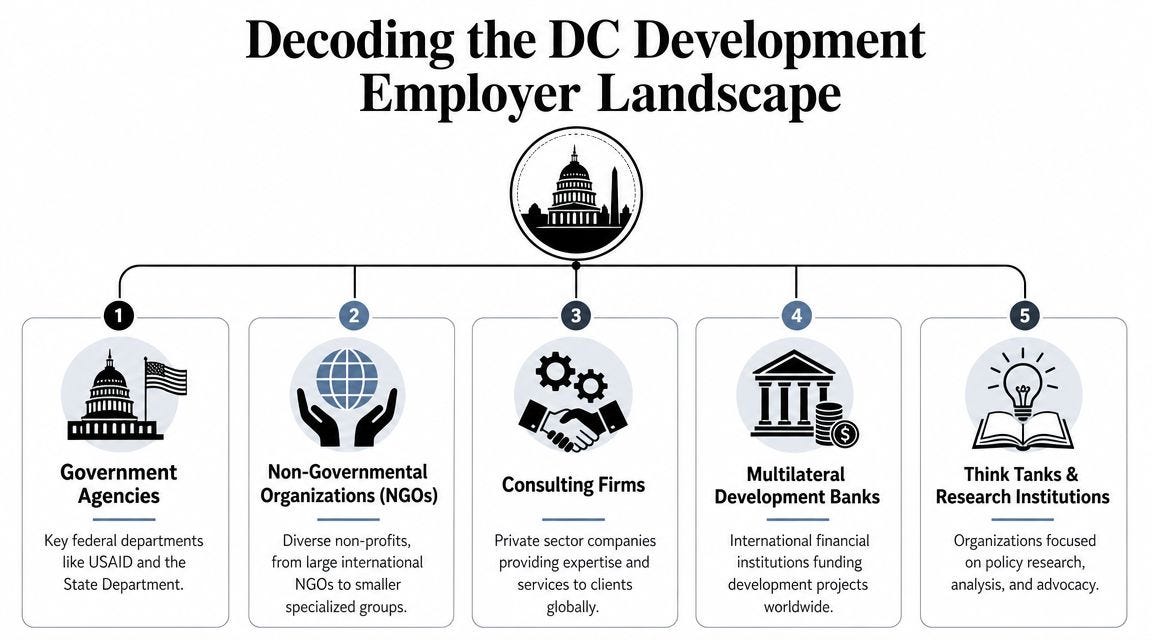
Decoding the DC Development Employer Landscape
Most applicants search by keyword. That’s backwards. Start with employer logic. Once you know how each category hires, you can tailor your pitch to what they value.
Multilateral development banks
MDBs and related international financial institutions hire for structured, specialized work. Think operations, economics, public finance, procurement, safeguards, private sector development, and evaluation. Their hiring tends to favor candidates who can show technical depth, polished writing, and comfort working across governments and internal stakeholders.
Culture matters here. These institutions usually expect precision, discretion, and a strong grasp of process. A candidate who sounds broadly passionate but thin on substance won’t go far.
What works:
Strong analytical writing
Evidence of policy or operational rigor
Experience with governments, donors, or complex institutions
A CV that reads internationally, not domestically
What does not:
Generic “I want to change the world” cover letters
Vague project descriptions
Resumes that hide the candidate’s actual function
Bilateral agencies and government contractors
This lane includes agencies such as USAID-connected work and the large firms that implement, advise, and support donor-funded programs. Contractors often hire for project management, capture, finance, MEL, procurement, staffing, communications, and home-office support.
This side of the market runs on delivery. Hiring managers look for people who understand deadlines, donor rules, budgets, staffing pipelines, and compliance pressure.
A quick comparison helps:

If you’ve only framed your background around mission, rewrite it around execution. In this part of DC, being reliable beats being inspirational.
NGOs from major brands to specialized shops
NGOs in Washington vary wildly. Some are large international implementers with formal systems and donor-heavy portfolios. Others are lean advocacy or membership organizations where one person handles program support, fundraising, events, and partner coordination.
The hiring logic changes with size. Large NGOs often want candidates who can slot into established functions. Smaller organizations want range. They need people who can move from donor correspondence to CRM cleanup to briefing prep without drama.
Hiring managers in smaller DC nonprofits often read for operational maturity before they read for idealism.
That’s why candidates with clean administrative habits often beat candidates with stronger rhetoric.
Consulting firms and think tanks
These are different animals, but they share one trait. They pay attention to writing and judgment. Consultants need people who can solve a defined problem for a client. Think tanks need people who can produce credible analysis and communicate it clearly.
For consulting firms, client management and responsiveness matter. For think tanks, intellectual fit matters. In both cases, sloppy application materials are fatal.
Look for clues in the posting:
If the language emphasizes deliverables, timelines, and client support, treat it like consulting.
If it emphasizes publications, analysis, and policy engagement, treat it like research.
If it sits between both, your application has to show that you can think and execute.
The core point is simple. “International development” is one label covering very different hiring cultures. If you don’t sort the market first, your job search stays noisy and inefficient.
The Real Strategy for Finding Openings
Generic job boards are useful for volume and weak for precision. That distinction matters in Washington. You can confirm the market is active through broad aggregators. Glassdoor’s search shows 4,807 international development jobs in Washington, DC, and SimplyHired shows 5,045. That tells you demand is broad. It does not tell you where the best-fit openings surface first.
Go where development hiring actually happens
Serious candidates use broad platforms as radar, then move quickly to specialist sources and employer sites. Devex and ReliefWeb are standard tools for international development hiring. They won’t replace direct employer monitoring, but they will sharpen your view of who is hiring, in what functions, and at what level.
Then go direct. Bookmark the career pages of your target institutions and check them regularly. That sounds obvious, but many still rely on aggregators to surface roles after everyone else has already seen them.
A practical system looks like this:
Create a focused employer list: Separate MDBs, contractors, NGOs, think tanks, and research institutions.
Set a weekly review cadence: Check priority employers on the same days each week.
Track recurring functions: Program management, M&E, grants compliance, donor relations, research, and operations often appear under different titles.
Use one curated source: MDB Jobs’ remote international development jobs page is one example of a niche resource that can help you monitor development-related openings alongside broader search habits.
Search by function, not by passion statement
“International development” is too broad for a productive search string. It pulls in everything from fundraising to intelligence-adjacent training to policy research. You need narrower filters tied to how employers staff teams.
Good filters include:
Program management
Monitoring and evaluation
Grants and contracts
Business development
Research and policy analysis
Donor relations
Procurement
Finance and operations
Many candidates lose time by searching for the field name instead of the job they can do.
Search the work, not the identity. Recruiters hire for a function.
Timing matters more than people admit
Hiring in DC moves in waves. Budgets get approved. New projects launch. Teams realize they need backfill. Fellowship and structured program timelines also run on their own cycles. That means a dry month does not necessarily reflect your competitiveness.
What works is disciplined monitoring over time. Candidates who apply hard for two weeks and then disappear usually miss the market’s rhythm. The stronger approach is to treat the search like pipeline management. Keep a live tracker, revisit target employers, and follow roles that match your actual profile.
A broad market rewards consistency. It punishes random effort.
Crafting Your Application for a DC Audience
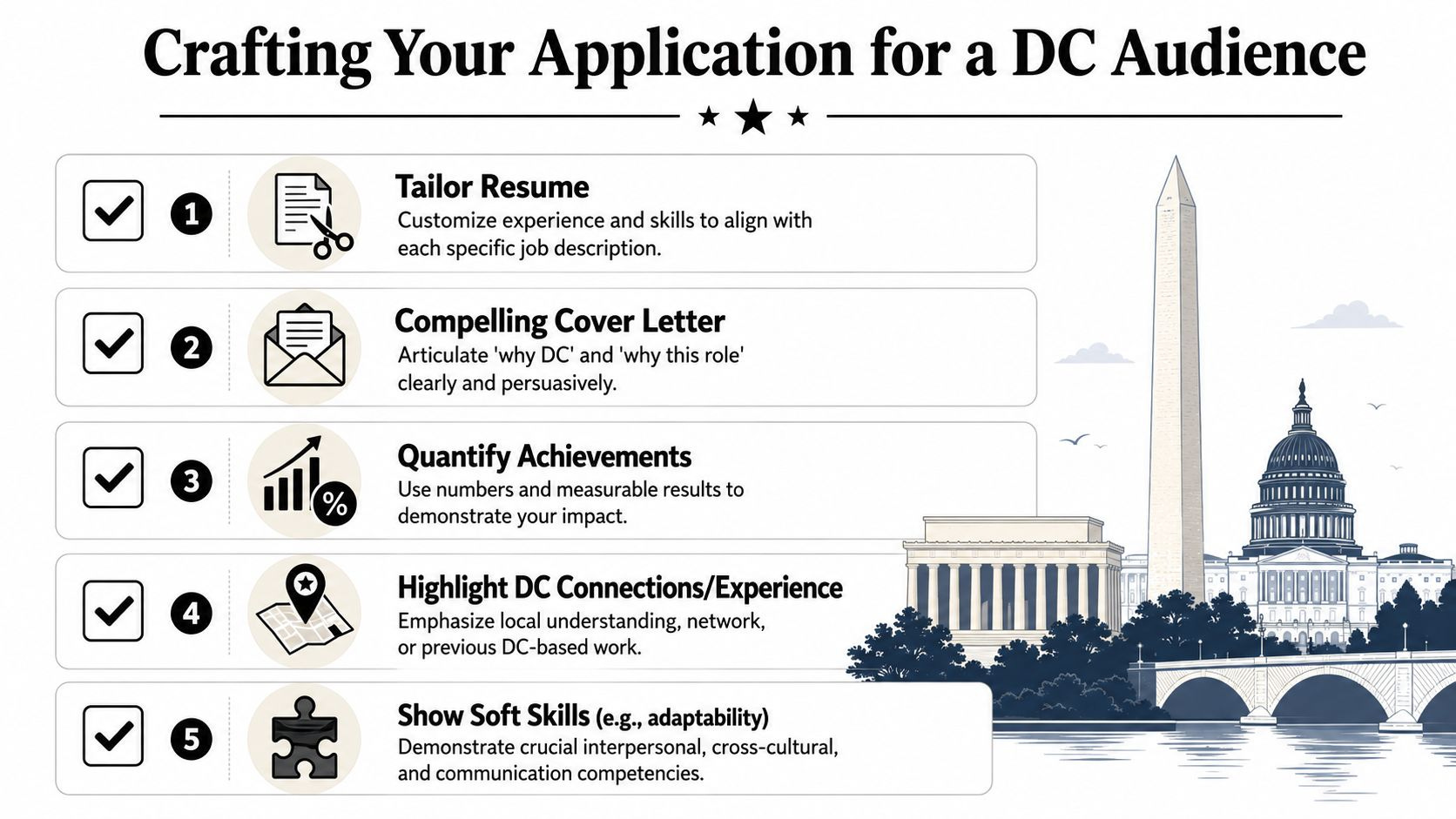
Your resume has one job in this market. It must show that you can solve problems inside a development institution. Most resumes fail because they read like task lists. DC hiring managers don’t need another candidate who “supported program activities.” They need proof that you understood the assignment, took action, and moved work forward.
Build bullets around problem action result
A good DC resume is specific. It shows context, your role, and the outcome. Even when you can’t disclose sensitive details or quantify every result, you can still write clearly about what changed because of your work.
Compare the difference:
Weak: Supported donor reporting and project coordination.
Stronger: Coordinated reporting inputs across program and finance teams, reconciled submission gaps, and helped keep donor deliverables on schedule.
Weak: Assisted with stakeholder engagement.
Stronger: Managed communication flow across partners, tracked follow-ups, and prepared briefing materials that senior staff used in external meetings.
That style tells a recruiter how you operate. It also signals that you understand professional accountability.
Speak the language of the field
DC employers screen fast. If the job description asks for M&E, grants management, IFI exposure, proposal support, CRM fluency, or stakeholder coordination, your application needs to reflect the same vocabulary when it is true to your background.
Do not keyword-stuff. Do translate your experience into language the field uses.
Here’s what strong candidates usually do well:
Match functional terms: If you did monitoring work, call it monitoring and evaluation when appropriate.
Surface tools and systems: Mention CRM platforms, reporting tools, or donor-facing workflows if you’ve used them.
Clarify scope: Show whether your work was country-level, regional, headquarters-based, or client-facing.
Name the audience: State whether you supported donors, implementing teams, senior leadership, or external partners.
This also applies to interviews. If you’re moving into competency-based processes, review how to structure examples before you walk into the room. This guide to passing a competency-based interview is useful because it focuses on how candidates present evidence, not just how they answer casually.
Application standard: Every bullet should answer one of three questions. What did you own, what did you improve, or what did you help deliver?
Cover letters still matter when they add judgment
A cover letter should not summarize your resume. It should explain fit. In DC, that usually means connecting your experience to the organization’s actual work, not reciting your personal values in abstract terms.
A strong letter does three things:
It shows you understand the employer’s mandate.
It explains why your background fits this role specifically.
It demonstrates judgment through concise, relevant examples.
If your letter could be sent to ten different organizations with only the name swapped out, it’s weak. This audience can spot recycled language immediately.
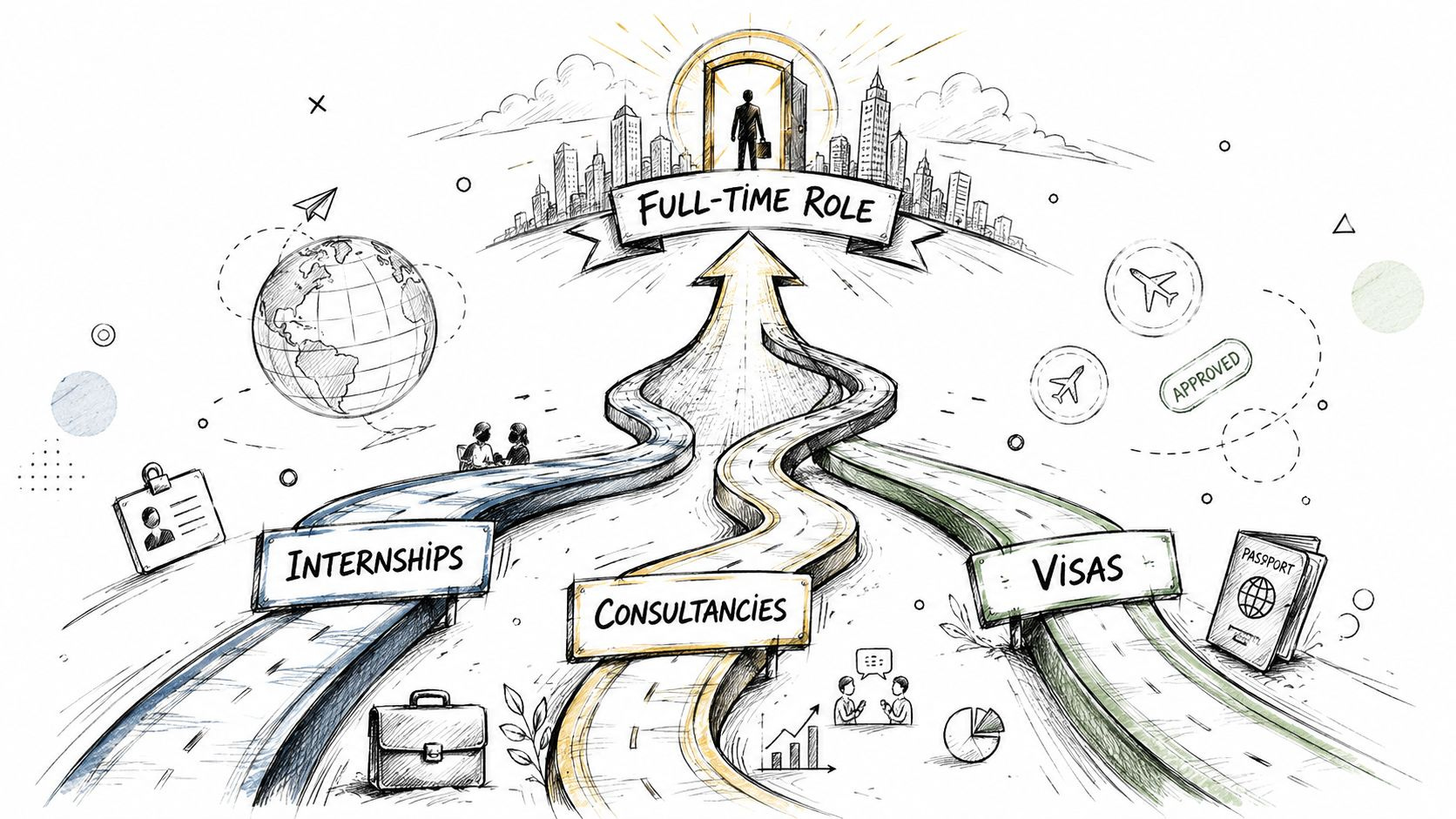
Pathways to Entry Internships Consultancies and Visas
Breaking into international development jobs washington dc often happens through side doors. Full-time staff hiring gets the attention. Internships, short-term consultancies, and operational entry roles do much of the significant access-building.
Internships and early-career roles
In DC, internships function as extended assessments. Teams watch how you write, follow through, manage logistics, and handle ambiguity. If you’re good, people remember. If you’re careless, they remember that too.
Entry-level roles also tend to be more operational than many applicants expect. Indeed’s entry-level results include a Development Associate role at DC Youth Orchestra Program paying $50,000 to $60,000 and requiring 1 to 3 years of experience plus CRM proficiency. That example is development-adjacent rather than field-based, but the skill signal is important. DC employers often use CRM fluency, stakeholder coordination, and clean administrative execution as proof that a candidate can support revenue, reporting, and team workflow.
If you’re early in your career, build around that reality:
Learn a CRM well: Even basic confidence helps.
Show coordination experience: Scheduling, follow-up, reporting support, and database accuracy matter.
Treat internships professionally: Teams often hire from people they’ve already tested.
For candidates looking at institutional pathways, this guide to World Bank jobs for fresh graduates is useful for understanding how early-career applicants can think about bank-facing routes.
Consultancies and short-term contracts
Short-term consulting is one of the clearest bridges into the field. Organizations use consultants when they need a specific skill now, not after a long hiring cycle. That can favor candidates with niche writing, research, data, operations, training, or project support experience.
The trade-off is stability. Consulting can open doors, but it often requires you to manage uncertainty, timelines, and self-marketing better than a staff role does.
Nationality and visa realities
Many candidates need a blunt assessment concerning how visa and work authorization shape access in DC more than people like to admit.
Some multilaterals have their own institutional pathways and visa frameworks. Some NGOs can hire internationally for certain roles. Many organizations, especially for junior and mid-level roles, prefer candidates who already have U.S. work authorization because the process is simpler, faster, and lower risk for them.
For U.S. government-linked work, citizenship or specific authorization can be a major factor. For MDBs and internationally staffed institutions, nationality rules and appointment categories can differ by organization and by role. Read every posting carefully. Do not assume one institution’s eligibility rules carry over to another.
A realistic search is a stronger search. Candidates lose time when they target roles they were never eligible for.
Networking That Actually Works in DC
The worst networking in Washington is easy to recognize. Someone shows up to an event, asks for jobs in the first minute, collects a few business cards, and disappears. That approach rarely produces anything useful.
The networking that works is slower and more deliberate. It starts with a real target, a reason for the conversation, and a question worth asking.
A better event strategy
Say you attend a public event at a think tank or policy school. One candidate asks a broad question designed to sound impressive. Another asks a specific question about donor shifts, implementation bottlenecks, or how a team manages cross-functional coordination. Guess which one sounds employable.
After the event, the follow-up should be light and intelligent. Thank them for the point they made. Mention the issue you’re trying to understand better. Ask for a short informational conversation if there’s a clear fit.
That works because it respects the other person’s time and shows that you’re serious enough to do your homework.
Ask for perspective, not for a job. Good conversations create referrals later.
Informational interviews that produce signal
A strong informational interview is not a disguised application. It’s a market research call. Your goal is to understand how someone entered the field, what their team hires for, and what mistakes they see candidates make.
Useful questions include:
What backgrounds tend to do well on your team
Which skills are hardest to hire for right now
How do applicants usually misunderstand this kind of role
What would make someone credible for an interview six months from now
Then listen. Take notes. If the person gives advice, act on it before you reconnect.
The unspoken rule
DC is a city of repeated contact. People notice who follows through, who writes clearly, and who shows professional restraint. A concise thank-you email after a useful conversation does more for your reputation than a long pitch about your ambitions.
Most networking pays off indirectly. You learn how employers think. You refine your application language. You hear about teams before roles become obvious. That’s the point.
Your 30-60-90-Day DC Job Search Plan
A DC search goes better when you run it like a workstream. The market is large, but it’s also competitive. Indeed, SimplyHired, and Glassdoor each show around 5,000 international development openings in Washington, DC. That volume creates opportunity and noise at the same time. Persistence and role-specific filtering matter.
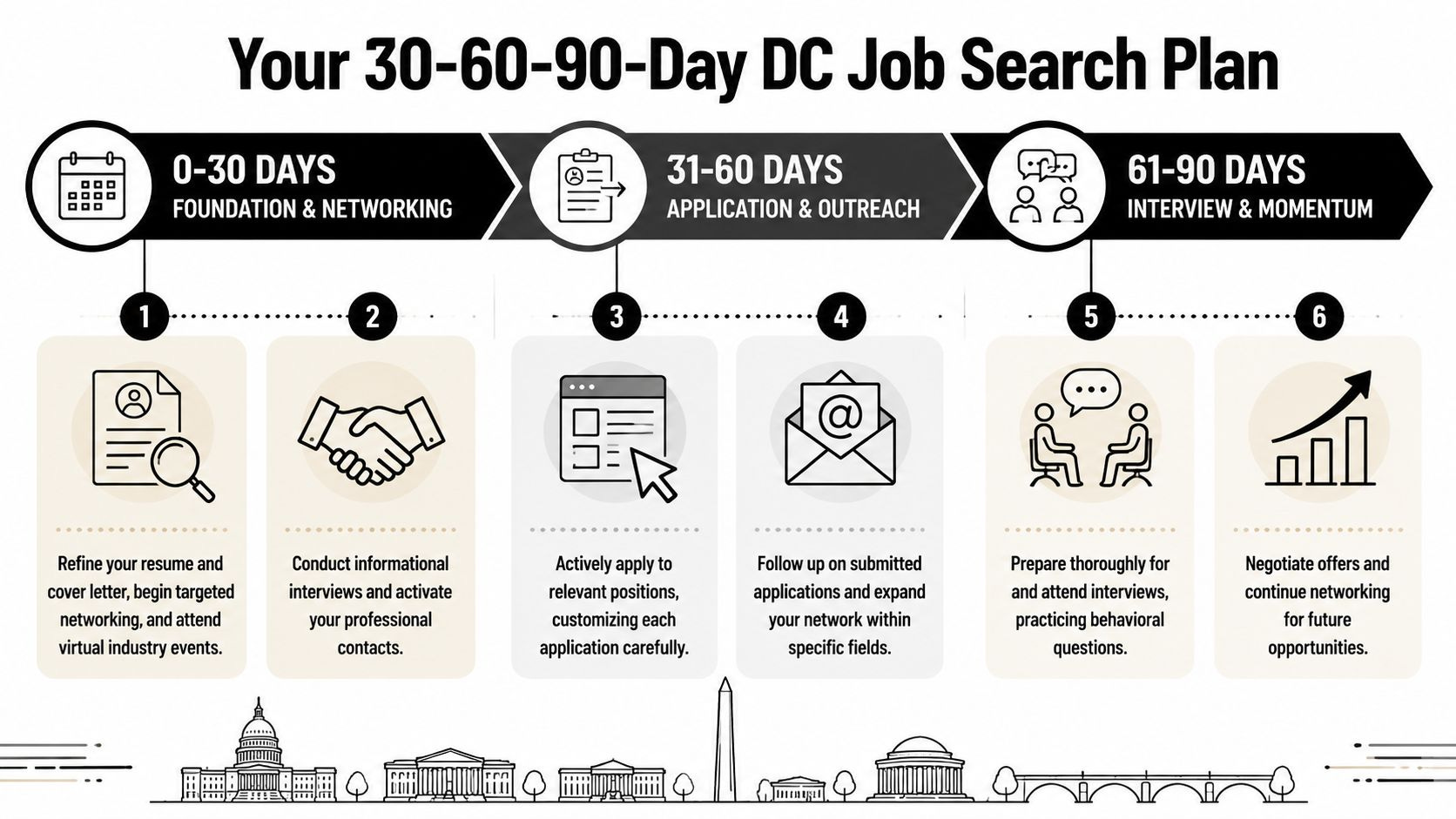
Days 1 to 30
Start with clarity. Pick target employer categories, define your functional lane, and rebuild your CV around results and relevance.
Your core tasks:
Build a target list: Focus on organizations that match your background.
Rewrite materials: Tailor your resume, cover letter template, and LinkedIn profile.
Set your search system: Save searches by function, not just by field.
Start outreach: Request a small number of informational conversations with clear intent.
Days 31 to 60
This phase is about disciplined execution. Apply selectively, customize every serious application, and keep networking active.
Use a tracker that includes role, deadline, contact points, status, and follow-up date. If you’re applying widely without tracking patterns, you won’t learn what is and isn’t working.
Days 61 to 90
Shift toward interview performance and pipeline management. Review your examples, tighten your story, and keep momentum even if responses are uneven.
A practical checklist helps:
Prepare interview stories: Use examples that show judgment, coordination, and delivery.
Follow up professionally: Short, clear messages are enough.
Adjust based on evidence: If one lane produces interviews and another produces silence, lean into the lane with traction.
Keep the network warm: Update useful contacts when there’s a genuine reason.
This market rewards candidates who stay organized, self-aware, and steady. Random effort looks random.
If your target is multilateral hiring, Multilateral Development Bank Jobs is a practical place to monitor openings and career guidance tied to institutions like the World Bank, IMF, ADB, AfDB, and AIIB. That’s useful when you want a more focused view of the MDB side of the DC ecosystem instead of relying only on general job boards.