

You’re probably looking at an MDB posting right now with three reactions at once.
First, the job sounds familiar. Second, the wording feels vague. Third, the requirements look broader than what one person could possibly do. That’s normal. An international development job description often reads like a mix of HR template, operational wish list, and institutional politics.
Many candidates misinterpret job descriptions by reading them plainly. MDB job descriptions are strategic documents. They tell you what the unit needs, what the manager worries about, how the institution defines risk, and where the effective screening line sits. If you can read that subtext, you stop applying like a hopeful generalist and start applying like someone who already understands how the bank works.
The Anatomy of an MDB Job Description
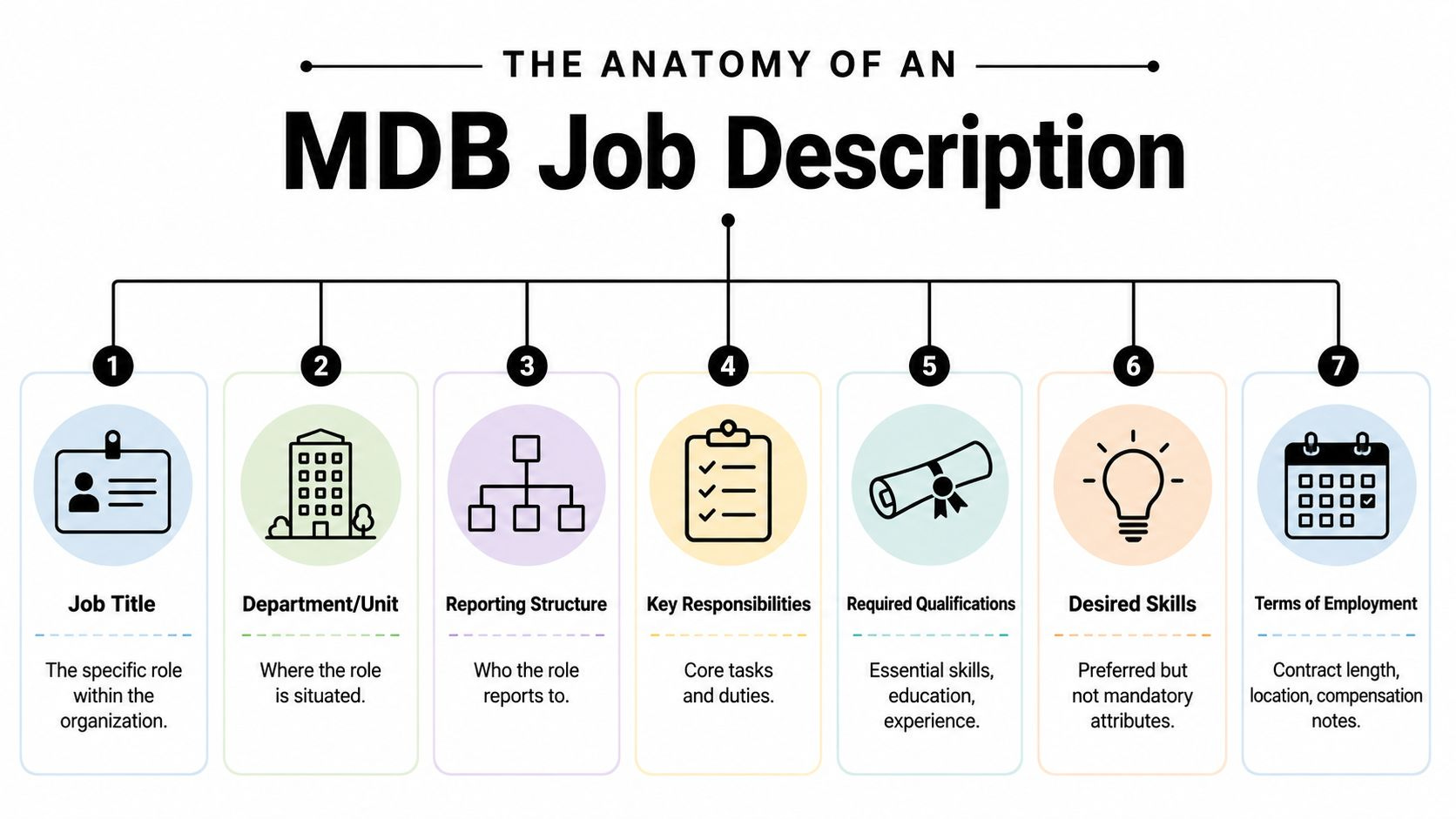
Most MDB postings follow a recognizable structure. The labels vary a bit by institution, but the logic is steady. The document is built to answer seven questions: what the role is, where it sits, who it supports, what work gets done, what qualifications are mandatory, what qualifications are preferred, and what employment terms shape the offer.
Sector guidance describes international development as a broad field focused on reducing poverty and improving health, education, infrastructure, gender equality, and environmental sustainability in low- and middle-income countries. It includes roles such as programme officer or manager, policy analyst, monitoring and evaluation specialist, grants manager, and technical advisor, with major multilateral employers including UNICEF, UNDP, UNHCR, the Asian Development Bank, and the World Bank Group. The same guidance notes that graduate routes and field experience are common entry paths, and that employers often ask for advanced degrees, multilingual ability, and hands-on programme experience because the work spans policy, donor relations, humanitarian coordination, and organisational change (career guidance on international development roles).
Start with the title and grade
The title tells you less than the grade. “Officer,” “Specialist,” “Analyst,” and “Consultant” can mean very different things across institutions. Grade is where the signal sits. It usually points to the level of independence expected, the complexity of stakeholder management, and whether the job exists to support delivery or shape it.
A junior candidate often gets distracted by the title and misses the operating level. Don’t do that. If the grade implies the role must manage external counterparts, review technical outputs, and represent the unit, the hiring manager is not looking for potential alone. They’re looking for proof.
Read the context paragraph like a briefing note
The opening background section is usually bland on the surface. It still matters. It tells you why the role exists now.
Look for language around lending operations, policy dialogue, portfolio performance, country support, climate, fragility, digital systems, or institutional reform. That framing is a clue to what will matter in the interview. If the background paragraph leans heavily toward implementation bottlenecks, then the role is probably about execution. If it leans toward strategy, analytics, or donor alignment, then the work will likely involve synthesis and influence.
Practical rule: The first third of the posting usually tells you what problem the team is trying to solve. The last third tells you how they’ll filter applicants.
Separate core duties from decorative duties
Not every bullet in responsibilities carries equal weight. Usually, a handful of bullets define the core job. The rest reflect institutional completeness.
Here’s a clean way to read them:
Core delivery work: These bullets describe what you’ll spend most of your time doing. Think pipeline review, project supervision, analytics, reporting, coordination, or policy support.
Visibility work: These include presentations, knowledge products, missions, and stakeholder engagement. Important, but often secondary.
Institutional filler: Phrases like “perform other duties as assigned” matter for flexibility, not fit.
A useful shortcut is to ask: which bullets would make the manager anxious if left undone for two months? That’s the true role.
For candidates tracking openings across institutions, curated listings like international development group jobs can help you compare how similar roles are described in different banks and agencies.
The selection criteria decide the shortlist
This is the section often skimmed. It’s the section that decides whether your application survives.
Use this quick reading table:
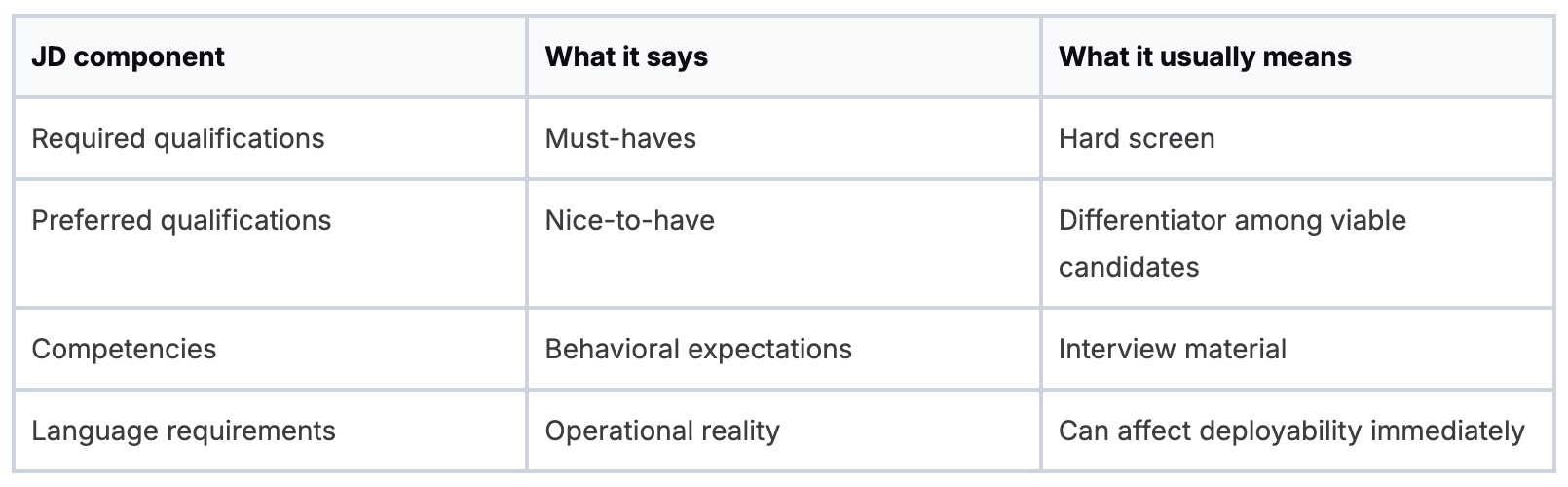
If a criterion is listed under “required,” assume HR will use it to eliminate applicants before the hiring manager sees the file. If it sits under “preferred,” you can still compete without it, but you need stronger evidence elsewhere.
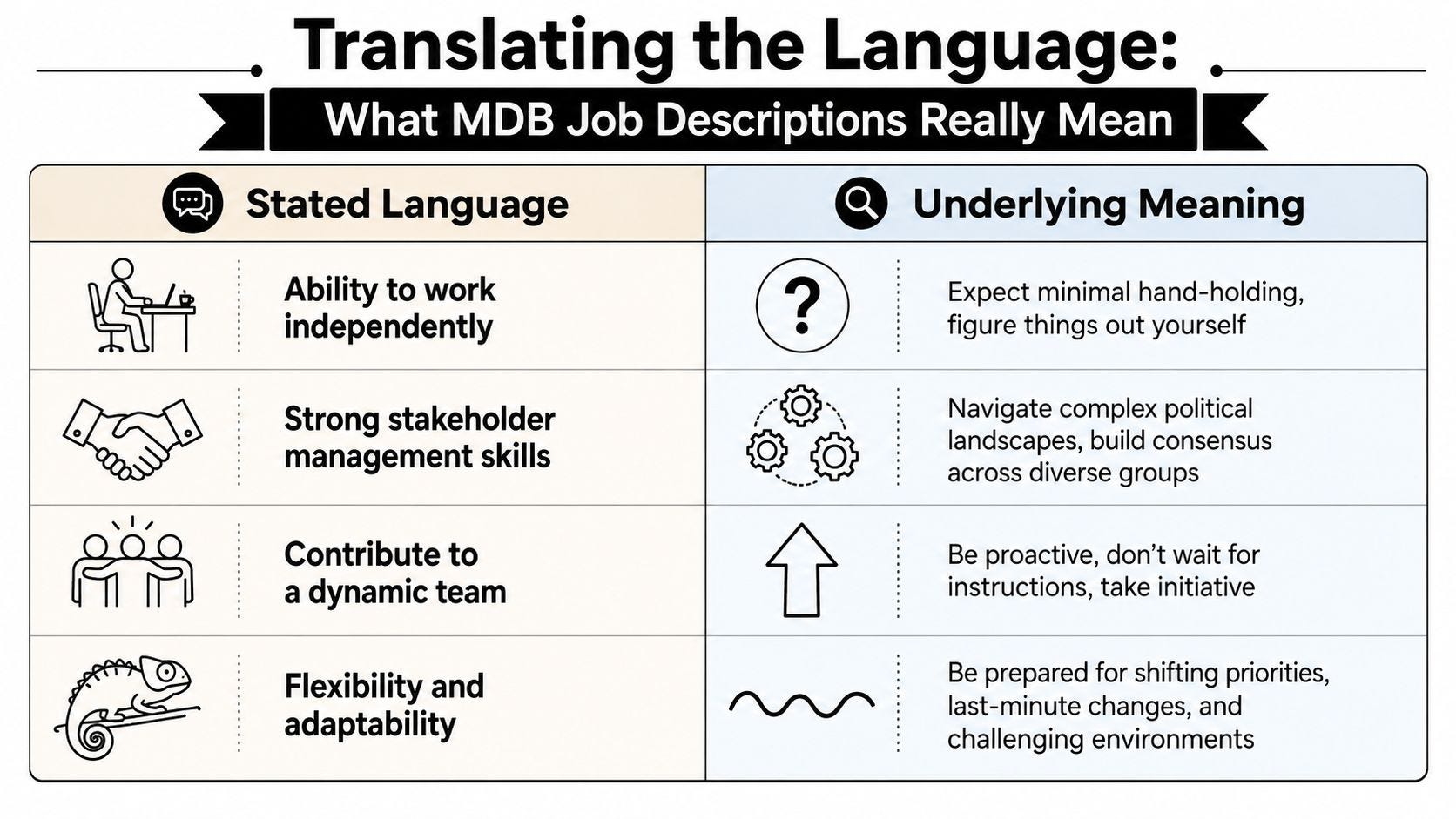
Translating the Language What They Really Mean
Most candidates read MDB wording at face value. That’s a mistake. Institutional language is polite, formal, and carefully neutral. The underlying message sits underneath.
The biggest shift in recent postings is straightforward. Employers increasingly value monitoring and evaluation, program management, and policy advisory skills because development organizations and donors are focusing more on measurable outcomes. That makes the international development job description more technical than older guides suggest. Applicants need data analysis, project management, and cross-cultural communication, and the field has become more evidence-driven and operationally demanding (labor-market analysis on fast-growing development skills).
Common phrases and the real test behind them
Here’s how experienced applicants read standard wording.
“Strong analytical skills” usually means you must show that you can handle structured evidence, not just write clearly.
“Experience in multicultural environments” means you’ve worked across conflicting incentives, not just traveled widely.
“Ability to work independently” means the team is stretched and won’t coach you through basics.
“Excellent communication skills” means you’ll need to brief busy people fast, often in writing.
“Stakeholder management” means government counterparts, donors, internal reviewers, and sector specialists all want different things.
That last point matters more than candidates realize. In MDB work, stakeholder management is rarely social polish. It’s operational judgment under pressure.
Why technical language now shows up more often
A lot of older career advice for development jobs still centers on commitment, mission fit, and broad thematic interest. Those still matter. They just don’t carry the same weight in screening.
Teams are under pressure to show results, manage complex programs, and defend decisions with evidence. That’s why you now see more references to M&E, delivery systems, implementation support, operational reporting, and policy follow-through. If a posting mentions results frameworks, indicators, portfolio reviews, implementation progress, or learning loops, the team wants someone who can work inside a results culture.
If a JD sounds abstract, assume the team still has concrete pain points. MDB managers hire to reduce execution risk.
A useful lens here is results-based management. If you’re not already familiar with that logic, this overview of what results-based management means in practice will help you decode why so many postings now prioritize measurement and delivery language.
How to prove fit without the exact title
You do not need a perfect title match. You need evidence that transfers.
For example, if the role asks for policy advisory experience, you can make a credible case with work that involved drafting recommendations, briefing decision-makers, or helping translate technical findings into institutional action. If it asks for program management, show ownership of timelines, coordination, risk tracking, and reporting. If it asks for M&E, show indicator design, data interpretation, learning reviews, or progress reporting.
What does not work is saying you’re “passionate about development” and expecting that to bridge a technical gap. Hiring teams may appreciate the motivation. They shortlist the candidate who can do the work.
How Job Descriptions Change by Career Level
A junior economist and a senior sector specialist can sit in the same transport unit and read completely different job descriptions. That is not HR wordplay. It reflects what the team needs the person to carry on day one.
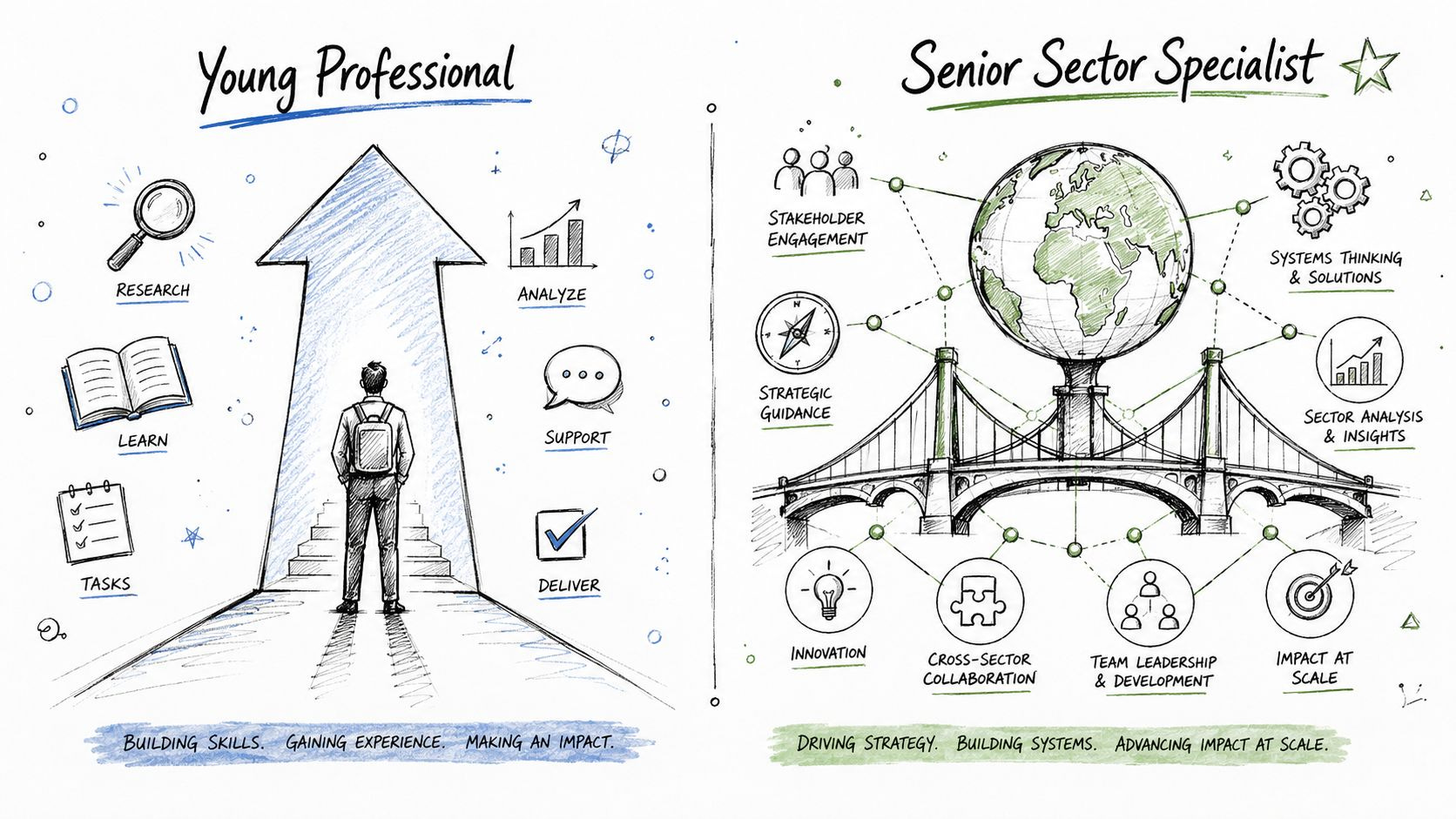
At each level, the posting is testing a different kind of risk. Junior roles test whether you can produce reliable work under supervision. Mid-level roles test whether you can apply judgment without constant guidance. Senior roles test whether you can protect quality, manage institutional relationships, and keep delivery on track when the politics get messy.
That shift has become sharper in recent years. MDBs still care about diplomacy and sector familiarity, but many teams now screen harder for technical credibility. If a posting asks for econometrics, portfolio analytics, impact evaluation, geospatial work, financial modelling, or implementation data, do not treat that as decorative language. In a lot of units, those skills moved from “nice to have” to shortlist criteria.
Entry level means usable fast
At the junior end, nobody expects you to run a portfolio. They do expect you to become productive quickly.
That is why entry-level JDs often emphasize academic training, analytical discipline, drafting, and support to operations or research. The subtext is simple. The manager needs someone who will not create extra review cycles. Clean spreadsheets, solid notes, accurate citations, and sensible first drafts matter more than inflated claims about leadership.
Typical signs of an entry-level role:
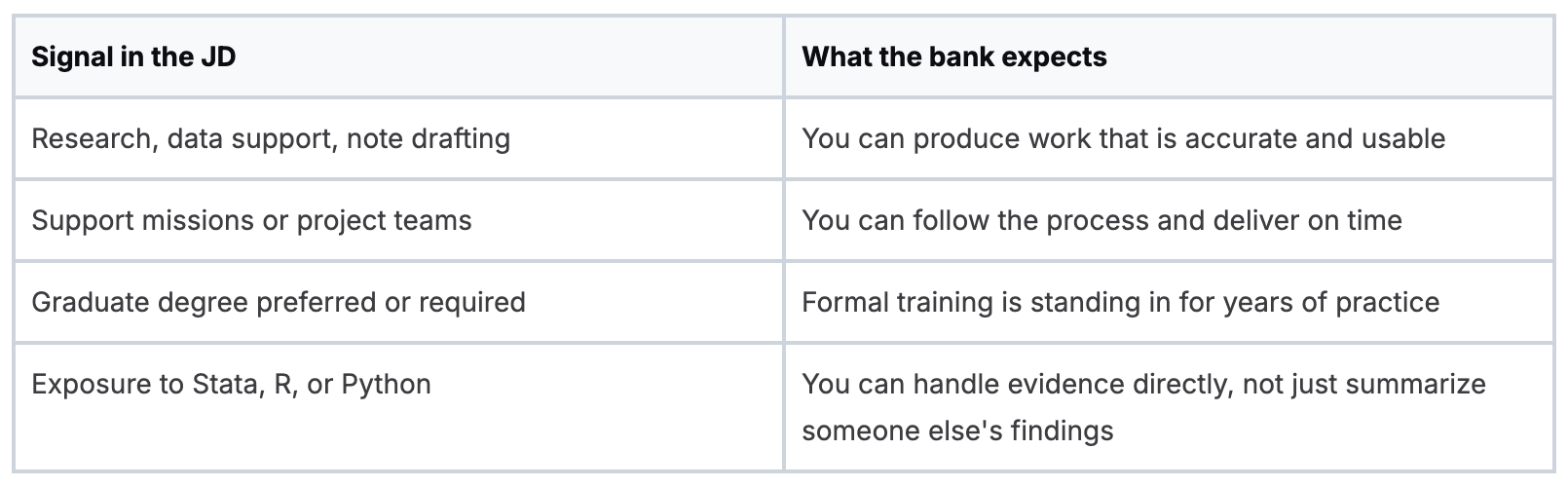
A practical warning. Junior candidates often focus on the sector words and miss the delivery words. If the posting says “support preparation of project documents” or “contribute to implementation monitoring,” the team is not hiring a general enthusiast. They are hiring someone who can read guidance, process comments, and turn around decent work at speed.
Mid-career specialist roles reward repeatable judgment
Many applications fall apart at this point.
Candidates with six or eight years of experience often assume time served is enough. MDB hiring teams usually read the file differently. They ask whether you have handled comparable problems, with comparable stakeholders, under comparable constraints. A mid-career posting is less interested in potential than in proof.
At this level, the language usually shifts toward ownership. You may see responsibility for supervising consultants, advising counterparts, reviewing project design, leading analytical inputs, or coordinating across country teams and sector teams. The hidden test is whether you can make sound calls without escalating every issue upward.
The technical bar also gets less forgiving. If the unit is under pressure to show results, “familiarity with data analysis” may really mean the team wants someone who can structure a dataset, interrogate assumptions, and defend conclusions in front of economists, engineers, or government counterparts. If the posting mentions implementation support, quality assurance, or results reporting, expect the panel to probe how you handled trade-offs, not just what you delivered.
Hiring manager lens: Mid-level experience means judgment you can repeat under pressure. One good project helps. A track record of good decisions gets trusted.
Senior roles are about scale, judgment, and institutional friction
Senior managers and senior specialists are hired for reach. Their decisions affect bigger portfolios, more people, and more sensitive relationships.
The language reflects that. JDs at this level move toward strategy, portfolio oversight, team leadership, client dialogue, resource planning, and external representation. Technical depth still matters, especially in banks that have raised the bar on evidence and operational quality. But the institution is also asking a harder question. Can this person keep standards high without slowing the machine down?
A few practical differences usually show up:
Entry level: “Assist,” “support,” “contribute,” “analyze.”
Mid-career: “Lead,” “manage,” “coordinate,” “advise.”
Senior: “Oversee,” “shape,” “represent,” “drive.”
Read those verbs carefully. They tell you how much institutional weight the role carries.
If you are applying one level up, show a clear increase in scope. For junior-to-mid moves, prove independent execution and technical judgment. For mid-to-senior moves, prove that you improved team output, handled difficult counterpart relationships, and made decisions that held up under scrutiny. Strong analysis helps at every grade. It does not substitute for evidence that you can carry the level of risk the job is designed to absorb.
A Sample MDB Job Description Template Annotated
Theory helps. A marked-up example helps more. Below is a fictional MDB posting for a Project Analyst, Climate Finance role, followed by the kind of reading an experienced insider would apply.
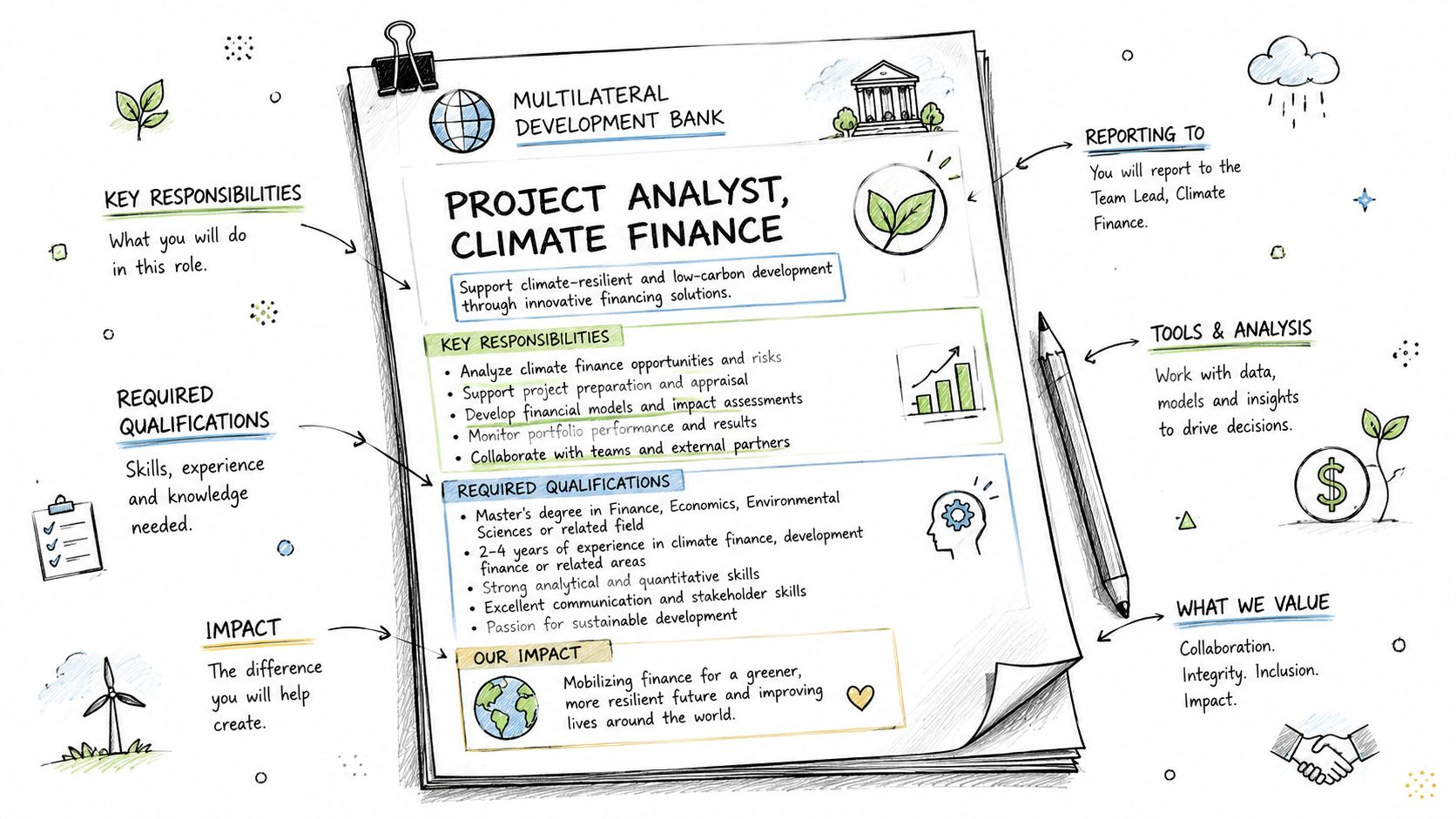
Fictional posting
Job title
Project Analyst, Climate Finance
Department
Climate and Sustainable Finance Unit
Reporting line
Reports to Senior Climate Finance Specialist
Role summary
The Project Analyst supports preparation, implementation monitoring, and analytical work for climate-related investment operations and technical assistance activities.
Key responsibilities
Support project teams in preparing financing documentation, background notes, and implementation updates
Review project data and contribute to results tracking and internal reporting
Coordinate inputs from sector teams, country units, and external counterparts
Draft presentations, briefing notes, and knowledge materials for internal and external audiences
Support portfolio reviews and follow-up actions linked to implementation performance
Contribute to analytical work related to climate finance trends, instruments, and operational lessons
Required qualifications
Advanced degree in economics, public policy, finance, environmental studies, or related field
Relevant experience in project support, development finance, public policy, or program analysis
Strong quantitative and writing skills
Ability to manage multiple deadlines across teams
Professional fluency in English
Preferred qualifications
Exposure to climate finance, blended finance, or sustainable investment
Experience with data analysis tools
Additional language skills
What each block is really doing
The job title sounds straightforward, but “Project Analyst” usually signals a delivery support role with some technical content. You’re not shaping the institution’s climate strategy here. You’re helping teams move work through the system accurately and on time.
The department and reporting line matter because they define your operating environment. Reporting to a senior specialist often means the role sits close to active operations. That usually brings faster turnaround, more drafting, and less room for abstract research detached from delivery.
The role summary contains the strongest clue in the whole posting: “preparation, implementation monitoring, and analytical work.” That combination tells you the unit wants someone who can move between operations and evidence. A candidate who only knows research will look incomplete. A candidate who only knows coordination will also look incomplete.
How to answer a posting like this
Use the responsibilities as prompts for proof. If the posting says “review project data,” your CV should show where you handled performance information, indicators, reporting, or analysis. If it says “coordinate inputs,” give one example where you pulled contributions from multiple teams into a usable output.
A practical way to annotate the posting for yourself is to create a three-column worksheet:
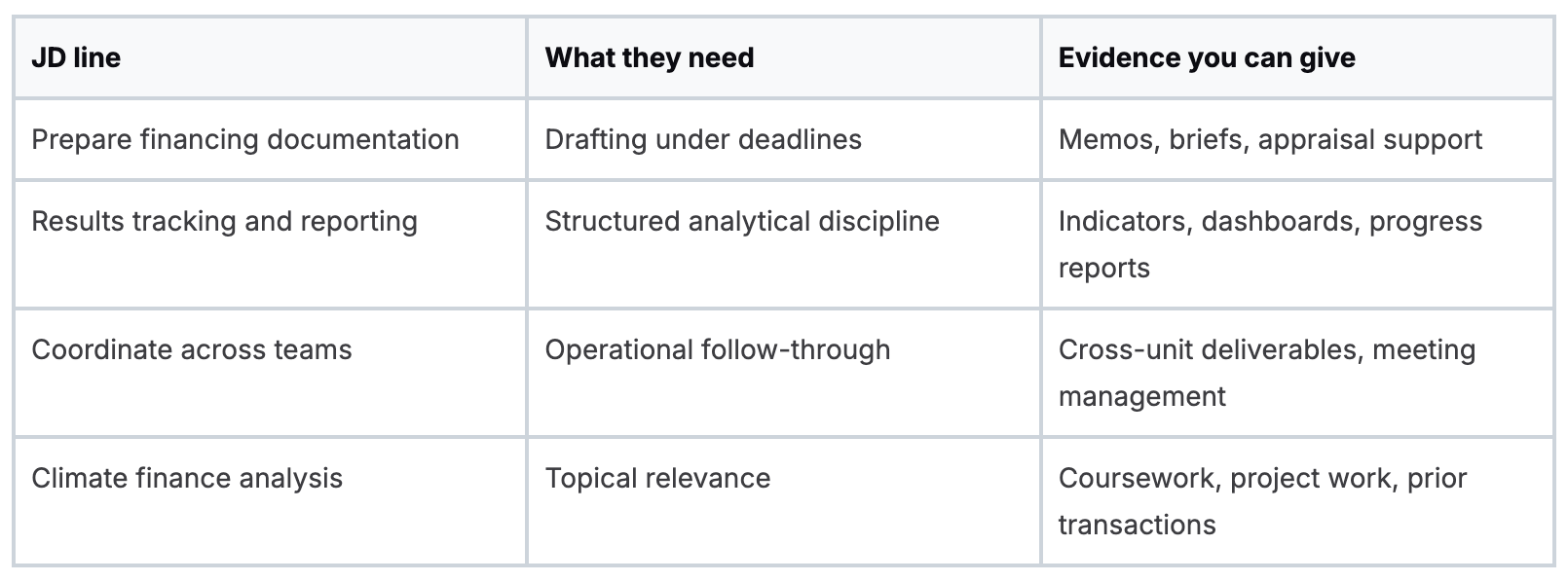
“If you can’t point to evidence for each major duty, your application is still too generic.”
The required qualifications section tells you what must be visible in the first pass. The preferred qualifications tell you how to tilt the decision in your favor. If you have climate finance exposure, put it high on page one. If you have tool experience, name the tool. If you have multilingual ability, don’t bury it at the end.
Building Your Application Strategy from the JD
A strong application is a direct response to the posting. Not a life story. Not a values statement. Not a recycled CV with a new cover letter on top.
Most weak applications fail because they make the screener do interpretive work. Your job is to remove that burden.
Mirror the posting without parroting it
Mirroring means using the institution’s language where it accurately reflects your experience. It does not mean copying lines from the JD and hoping nobody notices.
If the posting prioritizes implementation monitoring, don’t describe your experience only as “project support.” Name the monitoring work. If it asks for policy advisory skills, don’t bury your policy memo, briefing, or reform support experience under a vague “research” heading. Match your evidence to the institutional wording because that’s how screeners and applicant systems sort relevance.
A practical workflow looks like this:
Highlight the hard requirements and specify which ones are mandatory.
Circle repeated concepts such as implementation, analytics, coordination, or reporting.
Rewrite your top bullet points so they answer those requirements directly.
Cut unrelated material even if you’re proud of it.
Structure your CV for fast screening
The first page has one job. It has to show that you meet the role.
That usually means:
Headline alignment: Use a short summary that reflects the role’s actual content.
Front-loaded relevance: Put your most relevant experience first, not just your most recent if the difference matters.
Visible tools and methods: If you know Stata, R, Python, Excel modeling, results frameworks, or portfolio reporting, state it clearly.
Clear sector anchors: Climate, education, infrastructure, governance, health. Name the field.
One practical resource in this space is Multilateral Development Bank Jobs, which publishes MDB and related vacancies along with guidance that can help candidates compare role language and prepare more targeted applications.
Write a cover letter that answers institutional need
A cover letter for an MDB role should open with fit, not autobiography.
Bad opening: broad enthusiasm, generic mission language, long personal background.
Better opening: direct alignment with the role’s core need.
For example, if the posting centers on portfolio monitoring and analytical support, your opening paragraph should say that you bring relevant experience in project reporting, data analysis, and coordination across teams. Then prove it with one or two concrete examples.
Use this checklist before submitting:
Selection criteria covered: Every required item appears somewhere in the CV or letter.
Keywords mirrored accurately: Same concepts, your own wording.
Evidence over adjectives: “Managed reporting across multiple stakeholders” beats “excellent communicator.”
Role level respected: Don’t pitch yourself as a strategist for an analyst role, or as a support officer for a leadership role.
File coherence: CV, cover letter, and application form should tell the same professional story.
Candidates often think tailoring means polishing. In MDB hiring, tailoring means building a case file.
Your Final Check Before You Apply
Before you hit submit, stop reading the job description as an advertisement and read it as a set of institutional clues.
The title tells you the level. The context tells you the problem. The duties tell you where the team is overloaded. The criteria tell you how the first cut happens. Once you see that, you stop wasting time on roles where your profile doesn’t match and you get sharper on the ones where it does.
Use a final five-point test.
Have you identified the top three real duties? Not every bullet matters equally.
Have you translated vague phrases into operational demands? “Analytical” and “stakeholder” always need proof.
Does page one of your CV show the required fit? If not, the rest may never be read.
Does your cover letter answer the role’s main need in the opening paragraph? It should.
Are you ready for competency-based examples if shortlisted? If not, prepare before applying, not after.
For that last step, it helps to review how to pass a competency-based interview so your written application and interview examples line up.
A good international development job description rewards careful reading. A great application turns that reading into evidence. That’s the difference between sounding interested and looking appointable.
If you want a steady stream of MDB vacancies plus practical guidance on how these institutions hire, Multilateral Development Bank Jobs is a useful place to track roles and sharpen your application strategy.