

You’ve probably done this already. You open a foundation or MDB vacancy, read a mission statement that sounds perfect, then hit the requirements and wonder whether you’re underqualified, overqualified, or just invisible in a pile of applicants.
That confusion usually comes from treating all development employers as one market. They aren’t. Foundations, multilateral development banks, bilateral contractors, UN agencies, and implementing partners hire for different reasons, on different timelines, and with different filters. If you want international development foundation jobs, you need to read the ecosystem the way hiring managers do.
A strong search starts with realism. You need to know where the jobs sit, how institutions screen, what contract structures mean for your career, and how to turn short-term work into something durable.
Understanding the Development Job Market
You read a vacancy at a foundation and think, “I’ve done this work.” Then you open an MDB posting in the same sector and realize the institution is hiring for a completely different job. One wants grant portfolio judgment, board-ready writing, and donor diplomacy. The other wants lending operations, procurement discipline, and comfort working inside a grade structure.
That gap is why good applicants miss the market.
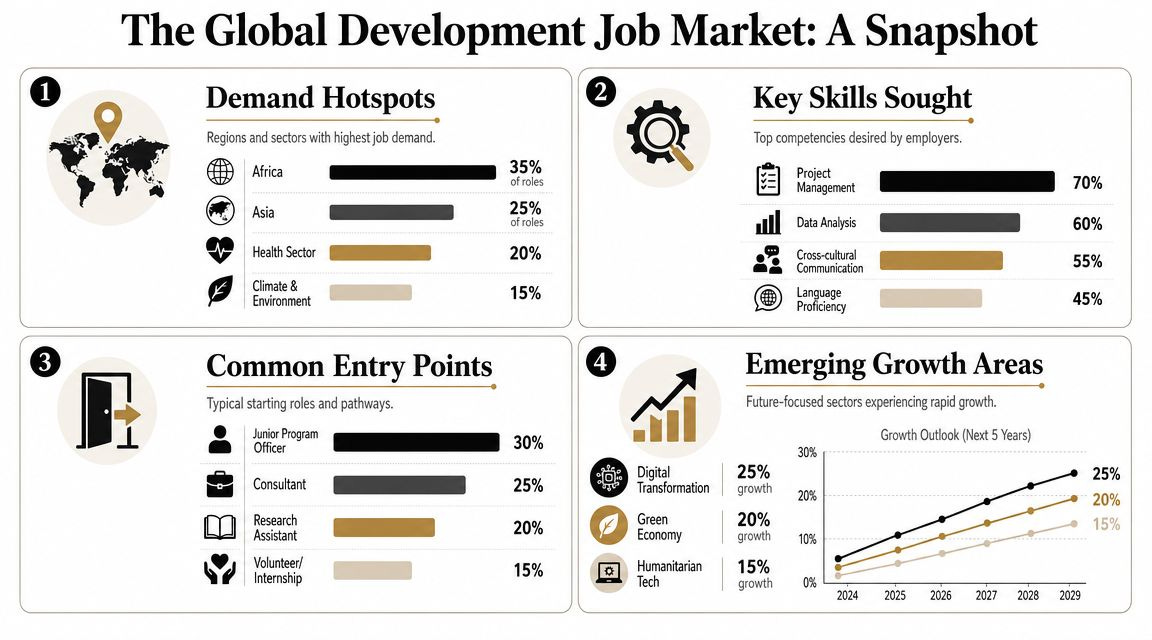
In the United States alone, Cause IQ lists 17,475 international development organizations employing 296,817 people, generating more than $45 billion in annual revenue, and holding $126 billion in assets. This is significant because it reveals something simple and useful. International development foundation jobs sit inside a real labor market with distinct employer types, budget models, and hiring filters.
Learn the employer types before you apply
Applicants waste months by treating development hiring as one category. It is a cluster of separate markets.
Foundations usually hire around strategy, grantmaking, partnerships, research, policy influence, MEL, communications, and internal operations. The bar is often judgment. Can you assess a portfolio, write clearly for senior stakeholders, spot execution risk in a grantee, and represent the institution without creating noise? Foundation teams are often small, which means one hire can carry a wide brief.
MDBs hire around lending and advisory operations, economics, public sector management, private sector development, safeguards, fiduciary functions, and corporate services. The process is more formal. Grades matter. Competencies are mapped in advance. Interview panels often test whether you can operate inside a large bureaucracy without slowing delivery.
Implementing partners hire to deliver contracts and grants. They care about workplans, donor rules, field coordination, budget burn, technical quality, and client confidence. If a foundation asks, “Can this person shape a smart portfolio?” an implementer often asks, “Can this person deliver by quarter end without creating a compliance problem?”
Those are different careers, even when all three roles sit under climate, health, or education.
If you are targeting bank pathways, a focused source of international development group jobs helps separate MDB and related institutional roles from the wider development market.
Volume matters less than institutional fit
A busy market does not make the search easy. It raises the cost of applying badly.
Hiring teams at foundations and MDBs use fast filters. They screen for function, grade fit, geography, language, sector familiarity, and whether your experience matches how the institution operates. A strong NGO program manager can still miss at a foundation if the role is really about grant governance and board communication. A sharp policy adviser can still miss at an MDB if they have never handled operational cycles, public finance, or cross-unit clearance processes.
This is the unwritten rule. Employers are rarely hiring “passion for development.” They are hiring for institutional risk reduction.
What this means for your strategy
Search by institution type, function, geography, and contract type, then by issue area. That order saves time.
A program officer role at a private foundation, an operations analyst role at an MDB, and a grants manager role at an implementing partner may all touch the same sector, but they reward different evidence. One application needs portfolio examples and concise writing. Another needs transaction or project-cycle experience. The third needs proof that you can deliver under donor deadlines.
Use the mission statement to decide whether the employer is worth your time. Use the vacancy language to decide whether you are competitive.
Candidates who get hired usually do one more thing well. They build a market map before they start applying. They know which institutions use fixed-term contracts as a feeder pool, which teams hire consultants before staff, which offices recruit locally, and which roles are realistic at their experience level. That is how a scattered search turns into a durable development career.
Where to Actually Find Foundation and MDB Jobs
Tuesday, 7:40 a.m. A foundation posts a grants officer role with a 10-day deadline. By Thursday, strong candidates have already pulled the vacancy PDF, checked who the role reports to, and started tailoring. By the final weekend, the portal is full of applications from people who found the job too late or treated it like a generic development opening.
That gap matters. Good candidates do not just search harder. They build a system around how foundations and MDBs hire.
General job boards can help with visibility, but they are rarely where a serious search begins. The highest-value openings usually appear first on institutional career portals, specialist development platforms, consultant rosters, and mailing lists tied to the employer itself. If you want a stable pipeline, use all four.
Use the right platform for the right kind of role
Here is the split that saves time.
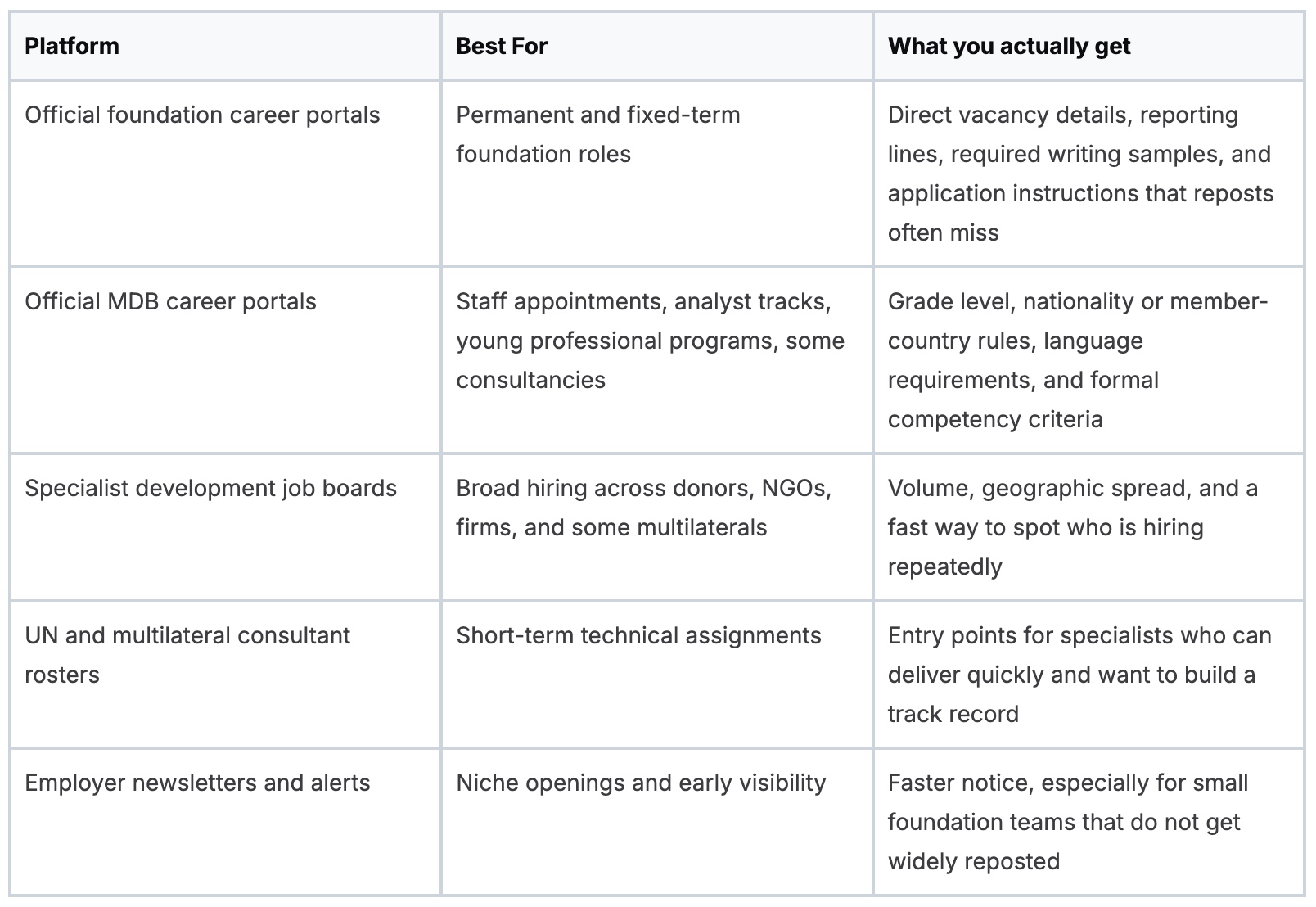
Each source serves a different purpose. Official portals are slower to scan, but they carry the cleanest information. Specialist boards are useful for market coverage, but they include noise. Consultant rosters move fastest and reward candidates who already have a polished CV, references, and a reusable statement of interest.
If you need help with that document, keep a template based on a strong statement of interest for MDB and foundation applications. It saves hours when short-term assignments open with little notice.
Build a monitoring routine you can sustain
Do not rely on memory. Use a tracking sheet.
Five columns are enough:
Institution
Role title and grade
Deadline
Status
Tailoring notes
That last column is where weak searches fall apart. If you cannot write one line on what the institution cares about and what proof you will use, you are not ready to spend 90 minutes on the application.
A simple weekly routine works better than occasional bursts of effort.
Monday: Check target foundation and MDB portals for newly posted staff roles.
Wednesday: Review openings that require writing samples, cover letters, or technical statements.
Friday: Scan consultant rosters and short-term assignments.
Weekend: Finish one or two strong applications and archive the rest.
That rhythm sounds basic. It works because development hiring is uneven. Some institutions post in clusters around budget approval, board cycles, grant rounds, or new project launches. A repeatable search process catches those windows.
Know what each source signals
A posting is not just a vacancy. It is a clue about how the institution hires.
If a foundation role appears only on its own website and asks for a writing sample, expect a small pool and close review of judgment, tone, and board-facing communication. If an MDB role includes grade level, language requirements, and a detailed competency framework, expect a formal screen and less tolerance for vague claims. If the same unit advertises three consultancies in six months, that often signals project growth, delayed staff approval, or a team that uses consultants as a feeder pool.
Those patterns matter more than people admit.
A few practices improve your hit rate fast:
Set alerts by function as well as sector. “Grants management,” “operations analyst,” “resource mobilization,” and “evaluation” surface better leads than broad topic terms alone.
Track repeat employers. Hiring patterns tell you where budget is expanding and where turnover is chronic.
Save vacancy PDFs on day one. Many institutions remove the text after the deadline, even while assessments and interviews continue.
Separate staff applications from consultancy applications. Staff roles require evidence of fit inside an institution. Consultancy bids require proof that you can deliver outputs on schedule.
Note local versus international hiring. Many country-office roles are locally recruited, and some are open only to nationals or residents.
One more point from practice. A short-term contract is not a side path in this field. At foundations, UN agencies, and MDB-adjacent consulting teams, it is often how managers test whether you can write, clear comments, manage stakeholders, and deliver without supervision. Candidates who treat consultancies as strategic entry points often build more durable careers than candidates who wait only for permanent roles.
The goal is a prepared pipeline. That means fewer random applications, faster response when the right role opens, and better judgment about which openings are worth your time.
Crafting an Application They Can’t Ignore
Generic development CVs fail because they read like autobiographies. Hiring teams aren’t scoring your life story. They’re scoring whether you can solve the problem in front of them.
That’s especially true in technical and donor-facing roles. The strongest applications translate the vacancy into a response plan.
Read the TOR like an evaluator
The most useful discipline in this field is learning to deconstruct a Terms of Reference. World Bank evaluation guidance supports the core idea that design must match the question and that focus, consistency, reliability, and validity matter. In hiring terms, that means you should map your application directly to the problem statement, objectives, scope, deliverables, and evaluation criteria because evaluators score that alignment.
That gives you a simple method.
Start by pulling out five things from the vacancy or TOR:
Problem statement
What institutional pain are they trying to fix?Objectives
What results do they want, in concrete operational terms?Scope
What sits inside the role and what clearly does not?Deliverables
What will this person produce, manage, draft, review, or coordinate?Evaluation criteria
What signals will they use to compare candidates?
Then build your CV and letter around those items, in that order.
Your CV should prove pattern match
A strong development CV is selective. It doesn’t list everything you’ve done. It selects evidence that mirrors the vacancy.
If the role asks for grant portfolio management, your bullets should show portfolio review, partner coordination, due diligence support, reporting, and risk tracking. If the role is at an MDB, show cross-functional work, memo writing, policy analysis, stakeholder management, and structured outputs.
Use verbs that imply delivery. Drafted. Managed. Coordinated. Analyzed. Led. Supported. Synthesized.
Avoid empty claims like “passionate development professional” or “results-driven team player.” Those lines take space and add nothing.
Write the letter as a response, not a performance
Most cover letters fail because they open with admiration. Hiring teams don’t need praise. They need confidence that you understand the work.
A better structure looks like this:
Opening fit statement tied to the role and institution
Two or three aligned examples that match the core duties
A short paragraph on operating style such as stakeholder management, writing, or evidence use
A closing line that reinforces readiness for the specific scope
If the employer requests a statement of interest, treat it with the same discipline. This guide on how to write a statement of interest is useful because this document often functions as a first technical filter rather than a formality.
Submit an application that reads like a hiring manager’s briefing note. Clear problem, clear evidence, clear fit.
The mistake that knocks out strong candidates
The biggest error is using a stock methodology paragraph. Applicants write that they will “conduct stakeholder consultations, review documents, and provide recommendations.” That sounds competent until you compare it with a candidate who mapped each activity to the TOR’s actual scoring criteria and expected outputs.
Specificity wins. Alignment wins. Generic competence language loses.
Networking, Nationality, and Special Programs
Development hiring runs on formal rules and informal visibility at the same time. Ignore either side and you’ll miss opportunities you were technically qualified for.
Nationality is the first filter many applicants underestimate. MDBs and some multilaterals may tie eligibility to member-country citizenship, local office status, or specific visa and appointment rules. Foundations are often more flexible, but location, work authorization, and regional expertise still shape who gets interviewed.
Nationality rules shape your shortlist
Before you invest hours in an application, check three things on the vacancy notice:
Citizenship eligibility
Duty station requirements
Whether international recruitment or local recruitment applies
That sounds basic, but candidates waste huge amounts of time applying into closed channels. Read the fine print early.
Young Professionals Programs raise the stakes even further. These programs are structured entry points into MDB careers, but they’re selective and highly screened. Competitive candidates usually show a combination of graduate training, strong analytical writing, international exposure, and evidence that they can operate across policy and implementation.
Networking has to be specific
Bad networking in this field is transactional. Good networking is informed and narrow.
Write to people whose work is directly relevant to the function you want. A short note to a program officer about grantmaking workflow is better than a vague message to a senior executive asking for “career advice.” You’re more likely to get a response when your question is practical and bounded.
Good informational interview prompts include:
How does your team define a strong application for this function?
What experience is most useful before entering this unit?
How much of the role is technical work versus coordination and internal process?
What mistakes do external applicants make when they interpret the vacancy?
You’re not asking for a referral in the first message. You’re learning how the institution hires.
The best networking outcome is clarity. Sometimes the most useful conversation tells you not to apply yet.
Special programs are one lane, not the whole road
Young professional tracks matter. So do internships, junior professional programs, and fellowship-style placements. But don’t build your entire plan around one prestige route.
A more durable strategy pairs those applications with direct-entry roles, assistant and coordinator jobs, and consultant work that builds recognizable institutional experience. That mix gives you more shots on goal and keeps your career moving while you wait for highly selective programs to run their cycle.
Surviving the Application and Interview Gauntlet
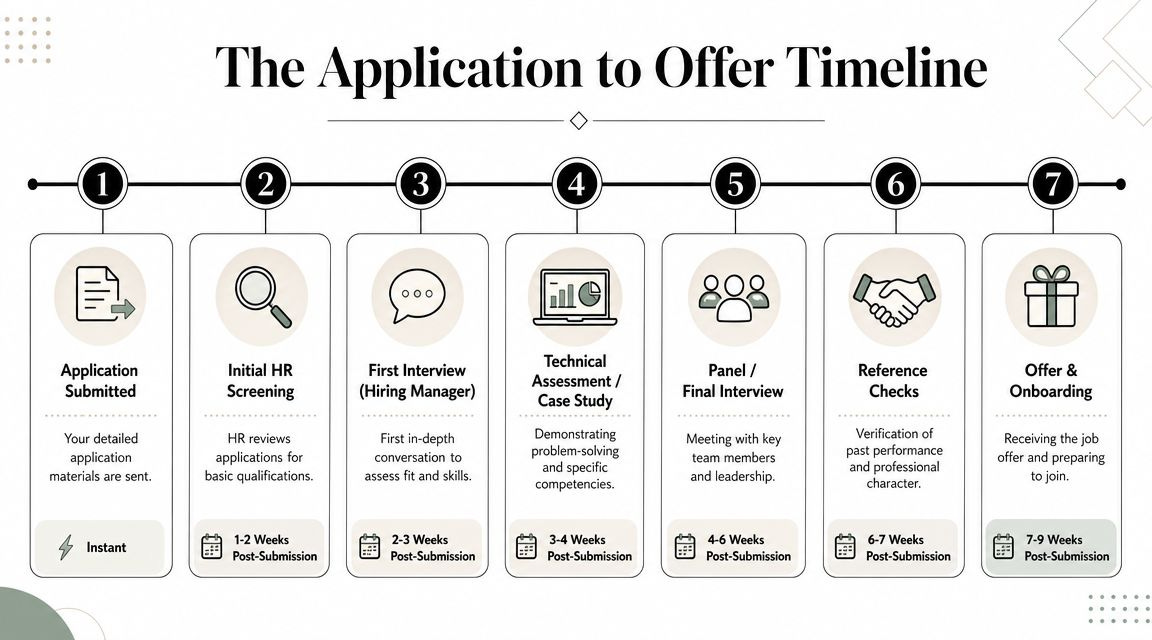
The interview stage in development hiring often feels slower and more layered than candidates expect. That’s normal. Foundations and MDBs commonly run multiple screens because they’re testing judgment, writing, technical depth, and institutional fit, not just charm.
Your job is to prepare for the process as a sequence, not a single conversation.
Expect different interview modes
A typical sequence may include an HR screen, a hiring manager interview, a technical task or written exercise, a panel, and references. The exact order varies, but the logic doesn’t.
Each stage tests something different:
HR screen checks baseline eligibility, communication, and motivation.
Hiring manager interview tests whether your experience matches the role’s actual work.
Technical assessment checks whether you can think clearly under constraints.
Panel interview checks judgment, collaboration, and consistency across stakeholders.
Treat every stage as cumulative. Weak answers early can frame how later interviewers read you.
Prepare your stories the right way
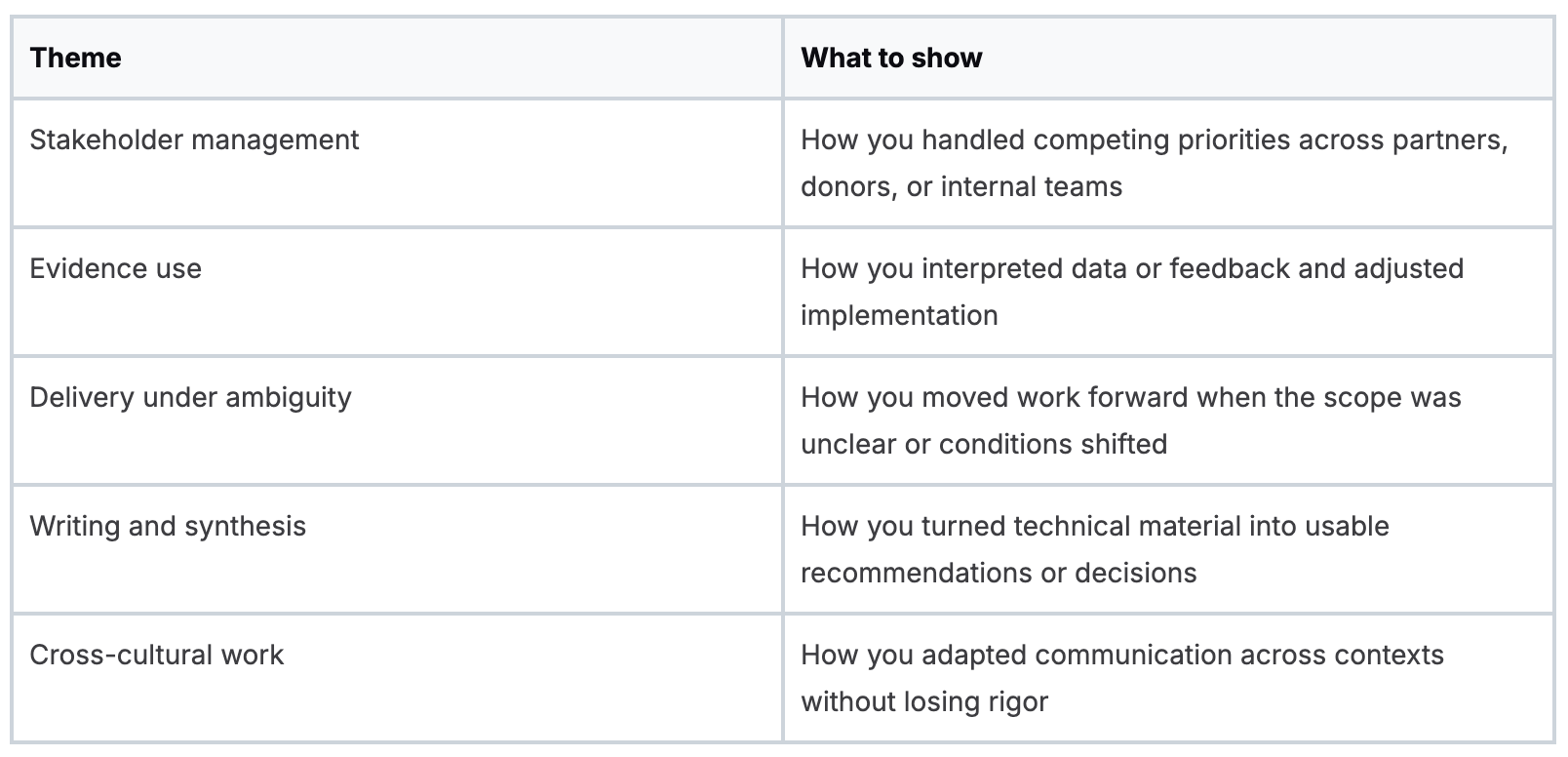
The STAR method still works here, but it needs a development lens. Don’t just tell a story about a challenge. Show the operating context, stakeholder complexity, and what you learned.
Build stories around themes hiring teams care about:
Adaptive management is an interview signal
One of the strongest signals you can send is that you understand adaptive management. Yale’s summary of an evidence-to-practice model highlights the value of learning loops that connect design, implementation, and course correction, rather than rigid execution that ignores new evidence.
That becomes interview language very quickly.
Instead of saying, “We implemented the work plan successfully,” say what changed, what evidence you used, and how you adjusted. Hiring committees notice candidates who can connect monitoring, implementation, and decision-making.
A strong answer sounds like this in substance:
We launched with one assumption, saw different behavior in implementation, pulled feedback from field and partner reporting, adjusted the approach, and improved delivery without losing sight of the objective.
That’s far more credible than claiming everything went exactly to plan.
Practice for competency pressure
Panel interviews often compress multiple competency questions into a short slot. You need concise stories, not long scene-setting. This resource on how to pass a competency-based interview is useful if you want a framework for tightening those answers.
Three final rules matter:
Answer the question asked. Don’t turn every prompt into your favorite project.
Name trade-offs. Development work is full of constraints. Good candidates show judgment under those constraints.
Close with the result and lesson. Interviewers remember endings.
Building a Sustainable Development Career
The biggest career mistake in this field is believing your path should look linear. It usually won’t. Many people enter through contracts, consulting assignments, project roles, or coordinator jobs that look temporary from the outside and turn out to be career-defining if used well.
That’s why contract strategy matters as much as job search skill.
Short-term work can build long-term leverage
Career advice often treats short-term contracts as second best. That misses how the sector operates. Second Day’s guidance on international development careers notes that many roles are only a few months long, some can convert to full-time, entry-level jobs are often assistant or coordinator roles, technical jobs frequently require a master’s degree or field experience, and applicants should expect high volumes with only shortlisted candidates contacted.
The practical point is straightforward. A short-term role is useful when it gives you one of four assets:
Recognized institutional experience
Access to stronger references
A clearer technical niche
Evidence of delivery in a funded environment
Take contracts that add at least one of those. Skip contracts that only add workload.
Pick a direction before you pick a title
A lot of early-career candidates chase titles that sound impressive but don’t build a coherent profile. The better question is what professional identity you’re building.
You generally have two broad paths:
Technical specialist
You go deep in an area such as health systems, education finance, climate adaptation, gender, MEL, or public financial management. This path can make you valuable across consultancies, donor programs, and specialist units.
Operational generalist
You build strength in portfolio management, grants, partnerships, budgeting, reporting, internal coordination, and cross-team execution. This path often opens foundation and program management roles.
Both are valid. Problems start when your CV shows random movement without a clear through-line.
Use each role to buy the next one
Think one move ahead. Every position should leave you with something transferable.
Ask yourself:
Will this role give me writing samples I can use later?
Will I leave with references who’ve seen my work closely?
Will I understand donor or institutional systems better than I do now?
Will this sharpen my credibility in one sector or function?
If the answer is no across the board, the role may keep you busy without moving you forward.
Sustainable careers in development are built through accumulation. Skills, references, institutional literacy, and reputation stack over time.
The field rewards patience, but not passivity. You need a plan for the next contract, the next function, and the next level of responsibility before the current role ends.
If you want a focused stream of opportunities and career guidance in this space, Multilateral Development Bank Jobs publishes MDB staff listings, consultant openings, and practical guides on topics like young professional programs, nationality requirements, and hiring processes.