

The most popular advice on international development engineering jobs is wrong at the starting line. It tells engineers to polish their degree, apply broadly, and wait for mission-driven employers to notice them. That approach burns time and gets very smart people screened out before a human being reads the second page.
This market runs on insider rules. Seniority matters more than potential. Program language matters more than clean technical prose. In some institutions, passport and hiring channel matter before merit even gets discussed. If you want to work in climate infrastructure, water systems, digital public infrastructure, humanitarian engineering, or renewable energy inside the development ecosystem, you need to treat this as a system to operate within, not a normal job search.
Why Your Engineering Degree Isn’t Enough
A strong engineering degree helps. It does not separate you.
International development engineering jobs sit inside an ecosystem that has become a “mega freelance market” with boutique operations and insular hiring practices, where early-career opportunities are scarce and organizations heavily favor engineers with 20 to 30 years of experience, as outlined in Devex’s reporting on engineering jobs in global development. That one fact changes the whole game.
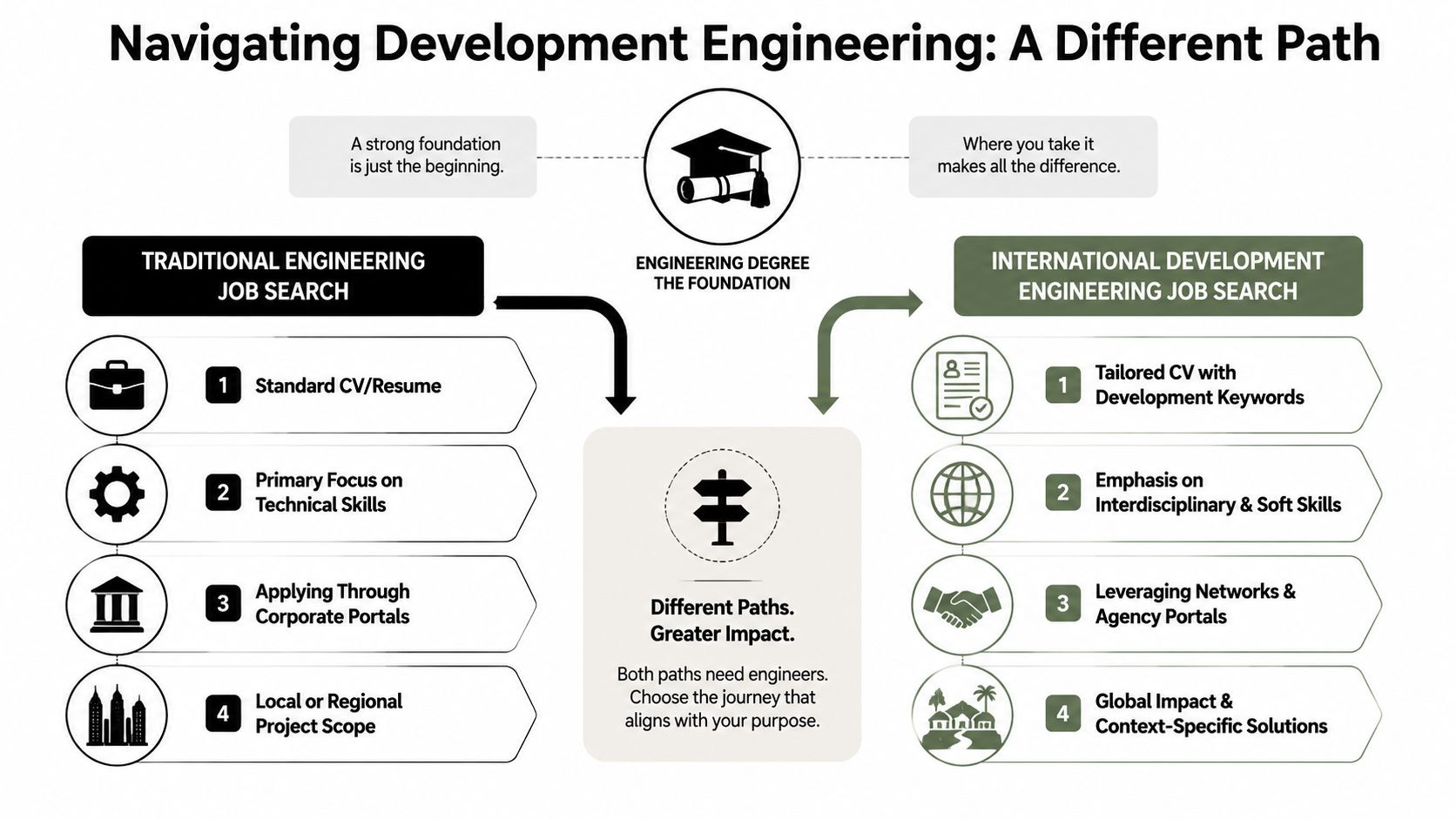
The field screens for more than technical skill
A private engineering firm may hire for capability and train for context. Development employers usually want both on day one. They expect technical depth, stakeholder management, donor literacy, writing discipline, and comfort working through ministries, community actors, and procurement rules that slow everything down.
That is why general advice about “show your passion” falls flat. Hiring teams want evidence that you can operate in a funded program environment where compliance, reporting, and politics shape technical decisions.
Practical rule: Your degree gets you into the pile. Your ability to frame engineering work in development language gets you shortlisted.
What changes once you understand the market
You stop asking, “What jobs can I apply for?” and start asking sharper questions:
Which employers buy this skill set? MDBs, UN agencies, NGOs, and consultancies buy engineering differently.
What level am I realistically competitive for? Many candidates target staff roles that are structurally out of reach.
What language does the buyer use? “Pump design” and “feasibility modeling” matter, but so do safeguards, implementation support, capacity building, resilience, and results frameworks.
What credential gaps are blocking me? In this sector, graduate study often acts as a sorting mechanism, not an academic luxury.
If you’re still deciding whether to add policy or development training, this guide on an international development degree is worth reviewing because it helps clarify when another credential changes your market position.
The engineers who break in rarely win by being the smartest technical applicant. They win because they understand what institution they’re applying to, what kind of mandate drives the hire, and what trade-offs that employer is making behind the scenes.
The Real Landscape of Development Employers
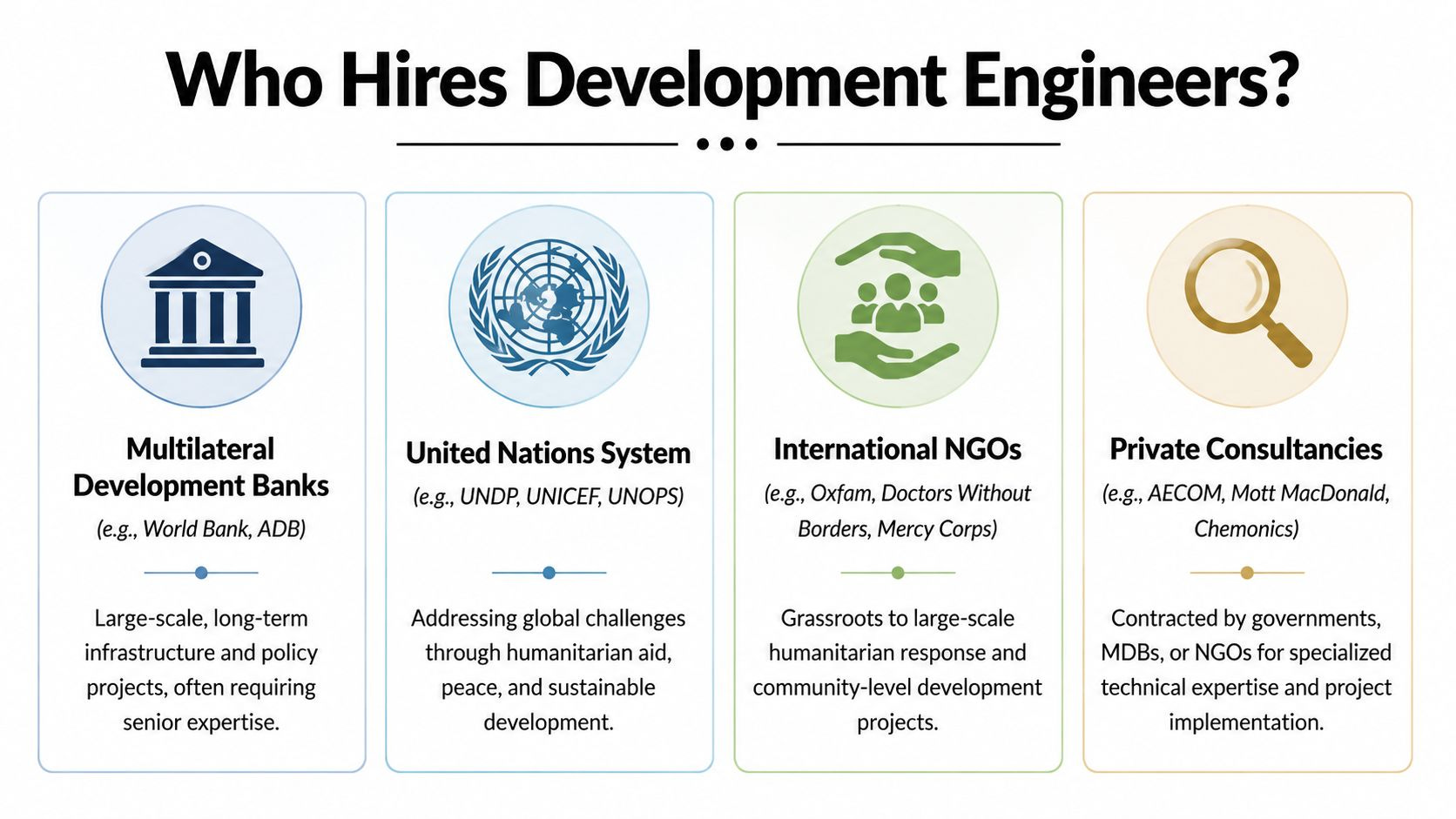
Engineers often talk about “breaking into development” as if one application strategy fits every employer. It does not. The phrase “development sector” hides four very different hiring systems, each with its own gatekeepers, timelines, and filters. Treat them as one market and you waste months chasing roles you were never structurally positioned to win.
Compensation can be strong, especially for engineers who combine technical depth with donor, procurement, or program experience, but pay varies sharply by employer type, contract model, and duty station. The bigger issue is access. These jobs skew toward people with prior field delivery, funded-project exposure, language skills, or the right passport mix for the vacancy. Merit matters. Structural fit matters too.
Multilateral development banks
MDBs attract engineers for good reason. The projects are large, the budgets are serious, and the work can shape national infrastructure priorities across water, transport, energy, climate adaptation, and digital systems.
The catch is seniority bias. Many bank vacancies read like mid-level jobs but are screened like late-career roles. Hiring teams want candidates who can manage government relationships, survive procurement scrutiny, and produce documents that hold up under internal review. A strong design background helps, but it rarely carries the application on its own.
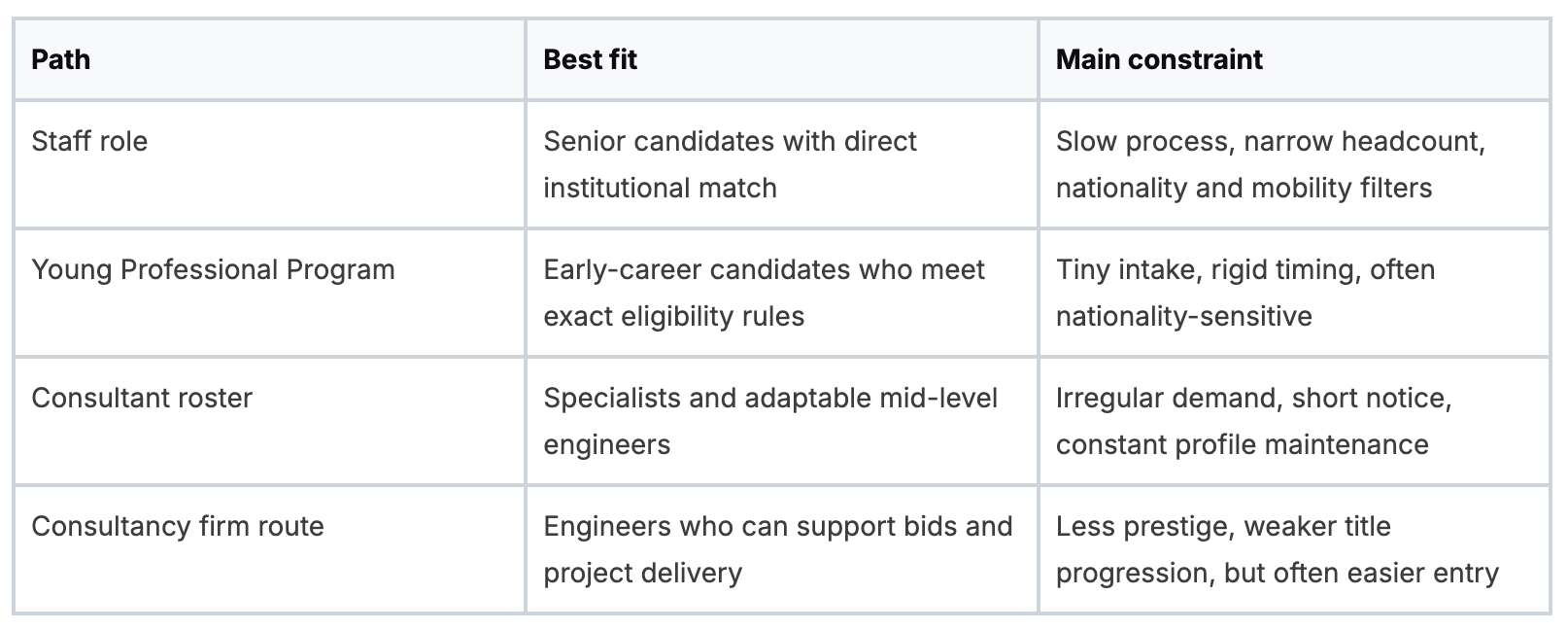
For many engineers, consultant rosters and short-term assignments are the entry route that works. Staff jobs are fewer, slower, and often filled by people who already know the institution from the inside.
United Nations agencies
UN agencies hire engineers across humanitarian response, infrastructure support, logistics, shelter, energy access, WASH, and recovery programs. The title may sound technical. The job often is not purely technical.
These roles reward engineers who can coordinate across operations, procurement, government counterparts, and field teams without getting precious about scope. Agency mandate matters a lot. An engineer who fits UNICEF on water systems may be a weak fit for UNOPS delivery support or for a humanitarian shelter role in another entity.
Nationality rules can also shape who is even eligible, especially in early-career streams and some internationally recruited posts. That is one of the least discussed barriers in this field.
International NGOs
NGOs are often the fastest place to build evidence that you can deliver under messy conditions. If you want hard-earned credibility in WASH, shelter, resilience, off-grid energy, or post-disaster reconstruction, many careers are built within NGOs.
The trade-offs are real. Budgets are tighter, systems are uneven, and technical standards can vary by country office and donor. You may get more responsibility earlier than you would in a bank or UN agency, but you may also get less training, less stability, and fewer clean career steps.
Still, field-heavy NGO work gives hiring managers something they trust. Proof that you can make engineering decisions when the data is incomplete, the procurement is late, and the client is a ministry under political pressure.
Some of the strongest development engineers started in operational roles with difficult constraints, not prestige institutions.
Private consultancies
A large share of development engineering work is packaged and delivered by consultancies. That includes feasibility studies, design reviews, owner’s engineer roles, supervision, safeguards, technical assistance, and framework contracts funded by donors or banks.
Consultancies hire differently. They do not always need a rounded institutional profile. They need bid-ready expertise they can sell now. That makes them a practical entry point for engineers with a clear niche, good availability, and project experience that maps cleanly to terms of reference.
This is also where many applicants learn the unwritten rule fast. Your CV is a commercial document before it is a career story.
Where demand concentrates
Demand stays strongest in areas donors continue to fund year after year: climate-resilient infrastructure, water and sanitation, renewable energy, grid modernization, digital public systems, data work, cybersecurity, and urban service delivery. Graduate credentials also carry more weight here than in commercial engineering, partly because they act as a filter in crowded applicant pools.
Search accordingly. Broad job hunting wastes time in this market. If you want roles with flexible location setups, this guide to remote international development jobs is useful because it separates fully remote roles from jobs that only look remote until deployment starts.
A simple comparison helps:
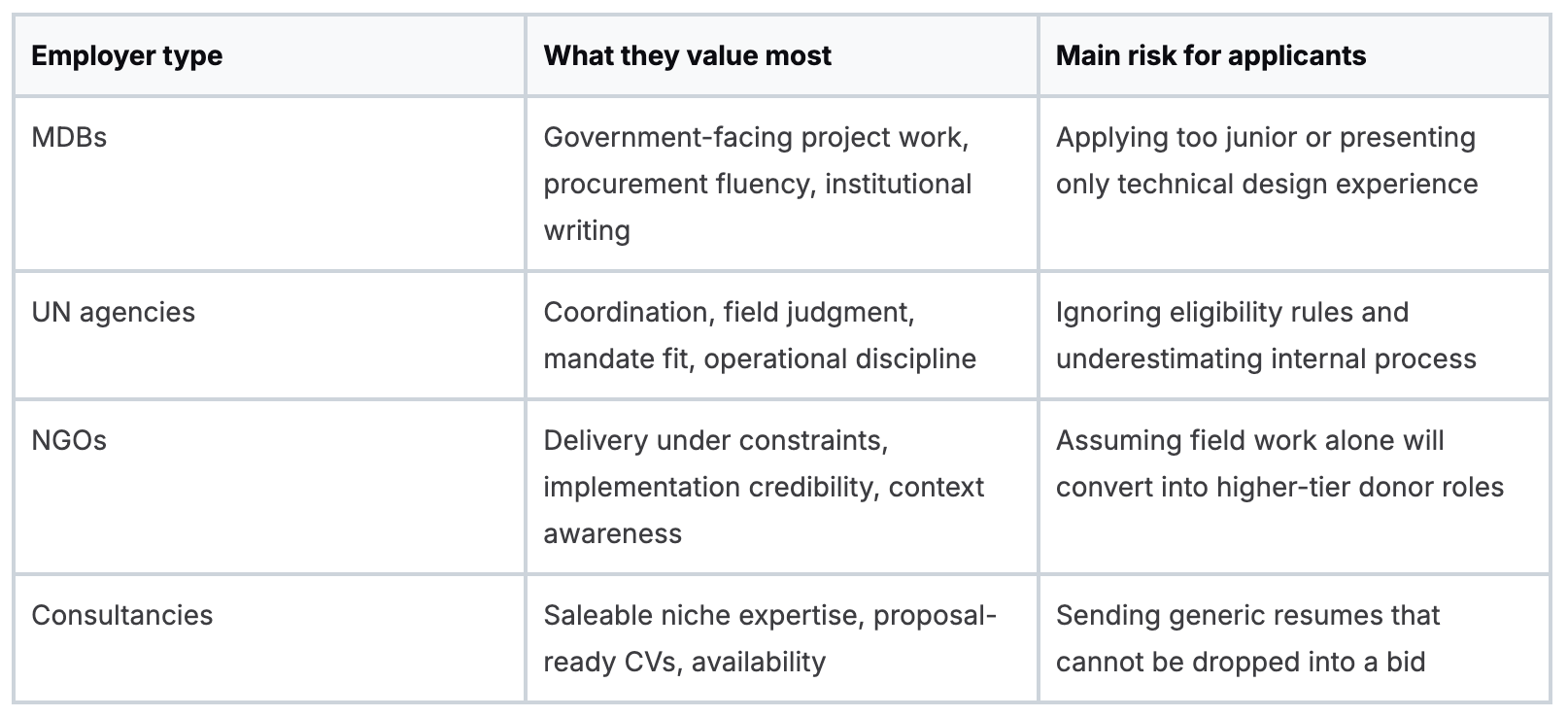
The right target depends on your current evidence, your eligibility profile, and how each employer hires. Ambition matters. Fit gets interviews.
Crafting Your Application to Beat the System
International development engineering applications are screened for procurement fit before anyone cares how clever you are technically. A strong engineer can still get cut fast if the CV does not match the format, the terminology, and the evidence the buyer needs.
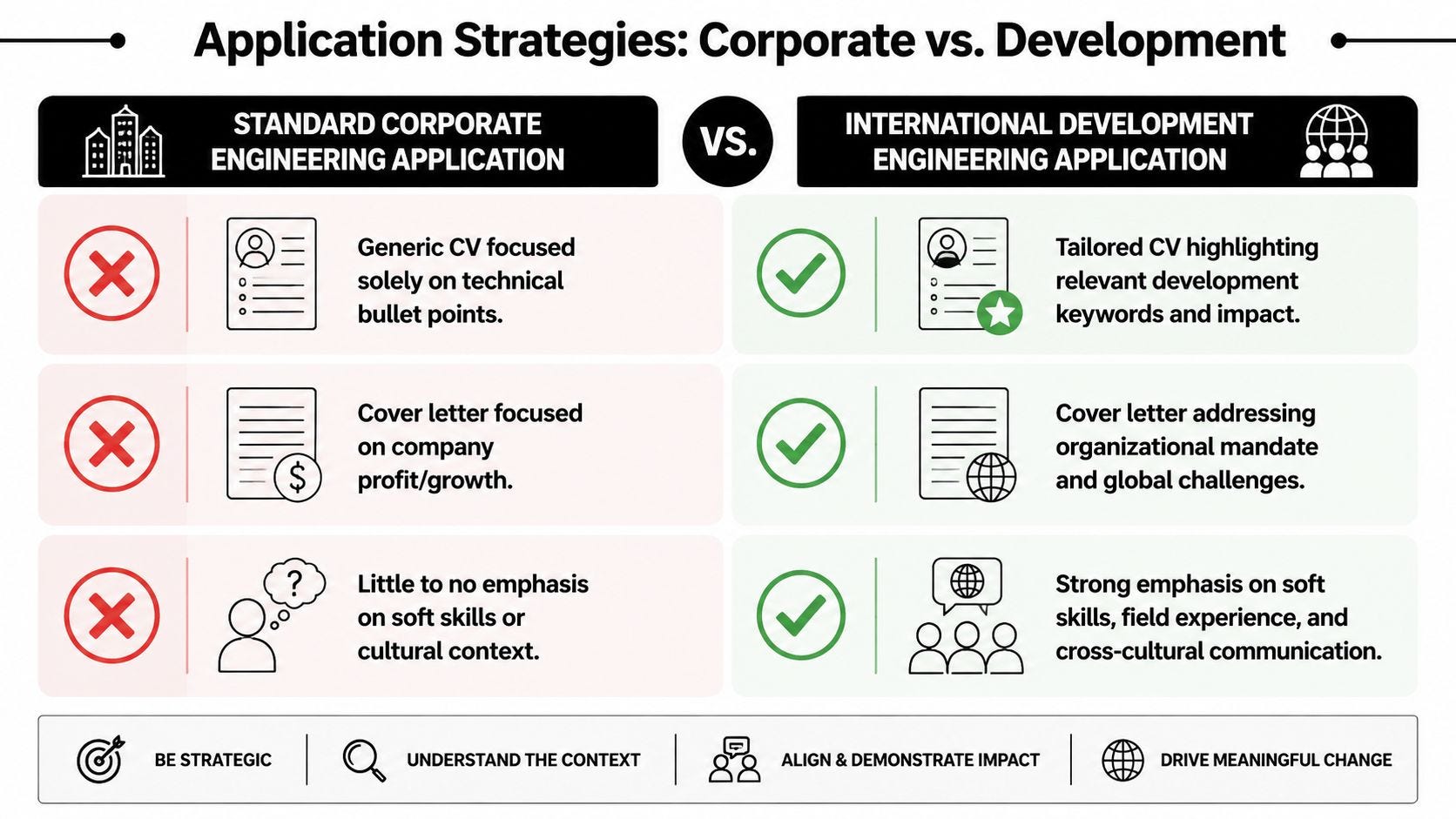
This is the part many candidates underestimate. Hiring teams are often reviewing applications that may later be used in an audit trail, a donor submission, or a bid roster. If the call says the European Commission requires a 3-page CV, treat that as an instruction, not a suggestion. Communication skill matters here too, but the honest point is simpler than any unsupported statistic. Engineers who cannot write clearly for non-technical readers struggle in drafting, coordination, and donor-facing roles.
Rewrite your CV for buyers, not peers
A conventional engineering resume often reads like it was written for another engineer. It lists design tasks, software, calculations, and deliverables. That is not enough in this market.
Your CV needs to answer four practical questions fast. What was the assignment? Who paid for it? Who did you deal with? Why did the work matter in public or development terms?
“Designed stormwater network for municipal corridor” is weak because it hides the context.
A stronger bullet is more useful: “Designed stormwater network for a municipality under a flood resilience program funded by a development partner, coordinating with city engineers, contractors, and community representatives during right-of-way constraints.” Same engineer. Same project. Better evidence.
That is how shortlist decisions get made.
Follow formatting rules exactly
Development hiring has a bureaucratic side, and applicants who fight it usually lose. If an agency asks for exact headings, use exact headings. If the form asks for dates in a specific order, follow that order. If the page cap is three, do not send four and hope your experience excuses it.
A lot of candidates get screened out for preventable reasons. Not because they lack ability. Because the application is annoying to process, impossible to score cleanly, or unusable in a bid file.
Use this check before you submit:
Match the page limit: Donor and agency caps are hard limits.
Mirror the terms of reference: Use the employer’s wording where it truthfully fits your background.
Front-load relevant work: Put funded assignments, public-sector work, field delivery, and cross-border projects near the top.
Name institutions clearly: Ministries, utilities, municipalities, NGOs, and contractors each signal a different kind of operating experience.
Cut dead weight: Long software lists, outdated academic detail, and publications unrelated to the role usually hurt more than help.
Your CV should read like a document a consulting manager could paste into a proposal with minimal editing.
Prove coordination skills with evidence
Plenty of engineers claim stakeholder management. Shortlisted candidates prove it.
In development hiring, communication does not mean being friendly in meetings. It means turning technical material into actions a ministry official, donor representative, utility manager, or community counterpart can use. Show that with hard examples:
chaired or supported coordination meetings with ministries, utilities, or municipal departments
wrote reports, briefs, or presentations for non-technical decision-makers
handled community consultation inputs that changed design or sequencing
resolved disputes between contractors, client teams, and technical specialists
kept delivery moving when approvals, procurement, or site access slowed the work
These details do two things. They show you can operate beyond pure design, and they signal you will not become a liability once the job turns political or operational.
Fix the cover letter problem
Weak cover letters sound like graduate school statements. Strong ones sound like someone who understands how the institution works.
Do not spend half the letter explaining your passion for sustainable development. Use the space to show that you understand the employer’s problem, the constraints around it, and the part you can play. If the role sits inside a water utility reform project, speak to utility operations, implementation bottlenecks, contractor management, or service delivery pressure. If it supports an MDB project team, show that you understand reporting discipline, counterpart coordination, and the difference between technical advice and bankable project support.
A good cover letter usually does three jobs:
Names the problem the institution is trying to solve.
Connects your engineering experience to that problem in concrete terms.
Shows you can work inside the employer’s process, not just inside your technical specialty.
That is enough. No dramatic life story required.
Navigating Nationality Rules and Program Timelines
Many engineers waste months applying for roles they were unlikely to get from the start.
The uncomfortable part is that hiring in international development is filtered long before anyone compares technical quality. Passport, funding rules, member-country politics, local hiring targets, visa friction, and headcount timing all shape who even gets serious consideration. Institutions rarely spell this out in public job ads, but anyone who has worked around MDBs, bilaterals, and large implementers has seen it.
Staff hiring follows institutional rules, not just merit
Full-time staff recruitment is constrained by factors that sit outside your CV. Some organizations need broader nationality representation. Others are under pressure to place nationals of shareholder or donor countries. Country offices may prioritize local nationals or residents for cost, optics, or legal reasons. Early-career programs can be even narrower because they are built around fixed cohorts, degree windows, and nationality eligibility rules.
That does not make the process fake. It makes it structured.
A strong engineer can still lose to a weaker candidate who fits a quota, a mobility requirement, a hiring target, or a pre-cleared nationality slot. If you do not account for that, you will misread silence as a problem with your profile when the issue is channel fit.
Choose the route that matches your passport and career stage
If you are from a non-donor country, or from a country that is underrepresented in staff intakes, direct staff applications may still be worth trying, but they should not be your only plan. The more practical route is often contract work first. Consultant hiring is usually tied more closely to immediate delivery needs, budget availability, and assignment fit.
That matters because contract work does three things staff applications cannot do on their own. It gets you inside the operating system. It gives managers evidence that you can work in their process. It creates references from people who are already trusted internally.
Use that reality.
A simple way to assess your options:
Program timelines matter more than motivation
Applicants often wait for a vacancy notice, then scramble. By that point, the actual hiring cycle may have started months earlier through budget approvals, project preparation, roster updates, or expected financing decisions.
A transport engineer might see a posted consultancy in October. The team may have scoped the work in June, lined up budget in August, and already have three familiar names in mind by the time the notice goes live. Public competition still happens, but it happens on top of internal momentum.
This is why timing beats enthusiasm. Good candidates track institutions on a calendar, not just a jobs page.
Watch for:
annual budget approvals and new project effectiveness dates
recurring Young Professional Program application windows
consultant roster refresh cycles
framework contracts and implementation support tenders
end-of-fiscal-year spending pushes
project supervision periods that create short-term technical gaps
Build your search around institutional rhythm
Each employer has its own clock. MDB staff hiring can drag for months. Bilateral agencies often move in batches tied to funding cycles. Consulting firms hire around live bids, expected wins, and project mobilization dates. NGOs may move faster, but often around grant start dates and country program renewals.
Treat this like campaign planning. Build a 12-month target list. Mark likely application windows. Track when country strategies, project approvals, and major tenders tend to hit. Follow up before demand becomes public.
If interview rounds do come through, prepare for competency screens early. MDBs and large development employers tend to repeat the same evidence patterns, and this guide on passing a competency-based interview for MDB roles is useful for that stage.
The blunt rule is simple. Do not treat all vacancies as equally attainable. Pick the route that fits your nationality constraints, your seniority, and the employer’s hiring calendar, then commit to that route hard enough to matter.
How to Network and Ace the Interview
Cold applications matter less here than engineers want to believe. In international development, hiring managers screen for trust, fit, and institutional familiarity long before they debate your technical depth. A strong profile helps. Prior visibility often decides who gets a serious look.
That is why networking is part of the selection process, not a side activity.
The field runs on pattern recognition. Teams remember candidates who ask sharp questions, understand how donor-funded delivery works, and can speak about risk, procurement, reporting, and counterpart management without sounding like they just discovered the sector last week. Unknown candidates can still break in, but they usually do it by becoming familiar before they become available.
Ask for hiring intelligence, not help
Good outreach does one job. It gets you information that improves your odds.
Do not ask for a job. Do not ask to “pick someone’s brain.” Ask how a specific team hires, what backgrounds get taken seriously, which phrases signal credibility, and where private sector applicants misread the role.
A message that works is short and concrete:
the role family you are targeting
your current background in one line
why you chose that person
two or three focused questions
That approach gets better replies because it respects the other person’s time and gives them something easy to answer.
If you are coming from the private sector, fix the story before you start networking
A lot of engineers sabotage themselves here. They present as candidates trying to escape commercial work and enter development. That framing triggers doubt. It makes you sound junior, even when you are not.
A better approach is to present yourself as someone who already does delivery under constraints that development employers understand. For many mid-level roles, especially project administration and coordination work, institutions often value engineers who have run contractors, handled client reporting, managed compliance documents, and kept messy projects moving when conditions were not ideal. I have seen private sector candidates get traction when they make that overlap obvious.
The parts of your background that usually carry weight are clear:
coordinating contractors, public agencies, and consultants
managing schedules, documentation, and approval chains
handling quality control and delivery risk
writing reports that non-technical managers can act on
working in utilities, transport, reconstruction, or infrastructure delivery
Those are not supporting details. They are your bridge into the sector.
Interviews test whether you can work inside a broken system
Development interviews are rarely pure technical screens. The harder question is whether you can deliver when the system around the project is slow, political, under-resourced, or all three.
Expect scenarios about procurement delays, weak implementing capacity, counterpart friction, vague data, and pressure from stakeholders who want different things. The strongest answers show judgment under constraint. Hiring panels want proof that you can protect delivery quality without pretending the institution is more efficient than it is.
Prepare examples that show:
how you made decisions with incomplete information
how you explained technical issues to non-engineers
how you handled conflict across teams or agencies
how you kept standards from slipping under schedule pressure
If you are targeting MDBs or similar employers, study the format before the interview. This guide on passing a competency-based interview for MDB roles is useful because it shows how these panels structure behavioral questions and where candidates lose points.
The unwritten rule: credibility transfers through people
This is the part generic career advice avoids. Many development employers claim to run fully open competition, and formally they do. In practice, candidate risk matters a lot. A referral will not override a weak profile, but it can move you from unknown to plausible. That is a major shift in a field with seniority bias, internal candidates, and frequent pressure to hire people who already understand the institution.
So build relationships that create credibility transfer. Former consultants, task team staff, implementation managers, and technical leads are useful because they know how teams talk when they are deciding whether someone is worth interviewing. Their language will also improve your CV and your interview examples.
One practical tool can help with this research. Multilateral Development Bank Jobs publishes staff vacancies, consultant opportunities, and guides on hiring routes such as YPPs and nationality constraints. Used well, it helps you identify who hires for what, and where your profile fits.
A simple monthly rhythm that produces better interviews
Use one lane for thirty days. One technical niche. One employer type. One set of target teams.
Then work the process:
build a list of 20 to 30 relevant people
contact a small number each week with a specific reason
track the terms they use, the warnings they give, and the roles they mention
revise your CV and interview stories after every five conversations
test your pitch until it sounds like a practitioner, not an applicant
That is what works.
Candidates who do this stop sounding generic. They start sounding like people who understand how development work gets delivered, where projects fail, and why a hiring manager should trust them with a difficult portfolio.
Your Action Plan for Landing a Development Job
You do not need more inspiration. You need a sequence.
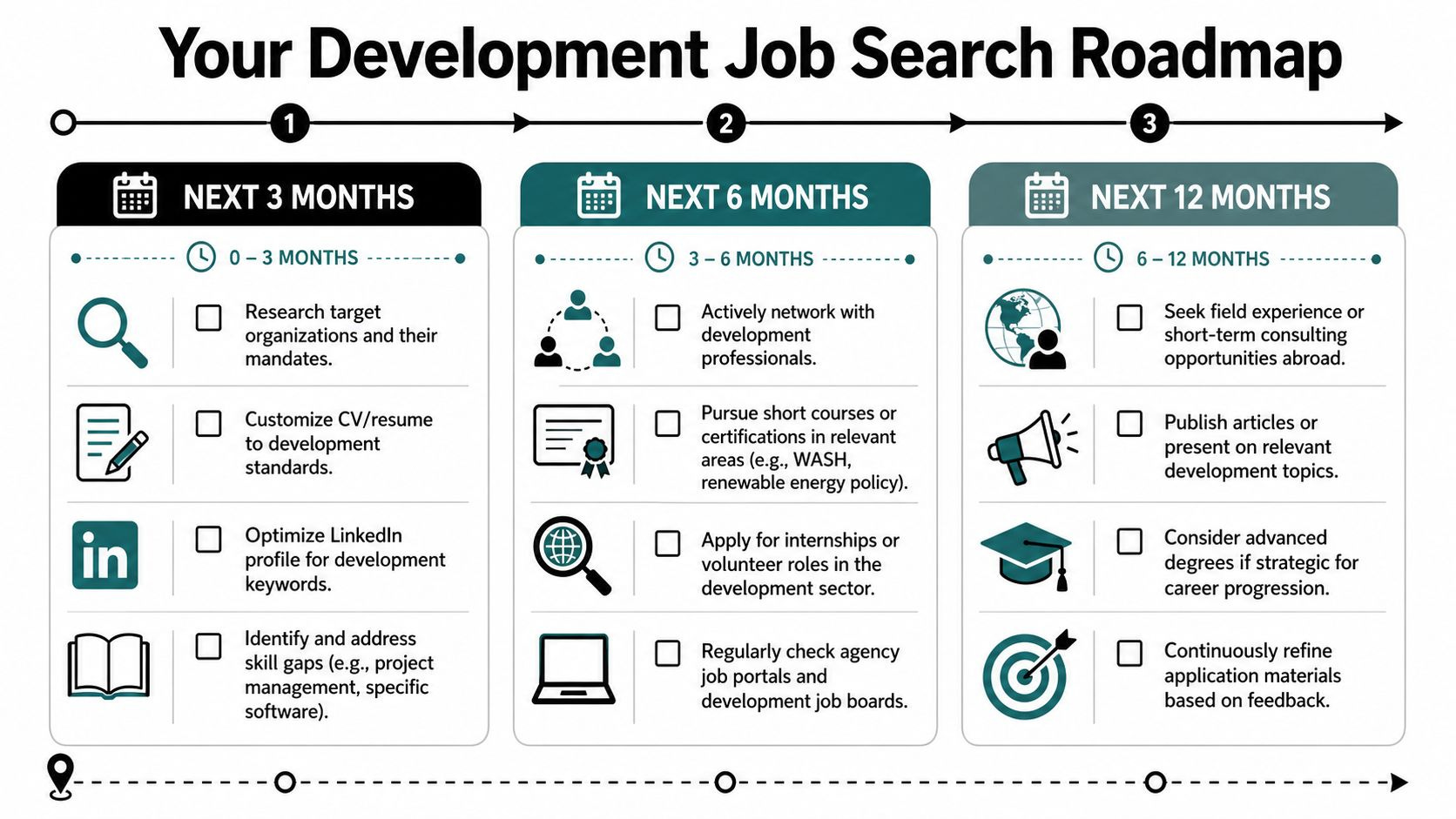
Next three months
Start with a hard audit of your market position. Identify whether your profile is strongest for staff roles, consultant pathways, NGO implementation roles, or private consultancy work tied to donor contracts.
Then do the document work that is often avoided:
Rebuild your CV: Strip out generic engineering filler and rewrite it for development buyers.
Choose a niche: Water, energy, climate, digital, reconstruction, or project administration. Pick one primary lane.
Study employer language: Pull terms from real job descriptions and terms of reference.
Fix your profile: Your LinkedIn headline and summary should reflect development-relevant capability, not a generic engineering identity.
Next six months
Shift from preparation to visibility. Reach out to practitioners in your chosen lane and ask focused questions about hiring routes, common screening failures, and the language used in successful applications.
At the same time:
Track consultant pathways: Monitor rosters, framework vendors, and recurring procurement channels.
Build proof of communication: Publish short pieces, present internally, or document technical work for non-technical audiences.
Add one targeted credential if needed: Do this only if it closes a known gap. Don’t collect courses randomly.
Practice interviews out loud: Institutional interviewing punishes candidates who sound polished but vague.
Next twelve months
By this point, you should have a tighter market fit and better evidence. Use that to pursue higher-conviction applications instead of broad, hopeful ones.
Focus on:
Applying in cycles: Align with program windows and likely budget timelines.
Leveraging warm contacts: Use previous conversations to sharpen applications, not to request rescue.
Stacking relevant work: Short-term advisory, implementation, M&E-adjacent, QA, and project coordination assignments all build usable credibility.
Reviewing misses: If you’re not getting traction, the problem is usually level, channel, or framing.
The candidates who land international development engineering jobs usually look strategic long before they look lucky.
If you want a steady way to track actual openings across the World Bank, ADB, AfDB, IMF, AIIB, the UN, and related institutions, Multilateral Development Bank Jobs is a practical resource. It publishes full-time MDB listings, consultant opportunities, and focused guides on hiring mechanics that matter in this market.