

You’ve finished the coursework, learned the language of systems change, maybe written a dissertation on governance, gender, public health, migration, or finance. Then you open job boards and hit a wall. Every posting seems to ask for a different mix of sector knowledge, donor familiarity, software, field experience, and language ability. Half the organizations use acronyms before they tell you what the job does.
That confusion is normal. The degree gives you context, vocabulary, and a way to think. It does not hand you a clean job title.
What matters now is translation. You need to translate your degree into a marketable function, your coursework into employer language, and your interest in development into a hiring case that makes sense to one specific type of organization. That’s how people get hired.
A lot of advice in this field stays too general. It tells you to network, gain experience, and be passionate. None of that is wrong. It’s just incomplete. International development degree jobs sit inside several very different employer systems, and each one rewards different signals. An INGO recruiter screens differently from a multilateral bank recruiter. A government aid agency values different evidence than a private consulting firm. If you treat them as one labor market, you’ll waste months.
So You Have an International Development Degree Now What
Start with one hard truth. “International development” is not a job function. It’s a field. Employers hire for functions inside that field.
That means your next move is not “apply everywhere in development.” Your next move is to decide how you’ll be useful. Can you manage grants? Build results frameworks? Analyze policy? Run procurement? Write donor reports? Support field operations? Clean survey data? Coordinate partnerships? Those are real hiring categories.
Stop leading with the degree
Early applicants often write profiles that sound like this: passionate about global development, committed to equity, interested in impact. That language blends into the background because everyone says some version of it.
Hiring managers look for operational clarity. They want to know where you fit on a team and what problem you can solve in the first few months.
A better framing looks like this:
Programme track: support implementation, budgets, workplans, reporting, partner coordination
Policy track: research, briefing notes, stakeholder mapping, government engagement
M&E track: indicators, logframes, survey tools, data cleaning, results reporting
Grants and partnerships track: proposal support, donor compliance, relationship management
Technical track: health, education, governance, climate, macroeconomics, PFM, livelihoods
Practical rule: Pick one primary lane and one secondary lane. Anything broader reads as unfocused.
Build your map before you send applications
You need three lists on one page.
Target employers
Not all development employers work the same way. Separate INGOs, multilaterals, government, think tanks, and firms.Target job titles
Search titles, not ideals. “Programme Officer” gets traction. “Development professional” does not.Target proof points
Pull evidence from your degree and any prior work. Dissertation methods, field research, budget handling, stakeholder interviews, volunteer management, data analysis, policy memos. These become resume bullets.
The struggle with international development degree jobs often arises because the degree is presented as the product. It’s not. You are the product. The degree is supporting evidence.
The Five Worlds Where Development Professionals Work
The field is large, but it becomes manageable once you stop treating it as one market. In practice, most international development careers sit inside five employer worlds, each with its own culture, pace, and hiring logic.
One major signal of that breadth comes from the market itself. In 2023, DevelopmentAid reported more than 86,000 job posts across seven key sectors on its board, while donors and implementing partners sought experts and consultants for over 163,000 vacancies overall. The same review noted nearly 1,000 openings in macroeconomy, statistics, and public fiscal management, over 600 in health, and nearly 500 in fundraising and NGOs, which shows real demand across technical and operational work, not just frontline humanitarian roles (DevelopmentAid hiring sectors in 2023).
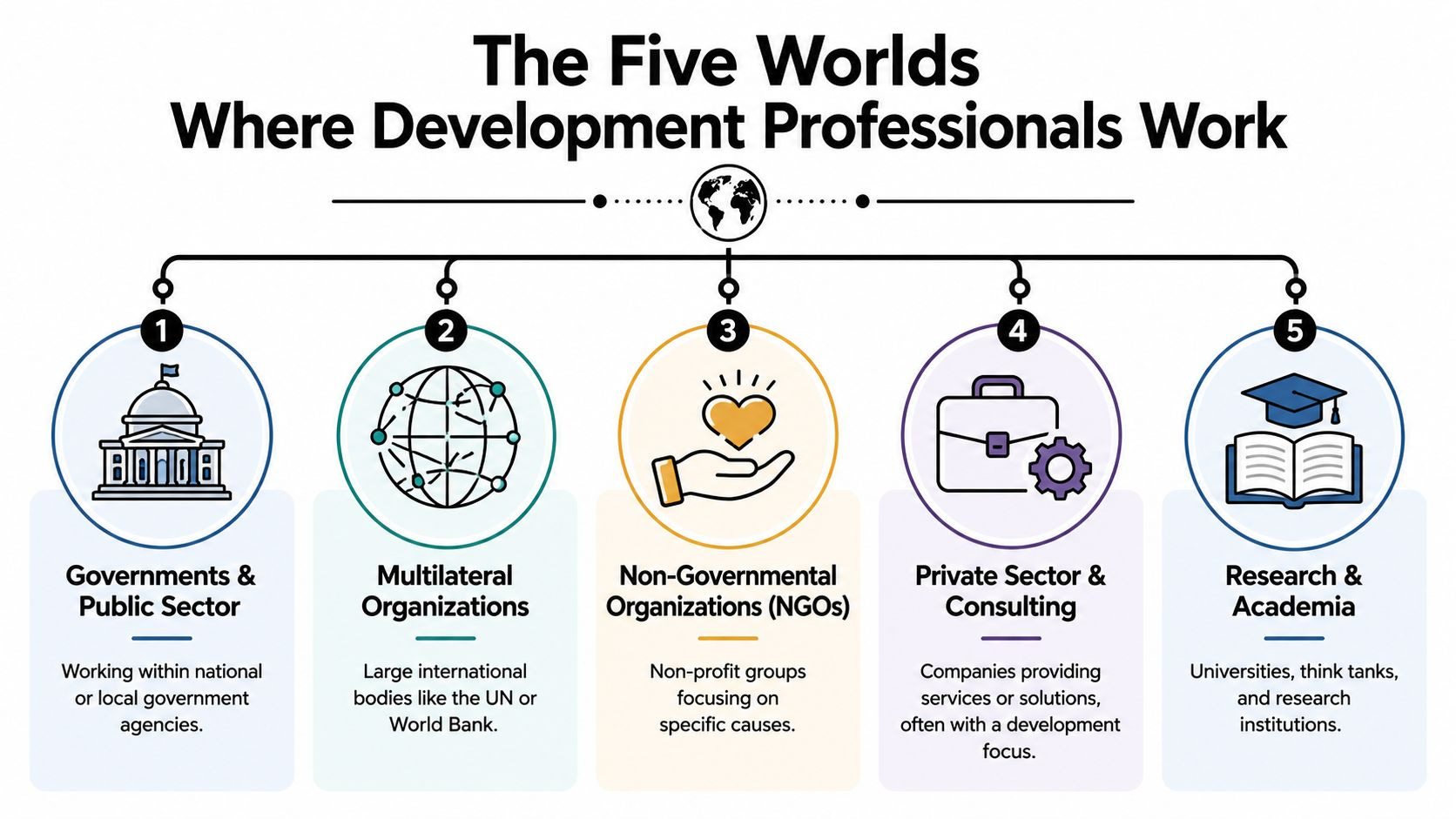
International NGOs
INGOs are the biggest entry point for many graduates. LSE identifies international NGOs as the largest sub-sector within this space, and that tracks with what you’ll see in the market: lots of project delivery, grants, advocacy, humanitarian coordination, and country-office support roles.
The culture is usually mission-driven and deadline-heavy. Teams move fast because they answer to donor timelines, partner commitments, and operational realities. You’ll hear a lot about reporting cycles, procurement delays, proposal windows, and compliance.
What works here: showing you can execute, coordinate, and write clearly.
What does not: sounding purely academic.
Multilateral organizations
This includes the UN system and multilateral development banks. These employers are prestigious, bureaucratic, and highly structured. They run on formal processes, grades, competencies, and long review chains.
The attraction is obvious. The trade-off is just as obvious. Entry is hard, and many early roles come through contracts rather than stable staff appointments. If you want a fast read on this niche, MDB Jobs’ overview of international development group jobs is one example of a role-focused resource in this space.
Multilaterals reward precision. If your application is vague, it dies quietly in the system.
Government and bilateral agencies
These are ministries, aid agencies, and development arms of national governments. Their work blends policy, diplomacy, procurement, and oversight of funded programs.
The culture is procedural. Hiring can be slow. Clearances, citizenship rules, and formal criteria matter a lot. Strong writing, policy judgment, and comfort with official process matter more than startup energy.
Think tanks and academia
This world suits people who like analysis, evidence, and public argument. You’ll find policy researchers, research associates, evaluation specialists, and subject matter experts here.
The upside is depth. You get to build expertise and publish. The downside is that some roles can become narrow if you never develop operational experience or client-facing credibility.
Private sector and consulting
A lot of graduates underestimate this path. Firms work on donor-funded projects, impact advisory, economic analysis, ESG-related mandates, implementation support, digital systems, and technical assistance.
This world values delivery. Can you meet deadlines, handle clients, produce clean slides, write concise reports, and solve practical problems? If yes, you’re useful.
International Development Employer Types Compared
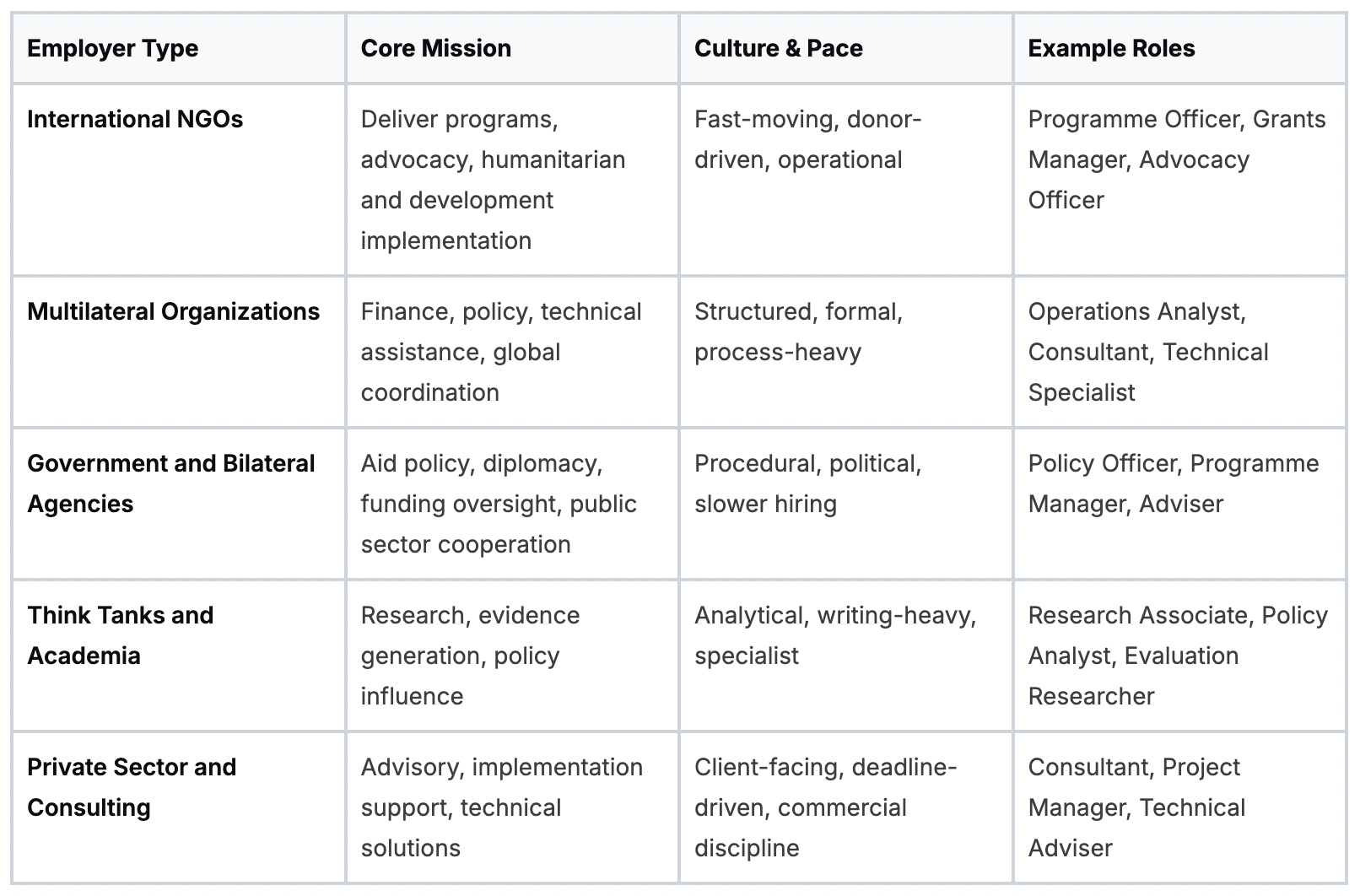
The mistake people make is choosing employers by prestige alone. Choose by fit. If you hate bureaucracy, a multilateral may frustrate you. If you hate ambiguity, an INGO country team may wear you down. If you hate writing, policy work will punish you.
Connecting Your Degree to Actual Job Titles and Salaries
Your degree becomes useful when you can attach it to a job family. That’s the bridge most applicants fail to build.
The roles employers hire for
LSE’s careers guidance lists a set of common graduate-level roles that come up again and again in this field: Programme Officer or Manager, Policy Analyst, Monitoring and Evaluation Specialist, Humanitarian Affairs Officer, Grants Manager, Technical Advisor, and Advocacy and Campaigns Officer (LSE careers in international development).
That list matters because it gives you a realistic conversion from degree to work. If your CV still says “seeking a role in international development,” you’re forcing the recruiter to guess. If it says “early-career Monitoring and Evaluation candidate with survey design, data cleaning, and reporting experience,” you’re easier to place.
A real salary ladder exists
Indeed salary benchmarks cited by LSE’s guide give a useful picture of progression in the UK market. The figures listed there include:
Outreach worker averaging £22,791
Development coordinator averaging £27,754
Donor relations officer averaging £29,468
Advocacy manager averaging £34,558
Research associate averaging £34,928
Policy analyst averaging £37,840
Project manager averaging £44,076
Those figures matter because they show structure. International development degree jobs are often discussed as if they lead into a fog of unpaid passion work. That’s inaccurate. There is a career ladder. It spans operations, fundraising, advocacy, research, and management.
Translate your degree into one sentence
Try this test. Can you describe yourself in one sentence that ends with a recognizable title?
Examples:
I’m building toward Programme Officer roles focused on implementation and donor reporting.
My background fits Policy Analyst roles in governance and public sector reform.
I’m targeting M&E Specialist roles with a focus on indicators, data quality, and learning.
Your CV headline should name the function you want next, not the subject you studied last.
That one shift changes how people read your application. It moves you from student mode to practitioner mode.
The Specific Skills That Get You Hired
Degrees open the door. Skills decide who gets shortlisted.
Most hiring managers screen for proof, not promise. They don’t care that you’re generally interested in impact. They care whether you can do work that reduces risk for the team. In development, that usually means handling information accurately, writing for different audiences, and staying useful when projects get messy.
The hard skills that travel well
Some skills move across almost every employer type because they solve common operational problems.
Quantitative analysis: If you can work with survey data, indicators, Excel, Stata, R, or Python, you become useful to M&E teams, policy units, research shops, and technical programs.
Budget and financial literacy: You don’t need to be an accountant. You do need to understand budgets, burn rates, cost categories, and donor restrictions.
Project management: Workplans, timelines, risk logs, deliverables, meeting notes, follow-up. This sounds basic until a team is behind schedule and nobody is tracking decisions.
Writing for donors and decision-makers: Many smart graduates can write essays. Fewer can write a one-page brief, a clean donor update, or a clear concept note.
Language ability: A second working language can help, especially when a role supports country teams, partners, or multilingual stakeholders.
If your analytical side is weak, fix that early. This is one of the few skill gaps you can improve in a structured way. MDB Jobs’ guide to improving analytical skills is one example of practical reading if you need to sharpen that area.
The soft skills that are not optional
Development organizations deal with politics, hierarchy, partners, donors, and public scrutiny. Technical ability without judgment creates problems.
Here’s what employers notice:
Cross-cultural judgment
Not performative sensitivity. Actual judgment. Knowing when to push, when to ask, when to listen, and when your assumption is wrong.Resilience under ambiguity
Funding shifts. Partner timelines slip. Government approvals stall. A good junior hire stays calm and keeps moving.Stakeholder management
You may need to keep a donor informed, support an overworked local partner, and brief a senior manager on the same day.Professional humility
The field has no shortage of people who talk like they’re there to save systems they barely understand. Employers notice that too.
What works and what doesn’t
What works is matching skills to the employer.
A multilateral may care more about analytical rigor, formal writing, and process discipline. An INGO country team may care more about coordination, flexibility, and partner communication. A consulting firm may care more about client handling and output quality.
What doesn’t work is listing every software tool you touched once in graduate school and hoping volume looks impressive. Show competence you can defend in an interview.
Your Three Main Entry Routes Into the Field
Early careers in development usually start through one of three routes. None is perfect. Each has trade-offs. The smartest move is to pick the route that matches your current profile instead of chasing the one that sounds most prestigious.
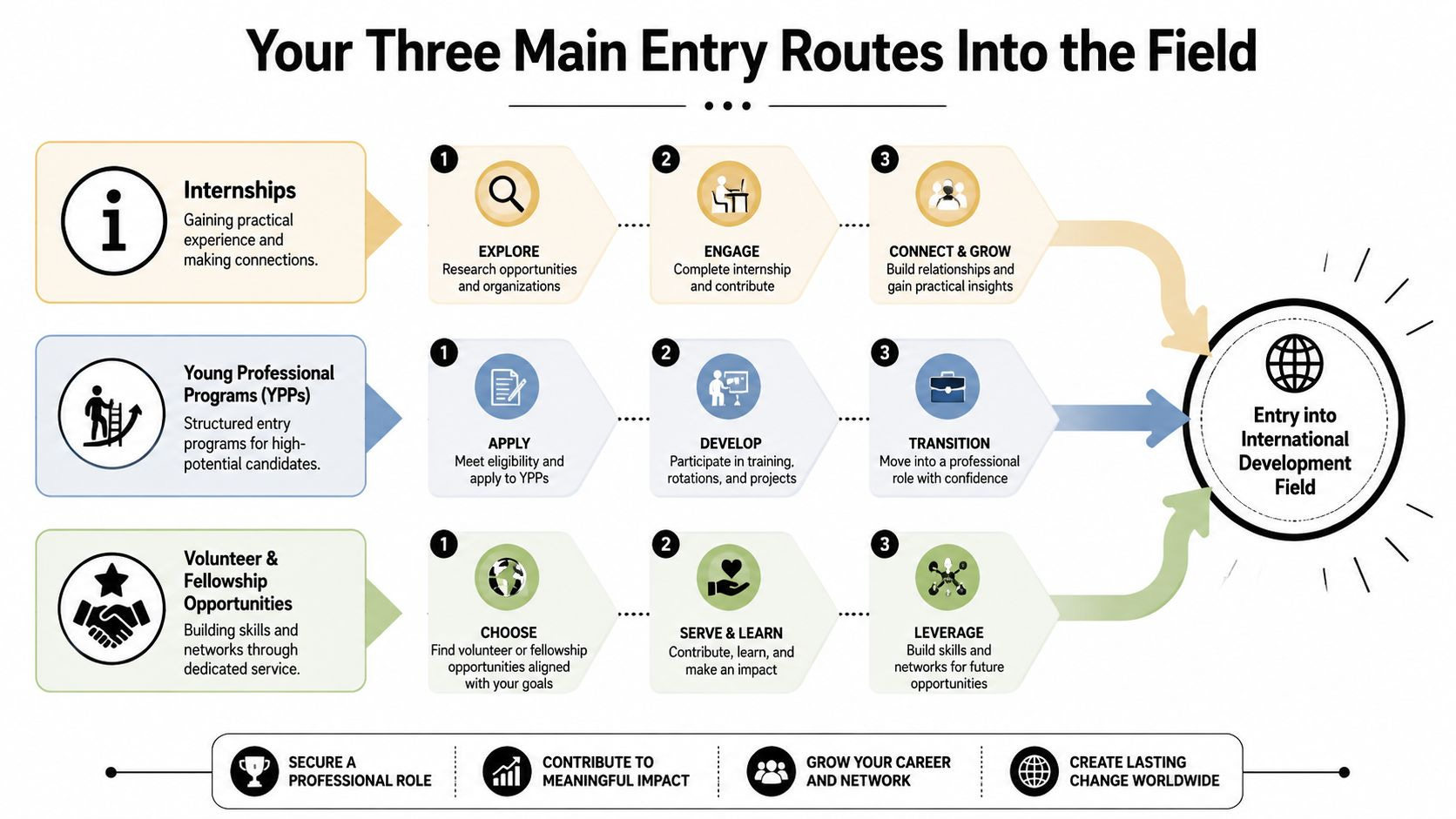
Internships
Internships are still one of the clearest ways to get recognizable experience on your CV. They help you learn internal systems, donor language, and office norms. They also give hiring managers something they trust: evidence that another organization already took a chance on you.
The downside is obvious. Some internships are weakly structured, narrow, or financially difficult to accept. A bad internship gives you brand name exposure and very little real responsibility.
Choose internships that offer one of these:
Concrete outputs: reports, data work, event support, briefing notes, coordination tasks
Exposure to systems: grants, operations, program management, research, procurement
Manager access: someone senior enough to explain how the organization works
Young Professional Programs
YPPs are structured, selective, and attractive for good reason. They often offer training, rotation, and a recognized entry route into major institutions.
They also absorb a lot of applicant energy because they look like a clean answer. They rarely are. The competition is intense, the requirements are narrow, and many candidates overinvest in this route while ignoring more realistic paths.
Apply if you’re eligible and competitive. Do not build your entire plan around being chosen.
Consultancies and short-term contracts
This is the route many people misunderstand. They see short-term contracts and think instability. Sometimes that’s true. It can also be the most realistic entry point into systems that rarely hand out permanent roles to outsiders.
Second Day notes that development bank and UN-style roles are often highly competitive, may last only a few months, and operate under rules that limit how long people can work on projects, while still sometimes transitioning into full-time offers. The same guide also points out that the market is increasingly segmented by specialization, which makes a niche contract in areas like macroeconomics or health a credible career-building move (Second Day international development career guide).
Treat contracts as auditions, not as disappointments.
A short consultancy can do three important things. It gets you inside the institution. It gives you current references. It teaches you the internal language of the place. Those three things often matter more than another year of broad, unfocused applications.
How to choose your route
Use a simple filter.
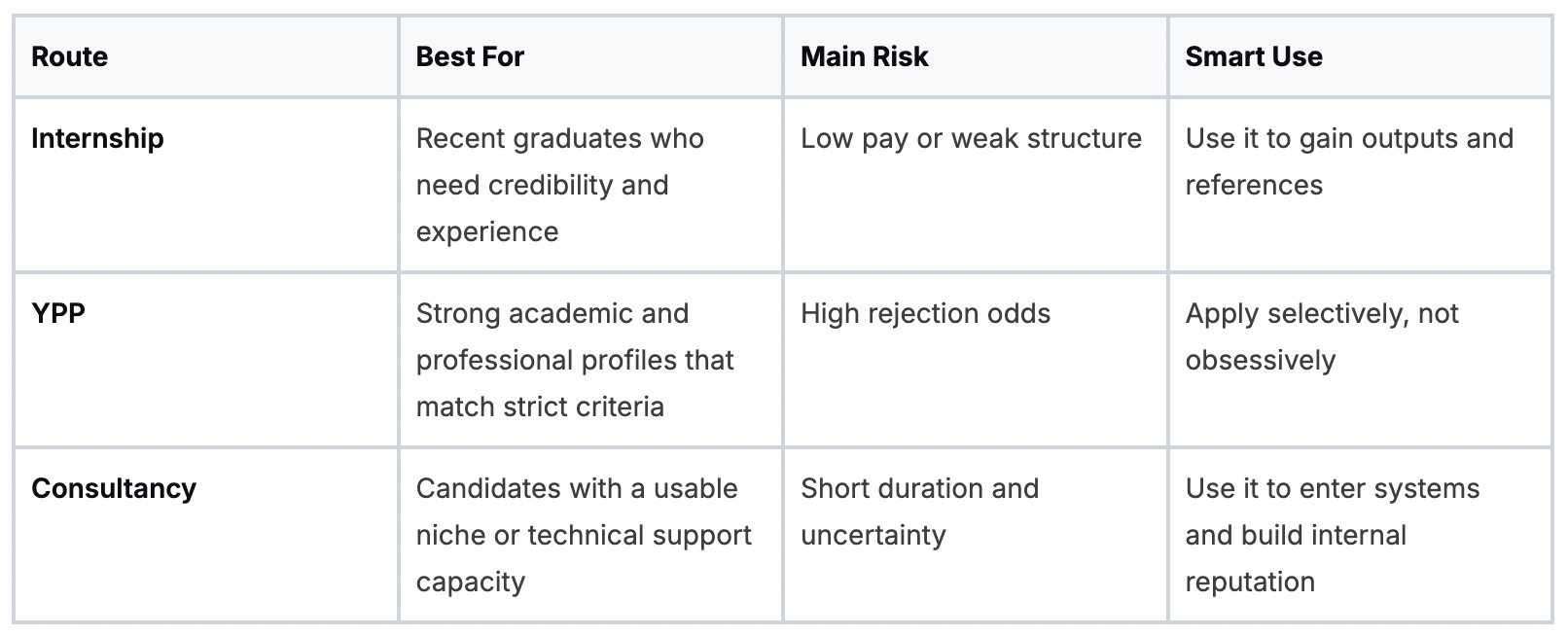
The wrong move is waiting for the perfect opening. Careers in this field often begin through imperfect but strategic roles.
Insider Tips for Landing a Multilateral Bank Job
Multilateral bank hiring looks open from the outside. Vacancies are public, competencies are listed, and application portals seem straightforward. In practice, these institutions reward candidates who understand how the machine works.
That means targeting, not spraying applications.

Match the institution’s language
A lot of good applicants lose because they describe themselves in university language instead of operational language. MDBs care about country programs, lending, technical assistance, policy dialogue, implementation support, knowledge products, results frameworks, and public sector constraints.
If you wrote a thesis on fiscal decentralization, don’t leave it framed as a purely academic project. Show the operational relevance. Did you assess implementation bottlenecks? Compare institutional incentives? Work with administrative data? Produce policy recommendations?
That translation is what gets attention.
Apply by niche, not by logo
Many candidates decide they want “the World Bank” or “an MDB” and stop thinking there. That’s too broad. Banks hire into teams, sectors, and functions.
A stronger approach is narrower:
governance and public sector
infrastructure
health
education
climate
macroeconomics and PFM
social development
results and knowledge support
That’s where specialization helps. Broad passion is forgettable. Specific fit is shortlist material.
For candidates exploring that route, this guide to World Bank jobs for fresh graduates is one example of a bank-specific starting point.
Respect process without sounding robotic
MDB interviews often test competencies in a structured way. That means your stories need shape. Use examples that show problem, action, judgment, and result. Keep them concrete. Name your role. Explain constraints. Show how you worked with others.
Bad answer: “I’m collaborative and passionate about development.”
Good answer: “I coordinated three workstreams for a research-to-policy project, managed comments from multiple stakeholders, and turned a long technical draft into a brief senior leaders could use.”
Bank recruiters trust evidence that looks repeatable. They are not hiring your ideals. They are hiring your operating habits.
Build credibility before you need it
Networking in multilaterals is less about charm and more about informed contact. Reach out when you have a focused question, a credible profile, and a reason for speaking to that person.
Good outreach usually includes:
A clear niche: not “I’d love to work in development,” but “I’m targeting junior governance roles tied to public financial management.”
A short ask: ten or fifteen minutes, one or two questions
Proof you did homework: team mandate, recent project themes, role type
What fails is generic admiration and long autobiographies in email form.
Also, understand that these institutions are large bureaucracies. Nationality rules, grade structures, and internal mobility patterns shape outcomes even when they are not obvious from the vacancy text. You can’t control those factors. You can control whether your application reads like it belongs inside the institution.
Your First Three Steps After Reading This Guide
You do not need a complete ten-year plan. You need a disciplined next move.
Pick one job family and rewrite your CV
Choose one target role family from this guide. Programme, policy, M&E, grants, research, technical advisory. Then rewrite your profile, bullets, and cover letter language around that function.
If one bullet does not help you get that role, cut it.
Commit to one entry route for the next 90 days
Pick internships, YPPs, or contracts as your main route. You can keep a secondary path alive, but one route should get most of your energy.
That focus changes your search behavior. It sharpens your alerts, outreach, and documents.
Speak to three people who already do the work
Not famous people. Not random executives. Three practitioners one or two levels ahead of where you want to be.
Ask short, useful questions:
Which entry roles feed into your team?
What skills are screened hardest?
What makes junior applicants look credible?
Do that in the next week. Not someday.
The field rewards people who learn its structure early. Once you see the structure, international development degree jobs stop looking mysterious and start looking navigable.
If you want a steady stream of openings and practical guidance focused on multilateral hiring, Multilateral Development Bank Jobs tracks full-time roles, consultant opportunities, and career advice across major MDBs and related institutions.