

You’re probably staring at a messy mix of job titles right now. Economist. Research analyst. M&E specialist. Program officer. Consultant. Data analyst. Operations analyst. Country economist. Social protection specialist. They all seem adjacent, and the official descriptions rarely tell you what hiring managers actually value.
That confusion is normal. International development economics jobs sit inside a wider development labor market, and the people who land them usually understand one thing early: employers pay for applied judgment, usable analysis, and delivery. A strong transcript helps. A polished statement helps. What gets you hired is showing that you can take a development problem, work with imperfect data, and produce something a manager, government counterpart, or donor can use.
The Landscape of International Development Economics Jobs

A development economist in practice rarely spends the day proving theory. The work is more concrete. You assess whether a cash transfer reached the intended households. You review labor market data before a policy dialogue. You build a results framework for a health or education project. You clean ugly administrative data and turn it into a short note that a country director can use before a meeting.
The employer map matters because each institution pays for a different version of that work.
Where the jobs sit
At the top are the multilateral development banks. That includes the World Bank and regional banks such as the African Development Bank, Asian Development Bank, and Inter-American Development Bank. These institutions finance projects, produce economic analysis, advise governments, and supervise implementation. Their economics roles often sit near operations, public policy, and sector teams.
Then there’s the IMF, which is more macro-heavy. If you want country surveillance, fiscal analysis, debt issues, and external balance work, that’s a different lane from project economics. It attracts a narrower profile and rewards stronger macro training.
You also have UN agencies, bilateral donors, consulting firms, and think tanks. In those settings, the line between economist, analyst, evaluator, and program specialist gets thin very quickly. Plenty of work that should interest economists is not posted under an economist title.
Practical rule: Search by function, not by title. Some of the best economics-adjacent roles are posted under monitoring and evaluation, policy, analytics, social protection, or results management.
What’s actually in demand
The broad aid market has tightened. A 2025 DevelopmentAid analysis of hiring sectors reported that total open vacancies for aid-sector professionals fell by nearly 22.5%, from more than 138,000 to 106,000. In the same analysis, Project Management, Monitoring and Evaluation accounted for 25,996 job postings in 2025, which kept it as the top hiring sector.
That tells you something important. The market still hires people who can connect evidence to execution. It also means the pure theory-first version of a development economics career is smaller than many students assume.
A second category in that same analysis, Education, Training, and Capacity Building, still recorded 7,386 postings in 2025. That’s another signal that institutions value people who can turn analysis into policy support, operational guidance, and implementation.
Who pays for the work
Follow the money and the structure gets clearer:
MDBs and major multilaterals fund lending, technical assistance, country diagnostics, and evaluation.
Bilateral donors fund programs, implementing partners, and advisory work.
Consultancies win contracts to design studies, evaluate results, draft strategies, and support supervision.
Think tanks and research centers produce evidence that feeds donor and government decisions.
If you want a stable career in this field, build for the intersection of economics, evidence, and delivery. That’s where a lot of the durable work sits.
Key Entry Routes and How They Work
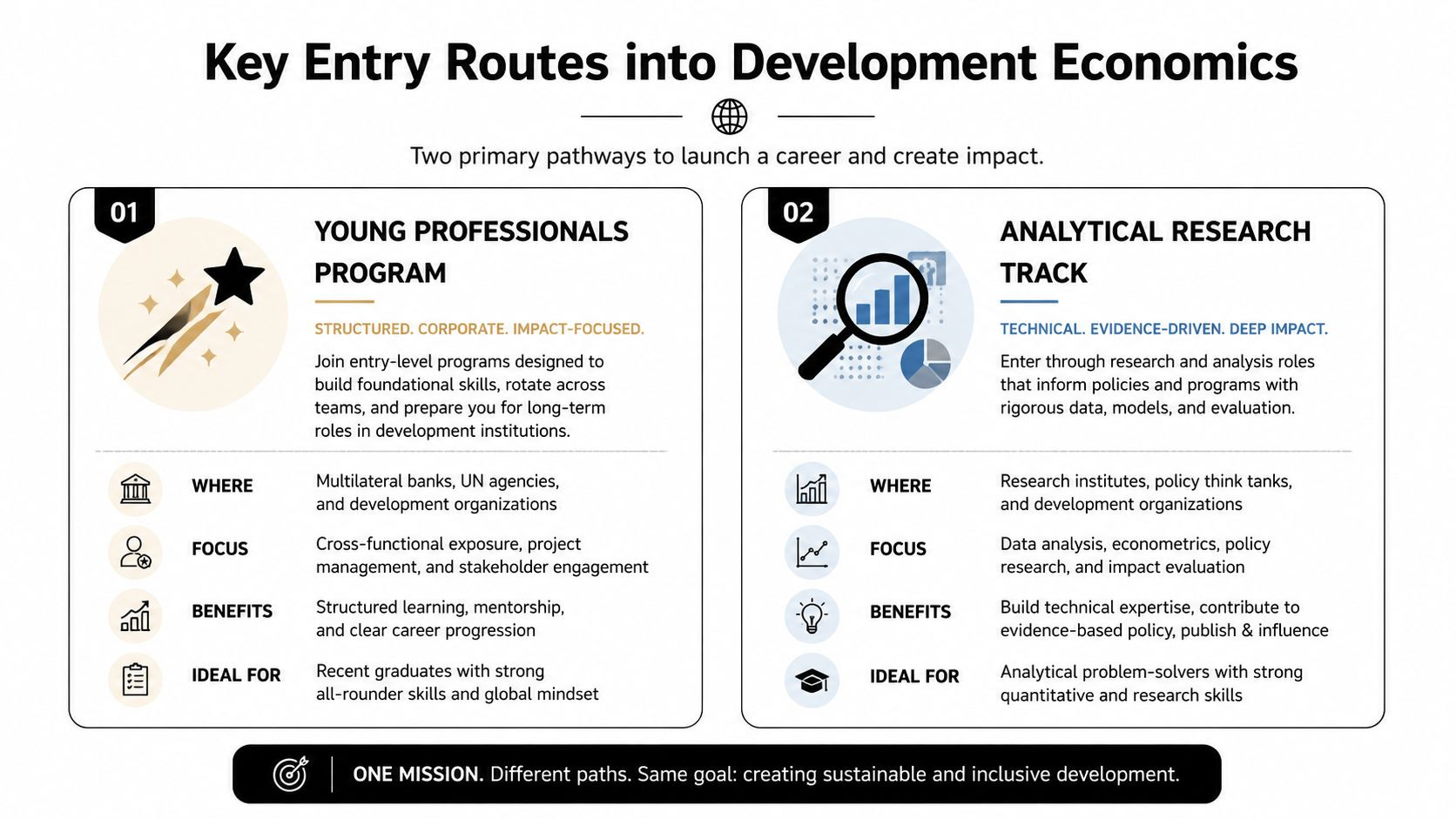
People talk about breaking in as if there’s one front door. There isn’t. There are several, and each one comes with trade-offs.
The mistake is treating prestige as the only criterion. The better question is simpler: which route gives you the fastest path to relevant work, visible outputs, and supervisors who will vouch for you later?
The structured route
Young Professionals Programs are the most visible path into multilateral institutions. They offer a branded entry point, formal rotations in some cases, and a clearer long-term staff trajectory.
They also filter heavily. These programs reward polished academic profiles, strong technical grounding, international exposure, and a clean narrative about why your work fits the institution. If your profile is strong enough, apply. If it isn’t, don’t wait around for one annual intake to decide your future.
For candidates mapping that route, this guide to World Bank jobs for fresh graduates is a useful starting point because it lays out the types of early-career openings that sit below the famous headline programs.
The working route
The more common entry path is less glamorous and often more effective:
Internships: Good for brand access, weak for financial stability.
Short-term consultancies: Good for building a portfolio, weaker for benefits and predictability.
Research assistant roles: Strong if you want technical credibility and publication-adjacent work.
Project analyst roles: Strong if you want to get close to lending, implementation, and client-facing work.
This route rewards hustle, responsiveness, and consistency. You get hired again because someone trusts you to deliver a clean dataset, a reliable slide deck, a donor memo that doesn’t embarrass the team, or an evaluation draft that needs minimal rewriting.
The first serious break often looks temporary. That doesn’t make it weak. It makes it normal.
Staff, consultant, and local contracts
A lot of newcomers miss this distinction, and it matters.
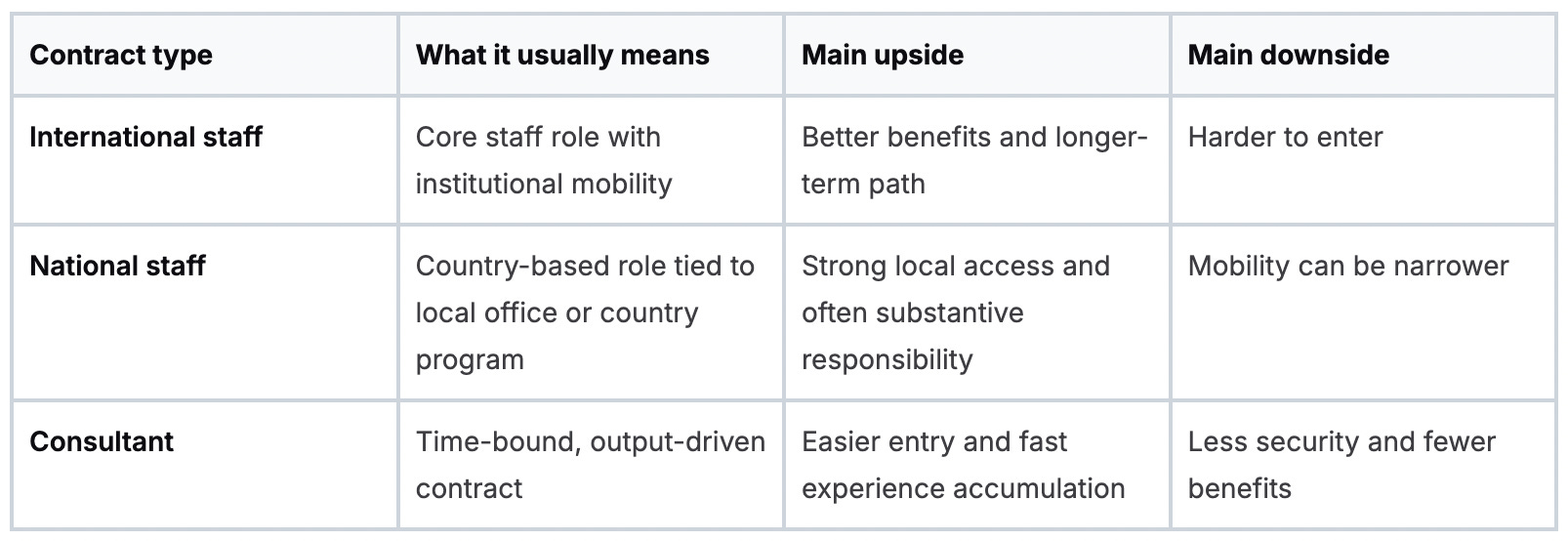
Consultancy can be a smart first move if your goal is to get inside the workflow of an MDB or UN team. It becomes a bad move when you drift from one contract to the next without building a track record in one technical area.
What to choose
Use this filter.
Choose the YPP-style path if you already have a competitive academic profile, policy signal, and patience for long hiring cycles.
Choose analytical or consultancy routes if you need traction now and want proof of work on your CV within months, not years.
Choose country-based roles if you have local knowledge, language ability, and want operational credibility early.
Avoid random applications that don’t add up to a story. Hiring managers notice scattered profiles fast.
A coherent early career beats a prestigious but passive strategy.
The Skills and Credentials That Actually Matter
A degree opens the conversation. Skills decide whether it continues.
In hiring discussions, managers usually ask versions of the same questions. Can this person handle data without hand-holding? Can they write clearly enough for senior review? Can they survive a project environment where priorities change, stakeholders disagree, and the dataset arrives late and incomplete?
The technical stack that gets noticed
LSE’s careers guidance is unusually direct on this point. It notes that employers in international development commonly expect analytical skills such as data analysis and impact evaluation, using tools including Excel, SPSS, and GIS, plus sector-specific methods like monitoring and evaluation. You can read that benchmark in LSE’s international development careers guidance.
That list is broader than many economics students expect. The market rewards people who can move between methods and formats.
The most useful profile usually combines:
Economics training: You need a solid grip on incentives, welfare, public finance, labor, trade-offs, and policy logic.
Applied quantitative work: Cleaning data, documenting assumptions, building indicators, checking quality, and explaining limitations.
Evaluation literacy: Baselines, theories of change, indicators, outcome measurement, and causal reasoning.
Operational translation: Writing recommendations that fit budgets, institutions, and political constraints.
If you can only run regressions, you’re incomplete. If you can only write narrative memos, you’re also incomplete.
What employers actually test
They rarely say it this bluntly, but they’re screening for four things.
Can you make sense of messy data
Real project data is inconsistent, delayed, incomplete, and often politically sensitive. Clean code and perfect assumptions are nice. Judgment matters more.
Can you write for decision-makers
Long academic prose hurts candidates. Good development writing is short, evidence-based, and specific about implications.
Can you talk to non-economists
Your audience may be a task team leader, ministry official, donor representative, or sector specialist. If you need ten minutes to explain one coefficient, you’re going to struggle.
Can you finish work under institutional constraints
This field runs on deadlines, comments, revisions, procurement rules, and internal review. Some brilliant candidates fail because they can’t operate in that system.
Your strongest credential is a piece of work someone can read. A clean brief, dashboard, evaluation note, or policy memo beats vague claims about being analytical.
Credentials that help and credentials that don’t
A master’s in economics, public policy, development, or a related field is often the practical baseline. A PhD helps for research-heavy and senior economics tracks, but it’s not a universal advantage. In operations-heavy hiring, a candidate with stronger implementation judgment can beat a more academic profile.
Useful signals include:
A writing sample with clear findings
Evidence of software use in real projects
Field or country experience
Language skills tied to actual regions
A coherent specialization such as education, health, agriculture, social protection, or infrastructure
Weak signals include generic certificates with no applied output, inflated claims about leadership, and CVs packed with coursework but thin on deliverables.
Understanding Nationality Rules and Hiring Priorities
Nationality matters more than most institutions say out loud. It doesn’t determine everything, but pretending it’s irrelevant wastes your time.
International organizations balance technical merit with representation, internal mobility, language needs, office location, and shareholder politics. That’s true even when job postings frame selection in purely meritocratic language.
What the unwritten rule looks like
Some institutions need broader geographic representation in staff ranks. Some teams need specific language coverage. Some offices prefer candidates who already understand a region’s policy environment and can work credibly with local counterparts. Some roles are easier to fill through consultant contracts because the staffing process is simpler.
That means your passport can shape the route that’s most realistic for you. For some candidates, international staff roles are a sensible target early. For others, consultancy or country-office roles create a more plausible bridge.
If you’re looking specifically at regional institutions, this roundup of Inter-American Development Bank jobs is useful because it gives you a practical feel for how openings cluster by function and location.
Why political skill matters
An OECD job posting for a Data Analyst captures a point many applicants miss. The role involves liaising with countries and other international organizations to maintain databases and representing the organization in technical meetings. You can see that benchmark in the OECD Data Analyst vacancy.
That’s not clerical work. It’s political and technical at the same time.
Many international development economics jobs operate in this manner. You need enough statistical credibility to defend the numbers and enough institutional judgment to handle disagreements over definitions, comparability, timing, and presentation.
How to read postings strategically
Look for signals embedded in the job ad:
Duty station language: Country office roles often value local context and relationship management more heavily.
Language requirements: Treat them as real unless the posting says preferred.
Roster and consultant language: This usually signals flexible hiring pathways.
Representation language: It can indicate institutional pressure to broaden geographic diversity.
Don’t take this personally. Take it seriously.
If a role asks you to coordinate across governments and institutions, they are hiring for diplomacy under technical pressure. Pure technical ability won’t cover that gap.
Finding Openings and Crafting Your Application

Most applicants rely too much on the obvious portals. By the time a posting reaches the big public boards, you’re already in a crowded field.
That doesn’t mean public listings are useless. It means you need a system, not casual browsing.
Where the openings are
The development labor market is fragmented. According to an overview of fast-growing roles in the field, DevNetJobs lists over 2,500 opportunities and the International Economic Development Council maintains its own career board, which gives you a sense of the volume across adjacent specializations like M&E, data analytics, and financial inclusion. That summary appears in this international development jobs market overview.
A practical search stack usually includes:
Institution career pages: MDBs, UN agencies, bilaterals, foundations, and major NGOs.
Specialist boards: Development-focused aggregators and consultancy listings.
Curated newsletters: These save time because someone else already filtered the noise.
Professional networks: Former classmates, supervisors, and country specialists still surface openings before most algorithms do.
One useful option is Multilateral Development Bank Jobs, which publishes recurring listings for staff roles across major MDBs and separate consultant roundups. That’s useful if you want a narrower feed focused on these institutions rather than the whole development market.
If you’re targeting flexible arrangements while building experience, this list of remote international development jobs helps you spot roles that fit a consulting-heavy or transitional phase.
How to tailor the CV
A development CV is not a generic economist CV with a different header.
Hiring managers scan for evidence that you’ve already done the kind of work they need. Put the most relevant evidence high on the page. Lead with outputs, tools, and policy relevance.
Use bullets like these:
Built indicators and dashboards: Mention the dataset, the policy question, and the output used by a client or team.
Produced evaluation inputs: Name the method or framework only if you used it.
Wrote decision-ready notes: Show that your writing informed design, supervision, targeting, or reporting.
Worked across actors: Governments, NGOs, donors, researchers, or implementing partners.
Avoid these mistakes:
Coursework overload: Nobody needs a long inventory of classes.
Theory-heavy language: Translate your economics work into applied relevance.
Responsibility-only bullets: “Supported” and “assisted” are weak unless paired with a result or deliverable.
One CV for every role: That approach fails in this sector.
Interview prep that works
Expect questions that test judgment, not just knowledge.
You may get asked how you’d evaluate a youth employment program with weak administrative data. Or how you’d explain mixed results to a donor. Or how you’d prioritize indicators for a project under budget pressure.
Prepare in three layers:
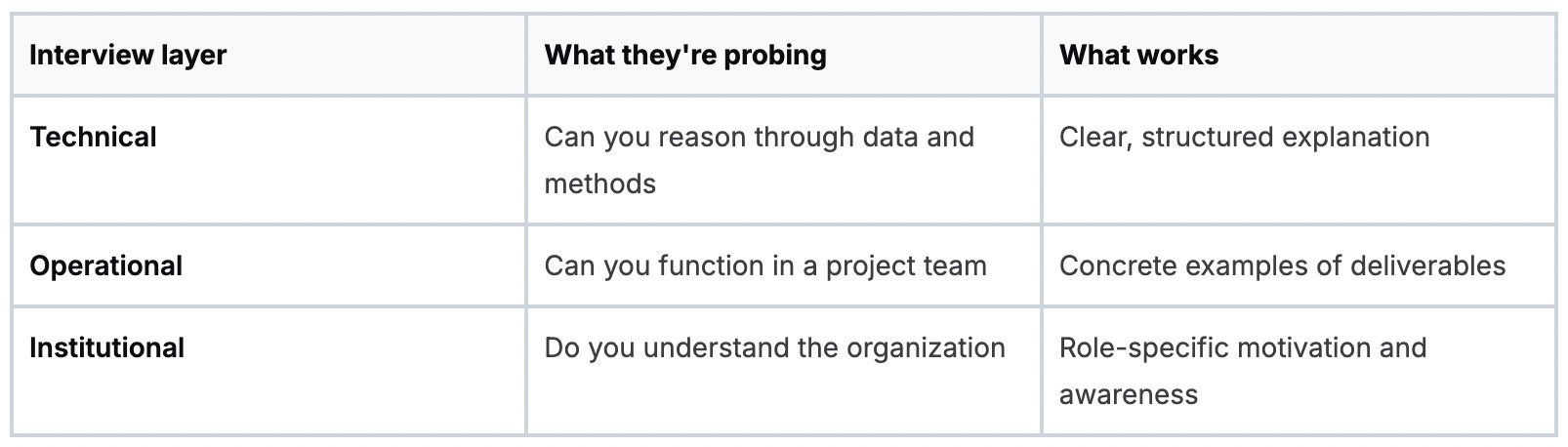
Bring examples from your own work. Keep them short. Make them legible to someone outside your exact specialty.
Sample Career Paths and Compensation Norms
Very few careers in this field move in a straight line. The cleaner story usually gets written afterward.
A realistic path often starts with a role that feels slightly beneath your training. That’s frustrating, but it’s common. The field rewards people who build trust, ship usable work, and become known for one thing before expanding into bigger responsibility.
Path one through applied analysis
A common route starts with a research assistant, analyst, or junior consultant role. At this stage, your job is to become dependable. You learn how internal reviews work, how project cycles shape deadlines, and how much rework bad data creates.
After a few years, people who perform well often move toward one of three identities:
Technical specialist: You go deeper in impact evaluation, poverty analysis, labor, agriculture, education, or another theme.
Operations-facing economist: You stay close to lending, project design, supervision, and country dialogue.
Program and results lead: You move toward M&E, results frameworks, learning agendas, and portfolio oversight.
The strongest candidates don’t try to be broad too early. They build a reputation in one lane, then widen.
Path two through country work
Another route starts in a country office, implementing partner, or region-specific consulting role. This is often less glamorous from the outside and much stronger for practical learning.
You learn how policy gets made, delayed, diluted, or rescued. You also learn that institutional success depends on timing, relationships, and administrative realism as much as technical quality.
That profile can later move into regional bank roles, donor advisory work, sector management, or senior country economist tracks. It’s a strong route for people with language ability, regional depth, and tolerance for ambiguity.
Early career prestige fades fast. Credible field-facing experience keeps paying off.
What compensation usually looks like
Compensation varies sharply by contract type, location, and institution. Staff roles generally offer more stability, better benefits, and clearer progression. Consultant roles can pay well on a day-rate basis while offering less security. Country-based contracts may have strong local relevance but a different benefit structure from international hires.
One broad benchmark is still useful. The U.S. Bureau of Labor Statistics reported a median annual wage of $115,440 for economists in May 2024, as summarized in this development economics career profile. That doesn’t tell you what a specific MDB, NGO, or consulting contract will pay, but it does signal that economist skill sets remain well-compensated in specialized markets.
Compensation norms in this field usually break down like this:
Staff positions: Better long-term value because of benefits, internal mobility, and pension-related structures where applicable.
Consultancies: Better for speed, flexibility, and portfolio building, weaker for financial predictability.
Think tank and academic-adjacent roles: Good for research depth, often less aligned with project-side compensation structures.
NGO and implementing partner roles: Range widely depending on donor funding, geography, and seniority.
What a realistic long game looks like
By the mid-career stage, the differentiation is sharper. Some people become institution builders who can run teams, supervise portfolios, and manage country relationships. Others become technical names that teams bring in when the evidence needs to be defensible.
Both paths work. Problems start when people drift without choosing. If your CV says labor one year, climate the next, education after that, and nothing ties the moves together, hiring managers get cautious.
Pick a lane that matches your strengths. Then build enough breadth to stay useful.
If you want a simpler way to track openings across multilateral institutions, Multilateral Development Bank Jobs curates staff roles, consultant opportunities, and practical guides that help candidates make sense of the hiring process.