


You’re probably in one of three places right now.
You want to break into international development and can’t tell which advice is real. Or you’ve applied for roles at the World Bank, AfDB, ADB, the UN, or INGOs and heard nothing back. Or you’re already adjacent to the field and trying to make a clean move into work that counts as development experience.
All three situations are common. So is the confusion.
Most international development career advice stays shallow. It tells you to network, care about impact, tailor your CV, and get international exposure. Fine. None of that tells you why one strong candidate gets screened out in minutes while another gets hired into a country office, a consultant roster, or a Young Professionals pipeline.
The true game is more specific than that. You need to understand how institutions hire, what kind of experience they value, where nationality rules block access, and when a consultant role is smarter than chasing a staff contract. That’s what moves you from hopeful applicant to viable candidate.
Your Guide to a Career in International Development
The field is competitive, but it isn’t closed.
There are real openings, real hiring needs, and real gaps between what organizations say they want and how they evaluate candidates. The candidates who get traction learn to read those gaps early.

The first useful reality check is market size. The international development job market posted over 163,000 vacancies across 2022 and 2023, and DevelopmentAid listed more than 86,000 jobs in 2023 alone. The strongest demand showed up in Macroeconomy and Public Fiscal Management, while Africa held the largest share of opportunities, much of it with NGOs and major international organizations including the World Bank. Those figures come from DevelopmentAid’s review of hiring sectors in international development in 2023.
That matters for one reason. You are not trying to squeeze into a tiny, static niche. You are trying to enter a large, active market that still filters applicants brutally.
Why smart candidates still get nowhere
Strong applicants get rejected for predictable reasons:
They target prestige, not fit. They apply to the World Bank, UNDP, UNICEF, and every major NGO without understanding which institutions match their profile.
They pitch values instead of usefulness. Hiring managers want people who can draft, analyze, coordinate, negotiate, and deliver.
They miss structural constraints. Nationality, language, location, procurement rules, and funding windows all affect whether a role is even open to you in practice.
They underweight entry routes. Fellowships, internships, roster positions, Junior Professional tracks, and consultancy pools often matter more than cold applications to open staff roles.
Practical rule: Treat your job search like portfolio strategy. Pick targets that match your skills, passport, language ability, and tolerance for risk.
What helps
International development rewards people who can combine mission with operational credibility.
That means knowing how a project gets designed, funded, staffed, supervised, reported on, and eventually handed over. It also means understanding that the field is broad. Policy, finance, data, safeguards, MEL, procurement, communications, governance, climate, health, and education all sit under the same umbrella, but they hire differently.
Good international development career advice gives you a map. Better advice gives you filters. The strongest advice gives you a sequence of decisions.
That’s the point here.
Decoding the Development Sector
If you apply blindly across the sector, you’ll waste months.
The development ecosystem looks unified from the outside. It isn’t. Different organizations use different hiring logic, reward different behavior, and define “relevant experience” in different ways.
The four main employer types
Here’s the simple map.
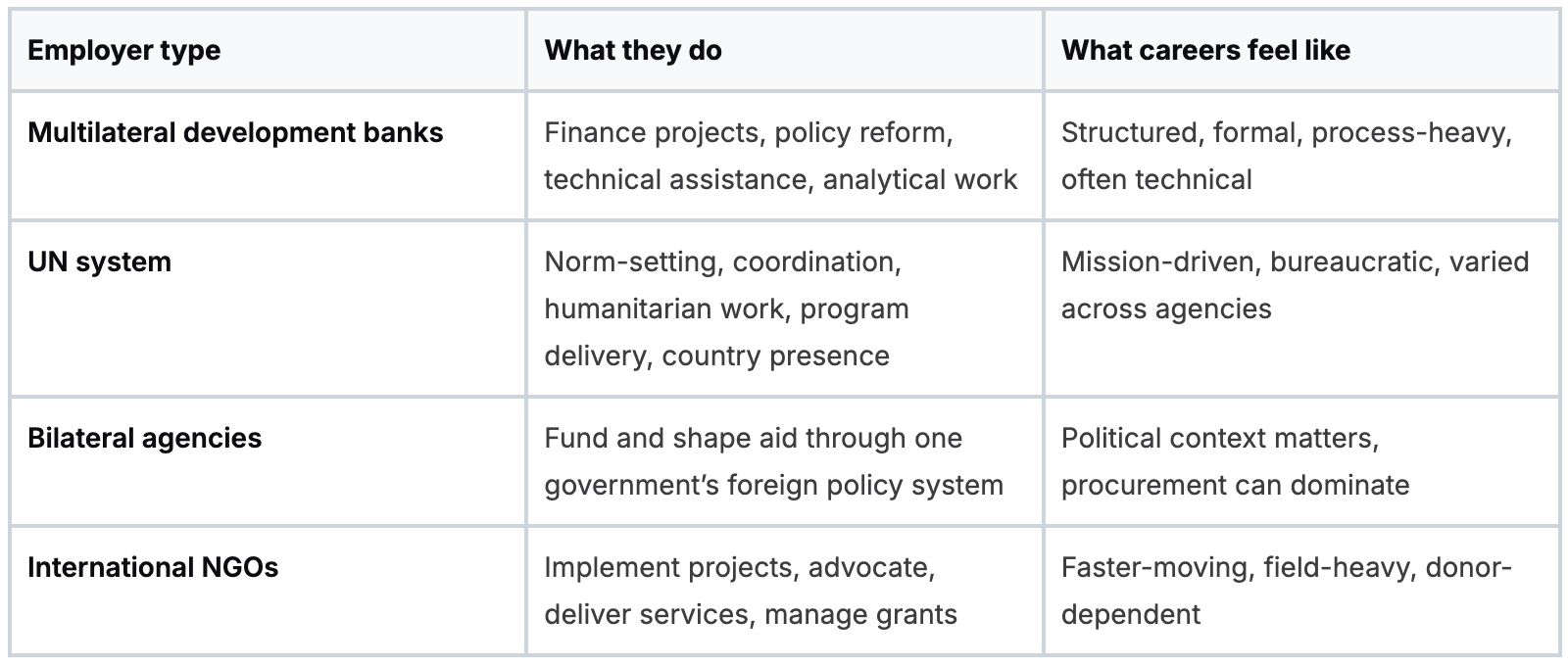
The trick is to choose based on operating style, not brand recognition.
MDBs reward technical credibility
MDBs like the World Bank, ADB, AfDB, IMF, and AIIB hire people who can work inside a rules-based system.
That usually means comfort with analysis, writing, review cycles, internal clearance, country dialogue, and operational procedures. These institutions often value economists, sector specialists, social development experts, procurement professionals, legal staff, finance people, and program managers who can handle both substance and process.
If you like structured environments, policy influence, and technically demanding work, MDBs are often the best fit.
They are also slow to hire, formal in assessment, and unforgiving about eligibility.
The UN runs on systems and relationships
The UN system is not one employer in practice. UNDP, UNICEF, WFP, UNHCR, WHO, and other agencies all have distinct cultures.
Some roles are heavily operational. Others are diplomatic, humanitarian, or coordination-based. Mobility can matter more. Language requirements often matter more. So does prior system familiarity.
People who thrive in UN careers usually understand program cycles, interagency coordination, and the politics of country presence. Generalist profiles can work there better than they do in MDB recruitment, but only if the candidate has clear field relevance.
The biggest mistake is assuming all “international organizations” want the same kind of person. They don’t.
Bilaterals sit closer to policy and procurement
Bilateral agencies channel aid through a national foreign policy lens. That changes the work.
You may find stronger roles in contracting, program oversight, donor relations, grants, evaluation, governance support, and politically sensitive sectors. These organizations can be excellent for people who know how to manage vendors, write scopes of work, oversee implementing partners, and translate policy priorities into funded programs.
But if you want a globally portable career, bilaterals can tie your trajectory more closely to one country’s system.
INGOs are often the best proving ground
Many candidates overlook INGOs because they’re focused on the logos everyone recognizes first.
That’s a mistake. INGOs often give you the operational base that later opens doors at MDBs or the UN. You may get earlier responsibility in grant management, field coordination, monitoring, stakeholder engagement, safeguarding, or emergency response.
What they usually won’t give you is the same level of long-term institutional stability.
Follow the funding, not the branding
Money flows through this ecosystem in layers.
Bilaterals and MDBs finance large agendas. UN agencies coordinate and implement. INGOs execute, partner, advocate, and report back to donors. Consulting firms support all of them through technical inputs, studies, evaluations, and project delivery contracts.
If you understand who funds whom, you start seeing where jobs come from. More important, you start seeing where your profile fits best.
A strong operator with grant and field experience may be far more competitive at a major INGO than at the World Bank. A macroeconomist with a clean technical profile may be wasting time on generic NGO applications. A governance specialist may fit best in a bilateral-funded program office or an MDB public sector team.
That’s how you should understand the sector. Not by prestige. By fit, access, and hiring logic.
The Two Paths Consultant versus Staff Roles
This choice shapes your income, your risk, your network, and your influence.
Many candidates talk about “getting into” an institution as if there’s one door. There isn’t. In most development organizations, especially MDBs and the UN ecosystem, the consultant route and the staff route operate like parallel labor markets.
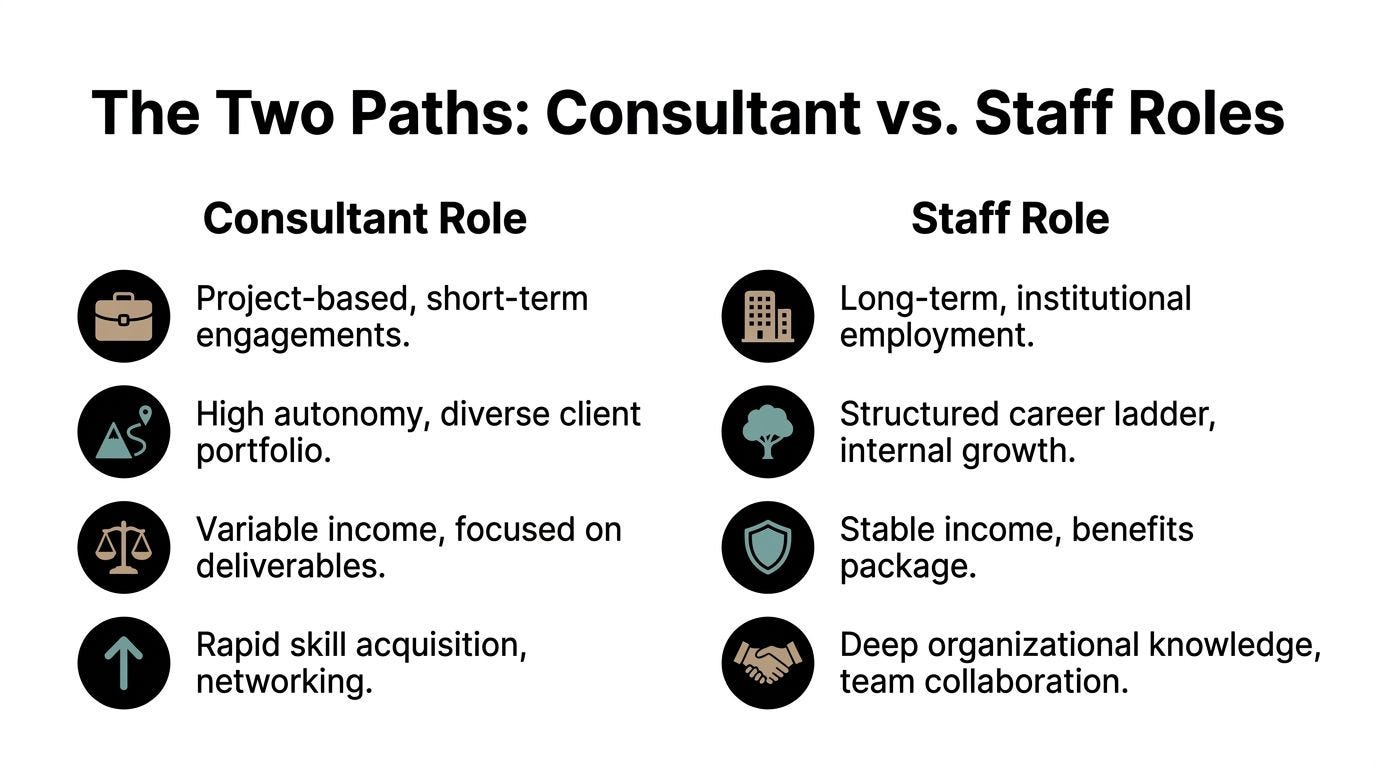
What consultant roles give you
Consulting is usually the faster entry point.
You get hired for a defined output, a project phase, surge capacity, research input, drafting support, or technical delivery. If a team has budget and urgency, they can often move faster on a consultant than on a staff requisition.
That speed is the upside.
The other advantage is access. Consulting lets you build direct experience inside the institution, learn the workflow, and develop references from actual task team leaders, practice managers, or program leads. For many people, that first contract is the bridge from outsider to known quantity.
Consulting also sharpens your commercial discipline. You learn to scope work, manage clients, and deliver clean outputs on time. If you plan to pursue this route, it helps to understand how to position your offer and respond to terms of reference. This practical guide on how to write a consulting proposal is useful for that transition.
What consultant roles cost you
The trade-off is obvious once you’ve lived it.
You may have uneven income. Your contract may end cleanly with no extension. Benefits can be limited or absent. You can become highly useful to a team without becoming structurally part of it.
Some candidates also stay too long in loosely defined consultancy work. They become the person who can “help out” across everything, but they never build a profile that supports a more senior hire.
That drift is common.
Consulting works best when you use it intentionally. It works poorly when you treat each contract as an isolated gig.
What staff roles give you
Staff roles offer something consultants rarely get. Institutional depth.
You’re inside the system. You gain access to formal career ladders, internal mobility, performance cycles, benefits, and the kind of trust that comes from being responsible for work over time rather than task by task.
Staff roles also position you differently in meetings, country dialogue, and internal decision-making. You’re not just delivering a product. You’re shaping process and carrying accountability.
That matters if you want to build long-term influence in development finance, operations, policy, or sector leadership.
What staff roles demand
The recruitment process is tougher.
You face stricter screening, longer wait times, more formal interviews, and in many cases more rigid eligibility requirements. Institutions take fewer risks on staff hires. They want evidence that you can operate in their culture for years, not just complete a deliverable next quarter.
The other hard truth is that many candidates chase staff titles too early. They have good credentials but not enough directly relevant experience, and they burn time applying into a level they are unlikely to land.
A side-by-side decision frame
Use this to choose your path.
Pick consulting if you need a faster entry route, can tolerate uncertainty, and want to build institution-specific experience quickly.
Pick staff if you already have a strong fit for the level, want stability, and are prepared for a slower process.
Use consulting as a bridge if your goal is staff later but your current profile needs a credibility upgrade.
Avoid random contract hopping if each role takes you farther from a coherent niche.
The mistake to avoid
Candidates often frame this as flexibility versus stability.
The better question is different. Which path gives you the strongest next move?
For some people, a consultant role with the right team is far more strategic than a staff role in the wrong institution or function. For others, passing on a short-term contract to stay available for a serious staff process is the smarter call.
Choose based on trajectory. Not title envy.
Building Your Essential Skills and Education
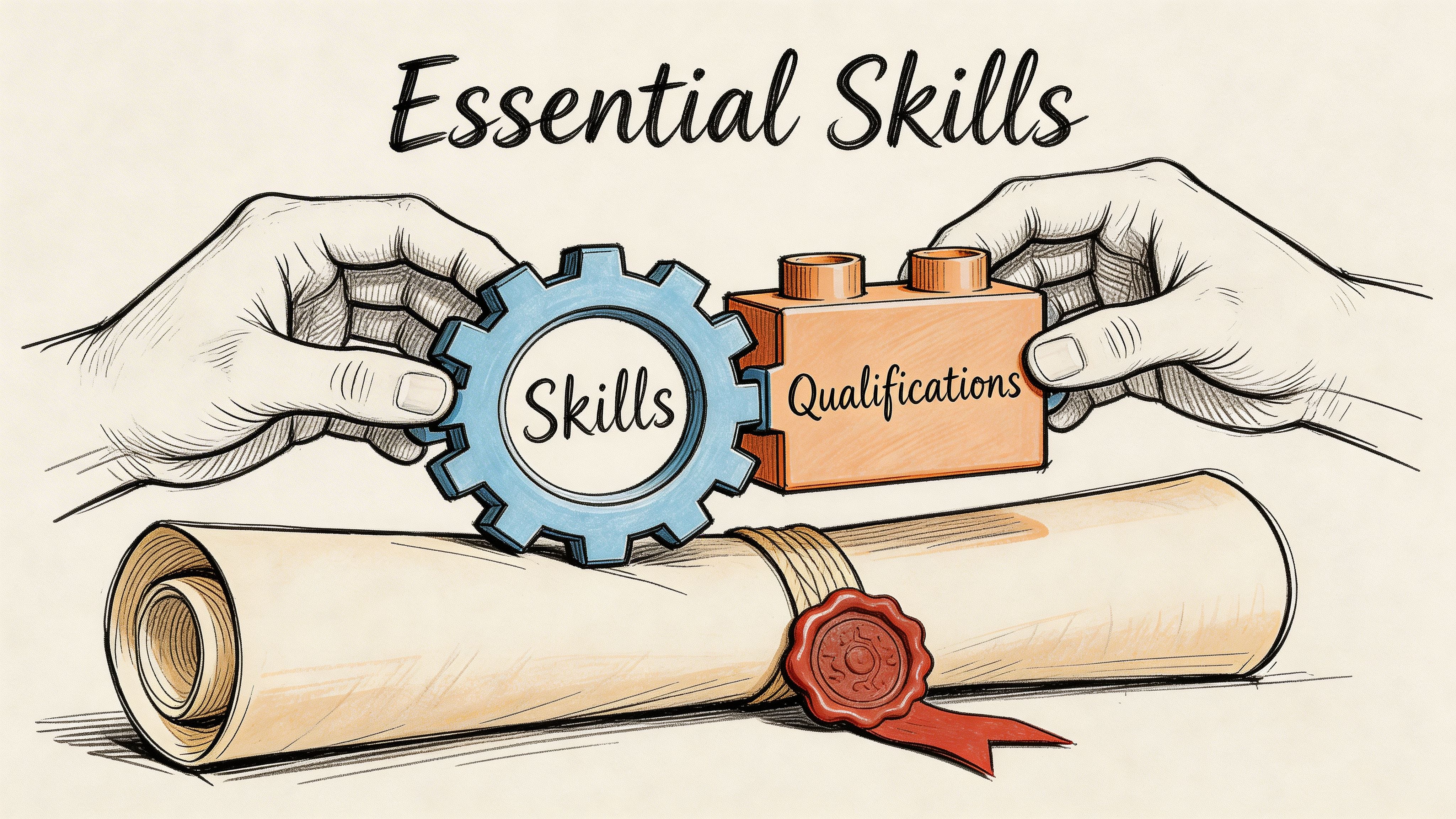
Degrees help you enter the conversation. Skills get you hired.
A lot of candidates overinvest in credentials and underinvest in proof of capability. A master’s can be useful, often necessary for certain tracks, and expected in many competitive pools. But employers still ask the same practical question: what can you do that solves a real operational problem?
According to EvalCommunity’s overview of fast-growing international development jobs, the core competencies most tied to career advancement are project management, data analysis, problem-solving, and cross-cultural communication. That same source notes that most roles require at least a bachelor’s degree, senior roles often call for advanced study, and fellowships and internships remain important entry routes.
The hard skills that move you forward
General interest in development is not a skill.
Hiring managers look for capabilities they can plug into existing workstreams. The exact skill depends on the institution and practice area, but the strongest candidates usually bring one or more of these:
Analytical work. Data cleaning, interpretation, dashboarding, policy analysis, economic reasoning, MEL, or sector diagnostics.
Project execution. Work planning, implementation tracking, donor reporting, logframes, results frameworks, procurement support, and coordination.
Technical specialization. Public finance, climate, education, health, governance, infrastructure, agriculture, gender, safeguards, or private sector development.
Writing under constraints. Briefing notes, concept notes, board-facing summaries, aide-memoires, donor updates, and concise analytical memos.
If your analytical base is weak, fix that directly. This guide on how to improve analytical skills is a practical starting point.
Cross-cultural communication is not a soft extra
This is the one skill people claim and rarely demonstrate well.
Cross-cultural communication shows up in how you write, how you ask questions, how you manage disagreement, and whether you can adapt your style across governments, donors, consultants, and local partners. In development, this is often the difference between a technically correct person and a trusted colleague.
You build it through real exposure. Multilingual work environments help. So do field assignments, exchange programs, volunteer placements, and roles where you coordinate across institutions and countries.
Your ability to work across context is often more important than your ability to talk about context.
Education strategy matters
A common mistake is choosing a degree that signals broad interest but no hiring use.
International relations, public policy, development studies, economics, public health, law, and area studies can all work. What matters is whether your coursework, thesis, internships, and outputs point to a usable professional profile.
A better educational strategy usually looks like this:
Pick a functional lane such as economics, governance, climate, health systems, procurement, MEL, or social development.
Add a technical layer through methods, finance, stats, evaluation, or data work.
Get applied experience early through internships, fellowships, field roles, or project-based work.
Show evidence in writing samples, datasets, briefs, presentations, or implementation results.
What makes you valuable
A valuable candidate combines three things in one profile.
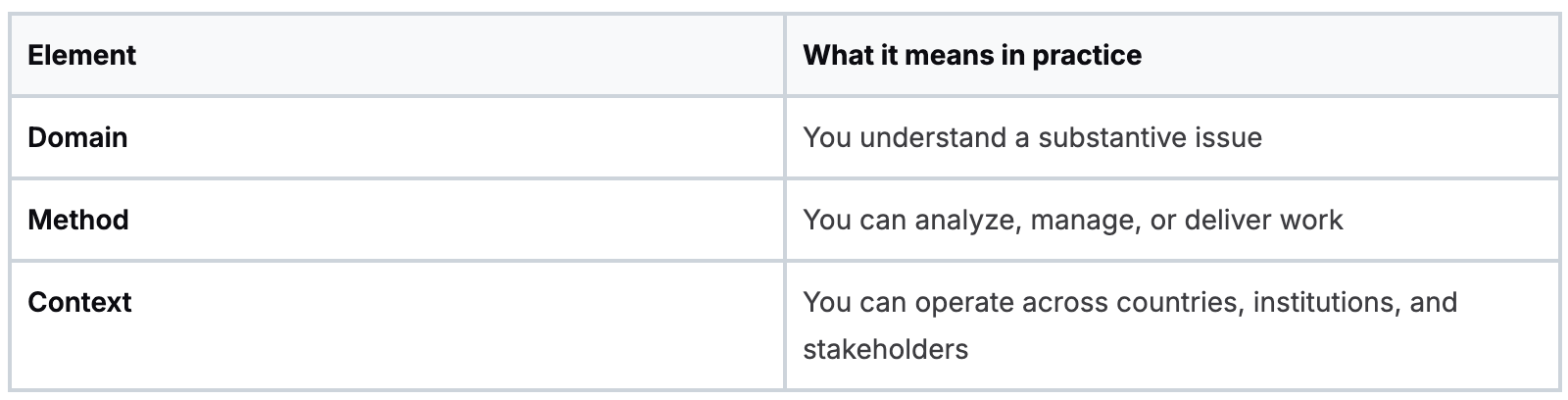
Plenty of candidates have one or two of those. The ones who rise faster usually have all three.
That’s the standard to aim for. Not “passion for development.” Operational value.
The Nationality Filter and How to Address It
Many candidates lose months in this phase.
They assume merit is the whole story. It isn’t. In MDB hiring, nationality can be a hard filter long before anyone evaluates your technical fit.
That doesn’t mean the system is arbitrary. It means the system is structured.
Why nationality matters in MDBs
Multilateral development banks are member-based institutions. Their hiring systems reflect that governance structure.
According to DevelopmentAid’s guidance on launching a career in international development, 45% of operational roles in 2023 at the World Bank were filled by nationals from borrower nations to meet charter-related representation goals. The same source notes that Young Professionals Programs are a key entry route, with the World Bank’s YPP reporting a 20 to 25% selection rate, and that YPP alumni were promoted 20% faster than lateral hires.
Read that carefully. Nationality is not a side issue. It is part of workforce design.
What this means for your application strategy
If you are from a borrowing member country, that can strengthen your position for certain operational tracks, country-facing work, and programs designed to maintain representation.
If you are not, you need to be more precise.
Some roles are effectively local in orientation, even when they look internationally branded. Country office positions may strongly favor nationals or residents with deep local familiarity. Other roles may be technically open but still shaped by representation targets. If you don’t account for that, you can spend a year applying into structural headwinds.
The practical filters to check first
Before you invest time in any MDB application, check these points:
Nationality eligibility. Is the role open to all member countries or a narrower group?
Borrowing country logic. Does the institution or program favor nationals from borrowing members?
Location model. Is the post based in headquarters, a regional hub, or a country office?
Residency expectations. Does the role require local residence, local market knowledge, or demonstrated ties?
Grade level. Is this a true entry route, or does it expect experience beyond what the title suggests?
These are not administrative details. They shape whether your application is realistic.
If a role is structurally designed for a profile you do not match, tailoring your CV won’t rescue it.
How to use YPPs intelligently
Young Professionals Programs are one of the few routes where institutions explicitly invest in future staff.
That’s why they matter. They are competitive, but they provide a cleaner path into long-term careers than many ad hoc applications do.
Candidates misuse them in two ways. First, they treat them as lottery tickets and apply without checking eligibility or institutional fit. Second, they ignore them because they assume only elite insiders get through.
Neither approach works.
Use YPPs strategically if your education, nationality profile, and early experience line up with what the program is designed to build. If they don’t, a consultant route, field-heavy role, or technical specialist track may be more realistic.
Hard truths for dual citizens and internationally mobile candidates
Mobility helps, but it doesn’t erase institutional rules.
Dual citizenship can be useful, yet it can also complicate how you present eligibility, especially when representation and residency norms matter. Candidates who have studied abroad for years, hold multiple passports, or have mixed professional histories need to read vacancy language carefully and decide which part of their background is most relevant to the role.
That includes how you frame local ties, language, and country knowledge.
What works better than generic optimism
Treat nationality as a planning variable.
Start by mapping your passport, member-country status, language profile, residence history, and likely target institutions. Then build a shortlist of roles where those factors help rather than hurt you.
That may sound less romantic than “apply widely and stay hopeful.” It is also how people save time and get hired.
Mastering Your Application CVs Interviews and Tests
Strong candidates fail because they present themselves badly.
Recruiters and hiring managers don’t see your intentions. They see documents, screens, structured answers, and test performance. If those pieces are weak, your background won’t save you.

Build your CV from the TOR backward
Most applicants write from memory. That’s the wrong method.
Start with the vacancy notice or terms of reference. Pull out the actual demands. Then map your experience against those demands in the language of delivery, analysis, coordination, and results.
A development CV should make these points easy to spot:
Scope. What kind of program, project, country, or portfolio did you work on?
Function. What did you do?
Stakeholders. Who did you work with?
Output. What did you produce?
Relevance. Why does that experience fit this specific role?
Don’t write “supported project implementation.” Write what support meant. Drafted procurement documents, tracked milestones, prepared donor reports, coordinated government consultations, or analyzed budget data.
Results beat responsibilities
Many candidates list tasks. Better candidates show contribution.
You do not need inflated claims. You do need specificity. If you built a monitoring framework, say so. If you coordinated with ministries, say which ministries. If you drafted sections of a policy note, mention the topic and purpose.
Competency interviews reward structure
MDBs and international organizations often use competency-based interviews.
That means they are not looking for your opinions on global development in the abstract. They want examples of behavior under pressure, ambiguity, conflict, deadlines, and stakeholder complexity.
Use a disciplined structure. STAR works well:
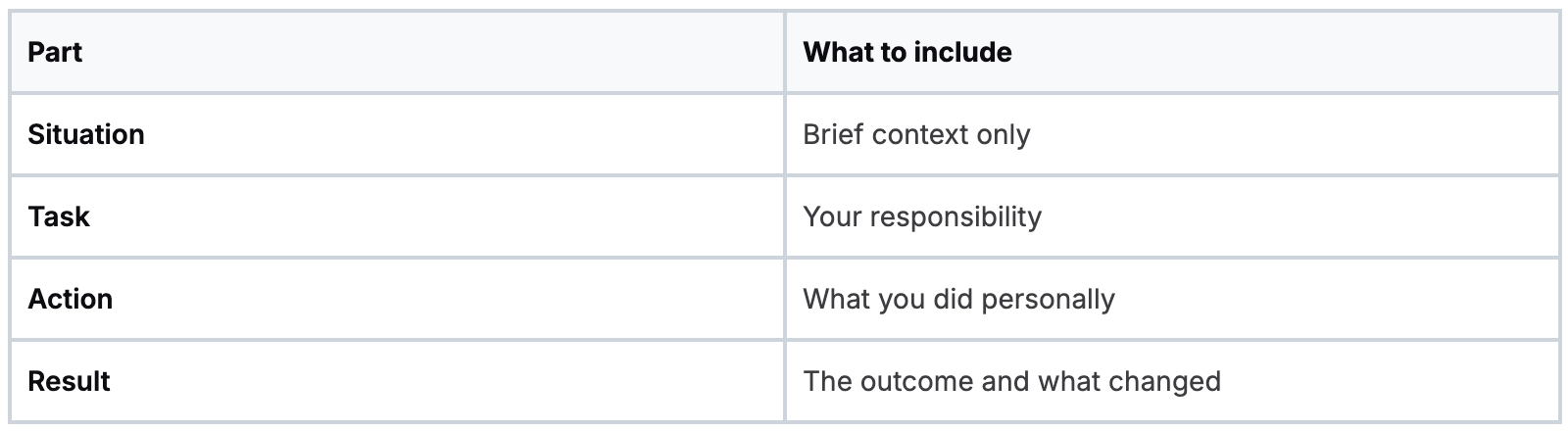
Keep the “situation” short. Most candidates waste time there.
Your answer should make it impossible for the panel to confuse your contribution with your team’s contribution.
Prepare for written tests like they matter
Because they do.
Organizations often use online assessments, written exercises, or technical screens to reduce large applicant pools. These tests usually reward clarity, judgment, prioritization, and concise writing under time pressure.
Prepare by practicing these tasks:
Briefing notes on a sector issue or project problem
Data interpretation using simple tables or charts
Editing for clarity under a word limit
Prioritization memos where you recommend an action
This is one area where candidates underprepare badly. They assume their degree covers it. It usually doesn’t.
Cover letters should do one job
A good cover letter is not your autobiography.
It should explain the match between your profile and the role’s needs. That’s it. If the organization does not require one, don’t force a long generic statement into the application portal elsewhere.
Small errors signal bigger problems
Hiring teams notice carelessness fast.
Watch for:
Mismatch between dates and titles
Country names or institutions written inconsistently
Long bullets with no clear point
Acronyms with no explanation
Claims you can’t defend in interview
Your application should read like someone who already works in a demanding institution. Because that’s what they’re trying to hire.
Your Step-by-Step Action Plan for Landing a Role
Many candidates need a system, not more motivation.
The job search gets easier once you turn it into a sequence. The hard part is choosing the right sequence for your profile.
A future-focused guide from SIPA identifies one recurring blind spot clearly: applicants often fail because they overlook MDB nationality rules, with up to 70% failing pre-screening for that reason, and candidates from middle-income countries who target routes such as Young Professionals Programs show a 25% higher success rate. That projection appears in the Career Pivots Guide hosted by SIPA.
Month one, define your real market
Start with self-audit, not applications.
List your:
passport and member-country status
languages
sectors
technical strengths
field exposure
writing samples
preferred locations
tolerance for consultant risk versus staff stability
Then create three target lists. First, institutions where you are strongly eligible. Second, institutions where you are plausible but need a better angle. Third, institutions you should stop chasing for now.
That one exercise cuts noise fast.
Month two, choose your route
At this stage, pick a primary route and one backup.
Your primary route might be:
YPP or junior professional tracks
Consultant entry into an MDB or UN team
INGO or implementing partner role to build operational credibility
Bilateral-funded project role with strong technical relevance
If you’re exploring junior pipelines, this page on the World Bank Junior Professional Associate route is one useful reference point.
Month three, build targeted proof
Now tighten your evidence. You revise your CV, sharpen your LinkedIn, organize writing samples, and build a short bank of interview stories. You should also prepare one-page summaries of your core profile for networking outreach.
Do not network randomly. Contact people who sit one or two steps ahead of you in the exact lane you want. Ask about hiring logic, team needs, and useful entry points. Ask less about inspiration and more about process.
People respond better to focused questions from candidates who’ve done their homework.
Months four to six, apply with discipline
By now, your applications should be selective.
A good weekly rhythm usually includes:
One block for vacancy review
One block for tailoring documents
One block for outreach
One block for interview or test practice
One block for tracking progress
Use a spreadsheet. Track role, institution, deadline, status, contact, eligibility notes, and lessons learned.
This is also where one practical tool can help. Multilateral Development Bank Jobs publishes recurring listings across major MDBs and consultant opportunities in the wider multilateral space, which can make targeted monitoring easier if you want a centralized scan of openings.
The habits that improve outcomes
Three habits separate serious candidates from the rest.
First, they stop applying to everything.
Second, they treat every rejection as market feedback. Was it eligibility, level, sector mismatch, weak framing, or timing?
Third, they keep building relevance while searching. Short consulting assignments, fellowships, volunteer technical work, applied research, language improvement, and writing samples all compound.
What to do next week
Keep it simple.
Monday: define your target institutions and eliminate poor-fit ones
Tuesday: rewrite your CV around one role family
Wednesday: identify five people for focused outreach
Thursday: prepare two STAR stories and one writing sample
Friday: submit only roles you are suited for
International development career advice becomes useful when it forces decisions. The field rewards people who understand systems, position themselves accurately, and move with patience.
That’s how you land the first credible role. Then the second one gets easier.
If you want a focused way to track staff roles, consultant openings, and practical guidance on hiring at major multilateral institutions, take a look at Multilateral Development Bank Jobs. It’s a straightforward resource for candidates targeting the World Bank, ADB, AfDB, IMF, AIIB, and related organizations.