

Let’s get straight to it. An IMF economist salary is designed to attract the best in the world, starting with a base pay of over $120,000 USD a year for new Ph.D. hires. For senior economists, that number climbs well past $200,000, and that’s before you touch the famously generous, often tax-free, benefits package.
Your Quick Guide to an IMF Economist Salary
You want to know what an economist at the International Monetary Fund really earns. Forget vague estimates. This guide gives you the numbers you need to understand the financial reality of an IMF career.
The takeaway is simple: the IMF pays top dollar to attract elite global talent. Their compensation is a structured, transparent system, and understanding it is key.
The salary structure is built on a clear system of grades and steps. Your starting point depends entirely on your qualifications and experience. For most Ph.D. economists, this means entering at the A11 grade, a professional level that immediately puts you in a high-income bracket.
Key Salary Benchmarks
From that starting point, your career path is clear. Your performance, leadership on missions, and the quality of your analytical work drive your progression through the steps within your grade, eventually leading to promotions to higher grades. This steady climb ensures your earnings grow in lockstep with your expertise and influence at the Fund.
Compensation for an IMF economist goes well beyond base pay, a structure similar to what you’ll find at other MDBs. If you’re comparing opportunities, you can learn more about the World Bank economist salary in our detailed guide. For now, let’s stick to the IMF’s core salary figures.
The IMF’s compensation strategy competes directly with top-tier private sector financial institutions and central banks. The goal is to remove financial barriers so the organization can recruit the world’s sharpest economic minds to work on global stability.
To give you a concrete snapshot of potential earnings at different career points, here are estimates based on publicly available grade structures and market data.
IMF Economist Salary Benchmarks (2026 Estimates)
This table provides estimated base salary ranges for IMF economists at different career stages, based on publicly available grade structures and market data.
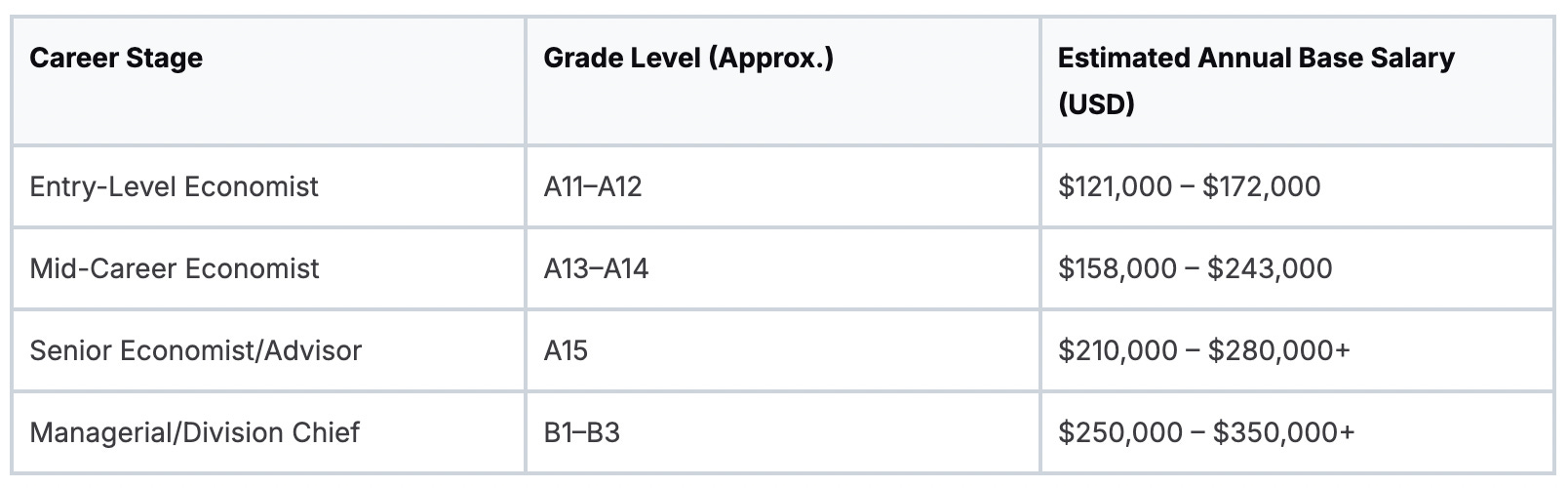
These numbers provide a solid baseline for what you can expect as you move through your career at the Fund. Remember, this is base salary alone. The total compensation package, which we’ll break down next, adds significantly to these figures.
Understanding IMF Pay Grades and Steps
An IMF economist’s salary isn’t a single, flat number. It’s part of a highly structured system of grades and steps that maps out your potential career path and earnings from day one. Getting your head around this system is key because it’s the transparent ladder you’ll be climbing.
The pay scale is split into two main buckets: ‘A’ grades for professional staff, where almost all economists land, and ‘B’ grades for managerial roles. As an economist, you’ll live and grow within the ‘A’ grades, and your performance is what moves you up.
This system is designed to tie your pay directly to your expertise and the weight of your responsibilities. As you take on bigger, more complex work, your spot on the scale moves up with you.
The A11 Starting Line
For most economists with a fresh Ph.D., your career at the Fund kicks off at the A11 grade. Don’t mistake this for a trainee position. It’s a full-blown professional role where you’re expected to contribute to core analytical work immediately.
Moving up isn’t automatic. Each grade is broken down into multiple “steps,” and moving through them hinges on your annual performance reviews. Nail your reviews, and you’ll move up the steps faster, getting a base salary bump each year even without a full promotion to the next grade.
This chart gives you a clear visual of how you progress from an entry-level role to a senior one.
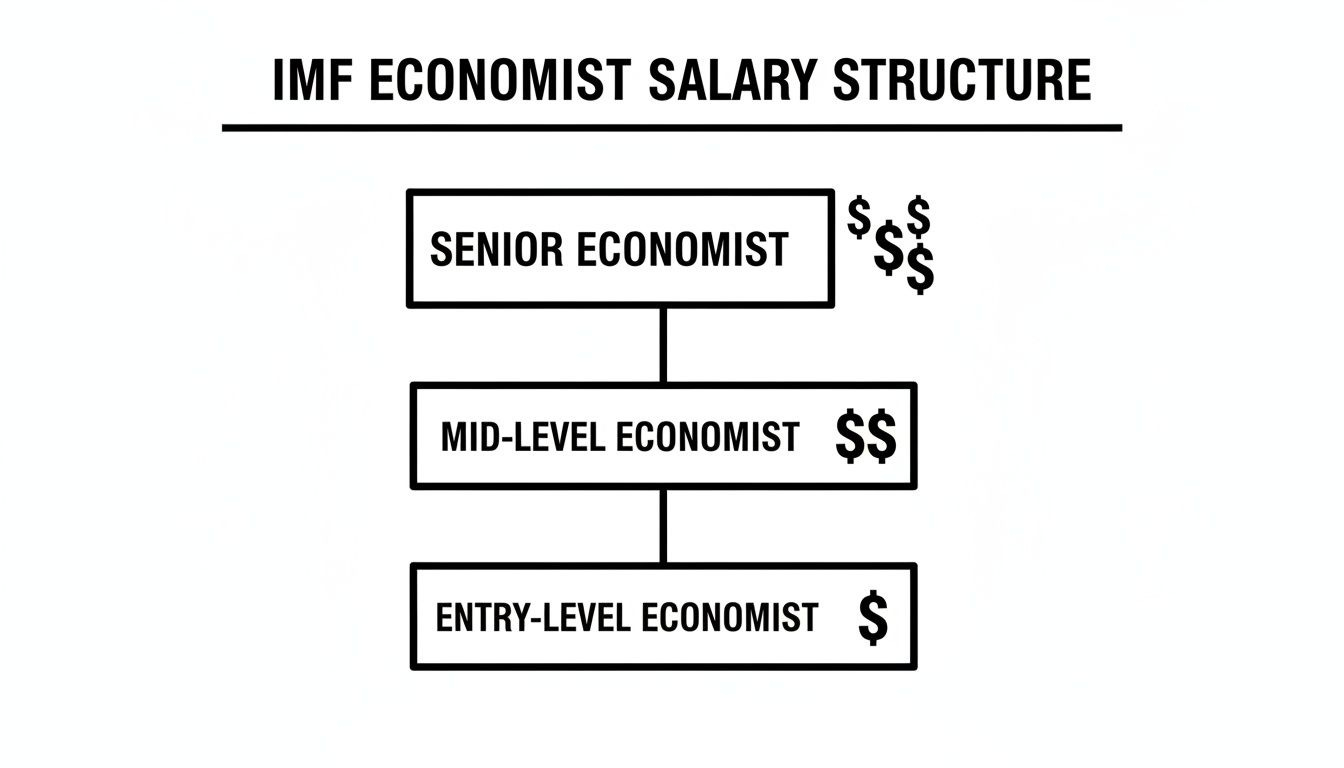
The earning potential grows substantially as you gain seniority. You start on a solid base and can climb to a highly competitive senior-level income.
The numbers really drive this home. New Ph.D. economists starting at the A11 grade can expect a base salary beginning around $121,480 and climbing to $151,850 at the top of that band. This isn’t just for economists; other professionals like finance or HR officers start here too. It’s a strong starting point that’s well above the U.S. average for similar jobs.
Once you get that first promotion, a confirmed economist at the A12 grade sees their salary range jump to $138,220–$172,770. You can get a sense of how these salaries stack up against the local market by checking out data for the Washington D.C. area on ZipRecruiter.
How You Climb the Ladder
Making the leap from one grade to the next, say, from an A12 Economist to an A13 Senior Economist, is a major career milestone. This isn’t about putting in the time. It’s about proving you can operate at a higher level of analytical skill and leadership.
Your progression is a direct result of your work. Leading missions, publishing high-impact research, and providing influential policy advice are the actions that drive you up the pay scale.
The Fund’s internal review process is notoriously tough and looks for very specific contributions. Here’s what really fuels your advancement:
Mission Leadership: Successfully leading country missions is the number one path to promotion. It shows you can handle complex negotiations and deliver critical analysis under pressure.
Analytical and Publication Record: The quality of your research is a huge factor. Getting papers published in top journals or contributing to flagship IMF reports builds the case for your promotion.
Teamwork and Mentorship: The IMF is a collaborative place. Your ability to work well with colleagues and guide junior economists is noticed and rewarded.
Because it’s a merit-based system, your career trajectory is truly in your own hands. Consistent high performance brings real, tangible rewards through step increases and grade promotions, making your salary a direct reflection of what you bring to the table.
Maximizing Your Earnings in the Mid-Career Sweet Spot

This is where the real action is. The mid-career phase at the IMF, typically hitting somewhere between your five and fifteen-year mark, is where your earning potential explodes. You’ve put in the time, cut your teeth as an entry-level economist, and built a solid track record. Now, the Fund is ready to pay for that hard-won expertise.
Your salary at this stage is a reflection of a massive leap in responsibility. You’re no longer just a participant on missions; you’re leading them. You’re not just crunching data; you’re the one shaping the economic policy advice that lands on the desks of finance ministers and central bank governors.
This period is all about moving into the A13 and A14 grades. These are the senior economist roles where your work starts having a direct, visible impact on global economic policy. It’s the point where the IMF economist salary package goes from being just “good” to truly world-class.
What Makes Mid-Career Pay Different
For a senior economist, the base salary is just the starting point. Think of your total compensation as a powerful financial package built on your proven ability to deliver results under immense pressure. It’s the Fund’s way of acknowledging that your skills in advanced modeling, policy negotiation, and technical assistance are at their peak.
During this prime phase, your base pay can easily climb from $158,000 to over $240,000 annually. But that number doesn’t tell the full story. Once you factor in all the adjustments and allowances, senior economists in high-cost posts like Washington, D.C. often see their total gross compensation push higher.
This premium puts the IMF’s pay 15-20% above what you’d typically find at many other multilateral development banks. The difference is about influence. At this level, you’re the one briefing department heads and presenting your team’s findings directly to country authorities. Your analytical signature is on the papers that shape global financial debates, and the salary reflects that ownership. You can dive deeper into how IMF mid-career benefits create this sweet spot in global finance.
How Your Expertise Turns into Dollars
Your value in this mid-career sweet spot is measured by your ability to untangle complex, high-stakes problems. The Fund handsomely rewards economists who prove their mettle in a few key areas. Think of these as the primary drivers of your earning potential.
Leading Technical Missions: Successfully guiding a team through a country’s Article IV consultation or a tough program negotiation is the clearest signal of your value. It proves you can manage sensitive political relationships and deliver critical analysis on a tight deadline.
Specialized Policy Expertise: If you develop a deep, sought-after knowledge in a niche like sovereign debt restructuring or financial sector stability, you become the go-to expert. That kind of reputation is currency at the Fund and directly fuels your career progression.
High-Impact Publications: Getting your work into major IMF publications, like the World Economic Outlook or the Global Financial Stability Report, cements your reputation. These flagship reports are your platform for demonstrating serious thought leadership.
Your mid-career compensation is a direct reflection of your influence. The more you become a trusted voice on critical economic issues, the faster your earnings will grow. The Fund pays for judgment, not just analysis.
Ultimately, this career stage is where you build both a global reputation and lasting financial security. The IMF knows that to keep its top-tier talent from jumping to the private sector, its compensation can’t just be competitive. It has to be compelling. The blend of a high base salary, significant benefits, and the chance to work on the world’s most pressing economic challenges is what makes this the definitive sweet spot.
Thinking Beyond the Base Salary: Your Real IMF Compensation
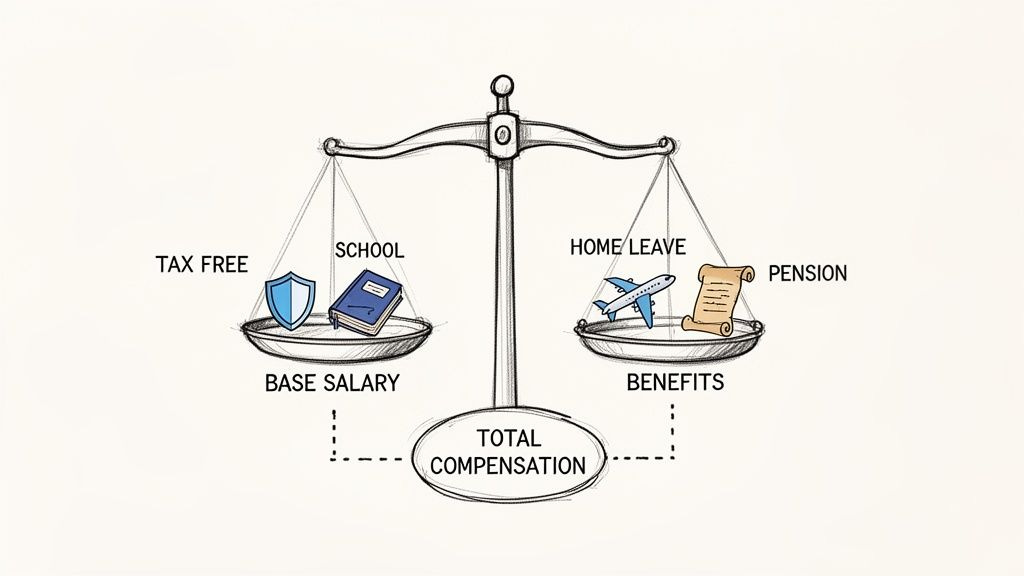
Looking only at the base salary on an IMF offer is a rookie mistake. That number is just the beginning. The real value is in the total compensation package, a powerful mix of benefits and allowances that dramatically changes your financial picture.
For most non-U.S. citizens, the single biggest game-changer is the tax-free salary. This is a massive financial advantage that can add tens of thousands of dollars to your take-home pay each year compared to a similar role in the private sector.
It’s critical to see how this stacks up against other major players in the development world. To get a clearer picture of the landscape, you should check out our deep dive comparing careers at the World Bank, IMF, and other MDBs.
The Big-Ticket Allowances
On top of the tax benefit, the Fund provides a set of allowances that are substantial cash benefits designed to handle major life expenses for you and your family.
The dependency allowance is straightforward financial support if you have a non-working spouse or dependent children. It’s a direct boost to your pay to help offset the costs of supporting a family, especially in a city as expensive as Washington D.C.
For anyone with kids, the education grant is where things get really interesting. The IMF covers a huge chunk of your children’s schooling costs, from elementary school right through university. This benefit alone can be worth over $20,000 per child, per year, effectively removing one of the biggest financial burdens for expatriate families.
IMF vs World Bank vs Private Sector Compensation Snapshot
To put it all in perspective, let’s look at how a typical mid-career economist’s compensation might break down across the IMF, its sister institution the World Bank, and a high-paying private sector job. The differences are revealing.
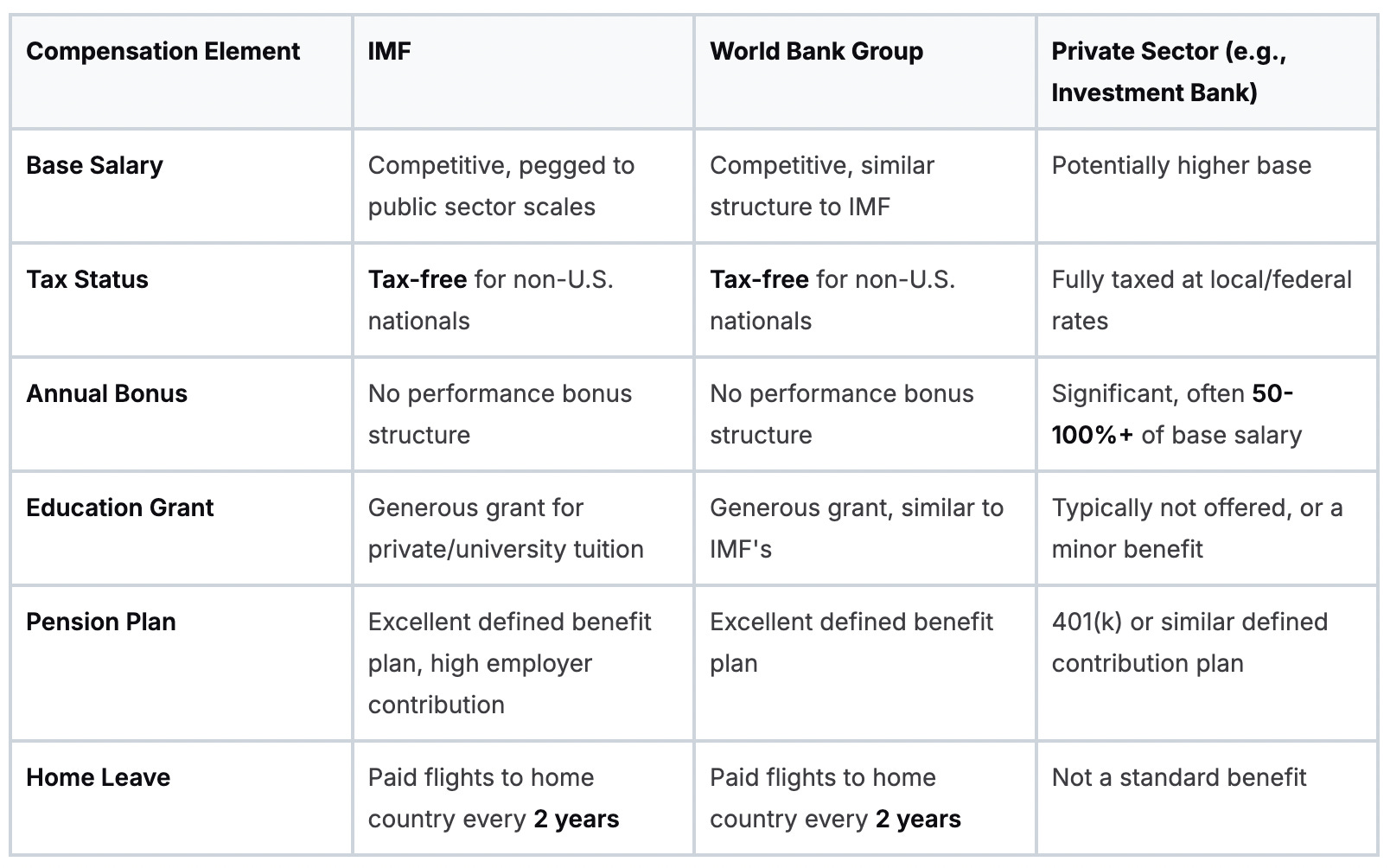
While the private sector might flash a higher bonus, the tax-free income and massive education and pension benefits at the IMF often create a far superior net financial position over the long term.
Lifestyle and Long-Term Security
The Fund’s benefits package is built for the long haul, focusing on your well-being and connection to home. These perks show that the IMF understands the realities of a demanding international career.
Home Leave Travel: Every two years, the IMF gives you and your family paid flights back to your home country. It’s a crucial benefit that helps you stay connected with relatives and your culture while living abroad.
Generous Pension Plan: The IMF’s retirement plan is truly world-class. You and the Fund both contribute to a pension that creates a secure and predictable income stream when you retire. This is a foundational pillar of your long-term wealth.
The total compensation package is deliberately structured to make a career at the Fund sustainable and financially rewarding. The IMF isn’t just hiring an economist; it’s investing in a global professional and their family for the long haul.
When you add it all up—the tax-free pay, dependency and education allowances, home leave, and a rock-solid pension—the true value of an IMF offer becomes crystal clear. A salary that seems competitive on paper often becomes exceptional once you factor in the entire package. You have to run the numbers to see the full story.
Reaching the Top with Senior and Managerial Pay
If you’re building a long-term career at the IMF, climbing into the senior and managerial ranks is where your salary goes from competitive to truly exceptional. This is the endgame. Your compensation stops being about your analytical skills and starts reflecting your shift into strategic leadership.
These roles are in the “B” grades, reserved for the people who guide the Fund’s core work. We’re talking about Division Chiefs, Deputy Directors, and Department Directors, the ones running entire country teams, shaping major policy, and representing the IMF on the world stage.
Getting here isn’t about putting in the years. It comes from a proven track record of genuinely impactful work. Your ability to lead high-stakes missions, deliver influential policy advice that gets adopted, and build consensus inside the organization is what unlocks the B-grades.
The Managerial B-Grades
Once you make the jump from the senior professional “A” grades into the managerial “B” grades, the entire pay structure changes. The salary bands get much wider and the ceilings are substantially higher, reflecting the immense responsibility these leaders carry.
Here’s a good way to think about it: as a senior economist, you’re the star player on the field. As a B-grade manager, you’re the coach and general manager, responsible for the whole team’s strategy and performance.
At this level, your pay is directly tied to your ability to lead large teams, manage huge budgets, and make calls that can impact the economic stability of entire countries. The Fund pays a massive premium for that kind of judgment and accountability.
What the Top Tiers Actually Earn
To its credit, the IMF is transparent with its pay scales, and the numbers at the top are impressive. The pay for these managerial roles scales up dramatically with responsibility, creating a very clear financial incentive to keep climbing.
Division Chief (B01-B03): These leaders manage specific teams within a department. Their base salary often falls between $250,000 and $350,000.
Deputy Director (B04): Taking on broader departmental responsibilities, their pay can easily push past $360,000.
Official data from the IMF’s own reports show just how high these salaries go. The pay band for a Director at the B05 grade, for instance, runs from $382,280 up to $430,070. At the very top of the organization, the Managing Director’s salary is $623,880, which shows the peak earning potential. These numbers are a powerful signal of how the IMF rewards its most senior leadership. To see how these figures stack up against more general economist roles, you can check out Indeed’s data on IMF economist salaries, which shows a much wider spectrum.
Reaching these senior levels is the culmination of a career spent navigating some of the world’s most complex economic problems. The salary reflects the immense trust placed in the people who hold these positions. For any ambitious economist, the B-grades represent the absolute pinnacle of both influence and earning power in the world of multilateral finance.
How to Find and Interpret Official IMF Salary Data
The IMF is surprisingly transparent about its pay structure, but you need to know exactly where to dig. Unlike many organizations that keep this data under lock and key, the Fund publishes its salary scales. You don’t need to find leaked documents; you just have to access official sources to benchmark your potential earnings.
Your go-to source is the IMF Annual Report. Buried deep within its pages, usually in an appendix, you’ll find the official Staff Salary Structure. This table lays out the minimum and maximum base pay for every single A-grade (professional) and B-grade (managerial) level. This is the hard data you need.
Another great source is the internal staff circulars that sometimes find their way into the public domain. These documents announce updates to the pay scales, often effective from May 1st each year. A savvy search for “IMF staff salary structure circular” can sometimes unearth these directly.
Decoding the Salary Tables
Once you have the salary table, you need to know how to read it. It’s more than just a list of numbers; it’s a map to the IMF’s entire compensation philosophy.
You’ll see columns for each grade (A11, A12, etc.) and rows showing the minimum, midpoint, and maximum salary for that band. An offer for a new Ph.D. hire at grade A11, for example, will almost always be at or very near the minimum. Your job is to move toward the maximum through strong performance and annual step increases.
Here’s a quick guide to making sense of the data:
Grade (A9-A15, B1-B5): This is your professional level. Most economists will start at grade A11.
Minimum: This is the floor for the salary band. New hires usually start here, give or take a little depending on experience.
Maximum: This is the absolute ceiling for the band. You only reach this after many years of strong performance reviews within the same grade.
The official salary table is your single best tool for negotiation. Knowing the exact band for your prospective grade gives you a powerful, fact-based foundation for any conversation about your offer. It proves you’ve done your homework.
Gross Pay vs. Net Pay
This is a critical detail, especially for non-U.S. citizens. The published salary scales always show the gross salary. For U.S. citizens, this amount is fully taxable, just like any other job in the States.
For most other nationalities, however, this income is tax-free thanks to international agreements. This means your net (take-home) pay is substantially higher than a U.S. colleague earning the exact same gross salary. When you compare an IMF offer to a private sector job, you must compare your net IMF salary to the after-tax private sector salary. It’s a game-changer.
Adjusting for Different Locations
The main salary scale is benchmarked against the cost of living in Washington D.C., where the IMF headquarters is located. If you get hired for a role in another country, your salary will be adjusted accordingly.
The IMF uses a post adjustment index to account for these cost-of-living differences. For an expensive city like Geneva or Tokyo, you’ll receive a significant uplift on your base salary. For a less expensive post, the adjustment might be smaller or even negative. This system ensures your purchasing power stays consistent, no matter where you are in the world.
Learning how to find and secure these roles is a skill in itself. For more on that, you can check out our guide on how to find and win IMF job vacancies. Your offer letter will always break down the base salary and any post adjustment, so you’ll see exactly how your pay is calculated.
Answering Your Top IMF Salary Questions
You’ve seen the pay scales and the benefits structure. Let’s get into the nitty-gritty questions that come up when you’re seriously weighing an offer from the Fund.
These are the details that often make or break the decision.
Is the Salary Negotiable?
The short answer: no, not in the way you’d negotiate a private sector salary. The IMF’s pay scale is transparent and rigid for a reason: fairness and predictability. Your starting grade (typically A11 for a fresh Ph.D.) and step are calculated with a formula based on your qualifications and relevant experience.
You can’t haggle for a 15% bump on the base salary. Where you do have some leverage is in making a case for a higher step within that grade. This is your real point of negotiation. You need to clearly demonstrate how your specific past work directly maps to the Fund’s needs, justifying a higher starting point on their official ladder.
How Do Cost-of-Living Adjustments Work?
The main salary you see is benchmarked to living costs in Washington D.C. If you’re posted to an office in another country, your pay gets modified by a Post Adjustment Index. This is a core feature of the UN common system, designed to give staff similar purchasing power no matter where they live.
It’s pretty straightforward:
High-Cost Locations: For an assignment in an expensive city like Geneva or Tokyo, you’ll get a significant positive adjustment. Your take-home pay will be noticeably higher than the D.C. base salary to cover the difference.
Low-Cost Locations: If you’re posted to a less expensive city, the adjustment will be smaller or could even be negative, bringing your pay in line with local costs.
This index isn’t arbitrary. It’s calculated using hundreds of economic data points and is completely non-negotiable. Think of it as a mechanism for equity, not a bonus.
Are There Performance Bonuses?
No. The IMF doesn’t do annual performance bonuses like an investment bank or a consulting firm. The entire compensation philosophy is built on a different model.
Your “bonus” at the IMF comes through steady, merit-based step increases each year and eventual grade promotions. Consistent high performance is rewarded with predictable salary growth over a long career, not a volatile cash payment at year-end.
This structure is built to encourage a focus on long-term institutional goals over short-term wins. Your financial rewards are tied directly to your sustained impact and your climb up the career ladder.
Can You Choose Your Country Missions?
Yes and no. It’s less about picking spots on a map and more about shaping your career’s focus over time. As you build a reputation in specific regions or policy areas (like fiscal policy or debt sustainability), you’ll naturally be assigned to missions where that expertise is most needed.
Early in your career, you’ll likely go where the department needs you most. As you become more senior and your specialization becomes clearer, you gain much more influence over your assignments. Your career path becomes a partnership between your professional interests and the Fund’s institutional priorities.
Ready to track down your own opportunity at a leading global institution? Multilateral Development Bank Jobs is the go-to resource for finding roles at the IMF, World Bank, and over 30 other MDBs. Subscribe today and get curated job lists and insider career guides sent directly to your inbox. Find your next role at mdbjobs.com.