

Development finance jobs are where high-level finance creates global impact. In these roles, you use sophisticated financial tools to fund projects in developing countries that private markets often won’t touch. The mission is to drive sustainable economic growth and pull people out of poverty.
What The Work Really Is
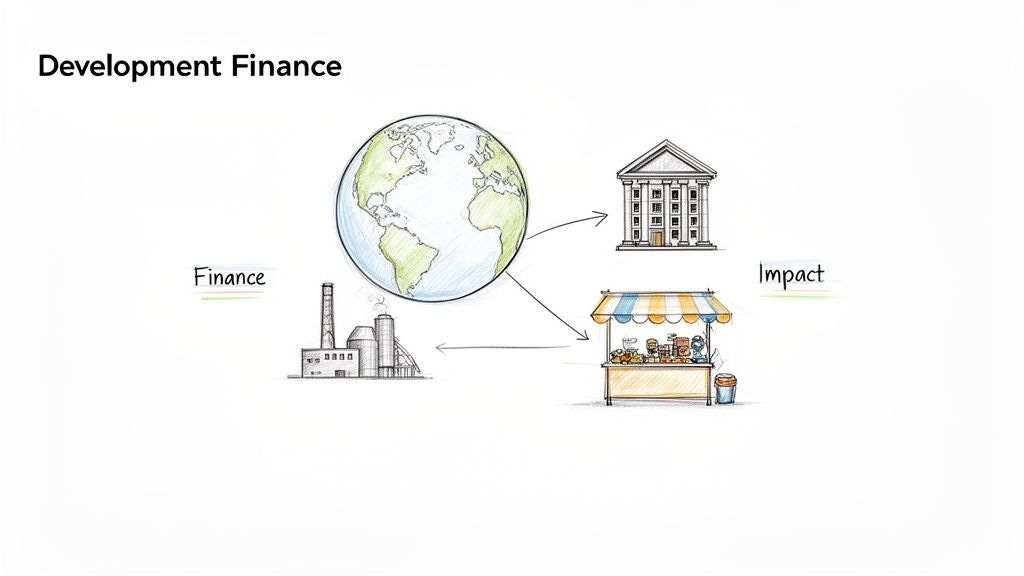
Think of it as investment banking with a conscience. Instead of maximizing shareholder profit, your primary goal is creating tangible, positive change. You’re financing the foundations of a modern economy.
These roles exist to fill a critical gap. A commercial bank might balk at funding a solar farm in a politically unstable region. A rural sanitation project with a long, uncertain payback period probably isn’t getting a loan from traditional sources. This is where development finance professionals step in. They structure deals that are financially sound and deliver a powerful developmental return.
Core Mission and Impact
The mission is simple: deploy capital to improve lives. This isn’t charity. It’s sustainable investment. The work underpins a massive range of initiatives, from building roads and power plants to providing credit lines for small, local businesses.
Your day-to-day work could directly lead to:
Infrastructure Development: Funding the construction of ports, highways, and energy grids that connect communities and unlock trade.
Private Sector Growth: Providing loans to local banks, which then lend to the small and medium-sized enterprises (SMEs) that are the true engines of job creation.
Social Programs: Financing projects that improve access to clean water, healthcare, and education for millions.
Climate Resilience: Investing in renewable energy, sustainable agriculture, and projects that help countries adapt to a changing climate.
The scale of this work is immense. The International Labour Organization identified a global jobs gap of 402 million in 2024. This staggering figure shows how urgent the need for development finance is to fuel job creation, which remains the primary path out of poverty. You can explore the full findings on job market transformations to see the data for yourself.
The Key Players You Need to Know
This field is dominated by a few key types of institutions. If you want to get your foot in the door, you first have to understand who they are and how they differ.
The main players are Multilateral Development Banks (MDBs) and national Development Finance Institutions (DFIs). MDBs are owned by multiple member countries, while DFIs are typically owned by a single government.
MDBs like the World Bank or the Asian Development Bank operate on a massive global or regional scale. They have enormous balance sheets and the political mandate to tackle large, complex development challenges that no single country could solve alone.
DFIs, on the other hand, act as a specific country’s primary tool for international development investment. Think of Germany’s KfW or the UK’s British International Investment. They often partner with MDBs and private investors to co-finance projects, blending public and private capital to stretch every dollar for maximum impact.
The Major Institutions Shaping Global Development
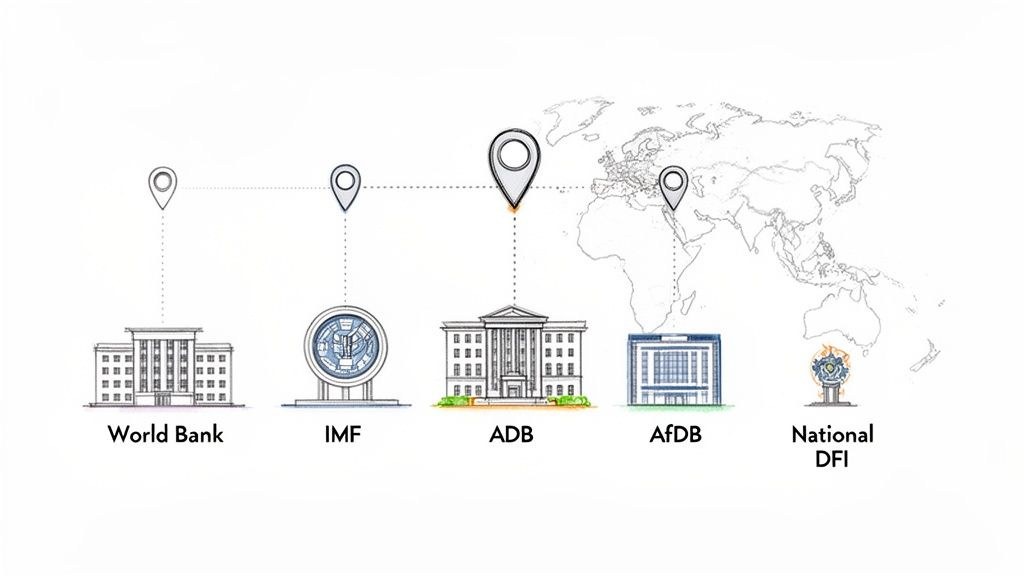
Before you land the right job in development finance, you have to understand the landscape. This world isn’t a single entity. It’s a network of powerful institutions, each with its own mission, culture, and focus. Figuring out where you fit is the first and most important step.
The ecosystem is dominated by two types of players: Multilateral Development Banks (MDBs) and national Development Finance Institutions (DFIs). MDBs are the heavyweights, owned by dozens of countries and built to tackle massive global and regional problems. DFIs are more targeted, acting as a single government’s tool for financing development abroad.
The Global Heavyweights: Multilateral Development Banks
MDBs are the bedrock of the development finance world. The system was kicked off after World War II with the creation of the Bretton Woods institutions: the World Bank Group and the International Monetary Fund (IMF). People often lump them together, but their jobs are fundamentally different.
The World Bank’s mission is about long-term development, fighting poverty by financing big projects and providing expert advice. The IMF is the world’s financial firefighter. It steps in with short-term loans when countries face a sudden economic crisis.
A career at an MDB puts you at the center of global capital flows directed toward the public good. These organizations have immense financial power and a unique mandate to go where commercial markets won’t.
This financial power is no accident. MDBs are incredibly resilient and have stockpiled around $230 billion in reserves since they were founded. This has boosted their total equity to nearly $380 billion, which is 2.6 times what their shareholder countries originally paid in. This strength lets them borrow money cheaply on capital markets and pass those savings on to developing nations for crucial projects.
Key Regional MDBs You Should Know
Beyond the global players, a set of powerful regional banks focus their efforts on specific continents. These organizations offer jobs with a deep focus on local challenges and opportunities. Knowing what makes each one tick is key to targeting your application.
Asian Development Bank (ADB): Based in Manila, the ADB drives development across the vast Asia-Pacific region. Its projects often zero in on infrastructure, energy, and financial reforms in some of the world’s fastest-growing and most complex economies.
African Development Bank (AfDB): Headquartered in Abidjan, the AfDB’s goal is to ignite sustainable economic growth and social progress across Africa. It prioritizes investments in agriculture, regional integration, and private sector growth to create jobs and lift people out of poverty.
Inter-American Development Bank (IDB): From its base in Washington D.C., the IDB is the main source of development funding for Latin America and the Caribbean. Its work is centered on tackling poverty and inequality, fighting climate change, and boosting health and education.
European Bank for Reconstruction and Development (EBRD): The London-based EBRD has a unique job: helping countries transition to market-based economies. It primarily invests in private businesses to promote entrepreneurship and healthy competition.
The table below gives you a quick snapshot of these major players to help you see where you might fit best.
Major Multilateral Development Banks At a Glance
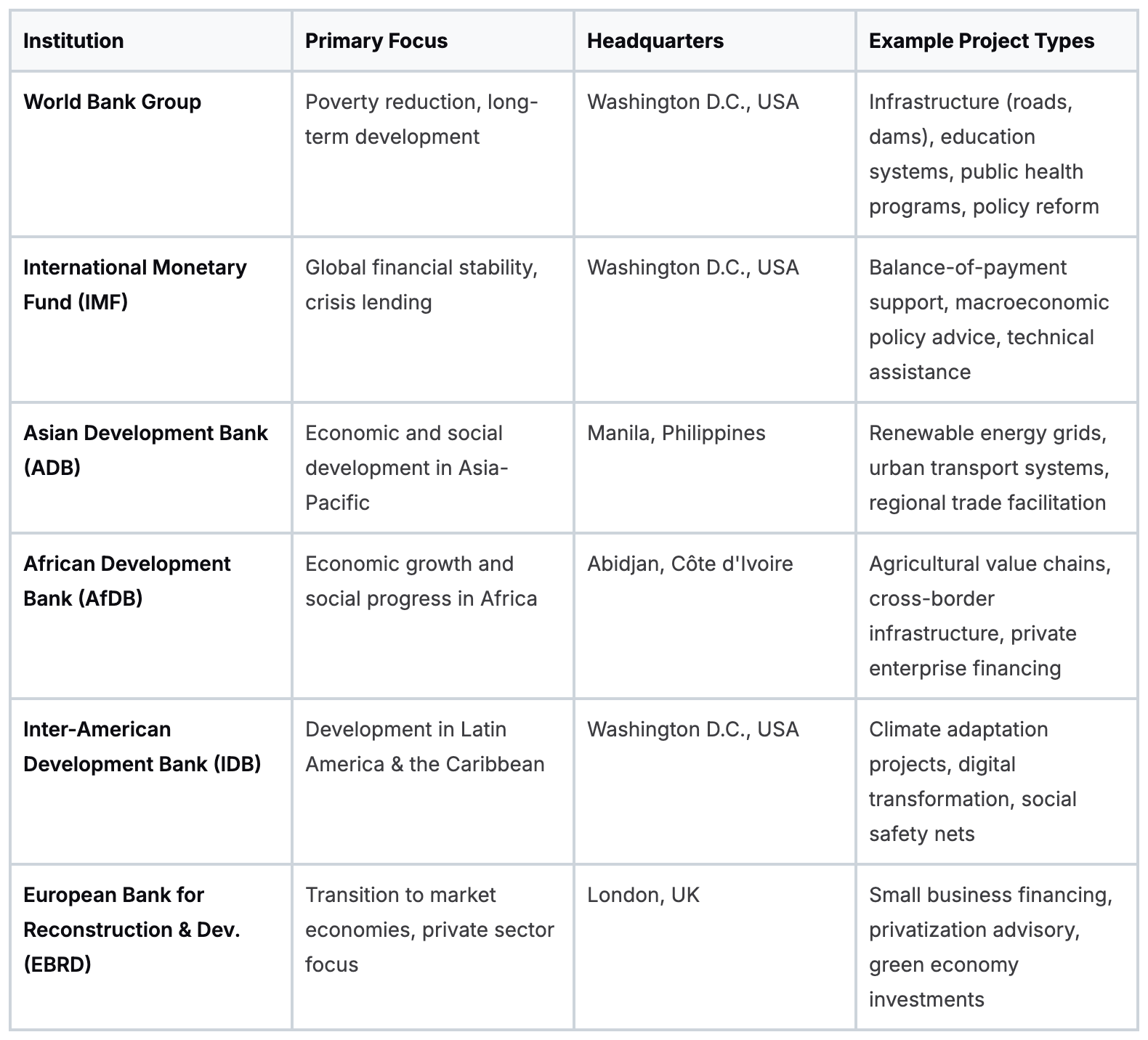
Each of these institutions offers a distinct career path. To get a much deeper look into how they stack up against each other, check out our guide on the differences between the World Bank, IMF, ADB, and other MDBs.
National Development Finance Institutions
DFIs are the other side of the development finance coin. Owned by a single government, they are designed to carry out that country’s foreign policy and development goals through investment. They’re often more nimble and can have a bigger appetite for risk, especially with private-sector deals.
Well-known examples include Germany’s KfW, the UK’s British International Investment (BII), and the U.S. International Development Finance Corporation (DFC). These institutions often partner with MDBs and private equity funds, acting as a catalyst to get private money flowing into development projects. A job at a DFI places you right at the intersection of public policy and private investment.
Common Roles And What The Work Is Really Like
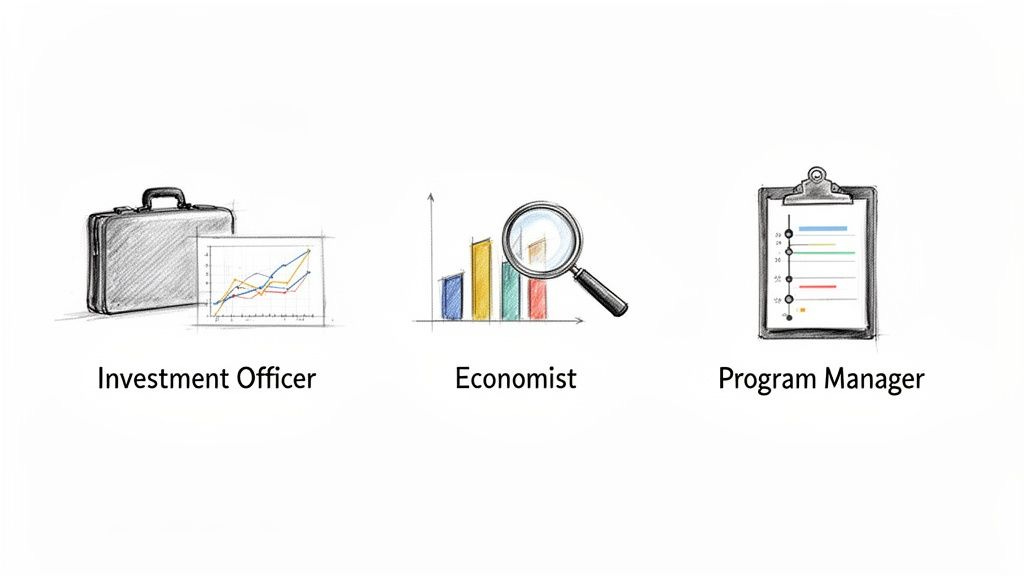
Knowing the big institutions is one thing. Understanding what you’ll actually do day-to-day is another. Development finance is a huge field spanning everything from front-line deal-making to high-level economic strategy.
Let’s break down the most common jobs. This will help you figure out where your skills and experience can make the biggest splash. Finding the right fit is about matching what you’re good at with the real, on-the-ground demands of the job.
The Deal Makers: Investment Officers
The Investment Officer (IO) is the classic front-office role. If you’re coming from investment banking, project finance, or private equity, this is where you’ll feel most at home. Your core mission is to find, evaluate, structure, and close deals.
You’re responsible for the entire investment lifecycle. That means hunting for promising projects, digging deep with rigorous due diligence, building complex financial models, and hammering out term sheets. Your days are spent talking to company executives, government officials, and other investors to get a deal across the finish line.
It’s a tough gig that demands sharp financial skills, serious negotiation chops, and a knack for managing tricky relationships. You need to be just as comfortable in a London boardroom as you are on a dusty project site in a remote province. The goal is to build a bankable project that delivers both a financial return and a real, measurable development impact.
The Strategists: Economists
While IOs are zeroed in on individual transactions, Economists look at the big picture. They are the analytical backbone of the institution, providing the macroeconomic context that shapes country strategies and investment priorities. Their work makes sure projects align with a country’s larger development goals.
An Economist’s job is heavy on research and analysis. You’ll produce country economic reports, analyze the fallout from policy reforms, and assess the systemic risks threatening a nation’s economy. This work directly tells the institution where to put its money for the biggest impact.
The Economist’s analysis is what separates a development bank from a commercial one. It ensures that investments are smart, strategic moves that support long-term, sustainable growth for an entire country.
This role requires a deep grasp of economic theory, strong quantitative skills, and top-notch writing. You have to distill mountains of complex data into clear, actionable advice for senior leaders and government partners.
The Implementers: Program Managers
Once a project gets the green light, someone has to make sure it gets built and delivers on its promises. That’s the job of the Program Manager or Operations Specialist. These are the people who oversee the execution of huge, complex development projects on the ground.
Program Managers are the ultimate problem-solvers. They’re managing budgets, tracking timelines, coordinating with contractors, and making sure projects don’t violate the institution’s strict environmental and social standards. The work is a constant juggle of logistics, stakeholder management, and putting out fires.
This job demands incredible organizational skills, a talent for diplomacy, and a relentlessly practical mindset. It’s less about spreadsheets and more about making things happen in challenging environments. If you thrive on seeing tangible results, this is one of the most rewarding roles out there. For a closer look at what these jobs involve at a major regional bank, our guide to careers in the African Development Bank offers some great context.
Essential Specialists: ESG, Treasury, And Legal
Beyond these core roles, MDBs and DFIs are packed with specialists who keep the machine running. These are critical jobs that support every stage of the investment process.
Environmental & Social (E&S) Specialists: These experts ensure every project meets tough safeguard policies. They assess potential impacts on local communities and ecosystems, then develop plans to manage those risks.
Treasury Officers: These people manage the institution’s balance sheet. They issue bonds on capital markets to raise funds and handle all the complex currency and interest rate risks.
Legal Counsel: These are the lawyers who draft and negotiate every loan agreement and contract, making sure each deal is legally airtight and protects the institution’s interests.
Each of these roles offers a unique path to making a serious contribution to global development. Your job is to figure out which one clicks with your own professional DNA.
The Skills and Credentials That Get You Hired
Getting a job in development finance requires a specific mix of hard financial skills and the street smarts to apply them in complex environments. Your resume needs to show you have both.
Your Technical Toolkit
The bedrock of any strong application is technical competence. You must speak the language of finance fluently. This is non-negotiable.
Hiring managers expect you to walk in the door with a core set of analytical abilities. They don’t have time to teach you the basics. You need to be ready to contribute from day one.
These are the hard skills that matter:
Financial Modeling: You have to build and pull apart complex financial models. This is how you’ll test if a project is viable, forecast its cash flows, and run scenarios to see what could go wrong.
Credit Risk Analysis: This is about sizing up a borrower’s ability to pay back a loan. That borrower could be a national government, a state-owned utility, or a private company. You need to spot the risks.
Project Finance: A deep, practical understanding of how to structure massive, long-term infrastructure projects is critical for investment officer roles.
Economic Analysis: You’ll need the chops to evaluate economic policies, understand macroeconomic trends, and realistically assess the developmental impact of an investment.
Think of these skills as your ticket to the interview. They prove you have the analytical horsepower for the job.
The most valuable candidates bridge the gap between rigorous technical analysis and the messy reality of implementation in a developing country. It’s a rare combination, and it’s what recruiters are hunting for.
The Soft Skills That Seal the Deal
Technical ability gets your foot in the door, but soft skills land you the job. This work is intensely collaborative and involves navigating delicate political and cultural situations.
If you can’t work well with people from different backgrounds, you won’t last long. One day you’re managing relationships with government ministers, the next you’re talking to local community leaders or co-financiers. It demands a high degree of emotional intelligence.
Here are the soft skills that separate the good candidates from the great ones:
Cross-Cultural Communication: You must communicate clearly and respectfully with people from vastly different cultural contexts.
Stakeholder Management: You’ll need to build consensus among diverse groups who often have competing interests. It’s more art than science.
Adaptability and Resilience: Projects almost never go according to plan. You need to think on your feet and solve problems in high-pressure situations.
The Right Credentials on Your CV
Your education and professional background are your proof. While there isn’t one perfect path, a clear pattern emerges when you look at who gets hired.
An advanced degree is standard. A Master’s in Business Administration (MBA), Finance, Economics, or International Development is often the minimum entry ticket, especially for mid-career roles. These programs give you the theoretical foundation and analytical toolkit you’ll need.
Professional certifications also make a difference. The Chartered Financial Analyst (CFA) designation is highly respected and signals a serious commitment to the finance profession. It immediately tells a hiring manager you have a mastery of investment analysis.
Finally, don’t underestimate language skills and field experience. Fluency in a language like French, Spanish, Arabic, or Portuguese can be a massive advantage. Having lived or worked in a developing country shows you understand the on-the-ground challenges, making you a much more credible candidate.
Navigating The Application And Interview Process
Applying for a job in development finance is a discipline in itself. These institutions don’t hire like normal companies. You need a specific strategy for each entry point, because a generic approach will get your application deleted before a human sees it.
The process is designed to filter for specific skills and a deep understanding of the institution’s mission. Success means knowing the rules. Prepare for a marathon, not a sprint.
The Main Entry Points
There are three main ways to get a job at an MDB or DFI: the highly structured Young Professional Programs, direct-hire staff positions, and flexible consultant rosters. Each path targets a different type of candidate. You need to know which one is the right fit for you before applying.
Young Professional Programs (YPPs): These are the premier entry points for exceptional, early-career candidates. YPPs are incredibly competitive and are designed as leadership pipelines. They look for top-tier academic credentials, a few years of relevant experience, and a clear commitment to development. The application process is a long, multi-stage affair that often takes the better part of a year.
Direct-Hire Staff Positions: This is the standard route for experienced professionals. MDBs post specific job openings on their career portals for everything from mid-level analysts to senior directors. The process is more straightforward than a YPP but demands a CV that is perfectly tailored to the job description.
Consultant Rosters: Getting onto a consultant roster is a common and effective way to get your foot in the door. These are short-term contracts for specific tasks. A successful consulting gig often leads to longer-term opportunities and can be a fantastic pathway to a full-time staff position.
Here’s a quick breakdown of how these routes compare:
Key Application Routes into MDBs
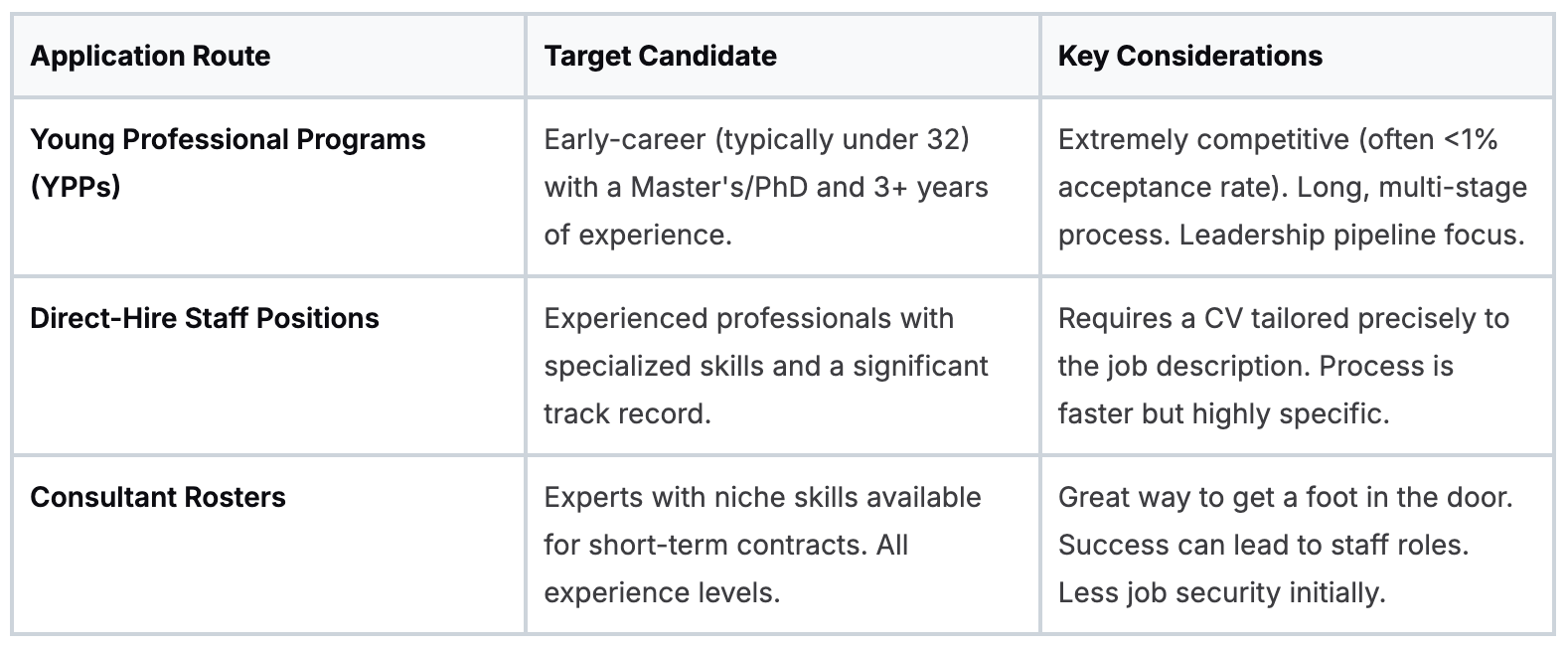
Each of these doors requires a different key. Using your YPP application strategy for a direct-hire role simply won’t work. Know your target and customize your approach.
Crafting a CV That Gets Noticed
Your CV is your most important marketing tool. Assume recruiters will spend seconds reviewing it. It must immediately show that you have the exact skills they’re looking for.
Forget the generic resume you use for corporate jobs. A development finance CV has to be results-oriented and packed with keywords from the job description. Quantify your achievements. Don’t say you “managed a project.” Say you “managed a $10 million infrastructure project that delivered clean water to 50,000 people.”
The best CVs tell a clear story. They connect your past experiences directly to the institution’s mission and the role’s requirements. A recruiter should see exactly how you would add value from day one.
Also, be aware of the strict nationality requirements. Many MDB positions are subject to a quota system based on member country shareholding. This is a critical, non-negotiable factor. Always check the eligibility requirements before you invest hours in an application.
The Multi-Stage Interview Gauntlet
If your CV makes the cut, get ready for a rigorous interview process. These interviews test three things: your technical skills, your behavioral competencies, and your genuine commitment to the work.
First up is usually a screening call with HR. Pass that, and you’ll move on to technical interviews with the hiring team. This is where they will grill you on your financial modeling, economic analysis, or project management skills. They want to see if you can do the job.
The final stage is often a panel interview, which can be intense. It frequently includes a case study where you’re given a complex development problem and a limited amount of time to analyze it and present your recommendations. They’re testing your analytical rigor, your judgment, and how you perform under pressure.
For more detailed strategies on how to navigate this, you can explore our practical guide to landing MDB jobs.
Where to Find Openings
The first place to look for jobs is on the official career portals of the institutions themselves. The World Bank, ADB, AfDB, and others all have dedicated sites. Bookmark them.
Beyond that, specialized job boards are your best bet. These platforms aggregate openings from across the MDB and DFI landscape, saving you a massive amount of time. They are the most efficient way to monitor the market for roles that match your profile. Staying informed and being ready to act quickly when the right job appears is a huge part of the search.
Your 90-Day Plan to Land a Development Finance Job
Landing one of these highly competitive jobs doesn’t happen by accident. It takes a focused campaign. Firing off random applications is a waste of your time. This 90-day plan breaks the process into manageable chunks. It’s about building momentum and putting your effort where it gets results.
Days 1 to 30: The Foundation Work
The first month is all about deep research and self-assessment. Your goal is to move from a general interest to a specific, targeted list of institutions and roles that are a perfect match for your background. This is the bedrock of your job search.
Get brutally honest with yourself. Map your skills and experience against the job descriptions for roles like Investment Officer, Economist, and Program Manager. Where are the gaps? What are your strongest selling points?
By the end of this phase, you must have:
A shortlist of 3-5 target institutions whose mission and projects genuinely excite you.
A clear understanding of 1-2 specific job families that align with your profile.
A “gap analysis” identifying any critical skills or experiences you need to highlight or strengthen.
This diagram shows the main routes your applications will take once you start moving.
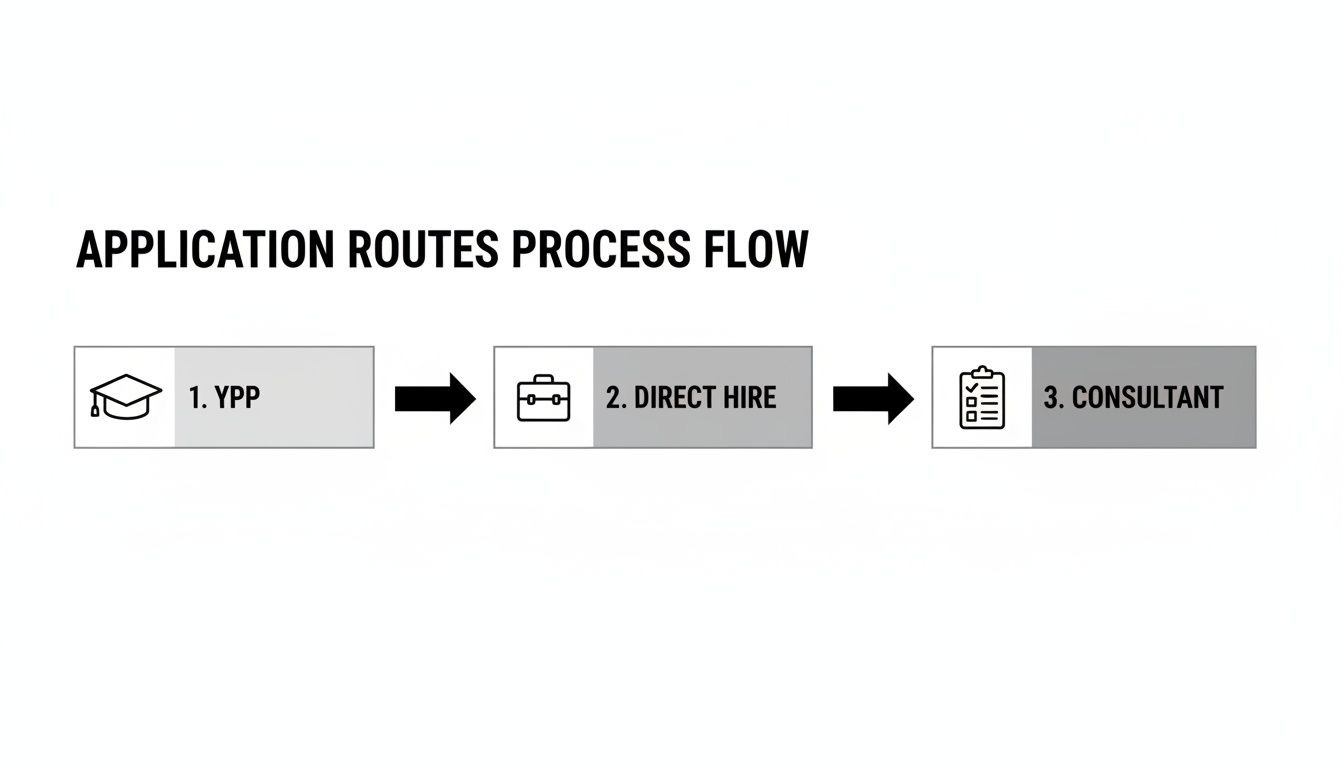
It clarifies the distinct pathways into these organizations from structured graduate programs to direct professional hires and specialized consulting roles.
Days 31 to 60: Building Your Toolkit
Month two is about preparation. Now that you have your targets, it’s time to build the tools you’ll need for your campaign. This means crafting a master CV, preparing for interviews, and strategically expanding your professional network.
Start by creating a master version of your CV that details every relevant project and accomplishment. Then, for each of your target roles, create a tailored version that mirrors the language and priorities of that specific job description. Generic applications get ignored.
You’re not just applying for a job; you’re making a case for why you are the solution to the institution’s problem. Every line on your CV should support that case.
During this period, you should also start conducting informational interviews. Find people on LinkedIn who are in the roles you want. Reach out professionally and ask for 15 minutes of their time to learn about their work. This is invaluable for gaining insider knowledge and building connections.
Days 61 to 90: Execution and Follow-Up
This is the action phase. With your research done and materials perfected, you will now actively and systematically apply for roles. Don’t just apply and forget. You need a system to track your applications, manage communications, and prepare for each specific interview.
Dedicate specific blocks of time each week to searching for openings and submitting high-quality applications. When you land an interview, your preparation from the previous month will pay off. You’ll already have your core stories and answers ready, letting you focus on researching the specific team and their projects.
Follow-up is crucial, but it has to be professional. A brief, polite thank-you note after an interview is standard. This disciplined, three-month approach transforms a daunting job search into a structured project with a clear path to success.
Your Questions, Answered
Let’s tackle some of the most common questions about a career in development finance.
What Kind of Salary Can I Expect in Development Finance?
The pay is very competitive. These institutions are trying to attract top talent from around the world, but the compensation structure is different from the private sector.
For the highly sought-after Young Professional Programs, you’re typically looking at a starting salary between $100,000 and $150,000 USD a year. A huge kicker is that this income is often tax-free, depending on your nationality and the specific agreements the institution has in place.
Mid-career professionals can expect salaries in the $150,000 to $250,000+ range, with senior leadership roles going well beyond that. On top of the base salary, the benefits packages are fantastic and usually include comprehensive health insurance, generous retirement plans, and full relocation assistance.
Do I Really Need a Background in Private Sector Finance?
Experience from investment banking or project finance is a plus. It’s a quick signal to hiring managers that you’ve got strong quantitative skills and solid commercial judgment, which are gold for investment-focused roles.
But it’s not the only path. These banks also hire heavily from the public sector, management consulting, and non-profits. This is especially true for roles in economics, policy, and program management. The trick is to connect the dots and show exactly how your unique experience fits the bank’s mission and the specific role’s demands.
How Important Is Field Experience in a Developing Country?
On-the-ground field experience is a massive advantage. It proves you can adapt to different cultures and gives you a credible, firsthand understanding of what development projects look like in reality.
For operational jobs like an Investment Officer or a Program Manager, it’s often a deal-breaker. Hiring managers for these positions need to see that you’ve been in challenging environments and can get things done. For headquarters-based jobs in areas like treasury or risk management, it might be less of a hard requirement, but it’s still looked upon very favorably.
At Multilateral Development Bank Jobs, we demystify this complex career path. Our weekly newsletter delivers curated job listings, insider guides, and expert analysis to help you land your ideal role at a top MDB. Subscribe to get full-time staff roles, consultant opportunities, and deep-dive career guides sent directly to your inbox. Join our community today.