

You already know the pattern. You do the analysis well, build a solid deck, answer every technical question, and still watch the client ignore the recommendation. The report lands. The meeting ends. Nothing moves.
That gap is the actual consulting job.
In MDB and UN work, technical quality matters, but it rarely carries the engagement on its own. The consultant who gets rehired is the one who frames the problem correctly, reads the politics, scopes the work tightly, and gives decision-makers something they can use. If you want to learn how to be a good consultant, start there.
A lot of smart specialists struggle because they treat consulting like expert delivery. It’s a different craft. You’re being paid to reduce ambiguity, create confidence, and move a process that usually involves multiple stakeholders with different incentives. In development consulting, that means your analysis has to survive procurement rules, internal review, donor pressure, and institutional caution.
That’s why non-cognitive skills matter more than most candidates realize. The hard part usually isn’t producing more content. It’s getting the right people to trust the diagnosis, agree on the scope, and act on the recommendation.
Beyond Technical Skill The Real Job of a Consultant
A weak consultant often looks strong on paper. They know the sector, the methods, and the language. Then they walk into a kickoff call, start talking too early, and solve the wrong problem with confidence.
That’s how good analysis gets wasted.
The American Statistical Association’s consulting guidance puts the standard in plain terms. A good consultant asks probing, relevant questions, understands project background and data quality, communicates clearly, meets deadlines, and stays honest about limits to expertise and ethical constraints. That guidance is useful far beyond statistics because it captures the core job of consulting: diagnose first, advise second, and protect credibility throughout the engagement, as outlined in the ASA guidance for clients working with consultants.
The client rarely hires you for analysis alone
In high-stakes development work, the visible request is often incomplete. A ministry says it needs a strategy. An MDB team asks for a rapid assessment. A UN office requests a stakeholder workshop. Those are delivery formats, not the underlying need.
The core need might be one of these:
Decision cover: A client needs an external voice to support a decision that’s already politically sensitive.
Problem clarification: Stakeholders disagree on what the actual issue is.
Process discipline: The institution needs someone to force milestones, synthesis, and follow-through.
Credible translation: Technical material needs to be converted into language senior officials will use.
If you miss that layer, you can work very hard and still be irrelevant.
Good consultants don’t just answer the brief. They identify the decision sitting behind the brief.
Consulting success is operational, not mystical
People like to treat consulting as charisma plus intelligence. That’s wrong. Strong consultants use repeatable habits. They listen in a disciplined way. They decompose problems before jumping to solutions. They communicate top-down. They manage expectations early. They know when to challenge the client and when to absorb uncertainty until the facts are clear.
In MDB and UN environments, those habits matter because the room is rarely simple. You may have a task manager, a procurement focal point, a government counterpart, and a donor audience all attached to the same piece of work. Your technical output needs to hold together across all of them.
That’s the unwritten rule. The work has to be right, but it also has to be usable, defensible, and timed properly.
Develop the Core Consultant Mindset
Most bad consulting starts with a basic error. The consultant treats the client’s first sentence as the problem statement.
Don’t do that.
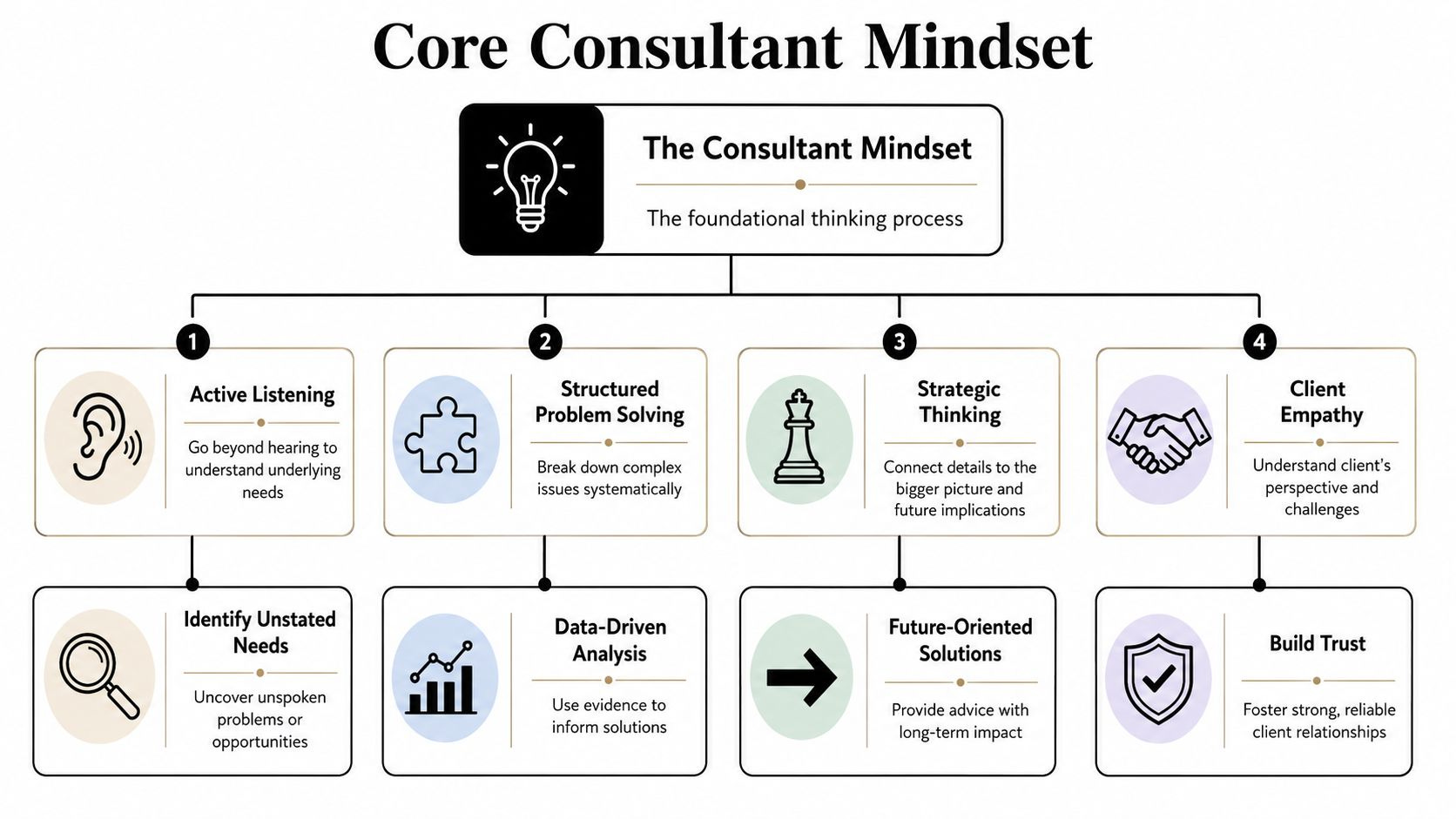
A high-performing consultant combines active listening, structured problem decomposition, and evidence-based communication. A practical version of that method is straightforward: define the central question, break it into parts, analyze the parts, and synthesize a recommendation that can survive scrutiny. Consulting practice reinforces this with tools like MECE and issue trees, plus stress-testing before presenting, as described in this consultant skills guide from AMP.
Listen for the problem behind the problem
Active listening in consulting is diagnostic. You’re listening for what is missing, what is politically loaded, and what the client doesn’t yet know how to articulate.
When a counterpart says, “We need a capacity-building roadmap,” your next mental move should be to test several possibilities. Is the issue really capability? Is it coordination? Is it budget? Is it a mandate conflict between units? Is “capacity” just the safest available label?
Use questions that expose constraints fast:
On decisions: “What decision will this work inform?”
On ownership: “Who needs to agree before anything changes?”
On urgency: “What has to happen by when?”
On evidence: “What data exists, and what do people mistrust about it?”
On failure modes: “What has already been tried?”
That line of questioning changes the engagement. You stop acting like a pair of hands and start acting like an advisor.
Break messy situations into answerable parts
A lot of junior consultants gather information too broadly. They interview everyone, collect every file, and drown in material. Senior consultants narrow the field earlier.
Use an issue tree. Start with one governing question, then break it into mutually distinct branches that cover the problem space well enough to guide the work. In development consulting, those branches often include institutional design, incentives, process flow, financing, stakeholder alignment, implementation capacity, and political feasibility.
A simple working table helps.
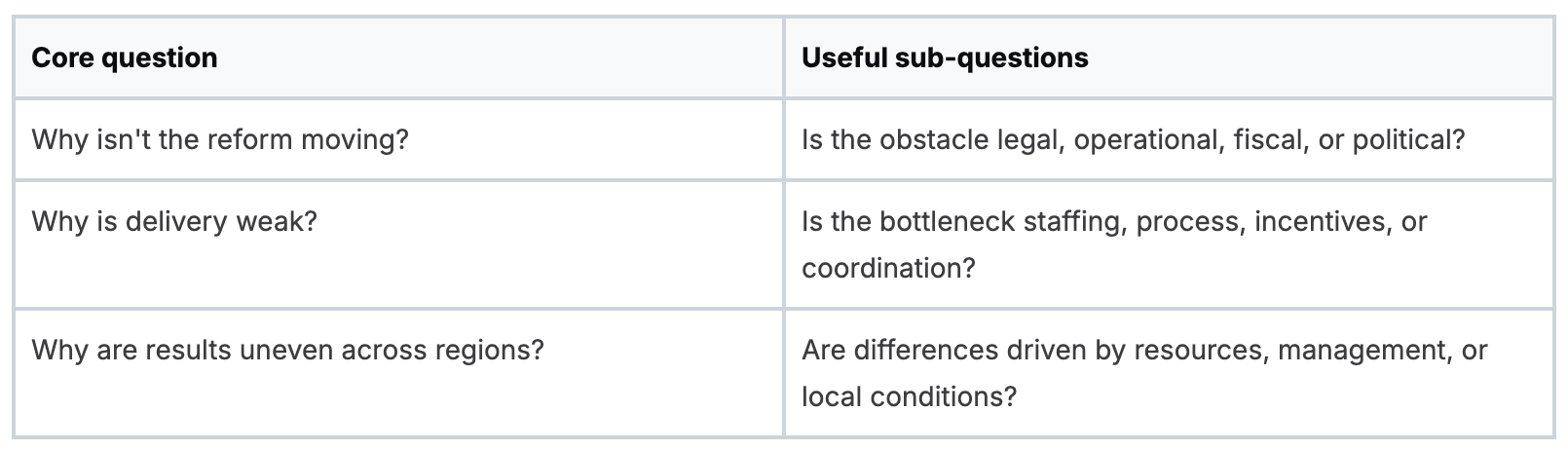
The point isn’t elegance. The point is control.
Practical rule: If you can’t state the central question in one sentence, you’re not ready to propose a solution.
Think in hypotheses, not in document volume
MDB and UN clients often work in document-heavy systems. The trap is obvious. The consultant responds by producing more documentation than judgment.
A better approach is hypothesis-driven. Form a provisional view early, then test it hard. Ask what evidence would disprove your current theory. Ask which assumptions remain weak. Ask what would change your recommendation.
That discipline matters when timelines are compressed and the brief is broad. It keeps you from boiling the ocean. It also improves your credibility in meetings, because you can explain why you pursued certain analyses and dropped others.
Communicate top-down from the start
Good consultants don’t wait until the final deck to become structured. They write emails, meeting notes, and interview summaries the same way they present recommendations. Answer first. Support second.
In practice, that means:
Lead with the conclusion or decision point
Group supporting reasons clearly
Show the evidence chain
Name open questions instead of hiding them
Clients trust consultants who make thinking visible. They distrust consultants who hide behind complexity.
How to Build Credibility and Win Work
A consultant without a point of view is hard to hire. A consultant with a vague profile is easy to forget.
That matters in a market with over 700,000 management consulting firms worldwide and an industry value of about $250 billion, according to this global consulting statistics roundup. The same source reports that 87% of clients say trust matters more in buying consulting services after recent shifts in purchasing behavior. In plain terms, clients don’t hire the most impressive résumé in the abstract. They hire the person they believe will deliver cleanly.
Pick a niche that procurement can understand
In MDB and UN consulting, “I do strategy, policy, and operations” sounds broad and capable. It also sounds expensive and hard to place.
You need a tighter market identity. Not a slogan. A usable buying category.
Strong positioning usually has three parts:
Institution type: ministries, MDB task teams, UN agencies, regulators
Problem type: implementation bottlenecks, institutional reform, results frameworks, stakeholder engagement
Delivery format: diagnostic, roadmap, review, facilitation, advisory support
That gives the buyer a reason to remember you. It also helps when terms of reference are drafted by people who are trying to map a problem to a shortlist quickly.
Your proposal has one job
Most proposals fail because they try to impress. Winning proposals reduce perceived risk.
If you’re writing for MDB or UN opportunities, the best structure is brutally simple:
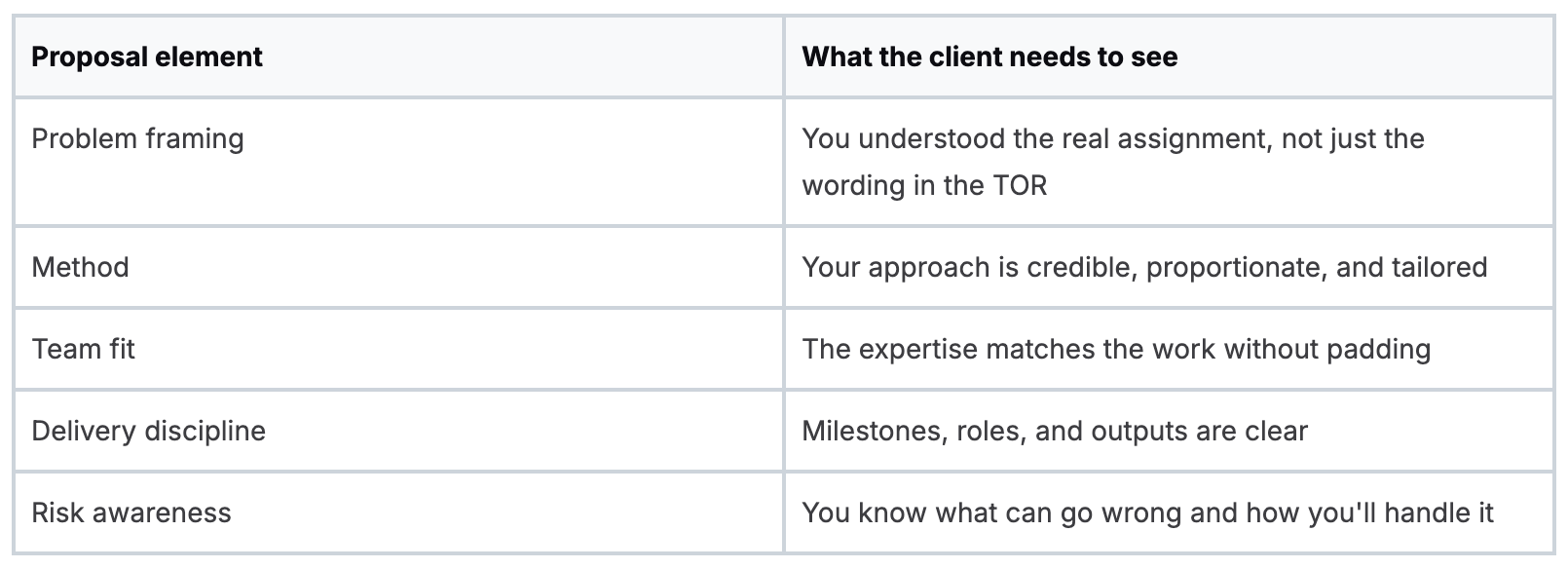
That’s why strong consulting proposals are specific about the problem, method, and delivery model. The buyer is asking a simple question: can this person do the work with minimal drama?
In MDB and UN systems, relationships are real but subtle
Business development in this ecosystem isn’t loud. It’s rarely about aggressive selling. It’s about pattern recognition and professional memory.
People remember consultants who do a few things consistently well:
Respond clearly: Fast, direct replies signal reliability.
Understand institutional language: Know the difference between outputs, outcomes, activities, and deliverables. Use the client’s operating vocabulary accurately.
Respect process: Procurement rules matter. So do templates, approvals, and review cycles.
Leave useful residue: Good meeting notes, practical comments on draft TORs, and concise scoping conversations make people want to call you again.
If a task manager has to explain your proposal to procurement, legal, and management, your job is to make that explanation easy.
Build reputation before you need it
Most consultants think about visibility when the pipeline is thin. That’s late.
Credibility compounds when people repeatedly see the same strengths from you: clear judgment, narrow claims, clean writing, and no theatrics. In development consulting, your reputation often travels through side conversations you’ll never hear. Someone asks, “Who can handle this without overselling it?” You want your name to fit that sentence.
That means publishing selectively, speaking carefully, and never stretching expertise beyond what you can defend. The market is crowded. The shortlist is usually not.
Scope Projects Correctly to Ensure Success
Most consulting pain starts before the work starts.
The project goes bad because the scope was fuzzy, the client assumed more than was written down, or the consultant accepted a brief that mixed diagnosis, stakeholder management, facilitation, and implementation support into one underspecified package. Then everyone acts surprised when deadlines slip and trust drops.
A practical consulting workflow follows a four-stage loop: Assess or Discovery, Plan, Implement, Optimize. That structure matters because it separates diagnosis from solution design and creates a final step for improvement and learning, as outlined in this consulting process framework.
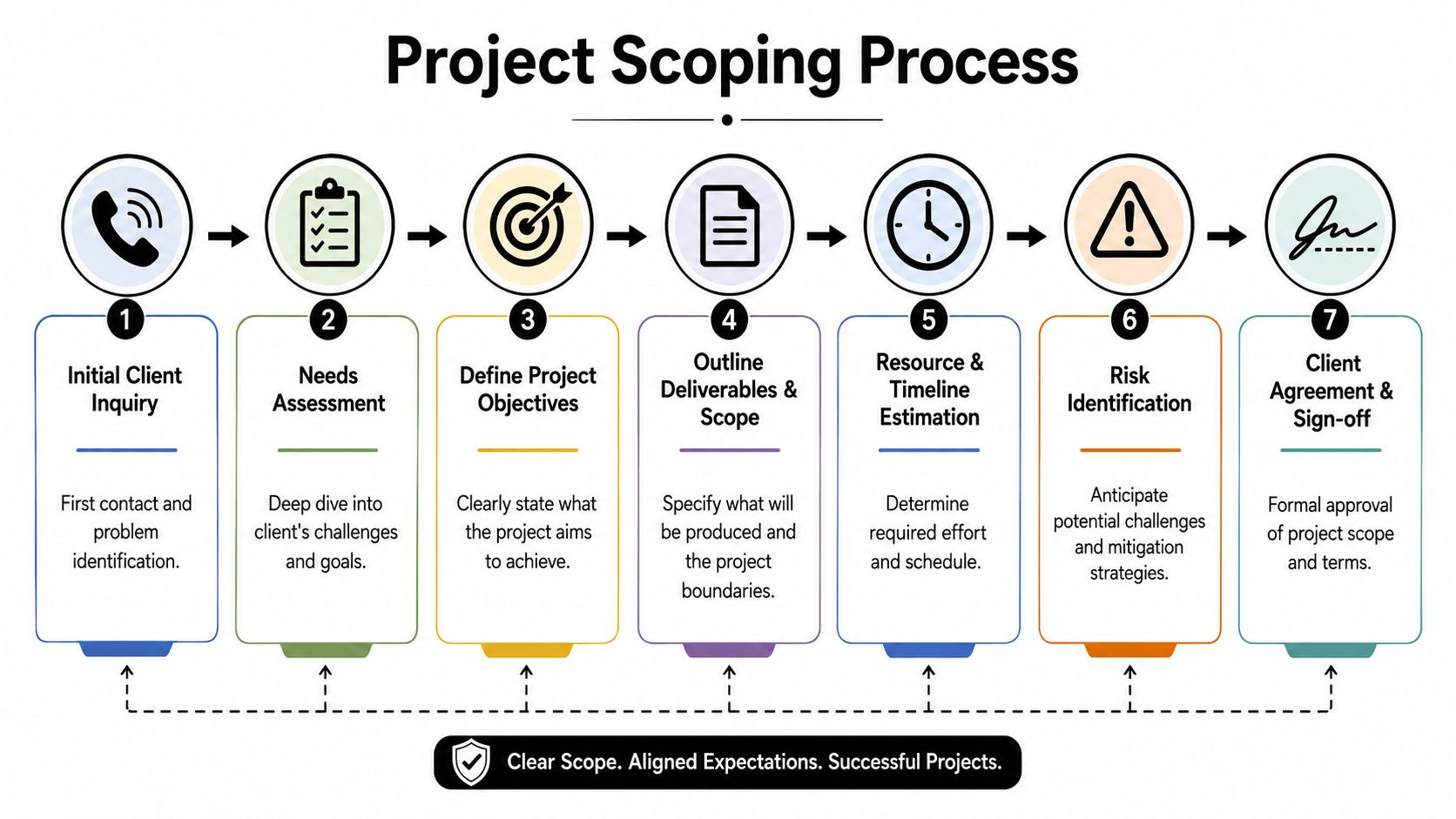
Assess before you promise
Discovery is where experienced consultants earn their fee. In MDB and UN contexts, this phase often reveals that the visible assignment is only part of the actual work.
You’re checking for four things at once:
Decision context: What decision will this project influence?
Constraint map: What approvals, politics, data gaps, and timing issues shape the work?
Stakeholder environment: Who can block progress, subtly or openly?
Scope boundaries: What is explicitly out of scope, even if it’s related?
Knowledge of results-based management helps sharpen objectives and expected outputs. If the client cannot express success in operational terms, you need to slow the engagement down and force clarity.
Turn ambiguity into a plan the client can sign
A good scope document should feel slightly narrower than the client’s first instinct. That’s a feature, not a flaw.
Use this checklist before work begins:
Objective statement Define the purpose in one or two sentences. If it reads like a donor brochure, rewrite it.
Deliverables Name the outputs in plain language. Draft diagnostic memo. Validation workshop. Final roadmap. Presentation deck. Avoid vague labels like “strategic support.”
Method and activities Specify interviews, document review, analysis, workshops, and feedback rounds. Clients need to know how the work will happen.
Timeline Tie dates to review points, not just final submission. In institutional settings, review cycles often create the actual schedule.
Assumptions State access needs, data availability, counterpart participation, and approval dependencies.
Exclusions Protect yourself clearly. If implementation support, translation, field travel, or additional consultation rounds are excluded, write it down.
Scope creep is usually a scoping failure
Consultants complain about scope creep as if it arrives from nowhere. Usually it starts with one of three mistakes.
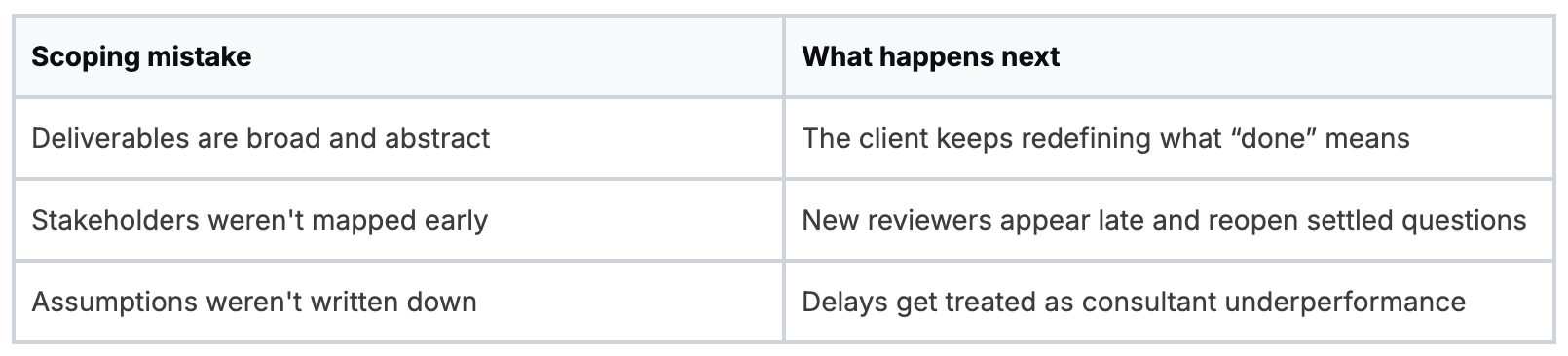
The fix is not defensiveness. The fix is precision.
The sentence “happy to support” has probably created more unpaid consulting work than any bad client ever did.
Optimize after delivery
Many consultants stop at submission. That’s amateur behavior.
The optimize step asks a few hard questions. What landed well? Where did the client hesitate? Which assumptions proved wrong? What should be changed in your method, templates, or communication next time? On repeat institutional work, that reflection is how you stop making the same expensive mistakes.
Projects improve when your process improves. That’s how to be a good consultant over time, not just on one assignment.
Master Client Management and Project Delivery
Once the project starts, your role changes. You are no longer mainly a problem-solver. You are now managing attention, confidence, timing, and conflict.
That’s why client management is leadership. Not etiquette.
Good consulting requires independence and candor. The consultant’s value often comes from telling uncomfortable truths, challenging assumptions, and providing judgment the client can trust, as described in this guide to consulting skills and trusted advisor work.

Run the engagement from the front
Clients feel safer when they know where the work stands. That doesn’t mean flooding them with updates. It means creating a steady rhythm.
A strong operating pattern looks like this:
Kickoff with real alignment: Confirm objectives, stakeholders, timing, and draft deliverables out loud.
Short written updates: Send concise progress notes after key interactions. What happened, what changed, what’s next.
Decision-focused meetings: Every meeting should end with owners, dates, and unresolved questions.
Early warning signals: Raise risks when they are still small.
The worst delivery style is silent effort followed by surprise. Clients hate being briefed into a problem at the moment it becomes expensive.
Deliver bad news without losing the room
In development consulting, difficult messages are normal. Data is weaker than expected. Stakeholders disagree. The timeline is unrealistic. A favored idea won’t survive contact with implementation reality.
The trick is to separate candor from provocation.
Use a structure like this in live conversation:
State the issue plainly “The current timeline doesn’t leave enough room for stakeholder validation.”
Explain the consequence “That increases the risk that the final recommendation won’t hold after review.”
Offer options “We can narrow the scope, move the deadline, or treat this as an initial diagnostic rather than a final roadmap.”
Recommend one path “I recommend narrowing the scope now.”
That approach protects the relationship because you’re not dumping a problem on the client. You’re leading through it.
Clients can handle bad news. What they won’t forgive is late bad news wrapped in evasive language.
Challenge assumptions with respect
A lot of consultants become yes-people because they confuse responsiveness with compliance. That destroys advisory value.
When a client pushes for a weak line of argument or a politically convenient conclusion, your job is to test it professionally. Ask what evidence supports it. Ask what alternative explanation has been ruled out. Ask what implementation consequence follows if that assumption is wrong.
A simple contrast helps:
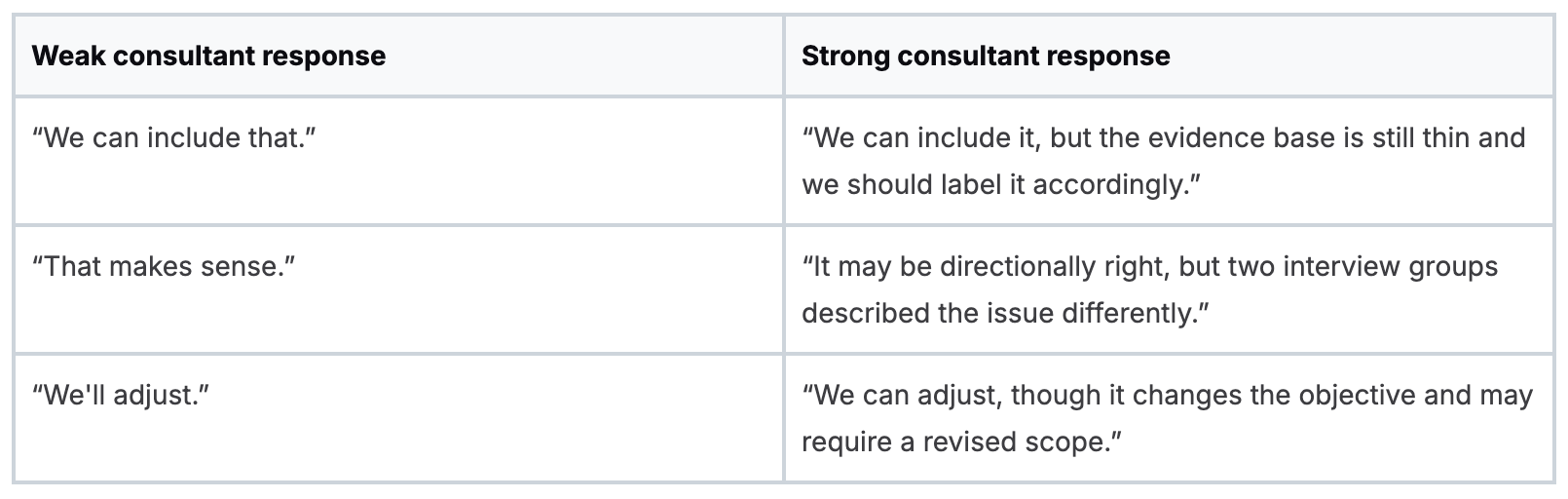
That’s how trust deepens. Not by agreeing faster. By helping the client think better.
Use AI where it helps, keep judgment where it belongs
Routine research, note organization, first-pass synthesis, and formatting support are increasingly easier to automate. Fine. Use that advantage.
But the work clients value sits elsewhere. Framing the right question. Reading a meeting correctly. Sensing when a stakeholder objection is procedural versus political. Deciding what to say in the room and what to leave for a memo. AI can help produce drafts. It can’t carry the advisory burden for you.
The consultant who wins now is the one who combines speed with judgment.
Uphold Ethics and Build Your Long-Term Reputation
You submit a draft on Friday. By Monday, it has been forwarded to a country director, a legal team, and a government counterpart you have never met. That is how reputation works in MDB and UN consulting. Your work travels before you do.
In this market, your final deliverable is your name. Senior managers remember who was reliable under pressure, who handled sensitive facts with care, and who made a difficult process easier to govern. Technical skill gets you shortlisted. Judgment keeps you in circulation.
The American Statistical Association makes a useful point in its guidance on consulting relationships. Good consultants ask better questions, test the quality of the evidence, and state limits clearly. That standard fits development consulting well because weak certainty creates real institutional risk, as described in the ASA’s expectations for effective consulting relationships.
Build quality control into the work
Clients should not be the first people to discover that your argument has holes.
Before any draft goes out, review it against four tests:
Logic: Does the recommendation answer the actual decision the client needs to make?
Evidence: Which claims are well supported, and which are still tentative?
Assumptions: What are you treating as true because it is convenient, familiar, or politically attractive?
Usability: Can a busy senior reader see the implication, trade-off, and next action within minutes?
That last test matters a great deal in institutional settings. A paper can be analytically correct and still fail if nobody can tell what decision it supports.
State the limits before someone else does
Reputation improves when you are precise about where your expertise ends.
That usually shows up in three places:
Subject-matter limits: The issue sits outside your real depth.
Evidence limits: The available material supports a range, not a firm conclusion.
Mandate limits: The client is asking for a judgment the assignment was not designed to make.
I have found that careful boundary-setting often increases trust, not reduces it. Serious clients do not expect omniscience. They expect honest calibration, followed by a sensible next step.
Ethics lives in ordinary moments
Consulting ethics rarely arrives as a dramatic scandal. It appears in small choices made under time pressure.
You decide whether to make a weak finding sound firmer than it is. You decide whether to reuse language from another assignment without checking institutional fit. You decide whether to stay quiet about a conflict because raising it will slow the work. You decide whether to let a politically convenient interpretation pass without recording the analytical caveat.
Those choices shape your ceiling. In MDB and UN work, impressions circulate among people and are remembered for years.
Protect independence without becoming difficult
Independence does not mean performative resistance. It means preserving the integrity of the work while helping the client move.
Sometimes that requires a trade-off. You may soften the wording of a recommendation to keep a counterpart engaged, but you do not change the underlying finding. You may sequence a hard message for the memo rather than the meeting, but you still document it clearly. You may accept a narrower question if it reflects the political reality of the assignment, but you do not pretend the narrower question answers the larger one.
That is the practical version of ethics. It is not abstract. It is operational.
Every assignment tests whether you can be trusted with ambiguity, pressure, and institutional sensitivity. If you want a durable answer to how to be a good consultant, keep it operational. Produce work that is accurate, usable, properly bounded, and honest about what it can and cannot support. Do that consistently and your reputation will start opening doors before you ask for them.
If you want more roles, consulting opportunities, and practical guidance for building a career across the World Bank, regional development banks, the IMF, AIIB, and the UN ecosystem, subscribe to Multilateral Development Bank Jobs. It’s one of the few resources focused specifically on helping candidates find and win MDB and international development work.