

When you hear “non-cognitive skills,” don’t get caught up in the term. It’s a formal label for the personal traits and social abilities that determine how you handle challenges and work with others.
Think of them as your operational skills, how you actually get things done when the pressure is on. This is about your resilience, your communication style, and your ability to be a productive part of a team. It’s separate from your technical knowledge.
Why Non-Cognitive Skills Are Your Edge in MDB Hiring
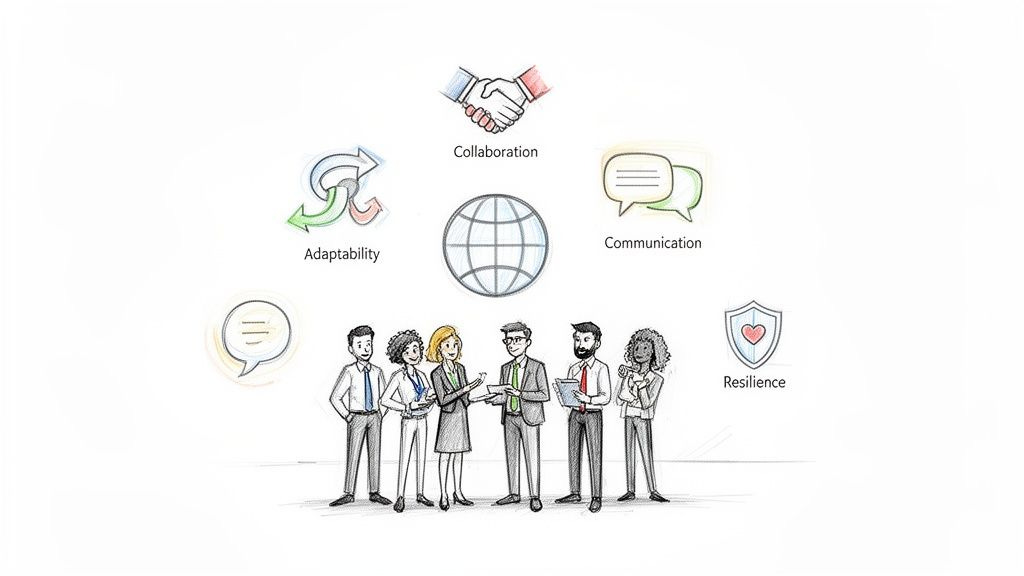
Let’s be blunt: your technical expertise might get your CV past the initial screening, but your non-cognitive skills will land you the job at a Multilateral Development Bank (MDB). These institutions learned a fundamental lesson from decades of work on the ground: projects succeed or fail because of people, not just plans.
MDBs operate in complex, unpredictable environments. A perfectly designed infrastructure project can grind to a halt because of poor stakeholder communication. A brilliant economic policy can fall flat if the team behind it lacks the resilience to navigate setbacks. This is why recruiters at the World Bank, ADB, and others actively look for these competencies.
The Real-World Impact on MDB Projects
Your qualifications prove you can do the work on paper. Your non-cognitive skills prove you can get it done in a high-stakes, cross-cultural setting where nothing goes perfectly to plan. This is the difference between being a theorist and being an effective practitioner.
MDBs need people who can consistently:
Build genuine trust with government officials from different cultural contexts.
Navigate tricky internal politics to secure project resources.
Stay focused and motivated when a project hits frustrating delays.
Explain complex ideas clearly to non-specialists.
This is a massive shift in the global labor market. Since the 1980s, tasks demanding social and service skills have shot up by 16% and 17%, respectively. Roles requiring high-level math skills grew by only 5%. The World Bank itself has confirmed that teamwork and clear communication are now non-negotiable for success. You can dig into more data on this economic shift if you’re curious.
You are being hired to solve problems, and those problems are rarely just technical. They are human. They require negotiation, persuasion, and the ability to adapt when your first approach fails.
What This Means for Your Application
MDBs are hiring a collaborator, a problem-solver, and a communicator who can function and thrive under immense pressure. They aren’t just hiring an economist, an engineer, or a project manager. Your CV needs to tell this story.
Every bullet point must pull double duty. It must showcase your technical achievements and the non-cognitive skills that made them happen. These are core, non-negotiable requirements. Understanding this is the first, most critical step toward building an application that stands out.
The Five Essential Non Cognitive Skills for MDB Success
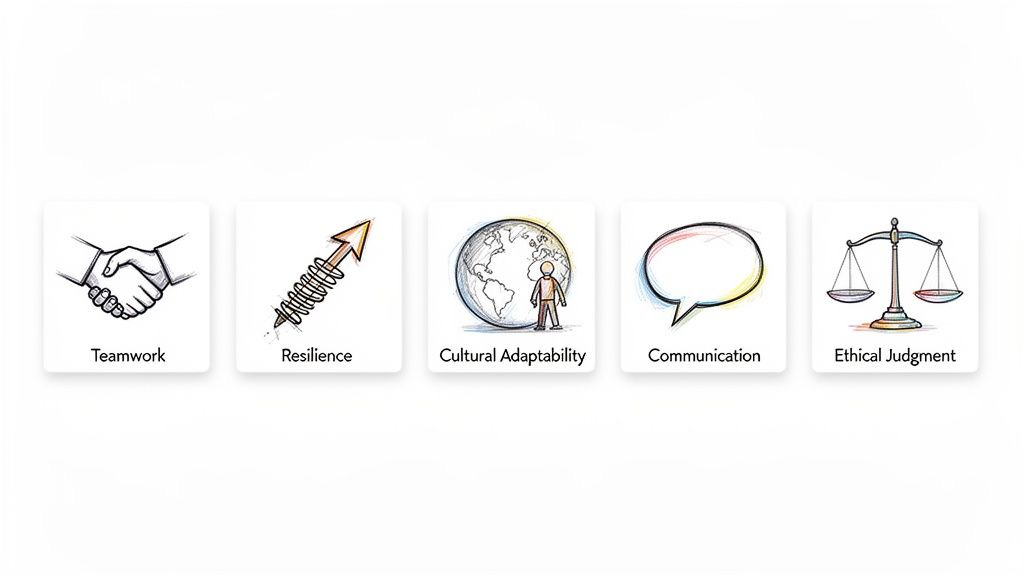
Your technical skills get you in the door. They’re the price of admission. Once you’re in the interview room, MDB hiring panels are looking for something deeper. They’re searching for a specific set of non cognitive skills that predict who will succeed and who will wash out under the pressures of international development work.
These are concrete, observable behaviors that separate high-performers from those who can’t handle it when things get tough. Mastering these five skills is the first step to proving you belong in that first group.
Let’s break down what these skills mean in the MDB world and what they look like in action.
The table below gives you a snapshot of the five core skills, their practical meaning in an MDB setting, and a concrete example of how each one is demonstrated.
Essential Non Cognitive Skills in MDB Contexts
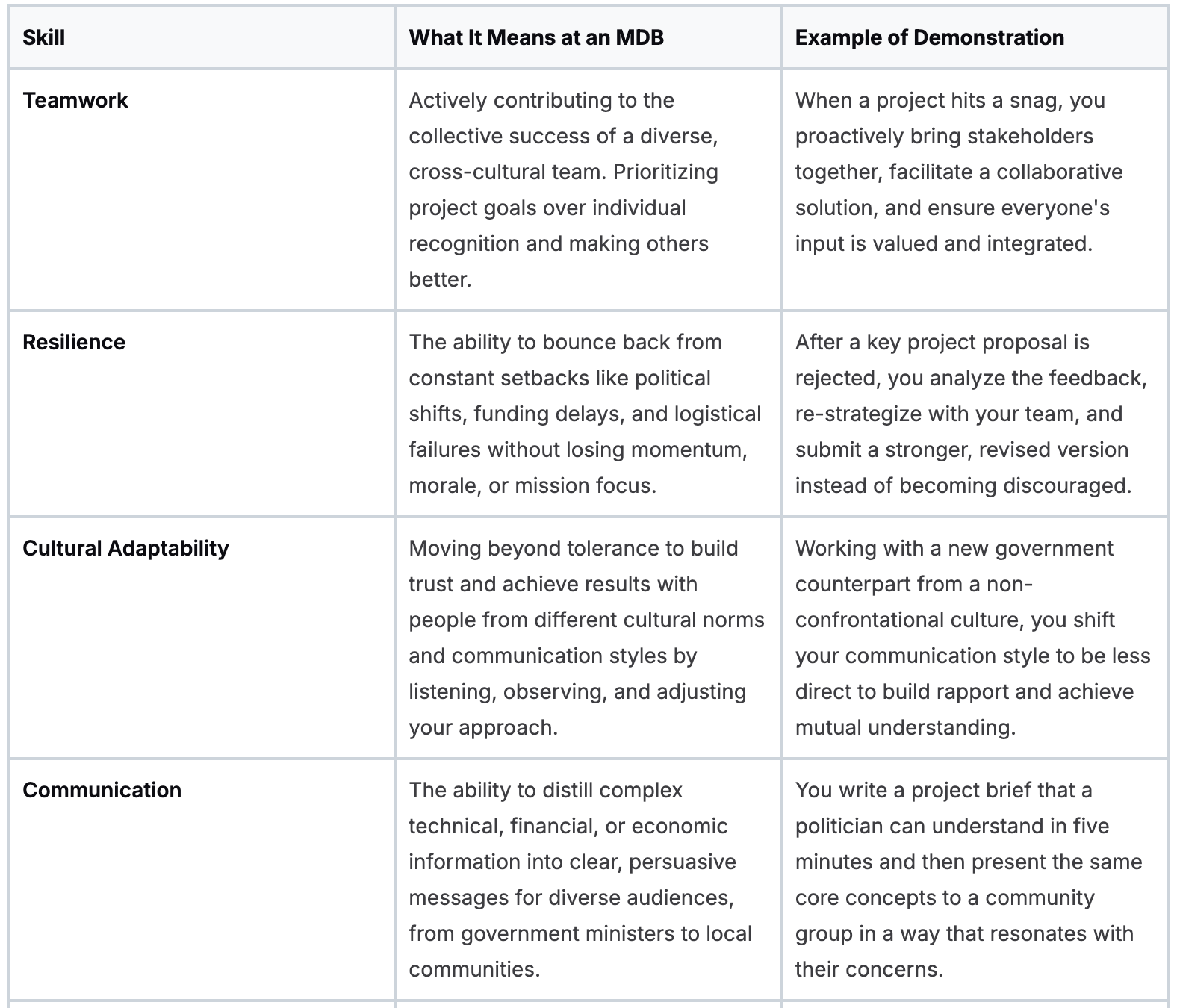

Understanding these skills is one thing, but demonstrating them is what counts. Let’s dig deeper into each one.
Skill 1: Teamwork and Collaboration
At an MDB, you don’t work alone. Every project is a massive, collaborative machine with parts spread across continents, time zones, and cultures. Real teamwork here is about actively making the entire team stronger.
This means you share information before you’re asked, give credit where it’s due, and help a colleague who’s swamped. You see the project’s success as your own. A brilliant lone wolf is a liability in this world.
How it looks in practice: A project hits a major roadblock after a partner government changes a key policy. The strong team player doesn’t just report the problem. They get all stakeholders on a call, transparently explain the situation, and run a brainstorming session to find a way forward together. They build consensus and amplify others’ ideas.
Skill 2: Resilience and Grit
MDB work is a marathon of navigating setbacks. Funding gets cut, political winds shift, and supply chains break. Resilience is your ability to take these hits, adapt on the fly, and keep pushing forward without losing your cool or motivation.
It’s mental toughness. It’s treating failure as a data point, not a final verdict. Hiring panels look for evidence that you’ve pushed through adversity before and come out stronger. They need to know you can handle the daily frustrations without burning out.
Resilience isn’t about avoiding failure. It’s about how you get back up, learn, and drive the mission forward when you do fail.
This quality is a huge predictor of long-term effectiveness. It shows you have the grit to see a multi-year project through to the finish line, no matter what hurdles appear.
Skill 3: Cultural Adaptability
When you work for an MDB, you constantly engage with people whose backgrounds, communication styles, and professional norms are different from your own. Cultural adaptability is the skill of navigating these differences with respect, curiosity, and effectiveness.
This is deeper than speaking another language or enjoying international food. It’s understanding that your way isn’t the only way. You have to listen, observe, and adjust your own behavior to build trust and get things done in any cultural context.
How it looks in practice: A new team member joins from a culture where direct criticism is deeply disrespectful. A culturally adaptable manager notices this. Instead of giving blunt feedback in a team meeting, they shift to private, constructive conversations that preserve harmony while still addressing the performance issue.
A lack of this skill can torpedo critical stakeholder relationships and bring entire projects to a halt.
Skill 4: Communication
In the MDB environment, communication is about clarity and influence. You must take dense, technical information and translate it into a clear, compelling message for non-experts, whether a government minister or a village elder. This is a vital non cognitive skill.
This applies to both writing and speaking. Your reports need to be sharp and to the point. Your presentations must be persuasive. Sloppy communication creates confusion, wastes time, and erodes trust. Exceptional communicators rally diverse groups around a single vision, which is the heart of development work.
Skill 5: Ethical Judgment
MDBs operate on public trust and are responsible for billions in development funds. There is zero room for error. Your ethical compass must be perfectly calibrated.
Ethical judgment is your ability to see and navigate complex moral gray areas with unwavering integrity. It’s more than following a rulebook; it’s making sound decisions under pressure when the choices are tough and the “right” answer isn’t obvious. Recruiters will test this relentlessly. They need proof that you are principled, transparent, and can be trusted to protect the institution’s reputation, even when nobody is watching. It is completely non-negotiable.
How Hiring Panels Evaluate Your Non-Cognitive Skills
MDBs don’t just hope you have strong non-cognitive skills. They design their entire hiring process to test for them. Every stage, from your application to the final interview, is a deliberate effort to peel back your technical qualifications and see the person underneath.
They want to know how you operate under pressure, think on your feet, and what kind of colleague you’ll be. Understanding their methods is key to proving you have what it takes.
Competency-Based Interview Questions
This is the bread and butter of MDB interviews. Panels lean heavily on competency-based questions because they want hard evidence from your past, not hypotheticals.
You’ll hear prompts like, “Tell me about a time when...” or “Give an example of a situation where...”. This format forces you to demonstrate a skill, not just claim it. A panellist doesn’t want to hear that you’re a “great team player.” They want the specific story of how you navigated a messy team dynamic to get a project over the line. Every answer is a chance to provide proof.
For a real inside look at what goes on, check out this interview with a former MDB panellist we published.
These questions are structured and consistent for all candidates to ensure a fair comparison. The panel is listening for a clear narrative: the situation, the specific actions you took, and the result. They’re digging for the how and the why behind your career highlights.
Situational Judgment Tests and Assessment Centers
To see your skills in action, many MDBs use Situational Judgment Tests (SJTs) and full assessment centers. This is where things get real. It’s the difference between describing how you’d swim and being thrown in the pool.
An SJT will present you with realistic workplace dilemmas. For example:
You discover a potential conflict of interest in a procurement process days before a major deadline. What’s your move?
A key government stakeholder is consistently blocking your project’s progress. How do you manage the situation?
Your team is behind schedule due to logistical nightmares in a remote area. What are your immediate next steps?
There are no simple answers. The goal is to evaluate your problem-solving process, your ethical compass, and your communication skills under pressure.
Assessment centers take this a step further. You might find yourself in a group exercise, negotiating a budget with other candidates or collaborating on a complex case study. Observers are watching everything: how you contribute, listen, handle conflict, and whether you focus on group success or just your own performance.
The Role of Rigorous Reference Checks
Never underestimate the power of reference checks at this level. This isn’t a formality to confirm your employment dates. It’s a critical tool for MDBs to validate everything you’ve claimed about your non-cognitive skills.
Hiring managers will ask your references targeted questions based on the competencies they’re evaluating. They’ll probe for specific examples of your teamwork, resilience, and integrity. A former supervisor might be asked, “Can you tell me about a time [Candidate’s Name] had to deal with a major professional setback? How did they respond?”
A lukewarm or generic reference is a huge red flag. A glowing reference who provides specific, compelling stories that back up what you said in your interview is incredibly powerful. It’s the final piece of evidence that tells the panel your skills are real, tested, and reliable.
Building Your Case: How to Prove Your Non-Cognitive Skills
You can’t walk into an MDB interview and say, “I have great teamwork skills.” They’ve heard it all before. In the high-stakes world of MDB recruitment, claims are cheap. Evidence is everything.
You need to build a case for yourself. This means translating your professional experiences into a clear, consistent narrative that runs through your entire application, from your CV to your final panel interview. You have to show, not just tell.
The hiring process is designed to test these skills at multiple stages. They’re not just taking your word for it.
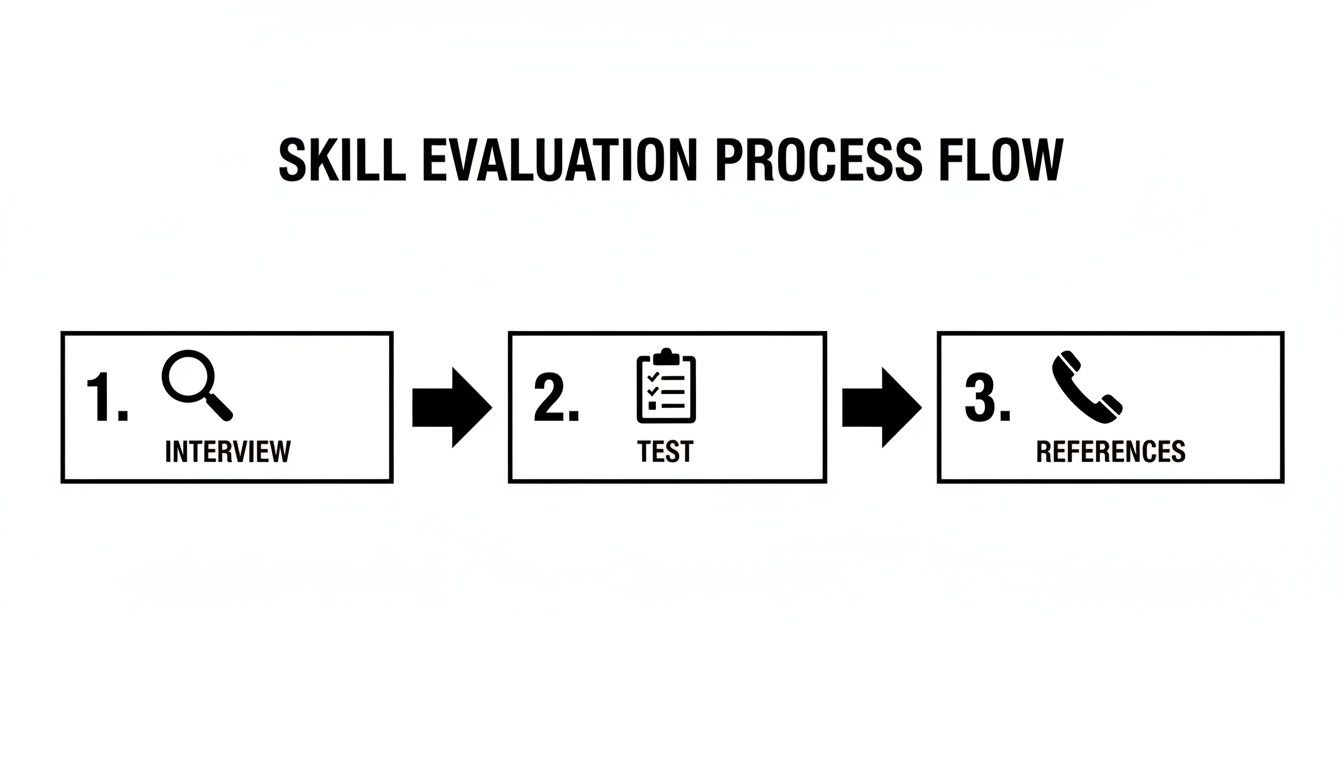
As you can see, MDBs use a multi-pronged approach. They question you in interviews, give you practical tests, and then validate everything with your references. They want a complete, 360-degree picture of who you are and how you operate.
Translate Your Experience with the STAR Method
The single most effective tool for building your evidence is the STAR method. It’s a simple, powerful framework for structuring your accomplishments to highlight your impact. This is the secret to writing killer CV bullets and interview answers.
Here’s the breakdown:
Situation: Briefly set the scene. What was the context or the challenge?
Task: What was your specific responsibility? What goal were you trying to achieve?
Action: What specific steps did you take? Get into the details of your contribution.
Result: What was the outcome? Quantify it whenever possible. What was the impact of your actions?
This structure forces you to move beyond listing duties and start showcasing achievements. It’s the difference between a passive CV and one that screams “I get things done.”
Rebuilding Your CV for Impact
Too many candidates write CVs that are technically accurate but completely flat. They list tasks, not accomplishments, and fail to demonstrate the skills MDBs need.
Here’s a classic “before” example from a project manager’s CV:
Responsible for managing a rural infrastructure project in Southeast Asia.
This tells the reader almost nothing. It’s a job description, not proof of your abilities. It’s forgettable.
Now, let’s rebuild that same point using the STAR method to actively showcase teamwork and problem-solving.
After:
Situation: Led a $5M rural infrastructure project facing delays due to disagreements between local government and community leaders.
Action: Facilitated town hall meetings and workshops, creating a new communication protocol that brought both parties to the table for regular, structured dialogue.
Result: Resolved core conflicts within three months, putting the project back on track and delivering it 15% under budget while securing formal community buy-in.
See the difference? The “after” version tells a compelling story. It proves you can navigate conflict, build consensus, and deliver tangible results under pressure. That’s the kind of evidence that gets you noticed.
Learning how to frame your entire history this way is crucial. For more guidance, check out our practical guide to landing MDB jobs.
Answering Interview Questions with Evidence
The same logic applies to your interviews. When a panelist asks, “Tell us about a time you showed resilience,” they’re setting up a test. They want to see if you can provide a structured, evidence-based answer.
A weak answer sounds like this: “I’m very resilient. In my last project, we had a lot of problems, but I worked hard and we got through them.” It’s vague, unconvincing, and a huge missed opportunity.
A strong answer uses the STAR method to tell a story that makes your resilience undeniable.
A Stronger, Evidence-Based Answer:
Situation: “In my role at XYZ, a critical project partner unexpectedly pulled their funding, which jeopardized the entire initiative and the jobs of 12 local staff.”
Task: “My objective was to find a way to salvage the project within 30 days before it was shut down.”
Action: “I immediately conducted a full operational review to identify the most critical components. I then developed a revised, scaled-down project proposal and presented it to three alternative donors, highlighting the long-term community benefits we could still achieve with a smaller budget.”
Result: “I secured bridge funding from one donor, which allowed us to retain the entire team and continue the project’s most vital services. The original partner even rejoined the project six months later after seeing our progress.”
This answer doesn’t just claim resilience; it demonstrates it with a specific, compelling example of problem-solving and perseverance. This is how you make your skills tangible and credible. It’s proof, not just talk.
How to Develop the Skills That Matter Most
Knowing you have a gap in your non-cognitive skills is the easy part. The real work is closing that gap. This requires a long-term, deliberate commitment to growing in ways that MDBs value.
Think of this as a marathon, not a sprint. You won’t become more resilient or culturally savvy overnight. Your focus should be on consistently putting yourself in challenging situations, reflecting on how you handled them, and learning from the experience. This is how you build the professional muscle MDBs look for.
Engineer Your Own Growth Opportunities
You can’t wait for development opportunities to find you. You have to hunt them down or create them yourself. The idea is to intentionally place yourself in situations that force you to strengthen these specific skills.
Here are a few practical ways to get started:
To Build Teamwork: Volunteer to lead a project that cuts across different departments. This will force you to talk to people outside your bubble, balance competing priorities, and forge consensus among stakeholders with different perspectives.
To Cultivate Resilience: Raise your hand for the tough assignments everyone else is avoiding. Take the project with the impossible deadline, the difficult client, or the ambiguous outcome. Every setback you navigate builds the mental fortitude MDBs need.
To Enhance Cultural Adaptability: Chase international assignments or join multicultural teams within your company. Make a conscious effort to listen and observe more than you speak. Your goal is to adjust your communication style to fit the room.
Seek Out Mentorship and Honest Feedback
You can’t see your own blind spots. A trusted mentor or a manager who gives you direct, constructive feedback is priceless. Their perspective is the only way to understand how your actions and communication style land with other people.
When you get that feedback, your only job is to listen. Don’t get defensive. Ask clarifying questions and try to see things from their point of view. Ask for specific examples. This isn’t a personal attack; it’s critical data you can use to improve.
Be proactive. Schedule feedback sessions. Ask a senior colleague, “After our next big presentation, could you give me some candid feedback on how I handled the Q&A session?” This signals you’re serious about growth.
A Long-Term View on Skill Development
This process is continuous and will stretch across your entire career. For a deeper dive into mapping this out, learn more about how to set targets for landing an MDB job.
The impact of honing these skills goes far beyond one job application. Research has shown that non-cognitive skills are powerful equalizers in the job market, boosting social mobility and creating opportunities, especially for vulnerable groups. One study found these skills were a major incentive for retirees to re-join the workforce, with the effect being stronger for men, those from rural areas, and individuals with lower education levels.
This proves that investing in these abilities pays dividends for your entire professional life. It opens doors and builds a more stable, impactful career path. It’s the single best investment you can make in yourself.
Burning Questions About Non-Cognitive Skills in MDB Recruitment
You get it: non-cognitive skills are a big deal. But knowing they’re important and knowing how to navigate the hiring process are two different things. Let’s tackle some of the most common questions I hear from candidates so you can walk into your next interview with confidence.
These are the real-world sticking points that can make or break an application. Getting these answers straight is the final piece of your prep.
Are Non-Cognitive Skills More Important Than Technical Skills?
No, and that’s the wrong way to look at it. They’re completely codependent.
Your technical expertise is the price of admission. It gets your CV past the first screen and proves you have the foundational knowledge to do the job. Without it, you’re not in the running. Period.
Once you’re shortlisted, the MDB assumes everyone has the technical chops. The hiring decision then pivots almost entirely to your non-cognitive skills. They become the tiebreaker that separates a pile of qualified candidates from the one who gets the offer.
Think of it like building a bridge. Your technical skills are the engineering blueprints. Your non-cognitive skills are your ability to manage the construction crew, negotiate with difficult local landowners, and solve supply chain disasters. Without both, that bridge is never getting built.
How Can I Demonstrate Resilience Without a Major Crisis Story?
You don’t need a dramatic story of corporate disaster to prove you’re resilient. MDB recruiters spot this skill in smaller, common workplace challenges. They care more about your process for handling adversity than the scale of the crisis.
The trick is to reframe what you think of as a “crisis.” Resilience is built and demonstrated daily.
Consider these powerful, smaller-scale examples:
The Impossible Deadline: Talk about a time a project’s timeline was suddenly slashed in half. Explain how you re-prioritized tasks, managed your team’s morale, and delivered the most critical components without letting quality slip.
The Unresponsive Stakeholder: Describe a situation where a key partner went radio silent. Detail the persistent, professional follow-up you initiated and the alternative communication strategies you used to get them back on board.
The Scathing Feedback: Discuss a time you received harsh, unexpected criticism on a major piece of work. Focus on how you processed the feedback, separated valuable insights from raw emotion, and used it to produce a much stronger final product.
The story isn’t about the size of the fire. It’s about showing you’re the kind of person who calmly grabs the fire extinguisher while others are panicking. That’s what proves you have the grit for MDB work.
Can These Skills Be Learned, or Are They Innate?
They can absolutely be learned, and MDBs are specifically looking for people who believe this. The idea that skills like teamwork or communication are fixed personality traits is outdated. MDBs want candidates who show a growth mindset, the belief that your abilities can be developed through dedication and hard work.
Your job is to show a clear, ongoing commitment to self-improvement. It’s not enough to just have these skills; you need to show you are actively sharpening them.
Here’s how you prove it:
Talk about feedback: When asked about a weakness, frame it as a development area you’ve actively worked on after getting constructive feedback.
Mention mentorship: Discuss how you’ve sought out mentors to help you navigate tricky team dynamics or level up your presentation skills.
Highlight training: Reference specific training or self-study you’ve undertaken to become a better communicator, negotiator, or leader.
Proving you’re coachable and dedicated to growth is just as important as the skills themselves. It tells the hiring panel you’re a good long-term investment who will only become more valuable over time.
At Multilateral Development Bank Jobs, we provide the insider knowledge and practical guides you need to navigate every stage of the MDB hiring process. Our weekly newsletters deliver curated job listings and deep-dive articles to give you a decisive edge.