

You’re probably in one of three situations right now.
You’ve done serious work, but it doesn’t look like “development” on paper. Or you’re staring at entry roles that ask for experience you were never given a fair chance to build. Or you’ve already collected a patchwork of internships, research, nonprofit work, policy exposure, and private sector skills, but you’re not sure what an MDB will count.
That confusion is normal. The phrase international development work experience sounds narrower than it really is. In practice, MDBs hire for delivery, analysis, finance, procurement, operations, communications, monitoring, and sector expertise. They want people who can help move a lending operation, advisory project, reform program, or knowledge product from concept to execution.
The mistake most candidates make is simple. They treat development experience as a location or a moral label. Recruiters treat it as evidence. Can you manage stakeholders, analyze a problem, work across institutions, produce something useful, and show results that matter in a public-interest context? That’s the test.
What Actually Counts as Development Experience
The old stereotype still hangs around. A lot of people think international development work experience means an unpaid stint abroad, ideally in difficult conditions, preferably with photos to prove it.
That’s incomplete and often misleading.
Field exposure still matters. Career guidance for the sector notes that fieldwork is required for some roles and a strong advantage for others, and that overseas or in-country exposure is widely valued. The same guidance also shows how much the field has professionalized, with entry roles such as project coordinator, program officer, communications associate, and research analyst handling budget tracking, reporting, and data analysis to support policy decisions, as described in this international development career guide.
Here’s the cleaner way to think about it.
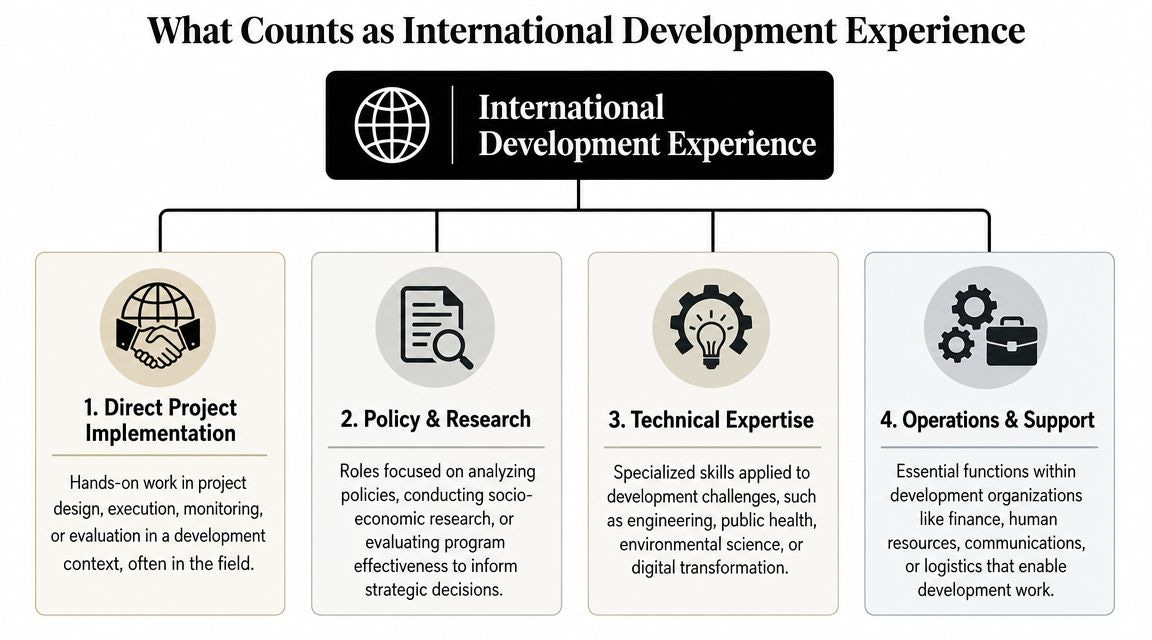
Four buckets MDBs recognize
Direct project implementation is the closest match to what is commonly imagined. You supported delivery. You coordinated a health, education, infrastructure, agriculture, governance, or social protection project. You worked on implementation plans, partner management, procurement support, monitoring, safeguards, workshops, beneficiary outreach, or reporting.
Policy and research counts too. If you’ve written policy briefs, analyzed administrative data, supported evaluations, reviewed regulations, produced sector notes, or helped build evidence for decision-makers, that is development-relevant work. Many MDB roles sit exactly in that zone.
Technical expertise often carries more weight than candidates expect. Engineers, urban planners, environmental specialists, public health professionals, economists, financial analysts, digital specialists, and climate practitioners are all part of the development labor market. MDBs don’t hire “general passion.” They hire skills applied to development problems.
Operations and support is where many strong candidates undersell themselves. Finance, procurement, HR, legal, communications, knowledge management, and risk functions all matter because projects fail when these systems are weak.
Practical rule: MDBs hire by function first and mission second. Start by identifying the function you already perform well.
What your current background might already mean
A corporate finance role can translate into sovereign finance, project finance support, treasury operations, or budget analysis. A data analyst at a healthcare company may already have experience with dashboards, KPIs, data cleaning, and decision support. A local government planner may be closer to urban development work than many applicants with international relations degrees.
That’s why understanding results-based management in development work matters early. MDBs think in terms of outputs, outcomes, implementation constraints, and evidence of progress. If your experience can be expressed in that language, it becomes legible.
What doesn’t count as strongly as people hope
Some experience is adjacent but weakly framed.
General volunteering without ownership carries limited weight if you can’t explain what you delivered.
Academic coursework alone won’t move much unless it produced a real research output, client deliverable, or applied project.
Passion statements about global impact don’t compensate for thin evidence.
Travel is not fieldwork. Living abroad only helps when you can tie it to work, analysis, language use, stakeholder engagement, or program delivery.
The strongest applications show contribution, not proximity.
If you want a useful self-audit, ask four questions. What problem did you work on? What function did you perform? Who used your work? What changed because you were there? If you can answer those clearly, you likely have more international development work experience than you think.
Concrete Pathways to Acquiring Experience
Most advice on breaking into development is too expensive, too vague, or both.
It assumes you can relocate, work unpaid, or wait patiently while better-connected candidates collect the “right” logos. That’s not how individuals typically build durable careers. Many candidates enter through a patchwork of smaller experiences: project work, writing, local nonprofit roles, research support, fundraising, and networking. UN career guidance also makes clear that experience can come through NGOs, nonprofits, and volunteering, while noting that many international organizations require several years of prior experience, which makes entry unusually difficult for candidates without early access, as outlined in UN and IO career guidance for students and junior professionals.
The formal routes
The formal paths are real. They’re just not the only ones.
Structured internships at MDBs, UN agencies, INGOs, and think tanks help because the brand is legible and the work is easier for recruiters to benchmark. The trade-off is access. These roles are competitive, often seasonal, and sometimes financially unrealistic.
Young professional pipelines are another route, but they are not starter roles. They usually reward candidates who already have a coherent profile, technical depth, and evidence of strong performance.
Short-term consultancies can be powerful if you already have a skill a team needs. Research support, editing, data work, procurement support, event coordination, and sector analysis often enter this way. The upside is relevance. The downside is instability.
The practical routes most people overlook
In this sector, many careers are built.
A local NGO role can absolutely count if your work maps to development functions. If you wrote donor reports, coordinated implementing partners, tracked indicators, managed community engagement, or supported grants, you have experience that translates well.
University-based research can also be strong. Not the degree title. The output. A literature review, policy memo, dataset, case comparison, survey instrument, or evaluation brief is useful because it demonstrates method and judgment.
Private sector roles matter when they involve transferable substance. ESG reporting, impact investing, public sector consulting, geospatial analysis, infrastructure advisory, health systems work, and supply-chain roles can all travel well into MDB hiring if you explain the development relevance.
For ongoing market visibility, some candidates also track openings through curated listings such as international development group jobs and related multilateral roles, alongside institutional career pages and specialist recruiter feeds.
Comparing pathways to development experience
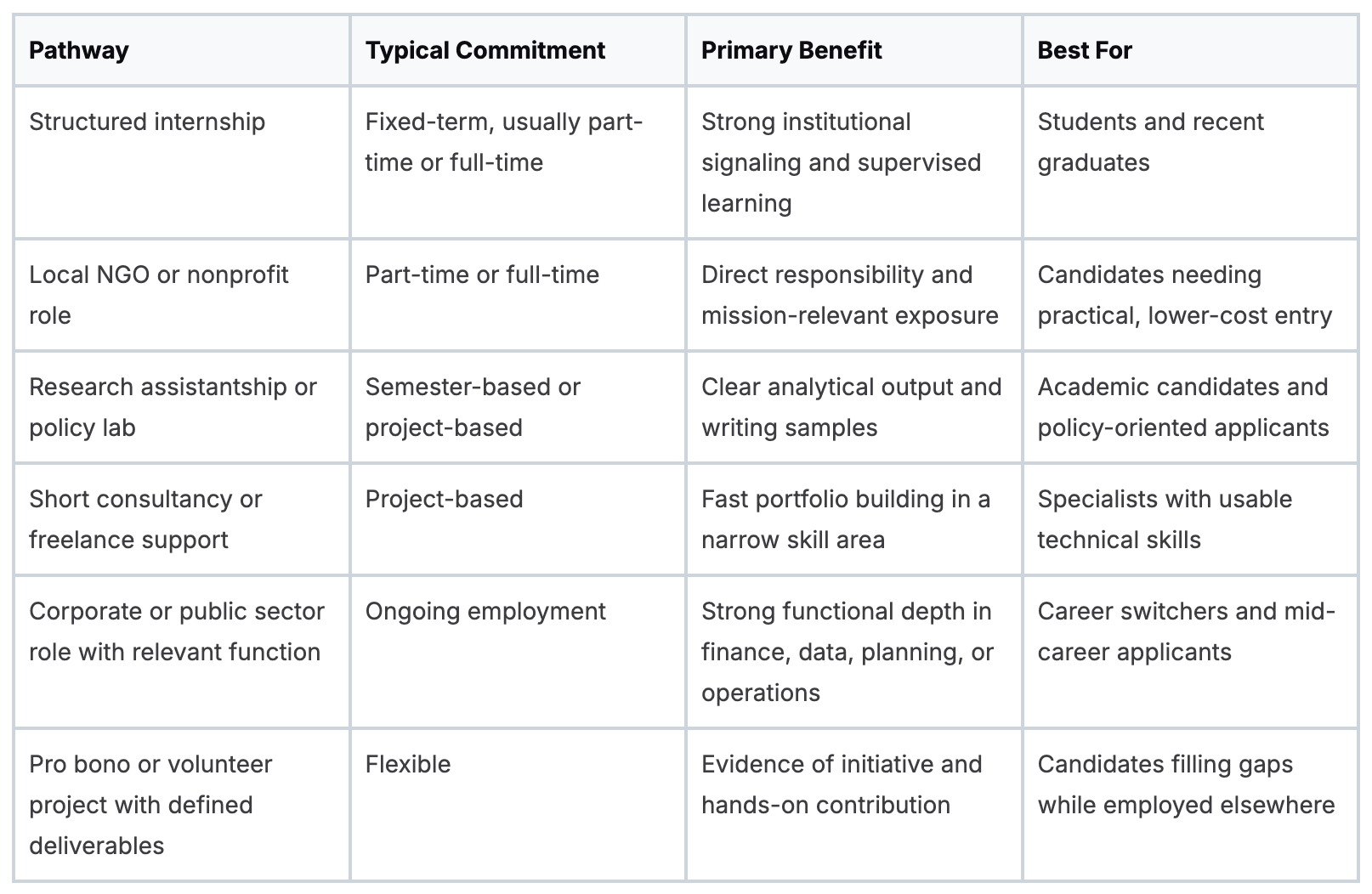
What works and what wastes time
The best pathway is the one that gives you ownership, outputs, and a credible story.
A six-month local role where you coordinate reporting, support implementation, and write donor-facing materials is often more useful than a glamorous but thin overseas placement where you mostly observe. A targeted volunteer assignment with a defined deliverable beats generic “member” experience every time.
Focus on roles that let you produce tangible evidence:
Writing samples such as briefs, memos, reports, or evaluation summaries
Operational evidence like workplans, meeting records, budget trackers, or risk logs
Analytical outputs including dashboards, surveys, coding files, or presentation decks
Stakeholder experience with governments, CSOs, donors, researchers, or community groups
Cheap prestige is still expensive if it gives you no real evidence.
The fastest way to build international development work experience is to stop waiting for one perfect opportunity and start assembling a body of relevant work. Recruiters respond to cumulative proof.
Translating Your Experience for MDB Applications
Having good experience is one thing. Making it readable to an MDB hiring panel is another.
Most weak applications fail at translation. The candidate may have done solid work, but the CV reads like an internal job description. That format hides impact, hides judgment, and hides relevance.
Career guidance for development resumes is blunt on this point. The strongest approach is to list roles in reverse chronological order, use concise bullets focused on achievements rather than duties, quantify impact where possible, and tailor keywords to the target role. Examples like improving literacy by 30% or reducing water scarcity by 50% show the kind of outcome evidence employers can quickly assess in competitive hiring processes, as explained in guidance on work experience in international development resumes.
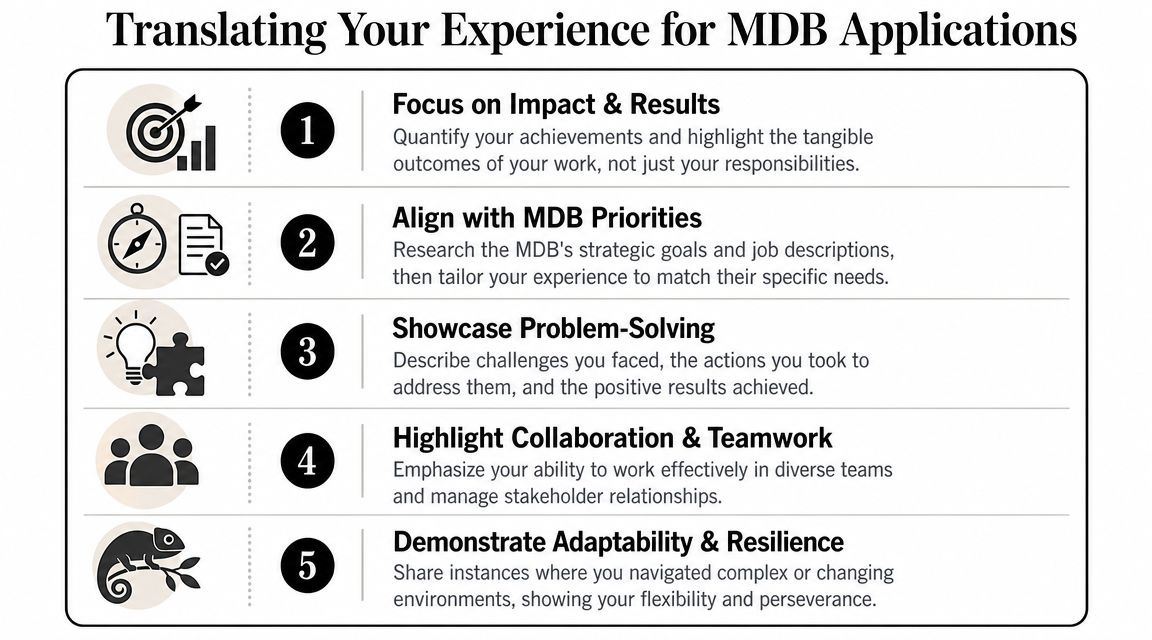
Before and after on CV bullets
Here’s what weak translation looks like.
Managed project budget
Supported research activities
Liaised with stakeholders
Assisted with reporting
Conducted data analysis
None of those bullets is false. None of them helps enough.
Now the stronger version.
Managed project budget tracking and expenditure monitoring for a multi-stakeholder program, helping the team maintain reporting discipline and flag implementation issues early
Produced research summaries and policy notes that informed team recommendations on sector priorities
Coordinated with government counterparts, civil society partners, and internal specialists to keep approvals and deliverables moving
Drafted progress reports and briefing materials for senior review, translating technical updates into decision-ready summaries
Analyzed program data to identify performance gaps and support course correction during implementation
Notice what changed. The second set shows context, user, and consequence. Even without adding invented numbers, the bullets feel more credible because they explain why the work mattered.
The language MDBs understand
MDB hiring managers scan for certain signals.
They want to see whether you can work in structured environments, manage complexity, and produce clear outputs under constraints. Your application should make those signals obvious.
Use words tied to actual functions:
Implementation support
Stakeholder coordination
Monitoring and reporting
Budget tracking
Policy analysis
Procurement support
Research synthesis
Data quality assurance
Results framework support
Knowledge product development
Cover letters and interviews
Your cover letter has one job. It should explain why your background is relevant to this specific role at this specific institution. No autobiography. No long statement of values. No generic “I have always been passionate about international development.”
Tie your past work to the vacancy’s function.
If the role focuses on transport, explain your infrastructure, planning, procurement, data, or urban policy work. If the role is in social development, show community engagement, inclusion work, safeguards exposure, or public service delivery analysis.
Strong candidates make the reviewer’s job easy. They connect past evidence to future contribution.
For interviews, use a clean STAR structure, but keep it grounded in delivery:
Situation with enough institutional context to matter
Task that clarifies your responsibility
Action that shows your judgment, not just team activity
Result that demonstrates change, learning, or operational value
A good answer sounds like someone who has worked inside constraints. Procurement delays. Conflicting stakeholder expectations. Weak data. Tight deadlines. Political sensitivity. That’s real development work. If your examples reflect that reality, you’ll sound credible.
Setting Realistic Timelines and Expectations
MDB hiring rewards patience, pattern recognition, and staying power.
A lot of candidates get discouraged because they assume one strong degree, one internship, or one referral should be enough. It usually isn’t. These institutions are cautious employers. They screen for fit, substance, and whether you can operate in systems that are slow, layered, and documentation-heavy.
That doesn’t mean the path is closed. It means you need a timeline that matches how these organizations hire.
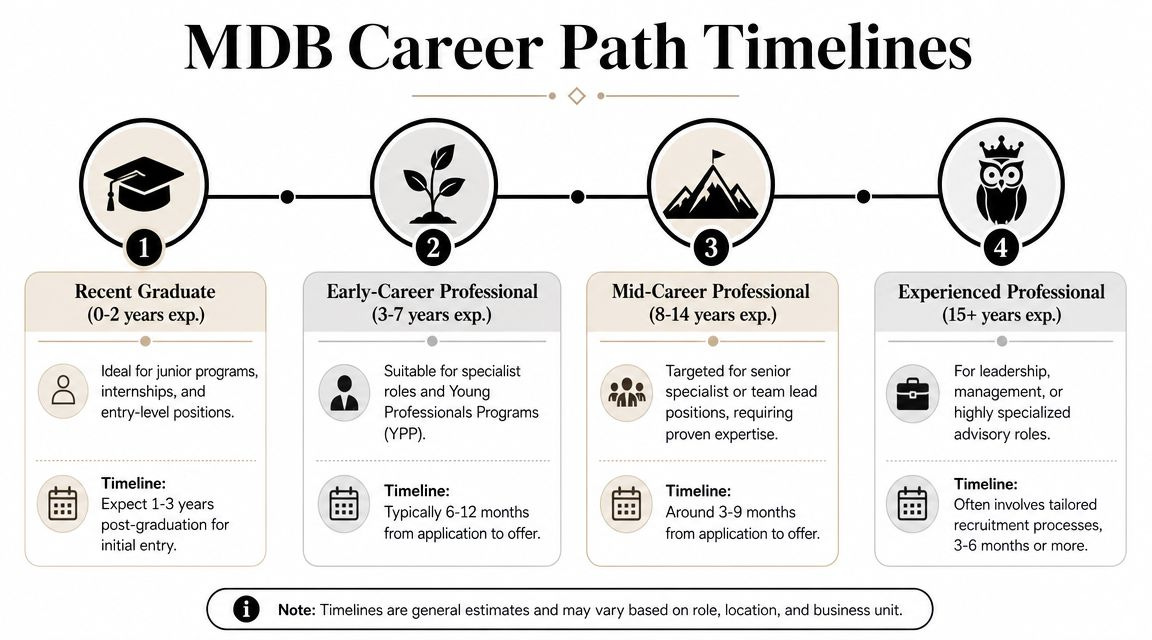
If you’re early in your career
Recent graduates often underestimate how much foundational experience they still need. The first objective is not “join an MDB immediately.” The first objective is to become undeniably useful in a function MDBs hire for.
That usually means building a base in one or more of the following: project support, policy analysis, sector research, data work, communications, finance, or operations. If you do that well, the later jump becomes much easier.
If you’re already working
Early-career professionals with a few solid years of experience are often in the strongest position to make a deliberate move. They’ve had time to own work, write clearer CV bullets, and collect examples that stand up in interviews.
Mid-career candidates face a different challenge. They usually have enough substance, but they may be framed incorrectly. A strong profile in banking, infrastructure, health systems, public administration, or analytics can translate well, but only if the candidate reshapes the story around public value, implementation, and stakeholder complexity.
What the process feels like in practice
The hiring cycle can be long. You may apply, hear nothing for a while, then get a request with little notice. Some roles move quickly. Others stall, reopen, or disappear. That’s normal.
What works is treating applications as a portfolio process, not a referendum on your worth.
Build in waves: Apply in clusters to related roles rather than one at a time.
Track your evidence: Save strong examples for interviews, written tests, and competency questions.
Refine after each cycle: If you’re not getting traction, adjust your framing before sending another batch.
Stay employed if possible: A stable role that keeps building relevant skills is better than waiting in limbo for the perfect opening.
Persistence matters, but blind persistence wastes energy. Keep applying, and keep improving the signal you send.
The candidates who eventually break in are rarely the ones with the most romantic story. They’re the ones who kept accumulating relevant proof and learned how to present it clearly.
Action Plans for Your Specific Career Stage
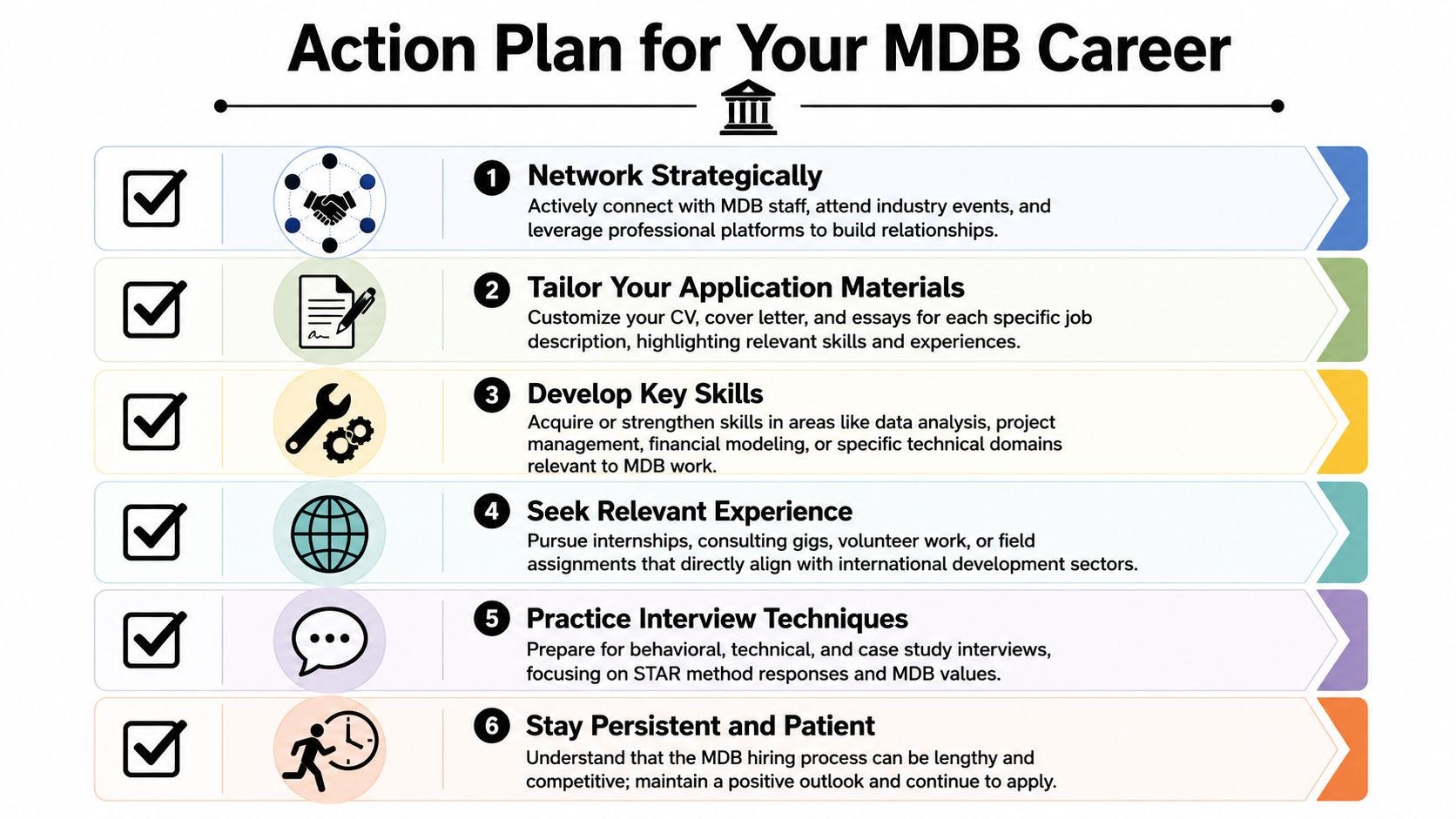
Advice gets useful when it turns into a short list you can execute.
The right next move depends on where you are now. A student needs signal. An early-career professional needs depth. A mid-career switcher needs translation and repositioning.
If you are an undergrad or grad student
Your goal is to leave school with evidence, not just credentials.
Pick one function early: Choose a lane such as research, project support, data analysis, communications, or finance. Breadth helps less than people think at this stage.
Produce usable outputs: Aim for policy memos, evaluation notes, research assistance, grant writing, or implementation support. Employers can assess outputs.
Choose practical affiliations: A local NGO, lab, student consultancy, or municipal office can be more valuable than a prestigious but vague role.
Build informed networks: Speak with staff in roles one step above where you’ll enter. Ask what they did before joining.
Track entry-level openings consistently: Curated resources on World Bank jobs for fresh graduates and similar junior pathways can help you understand what entry profiles look like in practice.
If you are an early-career professional
You need sharper positioning, not more random experience.
Start by auditing your last two or three roles. Which bullets show implementation, analysis, stakeholder management, or results? Which ones look generic? Rewrite them before you apply anywhere else.
Then tighten your target list.
Choose a function and a sector such as education operations, climate finance, transport policy, or social development.
Fill one obvious gap such as donor reporting, quantitative analysis, project management, or sector knowledge.
Collect stronger stories from your current role. Volunteer for cross-functional assignments, reporting tasks, or external-facing coordination.
Prepare for assessments by practicing concise written responses and interview stories grounded in real work.
Aim for coherence. A clear profile beats a busy profile.
If you are a mid-career professional pivoting into development
You do not need to erase your past. You need to recode it.
If you come from banking, infrastructure, public administration, consulting, health, tech, or law, the value is already there. The issue is usually framing. MDBs need specialists who understand systems, institutions, and execution. They just don’t want candidates who present themselves as abstract strategists detached from delivery.
Focus on these moves:
Map your experience to MDB functions: procurement, financial management, sector operations, safeguards, policy reform, analytics, or partnerships
Add one visible development bridge: a board role, pro bono assignment, policy fellowship, teaching contribution, or sector publication
Rewrite your professional summary: lead with the overlap between your expertise and development priorities
Target specialist roles first: broad “international development” applications are weaker than precise applications tied to your domain
The best pivots are disciplined. They don’t try to become someone else. They make existing expertise legible to a different employer.
Conclusion Your Experience is a Narrative
The strongest candidates understand one thing early. International development work experience is a narrative, not a label.
You build it by stacking proof. A local nonprofit project, a university research role, a finance job with public-sector exposure, a data assignment tied to service delivery, a communications role supporting policy work. Each piece can count when it shows skill, judgment, and contribution.
That matters because this work develops capabilities employers repeatedly value. In a 2024 IIE study, participants in global internships identified communication, problem-solving, confidence, interpersonal skills, teamwork, flexibility or adaptability, and work ethic as the professional skills most relevant to their careers, and more than half also reported gains in intercultural and language skills, according to IIE’s report on global internships and career readiness. Recruiters then look for those capabilities in concrete form. They want achievements, outcomes, and examples of how you worked.
That’s why the “perfect background” is overrated. What matters more is whether your story holds together. Can you show a consistent pattern of solving relevant problems? Can you explain your role clearly? Can you point to evidence rather than intention?
If the answer is yes, you’re already closer than you think.
Keep building the record. Keep translating it well. And stop disqualifying yourself because your path doesn’t look like somebody else’s. MDB careers are full of people who arrived through indirect routes, but they learned how to present their experience in the language institutions understand.
If you’re ready to turn your experience into actual applications, Multilateral Development Bank Jobs is a practical next stop. It tracks full-time roles across major MDBs, consultant opportunities across MDBs and the UN, and publishes career guides that help candidates understand how these organizations hire.