

A European Investment Bank internship is one of the few early-career roles that gives you direct exposure to how an AAA-rated public bank turns policy priorities into financing decisions. Candidates who treat it like a prestige internship usually miss what the EIB is actually screening for. It wants people who can operate inside a rules-based institution where analysis, drafting, stakeholder management, and political awareness all matter at once.
The programme follows a structured intake for final-year students and recent graduates, with fixed start dates, tight eligibility rules, and clear language expectations. That matters because your application is judged less like a campus internship submission and more like an entry point into an institution that expects discipline from day one.
For candidates targeting development finance, infrastructure, climate lending, or policy-linked banking, the attraction is obvious. The overlooked angle is strategic fit. If you are a non-EU national, the route is narrower but not closed. Programs and desks linked to FEMIP and partner regions such as MENA or ACP can matter, especially if your profile matches the Bank’s external mandate. The same is true for applicants who can show credible interest in climate finance, energy security, industrial resilience, or the EIB’s expanding work around European defence investment. Those priorities are shaping where attention goes, and strong candidates reflect them in their CV, cover letter, and interview examples.
Why an EIB Internship is Your Gateway to Global Finance
An EIB internship gives you something few early-career roles can match. Direct exposure to how a public bank turns political priorities into financing decisions, risk analysis, approvals, and portfolio work.
That matters because global finance is not only about models and markets. At the EIB, you see how capital is allocated inside a rules-based institution that answers to public mandates, internal controls, and multiple stakeholders at once. If you want a career in development finance, infrastructure, climate lending, sovereign-backed investment, or EU policy-linked banking, that operating model is worth more than a generic brand name on your CV.
Why recruiters rate EIB experience highly
Recruiters in MDBs, DFIs, export credit institutions, and public investment bodies look for evidence that you can function inside institutional complexity. The EIB is a strong signal because the work usually sits at the overlap of technical analysis, internal process, and political context.
A good traineeship there shows more than interest. It shows judgment.
In practice, employers read EIB experience as evidence that you can handle:
Policy-linked finance where strategic priorities must translate into defensible project work
Structured drafting and review under institutional standards, not startup speed
Cross-border coordination with legal, operational, and country-facing teams
Public-purpose banking where financial logic and policy logic must coexist
Multilingual professional environments where clear written English matters and other languages can strengthen your profile
That combination travels well. It is one reason candidates who miss the EIB often target similar pathways such as this World Bank internship guide for multilateral finance careers.
The value is stronger than many candidates assume
A common question is whether the effort is justified for an internship that may last only a few months.
Yes, if your goal is long-term credibility in international finance.
The primary return is not the title. It is proximity to live institutional work, managers who can assess your ceiling, and processes that shape how major public investments move from concept to approval. Candidates from private-sector internships often arrive with faster execution habits. Candidates from MDB-style environments usually develop stronger judgment about documentation, internal review, and stakeholder alignment. In this field, that trade-off matters.
Where the EIB creates a real career advantage
The EIB is particularly useful for candidates who want to build a profile around sectors and mandates that are gaining weight inside European public finance.
That includes:
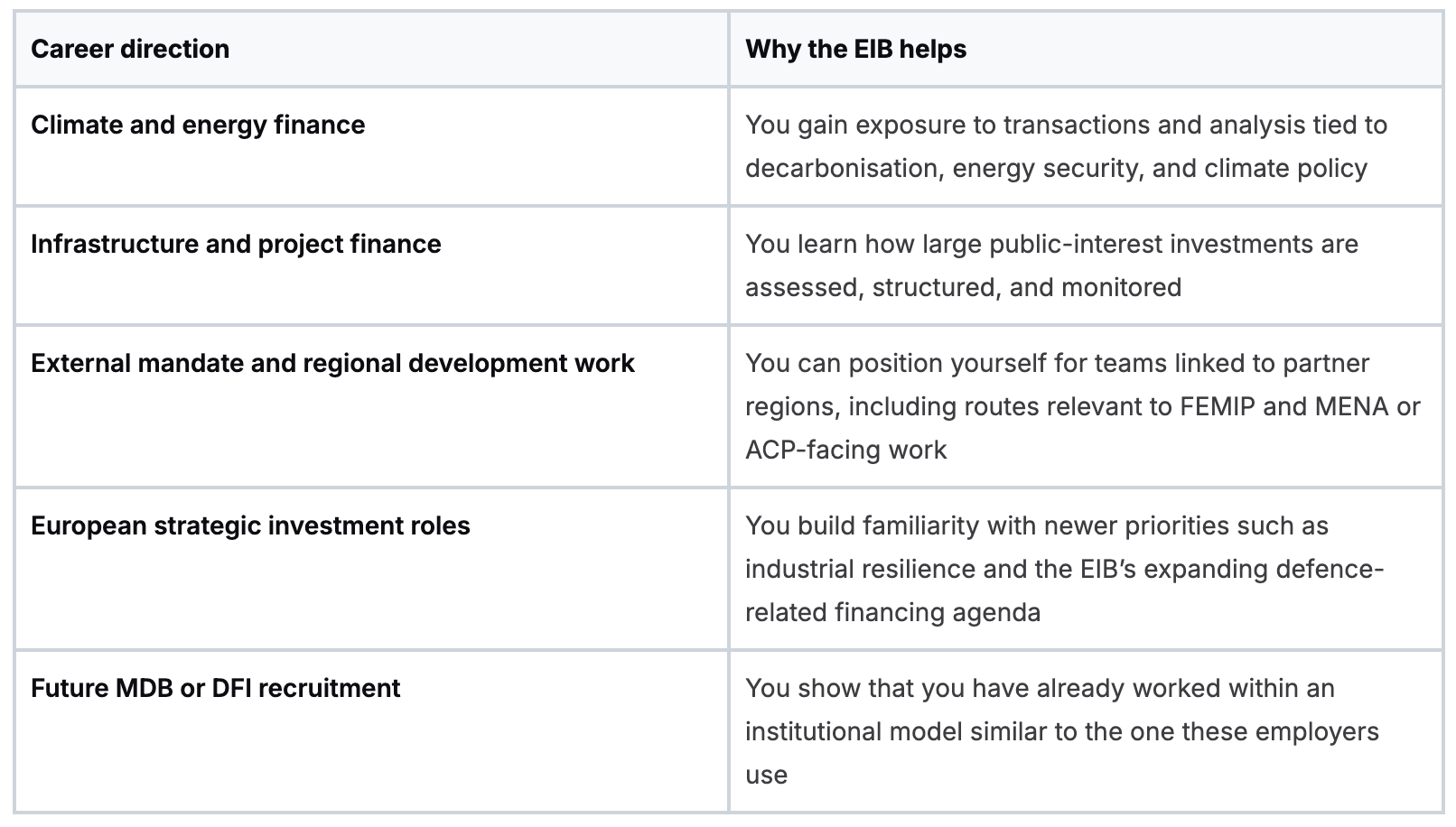
The overlooked opportunity is strategic fit. Strong applicants do not describe themselves as generally interested in international affairs. They show a credible link to the Bank’s current priorities and, if they are non-EU nationals, they target teams where the Bank’s external mandate gives their regional background or language profile a practical use.
What separates serious applicants from the rest
The strongest candidates treat the internship as an early test of staff-level habits. They write clearly, follow instructions exactly, and make it easy for reviewers to see where they fit.
That is the standard.
If your application shows that you understand climate finance, energy transition, partner-country operations, or the Bank’s newer emphasis on security and defence-related investment, you stop looking like a generalist chasing prestige. You start looking like someone the institution can place with purpose.
The EIB Internship Programs Explained
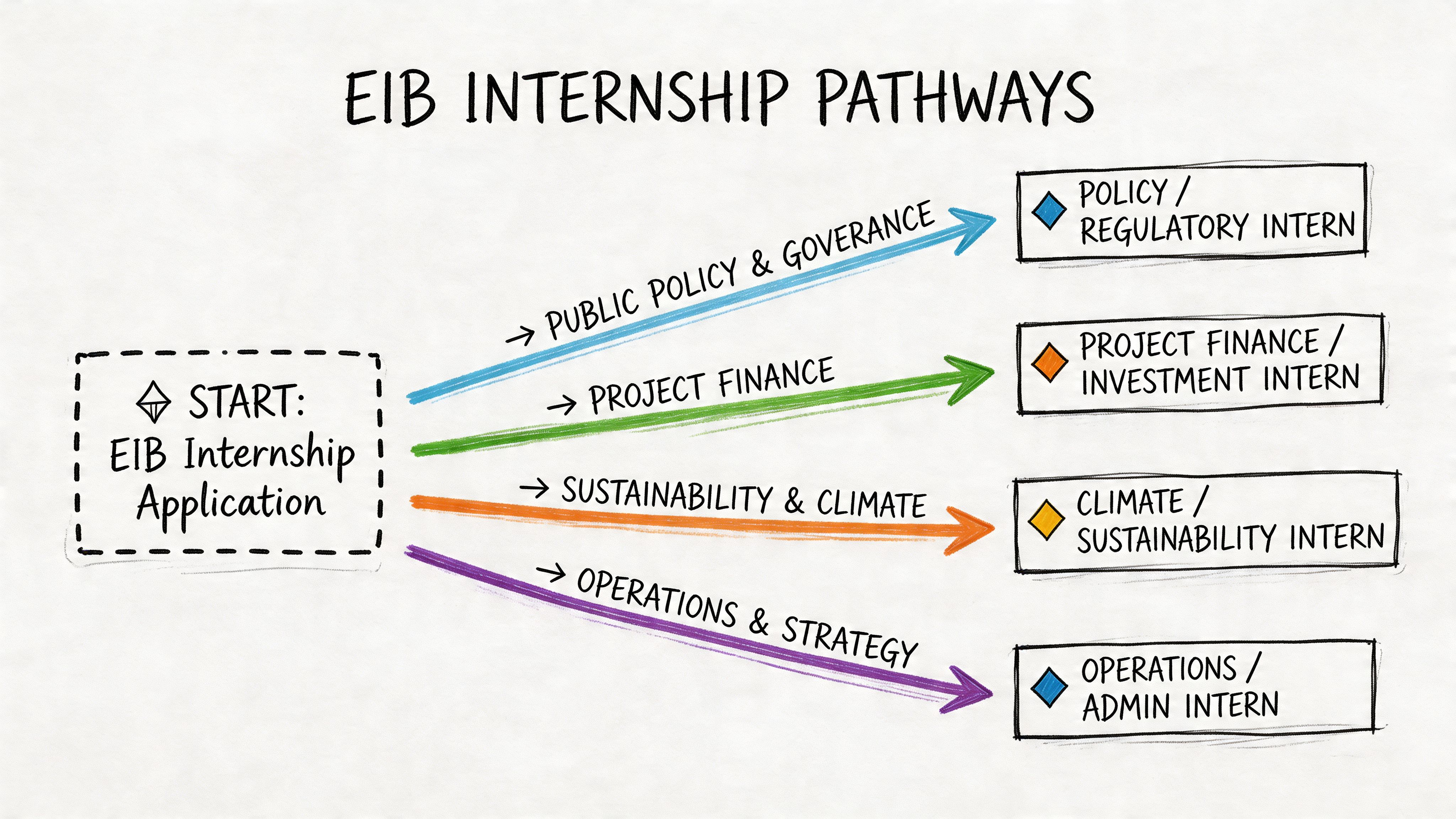
Getting the programme choice wrong is one of the fastest ways to waste a strong application. At the EIB, “traineeship” is not one uniform channel. It is a set of distinct entry routes, and each one rewards a different kind of fit.
The standard traineeship
This is the core programme most candidates mean when they refer to a European Investment Bank internship. It is usually Luxembourg-based, runs for a limited placement period, and pays a fixed monthly allowance.
Those basics matter less than one harder truth. The standard route is broad in visibility but narrow in fit. Reviewers are not looking for generic interest in European institutions. They are matching interns to teams that need usable research, drafting, modelling, policy support, or sector knowledge from day one.
That is why applicants should think in terms of business lines, not brand name. A candidate interested in project finance should read vacancies differently from someone aiming at legal, economics, climate, operations, or communications support.
The part many guides get wrong
Non-EU nationals are often told to treat the EIB as effectively closed. That is lazy advice.
The Bank has had specialised routes linked to partner regions, including MENA/ACP and FEMIP-related opportunities. These are not fallback options. For the right profile, they are the more rational target because they tie nationality, regional knowledge, language ability, and sector background to the Bank’s external mandate. The official EIB page on MENA/ACP traineeships gives the clearest starting point.
Smart positioning matters. If your background connects to North Africa, the Mediterranean, ACP markets, or external lending operations, say so in operational terms. Show how your knowledge helps a team assess counterparties, understand country context, or support projects in energy, infrastructure, private sector development, or blended finance. Do not write as if you are asking for an exception. Write as someone who fits a specific mandate.
A practical comparison
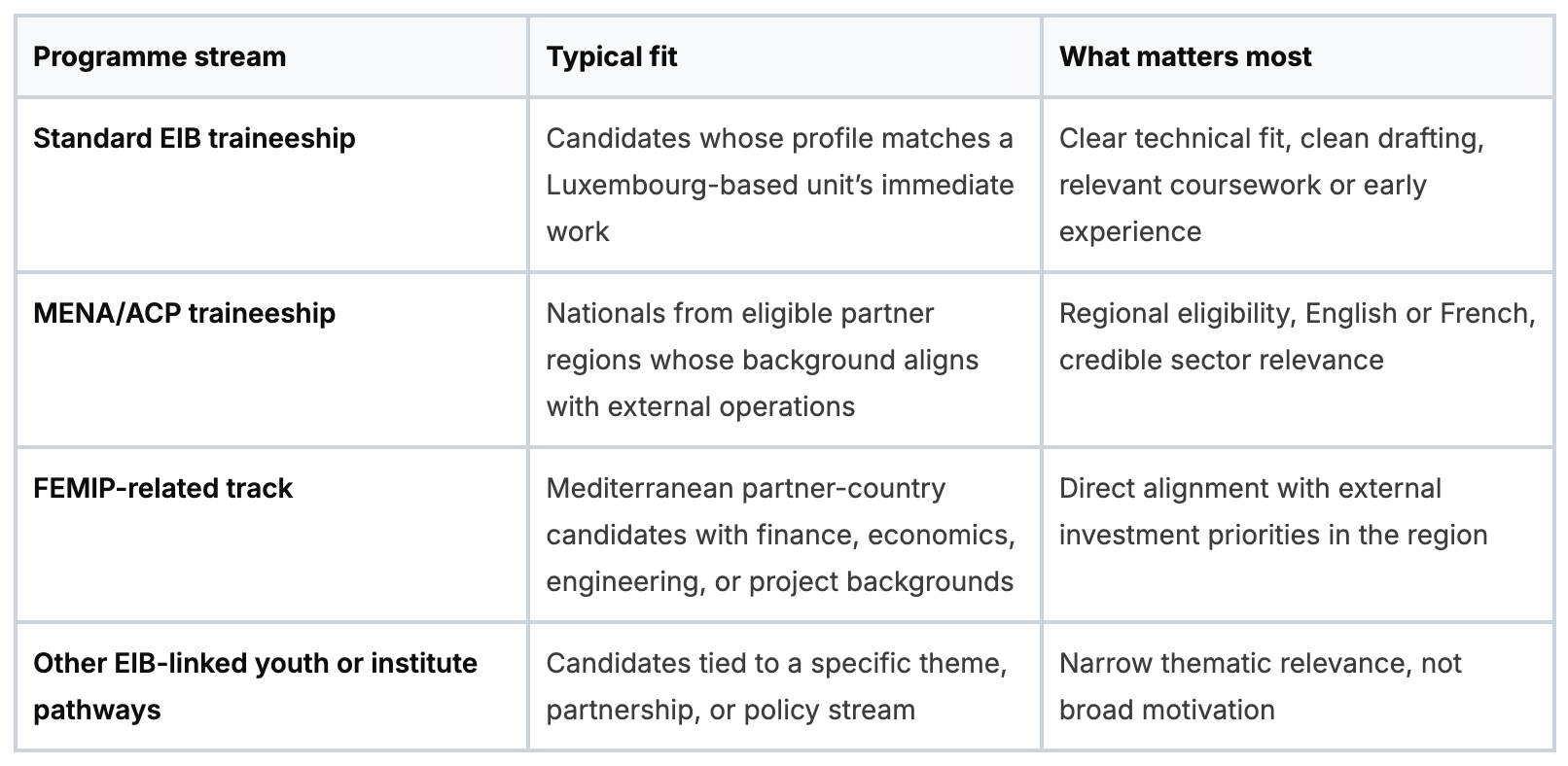
The trade-off is straightforward. The standard stream gives wider recognition and more volume. The regional routes can be less crowded by comparison, but only if your profile is aligned.
How strong candidates choose
Strong applicants start with placement logic. They ask where the Bank can use them.
Use this filter:
Standard traineeship. Best for applicants whose background maps cleanly onto a central EIB function in Luxembourg.
MENA/ACP or FEMIP-related routes. Best for applicants from eligible partner countries who can connect their regional profile to project work.
Dual-nationality cases. Present status clearly and choose the route that fits the formal rules and your strongest narrative.
Outside the listed pools. Put your effort into other EIB entry points or comparable MDB internships instead of forcing a weak fit.
I have seen capable applicants fail here because they wrote one generic application and tried to make it cover every stream. That approach rarely survives screening.
A better method is to build one target narrative per programme family. For the standard route, anchor your case in team function. For FEMIP or MENA/ACP, anchor it in mandate, region, and sector. If climate finance, energy transition, resilience, or the Bank’s growing security and defence-related financing work appears in the unit’s remit, bring that into your story with precision. Those priorities are shaping where attention goes, and candidates who can tie their background to them look easier to place.
For context on how another major institution structures intern hiring, this guide to the World Bank internship is a useful comparison. It helps clarify how MDBs separate broad prestige interest from actual programme fit.
The EIB rewards relevance. Broad enthusiasm is not enough.
Decoding Eligibility and Application Timelines
The EIB internship process is less forgiving than applicants expect. Strong candidates get screened out before anyone reads their motivation properly because they miss the right intake, choose the wrong programme family, or apply with an eligibility story that does not hold together.
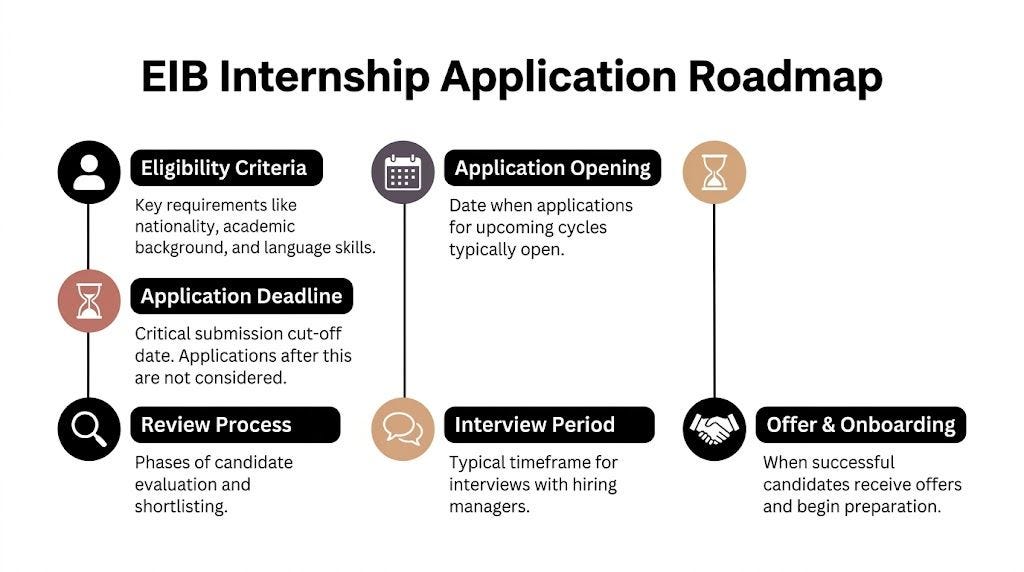
Treat this section as your single reference point for who can apply, through which route, and when to prepare.
The eligibility screen is stricter than the branding suggests
EIB traineeships are not one open pool. They are a set of routes with different eligibility logic. If you are an EU national or come from a recognised candidate-country pool, the standard traineeship route is usually the one to target. If you are a non-EU national, the relevant question is not “Can I apply anyway?” It is “Do I fit a specific regional or mandate-linked programme such as FEMIP or a MENA/ACP pathway?”
That distinction matters because screeners are matching formal eligibility first, then looking at whether your background fits a unit. A well-written application cannot fix a category mismatch.
Use this filter:
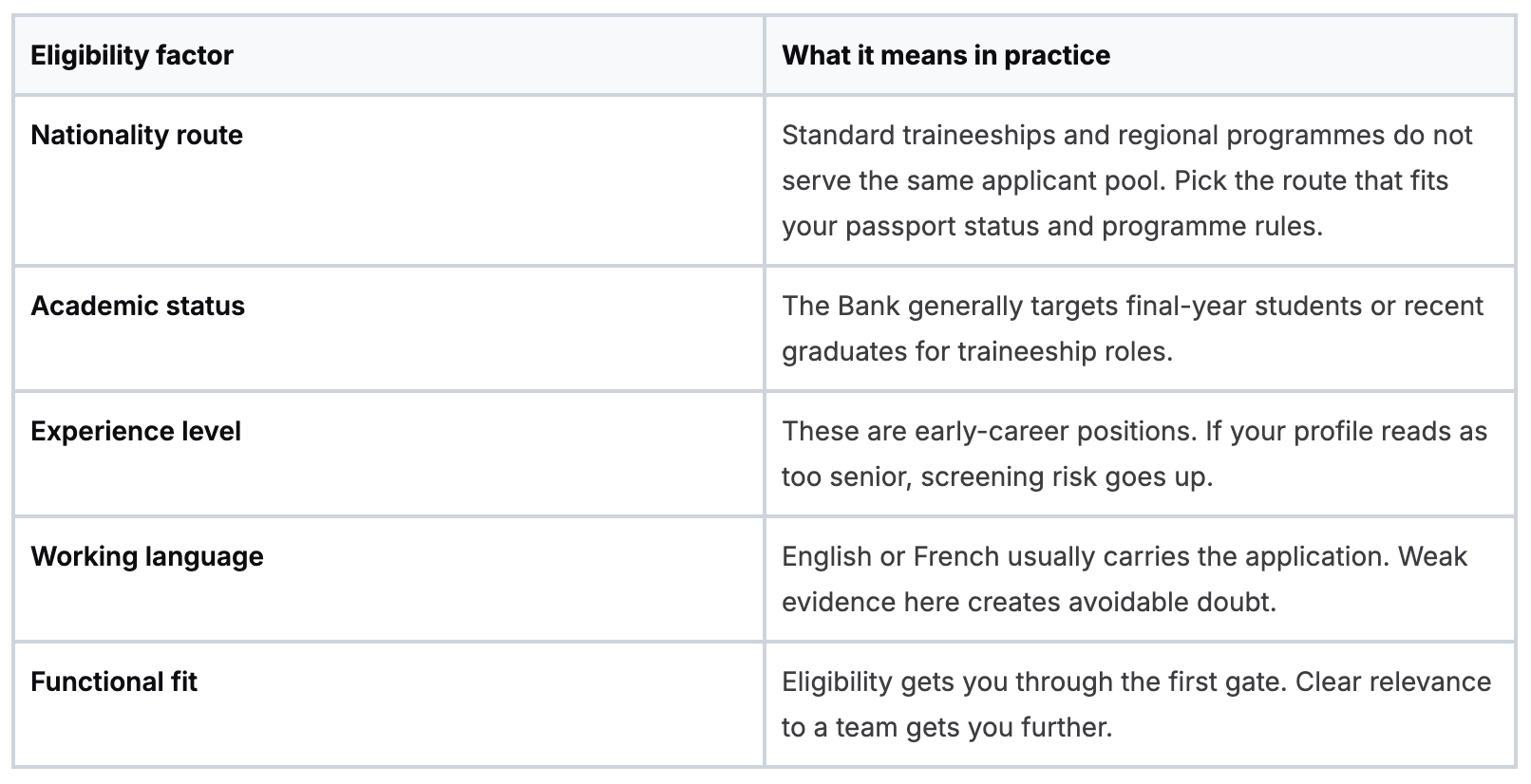
For non-EU nationals, many applications fail at this point. Candidates hear “European Investment Bank” and assume the door is closed, or they do the opposite and submit through the standard route with no valid basis. The better approach is to check whether your nationality and profile fit a regional stream, then build your case around the Bank’s mandate in that geography. For FEMIP, MENA, or ACP-related routes, regional knowledge is not a side note. It is often the reason your file gets a serious look.
Timelines are predictable enough to plan around
The EIB works on recurring intake cycles, not casual rolling hiring. Traineeships commonly start on 1 February and 1 September, with applications opening months earlier. That gives disciplined candidates a clear planning window.
I tell applicants to work backward from the start date, not forward from the vacancy post. The ones who wait for the portal to open usually rush the wrong things.
A practical calendar looks like this:
About five months before the intake. Decide which programme route you fit. Standard route and regional route applications should not use the same narrative.
About four months before the intake. Finalise your CV, transcript pack, language evidence, and nationality documentation.
As soon as the window opens. Apply while you still have time to review the file properly.
Right after submission. Prepare for interview questions on team fit, sector interest, and why the EIB rather than a generic EU institution.
Before the start date. Sort relocation, administrative documents, and a realistic plan for what you want to learn in the role.
This matters more than applicants think. The Bank’s hiring teams can usually tell who planned for the cycle and who assembled an application in a weekend.
The trade-off most applicants miss
Applicants often spend too much time proving they admire the institution and too little time proving they fit the intake and team. Screening does not reward broad enthusiasm. It rewards clean eligibility, clear timing, and a profile that can be placed with minimal friction.
That is especially true if your story touches current EIB priorities. Climate finance remains an obvious area of demand, but candidates should also pay attention to resilience, energy security, strategic infrastructure, and the Bank’s growing defence-related financing activity where relevant to the unit. If your background connects to those priorities, say so precisely. If it does not, do not force it.
A candidate with a credible climate, infrastructure, or public finance profile tied to the right intake has a real edge. A candidate with generic development language and unclear route selection usually does not.
Common mistakes that kill otherwise good applications
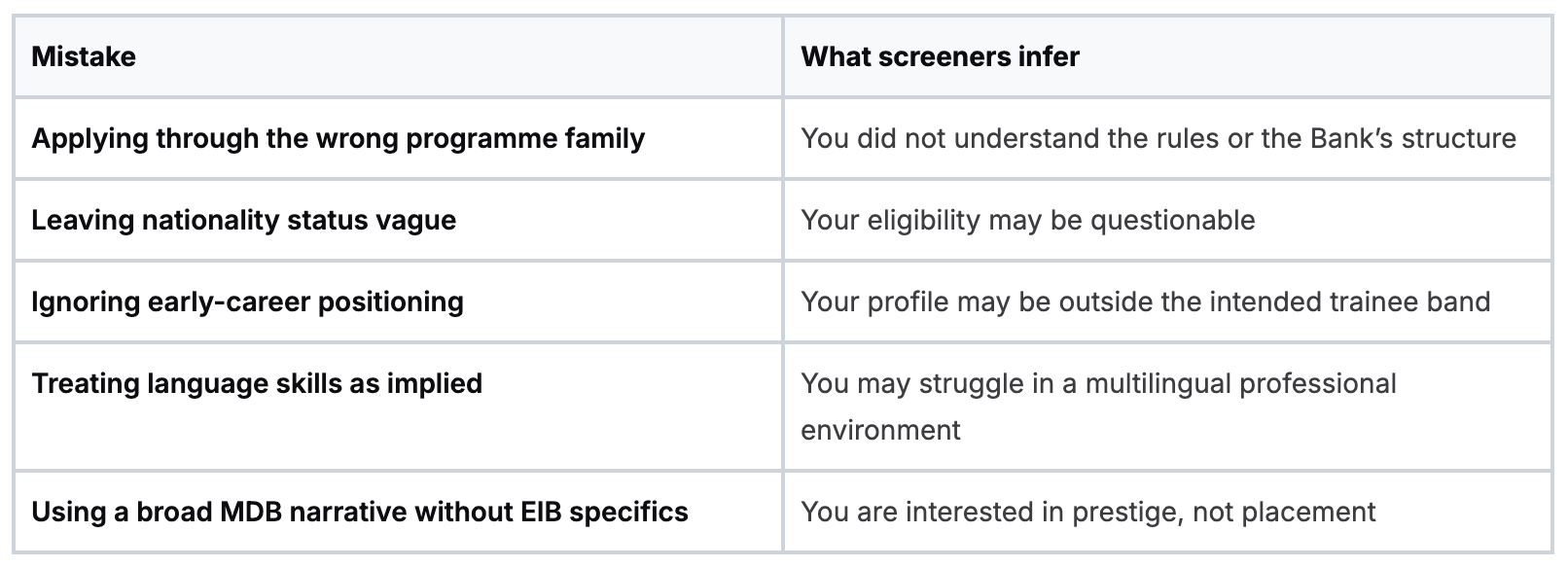
One more point. If you have worked with project monitoring, policy delivery, or donor reporting, describe it in language the Bank will recognise. A grounding in results-based management in development operations can strengthen your positioning for teams that care about implementation, performance, and measurable outcomes.
What to have ready before applications open
Prepare the file early and keep it factual:
A CV focused on one target business area
A short cover letter aligned to one programme route
Passport or nationality documents that make eligibility easy to verify
Academic records in a format an international recruiter can read quickly
Two or three examples of applied work in finance, economics, engineering, policy, climate, infrastructure, or project operations
That preparation does not make you more impressive. It makes you easier to hire. At this stage, that is what counts.
Crafting Your Resume and Cover Letter for the EIB
Most applicants write for HR. You need to write for the hiring unit.
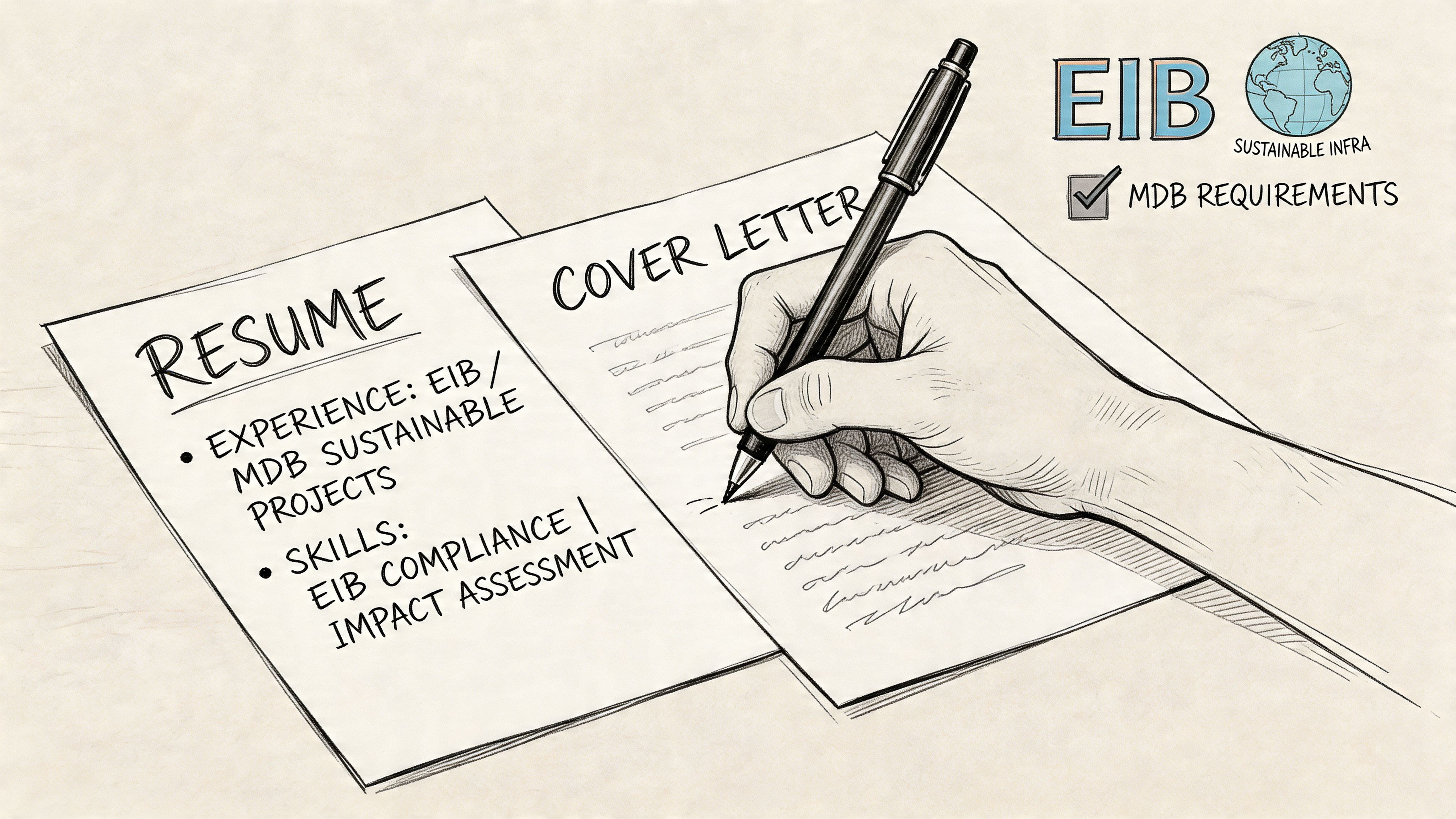
An EIB team wants to know whether you can support real work. That means your application materials should sound like they come from someone who understands project cycles, policy context, data, and stakeholder coordination. Generic “motivated student” language weakens you immediately.
Write for a mandate, not for admiration
Start with the unit’s likely problem set. If you’re applying to a team linked to infrastructure, climate, economics, risk, engineering, social policy, or project finance, your documents should reflect that language naturally.
Good EIB applications usually do three things well:
They frame academic work as applied work
They connect prior experience to institutional priorities
They show evidence of judgment, not just effort
That last point matters. Everyone worked hard. Recruiters want signs that you can think clearly.
Strong bullets versus weak bullets
Weak bullet:
Assisted professor with research on sustainability topics
Strong bullet:
Synthesized policy and financial research for a university project on sustainable investment, producing briefing materials used in seminar discussions with external stakeholders
Weak bullet:
Worked in team on infrastructure case study
Strong bullet:
Built part of a financing and risk analysis for an infrastructure case study, coordinating assumptions across a student team and presenting findings to faculty and practitioners
The difference is simple. The stronger version shows task, judgment, and output.
What your CV should emphasize
Your CV should foreground the parts of your background that map to EIB work. Focus on substance.
Use bullets that highlight:
Quantitative analysis such as financial modelling, economic analysis, data handling, or evaluation work
Policy exposure including EU policy, development policy, public finance, regulation, or sector studies
Project work across infrastructure, energy, climate, transport, SMEs, innovation, or social impact
Cross-cultural collaboration especially if you worked in multilingual or international settings
Writing under constraints such as memos, briefs, or client-ready presentation materials
If you’ve never had formal finance experience, use serious academic work, consulting projects, research assistant roles, think tank outputs, or public sector internships. Frame them as operational evidence.
The cover letter needs one argument
Your cover letter is not your autobiography. It should make one clean case: you have a profile that fits a specific EIB team and you understand the bank’s mandate.
Use a simple structure:
Opening fit statement Identify the function or theme you are targeting and why your background matches it.
Evidence paragraph Give two or three examples from coursework, internships, research, or technical work.
Institutional alignment Show that you understand the EIB works where finance and public purpose meet.
Closing Keep it short. Signal readiness to contribute.
Good cover letters feel selective. Bad ones read like they were sent to six institutions in one afternoon.
Use MDB language carefully
You don’t need to sound bureaucratic, but you do need to sound literate in MDB work. Concepts like project preparation, implementation, results, policy alignment, and development impact should appear where relevant and in plain English.
If you need a quick grounding in how institutions frame performance and outcomes, this results-based management explainer is useful because it helps you describe your work in terms that multilateral employers recognize.
What to cut immediately
Remove these from your draft:
Soft claims without evidence such as “excellent communication skills”
Mission clichés like “I have always dreamed of changing the world”
Laundry lists of coursework unless directly relevant to the role
Overlong intros that delay the point
Copy-pasted institutional praise that any applicant could use
Your aim is credibility. Credibility comes from precision.
Acing the EIB Interview Process
The interview usually exposes a basic problem. Many candidates have the credentials, but they don’t know how to talk about them in an institutional context.
That’s why a good EIB interview answer sounds different from a good private-sector internship answer. You’re not trying to come across as fast, hungry, and commercially polished. You’re trying to show that you can think carefully, communicate clearly, and support a mandate-driven team.
Expect three layers of questions
Most EIB interviews for traineeships will revolve around a mix of these themes:
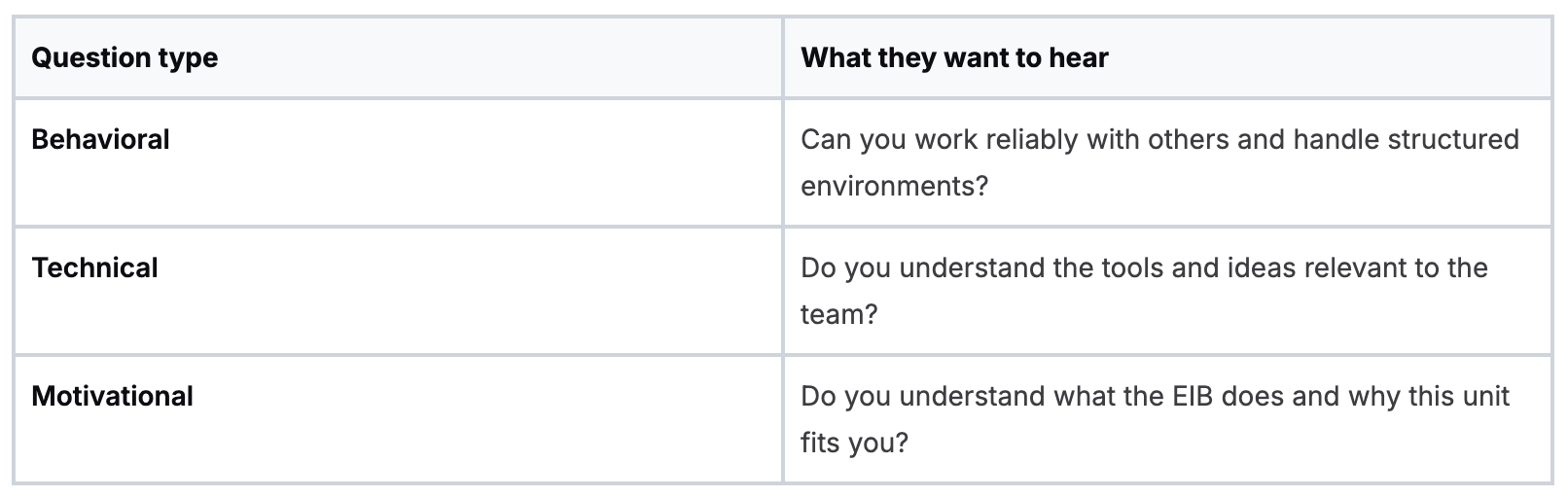
Don’t memorize canned answers. Build strong examples instead.
Use a development-finance version of STAR
The basic STAR structure still works, but adapt it.
Situation. Keep the context brief and relevant.
Task. State the actual problem or responsibility.
Action. Focus on your reasoning, not just your effort.
Result. Describe the output qualitatively if you don’t have hard numbers.
Relevance. Add one sentence connecting that example to EIB work.
That final step is where many candidates fail. They answer the question but never tie it back to the job.
Here’s a stronger way to close an answer: “I learned how to structure incomplete information, align with different stakeholders, and produce a concise recommendation. That’s directly relevant to a traineeship in a bank where policy, analysis, and execution have to line up.”
Prepare for strategic-priority questions
The EIB’s current direction matters in interviews. Official materials and recent institutional signals point toward a stronger emphasis on climate, sustainability, innovation, and defence, and applicants should be ready to explain how their skills fit those priorities, including themes in the bank’s 2024-2026 work programme such as gender strategy and non-EU bioeconomy support, as noted on the EIB traineeships overview page.
That doesn’t mean every interview will ask directly about defence or bioeconomy. It does mean you should be able to answer a question like this without drifting:
Why are you interested in the EIB at this moment?
How does your background connect to climate or sustainability?
What type of projects or policy themes interest you most at the bank?
How would you contribute to a team working on innovation, infrastructure, or impact-related priorities?
Your answer should show that you follow institutional priorities and can map your skills onto them. General enthusiasm for Europe won’t do the job.
Questions worth rehearsing
Try these before the interview:
Tell us about a time you had to analyze a complex issue with incomplete information.
Describe a project where you worked across different disciplines or stakeholder groups.
Why this team, rather than the EIB in general?
What does high-quality support look like in a multilateral institution?
Which current EIB priority areas connect most closely to your experience?
You do not need perfect answers. You need clear, grounded answers.
What works in the room
Strong candidates usually do four things well:
They answer directly first, then elaborate
They use specific examples, not abstract traits
They show institutional curiosity, not just self-interest
They stay measured, especially on policy-linked topics
A common mistake is trying to sound more senior than you are. Don’t. Trainee interviews aren’t looking for finished experts. They’re looking for people who can contribute without creating friction.
From Intern to Staff Your Strategic Roadmap
The internship itself is only half the game. The other half is what you do with the access.
A traineeship gives you proximity to teams, managers, workflows, and institutional language. If you use that well, the EIB brand can become a serious career asset. If you drift through the placement doing assigned tasks politely, you’ll leave with a line on your CV and not much else.
How to perform like someone they remember
You do not need to be loud. You need to be dependable and useful.
Focus on a few habits:
Turn work around cleanly Meet deadlines, write clearly, and make your manager’s life easier.
Understand the chain of purpose Know where your task fits in the wider unit workflow.
Ask better questions Good questions show judgment. Bad questions show you haven’t read the material.
Track your contributions Keep a private record of outputs, topics, and lessons while they’re fresh.
That last habit will save you later when you need to interview for your next role.
Network with intent
A lot of early-career candidates misunderstand networking in MDBs. The goal is not to collect coffee chats. The goal is to build a small number of credible professional relationships.
Try this approach:
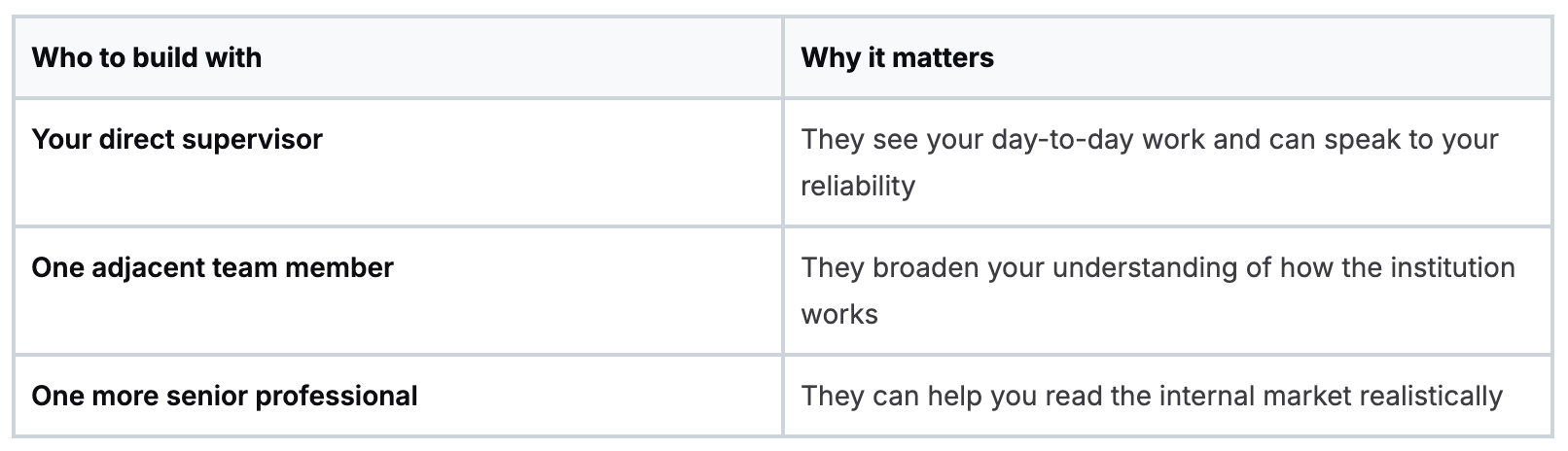
Ask about work, team needs, hiring patterns, and skills gaps. Don’t open with “how can I get a job here.”
The trainees who stand out usually combine humility with usefulness. They learn fast, deliver clean work, and stay easy to work with.
Think beyond one institution
Some applicants get too fixated on converting directly to EIB staff status. That can happen, but you shouldn’t build your whole plan around it, especially because public information does not clarify conversion rates or post-traineeship retention in the specialized streams discussed earlier.
Treat the internship as part of a wider MDB strategy. Use it to position yourself for analyst roles, consultant opportunities, junior professional pathways, or later EIB openings. If you want to monitor that market in a structured way, the European Investment Bank careers guide is one useful reference point for understanding how EIB roles fit into the broader multilateral hiring environment.
Build your post-internship package
Before the traineeship ends, leave with these assets:
A refined narrative about what you worked on and what you learned
Writing samples or sanitized work evidence where permitted
Updated references from people who know your work
A clear target list of next-step roles across MDBs and related institutions
That’s how you turn an internship into momentum rather than nostalgia.
If you’re serious about building a career in development finance, Multilateral Development Bank Jobs is a practical way to track internships, consultant roles, and full-time openings across MDBs in one place. It’s especially useful if you want to compare the EIB with institutions like the World Bank, ADB, AfDB, AIIB, and IMF instead of planning your career one vacancy at a time.