

You’re probably looking at jobs across the World Bank, regional development banks, donor agencies, and consulting firms, and a lot of them sound maddeningly similar. Same buzzwords. Same sectors. Same promises about impact. Then you hit the application questions and realize the institutions are solving different problems in different ways.
That difference starts with how aid money moves.
If you understand the difference between bilateral and multilateral aid, you stop reading development jobs as generic “international affairs” roles. You start seeing who controls the money, who sets the rules, why certain project teams exist, and why one employer wants a diplomat while another wants a project financier who can survive three layers of board review and procurement scrutiny.
For anyone targeting an MDB career, this is practical intelligence. It tells you where the institution sits in the aid system, what kind of projects it tends to run, and which skills hiring managers trust.
Why Aid Structure Is Your Secret Weapon in the MDB Job Hunt
Most candidates treat aid architecture like background theory. That’s a mistake.
Aid structure shapes the day-to-day reality of development work. It determines whether a project is designed around one donor’s foreign policy priorities or around a negotiated mandate shared by many member states. It affects project scale, approval processes, reporting lines, procurement standards, and the balance between political visibility and technical rigor.
For job seekers, that changes everything. A bilateral agency often values people who understand a specific donor government’s priorities, language, compliance rules, and diplomatic posture. An MDB usually hires for a different operating model. It needs people who can work across nationalities, handle shared governance, and manage projects that are built to outlast one electoral cycle.
Why this matters in hiring
When recruiters scan your CV, they’re trying to answer a simple question. Do you fit the institution’s funding logic?
If your background shows sharp technical skills but all your examples are framed around serving one government’s agenda, you may look stronger to a bilateral agency than to a multilateral bank. If your experience shows coalition building, standardized project systems, sovereign operations, and comfort working across member-state interests, you’ll read as more credible for MDB roles.
A quick comparison makes the point clear:
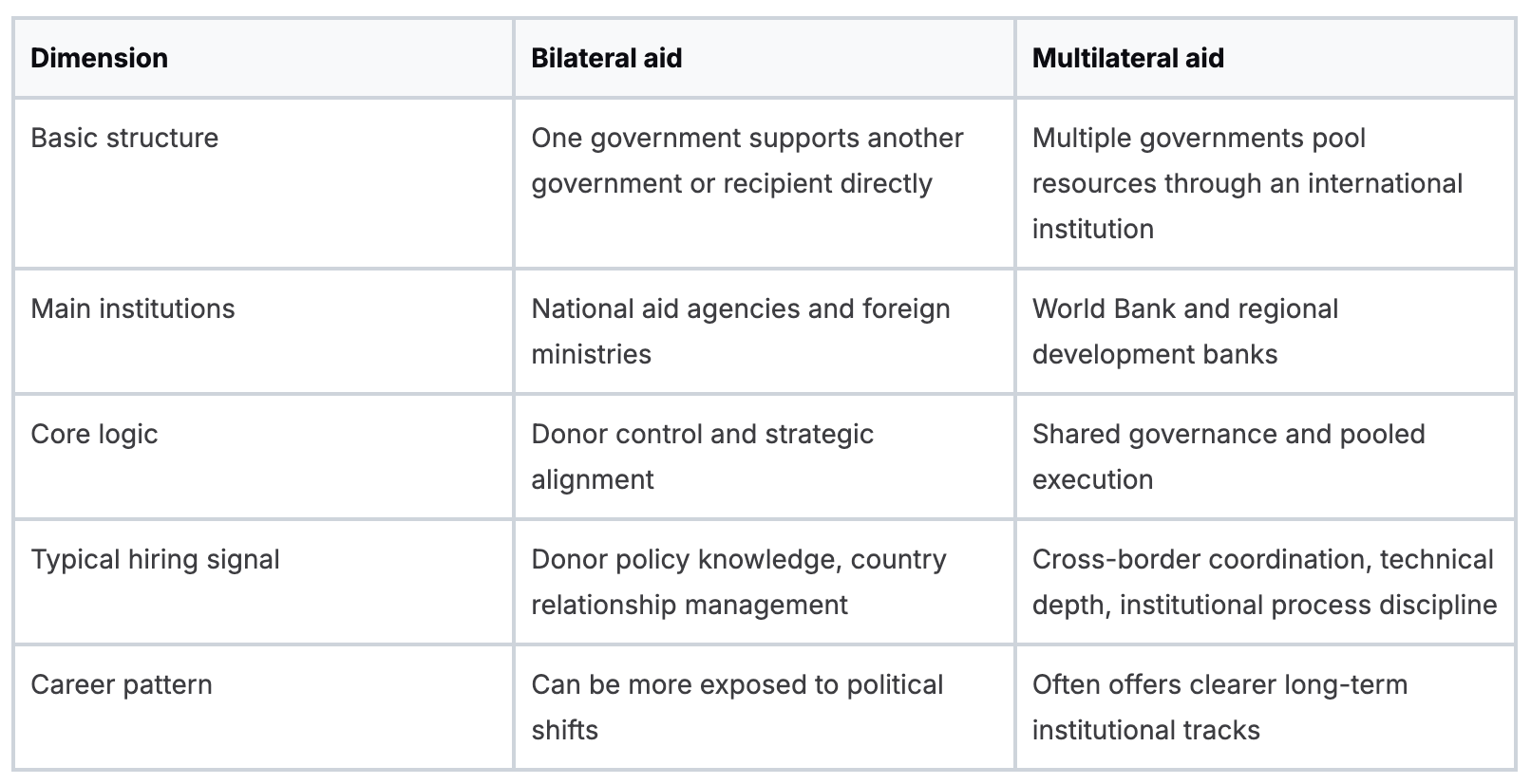
What works: reading job descriptions through the funding model behind the institution.
What doesn’t: treating all development employers as if they hire for the same mix of skills.
The career edge most applicants miss
Candidates who understand aid structure write better applications. They choose better examples. They explain their experience in language the institution recognizes.
That’s the edge. Not theory. Positioning.
Bilateral Aid The Direct Approach
A minister wants visible results before the next budget cycle. A donor agency wants the funding tied to its foreign policy priorities, its reporting rules, and its name on the program. That is bilateral aid.
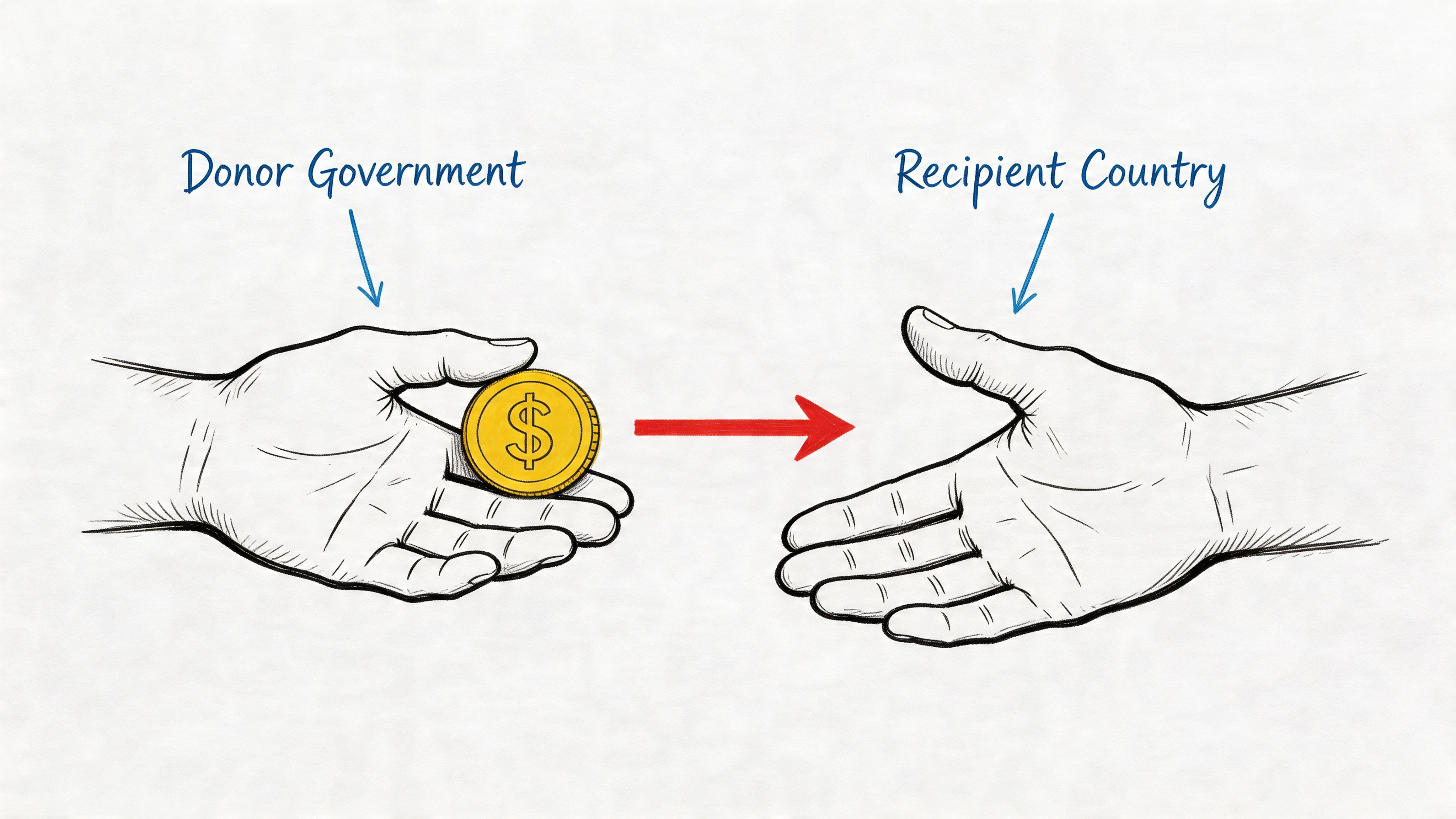
Bilateral aid means one government funds another government directly, or works through contractors, NGOs, and trust-managed mechanisms while retaining clear control over the money and the policy intent behind it.
Agencies such as USAID, FCDO, and JICA operate this way. The donor government appropriates funds, sets spending priorities, defines eligible uses, and measures performance against its own objectives. In practice, that often ties aid decisions closely to diplomacy, security interests, trade relationships, domestic politics, or historical links.
How bilateral aid usually operates
The operating model is direct, but it is not simple for the people running it.
The donor sets the terms. Priority countries, sectors, procurement rules, safeguards, and reporting lines usually reflect the donor’s own system.
Speed can be higher on targeted priorities. Bilateral channels are often used when a government wants quick action on a specific reform, crisis, or political relationship.
Visibility matters. Branding, attribution, and ministerial accountability often carry more weight than they do in pooled institutions.
Course correction can happen fast. A change in government, a diplomatic dispute, or a new cabinet priority can reshape a portfolio quickly.
That last point matters for careers. Bilateral aid can put professionals closer to decision-makers, but it can also expose teams to sharper political turns.
Where bilateral aid tends to show its strengths
Bilateral funding is often strongest where a donor wants a short line between policy intent and delivery. Humanitarian response is one example. Support linked to migration pressures, fragile-state politics, or a highly strategic country relationship is another.
The pattern is familiar across development practice. Where timing, national interest, or public visibility is central, donor governments usually prefer tighter control.
What this means for your career
This structure produces a distinct kind of job.
In bilateral roles, staff often spend more time on policy briefing, donor compliance, intergovernmental relationship management, partner oversight, and fast translation of political direction into program choices. Technical skill still matters, but it is rarely enough on its own. Strong performers can read the donor’s priorities early, shape programs that fit them, and protect implementation quality under pressure.
For someone targeting an MDB career, this distinction is useful. Bilateral experience can be a strong asset if it shows judgment, government-facing credibility, and execution under real political constraints. But the strongest signal is usually not just “I managed aid funds.” It is “I handled donor priorities, country realities, and delivery trade-offs without losing control of the program.”
That is the practical value of understanding bilateral aid. It tells you what the institution is built to do, and what kind of operator it tends to reward.
Multilateral Aid The Pooled Powerhouse
A transport corridor project that crosses three countries, requires sovereign lending, triggers environmental and social review, and needs twenty years of policy follow-through usually does not sit well in a single-donor model. It fits the multilateral model.
Multilateral aid pools money from multiple governments and channels it through a shared institution with its own mandate, governance, policies, and operating systems.
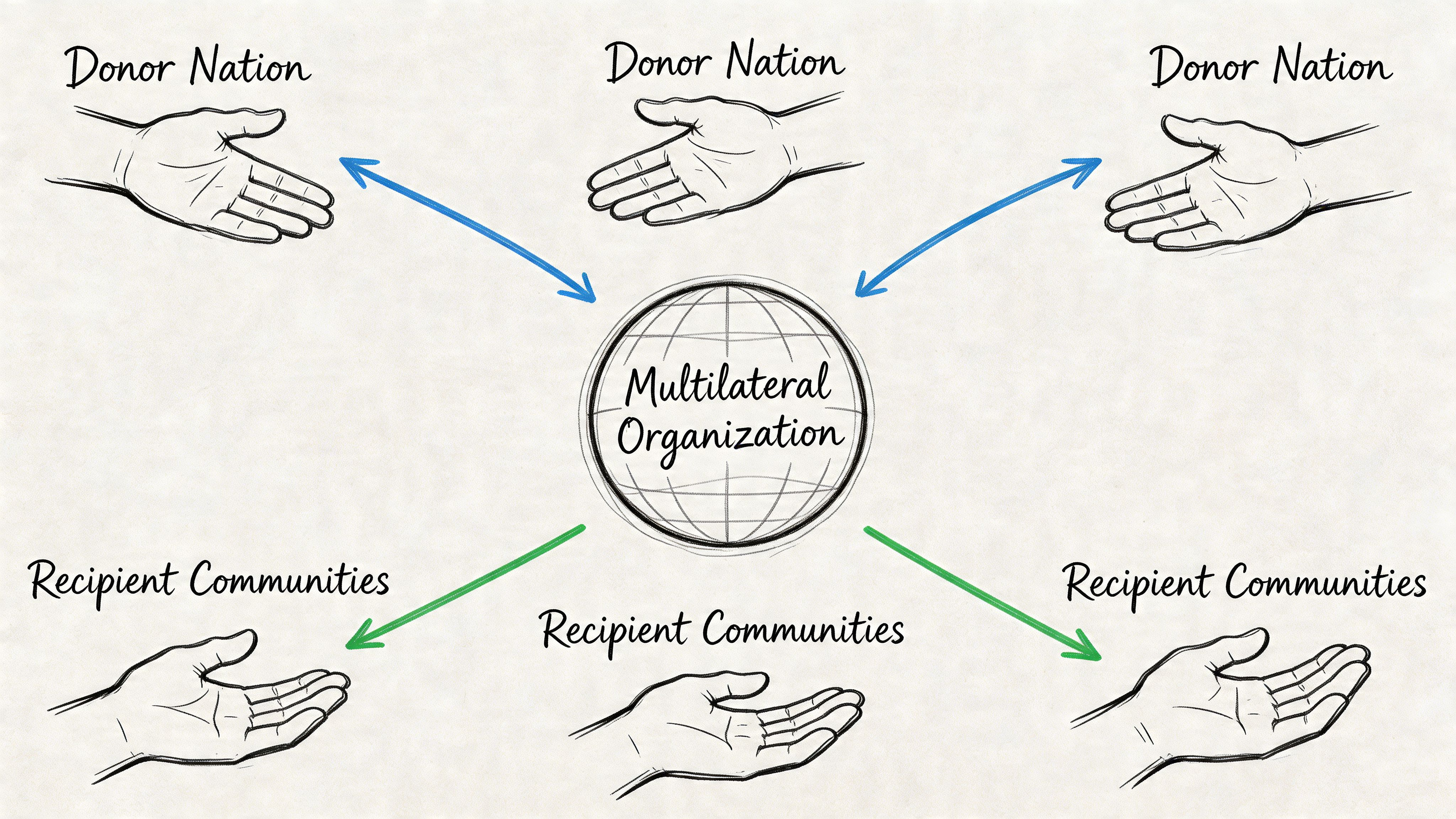
That is the world of the World Bank, Asian Development Bank, African Development Bank, and other MDBs. These institutions sit between contributors and borrowers or beneficiaries, but their role is much broader than fund transfer. They apply appraisal standards, fiduciary controls, environmental and social safeguards, procurement rules, supervision systems, and board-approved country or sector priorities.
Why the pooled model matters
Pooling money changes how decisions get made and what kinds of operations become possible.
No single donor can direct every choice. Member states influence strategy through boards and replenishment negotiations, management sets operational expectations, and staff work inside institution-wide rules. That can slow approval and create more layers of review. It also allows MDBs to finance projects and reform programs that need scale, neutrality across donors, and staying power beyond one government’s political cycle.
The multilateral channel has grown. Between 2010 and 2019, total official development assistance channeled through the multilateral development system rose by 35%, increasing from USD 53 billion to USD 73 billion, according to the OECD report on comparing multilateral and bilateral aid.
For job seekers, that structure matters because it shapes the work itself. MDB roles are built less around representing one donor’s priorities and more around converting collective mandates into bankable, supervisable operations.
Why MDBs hire differently
This funding model produces a distinct professional profile.
MDBs look for people who can handle institutional process without losing sight of development results:
Work inside shared governance: Staff answer to country counterparts, management, technical reviewers, legal teams, procurement specialists, safeguard functions, and member-state oversight.
Design operations that can survive scrutiny: Large projects must hold up across economic analysis, implementation readiness, fiduciary review, and environmental and social requirements.
Operate across countries and sectors: Regional integration, cross-border infrastructure, financial systems, and public sector reform fit naturally in a multilateral institution.
Manage trade-offs over time: MDB work often involves slower preparation in exchange for larger financing, stronger controls, and a better chance of sustaining reform after approval.
This is one of the biggest career differences between bilateral and multilateral aid, and it is often missed in academic summaries. In an MDB, strong candidates are rarely judged on technical knowledge alone. They are judged on whether they can move a complex operation through the institution without losing counterpart trust, compliance discipline, or implementation momentum.
The practical takeaway
Multilateral aid creates more process, more stakeholders, and more institutional discipline. It also gives staff access to larger financing packages, system-level reform work, and projects that shape how ministries, utilities, and financial systems operate for years.
For an MDB career, that means the winning profile is usually a mix of technical depth, patience with procedure, and sound judgment in coordination-heavy environments.
In MDB hiring, process discipline is part of the job. Anyone who dislikes layered review, formal clearance, and sustained stakeholder management will feel that pressure quickly.
Key Differences A Side-by-Side Breakdown
A hiring manager at an MDB and a hiring manager at a bilateral agency can look at the same CV and value very different things. One may care most about whether you can align work to a donor government’s priorities. The other may care whether you can get a difficult operation through review, satisfy multiple stakeholders, and keep the client relationship intact while the process gets heavier.
That is why aid structure matters in the job market. It does not just shape financing. It shapes authority, incentives, risk tolerance, and the kind of staff each institution rewards.
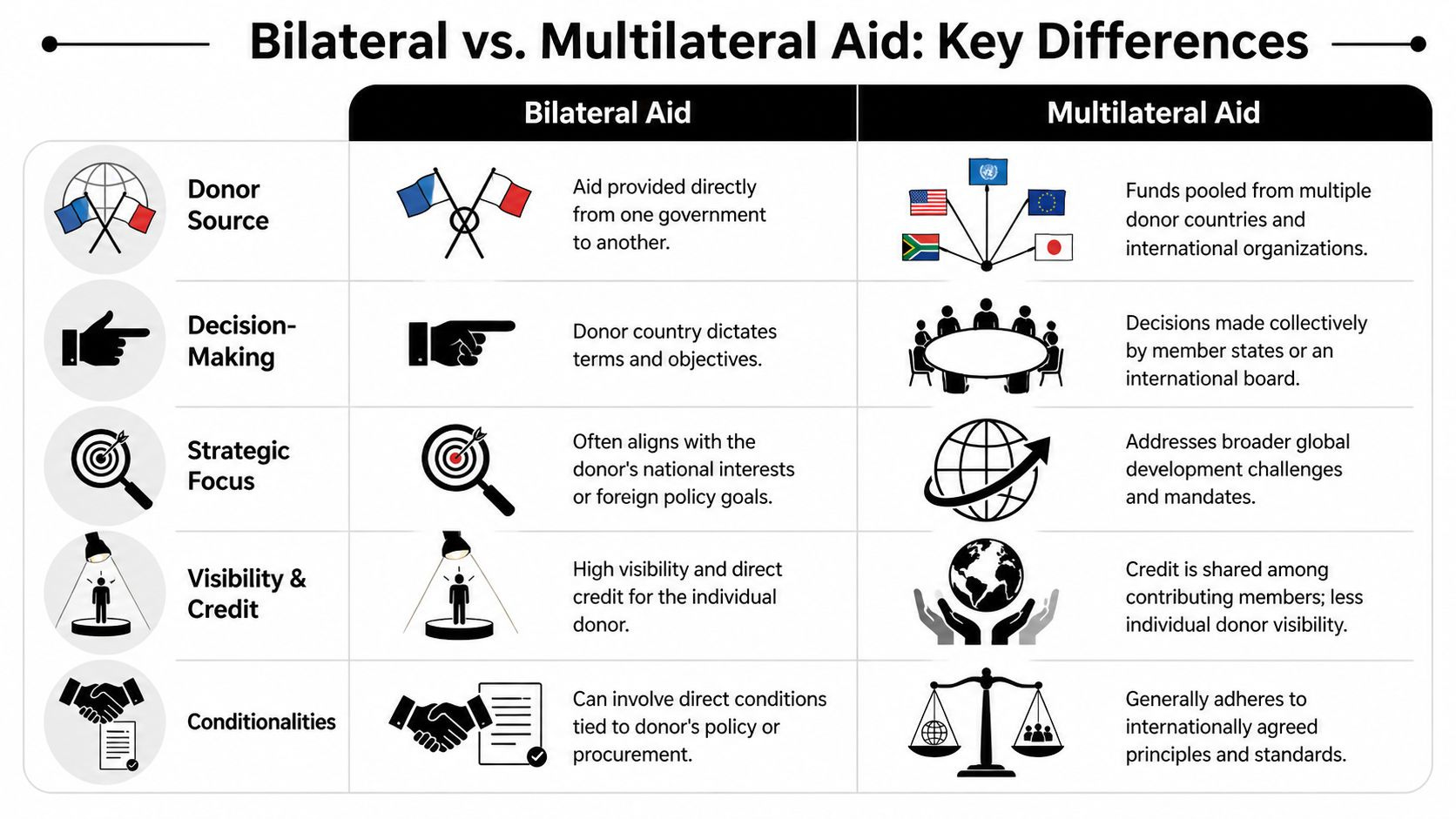
Core comparison
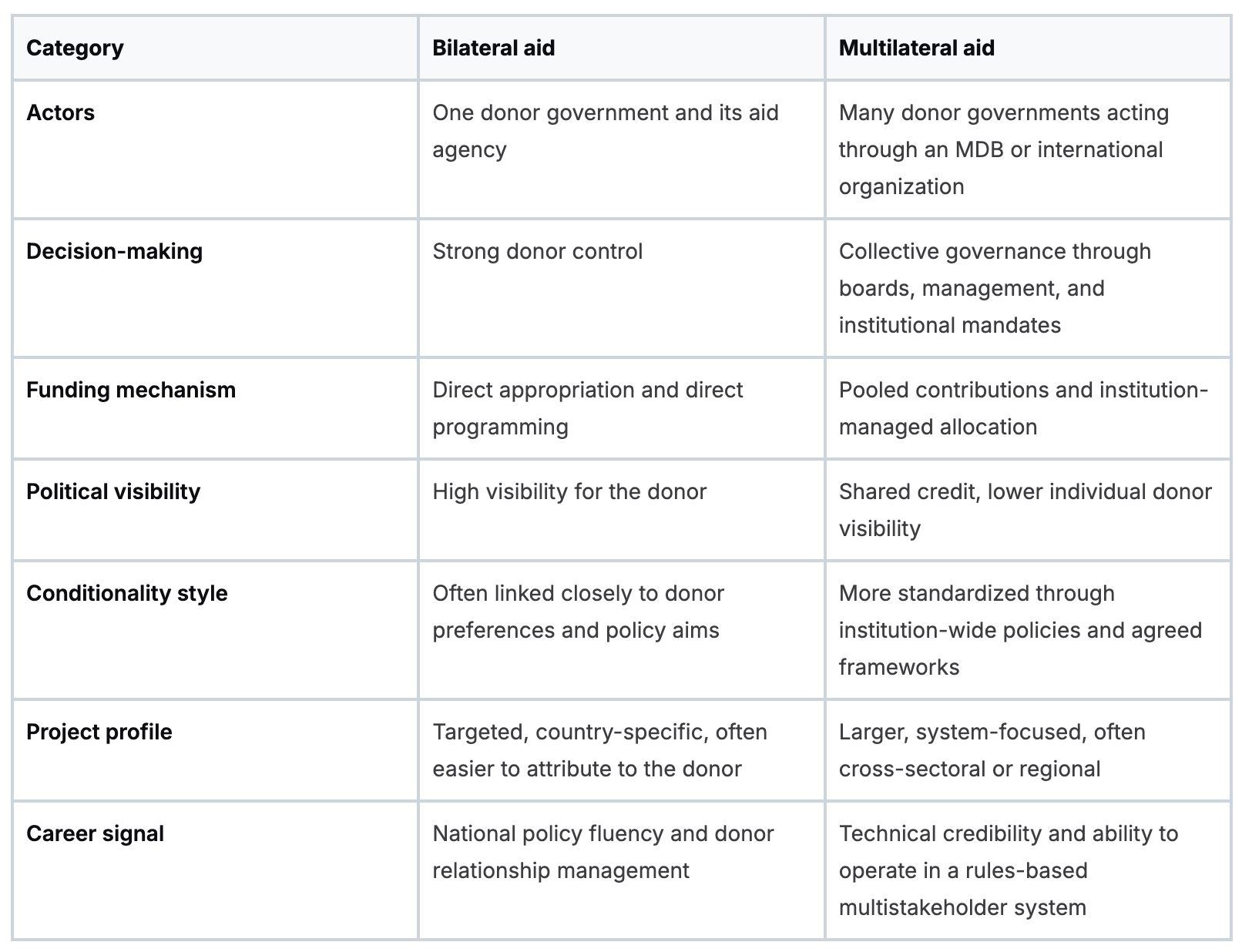
Authority, pace, and career fit
The clearest difference is who has room to decide.
In bilateral aid, the line from political leadership to program choices is usually shorter. Priorities can shift fast after an election, a diplomatic event, or a budget change. For staff, that often means tighter alignment with donor strategy, quicker repositioning, and more pressure to show visible results that matter back home.
In multilateral aid, authority is spread across country frameworks, management processes, legal requirements, and board oversight. That slows some decisions, but it also creates a more stable operating frame. MDB employers tend to reward people who can handle review cycles, write clearly, anticipate objections, and keep a project moving without forcing shortcuts.
That is a different professional profile.
Sector patterns reflect institutional design
The sector mix also follows the structure. As noted earlier, bilateral donors are often more active where direct control, speed, or national visibility matter. Multilateral institutions are often stronger in budget support, large infrastructure, public systems, and other areas where pooled finance and institutional discipline matter more than donor branding.
For job seekers, this has practical consequences. If you want roles tied to public financial management, sovereign lending, infrastructure preparation, or institution-wide results-based management in development operations, multilateral experience usually travels better. If your strength is donor policy positioning, external affairs, or highly targeted country programming, bilateral experience can be a stronger fit.
Accountability changes what good performance looks like
A bilateral agency answers first to its own government, legislature, taxpayers, and foreign policy system. That creates real pressure for attribution, visibility, and strategic coherence with national priorities.
An MDB answers through institutional governance to a wider membership. Staff still face political pressure, but it is less concentrated and more procedural. The test is often whether the team can satisfy institutional standards, protect fiduciary integrity, manage borrower relationships, and maintain support across internal reviewers and shareholders.
Who gets blamed when things slip, and who gets credit when they work. That is not a small distinction. It affects how jobs are scoped, how managers judge performance, and what kind of judgment gets promoted.
In bilateral settings
Donor fluency matters: Strong staff understand the donor’s policy language, approval culture, and reporting expectations.
Alignment is a core skill: Teams are expected to show how a program serves defined political and development priorities.
External communication carries weight: Visibility, diplomacy, and relationship management can shape career progression.
In multilateral settings
Institutional handling matters: Staff need to move work through reviews, comments, and cross-functional clearance processes.
Technical arguments face scrutiny: Subject expertise has to stand up to economists, lawyers, safeguards staff, procurement specialists, and management.
Coalition-building is part of delivery: Progress often depends on getting multiple internal and external actors to support the same deal.
Practical rule: If a vacancy emphasizes member states, board engagement, sovereign operations, safeguards, or cross-country coordination, treat it as a role that will reward MDB-style operating skills, even if the technical sector looks familiar.
What each model does well, and where each struggles
Bilateral aid tends to work best when the objective is politically important to the donor, tightly defined, and time-sensitive. It can struggle when portfolios become fragmented or when donor preferences narrow the space for longer-term system reform.
Multilateral aid tends to work best when financing needs are large, risks need to be shared, and the project requires institutional credibility beyond one government’s bilateral reach. It can struggle when process gets too heavy or when broad consensus weakens accountability for hard decisions.
For anyone targeting an MDB career, this comparison is not academic. It is a guide to fit. The better you understand the operating logic, the easier it is to read job descriptions accurately, position your experience, and build the skills that multilateral employers pay for.
How Aid Type Shapes Projects on the Ground
You can see the difference clearly by comparing two energy projects.
A bilateral donor funds a rural electrification program in one country. The goal is visible access expansion, fast deployment, and a strong donor-country partnership story. The program team spends a lot of time aligning with the donor’s priorities, handling donor reporting, and making sure the implementing setup matches the donor’s procurement and oversight requirements.
An MDB backs a cross-border power interconnection project. The work is slower upfront and heavier on preparation. Teams have to coordinate across governments, lenders, technical specialists, safeguards experts, legal teams, and procurement staff. Success depends less on one donor getting visible credit and more on whether the institution can hold a complex regional deal together.
The bilateral project reality
In the bilateral version, the donor may favor contractors or advisers with strong familiarity with that donor’s systems. The project can be highly effective when the objective is tightly defined and politically supported.
But the project logic usually stays close to a single-country frame. Even when the technical issue is broader, execution often reflects the donor’s own risk appetite, timeline, and diplomatic incentives.
The multilateral project reality
In the MDB version, the institution acts as a platform. The team has to define results in a way that multiple stakeholders can accept, supervise implementation through common procedures, and maintain discipline across a longer project cycle.
That’s why tools like results-based management in development operations matter so much in multilateral work. MDB teams are constantly linking financing, outputs, supervision, and institutional accountability. If you don’t understand how results frameworks shape project design, you’ll miss how these institutions operate.
A lot of applicants say they want “impact.” Far fewer can explain how financing structure changes procurement, safeguards, supervision, and the definition of success.
What professionals learn fast
On the ground, funding source changes the texture of the work:
Procurement culture: Bilateral projects may reflect donor-specific preferences. MDB projects lean on standardized institutional procedures.
Stakeholder map: Bilateral teams often manage a narrower political chain. Multilateral teams manage broader and messier coalitions.
Time horizon: Bilateral funding can support quicker, more targeted interventions. MDB operations often suit reforms and infrastructure that need institutional staying power.
Consultant profile: Bilateral work may reward donor familiarity. MDB assignments often favor people who can function across countries and systems.
If you’ve worked in one model and are applying into the other, you must carefully translate your experience. Hiring managers want proof that you understand the operating environment, not just the sector.
How This Shapes Your MDB Career Path
If your goal is to build a career inside an MDB, the funding model matters more than the job title.
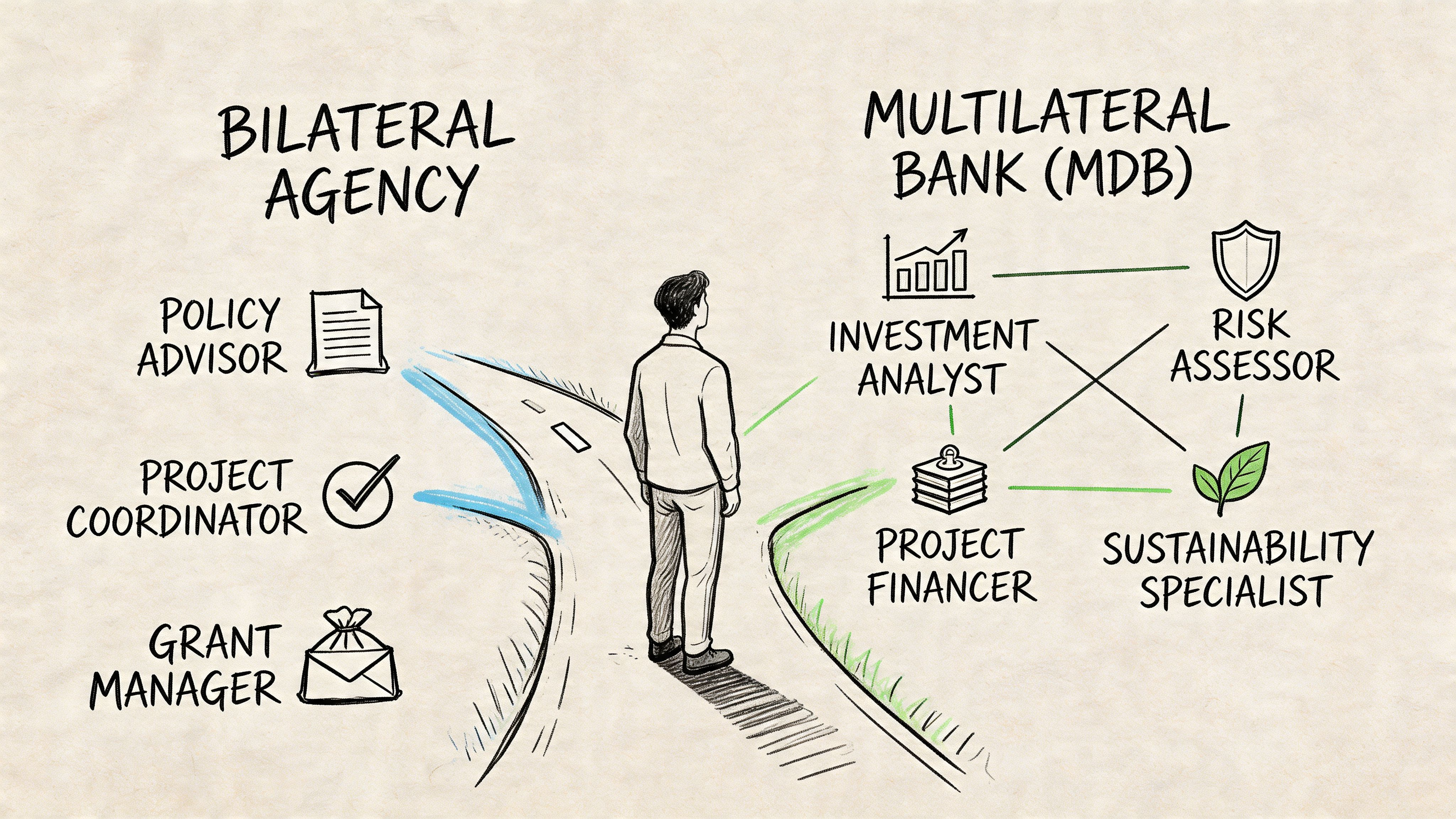
Multilateral institutions hire for a machine that is more procedural, more multinational, and more technically demanding than many candidates expect. They want people who can operate inside that machine without freezing it up.
The core MDB skill set
The strongest MDB candidates usually show a mix of the following:
Technical specialization: Energy, transport, health financing, public financial management, private sector development, safeguards, procurement, economics, or another hard domain.
Cross-cultural operating ability: You need to work credibly with governments, colleagues, and consultants from different countries and institutional cultures.
Institutional stamina: Review processes, quality assurance, board timelines, and implementation supervision are part of the job.
Negotiation without drama: MDBs value people who can reconcile interests smoothly and keep a project moving.
This is why many candidates with broad international enthusiasm but weak technical positioning struggle in MDB recruitment. Interest in development is assumed. Institutional usefulness is what gets tested.
Where many people enter
There are staff tracks, including structured early-career pathways, and there are consultant routes. A lot of people focus only on flagship entry programs and miss the consultant ecosystem built around trust funds, project preparation, supervision support, and analytical work.
That blind spot matters because multi-bi aid is rising. That means bilateral funds are increasingly earmarked for specific themes while being channeled through multilateral agencies. According to this discussion of bilateral, multilateral, and multi-bi aid, that convergence creates demand for consultants inside MDBs who can align donor priorities with multilateral execution, especially in areas like humanitarian aid and social infrastructure.
That’s a real career opening. If you understand both donor logic and MDB process, you become easier to place.
What to emphasize when applying
Your application should prove fit with the multilateral operating model.
Strong signals for MDB hiring
Show work across institutions: Government, donor, bank, UN, regulator, utility, or ministry coordination all help if you explain your role clearly.
Frame achievements through systems: Don’t just say you supported a project. Show that you handled appraisal, implementation, policy dialogue, procurement, supervision, or stakeholder coordination.
Highlight multinational exposure: MDBs care whether you can operate outside one national frame.
Use the institution’s language carefully: Sovereign lending, private sector operations, safeguards, country strategy, results frameworks, fiduciary controls. Use terms you fully understand.
Signals that need reframing
Experience that is purely advocacy-driven with no operational ownership.
Policy work with no implementation link.
Generalist international experience that never shows technical depth.
Strong national experience presented as if it automatically transfers into multilateral settings.
If you’re targeting a regional bank, study the institution’s geography and governance. If you’re targeting the Inter-American Development Bank, for example, start by understanding the kinds of roles, profiles, and entry points that show up in Inter-American Development Bank jobs.
MDB hiring is less impressed by vague passion than by evidence that you can survive complexity, write clearly, and move a project through institutional process.
Stability versus volatility
One practical difference people feel only after they’ve worked in the system is institutional stability. Bilateral agencies can swing sharply with political leadership and budget choices. MDBs have politics too, but the pooled structure and broader governance often support longer career arcs and more durable operating mandates.
That doesn’t mean MDB careers are easy. It means they are built on a different foundation. If you want long-run institutional development work, that foundation matters.
Finding and Winning Aid Funded Roles
Once you understand the difference between bilateral and multilateral aid, your job search gets more targeted.
Start by identifying the funding logic behind the role. A consultant post tied to a donor-funded trust fund inside an MDB needs a different application from a core staff role in a sovereign operations department. Same sector. Different employer logic.
How to search more strategically
Map the institution first: Don’t begin with the title. Begin with who funds the work and who governs the program.
Tailor your CV to the aid model: For bilateral roles, emphasize donor alignment, country presence, and policy fluency. For MDB roles, emphasize technical delivery, systems knowledge, and multistakeholder execution.
Write proposals like an operator: If you’re pursuing consulting work, your pitch needs to show methodology, deliverables, and institutional fit. This guide on how to write a consulting proposal is useful for that shift.
Track repeated themes: If trust-funded assignments in one sector keep appearing, that usually signals a funding stream and a hiring pattern worth learning.
What gets interviews
Specificity gets interviews.
Name the kind of operation you worked on. Explain your contribution. Show that you understand the employer’s approval chain, project cycle, and reporting expectations. Generic “international development professional” language won’t carry you far.
The candidates who do well aren’t always the most impressive on paper. They’re the ones who make it easy for the hiring manager to see the fit.
If you want a focused way to track real opportunities across the multilateral system, Multilateral Development Bank Jobs is built for that. It curates staff vacancies, consultant roles, and practical guidance for candidates targeting institutions like the World Bank, ADB, AfDB, AIIB, and the IMF, so you can spend less time sorting noise and more time applying well.