

You’re probably looking at contract management as a career step and wondering what separates the candidates who get shortlisted from the ones who get trusted with difficult portfolios. In the MDB world, that gap is wide.
A private company can survive a mediocre contract manager for longer than it should. A multilateral development bank project usually can’t. When a road project, health system upgrade, or energy contract slips, the consequences move fast. Payments stall. Ministries lose confidence. Suppliers start positioning for claims. The project team spends its time explaining problems instead of solving them.
That’s why contract management skills matter so much in this environment. The good contract manager keeps paperwork moving. The great one protects development outcomes, defuses risk early, and shows the team where value is being won or lost.
Beyond Paperwork The Strategic Role of Contract Management
A contractor misses a milestone on a transport project. The engineer says the delay is recoverable. The ministry wants payment held. Finance wants documentation. Legal sees a notice issue. The task team is worried about disbursement and reputational exposure. In that moment, contract management is not clerical support. It is project control.
A typical MDB contract sits inside a crowded operating environment. You may be dealing with a borrower, an implementing agency, a supervision consultant, a contractor, a financier, local oversight bodies, and internal legal and fiduciary teams, all reading the same contract for different reasons.

Why MDB contract managers carry more weight
In a private company, the role often centers on supplier performance, compliance, and renewals. In an MDB, the contract manager is also protecting development objectives, fiduciary standards, and institutional credibility under public scrutiny.
That changes the standard.
A strong MDB contract manager reads the contract and sees how implementation will play out in the field. They spot obligations that look acceptable on paper but will fail once procurement delays, permit issues, community concerns, or weak reporting lines start affecting execution. They know which variation requests are legitimate and which ones signal weak scope control, poor supervision, or a contractor building a claims position.
The work is strategic because the contract is one of the few instruments that links money, risk, delivery, and accountability in one place. If you manage it well, you protect time, cost, integrity, and results at once. If you manage it badly, even a well-designed project can drift.
A practical test helps. If you cannot explain how a payment term, performance indicator, reporting obligation, or amendment decision affects project outcomes, you are still handling administration rather than managing the contract.
That is also why MDB employers increasingly look for candidates who can connect contract decisions to value, not just compliance. Icertis notes that strong contract management improves business outcomes when teams link contracting decisions to financial performance. In MDB work, that same discipline supports economy, efficiency, and delivery. It also aligns closely with results-based management in development operations, where the question is not whether a document was processed correctly, but whether the contract is producing the intended result.
What good looks like in practice
In MDB portfolios, good contract management is visible early and often:
Commercial judgment: You know when to escalate, when to negotiate, and when the bank or implementing agency should hold its position.
Implementation focus: You track whether the contractor is delivering the intended output and service level, not just submitting the required paperwork.
Stakeholder alignment: You keep legal, operations, finance, technical teams, and the borrower aligned before disagreements harden into formal disputes.
Risk anticipation: You catch weak specifications, unrealistic milestones, poorly drafted reporting obligations, and fragile payment triggers before they become claims or audit issues.
The trade-offs are real. A strict reading of the contract may protect one control point while slowing delivery. A flexible approach may keep implementation moving but create precedent, audit exposure, or unequal treatment concerns. Good contract managers see those tensions early and frame options clearly.
The candidates who stand out understand this balance. They talk about preserving value, controlling risk, and protecting development results in difficult implementation conditions. That is the difference between someone who can administer contracts and someone a task team will trust with a high-stakes MDB portfolio.
The MDB Contract Lifecycle and Its Core Principles
A contract for a road corridor, hospital system, or digital public infrastructure project is signed on time. Six months later, the site is slipping, payment requests do not match physical progress, and the implementing agency is split on whether the problem is technical, commercial, or integrity-related. That is the point at which MDB contract management starts to show its real quality.
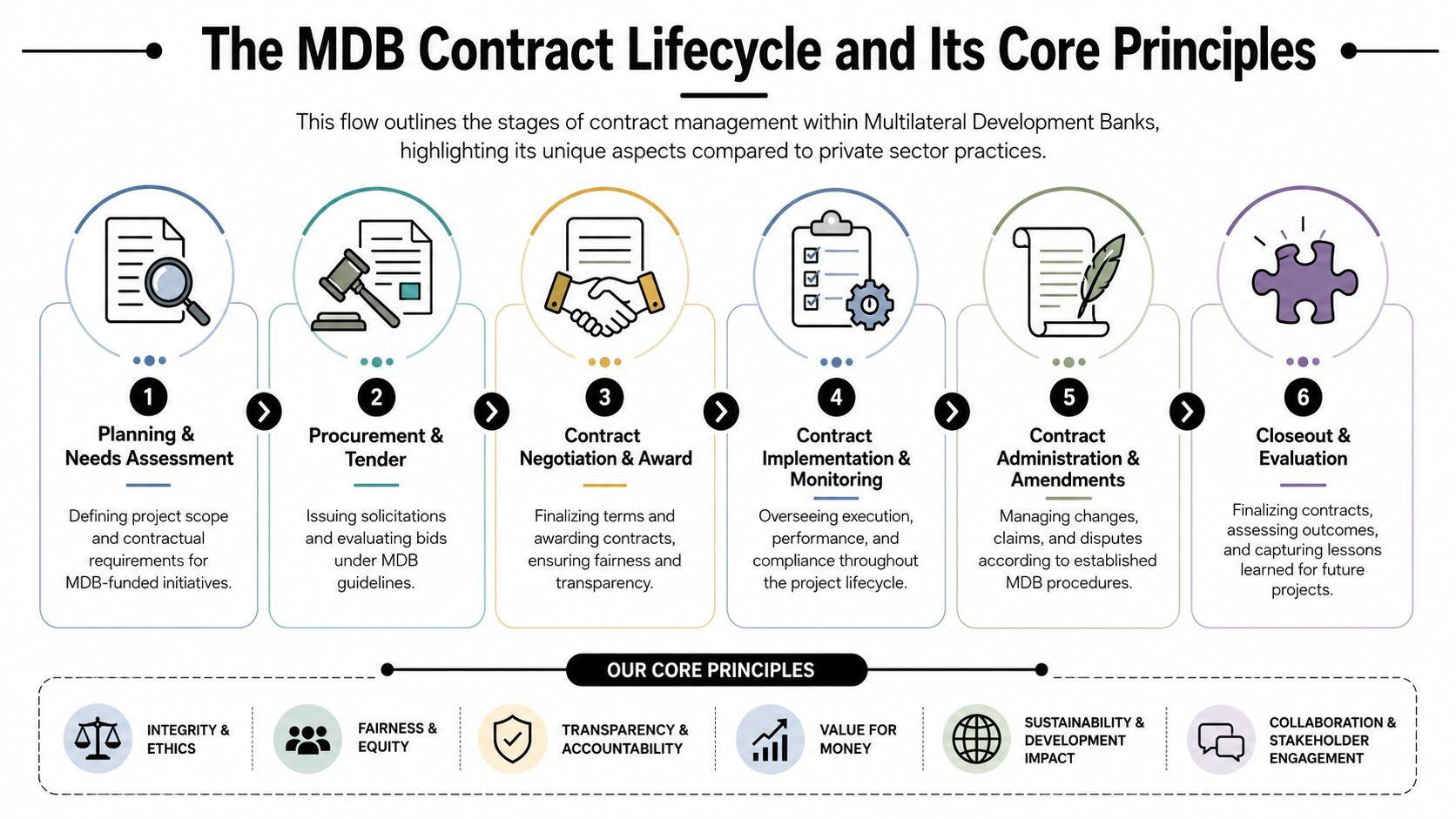
In MDB operations, the lifecycle matters because the contract has to survive scrutiny from project teams, borrowers, auditors, and sometimes investigators, while still delivering the intended development result. The Asian Development Bank explains in its guidance on contract management in multilateral development finance that the work runs across three stages: preparation and planning before award, administration during implementation, and closure after completion. Strong contract managers treat those stages as one control system, not three separate tasks.
Preparation before award
This stage sets the ceiling for later performance.
Before award, the contract manager’s job is to test whether the deal can be delivered under borrower conditions, supervision capacity, and field realities. On paper, a payment milestone may look clean. In practice, it may depend on inspections, data, or approvals that the agency cannot produce on schedule. That gap is where claims begin.
Good preparation usually comes down to a few hard checks:
Deliverables can be verified without argument
Reporting and notice obligations match the project’s actual governance capacity
Payment triggers reflect progress that can be observed and documented
Technical requirements fit local operating conditions
Likely variation points are identified before they become emergency amendments
This is also where MDB work differs from routine corporate procurement. The contract has to support development objectives, not just transfer risk. Teams that understand results-based management in MDB work draft better obligations because they connect outputs, evidence, and payment logic from the start.
Administration during implementation
Implementation is where discipline either protects value or disappears.
A capable contract manager keeps three records aligned at all times: what the contract requires, what the project team is observing, and what the official correspondence preserves. If those records drift apart, the agency loses control of time, money, and position. By the time a formal dispute starts, failure usually happened months earlier in weak documentation, unclear instructions, or tolerated underperformance.
The practical test is simple.
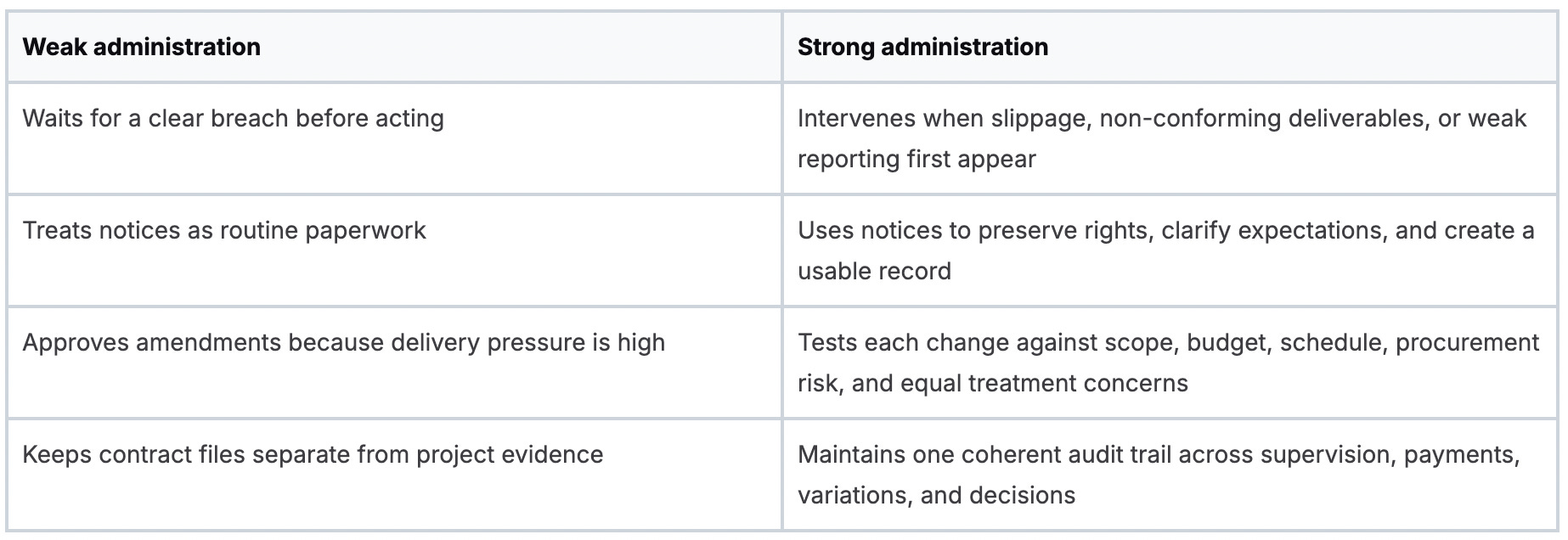
In MDB-financed contracts, administration is not only about enforcing clauses. It is about managing trade-offs under scrutiny. A rigid position can delay implementation and damage development results. A permissive position can create audit findings, distort competition, or weaken the agency’s legal footing later. Strong contract managers explain those trade-offs early and document why a given path is justified.
Closure after completion
Closeout is where the institution finds out what the contract really produced.
Final acceptance should confirm more than physical completion. It should confirm that payment conditions were met, records support what was paid, outstanding claims are resolved or reserved properly, handover obligations were completed, and lessons are captured for the next procurement. Poor closeout leaves the agency with unresolved liability, weak asset transfer, and no usable learning.
In MDB work, closure also has an integrity dimension. Contract managers often see the warning signs first: inconsistent invoices, unexplained subcontracting changes, repeated requests to bypass controls, or delivery evidence that does not match the field record. Handling those signals properly is part of the job. The core principles are straightforward. Keep the record complete. Preserve procedural fairness. Escalate concerns early. Protect both the project outcome and the institution’s position.
Core Technical and Legal Skills You Must Master
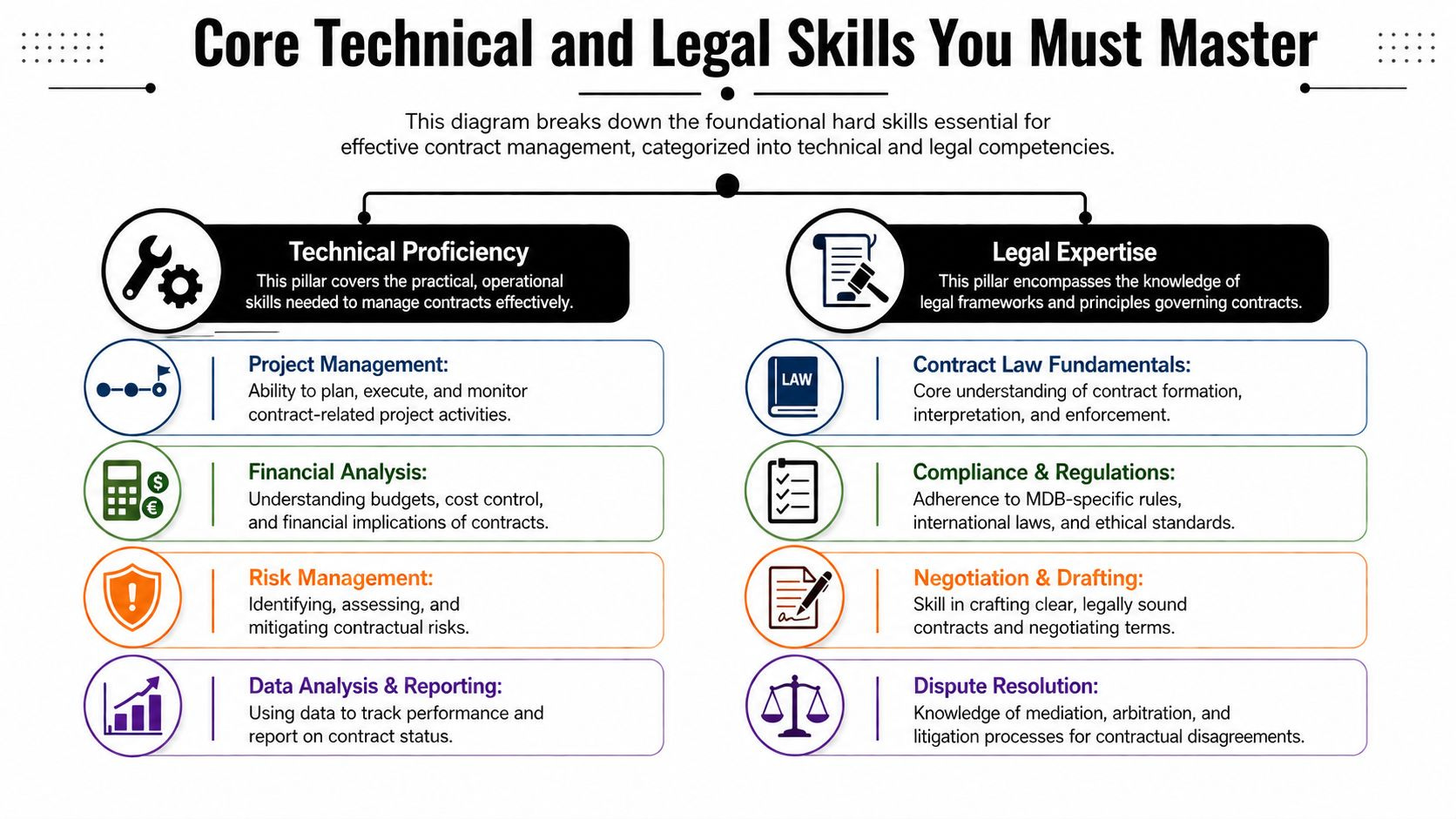
You can’t build a serious MDB contract career on personality alone. The technical base has to be solid. If you’re weak on systems, weak on drafting, or weak on legal interpretation, the rest won’t carry you far.
CLM capability is now a core skill
Manual tracking still exists in many project environments, but it’s a liability. The modern baseline is fluency with Contract Lifecycle Management systems, especially the functions that directly support implementation discipline.
According to HyperStart’s review of contract management skills, mastery of CLM technology is essential because AI-driven features such as clause extraction, renewal alerts, and automated approval workflows can reduce contract processing time by 40–60%. The same source states that organizations using automated CLM workflows report a 35% reduction in missed milestones and a 25% decrease in dispute resolution time, and that CLM proficiency has become a core standard for professional certification.
Those numbers matter, but the operational lesson matters more. In MDB environments, CLM tools help teams maintain discipline across obligation tracking, approvals, amendments, and performance records. They don’t replace judgment. They make judgment easier to apply consistently.
The legal skills that actually matter
A lot of candidates say they have “legal knowledge.” That phrase is too vague to be useful.
What matters in practice is whether you can interpret contractual language in the context of procurement rules, implementation realities, and formal dispute pathways. You need to understand what the clause says, what it was meant to control, and how it will behave when a real project starts slipping.
The legal skill set that carries weight usually includes:
Contract interpretation: Reading provisions with precision and spotting ambiguity before parties exploit it
Drafting discipline: Writing obligations, deliverables, and remedies in plain enforceable terms
Change control: Understanding how amendments affect risk allocation, payment, and accountability
Claims awareness: Recognizing when correspondence, delay events, or performance gaps are creating future disputes
Compliance judgment: Applying bank rules and project-specific conditions without turning the process into paralysis
Technical and legal skills in combination
The mistake I see most often is candidates treating these as separate tracks. They aren’t. In MDB work, the strongest professionals combine legal reading with operational control.
A simple comparison makes the point:
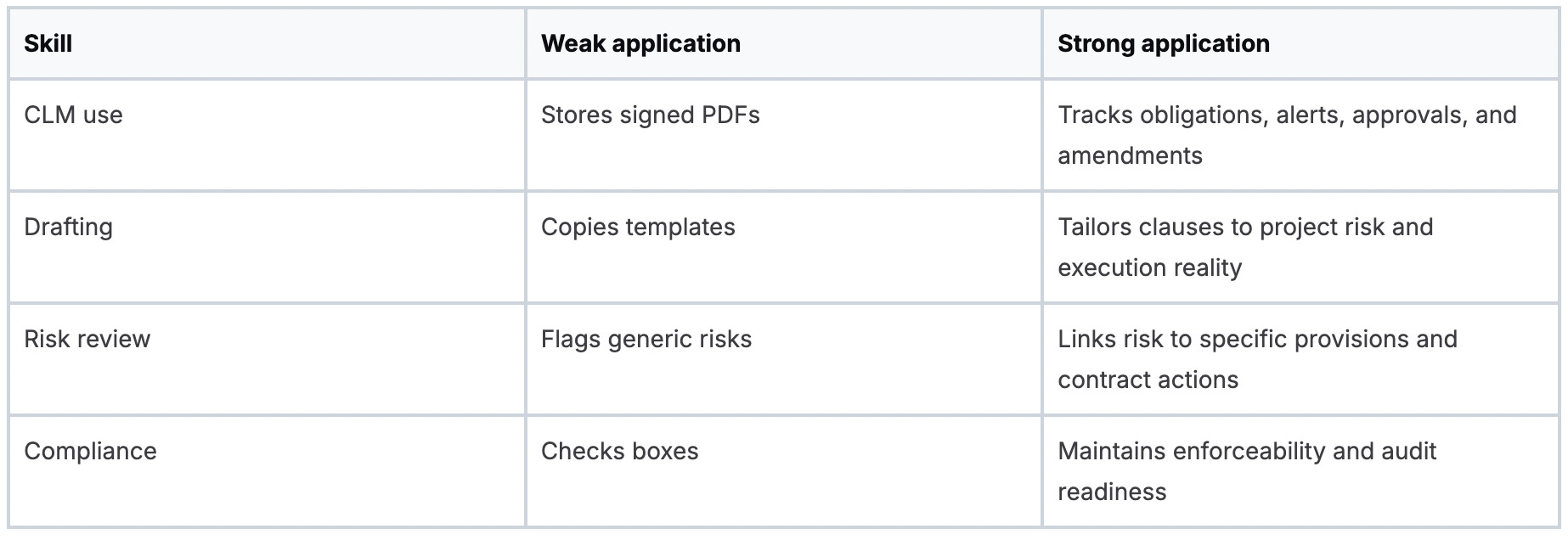
The best contract managers can move from a clause to a control action in one step.
That’s what hiring managers notice. They’re looking for people who can interpret a liquidated damages clause, review a variation request, assess documentary support, and decide what the team should do next. If you can only describe concepts in the abstract, you’re not ready for a difficult portfolio.
The Commercial and Financial Acumen That Drives Value
Contract managers who stay at the level of compliance rarely become influential. The ones who progress learn to think commercially.
In MDB work, commercial judgment means you understand how contract structure affects value for money, delivery quality, sustainability, and long-term project performance. You don’t treat price as the whole story. You treat price as one part of a wider performance equation.
Risk allocation is a commercial skill
The AIIB and other MDBs emphasize a basic principle that many candidates mention but few can apply well. MDBs allocate risks to the party best able to manage them, and they require contract documents to clearly specify work requirements, especially those supporting quality, performance in use, and sustainability impacts, to ensure contractual enforceability.
That principle should shape how you read every major contract decision.
If a risk sits with a party that cannot realistically control it, one of two things usually happens. The supplier prices it badly, or the issue returns later as a claim, delay, or quality failure. Neither outcome serves development value.
What commercial maturity looks like
Commercial and financial acumen shows up in small decisions long before it appears in a financial report.
A mature contract manager will:
Test payment terms against delivery reality: Milestones must reflect verifiable progress, not wishful sequencing.
Challenge vague specifications: Weak requirements create weak enforcement.
Read amendments commercially: Every change affects value, advantage, or future exposure.
Track performance with purpose: KPIs should reveal whether the supplier is delivering usable results.
Speak the language of cost and consequence: Project teams need to understand the financial effect of delay, rework, and poor administration.
One practical way to strengthen this skill is to review how consulting inputs, deliverables, and pricing logic fit together. This guide on how to write a consulting proposal helps sharpen that commercial lens from the supplier side, which is useful if you want to negotiate and manage more effectively.
The value question you should always ask
Ask one question every time you review a contract problem: What value is the project losing if this continues for another month?
That question changes the conversation. It forces the team out of procedural comfort and into financial reality. It also makes you more useful to task team leaders, procurement specialists, lawyers, and borrower counterparts because you’re translating contract administration into business consequence.
Commercial skill is what lets a contract manager move from “the clause allows this” to “this is the better option for the project and here’s why.”
The Overlooked Soft Skills That Prevent Project Failure
A surprising number of technically capable people struggle in MDB contract roles because they underestimate the human side of the work. That mistake is expensive.
You’ll spend your time dealing with ministries, project implementation units, engineers, legal counsel, consultants, contractors, and internal colleagues who each have different incentives, different risk tolerances, and different interpretations of the same event. The contract manager who can’t manage those interactions will lose control of the file, no matter how strong their drafting is.

Soft skills are not optional in this field
The evidence is clear. Research summarized in this discussion of contract leadership skills shows that 50% of the top contract management skills are soft skills such as stakeholder alignment and adaptive communication, yet most training programs neglect them. The same source states that this gap leaves professionals underprepared for relationship-driven scenarios that can prevent 30% of contract failures and reduce dispute risk by 22%.
That tracks with practice. Most difficult contract problems do not begin as legal problems. They begin as alignment problems, communication problems, expectation problems, or trust problems.
The three soft skills that matter most
Stakeholder alignment
You need the discipline to get different actors working from the same understanding of obligations, evidence, and next steps.
This means confirming who decides what, who owns the record, who speaks formally to the supplier, and which issues require escalation. Without that alignment, teams send mixed signals. Suppliers exploit the gap immediately.
Adaptive communication
MDB work crosses cultures, institutions, and levels of technical fluency. Strong contract managers adjust their style without diluting their point.
That might mean writing one kind of note for internal counsel, another for a project director, and a different one for an implementing agency counterpart. Same issue. Different audience. Same control over facts.
Conflict handling
Disagreement is normal. Escalation by ego is amateur work.
Good contract managers know how to de-escalate without surrendering the bank’s position or the project’s interests. They separate people from issues, keep records clean, and use meetings to narrow factual disagreement before legal disagreement grows around it.
A well-run conversation can prevent a dispute file from ever being opened.
What this looks like on the ground
Consider a familiar pattern. A contractor says delay came from late site access. The implementing agency says the contractor was under-resourced from the start. The engineer is documenting progress inconsistently. Legal has been copied too late. Everyone thinks they’re defending the project.
The contract manager who adds value does four things quickly:
Clarifies the timeline from the record
Separates allegation from evidence
Gets the right parties into one structured conversation
Frames the decision around contract rights and delivery consequences
That’s soft skill in action. Not charm. Not general professionalism. Applied control in a human system under pressure.
How to Demonstrate Your Skills and Get Hired
A hiring panel asks about a troubled works contract. The contractor is pressing for time and money. The borrower is frustrated. Internal teams are split on what the record shows. The weak candidate talks about coordination and communication. The strong candidate explains how they established the facts, tested the claim against the contract, aligned stakeholders, and protected project delivery without losing control of the file.
That is the standard in MDB hiring.
Plenty of applicants can describe procurement processes. Fewer can show that they understand post-award reality in MDB-funded operations, where contract decisions sit inside fiduciary controls, borrower relationships, reputational risk, and delivery pressure at the same time. Hiring managers are not looking for polished generalities. They are looking for evidence that you can exercise judgment in a system with formal rules and high consequences.
Resume bullets that sound like real contract work
Your CV should show what you handled, what context you handled it in, and what business or project consequence followed. A good bullet makes the reviewer think, “This person has done the work.” A weak bullet sounds copied from a procurement job description.
Use language like this:
Technical focus: Managed contract records, milestones, approvals, and amendment workflows in CLM and document control systems, giving project teams a clear view of obligations, deadlines, and pending actions.
Legal and compliance focus: Reviewed clauses, notices, correspondence, and change documentation to support enforceability, escalation decisions, and compliance with institutional procurement rules.
Commercial focus: Assessed variation requests, payment triggers, and performance evidence to support value-for-money decisions and keep budget exposure visible.
Stakeholder focus: Coordinated borrower, supplier, legal, and technical counterparts during contested implementation issues, maintaining a reliable record and supporting timely decisions.
Integrity and controls focus: Documented risk issues, reporting lines, and escalation paths in contracts or projects with heightened fiduciary sensitivity.
The point is accuracy. Do not claim ownership of negotiations you merely attended. Do not overstate legal responsibility if counsel made the final call. In MDB settings, senior reviewers spot inflated wording quickly.
A better interview answer structure
Competency interviews usually test how you behave under pressure, not how well you recite procurement terminology. Use a simple structure, but make the substance specific. The panel wants to hear what you did, why you did it, and how you balanced competing interests.
For a dispute or performance question, an answer like this is credible:
Situation: During implementation, a supplier disputed whether a delay event justified additional time and cost. The documentary record was incomplete, and internal stakeholders were taking different positions.
Task: I needed to establish a defensible factual record, align internal stakeholders, and support a response that protected contract rights and delivery objectives.
Action: I reviewed the relevant clauses, rebuilt the timeline from correspondence and progress records, identified gaps in the file, and convened technical, legal, and operational colleagues to agree a single position before any formal response was issued.
Result: The response went out on a coherent factual and contractual basis, internal confusion dropped, and the working relationship remained stable enough to continue implementation.
That answer works because it shows control, sequencing, and judgment. It also reflects MDB reality. The contract manager rarely solves the problem alone. The job is to get the institution to a sound position, backed by record, process, and timing.
If you need to sharpen that style of response, this guide on how to pass a competency-based interview is a useful place to practice.
Show that you understand the MDB operating environment
Candidates often miss the point that MDB contract management is not standard private-sector vendor management with extra approvals attached. The environment is different. Borrowers, implementing agencies, consultants, contractors, legal teams, technical specialists, auditors, and integrity functions may all affect the same contract file.
Your examples should reflect that complexity.
A strong candidate might say they supported a borrower-facing contract under strict documentation rules, managed notice deadlines while coordinating with technical teams, or helped structure a response to underperformance without prejudicing the bank’s position. Those details signal maturity because they show that you understand the trade-off between speed and control. In MDB work, acting fast without a clean record creates risk. Waiting for perfect information can damage delivery. Good contract managers know how to move with enough discipline to protect both.
A practical development path
If your profile is still developing, build it in an order that matches how the work is assessed:
Get solid post-award exposure: Many applicants know tendering steps. Fewer can explain what happens after signature.
Learn one system properly: CLM, document control, or contract administration tools matter when you can explain how you used them to manage obligations, approvals, and evidence.
Study institutional rules and standard forms: MDB hiring managers value candidates who can work inside formal frameworks without constant supervision.
Improve your written outputs: Clear notes, notices, meeting records, and issue summaries often determine whether a team can defend its position later.
Add formal training that matches your experience: Credentials from NCMA or World Commerce & Contracting help when they reinforce real contract work, not substitute for it.
The best applicants present themselves with restraint. They show where they added value, where they supported others, and where they learned to handle complexity without losing control of process or record.
If you want MDB roles where these contract management skills matter, Multilateral Development Bank Jobs is one of the best places to start. It tracks openings across major institutions and helps candidates understand how to position themselves for jobs that lead to serious international development careers.