
You’ve probably seen this pattern in your own applications. You have the master’s degree, the policy vocabulary, maybe a second language, and a clear commitment to development. You still get screened out for World Bank, regional development bank, or UN-adjacent roles because your profile reads as promising, not proven.
Recruiters in this space look for evidence that you can handle ambiguous problems, work across functions, and produce something useful for an institution under pressure. Coursework signals interest. Volunteer consulting can signal delivery.
That’s why consulting volunteer opportunities matter more than most candidates realize. Used well, they help you build the one thing many MDB applicants lack: a portfolio of real strategic work tied to mission-driven organizations.
The Strategic Gap in Your MDB Application
A lot of strong candidates assume they need another credential. Usually they need sharper proof.
If your resume is full of research, coursework, internships, and policy interest, but thin on executed projects, you have a credibility gap. MDB hiring teams rarely say it that way, but that’s often the issue. They want to see that you can structure a problem, work with stakeholders who don’t agree on priorities, and turn analysis into recommendations people can act on.
Volunteer consulting is one of the cleanest ways to close that gap. You’re not adding a feel-good extra. You’re stepping into a professional environment where organizations need real help and expect usable outputs.
The scale of that environment is larger than many applicants assume. In 2021, 60.7 million adults contributed 4.1 billion hours of service, with an estimated economic value of $122.9 billion, according to the U.S. Census Bureau and AmeriCorps. That matters because it places organized volunteering in serious operational territory. This is not a side arena. It’s a large, economically significant ecosystem where professional skills are routinely deployed.
What MDB recruiters actually notice
They notice specifics such as:
Project framing: Can you define the client problem in plain language?
Stakeholder management: Can you work with leadership, staff, and outside partners without creating friction?
Analytical discipline: Can you take messy information and make decisions from it?
Deliverables: Can you point to a memo, market scan, dashboard, strategy deck, or implementation plan?
That’s why targeted volunteer consulting often outperforms generic volunteering for career progression toward MDBs.
Practical rule: If you can’t describe the problem, your role, and the output in interview-ready language, the project won’t help your application much.
A strong volunteer consulting project also gives you material for competency-based interviews. You stop speaking in abstractions about development impact and start talking about how you assessed constraints, aligned stakeholders, and delivered recommendations under limited time and information.
If your analytical base needs work before you take on strategy-heavy projects, sharpen that first. This guide on how to improve analytical skills is a useful starting point.
What Pro Bono Consulting Actually Means
Pro bono consulting means delivering professional expertise without payment to an organization that needs the work but likely couldn’t buy it at market rates. The key word is expertise.
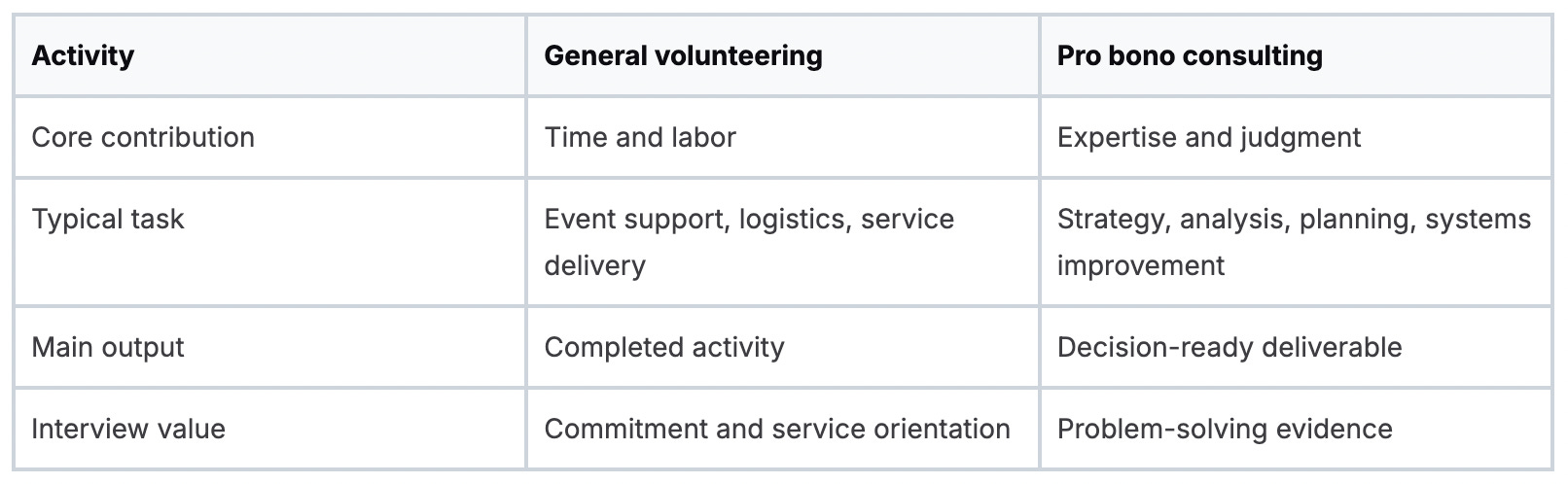
That’s the distinction many people miss. General volunteering supports operations. Pro bono consulting supports decisions.
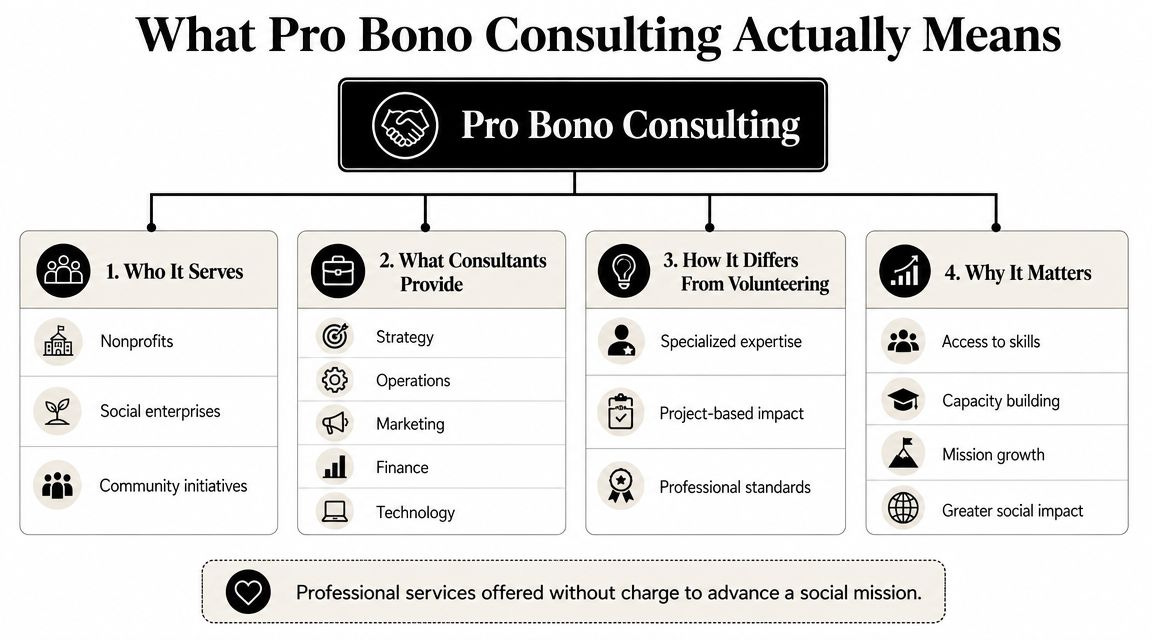
A nonprofit may need help with strategic planning, program design, fundraising systems, market analysis, pricing, operations, data cleaning, monitoring frameworks, communications, or board reporting. If you bring one of those capabilities in a structured way, you’re doing consulting work.
The difference between helping and advising
Here’s the cleanest way to think about it.
The nonprofit sector has strong reasons to seek this kind of support. Nearly half of nonprofit CEOs in mid-2022 said recruiting enough volunteers was a “big problem,” and almost two-thirds reported rising demand for services, as summarized by the Council of Nonprofits. That’s exactly the kind of operating pressure that creates demand for high-skill volunteers who can improve strategy, processes, and resource allocation.
What you should expect to produce
A real pro bono engagement usually ends with something concrete. For MDB career purposes, the deliverable matters as much as the service.
Useful examples include:
A strategic memo that defines options and recommends a path
A financial model that helps an organization test scenarios
A stakeholder map that clarifies incentives and influence
A dashboard or reporting tool that improves program oversight
A communications plan tied to audience priorities and channels
The strongest volunteer projects leave you with a work product you can discuss without oversharing confidential details.
That deliverable becomes part of your professional story. In an MDB interview, you can explain the client context, your methodology, the trade-offs you considered, and how you landed on a recommendation. That’s far more compelling than saying you care a great deal about development.
Why this matters for career strategy
Done well, pro bono consulting gives you three assets at once:
Proof of execution
Exposure to mission-driven organizations
A network around real work, not coffee chats
That combination is hard to get from online courses and general networking alone.
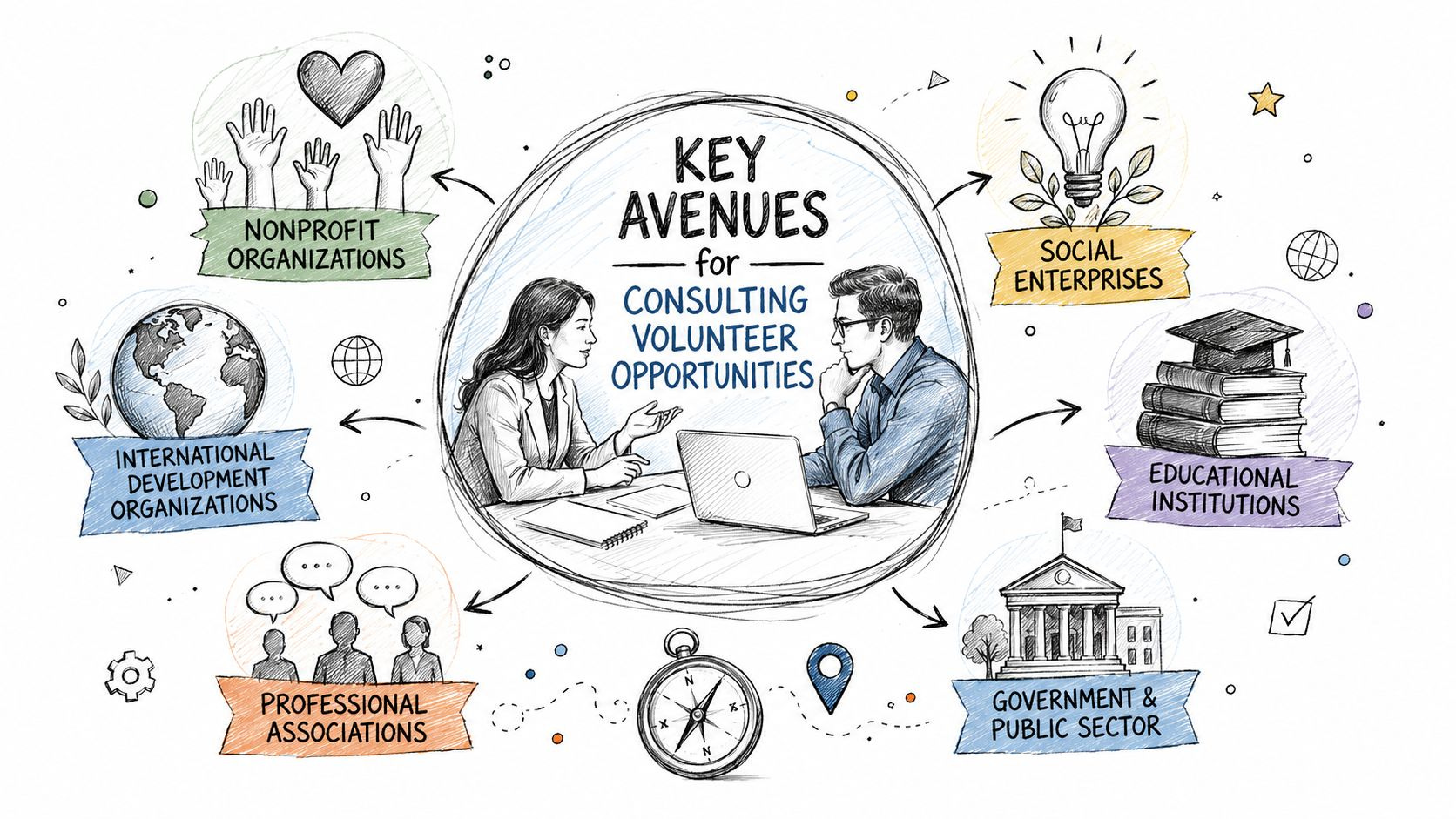
Key Avenues for Consulting Volunteer Opportunities
The market for consulting volunteer opportunities is fragmented. That’s frustrating if you want a simple list, but it’s useful if you understand how each channel works. Different paths produce different kinds of evidence.
Formal pro bono consulting networks
These are usually the best entry point for professionals who want structure, team support, and a defined scope. Organizations in this category often screen both nonprofits and volunteers, then match people by skill and project fit.
That structure matters. Programs such as CCT Atlanta run two annual project cycles, screen applicants, match volunteers into teams, and require a commitment of several months to deliver a final recommendations report and implementation support, according to CCT Atlanta’s description of its model. This is much closer to a real consulting engagement than an open-ended volunteer role.
These programs are especially useful if you need experience with team-based problem solving, client meetings, and formal deliverables.
Direct outreach to NGOs and social enterprises
This path is less branded and often more effective.
If you already know the sector you want to work in, climate adaptation, urban services, financial inclusion, health systems, digital public infrastructure, direct outreach can produce better-fit work than waiting for a platform to match you. Many organizations need help but don’t have a polished volunteer intake process.
A direct pitch works best when it is narrow. Don’t say you’d love to help in any way. Offer a specific service tied to a visible problem, such as donor reporting cleanup, partnership mapping, survey analysis, or a short market scan.
Field-tested advice: The best volunteer consulting opportunity is often the one you shape yourself around a real need.
Data-for-good and analytics platforms
If your strengths are quantitative, technical, or operational, this route deserves serious attention. Data-oriented programs tend to have tighter governance and clearer role definitions than broad volunteer marketplaces.
That’s valuable if you want project experience that resembles the way paid analytics consulting works. It also creates cleaner stories for applications to institutions that care about evidence, systems, and decision quality.
Development-adjacent field exposure
Some candidates also combine consulting volunteer work with broader international service or NGO-facing roles. If your goal includes eventual operational work in fragile settings or implementation-heavy units, that can be useful context. This overview of Voluntary Service Overseas jobs and pathways is one example of how to think about service roles alongside consulting-style experience.
The point is choice, not accumulation. You do not need every channel. You need one channel that gives you work you can finish and explain well.
Comparing the Top Pro Bono Consulting Models
You finish work at 9 p.m., open a volunteer application, and see two very different options. One is a tightly scoped advisory project with a clear end date. The other promises broader impact but leaves the scope, team structure, and deliverables vague. For someone targeting the World Bank, IFC, or another MDB, that choice matters more than the brand name on the website.
Recruiters in this field look for evidence you can handle structured problem-solving, produce usable recommendations, and work with clients who have real constraints. Different pro bono models signal those strengths in different ways.
Volunteer Consulting Models Compared
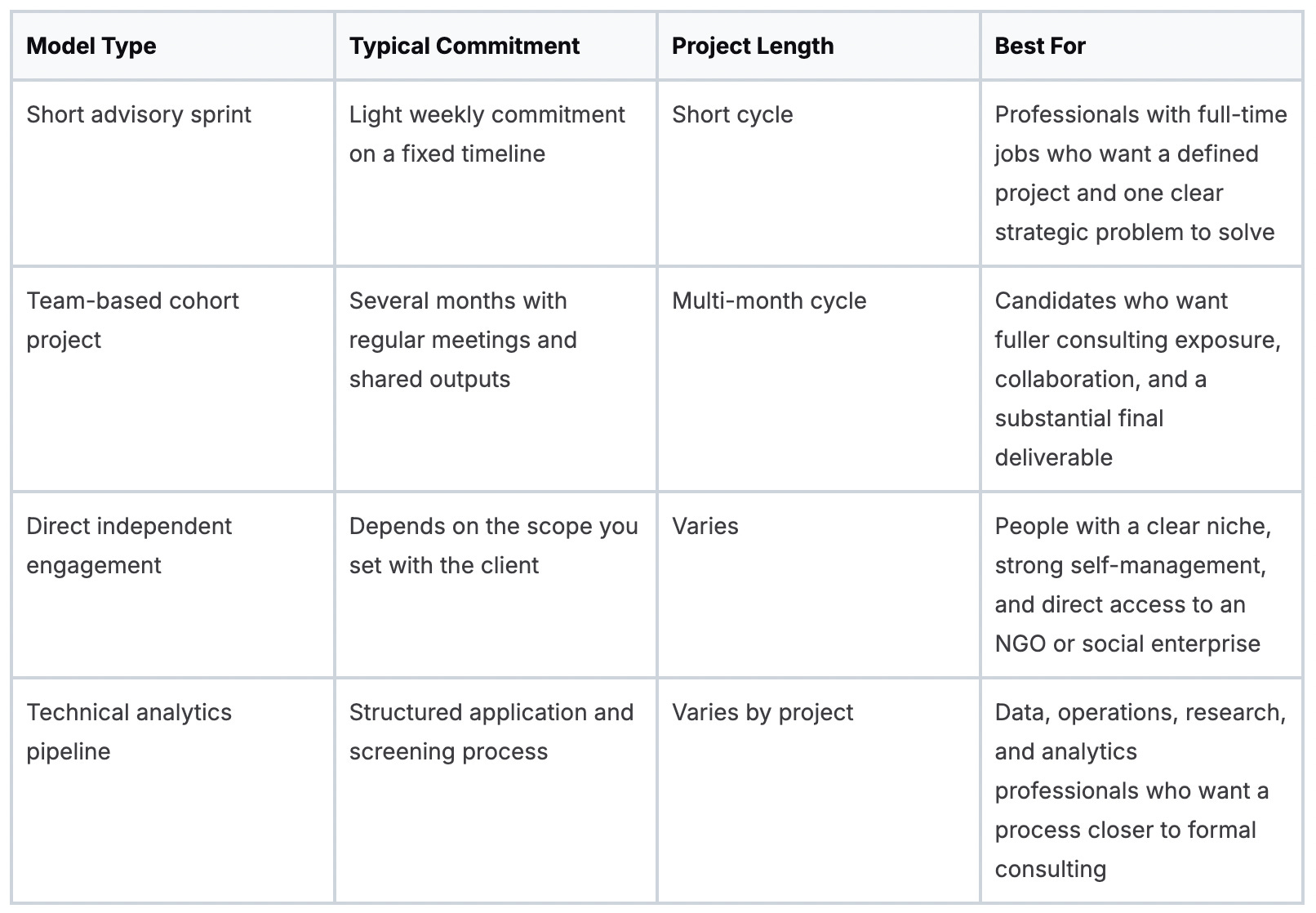
The practical difference is not just time. It is signal.
A short advisory sprint shows discipline, client communication, and the ability to get to a recommendation quickly. A cohort project gives stronger evidence on teamwork, stakeholder management, and synthesis. An independent engagement can produce the best story of all if you scope it well, but it can also become messy fast. Technical analytics programs are often the closest match for candidates targeting MDB units that care about data systems, evaluation, operational research, or evidence-based decision support.
What the structured technical model looks like
Analytics-focused volunteer programs usually run with more process than general volunteer marketplaces. DataKind asks volunteers to build a profile around their technical skills and apply to specific projects, as outlined on DataKind’s volunteer information page.
That kind of structure helps for three reasons:
It screens for real fit. Projects are more likely to match your actual technical depth.
It keeps scope under control. The client problem is usually defined before work begins.
It produces cleaner experience stories. You can explain your role, method, and output in a way that sounds credible in an MDB interview.
I usually advise candidates not to underrate this point. A polished but vague volunteer experience is weaker than a narrower project with a clear workflow, a real client question, and a concrete output.
Which model tends to work best
For early-career professionals or career switchers with limited time, the short structured model is often the highest-return option. You get one finished piece of work and one interview story you can tell without hand-waving.
For candidates who already have some consulting, policy, or research training, team-based projects often create better evidence for MDB-style work. They resemble the committee-driven, feedback-heavy environment you see in development institutions, where analysis is only half the job and alignment matters almost as much.
Independent projects sit at the other end of the spectrum. They offer flexibility and can align very closely with your target sector, but they depend on your ability to define the problem, manage the client, and stop scope creep before it ruins the experience.
A finished modest project still beats an ambitious project that never reaches a useful deliverable.
Choosing the Right Project for Your MDB Goal
A candidate applies to the World Bank with strong credentials, solid motivation, and a volunteer consulting project that sounds generous but irrelevant. Another candidate shows one small pro bono engagement tied to program measurement, stakeholder interviews, and a finished recommendations deck. The second profile usually reads better because MDB hiring teams look for evidence, not just intent.
Volunteer consulting becomes useful when it closes a specific gap in your MDB story.
Start with the gap, not the opportunity
Before you say yes to any project, ask what is missing from your application.
If you already have strong sector credentials in education, another education project may add little unless it gives you a new function such as budgeting, results measurement, or implementation planning. If your background is corporate strategy and you want MDB roles in social sectors, the better project may be one that proves you can work with public-interest clients, ambiguous data, and operational constraints.
That is the essential filter. The right project is not the most prestigious nonprofit. It is the one that gives you credible evidence for the role you want next.
Match the project to the type of MDB role
Different MDB tracks reward different signals.
Climate, infrastructure, and private sector roles often value market analysis, financial reasoning, transaction support, and policy context. Social sector and governance roles usually reward program logic, service-delivery analysis, stakeholder mapping, and monitoring frameworks. Results, evaluation, and knowledge roles place more weight on research discipline, synthesis, and clear written outputs.
Use the project brief the same way you would use a terms of reference. If the scope sounds close to work you may later pitch, this guide to writing a consulting proposal for development-focused clients will help you judge whether the assignment is defined well enough to be worth your time.
Test the signal before you apply
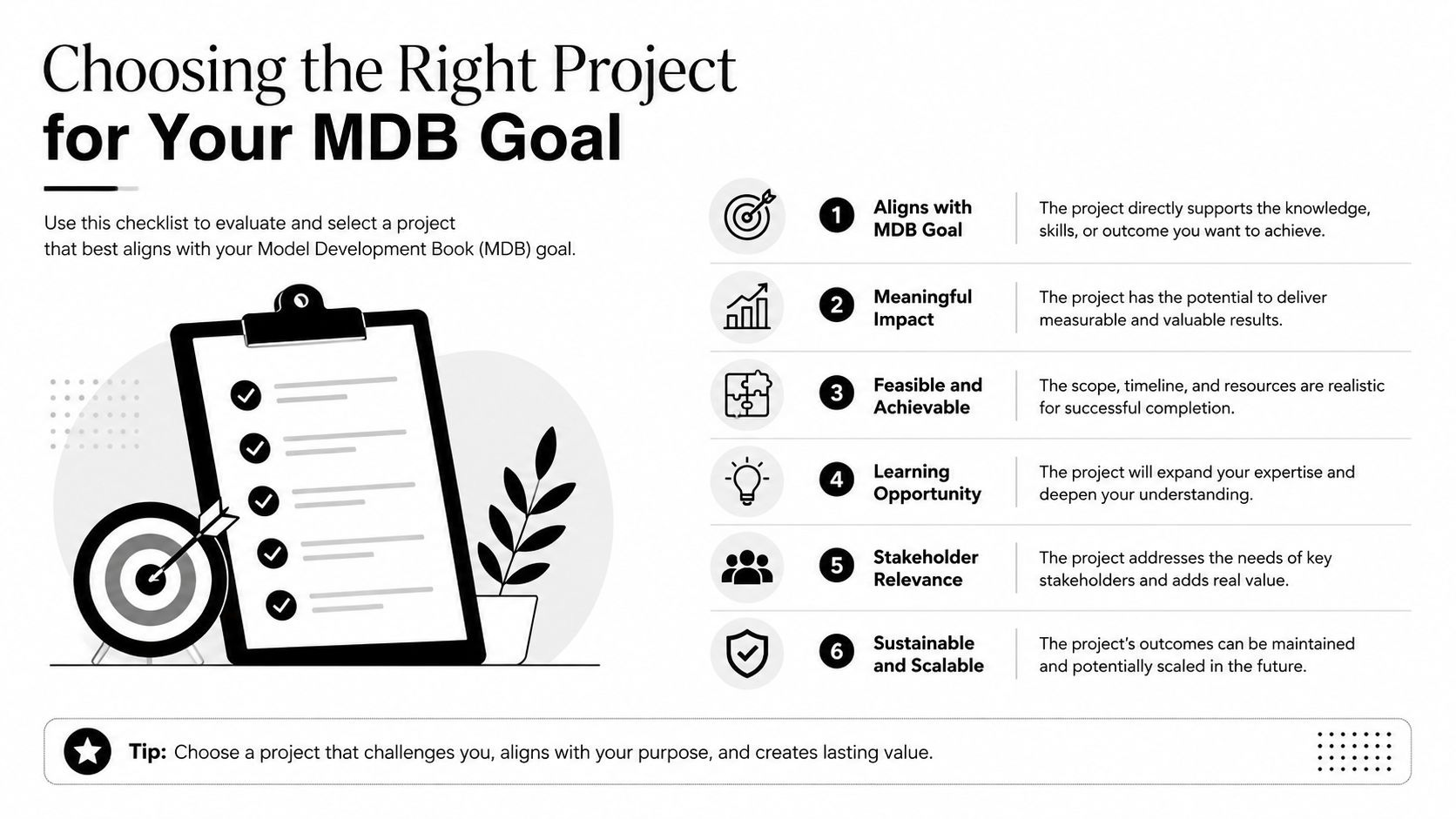
A good volunteer project should answer yes to most of these questions:
Will I produce a concrete output I can describe clearly in an interview?
Will I solve a problem that resembles MDB work, such as analysis, implementation support, strategy, or stakeholder coordination?
Will I have enough contact with the client to understand how decisions get made?
Will this project strengthen one weak point in my profile rather than add generic service?
Can I finish it well with my current workload?
That last question matters more than ambitious candidates like to admit. A modest project completed well gives you stronger material than a sprawling assignment that drifts, slips, and ends without a usable deliverable.
Use a simple selection framework
I usually advise candidates to score each opportunity on four dimensions: sector relevance, skill relevance, access to decision-making, and finishability.
Then make one trade-off on purpose.
You rarely get all four at once. A highly relevant sector project may give you weak ownership. A less glamorous local client may give you direct exposure to the country manager, program lead, or board. For MDB recruiting, that second option often has more value because it gives you better stories about judgment, constraints, and client communication.
The best project sits where relevance, ownership, and realistic scope meet.
That is the point where volunteer work stops being a nice extracurricular and starts functioning as career evidence.
How to Prepare a Winning Pro Bono Application
A hiring manager at an MDB will not care that you volunteered. They will care whether the experience proves you can scope messy work, manage stakeholders, and deliver something useful under real constraints.
Treat the application that way. You are not asking to help. You are showing an organization why you are a low-risk, high-utility choice for a specific piece of work.

Rewrite your resume for transferability
Strong candidates often send resumes that read well inside a firm or university and poorly everywhere else. The reviewer sees brand names, course titles, and internal project language, but not the operating skills that matter on a small consulting engagement.
Bring those skills to the top:
Project management: timelines, coordination, workplans, follow-up, delivery against deadlines
Analysis: Excel, data cleaning, research synthesis, policy review, market assessment, forecasting
Communication: slide decks, briefing notes, stakeholder interviews, workshop support, client updates
Execution: recommendations that led to decisions, new processes, tools, or implementation steps
Use plain language. “Supported PMO workstream governance for strategic transformation” says very little. “Tracked deadlines across four teams and prepared weekly decision memos for the program lead” gives the reader something concrete to trust.
For MDB-oriented candidates, this matters twice. Volunteer consulting should help close evidence gaps in your profile, not hide your useful experience behind corporate vocabulary.
Write a cover note around the client’s problem
A good cover note is short, specific, and easy to place. The reader should finish it knowing what you can do, what problem you can handle, and how reliably you can deliver.
I would structure it in four parts:
Show that you understand the mission and current operating problem
Point to directly relevant work you have already done
State the kind of deliverable you can produce
Confirm the time and discipline you can bring to the project
That last point is underrated. Many nonprofits have already dealt with volunteers who were enthusiastic for a week and unavailable by week three. If you can credibly say, “I can commit five hours a week for eight weeks and can own the research brief and presentation,” you reduce perceived execution risk.
If you need help framing scope, deliverables, and value in a more consulting-style format, this guide on how to write a consulting proposal is useful even for unpaid work.
Prepare for the interview like someone who has done client work
The interview usually tests judgment more than passion. Expect questions that reveal whether you can define scope, work with incomplete information, and stay useful when client contact is irregular.
Prepare clear answers to questions like:
What kinds of problems are you best equipped to solve?
How do you handle ambiguous requests or limited data?
How do you keep momentum when stakeholders are slow to respond?
What can you realistically commit each week?
What would you deliver by the midpoint of the project?
Specificity wins here. “I’m flexible and happy to help however needed” sounds generous but weak. “I’m strongest in research synthesis, interview-based analysis, and drafting decision memos. I would be less useful in a pure fundraising role” sounds like a consultant who understands fit.
That is the tone you want.
Show proof of work
Bring one or two work samples if the process allows it. A memo, slide deck, dashboard, interview guide, or project plan gives the reviewer evidence of how you think and how polished your outputs are.
Choose samples that map to MDB-relevant work where possible. A market-entry deck may still help if it shows structured analysis and executive communication. A policy brief, program review, or implementation tracker is often even better because the transfer is easier to explain later in interviews.
Enthusiasm helps you get noticed. Evidence helps you get selected.
Your Next Step Toward a Development Career
The jump into an MDB career rarely comes from wanting it more. It comes from making your profile harder to ignore.
Strategic volunteer consulting helps you do that because it converts abstract motivation into visible evidence. You move from “interested in development” to “has already solved problems for mission-driven organizations.” That shift changes how people read your application.
The strongest move is usually a focused one. Pick a project that matches your target sector, fits your current bandwidth, and ends with a deliverable you can explain clearly. Finish it well. Then use that experience to sharpen your resume, your interview stories, and your judgment about where you add value.
Candidates often chase prestige too early. A smaller, well-scoped nonprofit project that you complete with discipline will do more for your MDB trajectory than a flashy volunteer title attached to vague responsibilities.
Start with one concrete action this week. Identify one platform, one NGO, or one technical volunteer pipeline that matches your skill set. Apply with a clear value proposition. Then treat the engagement like real consulting work, because that’s exactly what it is.
If you want a practical way to stay close to the market while you build relevant experience, Multilateral Development Bank Jobs tracks roles across major MDBs and publishes recurring updates on consultant openings and career guidance. That makes it easier to connect your volunteer consulting work to the jobs you want next.