

You’re probably preparing for an MDB interview presentation right now with the wrong instinct. You’re polishing slides, tightening wording, and trying to sound smart. That’s not the bar.
The hiring committee already assumes you’re smart. For most operational roles, a master’s degree is the minimum requirement and a PhD is considered useful, according to UNU-MERIT’s guide to starting a career at a multilateral development bank. Academic strength gets you into the pile. Clear thinking under pressure gets you shortlisted.
In MDB interviews, communication and presentation skills decide whether your expertise lands or dies in the room. You’ll be asked to explain policy tradeoffs, operational risks, stakeholder constraints, and implementation choices to people who already know the field. They’re not looking for a lecture. They’re looking for judgment, structure, and credibility.
Why Your Communication Skills Matter More at MDBs
You are in a panel interview. One director wants the headline. An economist wants your assumptions. An operations lead wants to know whether your idea will survive procurement delays, weak counterpart capacity, and political pushback. If you cannot answer all three clearly and fast, your expertise does not count for much.
At an MDB, communication is part of execution. The job is not only to produce sound analysis. The job is to move analysis through committees, country teams, clients, and internal stakeholders until something gets approved, financed, and implemented.
That is why candidates who treat presentation skills as polish usually underperform. A review published by the Eurasian Development Bank links communication, interpersonal, and leadership skills to stronger project implementation in its overview of MDB training initiatives. The point is simple. MDBs value communication because poor communication slows decisions, weakens coordination, and creates execution risk.
The committee is testing how you’ll operate
A hiring panel is not grading a classroom answer. It is testing whether you can work in an institution where progress depends on persuading other people to act.
You will need to brief directors who have little time, align with specialists who care about detail, challenge weak assumptions without becoming defensive, and explain technical issues to non-specialists without sounding vague or patronizing. If you cannot do that in the interview, the panel will not picture you handling government counterparts, internal review meetings, or investment committees.
Practical rule: Every answer should sound usable in a real MDB meeting.
That means focusing on consequences and choices. State the constraint. State the tradeoff. State the recommendation.
Why generic career advice fails here
Generic public speaking advice is too shallow for this setting. Confidence, storytelling, and eye contact help, but they do not answer the core MDB question: can you turn messy policy, data, and institutional constraints into a concise recommendation someone can act on?
That is the difference many applicants miss. MDB communication is not generic executive presence. It is applied judgment under institutional pressure. Panels listen for whether you understand mandate limits, sequencing, implementation risk, cross-functional coordination, and political economy, then explain them without rambling. If you want a broader view of how these roles work, read this guide to international organization careers.
A strong candidate sounds like someone who has already worked through the decision. A weak candidate sounds like someone still describing the topic.
What the room is really asking
The panel is usually testing four things at once:
Can you simplify without distorting? MDB work is complex, but your explanation still has to stay accurate.
Can you prioritize? Senior people do not reward long windups.
Can you persuade without overselling? They want judgment, not performance.
Can you stay useful under pressure? Your Q and A often reveals more than your prepared remarks.
If your communication is weak, the committee sees a subject-matter specialist they will have to manage closely. If your communication is sharp, they can already see you representing the institution.
Adopt the MDB Communication Mindset
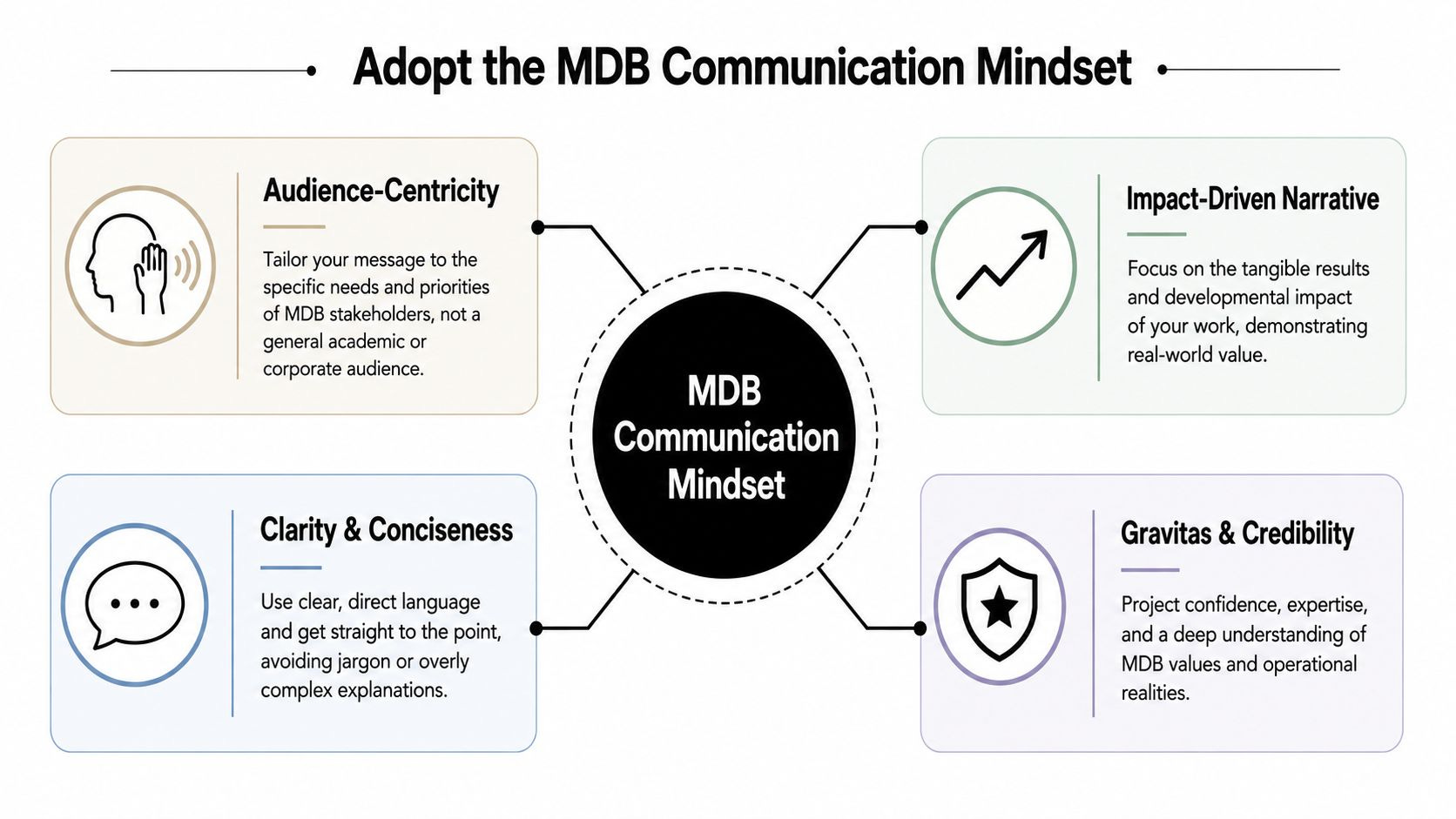
You are five minutes into a panel interview. One interviewer wants policy rigor. Another wants an operational answer. A third is testing whether you can brief senior management without wasting their time. If you sound like a researcher defending a thesis or a consultant selling a slide deck, you lose the room.
MDB communication is a specific professional discipline. You are expected to turn complex policy, messy data, institutional limits, and implementation risk into a clear recommendation someone can act on. Generic presentation advice misses that. The committee is not judging style in the abstract. They are judging whether you can communicate the way the institution works.
Lead with the decision, not the download
Panels do not need a tour of your thought process before they hear your point. They need the point first.
Start with the issue, your recommendation, and why it matters to the bank’s mandate. Then explain the analysis that supports it. If your opening sounds like background, context, or methodology, rewrite it.
Use this standard:
First sentence: Name the issue in plain language.
Second sentence: State your recommendation.
Third sentence: Explain the consequence for development impact, implementation, or risk.
That is the discipline. It also improves your written materials. The same habit will strengthen your statement of interest for MDB roles, because hiring committees look for the same skill across formats.
Speak to a mixed institutional audience
An MDB panel is usually a mixed room with different decision filters. One person is listening for operational feasibility. One is checking whether your logic holds up. One wants a brief they could repeat to senior management. Someone else may be assessing clarity, judgment, and composure more than content depth.
Adjust your explanation to fit that reality.

Your task is simple. Make different listeners trust the same conclusion for different reasons.
Stop sounding like a student
Advanced degrees are common in this hiring market. They do not distinguish you by themselves. The panel is not rewarding you for sounding careful, theoretical, or well read. They are assessing whether you can turn expertise into usable judgment.
Student language usually sounds like this:
“There are several perspectives to consider.”
“The evidence is complex and context-specific.”
“I would need more time before reaching a conclusion.”
That language signals hesitation unless you quickly convert it into a position. MDB language sounds different:
“The binding constraint is implementation capacity.”
“I’d reduce scope and fix sequencing first.”
“My recommendation is X. The main risk is Y. I’d monitor Z.”
That is the shift. You still show nuance. You stop hiding behind it.
Sound settled, not theatrical
Real gravitas in MDB interviews comes from control. Short sentences help. So does naming the tradeoff directly. Say what the bank can do, what it cannot do, and what choice you would make anyway.
Do not inflate your language. Do not bury your answer in caveats. Do not speak as if every issue deserves a seminar. Senior people trust candidates who can explain a difficult policy or financing problem with precision and restraint.
If your communication sounds polished but generic, the panel will hear technique. If it sounds concise, evidence-based, and institutionally aware, they will hear someone they can put in front of clients, managers, and government counterparts.
Structure Your Presentation for Impact
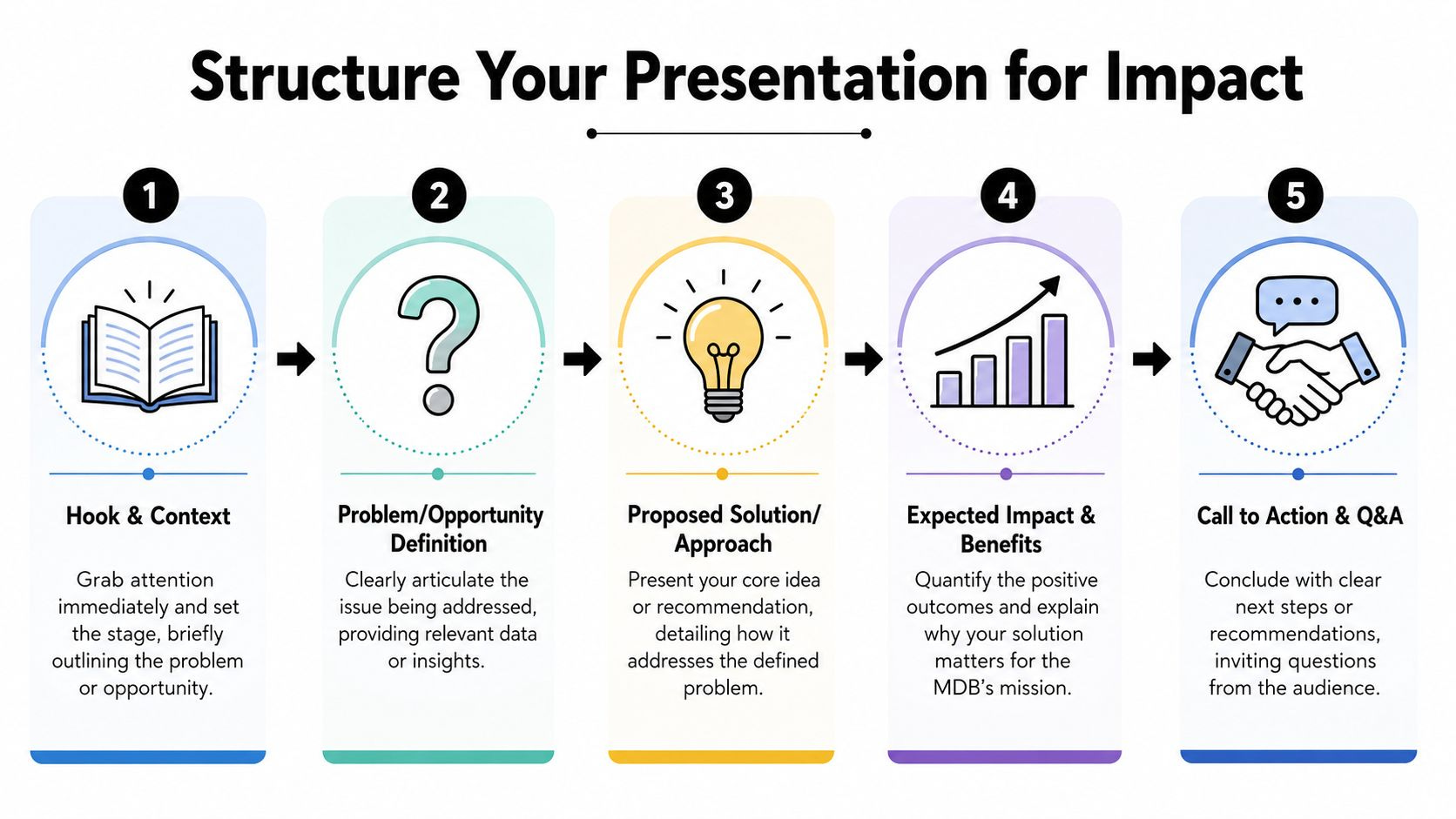
You are ten minutes into an MDB case presentation. A director stops you and asks, “So what exactly are you recommending?” If that question comes this early, your structure failed.
At MDBs, structure is not a style choice. It is proof that you can sort signal from noise, make a judgment, and present it in a way busy decision-makers can use. Generic presentation advice misses this. MDB panels are testing whether you can compress policy, financing, implementation, and risk into a clear line of argument.
Use a simple sequence: Problem, Analysis, Solution, Impact. It works because it mirrors how good MDB staff brief managers, clients, and approval committees. If you are also tightening your written narrative, this guide on how to write a statement of interest will help you carry the same logic into your application.
Open with the answer
Your first slide should contain your position, not a topic announcement. The committee should know your conclusion before you start walking through evidence.
Answer four questions in the opening minute:
What problem are you solving?
Why does it matter now?
What is your recommendation?
What result should the bank expect?
A weak opening says, “Today I’ll discuss challenges in urban transport financing.”
A strong opening says, “Urban transport financing is being held back by weak project preparation and fragmented municipal coordination. I recommend a staged pipeline tied to implementation readiness because it improves bankability and reduces execution risk.”
That gives the panel something concrete to test. It also shows you understand the MDB standard. Analysis is only useful if it leads to action.
Make every slide title carry an argument
Titles like “Background,” “Context,” and “Recommendations” waste space. They do not help the panel follow your reasoning. Write titles as conclusions.
Use this standard:

This matters more in MDB interviews than in ordinary business presentations. The panel is often scanning your deck while listening for your judgment. If the titles state the claim, your logic stays visible even when attention shifts.
Build the middle around a decision
The middle of the presentation should answer one question: why this option?
That requires discipline. Do not fill the deck with every fact you know about the sector. Select only the evidence that helps the committee choose a course of action.
A useful middle section does three jobs:
Identify the binding constraint. Name the one or two factors driving the problem.
Show the tradeoffs. MDB work is full of second-best choices. Present the options.
Justify your recommendation. Explain why your choice fits the institution, the client, and the implementation reality.
A seven-slide structure usually holds up well in interview settings:
Slide pattern that holds up in interviews
Slide 1. Executive summary
Slide 2. Problem definition and context
Slide 3. Diagnostic analysis
Slide 4. Options and tradeoffs
Slide 5. Recommended approach
Slide 6. Expected impact and implementation considerations
Slide 7. Risks, mitigants, and closing recommendation
Use that as a default. Then adapt it to the prompt. The point is not to look formulaic. The point is to show ordered thinking under time pressure.
Treat visuals as decision tools
Interview panels do not reward crowded slides. They reward clarity.
Use a chart only when it sharpens the point. Use a table when you need to compare options. Use a process diagram when sequence matters. If a visual needs a long explanation before anyone can read it, cut it.
Strong MDB visuals usually share three traits:
One message per visual
Plain-English labels
A title that states the takeaway
If the case includes a large data exhibit, do not paste the whole thing into your deck. Extract the part that supports your argument. Your job is to filter, not to display volume.
End with an operating recommendation
A weak ending repeats the presentation. A strong ending tells the committee what should happen next.
Your final slide should leave no doubt about four points:
What action you recommend
Why this option beats the alternatives
What risk could derail it
What indicator you would monitor first
That is how MDB professionals present. They do not stop at diagnosis. They move from recommendation to execution.
If your structure is doing its job, the panel will not have to work to follow you. They will spend their energy assessing your judgment instead. That is where offers are won.
Master Your Delivery and Q and A
Your slides can be solid and you can still lose the room. Delivery decides whether the panel experiences you as credible, tense, rigid, thoughtful, or senior enough for the role.
Moxie Institute’s advanced presentation guidance makes the hierarchy brutally clear: effective presentations are composed of 38% voice tone, 55% non-verbal communication, and 7% actual content, and it recommends an Energy Mapping Technique where you monitor whether audience energy drops below 6 during the opening in its guide to advanced presentation skills.
The exact percentages aren’t the main point. The practical point is that your delivery mechanics carry most of the impact.
Fix your voice before you fix your wording
A lot of candidates sound weaker than they are because their voice tells the wrong story. They speed up, drop their volume at the end of sentences, and bury their recommendation in a monotone explanation.
Work on three things:
Pace: Slow down when stating your point. Speed up only on background.
Emphasis: Stress the nouns and verbs that carry the decision.
Finish the sentence: Don’t let your voice trail off as if you’re asking permission.
A good test is to record yourself answering one case question out loud. If your recommendation doesn’t sound distinct from your supporting detail, your panel won’t hear the hierarchy either.
Control the room with deliberate presence
Non-verbal communication matters because the panel reads it as a proxy for how you’ll behave with clients, managers, and counterparts.
In person, that means upright posture, stable eye contact, and purposeful gestures. Online, it means looking into the camera when making key points, not staring at your own image, and avoiding the frantic head movement that signals nervousness.
Use energy mapping during the opening
The Energy Mapping Technique is worth stealing. Divide the room into visual quadrants. As you begin, scan each quadrant and watch for cues such as eye contact, note-taking, or visible disengagement. If the room’s energy drops early, change something fast.
Do one of these immediately:
Shorten your sentence length
State the recommendation earlier
Ask a clarifying framing question if the format allows
Move from abstract context to concrete implication
That adjustment matters more than clinging to your script.
If the room is drifting, your content may still be fine. Your delivery is what needs fixing in real time.
Rehearse for imperfection
One of the most common traps is perfection paralysis. You practice until the deck sounds memorized, then you panic the moment someone interrupts the script.
Don’t rehearse for flawless recital. Rehearse for controlled recovery.
Try this in practice sessions:
Deliberately stop mid-thought and restart
Have someone interrupt with a question
Switch one slide out of order and recover
Answer one hostile version of a reasonable question
That kind of rehearsal makes you look composed when the live interview gets messy. If you want a deeper look at the broader interview format around these moments, this article on how to pass a competency-based interview is useful.
Handle Q and A like an operator
Q and A is where many strong applicants collapse. They either become defensive or start rambling.
Use a disciplined response pattern:
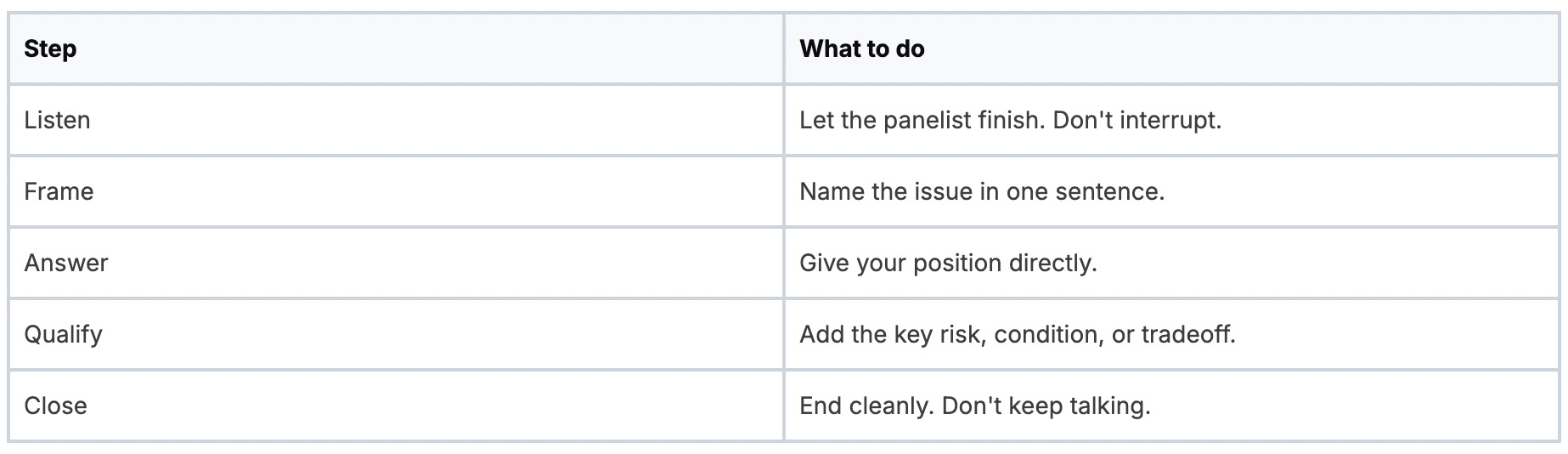
If a question challenges your assumption, don’t treat that as an attack. Treat it as an opening to show range.
For example, if a panelist says your proposal seems too ambitious, don’t say, “I understand your concern.” Say, “The ambition is in the end state. I’d sequence the rollout conservatively because implementation capacity is the immediate constraint.”
That answer shows you can defend the strategic direction while adapting the operational plan.
Avoid These Common MDB Applicant Mistakes
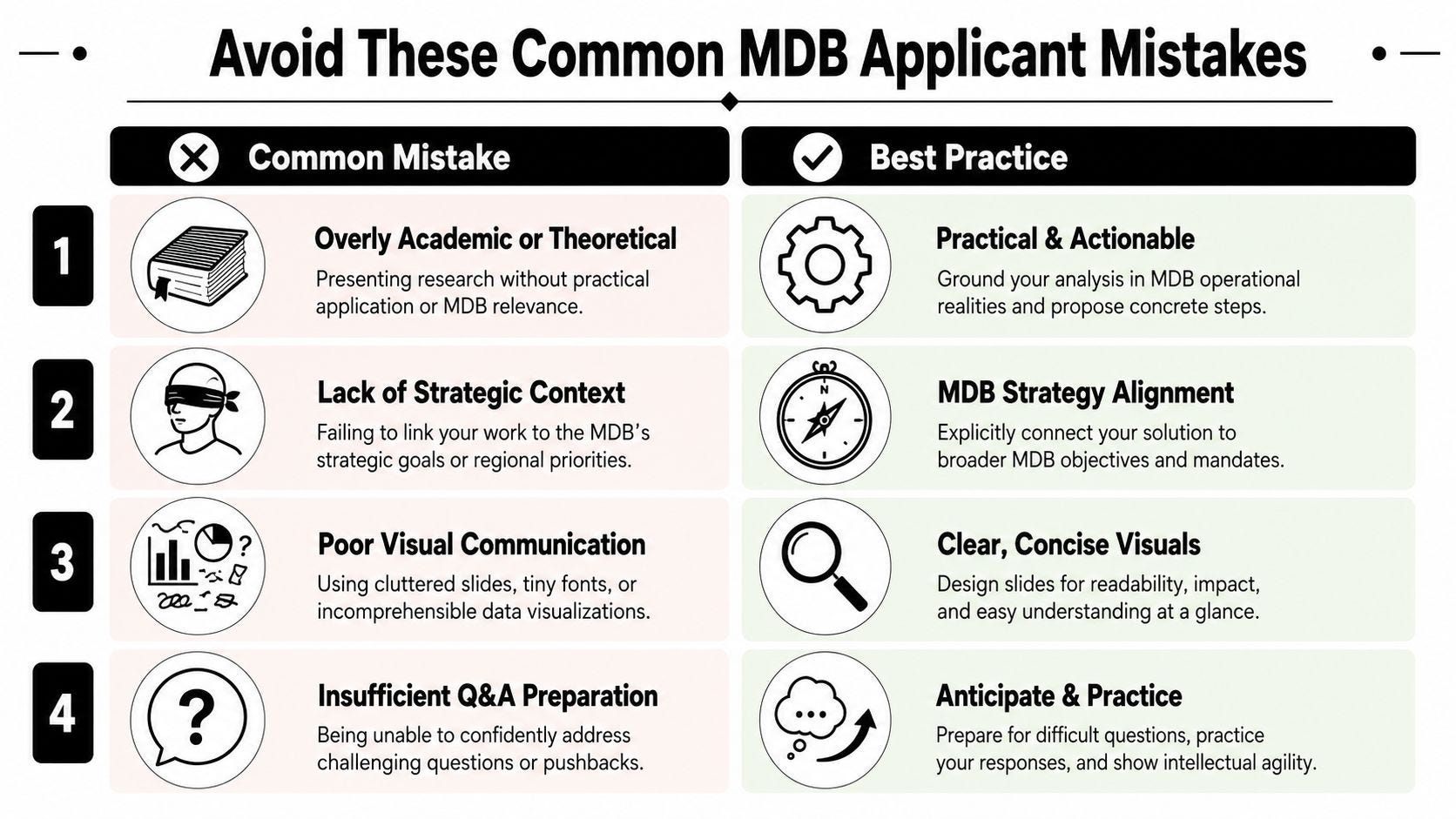
Most applicants don’t fail because they lack intelligence. They fail because they present in ways that make their intelligence unusable.
The mistakes are predictable. That’s good news for you, because predictable mistakes are easy to avoid if you’re honest about them.
Mistake one: sounding academic instead of operational
This is the classic trap. You explain the issue accurately, but you never land on a decision.
The panel hears background, caveats, and frameworks. They still don’t know what you would do. MDB hiring committees want someone who can move from diagnosis to action without pretending away complexity.
The fix is simple. Every major point should end with an implication for action. If you describe a constraint, tell the panel what that means for design, sequencing, or stakeholder management.
Mistake two: showing data without a message
Some candidates bring dense charts and call that rigor. It isn’t. It’s outsourcing the work of interpretation to the panel.
Your chart, table, or figure needs a point. If you can’t summarize the takeaway in one sentence, the visual isn’t ready. Keep reminding yourself that the committee is not grading your spreadsheet. They’re grading your judgment.
A fast test for every slide
Ask these questions before you keep any slide:
What decision does this slide support
What single message should the panel remember
Could I explain it in one short paragraph without reading it
If the answer is no, cut it.
Mistake three: managing time badly
This is more serious than most candidates realize. A lot of presentation advice spends endless time on storytelling and design while neglecting pacing. That’s a real gap. A study discussed in this article in the National Library of Medicine archive found that structured workshops improved visual material design, color schemes, and storytelling, but showed no significant improvement in time management.
That finding matches what I’ve seen. Smart applicants still run over time because they think content quality will save them. It won’t.
When you exceed the limit, you signal poor judgment. At an MDB, poor pacing suggests you may struggle with board briefings, management updates, and tightly timed client discussions.
Here’s the fix that works:

Time discipline is a proxy for executive discipline. The panel reads it that way.
Mistake four: treating Q and A like an exam
Weak candidates think they need the perfect answer. Strong candidates aim for a useful answer.
If you don’t know something, say what you would assess, what risk you’d watch, or what assumption you’d test. That sounds far better than bluffing. Panels can spot bluffing fast, especially when the room includes subject matter experts.
A good response under pressure often has this shape:
Acknowledge the core issue
State your current view
Name the uncertainty
Say what you’d do next
That’s how professionals answer when reality is incomplete. Which, in MDB work, is most of the time.
Your MDB Presentation Pre-Flight Checklist
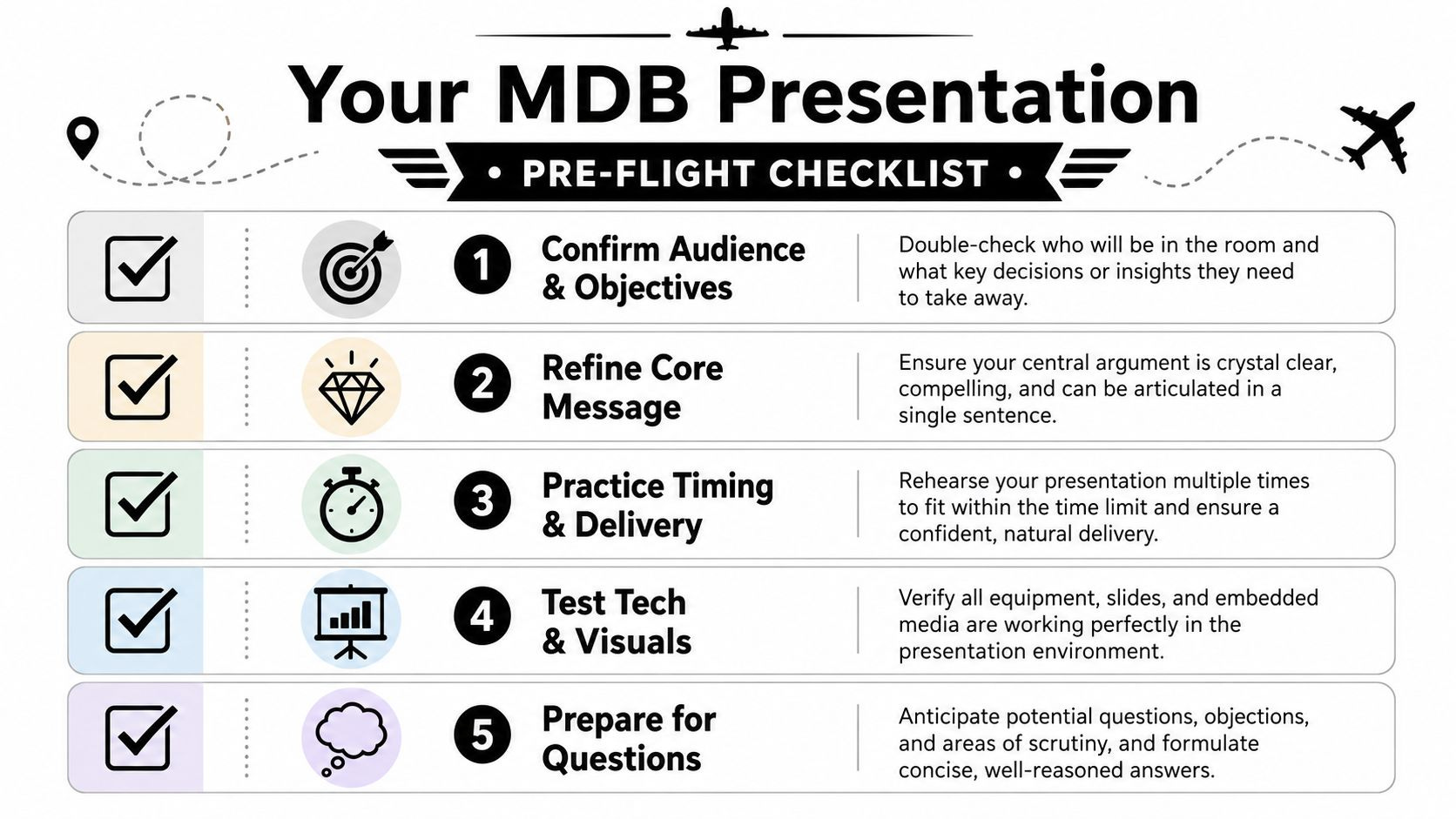
Communication and presentation skills are a known weak spot across the workforce. According to the OECD Survey of Adult Skills 2023, 26% of workers globally identify communication and presentation skills as the areas they most need to develop, as cited in Visme’s roundup of presentation statistics. In MDB interviews, you don’t get credit for sharing that weakness with everyone else. You get screened on whether you overcame it.
Use this checklist in the final hours before the interview.
Content and narrative
State your argument in one sentence. If you can’t, the deck is still fuzzy.
Put the recommendation early. Don’t make the panel wait for the point.
Check every slide title. Each one should express a conclusion, not a topic.
End on action. Your last slide should tell the room what should happen next.
Slides and data
Cut visual clutter. Small fonts, crowded charts, and copied tables weaken credibility.
Keep one message per slide. If a slide makes two arguments, split it or delete one.
Use plain language labels. The panel should understand a visual at a glance.
Check consistency. Terminology, capitalization, and formatting should match throughout.
Delivery and presence
Rehearse out loud. Silent review is not rehearsal.
Practice the opening twice as much as the middle. First impressions shape the room.
Mark your pause points. Short pauses after recommendations make you sound more senior.
Watch your pace. If you rush in rehearsal, you’ll rush harder live.
Technology and logistics
Test the deck on the device you’ll use. Formatting breaks happen.
Keep a backup file format ready. PDF is the obvious fallback.
Check your camera, microphone, and lighting if virtual. Don’t improvise on the day.
Know the timing limit cold. You should never be guessing where you are.
Questions and pressure points
List the five hardest questions you might get. Then answer them aloud.
Prepare one pushback on feasibility, one on risk, and one on prioritization.
Decide what you’ll say when you don’t know. Have a credible fallback line.
Finish answers cleanly. Don’t dilute a solid response by talking past the point.
A good checklist won’t make you brilliant. It will stop avoidable mistakes. In MDB hiring, that alone moves you ahead of a lot of otherwise qualified candidates.
If you want a steady stream of real openings, consultant roles, and practical guidance on landing work at institutions like the World Bank, ADB, AfDB, AIIB, and IMF, subscribe to Multilateral Development Bank Jobs. It’s one of the few resources built specifically for people who want MDB careers and need clear, field-tested advice rather than generic job search content.