


Hi everyone,
For those who are on the hunt for jobs at MDBs (which I’m guessing might be you), job listings dated 23 June, 2025 or older are now freely accessible. You can check out the most recent unlocked post here.
The 1st of July is an exciting day for you, if you work for the World Bank. It’s the start of the new fiscal year.
But what this actually means is that you get a pay rise. And what it also means is that the Bank releases updated information on the salary scales for the coming year.
Trying to wrap your head around the nuances of the World Bank’s salary system can be a nightmare. It depends on whether you’re recruited from overseas or not, which country you’re based in, and what grade you have.
So I’m going to do my best to break it all down for you here, so that even your grandpa can understand it.
Let’s go.
Salary Bands: From Junior to Senior Roles
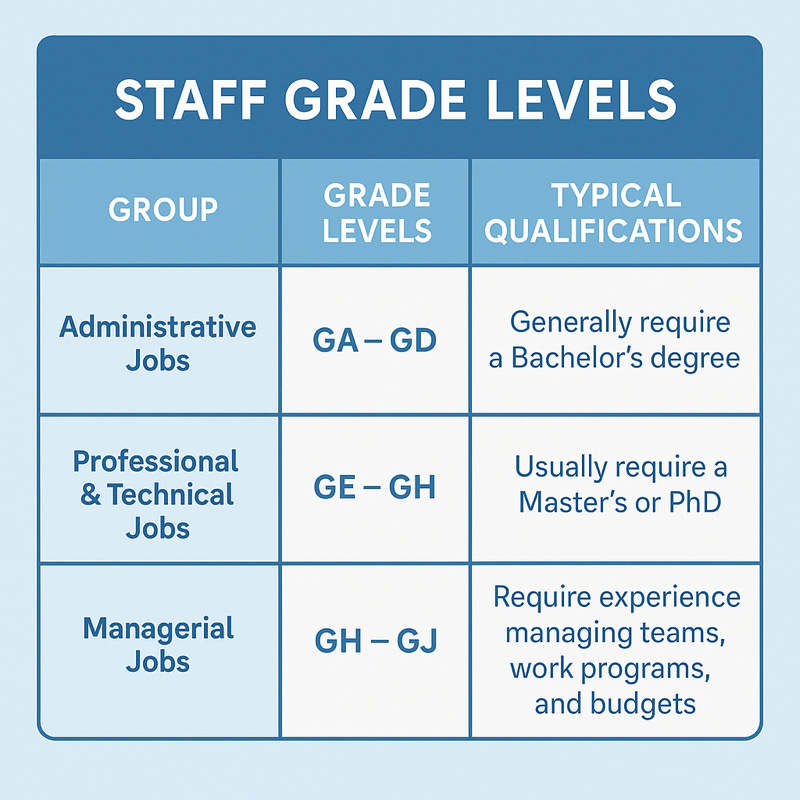
The World Bank uses a grade system (GA to GJ) to set pay, with clear distinctions between internationally recruited staff (IRS) and locally recruited staff (LRS) roles. International staff need global mobility and experience, while local roles are tied to specific country offices and don’t require relocation. These grades reflect the type of jobs you do at the Bank:
Admin jobs are considered grades ‘GA’ to ‘GD’ (who knows how they came up with these names),
Professional and technical jobs are usually grades ‘GE’ to ‘GH’,
Managerial jobs range from ‘GH’ to ‘GJ.’
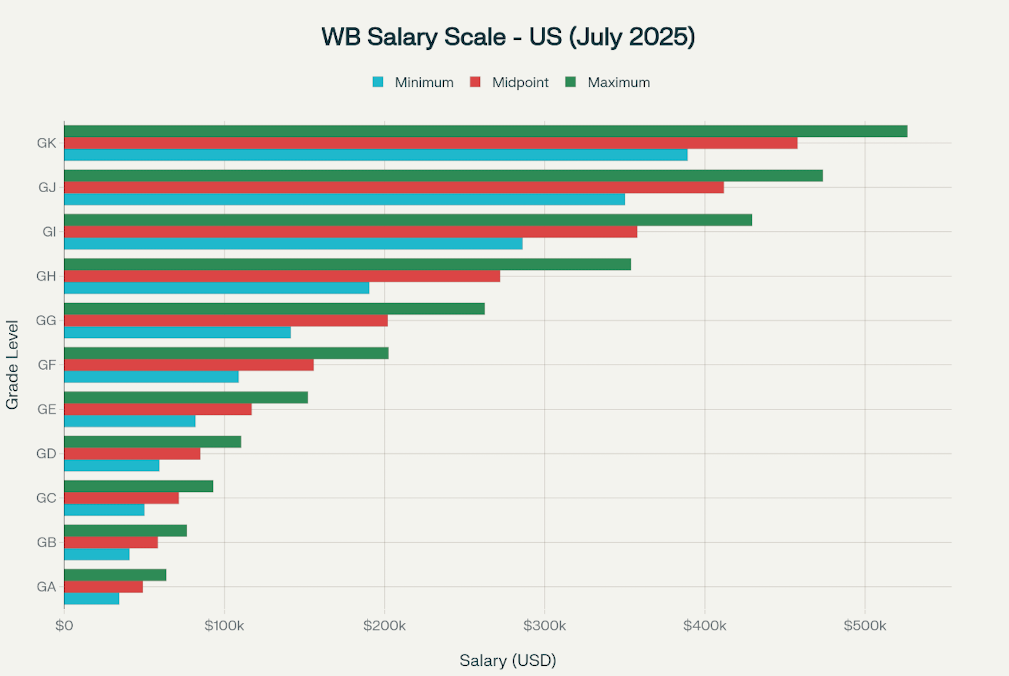
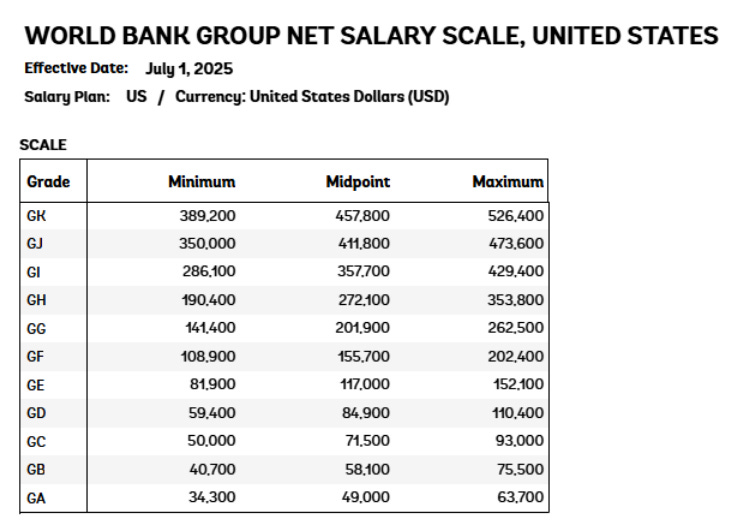
Anyway, here’s how the salaries stack up for 2025, based on the latest data.
Administrative Jobs
These are the support roles that keep the World Bank running, like program assistants and administrative assistants. Salaries vary significantly between international (IRS) and local (LRS) staff. So I’m going to compare IRS salaries to LRS salaries in my home country, South Africa.
IRS (International Recruited Staff, HQ)
Grade GA: $34,300 to $63,700. Entry-level admin roles, like program assistants, start low but include tax exemptions and mobility premiums ($15,000-$32,000 annually for non-US citizens).
Grade GB-GC: $40,700 to $93,000. Team assistants or HR support roles range from $40,700 (GB minimum) to $93,000 (GC maximum).
LRS (Local Recruited Staff, South Africa)
Grade GA: $13,800 to $25,700 ($230,400 ZAR to $427,800 ZAR converted). Basic admin roles, like office assistants.
Grade GB-GC: $16,700 to $31,800 ($285,900 ZAR to $530,900 ZAR converted). Includes roles like data entry clerks, with GC topping out at $31,800.
Entry-Level Analysts and Junior Professionals
Early-career roles, including analysts and Young Professionals (YPs), are mostly IRS due to mobility needs. YPs are usually hired at the GF level.
IRS (International Recruited Staff, HQ)
Grade GE-GF (Analysts): $59,400 to $202,400. Analysts at HQ, like data analysts, range from $59,400 (GE minimum) to $202,400 (GF maximum). Young Professionals at GF average $105,275 net, plus around $58,865 in benefits.
Grade GA (Junior Professional Associate, JPA): $34,300 to $63,700. Entry point for really new graduates, often temporary, with tax-free pay for non-US citizens.
LRS (Local Recruited Staff, South Africa)
Grade GE-GF: $34,600 to $90,000 ($576,300 ZAR to $1,500,300 ZAR converted). Local analysts in South Africa, like program analysts, start at $34,600 and reach $90,000 at GF level.Mid-Level: Specialists and Unit Heads
Mid-Level Roles
Specialists and unit heads see a significant pay increase. IRS roles often involve field work, while LRS stay local.
IRS (International Recruited Staff, HQ)
Grade GF-GG: $108,900 to $262,500. Specialists (e.g., investment analysts) earn $108,900 (GF minimum) to $262,500 (GG maximum). Senior specialists at GH hit $141,400 to $353,800.
Grade GH: $141,400 to $353,800. Senior roles, like statisticians, require expertise and global mobility.
LRS (Local Recruited Staff, South Africa)
Grade GF-GG: $48,400 to $144,570 ($807,800 ZAR to $2,429,500 ZAR converted). Specialists in South Africa range from $48,400 to $144,570, with GG roles like senior analysts at the high end.
Grade GH: $109,332 to $203,400 ($1,822,200 ZAR to $3,390,000 ZAR converted). Senior local roles, like unit heads, top out at $203,400.
Senior Leadership

IRS (International Recruited Staff, HQ)
Grade GI: $286,100 to $473,600. Directors at HQ oversee programs, with salaries reflecting 2025 scales.
Grade GJ: $350,000 to $526,400. Top roles, like Chief Officers, reach $526,400, including tax-free pay and relocation packages.
LRS (Local Recruited Staff, South Africa)
Grade GI: $171,660 to $284,160 ($2,861,000 ZAR to $4,736,000 ZAR converted). Rare local leadership roles, like country office managers, max out at $284,160.
Grade GJ: Not applicable. No LRS roles reach this level in South Africa.
The Perks: What Boosts Your Take-Home Pay
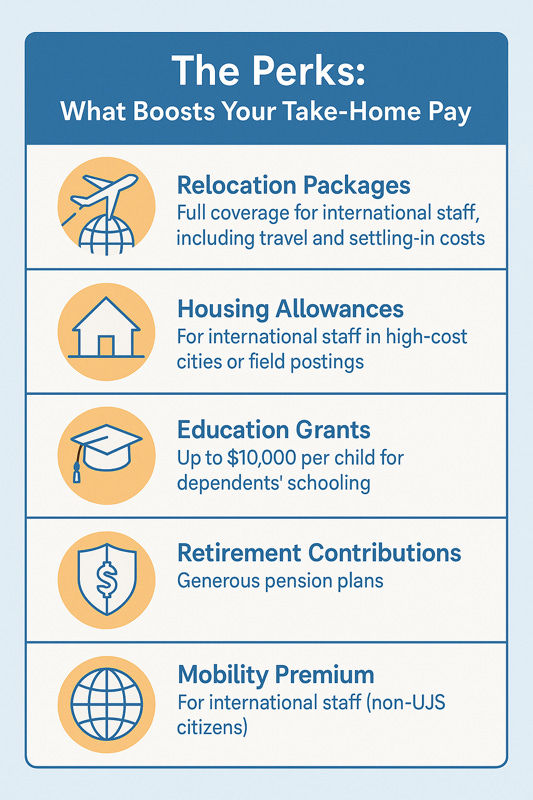
Base salary is just the start. World Bank staff get benefits that can add 10-30% to total compensation:
Relocation Packages: Full coverage for international staff, including travel and settling-in costs. Local staff rarely get this.
Housing Allowances: For international staff in high-cost cities or field postings.
Education Grants: Up to $10,000 per child for dependents’ schooling, a big win for families.
Medical and Insurance: Comprehensive health, dental, and life insurance plans.
Retirement Contributions: Generous pension plans, with employer contributions boosting long-term savings.
Mobility Premium: For international staff (non-US citizens), this adds $15,000 to $32,000 annually, depending on dependents.
Hardship allowances: Field postings (e.g., in Africa or South Asia) often include hardship bonuses for international staff, pushing total compensation higher.
These perks are more significant for international roles, as local staff often get scaled-down versions tied to local market standards.
Tax Treatment: A Game-Changer
Taxes make a huge difference. International staff (non-US citizens) enjoy tax-free salaries, which can boost effective income by 30% or more compared to private-sector jobs. For example:
A $100,000 net salary for an international hire equals roughly $130,000-$140,000 gross in a taxable private-sector role.
US citizens in local or international roles pay US taxes, but the World Bank offers gross salaries to offset this.
Always confirm tax rules with HR before signing. Your citizenship and posting location will directly impact your take-home pay.
World Bank vs. Private Sector
World Bank salaries are solid but, if you’re going to compare it to Meta paying $100m sign on bonuses for OpenAI staff, then might fall short.
World Bank salaries are solid, and when you compare actual take-home pay, they're often more competitive than they first appear.
What You'll Actually Take Home
Mid-level specialists (GG-grade) earn $141,400 to $262,500 annually. For international staff, this is tax-free, so you keep every dollar.
Compare this to top consulting: McKinsey, Bain, and BCG MBA hires earn $250,000-285,000 total compensation (including a bonus), but after federal, state, and local taxes (roughly 35-40% in high-tax cities), they take home around $150,000-180,000. A tax-free $200,000 World Bank salary gives you more spending power than a $285,000 consulting package.
Senior directors (GI-grade) make $286,100 to $429,400 tax-free. Investment banking VPs earn around $350,000+ total compensation, but after taxes, they're taking home roughly $210,000-245,000. A tax-free $350,000 World Bank salary is equivalent to earning about $540,000+ in the private sector.
The Tax-Free Advantage is Huge
This is the game-changer most people miss. Tax-free income means:
A $250,000 World Bank salary = roughly $385,000+ taxable private sector salary
A $350,000 World Bank salary = roughly $540,000+ taxable private sector salary
Local Staff Reality Check
Local World Bank staff don't get the tax-free benefit, so they're competing on straight salary comparisons. Here, the World Bank often falls short of what top private firms pay in expensive cities like DC.
The Hidden Gem for Non-Finance People
If you work in a non-finance role at the World Bank (e.g. transport, evaluation, accounting), you're taking home what finance professionals net elsewhere, but without the 80-hour weeks and job insecurity.
The Bottom Line
For international staff, World Bank compensation is genuinely competitive with top-tier private sector take-home pay, plus you get job security, excellent benefits, and meaningful work.
And if this makes you want to explore opportunities at MDBs like the World Bank, then luckily, I’ve got you covered.
I send out an email every Monday with the latest jobs from ~30 MDBs across the world.