

ADB deployed tens of billions during the pandemic response. That scale tells you what an ADB job really offers. Proximity to decisions that shape public systems, infrastructure, and labor markets across Asia and the Pacific.
Candidates who treat ADB like a prestige brand and ACES like a normal corporate application system lose ground early. ADB hiring is structured, filtered, and slower than many applicants expect. Strong profiles get screened out for basic reasons such as nationality eligibility, mismatched grade targeting, weak keyword alignment, or ACES entries that do not clearly map experience to the post.
That is why applicants need a process view, not just a vacancy alert.
A serious approach starts with three questions. Which entry pathway matches your profile. What the bank checks before any interview panel sees your file. How to submit an ACES application that survives the first cut and gives reviewers enough evidence to move you forward.
For a broader view of roles, grades, and hiring categories, see this guide to Asian Development Bank jobs.
Why an ADB Career is Worth the Effort
Few employers let one role touch sovereign lending, policy dialogue, procurement rules, and project execution at the same time. That is the unique attraction of an ADB career. The institution gives professionals a seat inside decisions that shape infrastructure, public finance, social services, private sector development, and regional cooperation across Asia and the Pacific.
That exposure changes your market value.
ADB experience signals something very specific to future employers. You can work inside a rules-based institution, write for formal decision chains, coordinate across governments and internal departments, and keep technical quality high even when approvals take time. That profile travels well across the wider MDB market, bilateral agencies, consulting, and some parts of the private sector that deal with regulated sectors or public clients.
The work carries institutional weight
ADB is large enough that even specialized roles connect to bigger outcomes. A treasury officer is not just managing transactions. A procurement specialist is not just reviewing compliance. A transport, energy, digital, legal, audit, or social development professional is usually working inside a system where the consequences reach well beyond one team or one country office.
That makes the work more demanding, but also more durable as a career asset.
Candidates often overfocus on prestige and underweight operating environment. ADB can be process-heavy. Clearance layers are real. Internal consultation can slow decisions that would move faster in a commercial setting. But those same controls are part of why ADB experience is respected. The bank needs people who can hold technical standards under scrutiny, not just move fast.
For readers comparing role types and hiring categories, this guide to Asian Development Bank jobs gives a useful overview of how ADB positions are grouped.
The upside is strong, but the trade-off is real
People compete hard for ADB roles for sensible reasons. The compensation is attractive, the benefits are usually better than many public sector employers can offer, and the institution still carries weight across international development hiring markets.
The trade-off is pace.
If you need wide personal autonomy, loose process, and fast decisions, ADB may feel restrictive. If you want structured influence, serious technical work, and a career path that remains credible across other multilateral institutions, the effort usually pays off. I have seen candidates underestimate this point. They apply because they want the brand, then struggle once they realize the job rewards patience, judgment, and institutional discipline at least as much as raw technical talent.
There is also a practical reason strong applicants return after rejection. ADB roles can lead to stable, long-horizon careers, especially for people who fit the institution’s way of working and target the right entry path from the start. That is why it makes sense to treat the process seriously, including how you position your experience in ACES rather than assuming a strong CV will carry you on its own.
The Four Main Pathways into the ADB
A large share of weak ADB applications fail before anyone assesses the candidate seriously because they target the wrong hiring track. That mistake is common in ACES. Strong people apply as if every vacancy sits in one pool, then wonder why they get screened out.
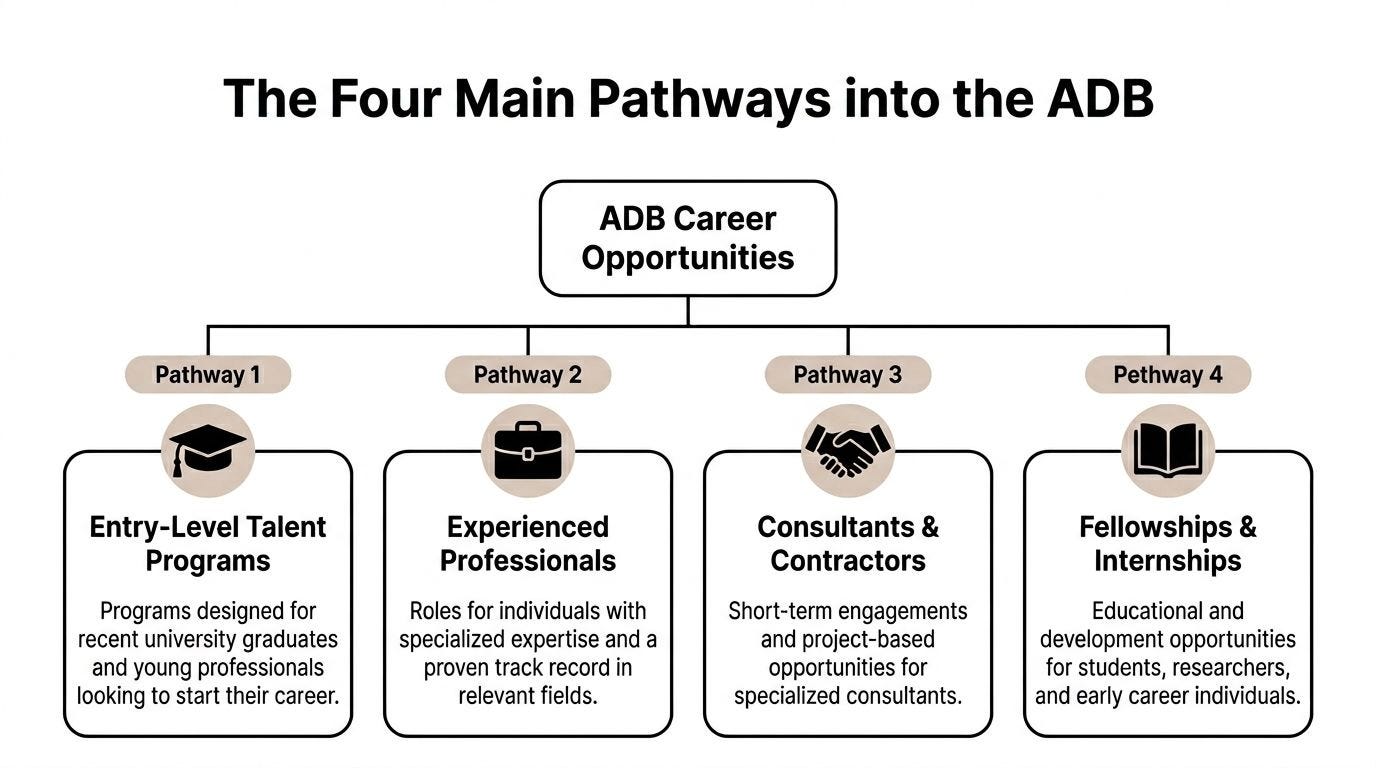
ADB runs several labor markets under one brand. The title matters, but the staff category matters just as much. It shapes who can apply, how experience is judged, what ACES asks you to document, and how much institutional commitment the bank is making.
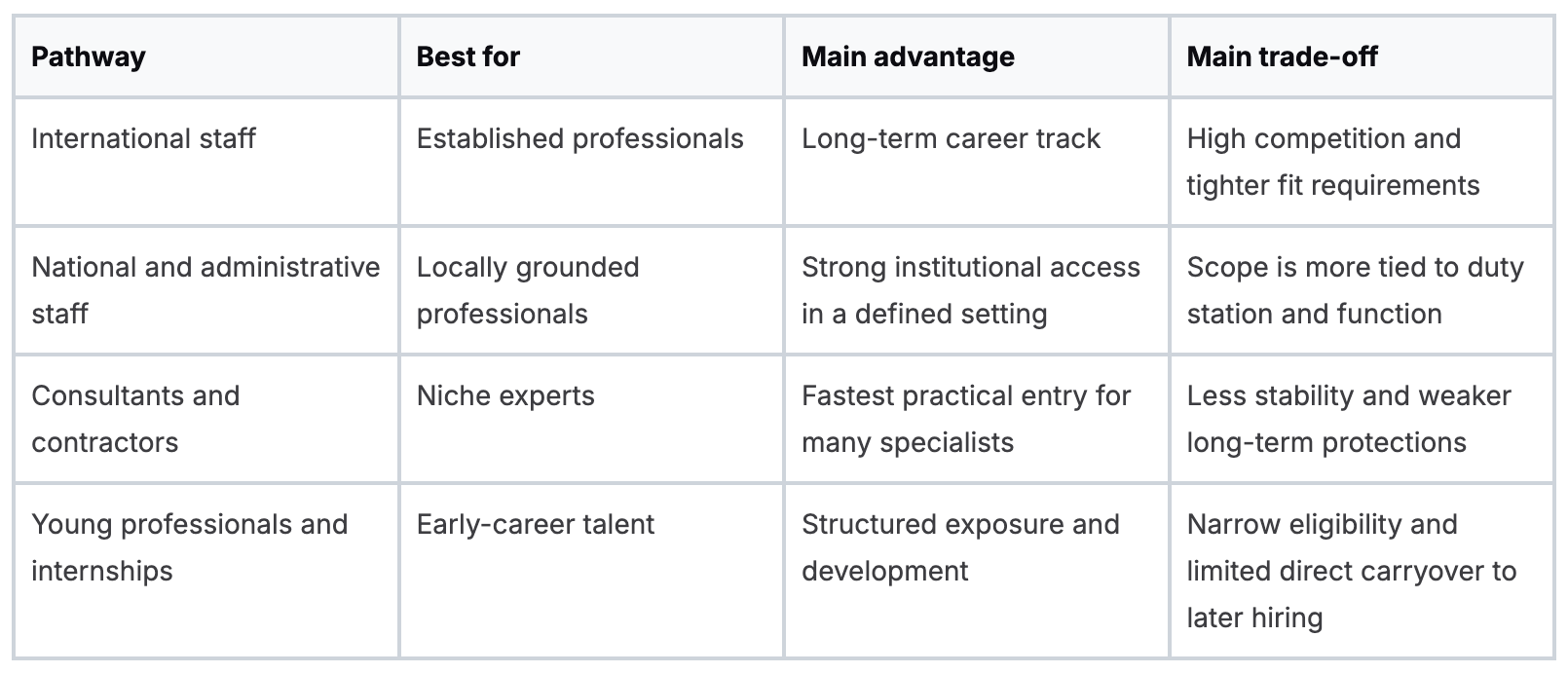
International staff
International staff roles are the main long-term professional track. They usually go to candidates with an established specialty, enough years behind them to show judgment, and experience that travels across countries and stakeholders.
This route fits people who can already operate at policy, program, or institutional level. Sector specialists, economists, finance professionals, lawyers, digital leaders, procurement experts, safeguards specialists, and operations staff often come through this channel.
Hiring managers usually look for three things:
A clear professional identity: Your profile should be easy to summarize in one sentence.
Proof you have handled complexity: Country work, sovereign clients, regulated sectors, large systems, or politically sensitive programs all help.
Writing that supports decisions: ADB places real weight on people who can draft papers, memos, and reviews that senior colleagues can use.
The common mistake is applying too early. Candidates with good technical backgrounds but thin evidence of institutional judgment often get stuck here. ACES also exposes weak fit quickly because your employment history, achievements, and answers must line up cleanly with the vacancy.
National and administrative staff
National staff and administrative roles are often underestimated by external candidates. They should not be. These positions keep resident missions, headquarters units, and internal business functions running day to day.
This path suits people with strong local knowledge, solid execution, and credibility in the duty station market. For many applicants, it is a better match than chasing an international staff title that asks for broader mobility and a different level of cross-country experience.
There is also a practical trade-off. National staff roles can give you meaningful responsibility and closer contact with operations, but the scope is tied more closely to location and local market context. Administrative roles can be a strong institutional entry point, though they do not convert automatically into professional-track progression. Candidates should apply with clear eyes about that.
Consultants and contractors
For many qualified professionals, consulting is the most realistic first entry into ADB work. The bank relies heavily on consultants for project design, implementation support, technical reviews, analytics, procurement work, safeguards, evaluation, and specialist advisory assignments.
This route works well for candidates who already know how to deliver against terms of reference without much hand-holding. It also suits experts whose experience is strong but too narrow, too recent, or too private-sector-heavy for staff hiring at that moment.
The upside is access. You can build a track record with ADB teams, learn how departments operate, and get a clearer read on whether the institution suits you.
The downside is just as real. Consultant status gives you less security, fewer long-term protections, and a different relationship to internal decision-making. I have seen candidates treat consulting as a guaranteed bridge to a staff role. It is not. It helps most when the assignment gives you visible, relevant work and strong references from the right unit.
Consultant applications do better when the candidate looks precisely matched to the terms of reference, not broadly impressive.
Young professionals and internships
ADB also has structured early-career routes, but candidates should separate them mentally. The Young Professionals Program is a selective management-track pipeline with narrow eligibility conditions and a very specific profile expectation. If that route is relevant, this ADB Young Professionals Program guide gives the detail.
Internships serve a different purpose. They provide exposure, a recognizable institutional line on the CV, and some understanding of how ADB teams work. They do not replace the professional record needed for staff roles later.
The practical rule is simple. Choose the path that fits your current evidence, not the brand label you like most.
The Eligibility Blueprint Who ADB Actually Hires
ADB screens for fit before it compares talent. That is the practical reality of multilateral hiring, and it explains why many qualified applicants never get traction.
Nationality is the first filter
ADB hires from its member countries. If you do not meet that requirement, your application will not survive the first pass. A vacancy summary for an Associate Statistics Officer role on UN Talent reflects that standard clearly.
Candidates sometimes waste weeks tailoring materials for roles they cannot legally hold. Do that eligibility check first, before you spend time on ACES, competency examples, or networking outreach.
ADB hires for role fit, not abstract promise
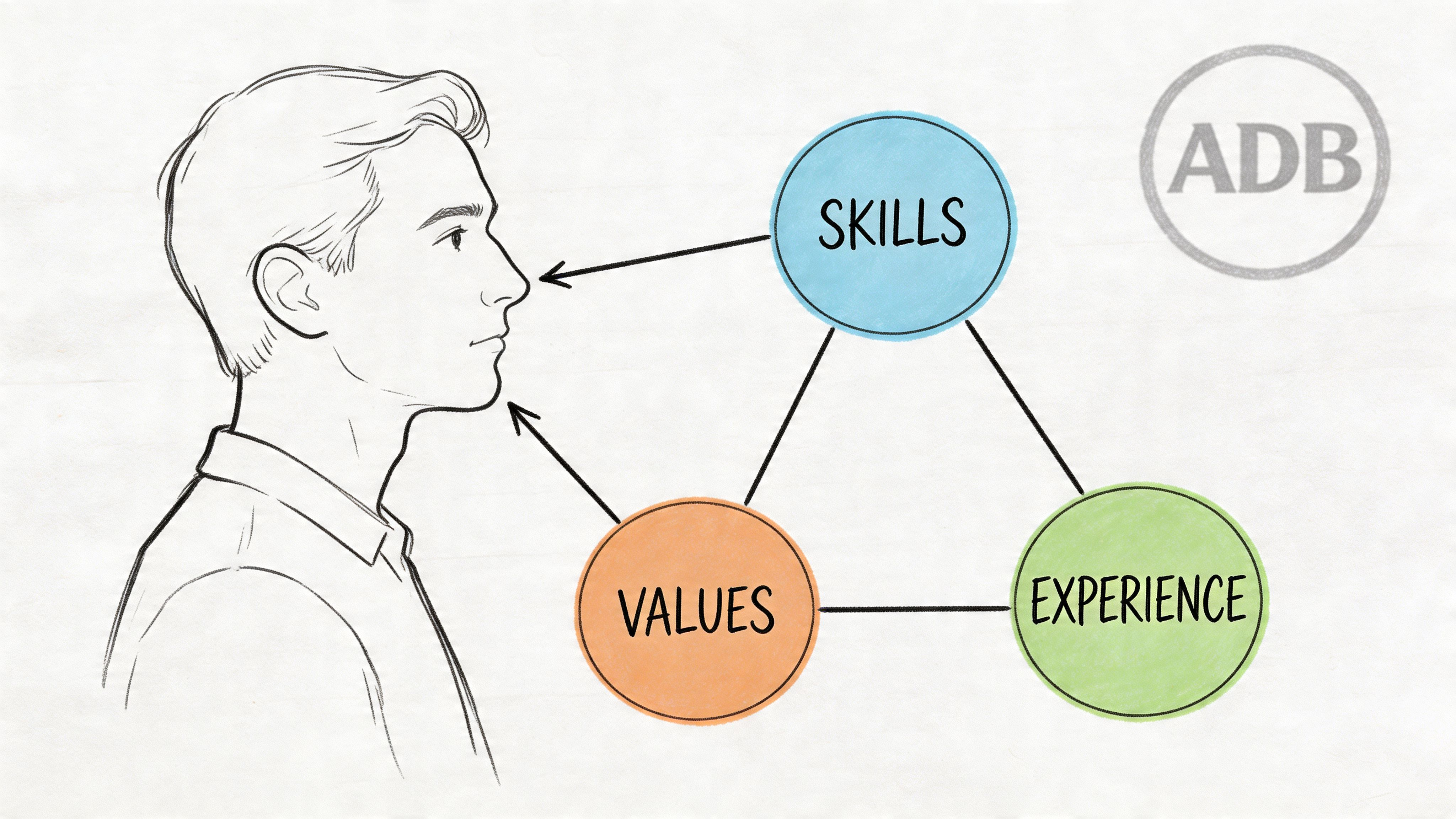
Strong candidates usually present a tight match across four points: education, functional experience, sector exposure, and written evidence of English proficiency. The bank is not looking for the most interesting profile on paper. It is looking for someone a division chief can place into a live portfolio with minimal hand-holding.
That is the unwritten rule many applicants miss.
A public policy degree, for example, does not carry much weight if the role is in transport project administration and your experience is mostly in communications. A prestigious university helps at the margins. It does not repair a weak line of relevance.
Education matters, but the match matters more
For many professional-track roles, a bachelor’s or master’s degree is part of the screen. What matters in practice is whether the degree supports the work history you are presenting.
A convincing file usually shows:
relevant academic training
several years in the same function or sector
progression in responsibility, not random title changes
examples of work that resemble the vacancy duties
This is also where candidates should be realistic about grade level. If you are targeting international staff roles, compare your background against the actual level, not the job title you prefer. ADB grade structures and pay bands give useful clues about seniority expectations, and this guide to ADB salary levels and grades can help you read that correctly.
Minimum experience usually means minimum usable experience
ADB vacancy notices often specify a floor, but hiring managers read that floor strictly. If a role asks for several years in statistics, procurement, energy, safeguards, or sovereign operations, adjacent experience only counts if the transfer is obvious.
That is why many applications fail in ACES even when the candidate looks accomplished. The profile is broad, but the evidence is thin where the vacancy is specific.
For the Associate Statistics Officer example, the listed requirements point to a candidate who can contribute early, not someone who needs a long training runway. That pattern shows up across ADB hiring. Even roles that sound junior often expect candidates who have already done similar work in government, consulting, development institutions, or regulated private-sector settings.
Contract terms tell you what ADB expects
Initial appointments are often fixed term. That should shape how you read the vacancy. ADB is not hiring for potential alone. It is hiring for output within a defined period, inside a bureaucracy that moves carefully and expects people to become productive fast.
From an insider’s perspective, the best applications answer a simple question before the panel has to ask it: can this person step into our workflow and reduce execution risk?
If your answer is unclear, do not rely on motivation statements to close the gap. Fix the evidence.
Use this three-part test before you apply:
Are you clearly eligible on nationality and location-related conditions?
Does your recent experience mirror the function in the vacancy?
Can your CV show direct contribution, not just exposure, in that area?
If one of those is weak, the right move is often to wait, build the missing proof, and apply later with a cleaner story.
Decoding Compensation and Benefits at the ADB
ADB compensation rewards candidates who assess the full employment package, not just the base salary. That is where many otherwise careful applicants misprice the offer, especially when they compare an ADB role to a domestic private-sector job with a higher cash number and weaker long-term terms.

How ADB structures pay
The first question is simple: are you looking at an international staff role or a local staff role?
ADB uses different benchmarking logic for each track. International staff at M1 to M3 levels are benchmarked against global markets. Local staff at TL1 to TL8 are benchmarked against local markets. The package can also include medical coverage, insurance, retirement benefits, and in many cases tax advantages that materially change take-home value, as noted in the ADB careers FAQ.
That distinction matters more than applicants expect. I have seen candidates reject a local staff offer because it did not match expatriate assumptions, and others underrate an international offer because they focused only on salary and ignored tax treatment and family coverage.
What the package is really buying you
At ADB, compensation is partly cash and partly risk reduction.
Medical coverage has real value for staff moving across jurisdictions or supporting dependents. Insurance matters more once you compare like-for-like with private employers rather than brochure claims. Retirement benefits become more important the longer you stay in the MDB system, especially if you may move between institutions rather than back to one domestic employer.
Duty station also changes the equation. Manila-based roles, resident mission posts, and different appointment types do not feel the same in practice, even at attractive grades. Candidates who handle this well build a simple comparison sheet before interviews and test the full package against their actual household costs.
For a more detailed look at grade logic and likely package components, this ADB salary guide is a useful reference.
Where candidates misjudge the offer
The usual mistake is a bad comparison set. Candidates line up ADB against private-sector cash compensation, then stop there.
A better comparison is below:
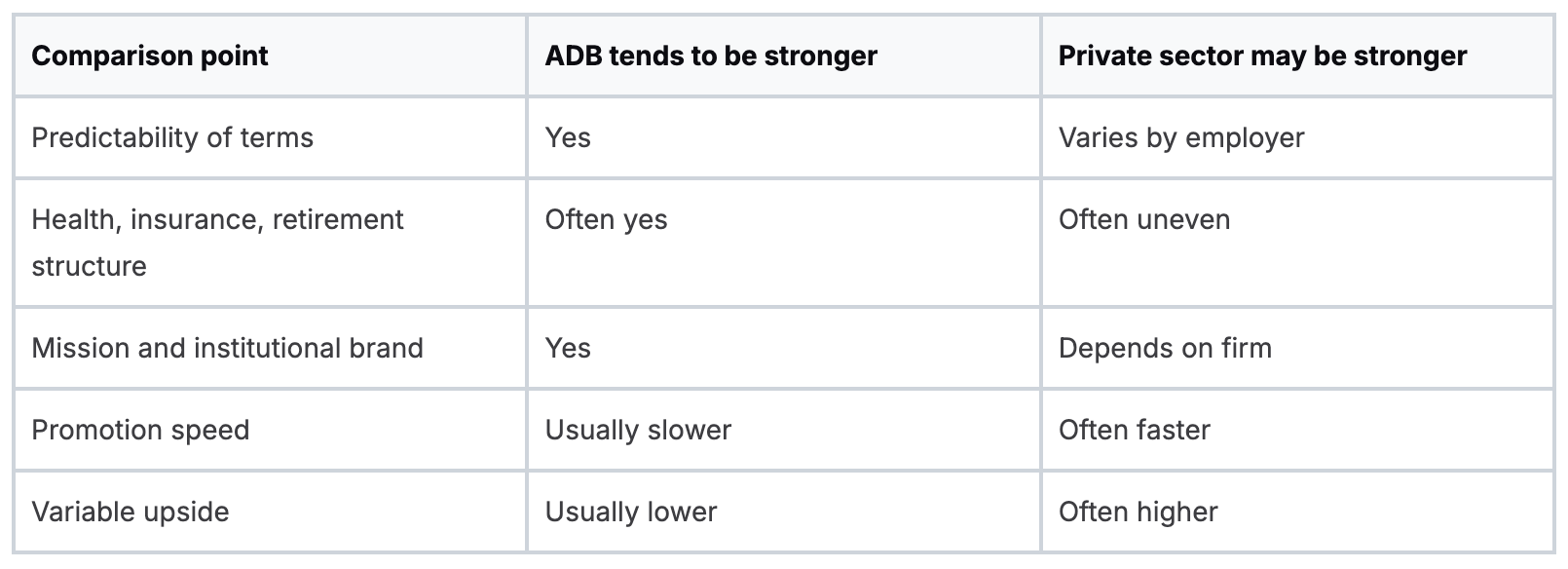
This is the trade-off. ADB often offers stronger employment quality, clearer institutional credibility, and a package that holds up well over time. The private sector may still offer faster salary growth, larger bonuses, and more room to negotiate.
Serious candidates judge ADB compensation the way hiring managers do. As a system. Salary, benefits, tax position, appointment type, and duty station all affect the true value of the offer.
Mastering the ADB Application Process and ACES
Many strong candidates falter, not because they lack substance, but because the ADB Career and Employment System (ACES) is the sole application portal and can trip people up with document uploads, rigid fields, and opaque status updates, as noted on ADB’s current opportunities page.
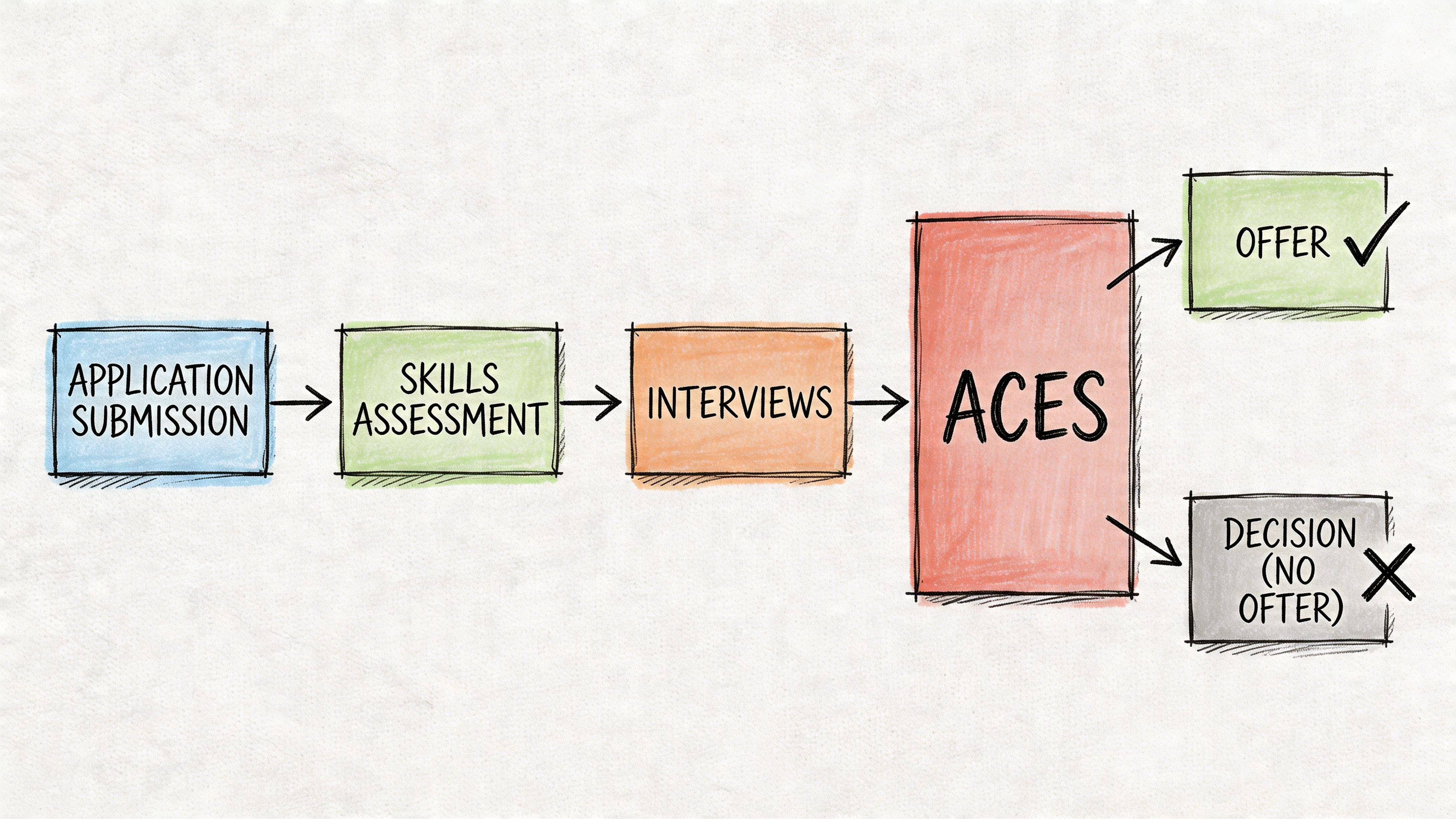
Treat ACES like a screening layer
Applicants often think the application starts after the upload works. Wrong. The application starts with how well you adapt your materials to ACES.
The portal is structured. It likes consistency. It expects formal entries for work history, dates, education, and documents. If your CV format is unconventional, heavy on graphics, or built for visual impact rather than machine readability, ACES may turn a strong profile into a messy record.
Use a plain, disciplined setup:
Chronological work history: Keep titles, dates, employers, and locations clear.
Standard file format: Use conventional document formatting and filenames.
Clean section naming: Experience, education, certifications, languages.
Simple typography: Avoid design-heavy layouts.
Build the profile before you apply
Don’t click into a live vacancy and rush the form. Create and test your profile first. Then review every field as if you were an HR screener trying to reject yourself.
A practical sequence works better:
Create the ACES account early. Waiting until the closing day is asking for avoidable trouble.
Complete the static profile fields first. Education, nationality, employment history, language capability, and contact information should already be in place.
Upload documents before the final application session. If the system rejects a file, you want time to fix it.
Apply only after the profile reads cleanly from top to bottom.
Match the vacancy language without copying it
ADB recruitment is formal. That doesn’t mean robotic. Your CV and cover letter should reflect the terms of reference closely, but they still need to sound like a real record of work.
Focus on alignment in four places:
Job title relevance
Functional keywords
Regional or sector exposure
Outcome-oriented bullets
Weak bullet:
Supported project implementation and stakeholder coordination.
Stronger bullet:
Coordinated project reporting, counterpart communication, and internal documentation for multi-stakeholder operations in a regulated environment.
The second version gives the reader a clearer picture of complexity and setting without inventing outcomes.
ACES rewards clarity. It does not reward creativity in format.
Handle uploads and formatting carefully
User complaints often center on upload failures and confusing system behavior. Since ADB’s own FAQs don’t provide much tactical troubleshooting, the safest approach is conservative formatting and early submission.
Use this checklist before you hit submit:
Filename discipline: Keep filenames short and conventional.
PDF review: Open the final PDF on another device before uploading.
No unusual fonts: If a font doesn’t embed well, the file can display badly.
No last-minute edits: Last-minute conversions create the most formatting problems.
Save confirmation records: Keep screenshots or confirmation emails if available.
If a document fails repeatedly, don’t keep changing ten things at once. Change one variable, retry, and verify.
Interpreting status messages
Candidates read too much into ACES statuses. “Under review” means very little on its own. It confirms that your application remains somewhere in process. It does not confirm active shortlist consideration, and it does not automatically signal rejection if it stays there for a long time.
The right response is procedural:
Keep monitoring the portal.
Keep records of what you submitted.
Keep applying to other suitable roles.
Don’t send unnecessary follow-ups unless the vacancy process clearly calls for it.
The cover letter still matters
Some candidates assume the system makes the cover letter irrelevant. That’s a mistake. ADB hiring teams still want a compact explanation of fit.
A strong cover letter does three jobs:
Names the role clearly
Shows direct alignment with the vacancy
Explains why your background fits ADB’s operating environment
Avoid mission-statement filler. Avoid generic enthusiasm. Show that you understand institutional work.
One more practical tool note. If you want a broader feed of openings beyond ADB’s portal, Multilateral Development Bank Jobs tracks full-time MDB roles and consultant opportunities across institutions, including ADB, in a newsletter format. That’s useful for vacancy discovery. It doesn’t replace ACES, because ACES is still the only way to submit to ADB.
A Realistic Timeline From Application to Offer
ADB hiring can feel silent even when a process is moving. The mistake is expecting a commercial-sector rhythm. MDB recruitment usually moves through more checks, more reviewers, and more scheduling constraints.
What the sequence usually looks like
A typical journey has these stages:
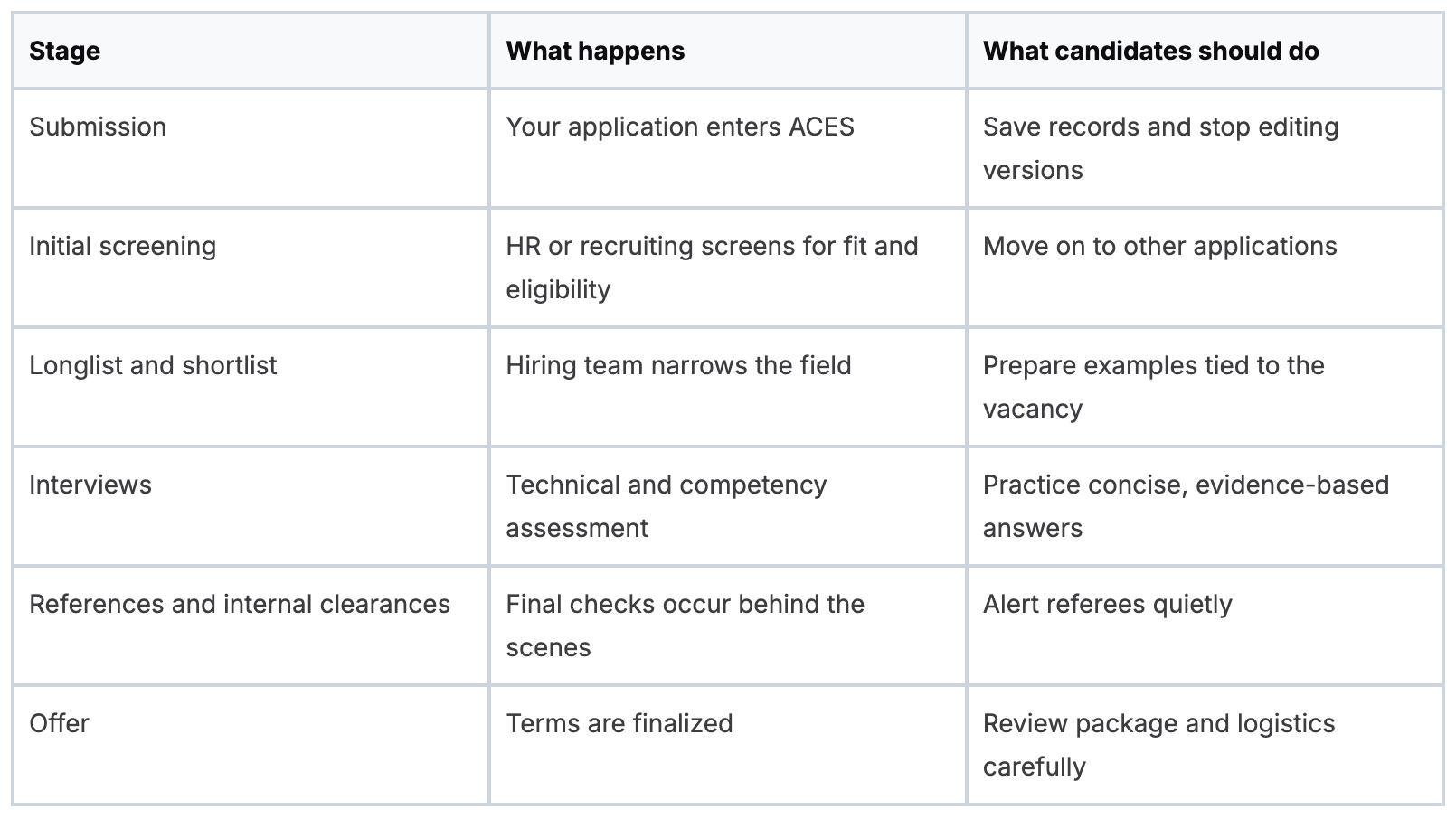
None of those stages is guaranteed to be fast. Delays happen because decision-makers travel, panels need coordination, internal approvals take time, and competing vacancies can pull attention away from your file.
What silence usually means
Silence usually means process, not necessarily failure. Candidates hurt themselves by assuming a quiet portal equals rejection and then turning up unprepared when contact finally comes.
Keep your posture steady:
Stay interview-ready: Have examples and documents organized.
Keep referees warm: Don’t overbrief them, but don’t surprise them either.
Maintain parallel applications: Never treat one ADB process as your only path.
Long gaps are normal in MDB hiring. Panic is optional.
A sample journey in practice
A realistic candidate story looks like this. You submit through ACES. The portal shows little movement for a while. Then an email arrives asking for an interview. You get limited lead time, because panel coordination often drives the schedule. After the interview, there may be another quiet stretch while references and internal approvals move.
That pattern throws off applicants who expect a clean, linear timeline. ADB rarely works that way. The better approach is to assume the process will be uneven and stay professionally responsive the whole time.
The candidates who handle this well do two things. They keep their expectations controlled, and they resist the urge to send anxious updates that add no value.
Final Tips to Make Your Candidacy Stand Out
Most applicants try to sound impressive. A smaller group makes it easy for ADB to say yes. Aim for the second group.
Show fit, not ambition
ADB does not hire ambition in the abstract. It hires role fit. Your materials should answer one question fast: why this person for this exact function in this institutional setting?
That means:
Use vacancy language intelligently: Mirror the substance, not the wording.
Keep your story narrow enough to be credible: Broad capability is less persuasive than clear relevance.
Make your progression visible: Show how one role led to the next.
Quantify only when you can defend it
If you have real scope markers in your experience, use them. If you don’t, don’t fake precision. Qualitative clarity beats inflated metrics every time.
Good phrasing includes:
Led cross-functional coordination across government and internal counterparts
Produced analytical outputs used in project or policy decision-making
Managed implementation tasks in regulated or multi-stakeholder settings
Weak phrasing includes:
Dynamic leader with excellent communication skills
Passionate about sustainable development
Results-driven professional with proven track record
Prepare for competency-based interviewing
ADB interviews often test judgment, structure, and relevance. Rambling kills momentum. So does jargon.
Prepare short examples for themes like:
Stakeholder management
Problem-solving
Working across cultures
Handling pressure or ambiguity
Technical credibility in your domain
Your answer should cover context, your role, your actions, and the outcome. Keep it disciplined.
The best interview answers sound specific, calm, and earned. They do not sound rehearsed for applause.
Respect the institution
Candidates sometimes try to outsmart MDB hiring by being overly informal, overly visionary, or overly polished. None of that helps. ADB is looking for professionals who can operate in a structured environment and still deliver substance.
Before you apply, run this final check:
Eligibility confirmed
Role choice is targeted
CV is plain and aligned
Cover letter is specific
ACES profile is complete
Interview examples are ready
Expectations are realistic
ADB career opportunities reward discipline. That’s the unwritten rule underneath everything else. Strong candidates usually know the subject matter. The ones who get hired also respect the system.
If you want a steady stream of relevant openings without checking multiple institutions manually, Multilateral Development Bank Jobs tracks full-time MDB roles, consultant opportunities, and practical career guides for candidates targeting ADB and other multilateral employers.