

If you’re targeting a role at the World Bank, you need to understand their pay structure. It’s not a corporate mystery. It’s a structured system built on professional grades, and your final paycheck is delivered net of income tax for most staff, which is a game-changer.
Your grade determines your potential salary range. Your experience pinpoints where you start within that range.
How the World Bank Salary Structure Works
Understanding World Bank compensation is straightforward once you grasp a few core concepts. The system is designed to attract top global talent, so the Bank offers competitive, tax-advantaged pay adjusted for your duty station.
It all comes down to two building blocks: grade levels and salary bands.
Grade Levels and Salary Bands
Your grade level is the most important factor. It’s the Bank’s shorthand for your seniority, the scope of your responsibilities, and your place in the professional hierarchy. A junior analyst might start at a GE grade, while a seasoned senior economist could be a GG or GH. Every job posting clearly states the grade, so you know exactly how the role is positioned.
Tied to each grade is a specific salary band. This band sets the floor, midpoint, and ceiling for the net salary you can earn at that level. Your starting pay within this band is pegged to your years of relevant experience, which places you at a specific “step.” More experience means a higher step and a better starting salary.
Your grade defines the salary potential. Your experience determines your starting point. The system provides clarity for candidates and ensures fairness across the organization.
The main pieces of your compensation package are built around a few primary elements.
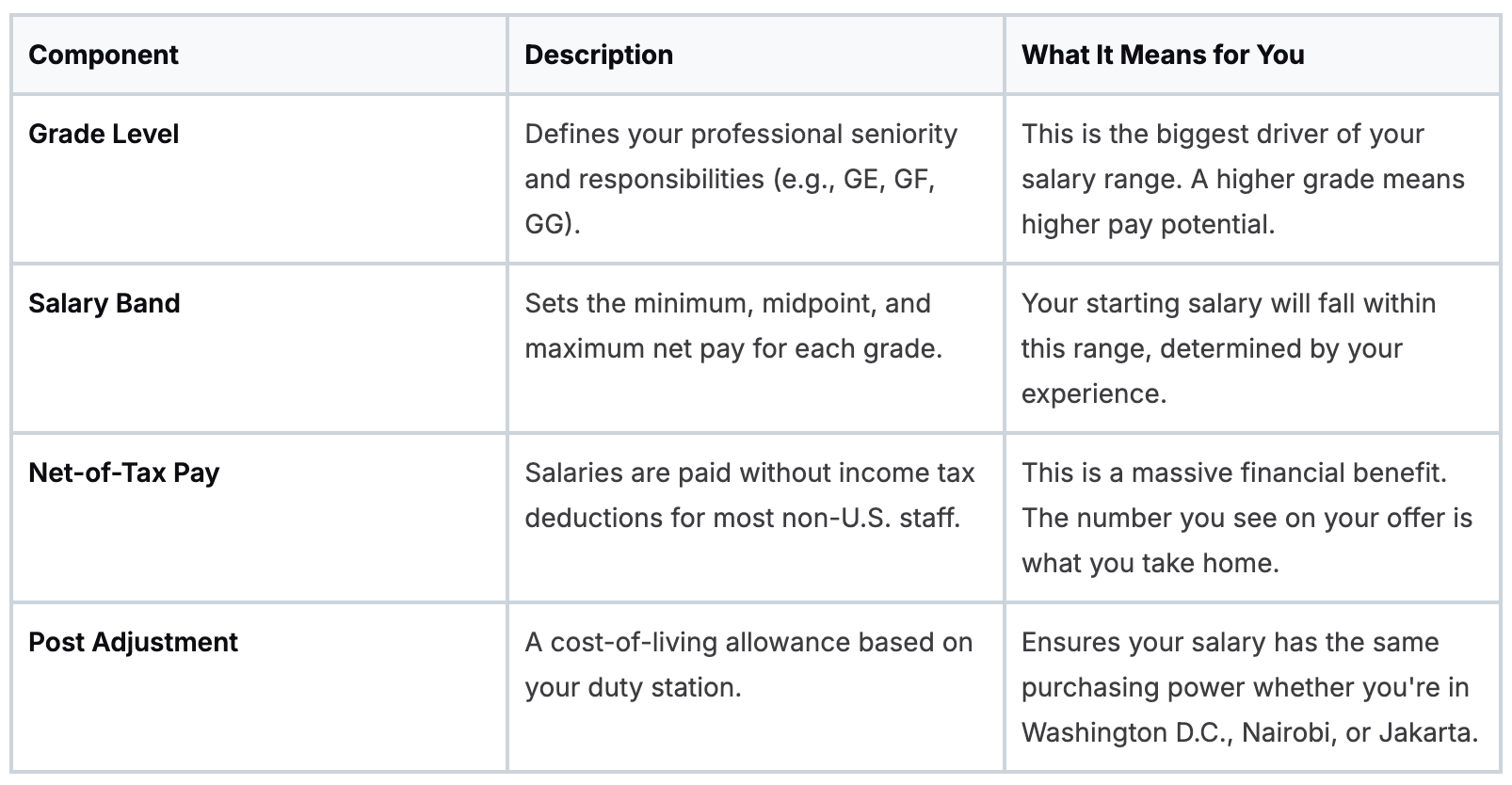
Here’s a quick summary of how it fits together.
Table: Key Components of World Bank Compensation
This table breaks down the main elements that form your total compensation package at the World Bank.
With these core concepts, you have the high-level picture. Now, let’s dig into the specific numbers and what these grades actually mean for your paycheck.
Breaking Down Grade Levels and Salary Bands
The World Bank’s career ladder is a well-defined structure of grades that maps directly to your responsibilities and salary. Understanding this is key to decoding any job offer you receive.
The entire system is split into distinct categories, from administrative roles to senior leadership, giving everyone a clear path for professional growth. Each grade is a significant step up in seniority and expectations. This hierarchy translates directly to the pay scale, where every grade has a matching salary band.
The Career Ladder From GA to GK
The grade system is straightforward. It starts with administrative and support roles and climbs to highly specialized technical and managerial positions.
Here’s a quick breakdown:
GA-GD Grades: These are the support and administrative levels. You’ll find roles like team assistants, administrative staff, and program assistants here. They are the essential backbone that keeps the Bank’s operations running.
GE-GK Grades: This is the professional and technical track where most staff land. It’s a broad category covering everyone from junior analysts and economists (GE) to senior project managers and lead specialists (GG/GH), up to department directors (GI/GJ/GK).
Your grade is your career anchor point at the Bank. When you see a job posting for a “Senior Economist (GG),” you instantly know the level of seniority and the approximate salary range that comes with it.
The diagram below shows exactly how these pieces, grade levels, salary bands, and net pay, fit together to form the core of the Bank’s compensation structure.
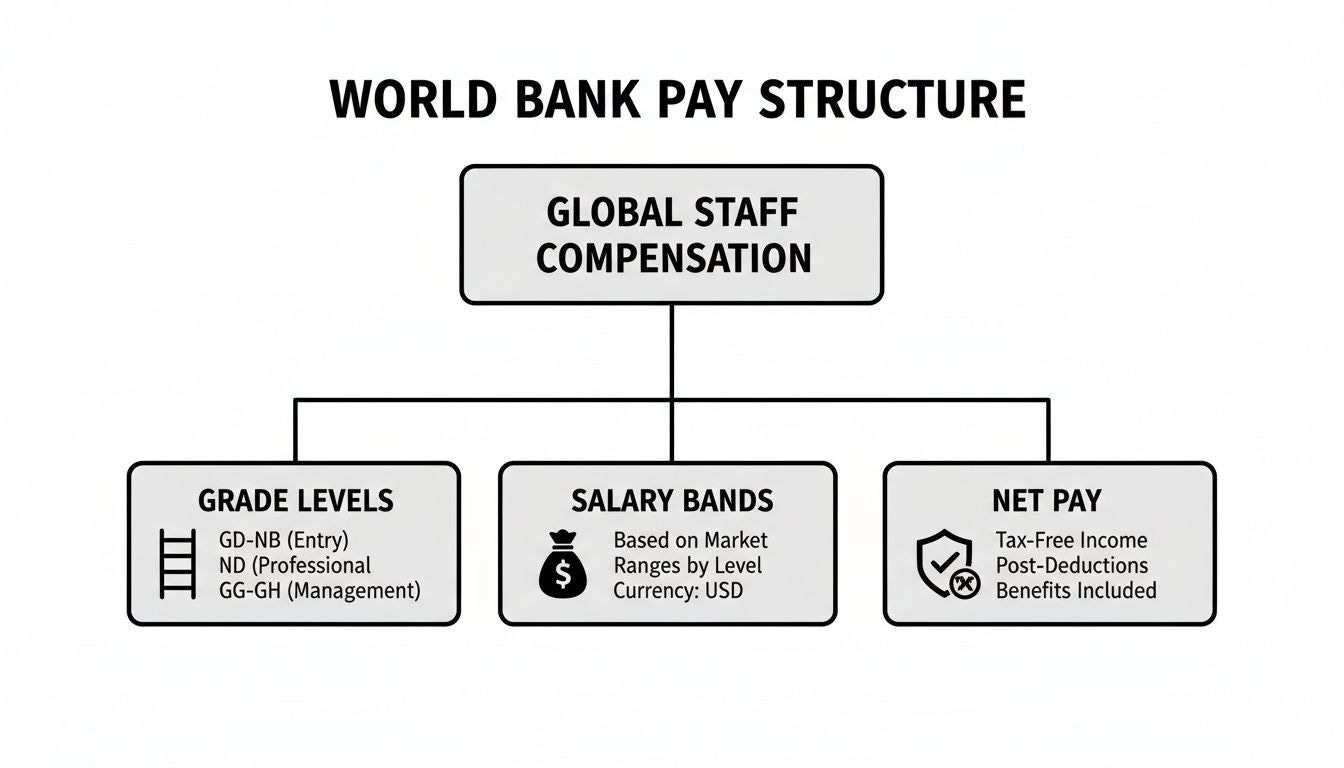
As you can see, your career progression (your grade level) is directly tied to your earning potential (the salary band), with the final take-home amount being tax-free for most staff.
Connecting Grades to Salary Bands
Every grade has a specific salary band with a clearly defined minimum, midpoint, and maximum net salary. This transparency is one of the system’s biggest strengths. You aren’t left guessing what a role is worth. The data is published in the official salary tables for everyone to see.
These bands are reviewed annually and adjusted based on market rates and inflation. This is how the Bank stays competitive in the international development world. This structured approach also creates clarity and fairness, since everyone at a specific grade and step earns a comparable salary.
Your placement within a grade’s salary band is determined by your “step,” which is based on your years of relevant professional experience. More experience means you start at a higher step, and therefore a higher net salary.
Mid-career professionals at the GF grade, the most common level, typically see net salaries from $115,000 to $165,000, depending on experience. This is perfect for those with 5-10 years in the field.
Climbing to GG senior professional roles boosts that to $160,000-$230,000, demanding proven expertise in areas like economics or infrastructure. At the top, GH lead specialists or managers command $220,000-$280,000 or higher, reflecting leadership in global projects. These bands are centered in Washington D.C., the highest-paid location, which then influences scales worldwide.
Understanding this framework is essential for any applicant. It lets you realistically determine which roles are a good fit and what compensation to expect. This knowledge is your biggest asset when evaluating an opportunity. For those interested in this career path, you can explore our deeper dive into World Bank salary bands and what they mean for candidates.
Understanding Net Pay and Post Adjustments
A World Bank salary isn’t a single, static number. Its real power comes from two concepts that shape your take-home pay: the “net of tax” salary and the “post adjustment.” If you’re looking at a role outside of Washington D.C. headquarters, you must understand these.
The baseline salary figures for a GF or GG grade are just the starting point. That number feels very different in a city with a much higher or lower cost of living. The Bank’s system smooths out these economic bumps, ensuring your compensation holds its value no matter where you’re posted.
The Power of Net of Tax Salaries
The most significant financial advantage for most World Bank staff is that salaries are paid net of income taxes. This is a massive benefit. It dramatically increases your disposable income compared to a similar private sector role where you might lose 25-40% of your gross pay to taxes.
For staff who are not U.S. citizens, it’s simple. The salary on your offer letter is what lands in your bank account. As an international organization, the World Bank has an agreement with member countries that exempts most employees’ official salaries from local income tax. This makes the compensation packages incredibly competitive.
U.S. citizens are the exception. They must pay U.S. income taxes on their earnings. To level the playing field, the World Bank provides an additional payment, a tax allowance, to cover the estimated federal, state, and local tax bills. The goal is to ensure American staff receive a net income that’s roughly the same as their international colleagues at the same grade and step.
How Post Adjustment Equalizes Purchasing Power
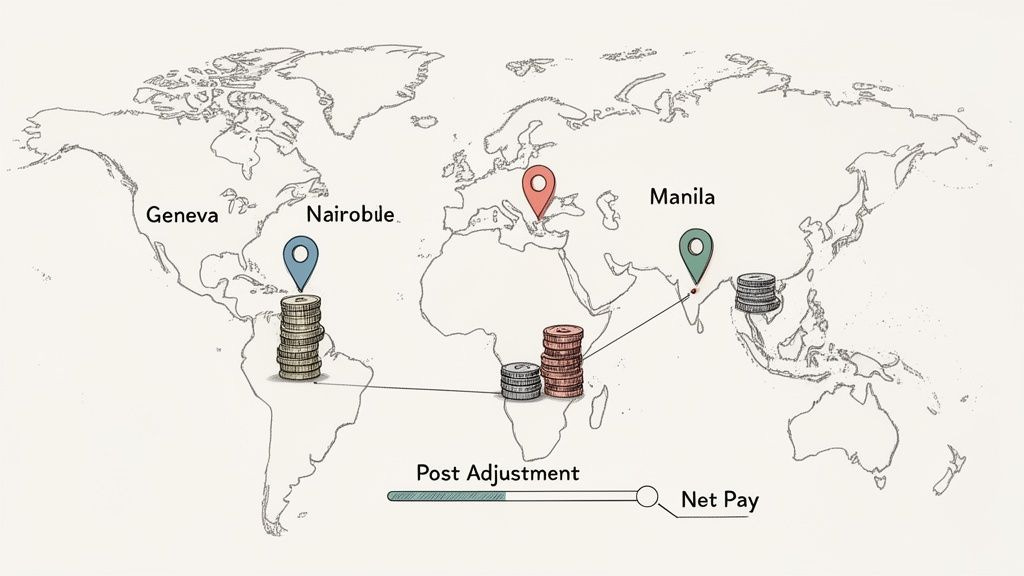
The second piece is the post adjustment. It’s a cost-of-living allowance that equalizes your purchasing power when you’re working in a country office. The logic is simple: a dollar of your salary should buy you the same amount, whether you’re in Geneva, Nairobi, or Manila.
This adjustment is calculated as a percentage of your base net salary. Washington D.C. is the base city, and every other duty station is measured against it.
Here’s how it works in the real world:
High-Cost Locations: Cities like Geneva or Tokyo have a high post adjustment percentage. Your net salary gets a significant boost to cover the higher costs of housing, groceries, and transportation.
Low-Cost Locations: In cities like Manila or Cairo, the post adjustment is lower and can even be negative. Your salary is adjusted downwards to reflect the lower cost of living, but your purchasing power remains on par with your D.C. colleagues.
This system makes global mobility at the Bank work. It allows staff to move between duty stations with different economies without taking a financial hit, making international assignments a viable and attractive part of a World Bank career.
The United Nations International Civil Service Commission (ICSC) calculates the post adjustment multipliers. They conduct detailed surveys on the cost of living in hundreds of locations, tracking prices for everything from rent and utilities to food and entertainment. It’s a data-driven process that keeps the adjustments accurate and tied to real-world economic conditions.
Don’t Just Look at the Base Salary—That’s a Rookie Mistake
When you get a World Bank offer, it’s tempting to fixate on the base salary. If that’s all you’re looking at, you’re making a classic rookie mistake. The figures on the salary scale are just the starting point. They’re one piece of a much larger, more valuable puzzle.
Judging a World Bank offer by its base salary is like judging a car by its paint job. It looks nice, but it tells you nothing about the engine, safety features, or warranty. The real power of the Bank’s compensation is in the full package, the pension, insurance, and allowances that provide serious long-term security and immediate support, especially if you’re relocating internationally.
You have to understand how all these pieces fit together to see what’s truly on the table.

Core Financial and Health Benefits
The Bank’s benefits create a rock-solid safety net for you and your family, no matter where your job takes you. These are not minor perks. They are the bedrock of the entire compensation philosophy.
Here’s what that foundation looks like:
Pension Plan: The Staff Retirement Plan is a defined benefit pension. These are rare. Both you and the Bank contribute, building a substantial fund that pays out a lifelong annuity when you retire. It’s an incredible long-term wealth-building tool.
Insurance Coverage: You get access to comprehensive medical and dental plans. The Bank also provides life and disability insurance at no cost to you. That’s a layer of financial protection you’d otherwise pay for out of pocket.
Leave Policies: The leave is generous. Annual leave, sick leave, and parental leave policies are often far better than the standards in many member countries.
These core benefits create a level of financial and personal security that is very difficult to find in the private sector.
Allowances That Make a Global Career Possible
For internationally recruited staff, the support goes further. The Bank understands that moving your family across the globe comes with real costs. A suite of allowances is there to smooth the transition and remove the financial sting from relocating.
People often wonder what these jobs actually pay. According to recent data, the average salary at the World Bank is around $134,000 per year, with most salaries falling between $112,000 and $194,000. The top 10% of earners clear over $192,000 annually. Remember, the Bank reviews its salary structure every year to stay competitive.
The World Bank’s goal is to hire you and ensure you and your family can thrive in a new duty station. These allowances are practical investments in making that happen.
Here are some of the most significant allowances for international staff:
Relocation Grant: A lump-sum payment to help cover the immediate costs of the move.
Settling-In Grant: Another lump sum designed to cover the expenses of setting up a new home.
Education Benefits: This is a huge benefit for staff with children. The Bank provides an education grant to help cover schooling costs, which is a game-changer in cities with high international school fees.
Mobility Premium: If you serve in a country office outside your home country, this premium offers an extra financial incentive for being globally mobile.
When you add the value of the pension, the robust insurance plans, and these targeted allowances, the total compensation package often blows the base salary out of the water. To get a more complete picture, you can explore our broader look at what makes up a World Bank salary. It’s a system built for a global workforce, providing security and support no matter where your assignment takes you.
How to Use the Salary Scale to Your Advantage
Knowing how the World Bank’s salary system works is one thing. Using that knowledge during the hiring process is another. The Bank’s structured system lets you enter the application and interview process with a clear view of your value and where you fit.
The trick is to move from theory to practice. This means decoding job postings, making an honest assessment of your professional background, and understanding what you can and cannot negotiate. It’s about approaching the process with confidence, backed by a solid understanding of the rules.
Decoding Job Postings to Find the Grade
Every World Bank job posting is a roadmap if you know how to read it. The most important clue is the grade level, which is almost always listed in the job title or description. You’ll see roles advertised as “Economist (GF)” or “Senior Operations Officer (GG).” That two-letter grade is your anchor.
Once you have the grade, you know the salary band. This immediately tells you the minimum and maximum net salary the Bank has budgeted for the role. It removes the guesswork and lets you decide right away if the position aligns with your financial expectations.
Don’t just skim the job title. Look for the grade letters like GF, GG, or GH. This is the single most valuable piece of data for understanding a role’s compensation potential.
If a job posting lists a range of grades, like “GF/GG,” it signals that the hiring team is open to candidates with different levels of experience. Someone with 7 years of experience might land the GF spot, while a pro with 12 years could come in as a GG. In these situations, your qualifications directly decide the grade you’re offered.
Realistically Assessing Your Experience
After you’ve identified the grade, the next step is to look inward. The World Bank is systematic about valuing experience. Your starting salary within a grade’s band is driven by the number of years of relevant professional experience you have. A brutally honest self-assessment is key.
Don’t just count the years since you graduated. Zero in on the experience that speaks directly to the job’s requirements. If you’re applying for a Transport Specialist role, your five years in transport policy are gold. Those two years in an unrelated field? Not so much.
Here’s a general guide to map your experience to the most common professional grades.
Table: Mapping Experience to World Bank Grades
This table is a rough guide to help you estimate the right grade level based on your years of relevant professional experience. It’s not a hard rule, but it’s a solid starting point for figuring out where you fit.
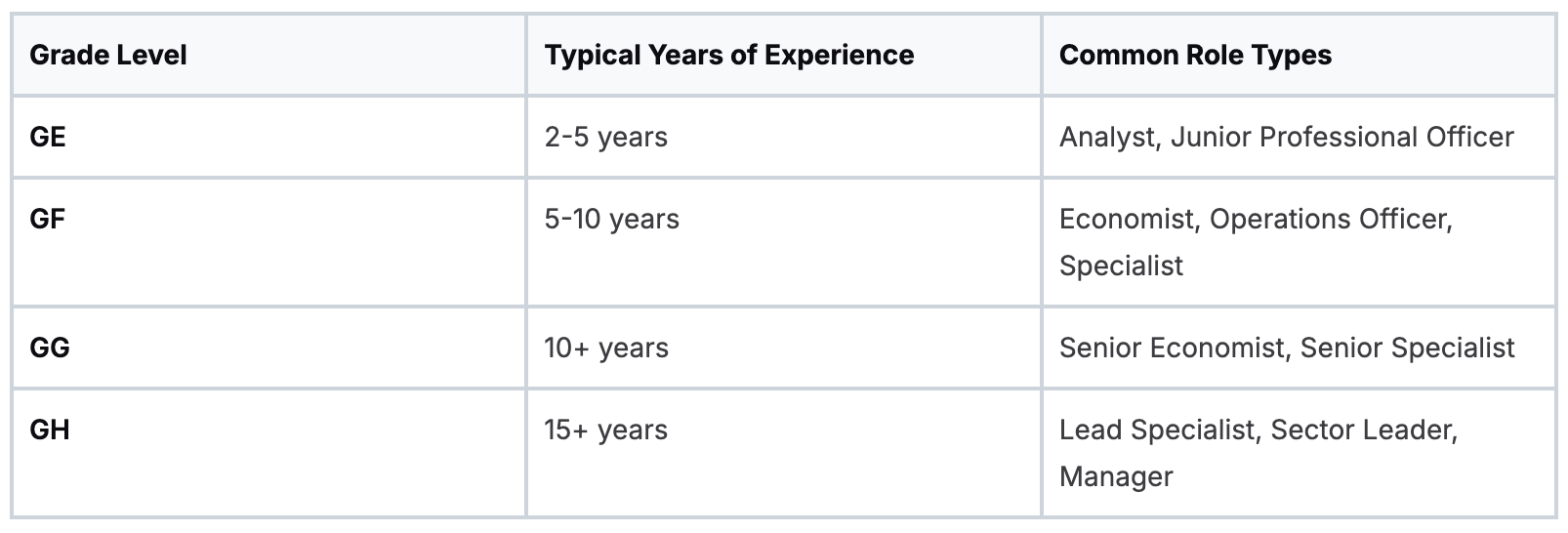
Use this as a reality check. If a role is posted as a GG and you have seven years of experience, it might be a stretch. If you have 15 years of deep expertise and are looking at a GF role, you might be overqualified or should be aiming for the absolute top of that grade’s salary band.
What You Can and Cannot Negotiate
The World Bank’s highly structured pay system means some things are set in stone, but you still have some room to maneuver. Understanding this difference is crucial.
Here’s what’s fixed: you cannot negotiate the salary band for a given grade. The minimums and maximums are locked in by the official World Bank salary scale and are non-negotiable. An HR manager has zero authority to offer a salary above the maximum for the grade you’re being hired into.
However, you can negotiate your starting step within that band. Your placement on the step ladder is based on how the Bank credits your experience. If you believe your unique skills or extensive background justify a higher starting point, you can make a case for it. This is your primary point of leverage. Come prepared with a clear, evidence-based argument for why your experience warrants a higher step and therefore a higher starting salary within that pre-defined band.
How World Bank Pay Stacks Up Against Other MDBs and the UN
When you’re looking at a World Bank offer, you need perspective. How does it compare to the other big players in international development?
The short answer: very well. But the details matter.
The World Bank, its sister organization the IMF, and other Multilateral Development Banks (MDBs) are all competing for the same elite global talent. Their compensation packages are designed to win.
The IMF is often cited as the top payer, with a salary scale that can edge just ahead of the World Bank’s at similar grade levels. Both institutions share the same superpower: a net-of-tax salary. This single feature puts them in a different league from most other employers. Factor in their powerful defined-benefit pension plans, and you’re looking at a total compensation package that’s hard to beat.
The Broader MDB and UN Landscape
What about the rest of the field? Regional MDBs like the Asian Development Bank (ADB) or the African Development Bank (AfDB) also provide compelling, tax-advantaged offers. While their base salary numbers might look different, they operate on the same core principle: provide a package that guarantees a high standard of living and solid financial security, whether you’re based in Manila or Abidjan.
The biggest difference comes when you look at the United Nations system. The UN has a unified salary scale for its professional staff across all its agencies, like UNDP and UNICEF. It’s a competitive scale and also uses a post adjustment system to even out purchasing power across the globe. But when you put the numbers side-by-side, the World Bank and IMF salary scales are generally a step above the UN’s base pay.
The key takeaway is this: the World Bank and IMF are at the peak of the pay scale in this sector. Regional MDBs are close competitors. The UN system, while offering good pay and benefits, typically doesn’t match the net salaries at the Bretton Woods institutions.
At the end of the day, while the IMF might have a slight edge on paper, the World Bank’s overall package is incredibly strong. When you line up the World Bank salary against its peers, it’s obvious the institution invests heavily to bring in and keep the best in the business.
For a deeper dive into how the big three stack up, you can learn more about how the World Bank, IMF, and ADB compare for career opportunities. This bigger picture is crucial for understanding the true value of any offer on the table.
Answering Your Top Questions
Let’s clear up a few of the most common questions people have about World Bank salaries. Getting these details right is key to seeing the full picture.
How Is My Starting Salary Actually Determined?
Think of it as a two-part formula. Your starting salary is a direct result of the grade of the job and your years of relevant professional experience.
First, the grade (like GF or GG) sets the salary band, which has a fixed minimum and maximum. Then, your specific experience determines where you land within that band. This is called your “step.” More years of directly applicable experience push you to a higher step, which means a higher starting salary. It’s a structured process, built to be fair and consistent.
Are World Bank Salaries Really Tax-Free?
For most staff, yes. If you are not a U.S. citizen, your World Bank salary is paid net of income taxes. This is a huge financial advantage. The number on your offer letter is what you take home. This setup is part of the Bank’s status as an international organization.
The big exception is for U.S. citizens. They are required to pay U.S. income taxes on their earnings. To level the playing field, the World Bank gives them an additional payment, a “tax allowance,” designed to cover their estimated U.S. federal, state, and local tax burdens. The goal is to make their final net pay comparable to that of their non-U.S. colleagues.
How Often Does the Salary Scale Get Updated?
The World Bank salary scale is reviewed and adjusted annually. This usually happens at the start of the fiscal year to keep up with inflation, cost-of-living changes in Washington D.C., and shifts in what comparable organizations are paying.
This annual adjustment is crucial. It’s how the Bank ensures its compensation stays competitive enough to attract and retain top-tier global talent in economics, development, and finance.
This regular update means the salary bands for each grade don’t get stale. It’s a key mechanism for maintaining the real value of the compensation package over time. You can always find the most current salary scale on the World Bank’s official careers page.
Navigating the world of MDB careers requires insider knowledge. At Multilateral Development Bank Jobs, we deliver curated job lists and expert guides directly to your inbox, giving you the edge you need to land your next role. Subscribe for free to start your journey:
https://mdbjobs.com