


Your MDB career starts with the right master’s degree. That sounds obvious, but most applicants still choose programs the wrong way. They chase broad prestige lists even though existing rankings lean hard toward academic reputation and general brand value, while leaving a real gap around MDB-specific employability, which is exactly the problem applicants on GradCafe’s discussion of top international development programs keep pointing out.
That gap matters because MDB hiring is narrow. The World Bank, IMF, ADB, AfDB, and IDB don’t recruit for one generic “international development” profile. They hire economists, operational staff, governance specialists, climate and infrastructure analysts, public finance people, and program managers. A degree that works for an NGO job or a policy fellowship might not carry the same weight for a Young Professionals pipeline or an economist shortlist.
The best graduate programs for international development are the ones that match the job family you want. If you want economist-track roles, your program needs serious quantitative training. If you want operations, lending, and implementation work, field exposure and project design matter more. If you’re mid-career, program format matters because stepping out of the workforce for two years can be the wrong trade.
I’m treating this as a career strategy guide, not a vanity ranking. These seven programs show up again and again because they solve real hiring problems. They build the skills MDB teams screen for, they offer recognizable credentials, and they put you in ecosystems where internships, consultant work, and alumni referrals happen. Some are expensive. Some are brutal academically. Some are better for operations than economics. That’s the useful part.
1. Harvard Kennedy School, MPA/ID
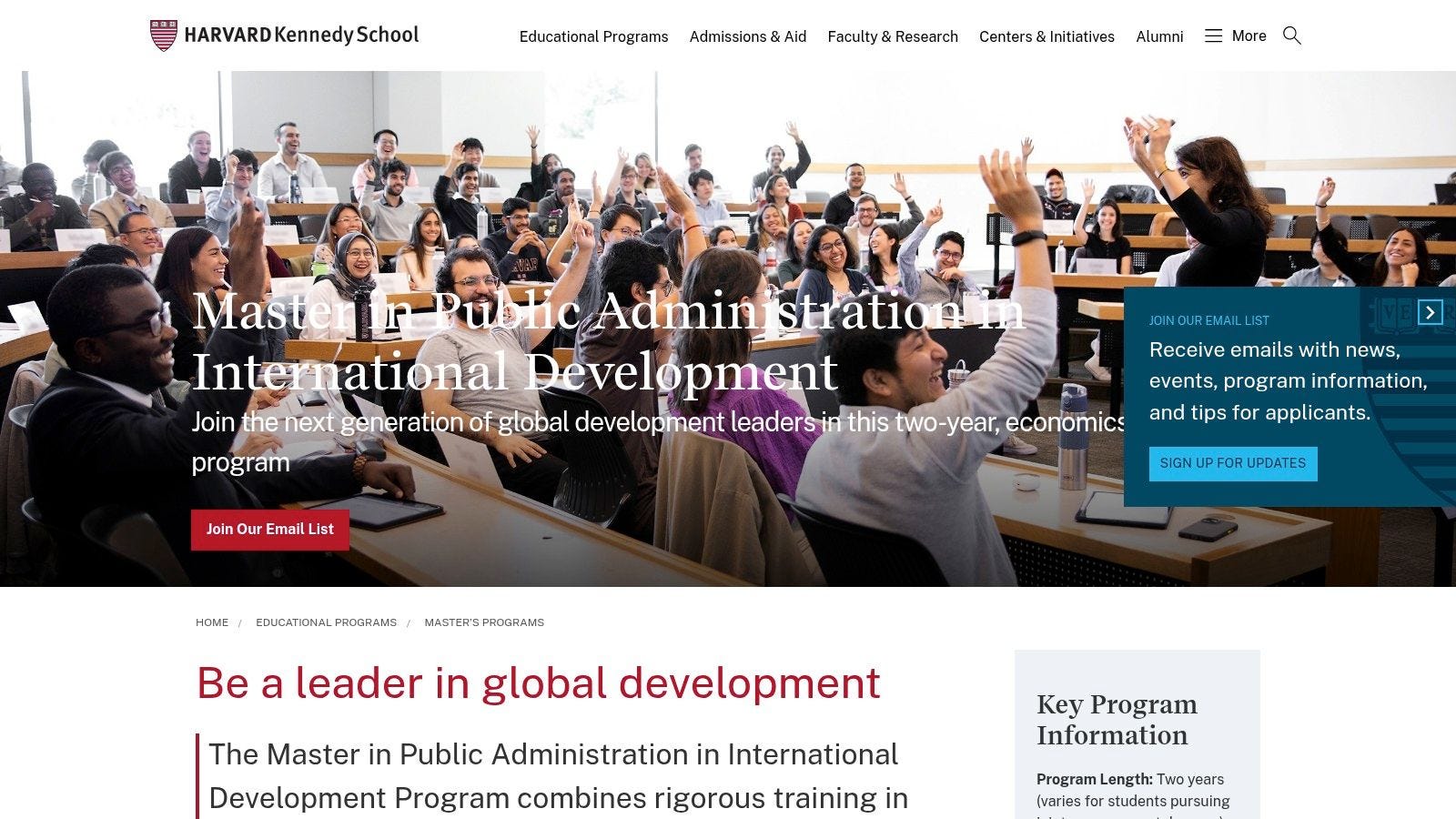
Harvard Kennedy School’s MPA/ID is the cleanest answer for candidates targeting MDB economist and policy-economics tracks. If your ambition is to work on macro, poverty, public finance, growth, labor, or impact evaluation inside an MDB, this is one of the strongest launchpads available.
The reason is simple. The curriculum is built around advanced economics and quantitative analysis, not around general international affairs branding. Hiring managers notice that difference immediately.
Why it works for MDB hiring
MPA/ID has the right academic signal. It tells employers you can survive and contribute in teams that work with country diagnostics, lending operations, economic memoranda, fiscal analysis, and evaluation work. That matters for economist-heavy institutions and for policy units inside broader MDBs.
The other advantage is ecosystem density. You get faculty who are strongly tied to development economics, cross-registration options across Harvard and MIT, and a second-year applied capstone that gives you client-facing work you can discuss in interviews.
Practical rule: Choose HKS MPA/ID if you want to be screened first for analytical strength. Choose something more applied if you want to be screened first for field operations.
A lot of applicants underestimate how much MDB interviews reward technical confidence. If you can’t explain identification strategy, causal inference limits, fiscal tradeoffs, or the implementation risks behind a policy recommendation, brand name alone won’t save you.
Where it fits and where it doesn’t
This program is strongest for people with real math and economics preparation. If you already have that base, HKS can sharpen it into something employers trust. It also pairs well with candidates aiming for junior economist paths and stepping-stone roles like the World Bank Junior Professional Associate track, especially when combined with internships or prior public sector experience.
The trade-off is cost. The sticker price is high, and that changes the risk calculation if you’re entering a field where many first jobs are fixed-term, consultant-based, or modestly paid relative to private-sector alternatives. You need a financing plan before you romanticize the brand.
Another hard truth: this isn’t the best fit for everyone who says they want “development.” If your target role is operational delivery, stakeholder engagement, social development, or project management, the program can still work, but there are more direct routes.
Best for
Economist-track candidates: Strong fit for World Bank, IMF, and regional bank analytical roles.
Quant-focused policy professionals: Best if you want rigorous training in econometrics, macro, and evaluation.
Applicants with solid preparation: You need comfort with math and economics before day one.
2. Princeton University, SPIA MPA
Princeton SPIA’s MPA changes the decision in one significant way. It cuts financial risk. For anyone serious about an MDB, government, or public-interest path, that matters more than applicants like to admit.
Debt shapes career choices. Programs that look attractive on paper can subtly force graduates away from development jobs and toward higher-paying exits. Princeton removes a lot of that pressure because admitted MPA students receive full funding for tuition, required fees, health insurance, and typically a living stipend.
The funding advantage is real
That funding structure gives Princeton an unusual advantage in this comparison. You can take an MDB internship, a summer placement, or an entry role without making every decision through a debt-service lens. In this field, that freedom is strategic.
The program itself is broad rather than narrowly technical. That works well for applicants who want a blend of economics, politics, policy analysis, and public management rather than a pure development economics degree.
The strongest feature of Princeton isn’t specialization. It’s optionality without debt.
That’s a serious advantage for candidates still deciding between MDBs, ministries, think tanks, and public-sector reform work. The small cohort and intensive advising also help. Students tend to get more direct attention than they would in larger policy schools.
Best fit for public-interest and MDB pathways
Princeton’s required summer internship matters because internships are often where MDB careers become real. A summer role can turn into a consultant relationship, a reference, or the first line on your CV that makes later applications credible.
The downside is that SPIA is generalist by design. If you want a hard-core economist identity, HKS MPA/ID or Columbia’s EPM will send a clearer signal. Princeton can still get you there, but you may need to build that profile through course selection and prior experience.
It’s also extremely selective. That sounds obvious, but it affects strategy. This is not the program to build your whole plan around if your profile is still developing. Treat it as a high-upside option, not your only shot.
What Princeton does especially well
Reduces career risk: Full funding supports lower-paid but high-value early career choices.
Builds broad policy judgment: Strong for future MDB staff who’ll work across policy, operations, and institutions.
Supports internship conversion: The summer structure helps you turn school into an actual career pathway.
For candidates who want elite training without carrying financial pressure into a development career, Princeton is one of the smartest plays in the market.
3. Columbia University SIPA, MPA in Economic Policy Management
Columbia SIPA’s MPA in Economic Policy Management is built for a specific kind of candidate. If you already work in a ministry, central bank, regulator, or policy unit and you want a fast, technical upgrade, EPM is one of the strongest options on the board.
This isn’t a broad “global affairs” degree dressed up as development. It’s a focused program in macroeconomics, fiscal policy, monetary policy, and economic management. That orientation lines up well with MDB departments that care about country policy, debt, public finance, and reform implementation.
A strong fit for mid-career professionals
The one-year format is the main attraction. You step out of the labor market for less time, finish quickly, and return with a tighter technical profile. For professionals who already have experience, that can be much smarter than spending two full years in school.
The pace is compressed, though. That means fewer electives, less time for exploration, and less margin for weak fundamentals. You need to arrive ready to work.
A second reason EPM stands out is proximity. New York gives students access to the UN ecosystem and international policy traffic that comes with it. For some candidates, that creates useful side channels for networking, events, and practitioner exposure.
The right signal for analytical roles
If you’re applying to economist or economic management roles, this degree sends a clearer message than many general international development programs. It says you trained in the language that ministries and IFIs use every day.
That also means your candidacy needs to hold up technically. If you want to sharpen that side before applying or interviewing, spend time building your analytical skills for MDB careers alongside the degree itself.
EPM works best when you already have a professional story. The degree strengthens it. It doesn’t invent it.
The main drawback is cost concentration. A one-year program shortens time away from work, but the total price is still high, and scholarship competition is tough. Candidates sometimes assume “one year” means “financially easy.” It doesn’t.
Choose EPM if you want
A technical mid-career reset: Strong for ministry, central bank, and policy professionals.
Macro credibility: Especially relevant for sovereign finance, reform, and country policy roles.
Speed: You can upgrade your profile without disappearing from the market for two years.
For professionals already on a policy track, SIPA EPM is one of the most efficient routes into MDB-relevant economic work.
4. Johns Hopkins SAIS, MAIR
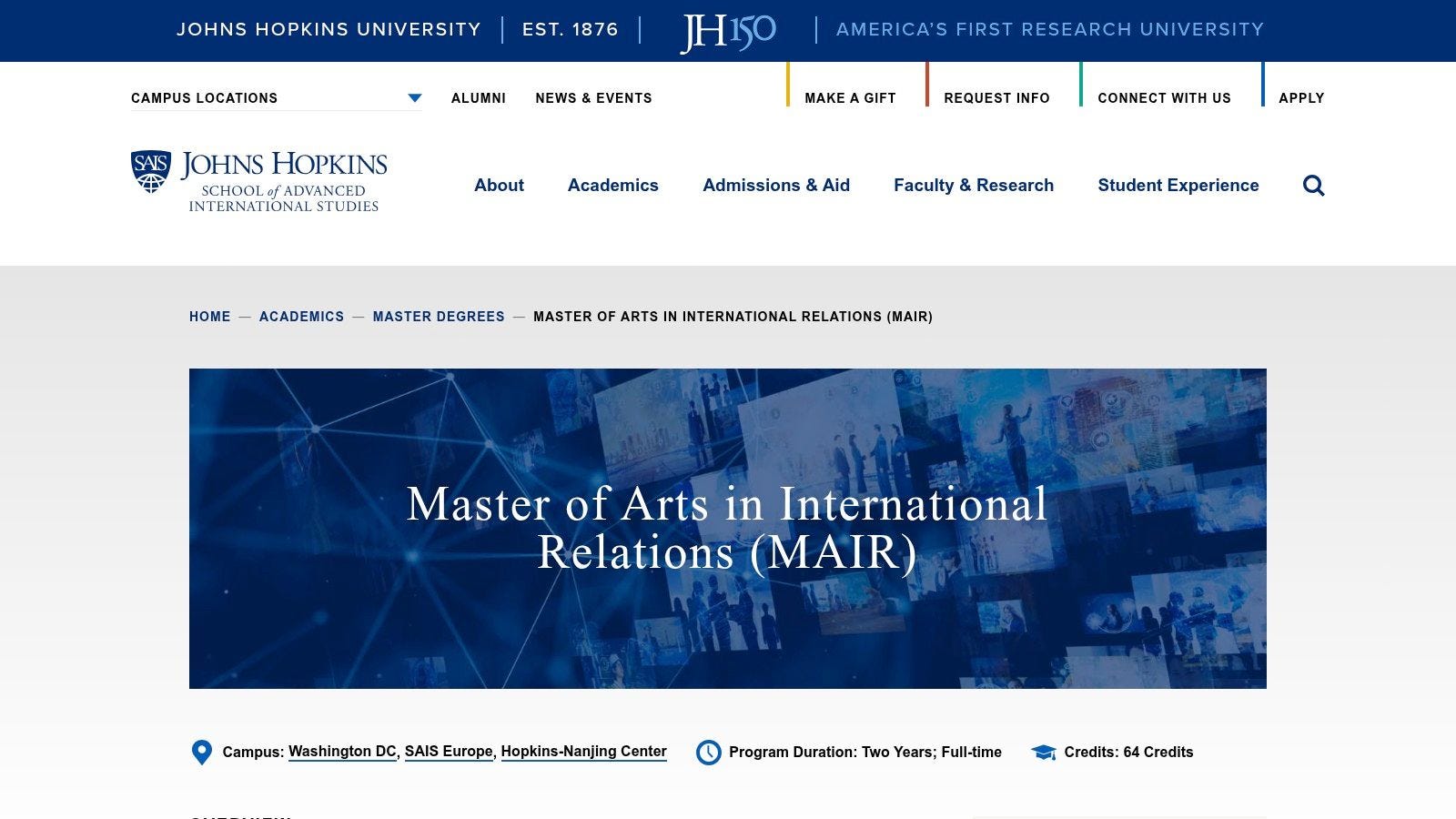
Johns Hopkins SAIS MAIR is where a lot of MDB-adjacent careers get built. It’s one of the few programs that consistently combines economics, international policy, language training, and direct exposure to the Washington ecosystem in a way that makes practical sense.
For development candidates, the key is concentration choice. The development-related pathways, especially IDEV and Development, Climate & Sustainability, map well to real MDB portfolios. That includes public sector reform, private sector development, climate finance, resilience, and cross-border policy work.
Why the D.C. location matters
Washington is an advantage you feel every week, not just during recruiting season. The World Bank Group, IDB, IMF, IFC, USAID, think tanks, contractors, and policy events are all nearby. That means informational interviews are easier, part-time work is more plausible, and alumni interaction is more frequent.
For MDB careers, proximity often beats abstract prestige. Students who can get into rooms, attend events, and build working relationships have an edge over students relying only on online applications.
The economics core helps too. SAIS isn’t as narrowly development-econ-focused as HKS MPA/ID or Columbia EPM, but it gives you enough quantitative credibility to avoid looking soft. That’s important for applicants who want flexibility across policy and operations.
Strong for climate and multi-sector careers
One reason SAIS has aged well is that MDB portfolios have shifted. Climate, sustainability, resilience, and cross-sector financing are central now. SAIS is well positioned for that mix because it doesn’t trap students in a single functional silo.
The Bologna option also appeals to students who want a more international start before moving into D.C. That won’t matter to every employer, but it can broaden your network and sharpen your regional perspective.
Inside-bank reality: A lot of MDB jobs sit between pure economics and pure diplomacy. SAIS trains well for that middle ground.
The weakness is focus. Some students need a more tightly defined professional identity than SAIS naturally gives them. If you want to be “the economist,” choose a harder-core economics degree. If you want to be “the operator” in development programs, Georgetown may feel more direct.
SAIS is strongest for
Candidates targeting Washington-based MDB ecosystems: Networking and access are major advantages.
Climate and sustainability pathways: Especially useful as MDB lending and advisory work shift in that direction.
Generalists with technical discipline: Good for people who want economics plus policy breadth.
5. Georgetown University, Master of Global Human Development
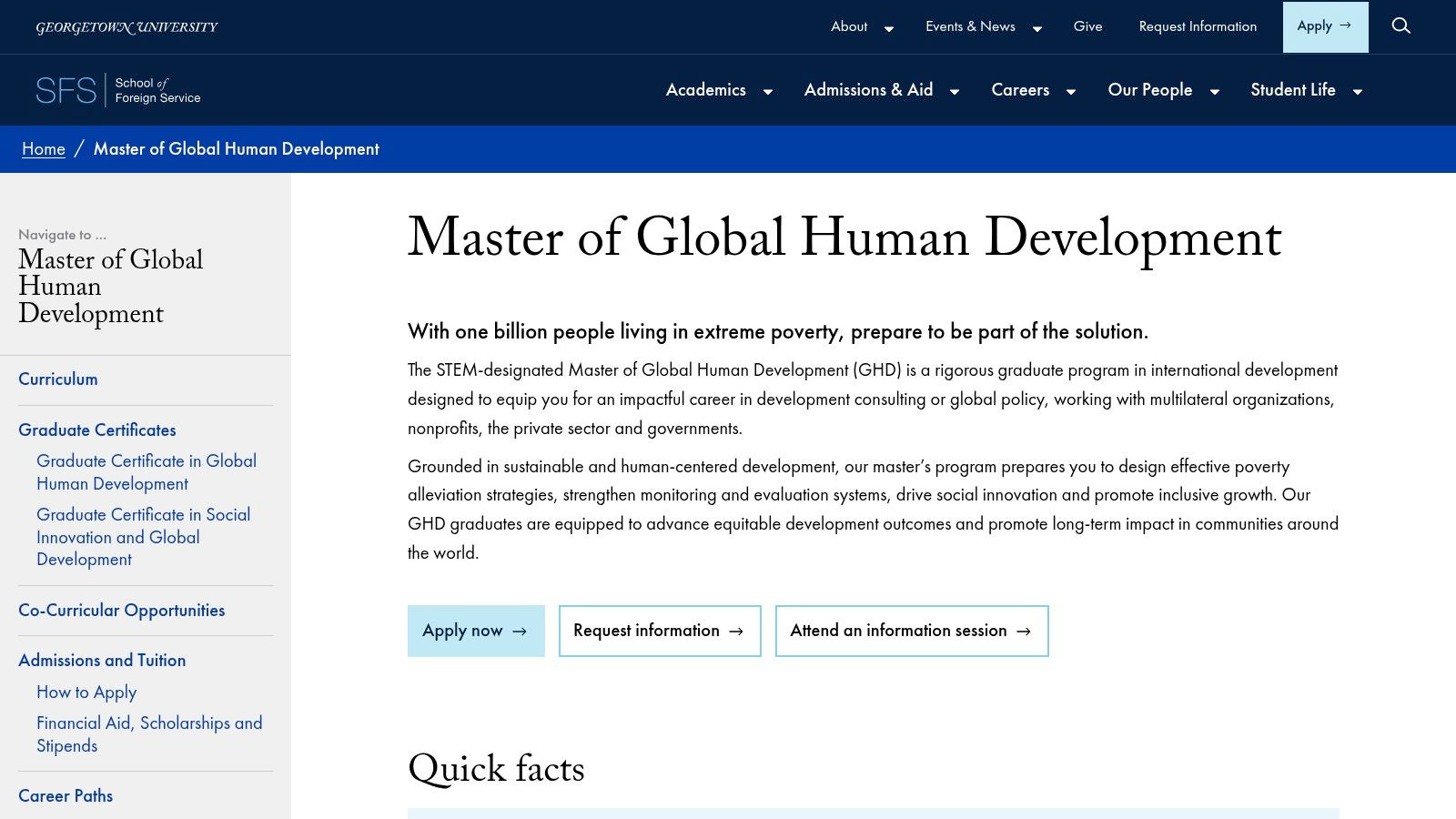
Georgetown’s Master of Global Human Development is one of the best graduate programs for international development if your target is MDB operations rather than a pure economist track. That distinction matters. Banks need staff who can design projects, manage implementation, work with clients, build results frameworks, and translate policy into actual lending or grant operations.
GHD is strong because it is applied. The program sits in the School of Foreign Service, but the training is grounded in development practice, monitoring and evaluation, finance and management, and sectoral work.
This is an operations-friendly degree
The required summer field placement is a major asset. Candidates who leave graduate school with only classroom credentials often struggle to explain how they’d operate in a real country or project setting. Georgetown reduces that problem by making field experience part of the program rather than an optional add-on.
The Washington location multiplies the advantage. Between the School of Foreign Service network, internships, research centers, and development employers in the city, students can build a practical profile while they study.
That’s especially useful for regional bank ambitions. If you’re interested in African development finance, infrastructure, social sectors, or public systems work, it helps to understand how institutions recruit and structure talent. A good starting point is this guide to careers in the African Development Bank.
Better for delivery than for economist branding
GHD can absolutely support a bank career. I’d rate it especially highly for social sectors, fragility, livelihoods, gender, human development, monitoring and evaluation, and operational design. It fits the day-to-day reality of many MDB staff jobs better than applicants realize.
The trade-off is obvious. If you want to compete as a development economist, this isn’t your cleanest signal. It includes quantitative and qualitative methods, but the center of gravity is implementation and practice.
GHD stands out when you need
Field exposure: The placement gives you concrete experience to discuss with recruiters.
Operational relevance: Strong fit for project and sector roles inside banks and development agencies.
Washington access: You can combine study with internships and networking.
Georgetown trains the kind of person who can walk into an operation and understand how the pieces actually move.
For candidates who want to work on human development and delivery inside multilateral institutions, Georgetown is one of the safest bets.
6. Duke University, Master of International Development Policy
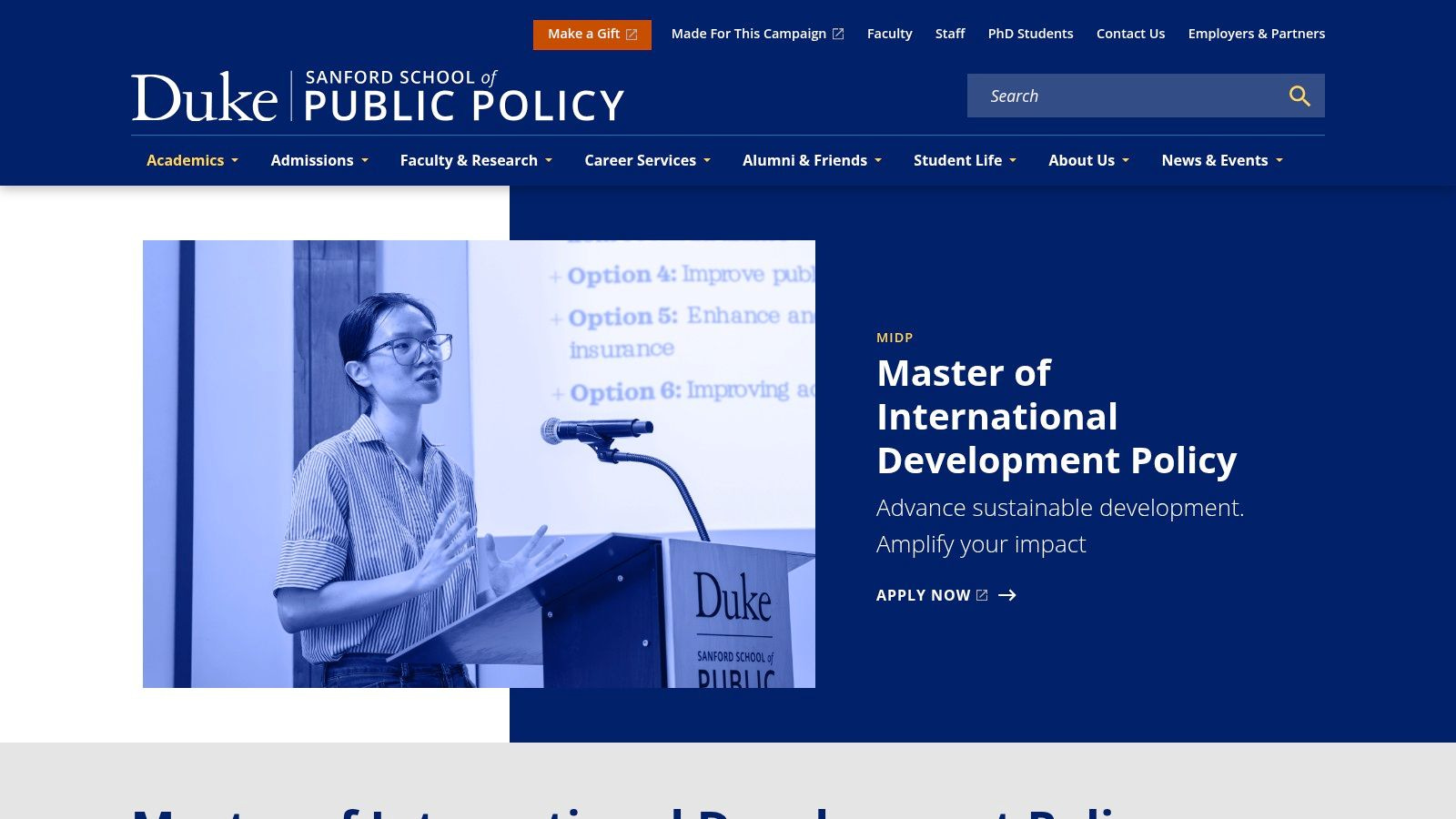
Duke Sanford’s MIDP is a practical choice for professionals who want to pivot into development without overpaying for a big-city brand or committing to a rigid two-year path. That flexibility is a bigger advantage than it first appears.
The program offers traditional and accelerated formats, and that matters for applicants balancing family obligations, current employment, or a narrow window to retool. In MDB terms, MIDP is strongest for operations, governance, social policy, environment, and applied analytics roles.
A good program for career changers
Some degrees assume you already fit the mold. Duke is more forgiving in a good way. It works well for people coming from government, NGOs, consulting, public administration, or adjacent policy backgrounds who need a credible development transition.
The applied master’s project is part of that value. Employers respond well when candidates can talk through a real problem, a client need, the trade-offs in the analysis, and how they arrived at a recommendation.
Cost of living also deserves attention. Durham gives students more breathing room than Washington, New York, or Boston. That won’t make the degree cheap, but it can make the total equation more manageable.
Where Duke wins and where it trails
MIDP gives you breadth without becoming vague. The economics, governance, social policy, environment, and analytics pathways let you shape a profile that fits your target. That’s useful if you want MDB operational roles and don’t need the hardest possible economics training.
The limitation is network concentration. Duke has strong reach, but it doesn’t have the same everyday MDB proximity as Georgetown, SAIS, or Columbia. You may need to be more deliberate about travel, networking, and internship planning.
Best use cases for Duke MIDP
Career pivots into development operations: Strong for professionals reorienting into public or multilateral work.
Applied policy roles: Good if you need practical project experience rather than theory-heavy training.
Candidates managing opportunity cost: Flexible formats can reduce time away from work.
If you know you want an economist label, look elsewhere. If you want a credible, practitioner-oriented degree that can move you into development policy and operational work, Duke is a strong option.
7. University of California, Berkeley, Master of Development Practice
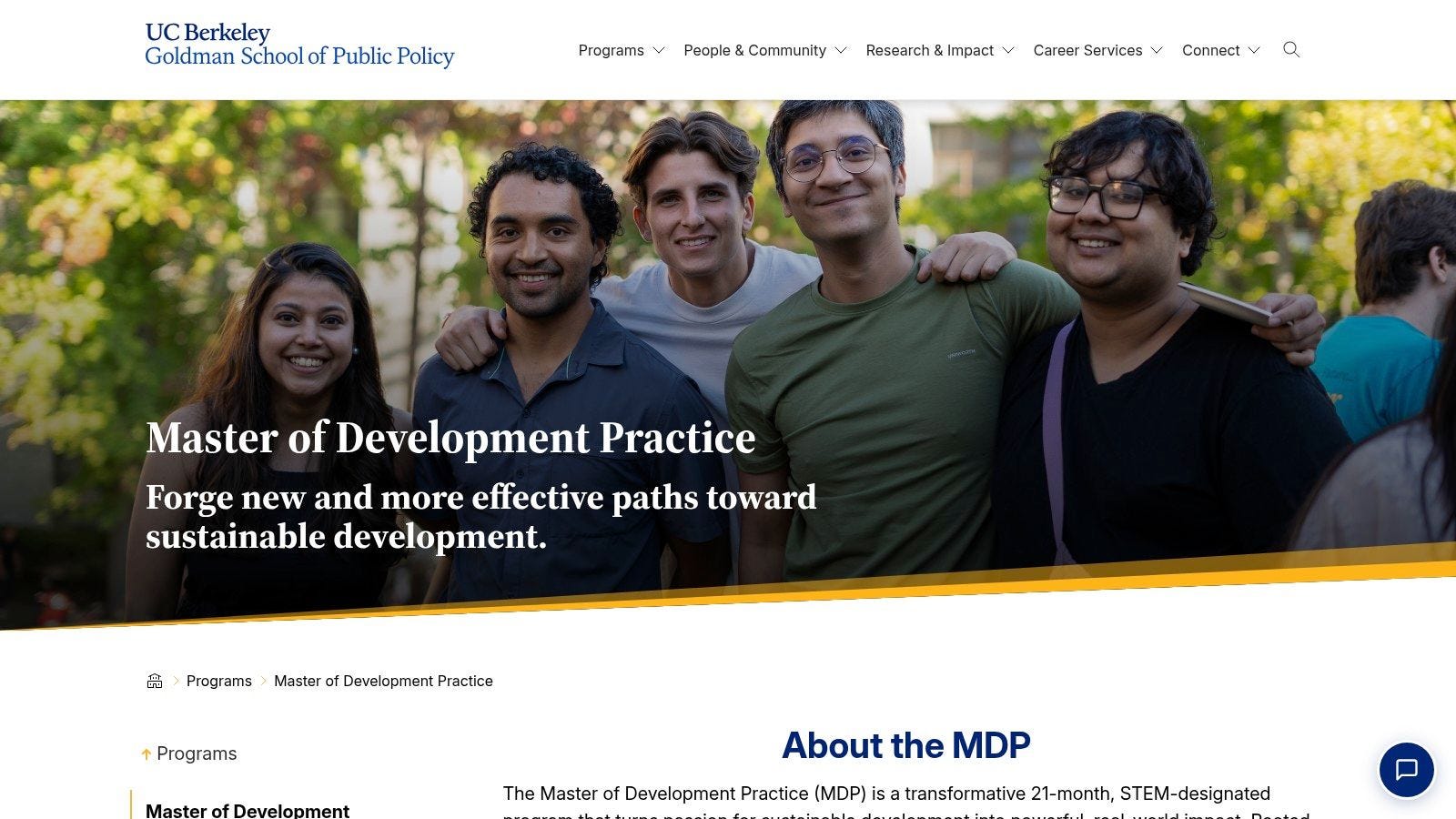
UC Berkeley’s Master of Development Practice is the strongest program on this list for candidates who want to work where development, climate, agriculture, food systems, public health, and sustainability overlap. That’s a serious niche inside MDBs now.
Banks increasingly need professionals who can think across sectors. Climate adaptation projects touch public finance, agriculture, health, infrastructure, and local governance at the same time. Berkeley’s MDP is built for that reality.
Best for cross-sector development practice
The program’s interdisciplinary design is the main selling point. You get economics and policy, but also environmental and public health exposure that many classic development degrees treat as secondary. That creates a different professional profile from a standard MPA or international affairs degree.
For MDBs, that can be valuable in climate finance, resilience, nature-related portfolios, and just transition work. If your interests sit at the intersection of policy and technical sectors, Berkeley gives you a useful foundation.
The field practice and studio-based learning also help. Development employers want evidence that you can move from concept to execution. Applied coursework gives you material for interviews and clearer judgment about what type of role suits you.
A smart choice for the climate era
Berkeley’s brand travels well, and the broader research ecosystem is a genuine asset. Students can tap into campus expertise that supports sector specialization beyond what many stand-alone development schools can offer.
The downside is geography. If your strategy depends on constant face time with World Bank, IDB, or IMF professionals, Berkeley requires more intentional networking because you’re away from Washington. That’s manageable, but you need to plan for it.
Berkeley makes the most sense when your development ambitions are sector-heavy, especially in climate and sustainability.
Another issue is budgeting. As a public university professional degree, pricing can vary and needs careful review before you commit. Don’t assume public automatically means affordable.
Berkeley MDP is strongest for
Climate and sustainability careers: Strong alignment with evolving MDB portfolios.
Interdisciplinary thinkers: Ideal if you want to work across sectors, not inside one narrow lane.
Practice-oriented candidates: Applied training supports operational and advisory roles.
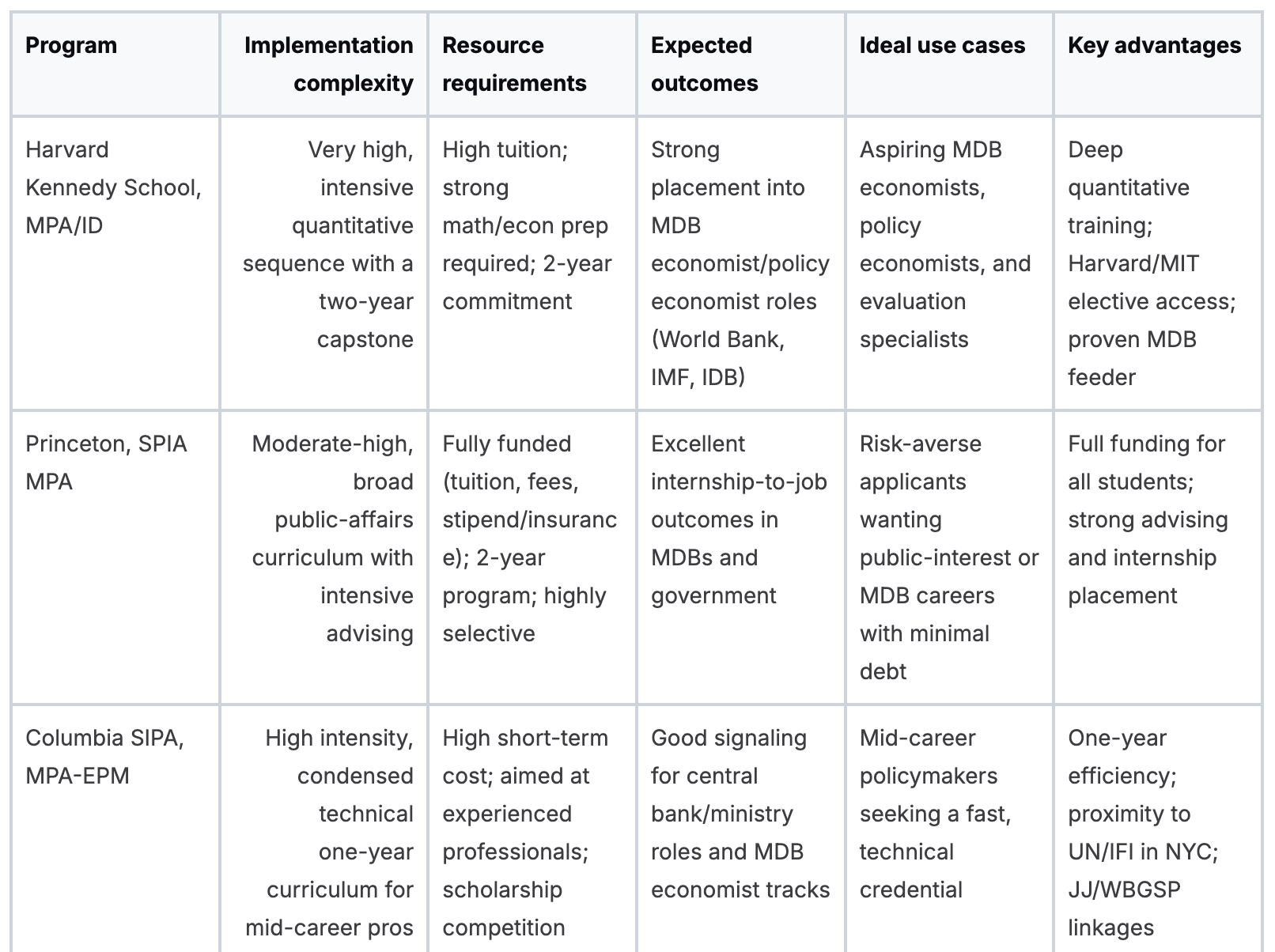
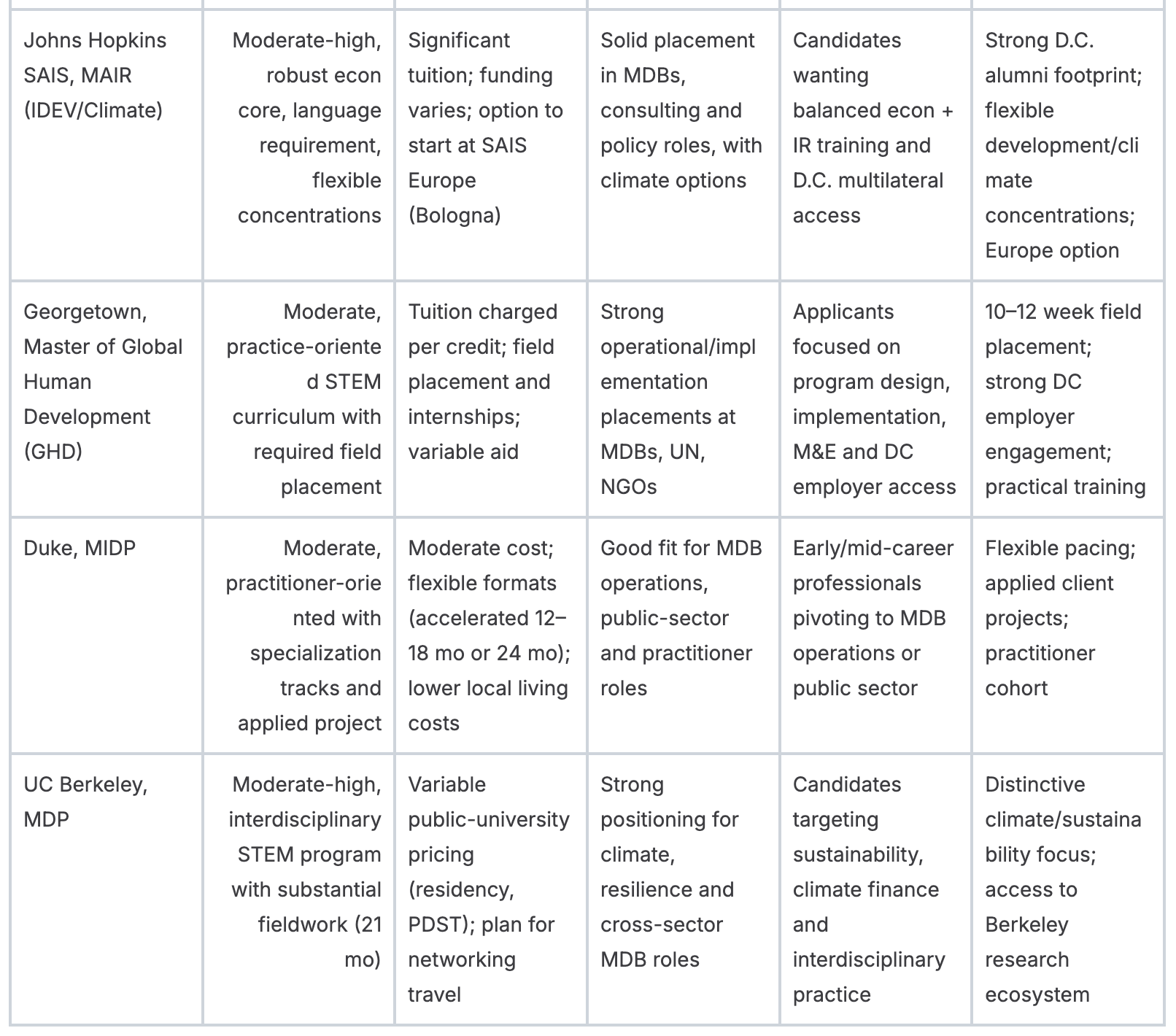
Top 7 International Development Graduate Programs Comparison
Making Your Choice The Final Calculation
The best program is the one that fits the job you want inside a multilateral development bank. That sounds basic, but it’s where most mistakes happen. Applicants often choose the school with the biggest general reputation instead of the school that builds the exact profile an MDB team wants to hire.
If you want a pure economist track, optimize for technical rigor first. Harvard MPA/ID and Columbia EPM are the clearest choices in this list for that path. They give you the strongest signal for roles that require economics, macro, fiscal analysis, quantitative policy work, and credibility with economist-heavy teams.
If you want operational roles, project design, social sectors, implementation, and client-facing work, Georgetown and Duke are often better fits. They train for practical execution. SAIS sits in an attractive middle zone because it combines economics and policy breadth with the practical advantage of the Washington network.
Princeton deserves special treatment in the decision because funding changes everything. A fully funded degree can make a lower-paid but career-defining internship or entry role possible. In MDB careers, that kind of flexibility has long-term value. It can shape the first five years of your career more than a slightly stronger brand name.
Berkeley is the pick for candidates who see where MDB portfolios are heading and want to position themselves around climate, resilience, sustainability, and cross-sector development practice. That is a smart bet if your interests are there. It is less useful if you’re forcing a climate narrative because you think the market wants one. MDB interviewers spot that quickly.
There’s also a broader lesson from the rankings data that does exist. The QS Development Studies 2026 ranking puts the University of Sussex at the top globally and evaluates programs across academic reputation, employer reputation, citations per paper, H-index, and international research network. Meanwhile, the 2025 College Factual ranking for development economics and international development places UCLA among the top schools in the United States. Both are useful signals. Neither solves the main problem by itself, which is translating academic standing into MDB employability.
That’s the lens you should use. Ask four direct questions.
What role am I targeting: Economist, operations officer, governance specialist, climate analyst, or something else.
What skills do I still need: Quantitative depth, field experience, policy design, sector knowledge, or language capacity.
What can I afford: Debt tolerance matters in this field.
Where will I build relationships: Washington, New York, a field placement, or an alumni network tied to your region.
The right degree opens the door. Your preparation, internships, writing sample, technical confidence, and networking determine whether you walk through it. That’s how MDB hiring works in practice. It rewards fit, evidence, and credibility far more than generic prestige.
If you’re serious about working at the World Bank, ADB, AfDB, IDB, IMF, or AIIB, Multilateral Development Bank Jobs is worth having in your inbox. It tracks full-time roles across major MDBs, surfaces consultant opportunities at MDBs and the UN, and publishes practical guides on YPP pathways, nationality rules, and hiring strategy that help you turn a good degree into an actual offer.