


The best jobs for international relations graduates are not the generic ones career offices usually recite. They sit inside multilateral development banks and major international organizations, where policy meets budgets, government relations, and implementation.
That matters because these institutions hire for judgment, not just interest in global affairs. An IR graduate who can read political incentives, write a sharp briefing, and handle counterparts across ministries, donors, and country teams has a clear place in this market. In practice, that often means roles at the World Bank, IMF, Asian Development Bank, African Development Bank, AIIB, and similar institutions with formal hiring tracks and long-term career ladders.
This is also a more structured market than many graduates realize. MDBs and large international organizations recruit through Young Professional Programs, fixed-term specialist posts, junior professional schemes, short-term consultant rosters, and field-based assignments that can lead to staff roles. Candidates who understand those entry points early usually make better choices about internships, language study, and first jobs. If you are also considering the wider UN system, this insider’s guide to UN job opportunities helps clarify how the hiring logic differs from MDB recruitment.
The trade-off is straightforward. These jobs carry prestige, policy exposure, and real influence over development outcomes, but they are competitive, process-heavy, and often slower to enter than private sector paths. Generic applications rarely work. Institutions want evidence that you understand their mandate, their regions, and the difference between analytical ability and operational usefulness.
That is where many strong graduates lose ground. They apply too broadly, describe themselves in vague “global affairs” language, and miss the fact that MDBs reward specialization early. A candidate who knows public financial management in West Africa, sovereign lending in South Asia, or climate policy negotiations in Latin America is easier to place than a candidate who is merely “passionate about international development.”
The roles below focus on the careers that carry the strongest combination of impact, credibility, and advancement potential for IR graduates who want to work inside the institutions that shape cross-border development policy.
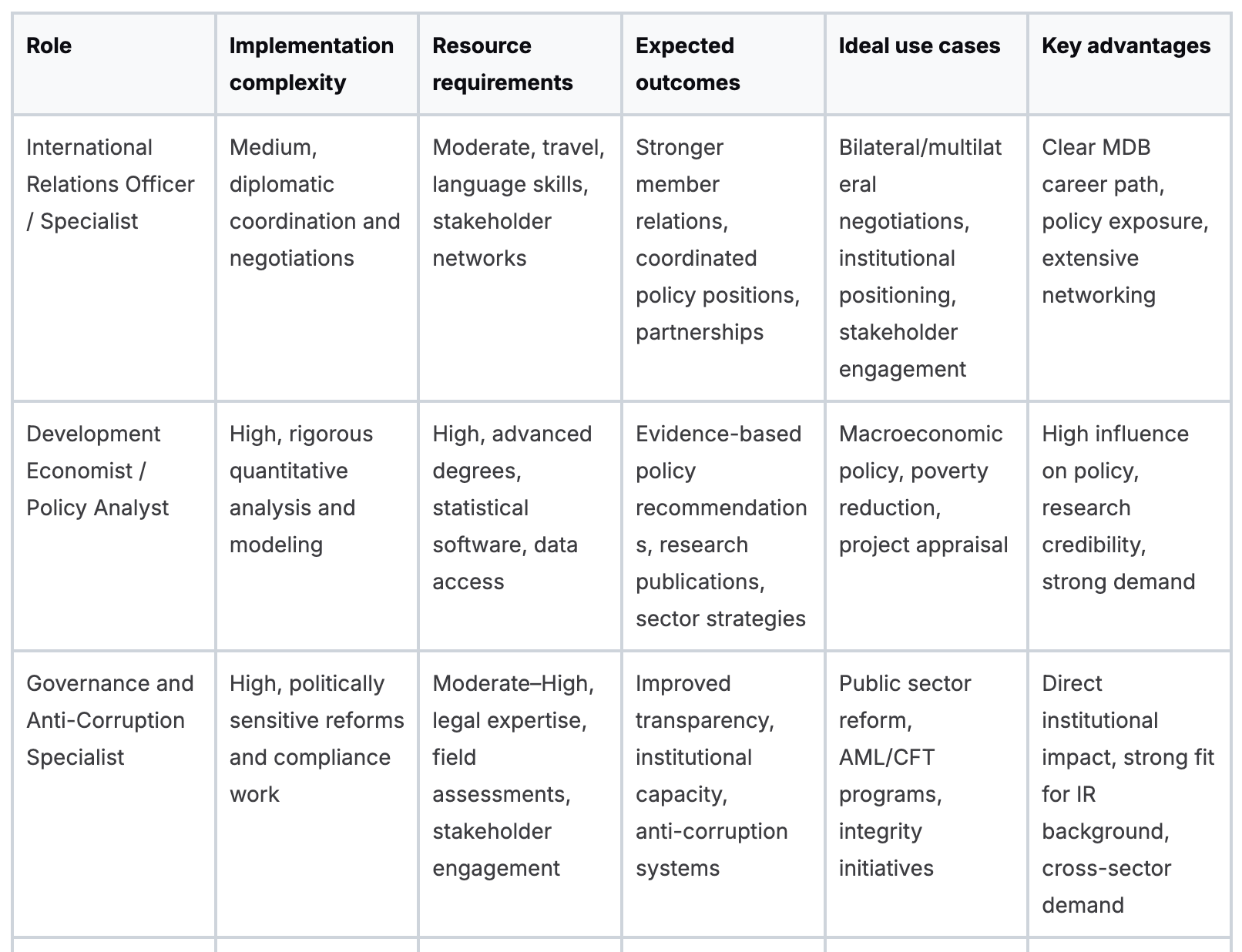
1. International Relations Officer or Specialist
This is one of the cleanest entry points for an IR graduate who knows how to write, brief, and manage official relationships. In practice, you’re the connective tissue between an institution and its member states, country counterparts, internal teams, and external partners.
Inside an MDB, this work can sit in institutional relations, member relations, partnership offices, or regional departments. One week you’re drafting talking points for senior management. The next, you’re coordinating with an executive director’s office, helping prepare a country visit, or smoothing a policy conversation that has gone politically sideways.

What the job actually rewards
This role rewards judgment more than theory. You need to know when a counterpart wants a formal note, when they want a quick call, and when a sensitive issue should never be left in email.
Strong candidates usually bring a few things early:
Regional fluency: Know one region well enough to understand the politics behind the formal language.
Briefing discipline: Write short, accurate briefs that a director can use without rewriting.
Forum awareness: Follow ministerial meetings, annual meetings, donor replenishments, and regional summits.
Protocol sense: Understand hierarchy, country sensitivities, and what different offices care about.
Practical rule: If you can turn a messy political situation into a clean one-page briefing note, you’re already useful.
A lot of graduates think this role is about charisma. It isn’t. It’s about discretion, precision, and being reliable when senior people are under pressure. The people who do well here become trusted fixers. That trust opens doors to country roles, partnerships, communications, and senior policy work.
If you want a parallel track in the wider multilateral system, this guide to UN job opportunities for international candidates is worth studying because the same habits carry over.
2. Development Economist or Policy Analyst
If you want a seat near real decision-making in an MDB, this is one of the strongest routes. The people who write the macro notes, policy memos, debt analyses, and sector diagnostics often shape what management and government counterparts treat as credible options.
The work is broader than many graduates expect. Development economists and policy analysts move between country strategy, fiscal and debt analysis, sector reform, trade, jobs, climate finance, and project preparation. The technical work matters, but true value lies in judgment. Good analysts know which finding belongs in a regression table, which belongs in a ministerial brief, and which should change the design of an operation.
What entry really requires
This is not a role you bluff your way into.
An IR degree gives you policy context, institutional awareness, and often better writing than pure economics candidates. That helps. It usually does not get you hired into economist-track roles on its own. In practice, serious candidates add graduate training in economics, public policy, development economics, statistics, or another quantitative field. They can also work comfortably with tools like Stata, R, or Python and explain their methods without sounding like they are hiding behind jargon.
As noted earlier in the article, economist and policy roles can pay well. That should be treated as a secondary consideration. The bigger question is whether you can do the work credibly under scrutiny from senior economists, country teams, and government officials who know their numbers.
Where IR graduates actually have an edge
The strongest IR candidates do not try to out-economist trained economists on every technical detail. They become dangerous in a narrower, useful lane.
A good profile usually centers on one of these areas:
Macroeconomic and fiscal policy: Public finance, debt, inflation, budget reform
Sector policy analysis: Energy, health, education, agriculture, transport
Cross-cutting development themes: Fragility, climate, jobs, gender, digital transformation
That specialization matters because MDB hiring teams look for signal. A candidate who has written on debt sustainability in frontier markets, supported public expenditure reviews, or worked on energy tariff reform is easier to place than a generalist who says they are interested in “development policy.”
For regional bank routes, this guide to careers at the African Development Bank gives a practical view of how economics, policy, and operations overlap in actual hiring.
One trade-off is worth stating clearly. The more technical the role, the narrower the entry gate. The upside is stronger long-term career mobility across country economics, sector policy, strategy, and senior advisory posts. If you can pair quantitative discipline with clear writing and political awareness, you become useful in rooms where a lot of smart people are only strong on one side of that equation.
3. Governance and Anti-Corruption Specialist
Governance work sits at the center of development results, even when institutions pretend otherwise. Projects fail because procurement is weak, incentives are distorted, ministries don’t coordinate, political ownership is thin, or nobody wants to touch the patronage system sitting underneath the formal structure.
That’s why governance and anti-corruption specialists matter. They work on public sector reform, integrity systems, accountability, institutional capacity, anti-money laundering issues, and the political constraints that shape implementation.
Why IR graduates fit this well
IR graduates often understand something economists and engineers miss. Formal policy design is the easy part. The hard part is how power works.
This role rewards people who can read institutions as political systems, not just administrative charts. You need to understand ministries, parliaments, executive incentives, donor dynamics, local reform coalitions, and where resistance is likely to surface.
Governance jobs go to people who can discuss politics without turning every conversation into ideology.
Good candidates usually have experience in one of these areas:
Public financial management: Budgets, expenditure controls, audit systems
Integrity frameworks: Anti-corruption rules, disclosure systems, sanctions processes
Justice and institutions: Rule of law, accountability bodies, administrative reform
Field exposure: Work with reform programs, oversight bodies, or governance-focused NGOs
This is also a trade-off-heavy career. The mission is compelling, but progress is slow and political setbacks are normal. If you need quick visible wins, you’ll get frustrated. If you can live with incremental progress and messy reform environments, it’s one of the most serious jobs in the system.
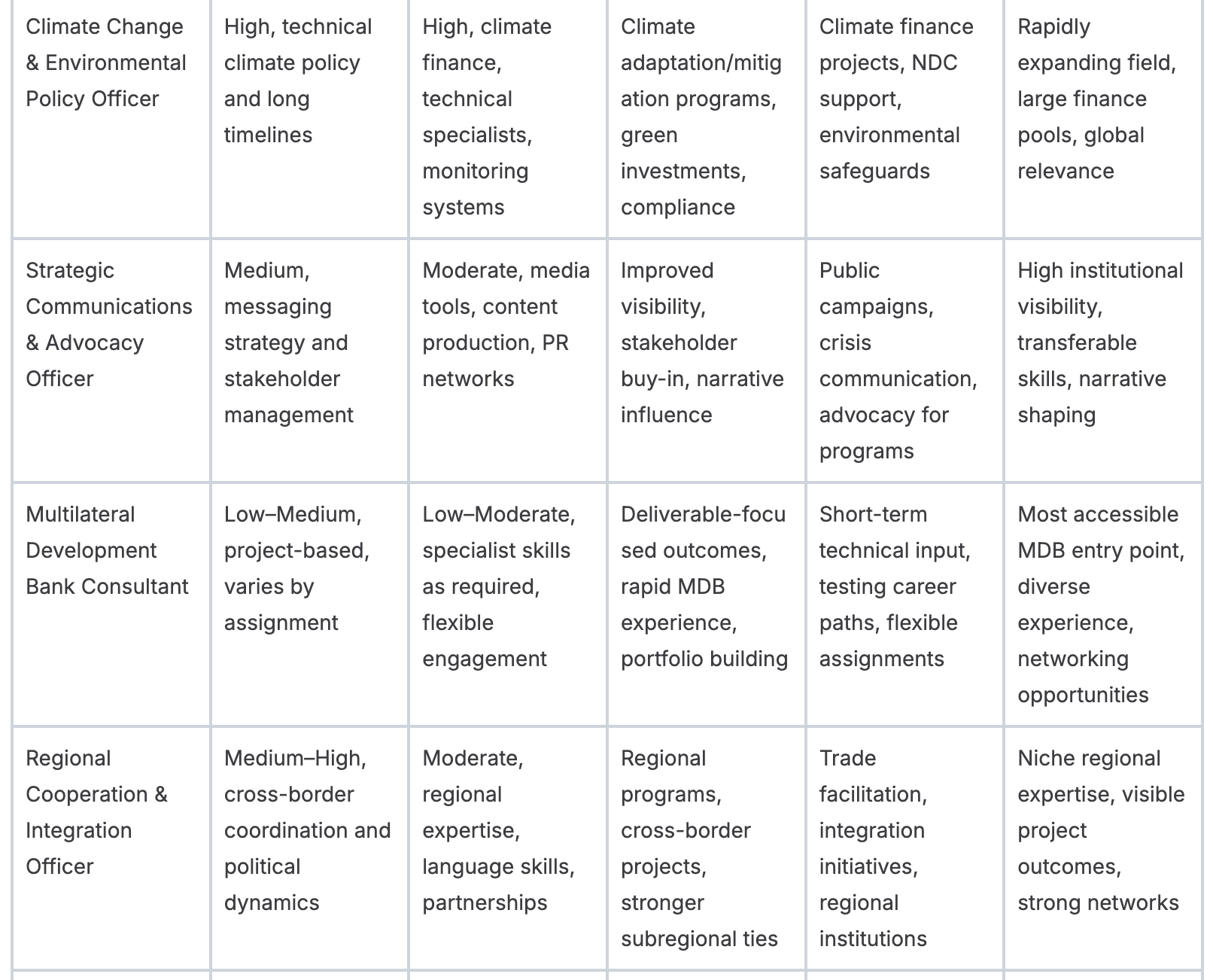
4. Climate Change and Environmental Policy Officer
Climate policy has moved from a side theme to a core line of business in development finance. That shift created real space for IR graduates who understand negotiation, multilateral frameworks, equity debates, and the politics of implementation.
In MDBs, climate and environmental policy officers help shape adaptation and mitigation programs, climate finance strategies, environmental safeguards, resilience planning, and country engagement tied to national commitments.

Where this job gets interesting
The best climate officers can move between three languages. They can talk to technical specialists, government negotiators, and finance teams without losing credibility with any of them.
That matters because climate work inside MDBs is rarely abstract. It touches lending, safeguards, country strategies, project pipelines, and politically sensitive trade-offs over land, energy, transport, and industrial policy.
A strong profile usually includes:
Negotiation literacy: Familiarity with UN climate processes and country positions
Policy grounding: Nationally Determined Contributions, adaptation plans, and sector reform agendas
Finance awareness: Climate funds, blended finance, carbon-related instruments
Operational sense: How policy gets translated into project terms, supervision, and reporting
This is a good field for graduates who want high-impact work with clear global relevance. The downside is that climate has become crowded. Generic passion for sustainability won’t carry you. Hiring managers want people who can tie climate goals to public policy, development operations, and country politics.
If you want to stand out, pick a lane early. Urban resilience, energy transition, nature and biodiversity, disaster risk, or adaptation in fragile contexts all signal more substance than “climate policy” alone.
5. Strategic Communications and Advocacy Officer
Communications jobs in MDBs and major international organizations carry more influence than many IR graduates realize. The people in these roles decide how an institution explains a reform, defends a lending program, responds to criticism, and keeps political support from fraying when a project gets contested. In practice, that puts communications close to power.
Strategic communications and advocacy officers write speeches, press lines, op-eds, executive messages, campaign materials, stakeholder notes, social copy, and talking points for moments when clarity matters fast. They also handle reputation risk across several audiences at once: borrowing governments, shareholder states, journalists, civil society groups, and internal leadership. One bad line can create weeks of cleanup.

What separates strong candidates
Strong candidates combine clean writing with institutional judgment. They know which messages need legal or management clearance, which issues need quiet consultation before any public line goes out, and which technical points can survive contact with reporters and ministers. That judgment is what makes this a serious career track inside the UN system, regional organizations, and development banks.
The prestige is real, but so is the pressure. Senior teams remember the officer who gets a board briefing, media note, and CEO speech ready in the same week without creating contradictions across them. They also remember the officer who turns complex operations into vague development slogans.
What to build before you apply
Hiring managers want evidence.
A writing portfolio: Speeches, briefing notes, op-eds, media statements, campaign copy, or executive messaging
Political judgment: Proof that you understand stakeholder sensitivities, shareholder dynamics, and public scrutiny
Crisis discipline: Clear, accurate writing under deadline pressure
Format flexibility: The ability to shift from internal memo to press quote to ministerial talking points without losing the thread
For early-career candidates, consultant assignments are often the quickest way to build that proof. If you plan to pursue communications consulting for MDBs, learn how to write a consulting proposal for development institutions before you start applying.
I have seen smart applicants miss these roles because they submit polished but generic writing samples. MDB communications teams look for substance. A good sample shows you can explain a financing decision, a policy reform, or a politically sensitive project in language that is accurate, concise, and usable.
This is one of the stronger options for IR graduates who like policy but are also comfortable with deadlines, hierarchy, and message discipline. The trade-off is obvious. You sit close to strategy, but you are often judged on speed, precision, and restraint more than public visibility.
6. Multilateral Development Bank Consultant
If your goal is to get inside an MDB early, consulting is one of the fastest legitimate entry routes. It gives you proximity to real operations, direct exposure to task teams, and work that ends up in project documents, policy notes, supervision missions, evaluations, or client-facing deliverables.
That speed comes with a price. Consultant roles are output-driven, contract-based, and uneven in quality. One assignment can put you close to a country strategy, lending pipeline, or reform dialogue. Another can leave you doing background research with little visibility. The job title matters less than the TOR, the manager, and whether the work gives you usable institutional credibility.
Why this route works
Good consulting experience gives hiring managers something concrete. They can see that you have already worked within MDB processes, handled comments from senior staff, met deadlines, and produced work that survived internal review.
It also remains a common route into these institutions, especially for graduates who do not enter through a formal Young Professionals Program or a junior staff stream. As noted earlier, IR career guidance consistently points to consultant hiring as a recurring access point for policy, research, and operations-related work across major development institutions.
The upside is clear:
Fast access to MDB work: You can get relevant experience before a staff role opens
Strong signaling value: A respected consultancy on your CV carries weight
Sector testing: You can find out quickly whether governance, infrastructure, climate, fragility, or regional work suits you
Network effects: Good managers often rehire consultants they trust
The downside is just as clear:
Weak job security: Contracts end abruptly and funding can disappear
Patchy supervision: Some teams invest in consultants. Others just need output
Conversion risk: Plenty of capable consultants stay external for years without moving onto staff contracts
How to use consulting strategically
Treat your first few assignments as a portfolio, not a series of random gigs.
If you start in political economy analysis, donor coordination, public sector reform, or country diagnostics, build from there. Stack assignments that point in one direction. MDB hiring managers respond to a profile they can place. They are less interested in applicants who have done a little of everything without a clear thread.
Proposal quality also matters more than many graduates expect. A weak proposal signals that you do not understand the institution, the assignment, or the difference between academic writing and deliverable-based consulting. This practical guide on writing a consulting proposal for MDB roles is worth studying before you start bidding.
I have seen consultants use short assignments very well. They ask for work that leads to visible outputs, get their names attached to solid deliverables where possible, and stay in touch with task managers who can bring them back. That is how consulting becomes a career accelerator instead of a holding pattern.
For IR graduates who can handle uncertainty and produce clean work fast, this is one of the strongest paths into high-prestige development institutions. The trade-off is simple. You get access early, but you have to earn your next step every time.
7. Regional Cooperation and Integration Officer
This is classic IR work in the best sense. You’re dealing with cross-border infrastructure, trade corridors, regional public goods, mobility, energy pools, customs coordination, and the politics of neighboring states trying to work together without fully trusting each other.
Regional cooperation officers sit where diplomacy meets operations. They need to understand regional organizations, intergovernmental dynamics, and the quiet frictions that can stall a technically sound program.
Why this role matters
Many development problems don’t stop at borders. Power transmission, transport links, water systems, disease control, migration management, and trade facilitation all require more than one government to move in roughly the same direction.
That’s why this role favors graduates who know a region thoroughly. General international awareness won’t get you very far. You need to understand the specific blocs, rivalries, protocols, and institutional habits of the places you work on.
Good preparation looks like this:
Regional specialization: ASEAN, the African Union system, MERCOSUR, the Gulf, Central Asia, or another defined area
Language skill: A regional working language matters more than people admit
Convening ability: You’ll spend a lot of time aligning actors who have different incentives
Political patience: Regional initiatives move slowly and often in uneven bursts
Regional work rewards specialists. “Globalist” is not a hiring category.
This role suits graduates who enjoy geopolitics but want applied work rather than commentary. It can be frustrating because success often depends on decisions outside your control. But when regional programs land well, the impact can be larger than a single-country intervention.
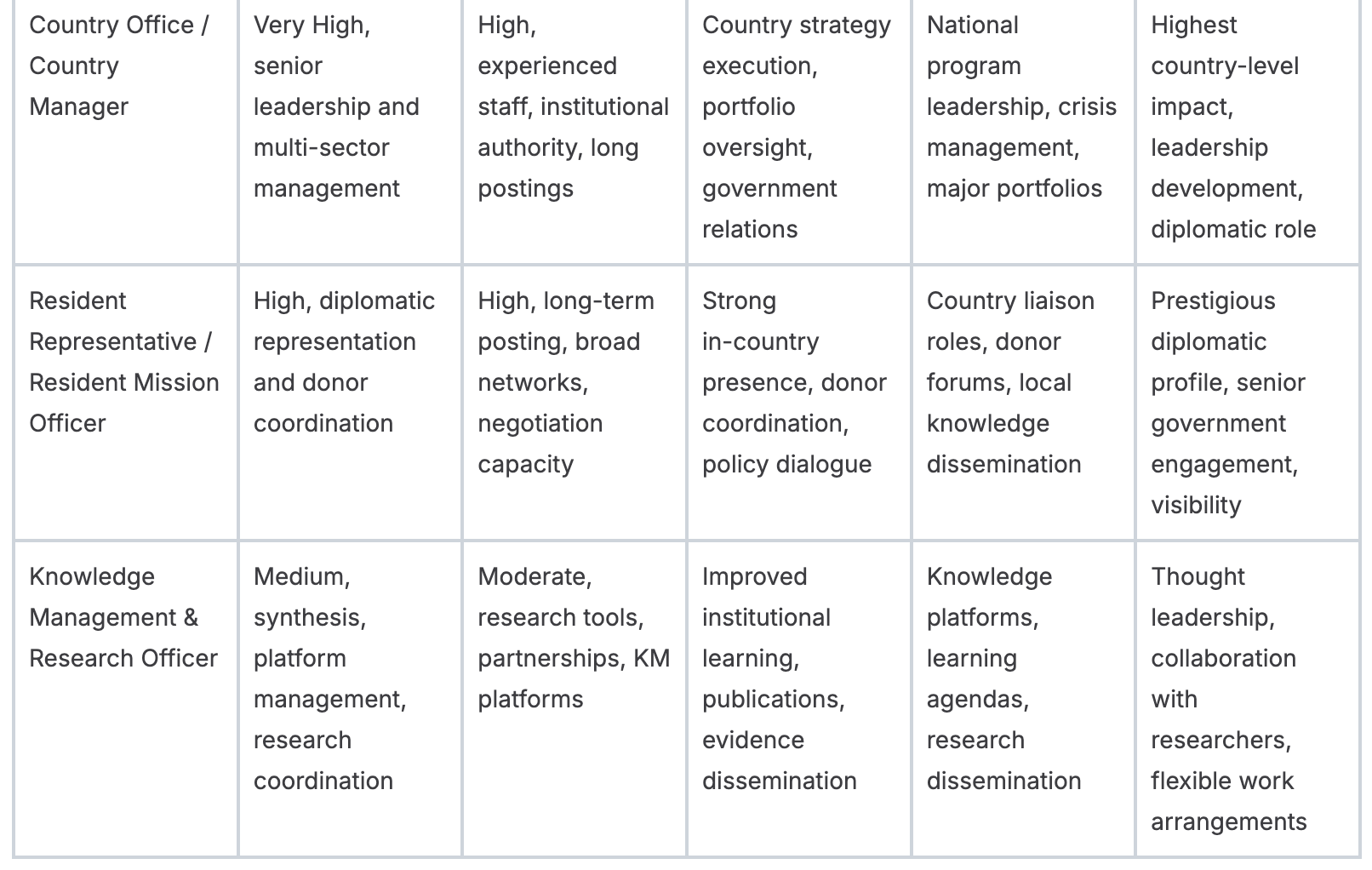
8. Country Office or Country Manager
This is a senior destination role, not a first job. But if you want to build a serious MDB career, it helps to understand the endpoint early.
Country office leadership combines diplomacy, operations, portfolio judgment, government relations, staff management, and institutional representation. You’re responsible for maintaining credibility with the host government while protecting the institution’s standards, pipeline, and internal interests. That balancing act is harder than it sounds.
What people get wrong about this path
A lot of graduates think country managers rise mainly through visibility or networking. They don’t. They rise through a track record. Institutions look for people who have handled difficult country environments, earned trust across sectors, managed teams, and stayed effective when politics got messy.
The salary upside can be significant in related senior roles. The University at Buffalo summary of IR career outcomes notes that salaries for economists and diplomats often exceed $100,000 with experience, and that in Washington, D.C. international policy analysts average $78,326 annually in a major market for IR talent.
Still, compensation is not the main reason to target this role. Influence is.
What to do early if this is your long game
Build toward it deliberately:
Take field postings seriously: Headquarters alone rarely prepares you for country leadership
Learn operations: Country leadership requires more than policy fluency
Develop management skill: Team leadership and budget judgment matter
Earn cross-functional credibility: Sector teams, country teams, legal, procurement, and government counterparts all need to trust you
This is one of the best jobs for international relations graduates with long-term stamina. It takes years to reach, but it puts you close to decisions that shape entire country programs.
9. Resident Representative or Resident Mission Officer
Few jobs put an international relations graduate closer to real institutional influence in-country than this one. A resident representative or resident mission officer is the person who translates headquarters priorities into usable relationships, honest reporting, and workable decisions on the ground.
The title sounds diplomatic. The work is operational, political, and exposed to scrutiny. You are often the first person government counterparts call when a reform stalls, a donor position shifts, or headquarters needs a clear read on what is happening behind official talking points.
That is why strong IR graduates can do well here. The degree helps with political analysis, stakeholder mapping, and reading incentives across ministries, donor groups, and international organizations. But the role rewards judgment more than theory. Country offices need people who can tell the difference between a temporary delay and a serious loss of government commitment, and then report that clearly without damaging relationships.
Resident posts also sit inside a very specific career ladder. In MDBs and major international organizations, they rarely go to outsiders straight from graduate school. The usual route runs through analyst, officer, specialist, or consultant roles, often with field exposure, before someone is trusted to represent the institution in-country. As noted earlier, major institutions have long used structured entry pipelines such as Young Professionals Programs to build that talent bench.
What separates average officers from trusted ones
The strongest people in these jobs usually bring four things:
Political judgment: They read formal policy signals and informal power dynamics
Institutional credibility: Headquarters trusts their reporting and country teams trust their follow-through
Controlled communication: They know when to push, when to stay quiet, and how to write the kind of cable or briefing note senior management can use
Stamina in the field: Country representation can look polished from the outside, but the day-to-day work involves pressure, ambiguity, and constant relationship management
There is a trade-off here. These roles carry prestige and influence, but they can also narrow your margin for error. One careless meeting, one sloppy note, or one misread political signal can create problems far beyond the country office.
For IR graduates with long-term MDB ambitions, this is one of the clearest end-state roles worth targeting. It is not an entry job. It is a trust job.
10. Knowledge Management and Research Officer
This role sounds softer than it is. In strong institutions, knowledge management officers shape what gets learned, what gets repeated, and what gets forgotten. That has real consequences for policy and operations.
These professionals curate research, synthesize lessons from projects, build internal knowledge systems, support communities of practice, and package evidence so teams can use it. In banks and major international organizations, they often sit between research units, operational teams, and external partners.
Why this is better than many graduates think
Most institutions generate far more information than they can absorb. The bottleneck is rarely raw content. It’s synthesis, access, and relevance.
That’s where IR graduates can be effective. If you can read across sectors, spot institutional patterns, and write clearly for busy teams, you can help turn scattered reporting into usable insight. This is especially valuable in organizations that operate across many countries and sectors.
There’s also a career advantage here. Mainstream IR career guidance still leaves major gaps around MDB pathways and progression, as noted by Schiller International University’s discussion of international relations job opportunities. Knowledge roles can give you broad visibility across teams and themes, which makes them a smart launchpad into operations, strategy, or thematic specialist tracks.
The person who knows where the evidence sits, what it means, and who needs it often has more influence than their title suggests.
This job fits graduates who are rigorous, organized, and interested in institutional learning. It’s a weaker fit for anyone who needs constant external visibility or very fast promotion. The upside is breadth, access, and a deep understanding of how big institutions think.
Top 10 Careers for International Relations Graduates, Comparison
From Degree to Development Your Next Move
The biggest mistake IR graduates make is treating the degree as the credential that should speak for itself. It won’t. In this market, the degree gets you into the stack. Your specialization, writing, field judgment, and persistence determine whether anyone pulls your application out.
That’s especially true in MDBs and major international organizations. These institutions are attractive for good reasons. They sit close to policy, finance, and government decision-making. They also attract smart candidates from economics, law, public policy, engineering, and area studies. You’re competing against people with strong technical profiles, strong language skills, or prior institutional experience. Generic enthusiasm for global affairs won’t survive that comparison.
The good news is that IR graduates have a real edge when they use the degree properly. You already understand cross-border politics, institutional behavior, negotiation, and policy context. Those are not soft extras. They are core operating skills in multilateral work. The trick is converting them into an employer-facing profile.
That means picking a lane early enough that your experience starts compounding. If you want governance, build governance. If you want climate, build climate. If you want policy analysis, get quantitative. If you want communications, create a portfolio that proves you can write under institutional constraints. A scattered CV is the fastest way to look uncommitted, even when you’re talented.
You also need to be honest about trade-offs. Consultant roles can get you in fast, but they don’t guarantee stability. Country and resident roles carry prestige and influence, but they usually require years of operational credibility. Economist tracks can be powerful, but they demand technical depth. Communications and institutional relations can open doors quickly, but only if your judgment is sharp and your writing is clean enough for senior use.
There’s another practical reality. Public information on MDB career progression remains thin. Mainstream career sites still do a poor job explaining the difference between consultant pipelines, specialist tracks, YPP routes, nationality considerations, and country office trajectories. They also leave major gaps on compensation progression across stages and institutions, a problem highlighted by Indeed’s overview of what you can do with an international relations degree. That lack of transparency makes live job intelligence more important than broad career advice.
So take the next step in a way that matches how this market works. Track openings consistently. Study role language. Build materials that fit the institution, not just the profession. Follow where consultants convert, where specialist posts cluster, and which regional teams are hiring around your profile. Timing matters more than most graduates realize.
If you want help doing that, one practical option is Multilateral Development Bank Jobs. It publishes recurring updates on full-time staff roles, consultant opportunities, and guides focused on MDB recruitment. That kind of steady visibility is useful because this career path rewards candidates who stay close to the market rather than checking in only when they feel ready.
The best jobs for international relations graduates are there. The institutions are hiring. The career paths are real. What matters now is whether you build a profile that fits the work and stay close enough to the market to move when the right opening appears.
If you want a practical way to track this market, Multilateral Development Bank Jobs publishes three emails each week covering full-time staff listings from 30+ MDBs, consultant opportunities across MDBs and the UN, and longer guides on topics like YPPs, nationality requirements, and hiring trends.