

If you’re serious about landing a role at the World Bank’s headquarters in Washington, DC, you need to understand one thing: this isn’t your typical corporate job hunt. Getting in the door means knowing how the institution thinks, what it values, and which hiring paths actually lead somewhere.
Success requires connecting your expertise to the Bank’s core mission of global development. It’s not just about having the right technical skills.
Charting Your Path to the World Bank in DC
The World Bank exists to end extreme poverty and boost shared prosperity. This mission is not a tagline on its website; it dictates every single role, from finance specialists in the treasury to education policy experts shaping country programs.
Your first step is to internalize this. The Bank looks for people who are genuinely committed to that development mandate, not just someone seeking a prestigious job title.
The variety of roles at the DC headquarters is staggering. You’ll find economists, project managers, data scientists, lawyers, and communications pros all working under one roof. No matter the title, each position is a cog in the massive machine of the Bank’s global operations.
Understanding the Mission-Driven Culture
The internal culture at the World Bank is woven into its external goals. Take global job creation. The Bank made it a top strategic priority, aiming to tackle an employment gap of nearly 300 million jobs worldwide.
This goal is not an abstract concept debated in boardrooms. It actively shapes the kinds of projects the Bank funds and the type of expertise it hires. They’re deploying new analytical tools to bake jobs analysis directly into country-specific growth strategies. You can get a sense of this institutional focus by checking out the Development Committee’s site on this initiative.
What does this mean for you? Your application has to scream “development impact.”
The key is to connect your professional experience to the World Bank’s larger objectives. Show how your skills in finance, technology, or public policy can be applied to solve real-world problems in developing countries. That’s what gets a hiring manager’s attention.
To get noticed, you must show how your background supports this overarching mission. Think less about what you did and more about how your work can contribute to building human capital, fostering sustainable infrastructure, or promoting economic stability on a global scale. That’s the language they speak.
Choosing Your Path: The Three Main Doors into the World Bank
Getting a job at the World Bank isn’t a one-size-fits-all process. Think of it like a fortress with three different gates, each designed for a different type of person. Picking the right gate from the start is the most important strategic decision you’ll make.
Your experience, specialization, and career goals point you toward one of three main entry points: the prestigious Young Professionals Program, a mid-career lateral hire, or a specialized consultant role. Each route has its own timeline, expectations, and ideal candidate profile. Misunderstanding these differences is one of the top reasons I see qualified people get rejected.
This decision tree gives you a quick visual of how your background maps to the main hiring channels for World Bank careers in Washington DC.
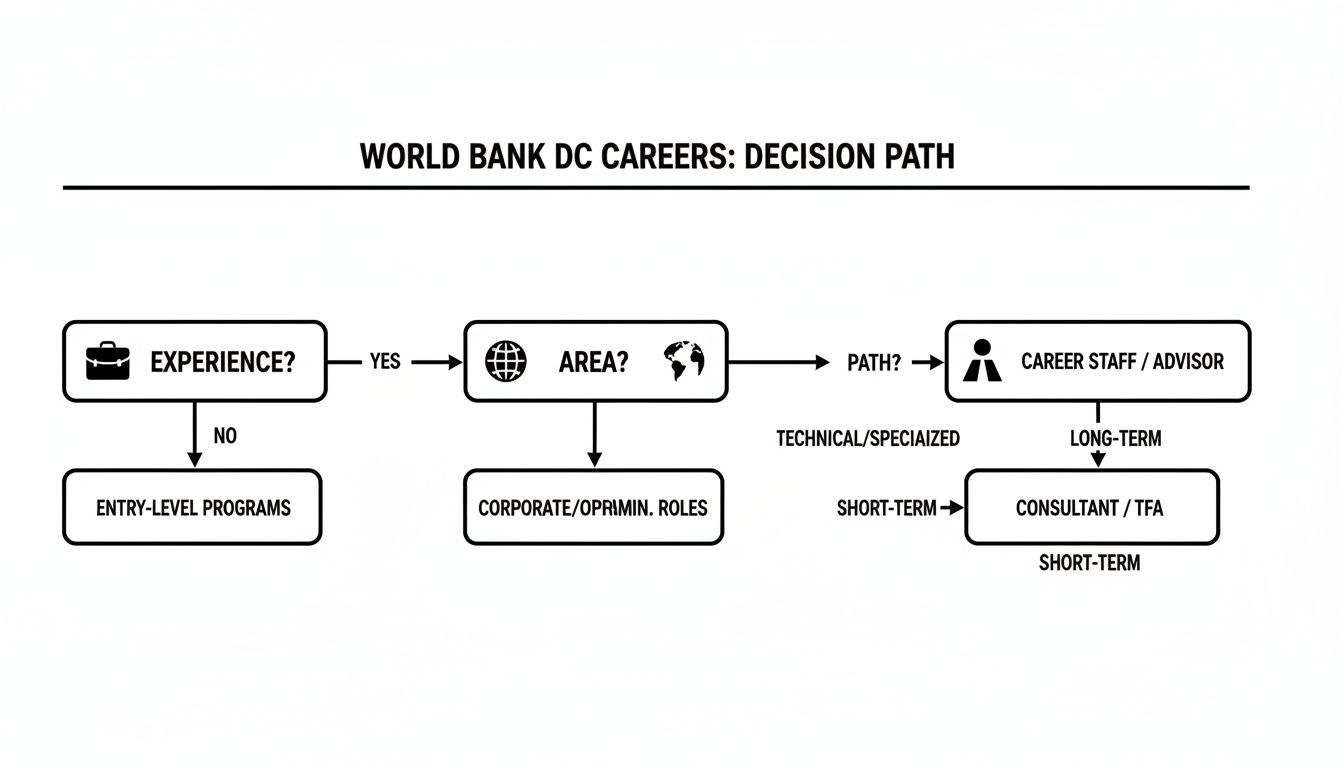
As you can see, your years of professional experience are the first and most important filter, pushing you toward a specific strategy right from the get-go.
To make this crystal clear, let’s break down the key differences between these routes.
World Bank Hiring Routes Compared
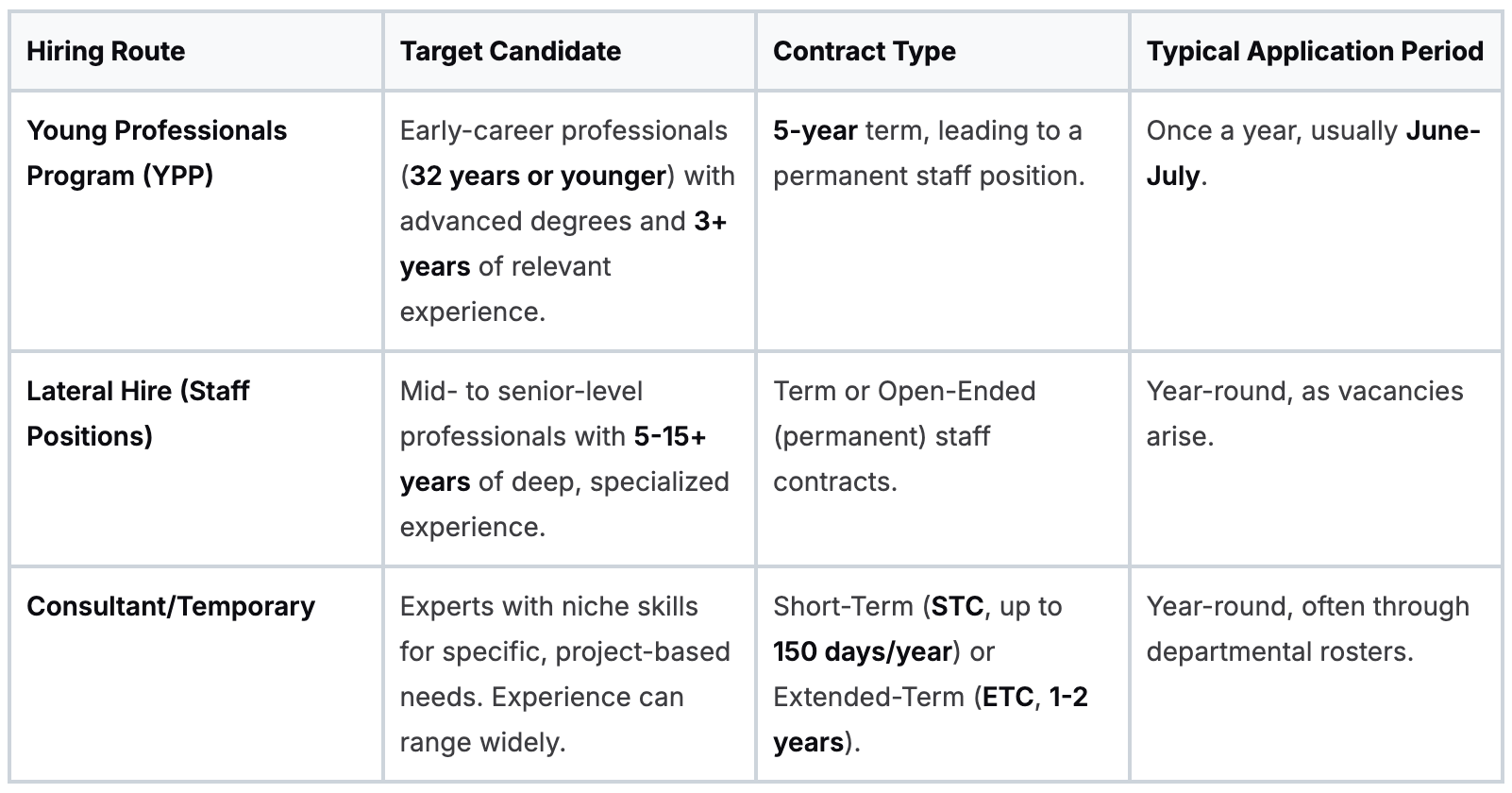
Each path serves a distinct purpose for the Bank. Aligning your profile with the right one is crucial before you even think about hitting “apply.”
The Young Professionals Program (YPP)
The YPP is the World Bank’s crown jewel for bringing in the next generation of leaders. It’s brutally competitive and built for highly qualified young professionals who live and breathe international development. Let’s be clear: this isn’t a grad program or an internship. It’s a fast-track leadership pipeline.
To be in the running, you generally need:
A Master’s or PhD degree.
Relevant professional experience in a field like economics, finance, public policy, or a technical sector.
A clear, demonstrable commitment to the Bank’s mission.
The application window is narrow and typically opens only once a year. Nailing it requires meticulous preparation months in advance. Our comprehensive 2026 World Bank Hiring Playbook breaks down the exact timelines and steps you need to follow.
Lateral Hires for Experienced Professionals
If you have significant, specialized experience, the lateral hire route is your door. This is how the Bank brings in seasoned experts to fill specific operational and corporate needs, from senior energy specialists and health economists to IT security architects and procurement lawyers.
These roles are posted all year round as vacancies pop up. The key here is a direct, almost perfect match between your expertise and the job description. The Bank needs proven practitioners who can parachute in and deliver value from day one. You have to show a track record of tangible results that line up perfectly with what the role demands.
Consultant and Temporary Roles
Consultant roles offer another way in, especially for those with niche, in-demand skills. These are usually short-term or project-based contracts, known as Short-Term Consultant (STC) or Extended-Term Consultant (ETC) positions. Consultants are hired to provide specific expertise on a project, often for a period of a few months up to two years.
This path gives you flexibility and a chance to work with the Bank without the long-term commitment of a staff position. It’s the most common way for professionals to get their foot in the door, build a network, and prove their value, which often leads to staff opportunities down the line.
Consultants are not staff members and don’t get the same benefits package, but they are absolutely essential to the Bank’s work on the ground. Landing these roles often comes down to getting your CV into the right departmental rosters and, frankly, networking effectively.
Navigating Job Types and Departments at World Bank HQ
You need to understand the World Bank in DC is not one big building full of people doing the same thing. Think of it less like a single company and more like a university campus with dozens of specialized colleges, each with its own focus, culture, and hiring needs.
Figuring out this internal map is your first real test. If you don’t know where you fit, your application is going nowhere.
Broadly, the Bank is split into two worlds: the operational side that gets projects done on the ground, and the corporate side that keeps the lights on for the entire institution. A project manager knee-deep in an energy project in Africa has a completely different job and needs a completely different skillset than a financial analyst in the Treasury department.
When you see a job posting, you’re not just applying to the “World Bank.” You’re applying to a specific team with a very specific job to do. Knowing the difference is everything.
The Operational Powerhouses
This is the core of the Bank’s development mission. The work happens inside the Global Practices and Regional Vice Presidencies. This is where you’ll find the frontline experts: the economists, sector specialists, and project managers running the show on lending operations and country reports.
The structure is a matrix of theme and geography:
Global Practices: This is the Bank’s technical brain trust, covering everything from Health and Education to Energy and Water. They provide the deep, subject-matter expertise that underpins projects all over the globe.
Regional Vice Presidencies: These are the relationship managers, handling the Bank’s entire portfolio and engagement in specific regions like Africa, Latin America, or South Asia.
Landing a role here means your work is directly plugged into the Bank’s impact in a specific country. The problems are massive and complex. Take labor markets. While some parts of the world worry about shrinking workforces, youth unemployment in Sub-Saharan Africa hit 8.5% in 2024, a crisis made worse by a huge funding gap for job programs. You can get a sense of the scale of these issues on the World Bank’s labor markets topic page.
The Corporate Engine Room
Behind every successful project team is a small army of corporate professionals keeping the institution running. These are the Corporate Units, the central nervous system that provides the infrastructure, policies, and support for the entire organization.
Think of it this way: if the Global Practices are building the car (the development projects), the Corporate Units are the ones designing the engine, managing the factory’s finances, and making sure the whole assembly line runs without a hitch.
This is where you’ll find roles in areas like:
Finance and Accounting
Information Technology
Human Resources
Legal Affairs
Communications
A job here means your main client is the World Bank itself. Your goal is to make the institution more efficient, secure, and effective. These roles are absolutely critical and offer a fantastic career path for experts in running a complex, multibillion-dollar global organization. Success here is measured by institutional health, not by country-level project outcomes.
How to Build an Application That Gets Noticed
Let’s be blunt: your application is your first real test. The World Bank doesn’t just scan for keywords. Recruiters are hunting for a very specific story, one that proves you get their mission and can deliver results.
Getting past that first screening means building a resume and cover letter that speak their language fluently.
Most people make the classic mistake of just listing their job duties. This is a fast-track to the “no” pile. The Bank cares about your quantifiable impact, not your responsibilities. Your entire resume needs to be built around achievements that show how you solved problems, improved a process, or delivered a measurable outcome.
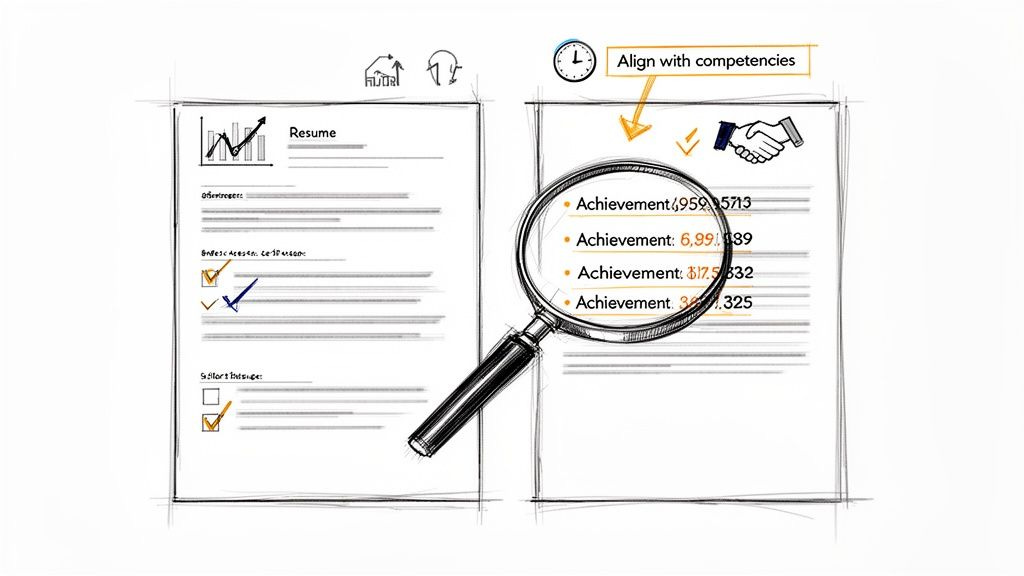
Align Your Experience with Core Competencies
The World Bank is open about the professional competencies it values. These are the exact framework your entire application will be judged against. Your job is to map your experience directly onto these criteria.
For instance, a key competency is “Client Orientation.” Instead of vaguely saying you “worked with stakeholders,” your resume should read something like, “Led consultations with government partners across three countries to align project goals, resulting in a 15% faster implementation timeline.“ See the difference?
Another critical one is “Knowledge Creation and Application.” You have to show you can generate insights and actually use them to drive action. Think about a time you ran research, analyzed data, or built a new model that informed a big decision. Frame it with a clear, tangible outcome.
Write a Cover Letter That Solves Their Problem
Your cover letter’s sole purpose is to make a direct, compelling case for why you are the solution to the hiring manager’s problem. Ditch the “To Whom It May Concern” and the formal fluff. It’s a waste of their time.
Your letter needs to immediately tackle the core requirements of the role, using the exact terminology from the job description. If they need someone with experience in “education finance systems,” your opening paragraph better highlight your direct experience in that very domain.
A great cover letter is a targeted argument. It should connect your top two or three achievements directly to the biggest challenges mentioned in the job posting. This shows you’ve done your homework and understand exactly what the team needs.
Make it easy for the reviewer. Structure your letter to mirror the job requirements, dedicating a short, punchy paragraph to each key qualification. This direct approach respects their time and proves you’re a serious candidate who gets it.
For a more detailed walkthrough, our article on how to apply for World Bank jobs offers a deeper dive into the online portal and the common pitfalls that trip people up. Your goal is to leave them with zero doubt that you’re the perfect fit.
Your Pay, Relocation, and Eligibility: The Nitty-Gritty Details
Before you pour hours into crafting the perfect application, let’s talk about the practical side of a World Bank job in DC. These are the core of the employment package and can make or break your decision. Getting a firm grip on what it actually means to work for an international organization on U.S. soil is a crucial first step.
The World Bank isn’t a typical American company, and its hiring rules reflect that. As an international organization, it aims to build a team that mirrors its diverse member countries. While there are no strict nationality quotas, you’ll be competing against a truly global pool of talent for most roles.
Getting to the U.S. – The G-4 Visa
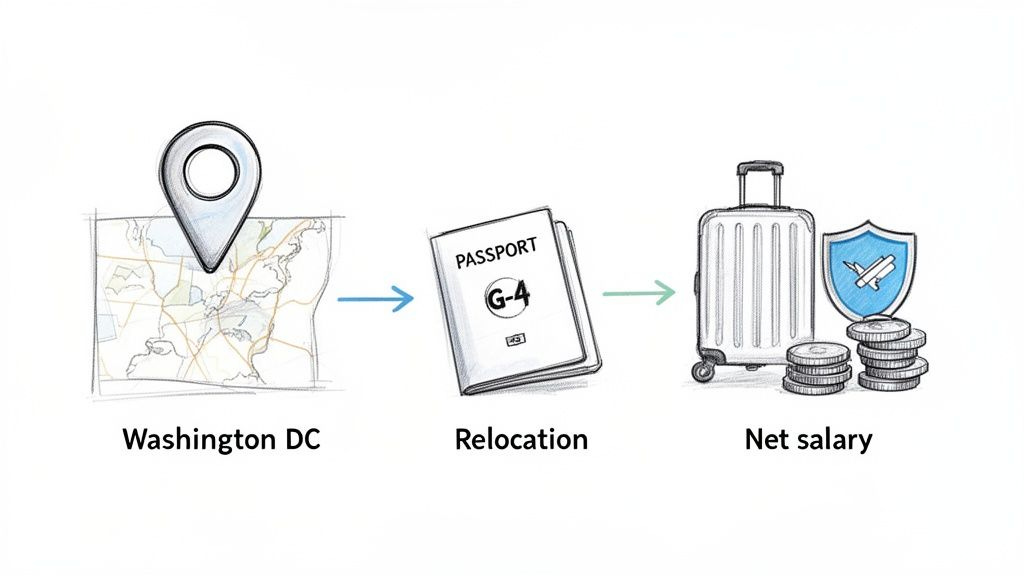
If you’re not a U.S. citizen or a green card holder, the World Bank will sponsor you for a G-4 visa. This is a special visa category specifically for employees of international organizations. It also covers your immediate family, including your spouse and dependent children, which is a huge plus.
A key thing to remember: the G-4 visa is tied directly to your job at the Bank. It allows you to live and work in the U.S. only for as long as you’re employed there. It’s not a pathway to a green card or U.S. citizenship. You need to be crystal clear on that from the start.
One of the biggest perks of the G-4 is that your spouse can apply for work authorization. This is a game-changer, allowing them to find a job and build their own career in the U.S. while you’re with the Bank.
How World Bank Pay Actually Works
This is where things get really interesting. One of the most unique and attractive features of a World Bank career is how you get paid. Salaries are “net of tax.”
This means the Bank pays you a salary and then pays an additional amount on top of that to cover your estimated U.S. federal, state, and local income taxes. The result is a take-home pay that is often significantly higher than what you’d see for a similar role in the private sector. If you want to dive deeper into the numbers, check out our complete World Bank salary guide.
The benefits package is just as robust. You’re not just getting a salary; you’re getting a comprehensive support system. This typically includes:
Top-tier health, life, and disability insurance for you and your family.
A generous pension plan where both you and the Bank contribute.
Plenty of paid leave, including annual vacation, sick days, and parental leave.
Making the Move to DC Smoothly
The Bank gets it: uprooting your life and moving to Washington DC is a massive undertaking. To make the transition as seamless as possible, they offer a solid relocation package to help with the financial and logistical headaches.
This isn’t just a token gesture. New hires usually receive a relocation grant, allowances for shipping your belongings, and other support to help you get settled once you arrive.
This support is more valuable than ever. Recent data from the U.S. Bureau of Labor Statistics shows the job market moderating, with the unemployment rate at 4.0%. This kind of economic climate impacts everything from the cost of an apartment to the availability of local services. Having the Bank’s financial backing for your move provides a critical cushion. You can learn more about the current trends in the U.S. labor market to get a better sense of the economic environment you’d be stepping into.
Answering Your Questions About World Bank Careers
So you’re thinking about a career at the World Bank in DC. You know it’s a big deal, the work matters, and the application process is a gauntlet. But what’s it really like? Let’s get into the practical questions people always ask.
How Competitive Is It Really?
Let’s be blunt: it’s brutally competitive. The World Bank is a magnet for the best and brightest from every corner of the globe. For any given opening, expect hundreds, if not thousands, of other highly qualified people to apply. This is especially true for the flagship Young Professionals Program and for roles at the DC headquarters.
The caliber of the competition is intense. You’re going up against people with PhDs from top-tier universities, years of gritty field experience in developing countries, and incredibly specialized technical skills. Getting an offer means you’re not just good. You’re in the top 1% of an already impressive talent pool.
What Is the Work-Life Balance Like?
The work-life balance can be intense. This is a mission-driven place, filled with people who are deeply committed to the work, and the environment reflects that. The problems are complex, the deadlines are real, and the stakes are incredibly high.
Don’t expect a standard 9-to-5. Long hours are common, especially when a major report is due or a project is hitting a critical phase. Many operational roles also demand significant international travel, which can be draining. While the Bank has generous leave policies, the day-to-day culture is one of intense focus and dedication.
Your passion for the mission is what will get you through. The people who thrive here are energized by the impact they’re making, and that drive helps offset the demanding schedule. If you’re looking for a relaxed, predictable pace, this probably isn’t the right fit.
What Are the Opportunities for Career Progression?
The World Bank has a very structured career ladder, but climbing it is all about performance and merit, not just putting in the years. The institution is hierarchical, with a formal grading system for staff that runs from junior professional levels (GF) all the way up to senior management.
Moving up means actively taking on more complex assignments, managing bigger projects, and eventually leading teams. The Bank encourages internal mobility, so staff often move between different departments, regions, or even out to country offices to get a broader perspective. Promotions are never a given. You have to hunt for those stretch opportunities and consistently prove you can deliver.
Do I Need a Security Clearance?
For most jobs, no, you do not need a U.S. government security clearance. The World Bank is an international organization, not a federal agency, so it operates under its own rules. It has a completely separate background check and clearance process.
Every new hire goes through a comprehensive pre-employment screening. They’ll verify your degrees, check your entire employment history, and run a criminal background check. It’s a thorough process designed to protect the integrity of the institution and its staff, but it’s not the same as the national security clearances required for many U.S. government jobs. Being completely honest and transparent on your application is non-negotiable.
Is a PhD Required for Most Jobs?
A PhD isn’t mandatory across the board, but it’s close to the standard for many technical and research-focused roles. If you look at the profiles of economists, sector specialists, and research analysts, you’ll see a lot of doctoral degrees. The Bank is a deeply evidence-based institution, and it prizes the rigorous analytical and quantitative skills that a PhD develops.
That said, for many operational roles like project management or in corporate functions like HR, IT, and finance, a Master’s degree plus significant, relevant experience is the norm. The key is matching your qualifications to what the job actually demands. A PhD won’t help you if the role requires hands-on project implementation skills that you simply don’t have.
At Multilateral Development Bank Jobs, we demystify the hiring process for institutions like the World Bank. Our weekly newsletter delivers curated job listings, deep-dive guides, and insider insights to help you land your dream role in international development. Subscribe today at
https://mdbjobs.com
.