

When you start looking at jobs with the African Development Bank (AfDB), one of the first things you’ll want to understand is the pay. Gross annual salaries for internationally recruited roles, like the entry-level Young Professional, kick off around $85,000 USD. For senior leadership, you could be looking at figures well over $200,000 USD, and that’s before you get to the substantial tax-free benefits.
A Quick Guide to the AfDB Salary Structure
If you’re seriously considering a career with the AfDB, you need to understand its compensation framework. The system is engineered to attract and keep top global talent for its mission in Africa.
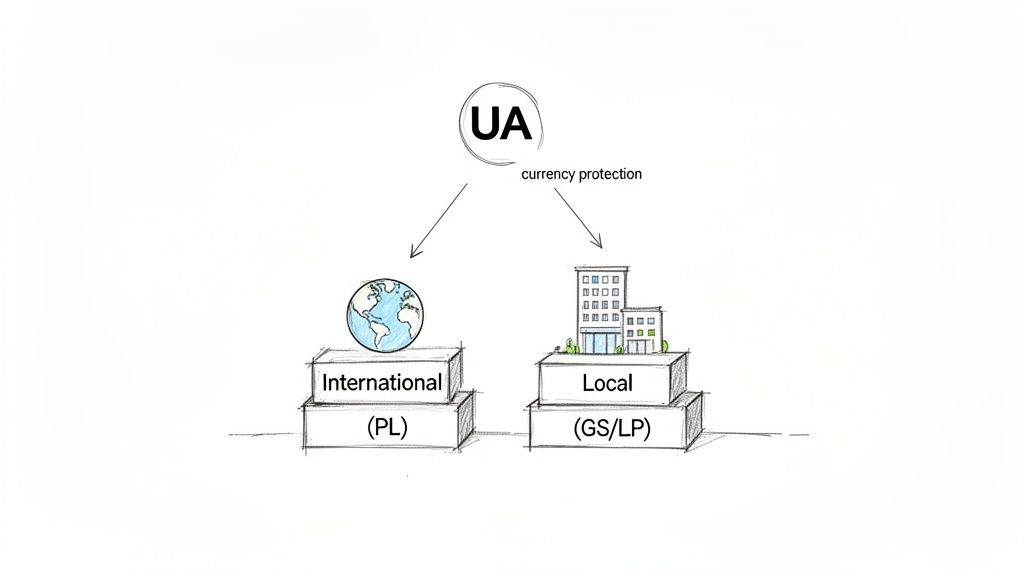
The most important thing to grasp is that your salary and classification hinge on one key distinction: whether you are hired as an international or a local staff member. This single factor dictates how the entire AfDB salary scale works, from your grade level to the benefits you receive.
International vs. Local Staff
The AfDB splits its workforce into two main camps:
Internationally Recruited Staff (IRS): These are the professionals hired from a global talent pool for roles that demand international expertise. Their salaries are pegged to the Professional Level (PL) scale.
Locally Recruited Staff (LRS): This group is made up of General Service (GS) and Local Professional (LP) staff hired within a specific duty station. Their pay is benchmarked against local market conditions.
This guide focuses on the international professional (PL) scale, since that’s what’s most relevant for candidates applying from outside a particular duty station.
The Role of the Unit of Account (UA)
Here’s where the AfDB gets unique. International staff salaries are denominated in something called the Unit of Account (UA), not a single currency like the US dollar or Euro.
The UA is a currency basket linked to the IMF’s Special Drawing Rights (SDR). This mechanism shields your earnings from wild currency swings and inflation, ensuring your purchasing power stays stable no matter where you’re based.
Honestly, it’s a huge advantage. It gives you a level of financial predictability that’s hard to find, especially when you’re an expatriate. All official salary bands and benefits are calculated in UA and then converted to a local currency for your monthly paycheck.
Understanding AfDB Staff Categories and Grade Levels
Before you can pinpoint your potential salary, you have to know where you’d fit within the Bank’s structure. The AfDB splits its workforce into two main categories, and your category determines your grade, pay, and benefits.
This isn’t just administrative jargon; it’s the fundamental starting point. Your classification hinges on whether you’re hired from the global talent pool or from within the country where the job is located.
Internationally Recruited Staff (IRS)
If you’re applying for a role from outside the country of the duty station, you’ll be considered Internationally Recruited Staff. These are the roles that demand a global search for specific skills and international experience, attracting talent from other MDBs, top-tier consulting firms, and the private sector.
IRS roles are graded on the Professional Level (PL) scale. This is the backbone of the Bank’s technical and leadership corps, designed to be competitive on a global stage.
Here’s how the PL grades break down:
PL1 to PL2: This is the executive tier. Think Vice Presidents and Directors. Compensation here is substantial, reflecting the immense responsibility of steering the Bank’s strategic direction.
PL3 to PL5: This is the heart of the Bank’s senior and mid-career expertise. You’ll find titles like Chief Officer (PL3), Principal Officer (PL4), and Senior Officer (PL5). These positions require deep experience, often anywhere from seven to fifteen years.
PL6 to PL7: These are the main entry points for professionals. The prestigious Young Professional (YP) program, for example, brings new talent in at the PL6 grade. Other analyst or officer roles also sit in this range, typically requiring a master’s degree and a few years of relevant work.
Locally Recruited Staff (LRS)
In contrast, Locally Recruited Staff are hired within a specific country to support the Bank’s operations on the ground. Their compensation is benchmarked directly against the local market to ensure it’s both competitive and fair for that region.
This category is split into two further groups:
General Service (GS): The GS scale is for essential administrative, secretarial, and operational support that keeps the Bank’s offices running. Grades usually run from GS4 to GS8, with advancement tied to experience and performance.
Local Professional (LP): In some country offices, the AfDB also hires Local Professionals. These LP grades are for roles that need professional expertise grounded in a national context, creating a career path for local talent to grow within the Bank without being on the international PL track.
How the International Professional Salary Scale Works
The pay for internationally recruited staff at the AfDB revolves around the Professional Level (PL) salary scale. If you’re looking for a clear picture of your potential earnings as an expat, you need to understand how this system works. It’s the backbone of how the Bank attracts and retains global talent.
All international professional salaries are set in the Unit of Account (UA). Think of it as a stable value benchmark, not a currency you can spend. Your salary is calculated in UA and then converted into a local currency like the US dollar or Ivorian CFA franc for your actual paycheck.
The Power of the Unit of Account
The UA is a currency basket pegged directly to the International Monetary Fund’s Special Drawing Rights (SDR). This is a massive benefit for international staff. It acts as a financial shield, protecting your earnings from the wild swings of global currency markets and inflation.
For an expatriate professional, this stability is a game-changer. The real value of your salary stays consistent, whether the dollar strengthens or the euro weakens. You can plan your finances with a certainty that’s rare in international careers.
The UA system ensures your purchasing power is preserved, no matter which duty station you’re posted to. This is a key feature that makes the AfDB’s compensation package seriously competitive.
Visualizing AfDB Staff Categories
The chart below shows the fundamental split between the Bank’s International and Local staff. This is the starting point for the whole salary structure.
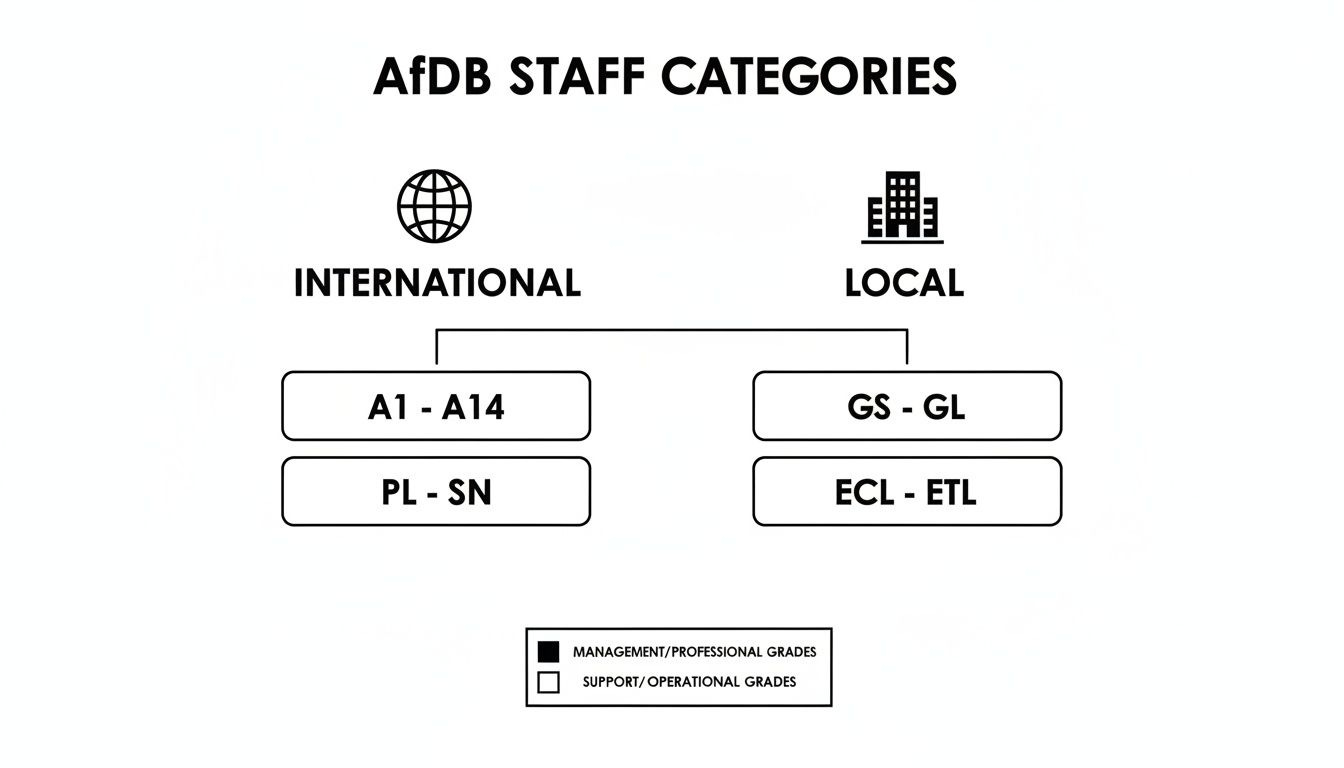
This distinction determines whether your pay is benchmarked against the global PL scale or a local GS/LP scale, which is a crucial difference.
Salary Bands and Grade Levels
The PL scale is broken down into grades, and each grade has a specific salary band with multiple steps inside it. Moving through these steps depends on your performance and years of service. As you climb the ladder from an officer to a principal or chief officer, your salary band jumps significantly.
The structure is designed to reward expertise and seniority. For example, historical data shows an entry-level international staff member might start around $45,516 annually. This scales up dramatically. A PL3 Chief Officer with enough experience could earn up to $128,748, and senior leadership roles at PL8 could reach as high as $261,558 per year.
This clear hierarchy lets you map out a potential career path and earnings trajectory within the Bank. You can get a better sense of this by exploring the historical data on AfDB grade and salary structures.
Decoding AfDB Benefits and Allowances
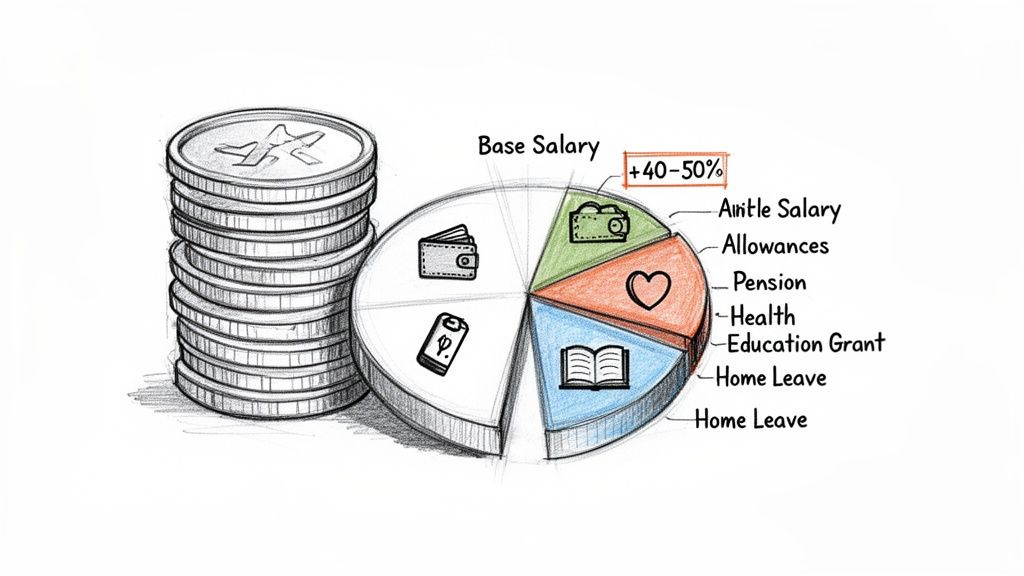
Let’s get straight to it: your base salary is just one piece of the puzzle at the African Development Bank. The real financial firepower comes from the benefits and allowances package. For international staff, these perks can easily add 40-50% or more to your take-home pay.
If you ignore these benefits, you’re drastically underestimating what you could earn. These aren’t minor perks; they are huge financial add-ons designed to support an expatriate lifestyle and pull in top talent from around the world. It’s a core part of the Bank’s total compensation strategy, and it’s extremely competitive.
Core Financial Allowances for International Staff
Several key allowances directly boost your net income. If you’re relocating for a role, these are the benefits that will have the biggest impact on your finances right away.
Here are the big ones:
Post Adjustment: This is a cost-of-living allowance that changes depending on your duty station. It equalizes your purchasing power, meaning an expensive assignment in Geneva won’t wreck your finances compared to a post in a cheaper location.
Dependency Allowance: The Bank provides a direct financial supplement for your recognized spouse and each dependent child. This is straightforward cash support for your family.
Installation Grant: Think of this as a one-time payment to cover the initial costs of setting up your life in a new country. It’s meant to soften the financial blow of a big international move.
The High-Value Perks: Education and Travel
Beyond the direct cash top-ups, two benefits stand out for their sheer monetary value: the education grant and home leave. For mid-career professionals with families, these are often the make-or-break factors in an offer.
The Education Grant is probably one of the most valuable benefits on the table. It reimburses a huge chunk of your children’s education costs, from primary school through university. This can be worth tens of thousands of dollars per child every year, a massive financial relief for any parent living the expat life.
On top of that, the Bank provides funds for Home Leave, allowing you and your family to fly back to your home country every two years. The Bank foots the bill for the flights to ensure you can maintain personal and professional ties back home.
The total package is seriously robust. For MDB professionals looking at the AfDB, these benefits—from generous pension contributions to education allowances that can hit $30,000 per child and paid home leave—can push your total remuneration 50% above the base salary. You’ll see this reflected on salary aggregator sites that track MDB pay.
This kind of package is very similar in structure to what you’ll find at other major international organizations. If you’re comparing offers, it’s worth checking our guide on UN staff benefits and allowances to understand the common principles.
Connecting AfDB Job Titles to Salary Grades
So, where would you fit on the African Development Bank’s salary scale? This is the crucial question. It’s where we map job titles and years of experience to the Bank’s internal Professional Level (PL) grades. Getting this right is key to benchmarking your own profile and understanding your potential earnings.
A great way to understand this is to look at a common entry point: the Bank’s flagship Young Professionals Program (YPP). YPs are typically brought in at the PL6 grade. This is the launchpad for high-potential candidates who have a master’s degree and a few solid years of experience.
Mapping a Typical Career Progression
From that PL6 starting block, the career ladder is surprisingly transparent. With good performance reviews and a growing track record, a Young Professional can realistically aim for a promotion to Senior Officer at the PL5 grade within a few years. That jump comes with more project ownership and a significant pay increase.
The next big step is to Principal Officer at the PL4 grade. Hitting this level usually means you have at least six to eight years of directly relevant experience. At this point, you’re a subject matter expert, often leading complex projects or policy initiatives.
The progression is clear and motivating. It’s not a black box. You can see the ladder and what it takes to climb it, which is a major reason talented people build long-term careers at the Bank.
This clear path is directly mirrored in the salary structure. Looking at historical data, an entry-level professional might start as low as $45,516, but a PL4 Principal Officer could see their salary go up to $114,935. Moving up to a PL3 Chief Officer opens up a band that can reach $128,748 or more.
The salary bands are designed to widen by 40-50% based on performance and time in grade, which strongly incentivizes staying. This helps explain why average staff retention at MDBs often tops ten years. You can get a sense of these ranges by checking historical data on sites like ZipRecruiter.
From Technical Expert to Leadership
Once your career moves past the principal level, you’re on the track for senior leadership and management.
PL3 (Chief Officer): At this point, you are a recognized authority in your field. You’re managing teams, shaping strategy for your division, and have oversight of major Bank initiatives. This role demands extensive experience, often 10+ years.
PL2/PL1 (Director/VP): These are the executive tiers. People at this level are running entire departments or regions, steering the Bank’s overall mission and strategy.
This hierarchy from PL6 to PL1 gives you a tangible roadmap for both your career path and your earning potential at the AfDB. You can explore a variety of potential career paths at the African Development Bank to see how different roles fit into this structure.
Comparing AfDB Salaries Against Other MDBs
If you’re a serious candidate for an MDB role, you’re probably not looking at just one institution. You’re likely weighing offers from several, so knowing where the African Development Bank salary scale fits into the bigger picture is critical for making a smart career move. It’s all about understanding your market value.
Direct, apples-to-apples comparisons are notoriously tricky. Each MDB structures its pay and benefits differently. But when you zero in on net base salaries for internationally recruited staff, a clear pecking order emerges. The AfDB holds its own, often competing directly with the heavyweights.
A High-Level Breakdown
The World Bank Group and the International Monetary Fund (IMF) are seen as the top payers in the development world, particularly for roles based in their Washington D.C. headquarters. Their salary bands often sit a touch higher than the AfDB’s, especially at the most senior levels.
That’s not the whole story. The AfDB’s compensation package consistently outpaces what you’ll find at most UN agencies. It’s also fiercely competitive with other major regional players like the Asian Development Bank (ADB) or the Inter-American Development Bank (IDB).
Where the AfDB really gains an edge is its incredibly comprehensive benefits package. This is where the gap with the World Bank often closes on a total remuneration basis.
Look at the entire package. A slightly lower base salary at the AfDB can be easily offset by a more generous education grant or a lower cost of living at the duty station, resulting in higher disposable income.
How AfDB Stacks Up on Total Compensation
When you start factoring in all the allowances, the picture really shifts. For most nationalities, the combination of tax-free status, generous education grants, and dependency allowances creates a total compensation package at the AfDB that is often on par with, or even better than, its peers.
For a clearer picture, it helps to compare what a mid-career professional (like a Senior Officer) might expect across the major MDBs. Keep in mind these are estimates, as official bands are rarely public, but they provide a solid directional guide.
High-Level MDB Salary Comparison for Mid-Career Professionals
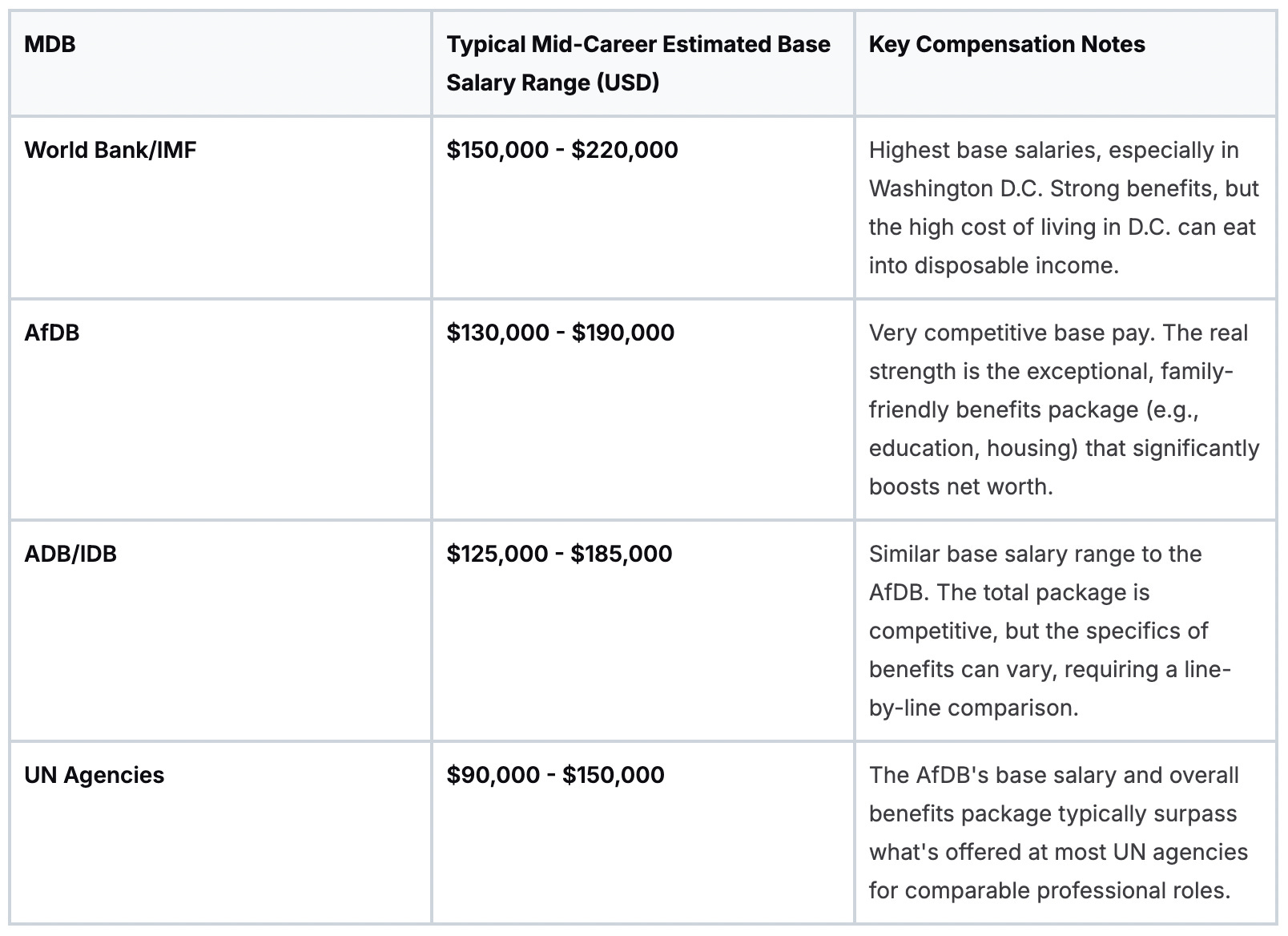
As you can see, while the D.C.-based institutions might have a higher starting number, the AfDB’s robust allowances for housing, education, and dependency often make its net, take-home value incredibly attractive, especially for staff with families.
This comparative knowledge is powerful when you’re at the negotiation table or deciding between offers. For an even deeper dive, you can read our more detailed breakdown of MDB salaries and the numbers you want to see.
Frequently Asked Questions About AfDB Salaries
Once you get serious about applying to the African Development Bank, the conversation always turns to money. It’s a critical piece of the puzzle. Here are some straight answers to the most common questions we see from candidates trying to navigate the african development bank salary scale.
Are AfDB Salaries Tax-Free?
This is the big one, and the answer isn’t a simple yes or no. For most internationally recruited staff, their AfDB salaries are indeed exempt from income taxes in their home countries. This is a standard perk for major multilateral organizations, baked into international treaties.
The major exception here is U.S. citizens. The U.S. government taxes its citizens on their worldwide income, no matter where they live or who they work for.
The AfDB levels the playing field by providing a tax allowance to its American staff. This is an extra payment calculated to offset the income taxes they owe, effectively making their net take-home pay equal to that of other nationalities. The bank’s goal is to ensure pay equity across all international staff, full stop.
How Is My Starting Salary Determined Within a Grade?
Your starting salary isn’t just pulled out of a hat. The AfDB has a structured system of “steps” within each pay grade, and where you land depends on a few key things:
Years of Relevant Experience: This is the heavyweight champion. The more your professional background goes above and beyond the job’s minimum requirements, the higher your starting step is likely to be.
Academic Qualifications: An advanced degree or a specialized certification that’s highly relevant to the role can give you a nice bump.
Internal Equity: The Bank is careful to place new hires at a step that’s fair and consistent with current staff who have similar experience and responsibilities in the same grade.
Basically, the grade is the ballpark you’re playing in (say, PL5), and the step is your starting position on the field. The Bank wants to make sure you’re placed correctly from day one.
Is It Possible to Negotiate My Salary Offer?
Yes, you can negotiate, but you need to understand the rules of the game. You absolutely cannot negotiate the grade level (PL) of the job. That’s fixed based on the position’s responsibilities and where it sits in the Bank’s structure.
Where you do have some leverage is on the step level within that grade. If you genuinely believe your experience and qualifications justify a higher starting salary than what they’ve offered, you can build a case for a higher step.
To pull this off, you need a strong, evidence-based argument.
Your negotiation has to be about demonstrating how your unique experience, specific skills, or extensive track record substantially exceed the role’s stated requirements. Just asking for more money won’t get you anywhere. You have to prove you bring exceptional value that warrants a higher starting point on that grade’s pay scale.
For instance, if a job asks for seven years of experience and you’re bringing twelve, including direct leadership on projects highly relevant to the Bank’s portfolio, you have a solid foundation for requesting a higher step.
Do Local Staff Get the Same Benefits as International Staff?
No, and the packages are designed this way for a reason. Internationally Recruited Staff (IRS) get a comprehensive package built for expatriates. This includes benefits designed to cover the unique costs of relocating and living abroad, such as:
Home Leave
Education Grants
Installation Grants
Post Adjustments
Locally Recruited Staff (LRS), on the other hand, receive a benefits package benchmarked against the top employers in that specific country. It’s still excellent, with great health insurance and a solid pension plan, but it doesn’t include the expatriate-focused allowances. The aim is to be a leading employer in every local market where the Bank has a presence.
This split is fundamental to the entire AfDB compensation philosophy, ensuring the Bank stays competitive for both global and local talent.
Finding your way into one of these high-impact roles can be tough, but you don’t have to do it alone. Multilateral Development Bank Jobs provides curated job lists and expert guides to help you land a career at the AfDB or another top MDB. Learn more and get access to exclusive opportunities at
https://mdbjobs.com