

World Bank Group jobs are some of the most sought-after positions in global development. Getting your foot in the door means you need to look past the job title and understand the mission: fighting poverty and promoting sustainable development. The work is about creating real-world impact, and that starts with knowing how the Group is structured.
Understanding the World Bank Group Mission
Before you look at a single vacancy, get the big picture. The World Bank Group is a strategic alliance of five distinct institutions, each with a specific role. Grasping this structure is your first step to showing you’re a serious candidate who gets the mission, not just the job description.
Think of the World Bank Group as a specialized toolkit. Each tool is designed for a specific development challenge, and the jobs within each institution are directly tied to that purpose. Knowing which tool does what helps you aim your application with precision.
The Five Institutions and Their Roles
The Group is made up of five core organizations. They work together, but their individual focus dictates the kinds of professionals they need.
The International Bank for Reconstruction and Development (IBRD): This is the original institution. It provides loans, guarantees, and advisory services to middle-income and creditworthy low-income countries. Jobs here are often in public finance, massive infrastructure projects, and government policy.
The International Development Association (IDA): IDA focuses on the world’s poorest countries. It provides grants and zero- to low-interest loans for projects that kickstart economic growth, reduce inequality, and improve people’s lives. You’ll find roles here in areas like health, education, and social safety nets.
Together, the IBRD and IDA form what most people call “The World Bank.” The other three institutions have specialized, private-sector-oriented functions.
Job creation is now a core, integrated goal in the World Bank Group’s work. This strategic pivot changes what they look for in candidates.
The Private Sector and Investment Arms
The other three institutions strengthen the private sector in developing countries. This is where you’ll find jobs related to finance, investment, and legal arbitration.
The International Finance Corporation (IFC): The IFC is the largest global development institution focused exclusively on the private sector. It provides investment, advisory, and asset management services. If you’re an investment officer, industry specialist, or financial analyst, look here.
The Multilateral Investment Guarantee Agency (MIGA): MIGA encourages cross-border investment by providing political risk insurance and credit enhancement guarantees. This arm hires professionals skilled in political risk, finance, and international law.
The International Centre for Settlement of Investment Disputes (ICSID): ICSID provides international facilities for conciliation and arbitration of investment disputes. The roles here are highly specialized, mostly for lawyers and legal professionals.
This focus on employment is urgent. As part of its 2025 initiatives, the World Bank Group has integrated job creation into every project. The numbers paint a clear picture: 1.2 billion young people will enter the workforce in developing economies over the next decade, but only 420 million new jobs are projected to be created. To tackle this massive gap, the Group has already helped countries deliver job-related benefits to 375 million people.
You can learn more about the future of jobs from the World Economic Forum’s detailed report. You might also be interested in our complete guide to the World Bank for a deeper look at its operations.
How to Get In: Key Recruitment Pathways
There’s no single front door for World Bank Group jobs. It’s a building with several distinct entrances, each designed for people at different career stages. Choosing the right one is the difference between a stalled application and a successful entry.
Your experience level, specialization, and long-term goals determine the best pathway. Let’s break down the main entry points so you can map out your approach.
The World Bank Group is a family of five institutions, each with a unique mandate.
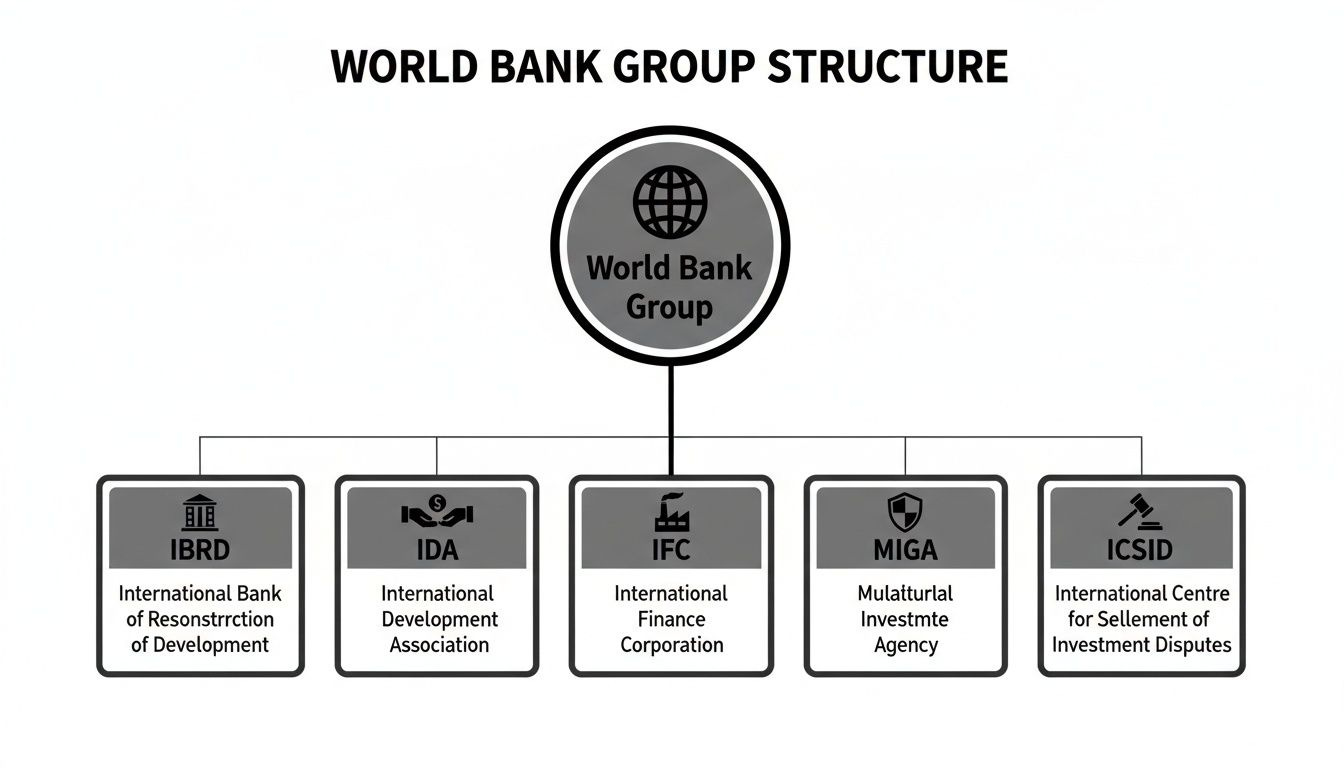
Knowing this structure helps you target your job search. A role at the private-sector-focused IFC is fundamentally different from a public policy position at the IBRD or IDA.
Here’s a quick comparison of the main ways people get hired.
World Bank Group Recruitment Pathways Compared
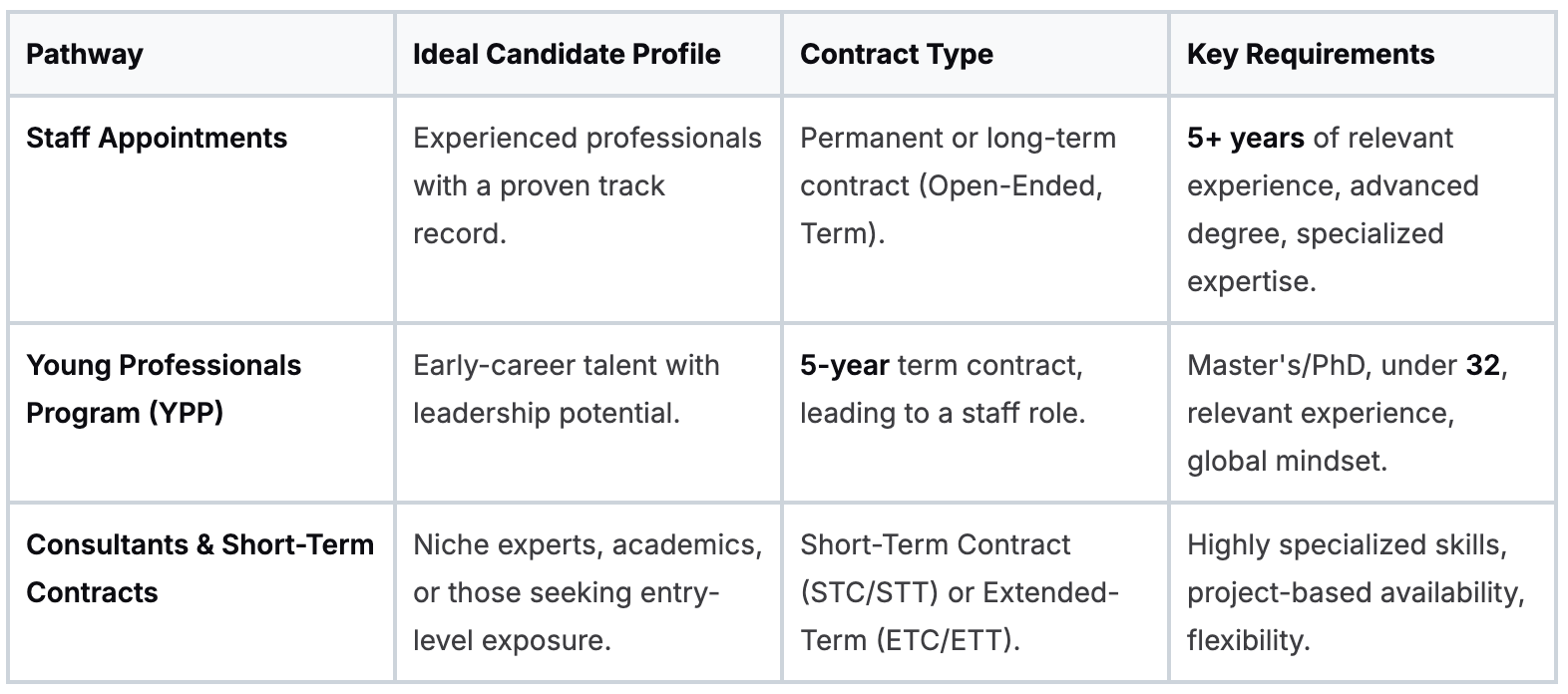
Each pathway serves a different purpose. Let’s dig into the details.
Staff Appointments: The Traditional Career Path
Staff appointments are the backbone of the organization. These are the permanent or long-term contract roles with full benefits and a clear career ladder. This is the path for experienced professionals with a solid track record.
These roles are graded on a scale, typically from GA (junior administrative) to GK (senior management). Most professional roles fall in the GE to GG range.
The competition is intense. You’re up against a global pool of top-tier experts. A successful application requires a deep understanding of the role and a CV that demonstrates clear impact.
The Young Professionals Program: A Launchpad for Future Leaders
The World Bank Young Professionals Program (YPP) is the most prestigious entry point for early-career talent. It’s an incredibly competitive program designed to cultivate the next generation of Bank leaders.
The YPP is your ticket if you have a relevant master’s or doctoral degree, solid professional experience, and are under the age of 32.
The YPP is a direct pipeline to a full staff position. It places successful candidates in roles with significant responsibility from day one. It’s structured, rigorous, and your fastest route to an impactful career within the Group.
Successful candidates, called YPs, are placed into a role within the IBRD, IFC, or MIGA and participate in extensive training and rotational assignments. It’s an immersive experience that gives you a panoramic view of the organization. The application window is tight and specific each year, so planning is essential.
Consultants and Short-Term Contracts: Specialized and Flexible Expertise
Consultant roles are how the World Bank Group brings in specialized expertise for specific projects. These are not staff positions. They are fixed-term contracts, from a few weeks to a couple of years, and don’t include staff benefits.
This pathway is perfect for seasoned experts who prefer project-based work or for those looking to get a foot in the door. Many long-term staff members started their careers as consultants.
These roles are often filled through consultant rosters or direct vacancy announcements. The key is to have a highly specialized skill set in demand, like climate finance, digital health, or a niche area of infrastructure policy. The hiring process is often much faster than for staff roles, reflecting an urgent, project-based need.
You can dive deeper into the specific timelines and expectations with our 2026 World Bank hiring playbook and timelines, which provides a detailed breakdown of each cycle.
Choosing the right pathway focuses your efforts and dramatically increases your chances of success. Assess your experience honestly and target the entrance that aligns with your profile. This strategic thinking is the first step toward landing one of the most rewarding World Bank Group jobs.
Let’s break down the non-negotiable rules for getting a job at the World Bank Group. Nationality and education are the first two hurdles you must clear. Get these wrong, and your application is dead on arrival.
First up is nationality, and it’s a deal-breaker. The World Bank Group is owned by its member countries, so it almost exclusively hires citizens of those countries. This is a requirement for nearly all staff and Young Professionals Program (YPP) jobs.
Before you do anything else, check if your country is on the member list. We’re talking about your citizenship, not where you live. If your country isn’t a member, you’re out of the running for the vast majority of positions. The rare exception is some highly specialized, short-term consultant gigs.
The Educational Standard
Cleared the nationality check? Great. The next gatekeeper is your education. For professional roles at the Bank, a bachelor’s degree won’t cut it. You need an advanced degree for most jobs in policy, finance, and operations.
A master’s degree is the minimum to be taken seriously. For senior or deeply technical roles, a PhD is often the expectation. This high bar reflects the complex analytical and strategic work involved in global development.
Your advanced degree is your ticket to the game. It proves you have the deep knowledge and research skills to hit the ground running. Without it, your application probably won’t get past the first screening.
In-Demand Fields of Study
While the Bank hires from many backgrounds, some academic fields are always in high demand because they align directly with the Group’s core mission.
Economics and Public Policy: This is classic World Bank territory. Deep expertise in macroeconomics, international development, or public finance is always needed.
Finance and Business: For roles at the IFC and MIGA, degrees in finance, business administration (MBA), and investment management are essential.
STEM and Sector-Specific Fields: The world’s development problems are changing, and so are the skills the Bank needs. Degrees in climate science, environmental engineering, public health, digital development, and agricultural science are increasingly sought after.
Language Proficiency
Last, let’s talk languages. Fluency in English is mandatory. All official business, reports, and day-to-day communication happen in English.
Fluency in other languages is a huge advantage. It shows you can work effectively on the ground in different countries and connect directly with local partners.
Key Languages That Give You an Edge:
French
Spanish
Arabic
Knowing Portuguese, Russian, or Chinese can also give you a leg up for certain regional or specific roles. Highlighting these language skills on your application makes you a much more compelling candidate.
Your Step-by-Step Application Playbook
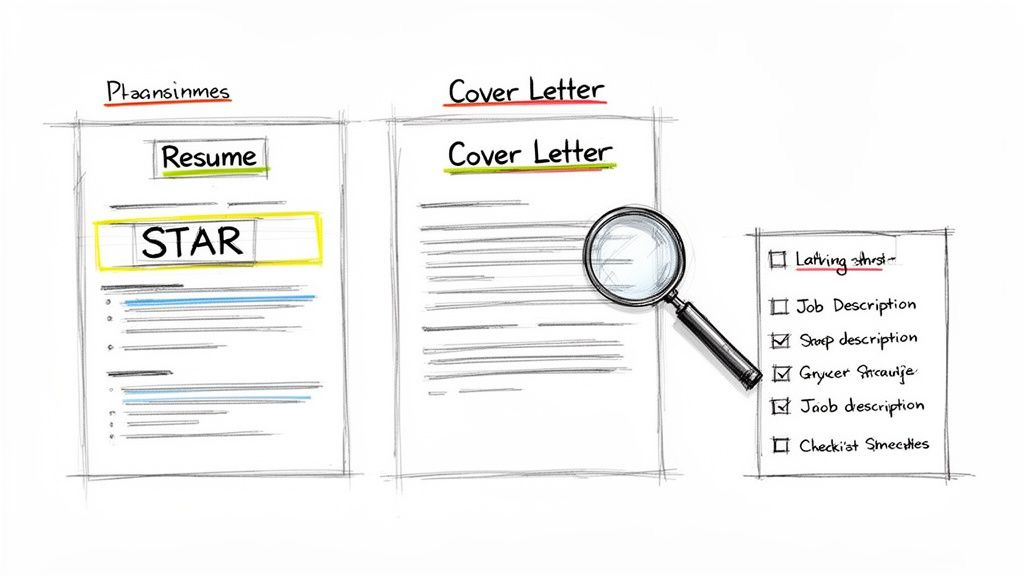
A strong application is your ticket in. You’re not just listing past jobs; you’re framing your professional story in the language the World Bank values. You have to translate your experience into their specific dialect.
This means ditching the generic approach. Every piece of your application, from your resume to your cover letter, has to speak directly to the role and prove you get the Bank’s mission. Let’s walk through how to build an application that gets noticed.
Decode the Job Description
Before you type a single word, dissect the job description. This document is your cheat sheet. It tells you exactly what hiring managers want.
Don’t just skim it. Print it, grab a highlighter, and get to work. Pinpoint the core competencies, technical skills, and key responsibilities they mention repeatedly. These are your keywords. Your application must reflect this language back to them.
Look for phrases like “client orientation,” “drive for results,” or “collaboration.” These are official World Bank competencies. Providing hard evidence for them is non-negotiable.
Structure Your Resume for Impact
Your resume is a highlight reel of your biggest wins, not a list of duties. Recruiters spend seconds on each one, so you have to show your value immediately. The best way to do that is by focusing on results.
For every role, prioritize what you achieved over what you did. Instead of “Managed a project budget,” write “Managed a $2.5 million project budget, delivering the project 10% under budget and one month ahead of schedule.” The second version proves your impact with numbers.
The STAR method is your best friend here. It’s a simple, powerful framework for structuring your bullet points.
Situation: Briefly set the context.
Task: What was your specific responsibility?
Action: What concrete steps did you take? Use active verbs.
Result: What was the outcome? Quantify it.
Your resume’s only job is to get you the interview. It does that by providing concrete, quantifiable proof that you solve the exact problems the World Bank is trying to solve. Every bullet point should be a mini-case study of your effectiveness.
The Bank’s internal focus on evidence is sharper than ever. Take the World Bank’s Country Growth and Jobs Report, launched in early 2025. It integrates job creation into growth strategies using precise, evidence-based tools. Your application needs to mirror this data-driven mindset. You can learn more about the Bank’s innovative approach to job creation.
Write a Compelling Cover Letter
Your cover letter is not a resume summary. It’s your chance to connect the dots for the hiring manager and make a direct case for why you are the best person for this job at this institution.
Your letter should have a clear, three-part structure:
The Hook: State the position and immediately connect your core expertise to the Bank’s mission. Show you’ve done your homework.
The Proof: Dedicate a paragraph or two to your most relevant accomplishments. Use the STAR method in narrative form to tell a story that aligns with the job’s top requirements.
The Close: Reiterate your enthusiasm for the role and its importance. End with a professional closing and a clear interest in an interview.
This is your shot to show you grasp the nuances of World Bank Group jobs. For more detailed tips, check out our guide on how to apply for World Bank jobs.
Navigate the Online Application Portal
Don’t let a technicality sink your hard work. The World Bank’s online application system, Taleo, can be particular. Give yourself plenty of time to fill it out and avoid last-minute submissions when the system slows down.
Be prepared to re-enter information from your resume into specific fields. It’s tedious, but skipping this can get your application filtered out by an algorithm. Double-check everything for typos and make sure your documents are uploaded in the correct format. A polished, error-free submission signals your professionalism.
The Interview Process and How to Prepare
Getting an interview is a huge win. Now the real work starts. The World Bank Group uses a structured, competency-based interview process designed to test your skills with precision.
This approach means they want to know how you’ve done things, not just what you’ve done. They’re looking for concrete evidence that you have the core competencies to succeed in their environment.
Understanding Competency-Based Interviews
Forget vague questions. A competency-based interview systematically evaluates specific skills and behaviors. Each question is designed to see if you can demonstrate an attribute like “Client Orientation” or “Drive for Results.”
Every answer you give must be a specific, real-world example from your past. No hypotheticals. They want proof.
The entire process is built on one premise: past performance predicts future performance. Your job is to provide irrefutable evidence from your career that proves you have what it takes.
To do this, you need the STAR method. Don’t skip this.
Situation: Briefly describe the context. What was the challenge?
Task: What was your specific goal?
Action: What precise steps did you personally take?
Result: What was the measurable outcome? Quantify it.
Mastering this framework is non-negotiable. It forces you to deliver the concise, evidence-based answers the panel is trained to look for.
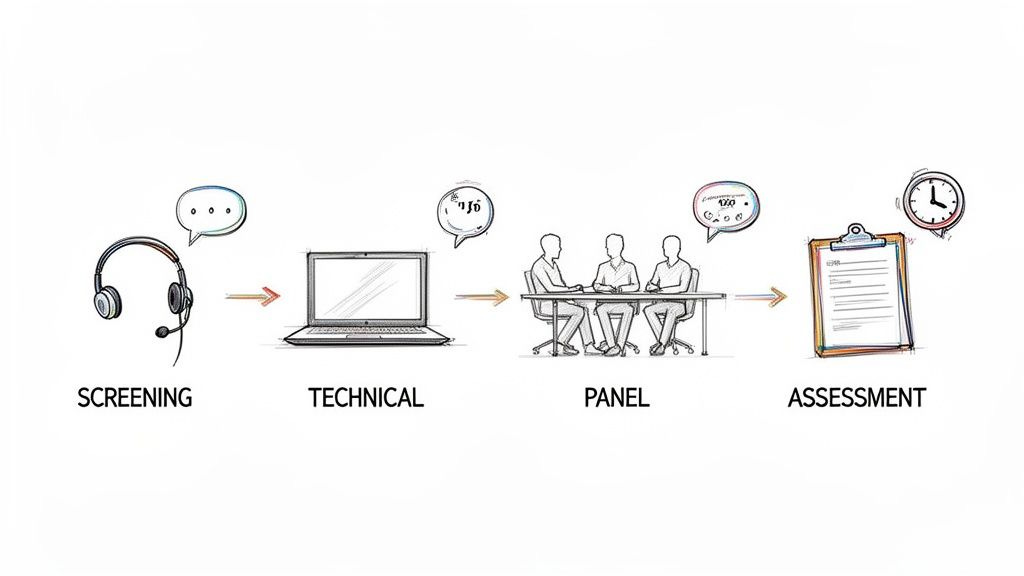
The Different Stages of the Interview Process
The interview process is a multi-stage affair. While the exact steps can vary, be ready for a rigorous sequence.
Initial Screening: This is often a brief call with HR or a hiring manager to verify your core qualifications, interest, and salary expectations. It’s a basic check.
Technical Interview: Here you’ll meet with subject-matter experts from the team. They will dig deep into your technical knowledge, whether it’s econometrics, project finance, or climate policy.
Panel Interview: This is the main event. You’ll face a panel of several interviewers, often from different departments, who will run you through a series of competency-based questions.
Assessments or Case Studies: For many roles, you’ll get a practical exercise. This could be a timed writing test, a data analysis problem, or preparing a presentation on a policy issue.
Your preparation needs to cover all these stages. Don’t focus only on the panel and forget that a technical screen or case study could knock you out early.
Preparing for Success
Effective preparation is more than re-reading your resume. Build a library of success stories from your career and map each one to the World Bank’s core competencies.
Tear the job description apart again. Identify the top three or four competencies and brainstorm at least two distinct STAR examples for each. Write them down and practice telling these stories out loud until they sound natural and confident.
The interviewers want to see how your skills apply to their mission. For instance, the Bank’s emphasis on job creation is directly tied to global labor trends. In 2025, employment in services dominates at around 50% of total jobs in many economies, while industry lags. This reflects the huge structural shifts the Bank is trying to address, particularly in lower-middle-income countries where jobs gaps can be as high as 28%. Showing you understand this context is powerful. You can explore more about the challenges in the global labor market on the World Bank’s data platform.
Finally, prepare your own questions. Asking about the team’s biggest challenges, performance metrics for the role, or how the position contributes to the institution’s larger goals shows you’re engaged and evaluating them just as much as they’re evaluating you.
Answering Your Top World Bank Career Questions
You’ve got questions about World Bank jobs. You deserve straight answers. Let’s cut through the noise and tackle the real-world concerns that trip up most applicants. Understanding the practical realities lets you focus your energy where it counts.
How Long Does the World Bank Recruitment Process Take?
Patience is a prerequisite. The timeline depends on the role. For permanent staff positions, expect a process that can take four to eight months from application deadline to final offer. It’s a marathon involving multiple layers of review.
The Young Professionals Program (YPP) follows a more structured and predictable annual calendar. On the other end, consultant and short-term contract roles can move very fast. Since they’re tied to urgent project needs, the hiring process can wrap up in just a few weeks.
Do I Need Experience in a Developing Country?
Field experience is a massive advantage. While it might not be a hard requirement on paper, it’s one of the clearest signals you can send that you understand the work. For any operational role working directly with client countries, it’s practically essential.
Field experience proves you can adapt to different cultural contexts and grasp the on-the-ground challenges that can’t be learned from a textbook. It shows you’re a practitioner, not just an analyst.
If you lack direct professional experience in a developing country, you need to compensate. Work harder to highlight relevant project work, academic research, or extended, meaningful travel that demonstrates a genuine commitment to understanding the Bank’s clients.
What Are the Biggest Mistakes Applicants Make?
I see the same three mistakes sink countless applications. Steer clear of these, and you’ll be ahead of the competition.
Submitting a Generic Application: This is the cardinal sin. Recruiters spot a lazy, copy-pasted resume and cover letter from a mile away. You must tailor every single application to the specific job description, weaving in its keywords and directly addressing its core requirements.
Focusing on Duties Instead of Results: The Bank wants to know what you achieved, not what you were assigned to do. Don’t just say you “managed a budget.” Instead, say you “managed a $5M budget, delivering the project 15% under cost.” Quantify everything. Numbers speak louder than words.
Ignoring the Institution: Showing you don’t know the difference between the IFC and the IBRD is an immediate red flag. Applying for an IFC role with a cover letter that talks about public policy for poor countries shows you haven’t done your homework. It’s a rookie mistake that gets your application tossed.
How Can I Stay Informed About New Job Openings?
Waiting for opportunities to find you is a losing game. Be proactive. Start by setting up specific job alerts on the official World Bank Group Careers website. This is your ground zero.
Don’t stop there. Follow the Bank’s main institutional accounts on LinkedIn, but more importantly, follow the specific departments or leaders in your field. They often share hiring priorities or announce major recruitment drives. The smartest move? Subscribe to a specialized newsletter that aggregates job listings from all the major Multilateral Development Banks. This gives you a single, reliable source for staff and consultant gigs across the entire sector.
At Multilateral Development Bank Jobs, we do the heavy lifting for you. Our newsletter delivers full-time staff listings and consultant roles from over 30 MDBs and the UN directly to your inbox, along with deep-dive guides to help you land the job. Sign up and stop searching, start applying:
https://mdbjobs.com