
International development consulting isn’t a typical 9-to-5. It’s a world of specialized, project-based contracts focused on tackling global challenges. You aren’t climbing a corporate ladder. You’re operating in a global marketplace driven by the procurement needs of organizations like the World Bank, UN agencies, and major bilateral donors like USAID.
To succeed, you need serious technical skill. You also need to master proposal writing and navigate a unique procurement system.
The Real World of Development Consulting
Forget what you know about traditional job hunting. Sending a generic resume into the void is a complete waste of time. The world of international development consulting has its own rulebook, governed by procurement processes, niche expertise, and your professional network.
The big players—Multilateral Development Banks (MDBs), UN agencies, and bilaterals—don’t hire consultants to be nice. They do it for a practical reason: they need specific, high-level skills for a set period, without the long-term cost of a full-time staff member. This model gives them the agility to bring in a top-tier water sanitation engineer for a project in Southeast Asia or a public health policy guru for a six-month contract in Sub-Saharan Africa.
Staff Role Versus Consulting Contract
Understanding the difference between a staff job and a consulting contract is fundamental. They are two different worlds.
Staff Roles: These are permanent or long-term jobs. They come with a steady salary, health insurance, a pension plan, and a defined place in the organizational chart. The work is about institutional goals and long-term program management.
Consulting Contracts: These are short-term, project-specific deals. You are a service provider, paid a daily or monthly rate to produce a specific output, known as a deliverable. There are no benefits, and the relationship is transactional.
This is a crucial mindset shift. As a consultant, you are a business. Your value is measured by your ability to deliver results on time and on budget.
The consultant model allows an organization to parachute in a world-class expert for a six-month project without the lifelong commitment. You’re paid for your brain and your output, not for warming a chair.
The sector has leaned heavily on this model for years. It’s a project-based economy, fueled by the global push to hit the Sustainable Development Goals (SDGs) by 2030. This trend is reflected in the kinds of opportunities available, from project management to niche policy analysis. Job sites like ZipRecruiter offer a high-level overview of the market.
A few core skills are always in demand. Deep technical expertise in a specific area—climate finance, digital health, or agricultural value chains—is your ticket to the game. Equally important are solid project management skills, a good grasp of monitoring and evaluation (M&E), and the ability to write a technical proposal that gets straight to the point.
This guide is your playbook for understanding that reality, setting the right expectations, and building a strategy that works.
How to Find and Win Consulting Opportunities
The most interesting and lucrative international development consulting jobs aren’t on LinkedIn or Indeed. Those platforms are for corporate gigs. To find high-value opportunities with the World Bank, UN agencies, or regional development banks, you go to their procurement portals. This is where the real action happens.
Success is a two-part game. First, you find the right openings. That’s the easy part. The real challenge is mastering the formal bidding process, where most aspiring consultants get eliminated before their CV gets a serious look. This is about precision and playing by their rules.
Consultants are the critical link between the big development organizations and the projects they fund on the ground.
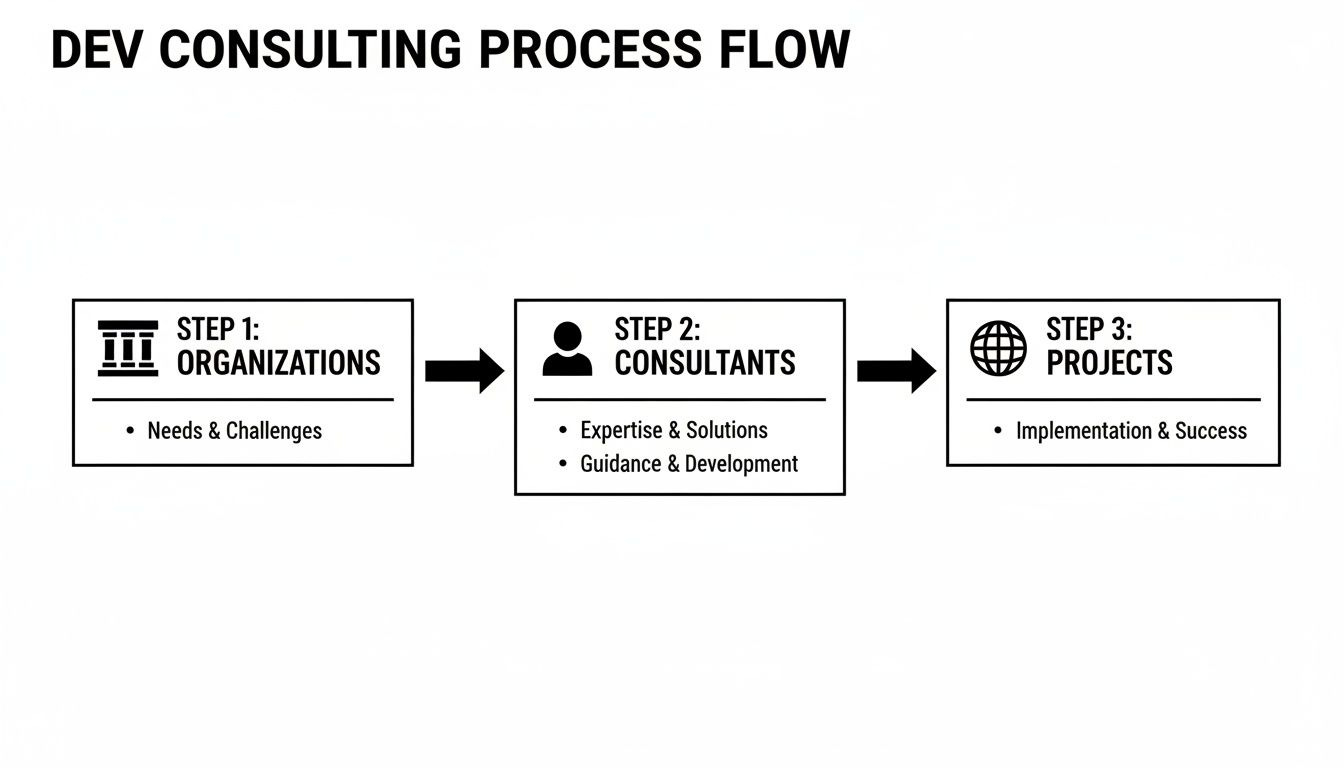
The organizations have the money and the mandate, but they need experts like you to get the work done.
The Portals Where Real Opportunities Live
Stop wasting time on generic job boards. Focus on the official procurement and business opportunity websites run by the major institutions. These are the primary sources for consulting contracts.
You need to get familiar with the key platforms where these opportunities are posted. Each has its own focus, and knowing which one to use is the first step.
Here’s a breakdown of the essential portals to bookmark.
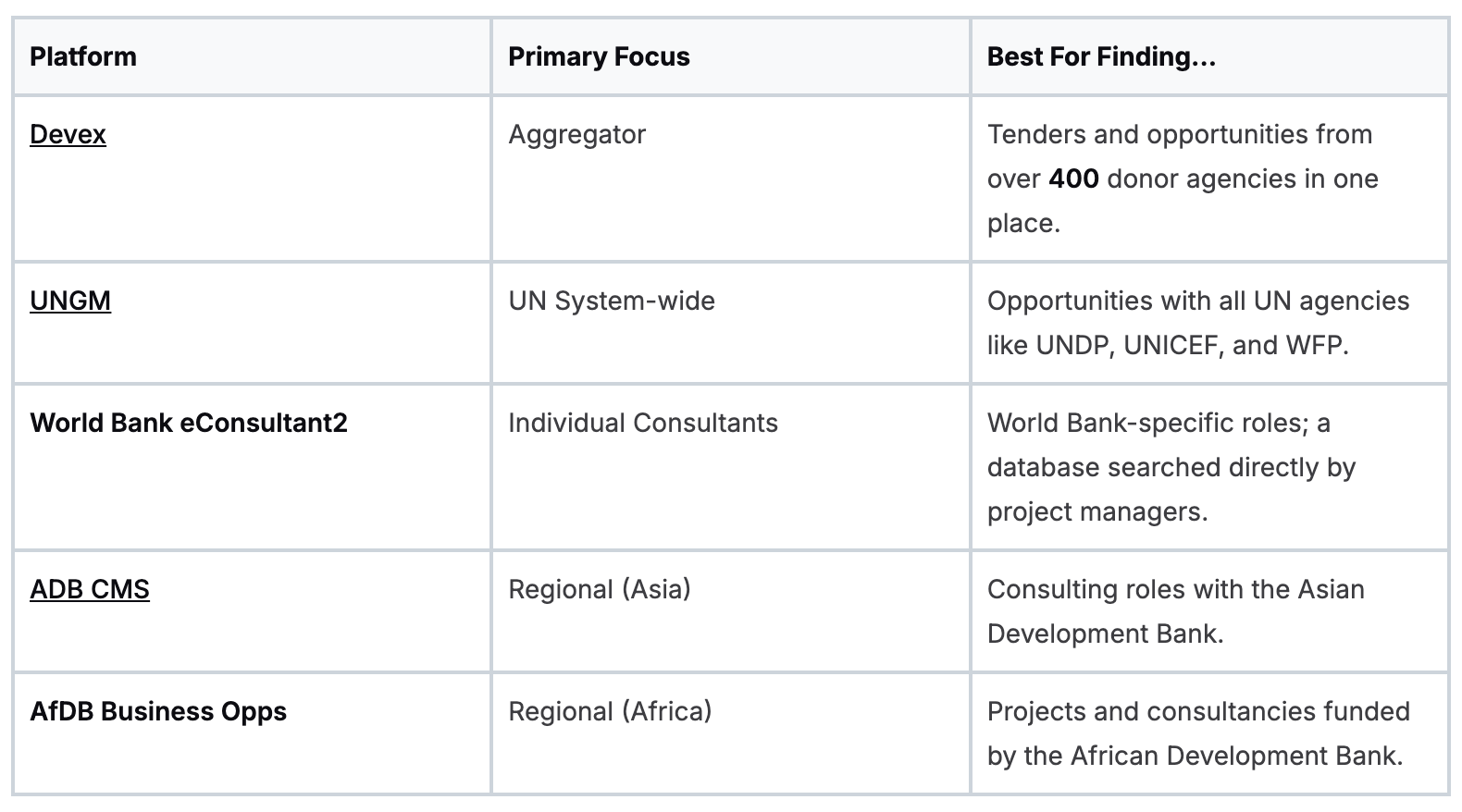
Getting registered and setting up alerts on these sites is non-negotiable. While a platform like Devex offers a great overview, you still want to be registered directly with the UN and the banks that align with your expertise.
Decoding the Terms of Reference
When you find an interesting opportunity, download and dissect the Terms of Reference (TOR). This document is your bible. It’s a procurement document laying out the client’s problem, the work they need done, and the deliverables they expect.
A procurement officer wrote the TOR to solve a specific problem. Your job is to read it and figure out their pain points. Pay obsessive attention to the background section, the list of objectives, and the required qualifications. These are the literal criteria your application will be scored against.
The TOR is a checklist, not a wish list. If you don’t meet the mandatory qualifications—like 10 years of experience in a specific field or fluency in French—do not apply. You will be automatically filtered out.
Drill down into the language they use. If the TOR mentions “stakeholder engagement” five times, your proposal and CV need to scream “stakeholder engagement.” You must mirror their language and priorities back to them. It’s the fastest way to show you’ve read the document and understand their needs. Our guide on how to land an MDB job has more on the timelines and strategies involved.
Writing an EOI That Gets You Shortlisted
Before writing a full technical proposal, you’ll often submit an Expression of Interest (EOI). This is the first and most brutal cut. The goal of an EOI is to convince a busy procurement officer that you are qualified enough to make the shortlist.
An EOI is short and sharp, usually just a few pages. It’s a direct, evidence-based argument that you are a perfect match for the TOR.
Structure your EOI to make the evaluator’s job simple:
Confirm You Understand: Start by stating you understand the project’s objectives as laid out in the TOR. A simple sentence or two will do.
Map Your Experience Directly: This is the most critical part. Use a table or bullet points to explicitly match every required qualification from the TOR with a specific example from your career. If they require “experience with M&E framework design,” you write that and cite the project where you did it.
Attach a Hyper-Tailored CV: Your CV must be customized for this specific opportunity. Reorder bullet points, change headings, and trim irrelevant experience to make the most relevant information jump off the page.
Most people get rejected at the EOI stage because they send a generic CV and a template cover letter. To win, prove you’ve read the TOR with a fine-tooth comb and that you are the low-risk, perfect-fit solution to their problem.
Crafting a CV That Gets You Shortlisted
Throw out your standard two-page corporate resume. In MDB and UN consulting, it’s practically useless.
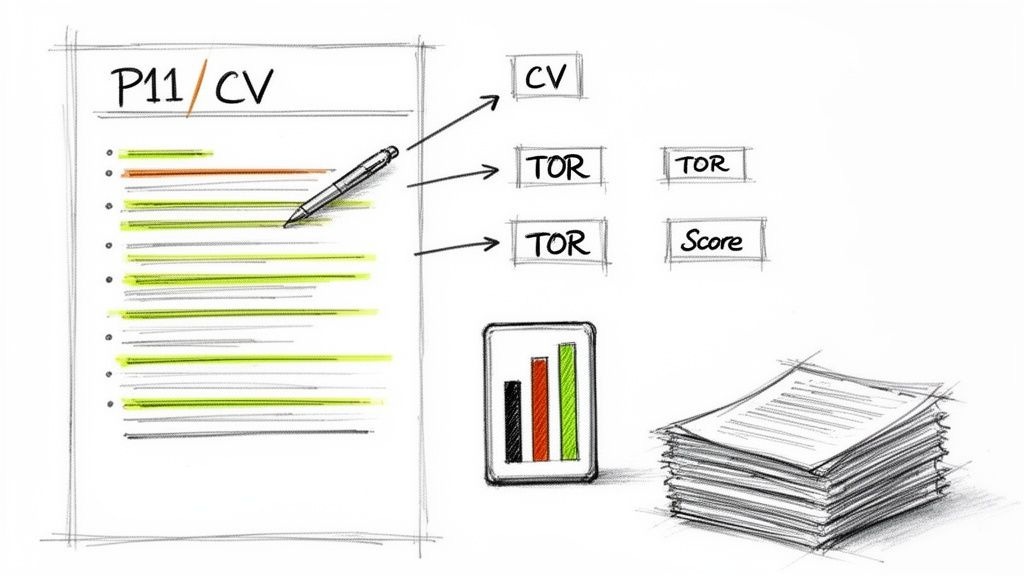
These organizations want structured data, not slick design. They often demand a specific format, like the UN’s P11 or a custom template in their application portal. Your only job is to make it dead simple for an evaluator to tick boxes against the Terms of Reference (TOR).
Get inside the head of the procurement officer, who is likely scoring dozens of applications against a rigid set of criteria.
From Responsibilities to Quantifiable Achievements
The biggest mistake consultants make is listing old job duties. An evaluator doesn’t care that you “were responsible for project monitoring.” They want to know what you did and what happened because of it.
Translate your experience into hard numbers and concrete outcomes. Every bullet point on your CV needs to answer the question, “So what?”
Don’t write this:
Managed project budgets and reporting.
Write this:
Managed a $3.5 million project budget, achieving a 10% cost saving through vendor renegotiation and improved resource allocation, while delivering all donor reports ahead of schedule.
The second example provides scale, a specific action, and a positive result. It proves your competence in a way a vague description of duties never can. You need this level of detail for every significant point in your work history.
Score Your Own CV Against the TOR
Become your own harshest critic before you hit “submit.”
Print out the TOR. Print out your tailored CV. Put them side-by-side.
With a highlighter, go through the TOR’s “required qualifications and experience” section line by line. For every requirement, find the corresponding evidence in your CV and highlight it.
Requirement: “Minimum 8 years of experience in public financial management.” Do you have clear dates and project descriptions that add up to 8+ years?
Requirement: “Demonstrated experience in Sub-Saharan Africa.” Have you listed the specific countries and the exact work you did there?
Requirement: “Fluency in Portuguese.” Is it listed prominently in your skills section?
If you find a requirement in the TOR that isn’t explicitly addressed in your CV, you have a gap. That gap means your application will be scored lower or tossed out. Fix it. Add the detail, rephrase a bullet point, or reorder a section to make the connection impossible to miss.
The evaluation is a mechanical process. An evaluator has a scoresheet, and your CV is the answer key. If the answers aren’t there, you get a zero for that criterion. It’s that simple.
Structuring a Winning Technical Proposal
Once your CV is airtight, the next hurdle is the technical proposal. This is where you prove you can solve the client’s problem. A weak proposal is the most common reason highly qualified candidates fail to win international development consulting jobs.
Your proposal is the heart of your application. It shows your grasp of the problem, your proposed solution, and your ability to execute. For a deeper look into the application mindset, check out our practical guide to landing these jobs.
A strong technical proposal for an individual consultant has three core parts.
1. Your Understanding of the Assignment
This section shows you’ve done your homework. Restate the problem and objectives from the TOR in your own words to prove you aren’t just copying and pasting.
Add your own insight. What are the nuances they might have missed? What are the key risks or challenges to success? This demonstrates expertise beyond the minimum requirements.
2. Your Proposed Methodology and Approach
This is the “how.” How, specifically, will you deliver the results they outlined? Be precise. If the TOR asks for a “stakeholder analysis,” your methodology must detail the exact steps you’ll take.
For example, your approach might include:
A desk review of existing project documents and government reports.
10-15 semi-structured interviews with key informants from government ministries and civil society organizations.
Two validation workshops to present preliminary findings and gather feedback.
Being specific shows you have a credible plan. It gives the evaluator confidence that you can hit the ground running.
3. A Realistic Work Plan with Deliverables
Translate your methodology into a clear timeline. A simple table is often best.
List the key activities, the deliverables tied to each one, and the timeframe for completion (e.g., Week 1-2, Week 3). This shows you respect deadlines and have thought through the practicalities of the assignment. It proves you’re a professional who can manage your own time and deliver on promises, which is the essence of being a successful consultant.
Contracts, Pay, and the Hard Truths About Eligibility
Getting your technical skills in order is one thing. Making a sustainable career out of consulting is another. It comes down to the business side: understanding contracts, negotiating a fair rate, and navigating the often-frustrating rules about who can apply.
Let’s break down the practical details you have to get right.
Not all contracts are equal. The contract type dictates your workflow, income stability, and how you work with the client. It’s critical to know what you’re signing.
Common Contract Types
You’ll generally run into a few standard contract structures. Each serves a different purpose for the organization and has different implications for you.
Short-Term Assignments (STA/STC): This is the bread and butter for most consultants, especially when starting out. They are project-based, hyper-specific, and can last from a few days to six months. You’re brought in to get a defined task done.
Long-Term Agreements (LTA): An LTA is a framework agreement that puts you on a roster of pre-approved experts for one to three years. There’s no guaranteed work, but when a need arises that fits your profile, the organization can hire you quickly without a lengthy procurement process. It’s a great way to build a relationship.
Retainer Contracts: These are the holy grail. While less common, they are incredibly valuable. An organization pays you a set fee to be available for a certain number of days per month or quarter. This gives you a predictable income stream and allows for a deeper, more strategic relationship.
Understanding these differences is key. If you want to dive deeper, we break down the nuances of short-term consultancy positions in our guide.
Getting Your Pay Rate Right
Let’s talk money. Figuring out your daily rate is stressful but manageable. Your rate is a function of your experience, how in-demand your skills are, and what the market will bear.
Your rate is almost always quoted as a daily fee. This number is all-inclusive. It must cover your take-home pay, taxes, health insurance, retirement savings, and any business overhead. Never compare it to a salaried employee’s daily pay; it’s an apples-and-oranges calculation.
As a rough baseline, junior consultants with a few years of experience might start in the $350-$500 per day range. Mid-career specialists with 10+ years of experience can command $600-$900, while top-tier, niche experts can bill $1,000 or more for highly specialized work.
When landing on your number, think about these factors:
Your Experience Level: Be honest. Are you a recognized name in your field, or are you still building your reputation?
The Client: UN agencies and the big MDBs have deeper pockets. Their pay scales are almost always higher than smaller NGOs.
The Technical Field: An expert in AI governance or climate finance will command a much higher rate than a generalist project manager.
The Location: A hardship post in a conflict zone comes with a significant premium compared to a comfortable, home-based assignment.
Below is a quick summary of common pay structures.
Common Consultant Pay Structures
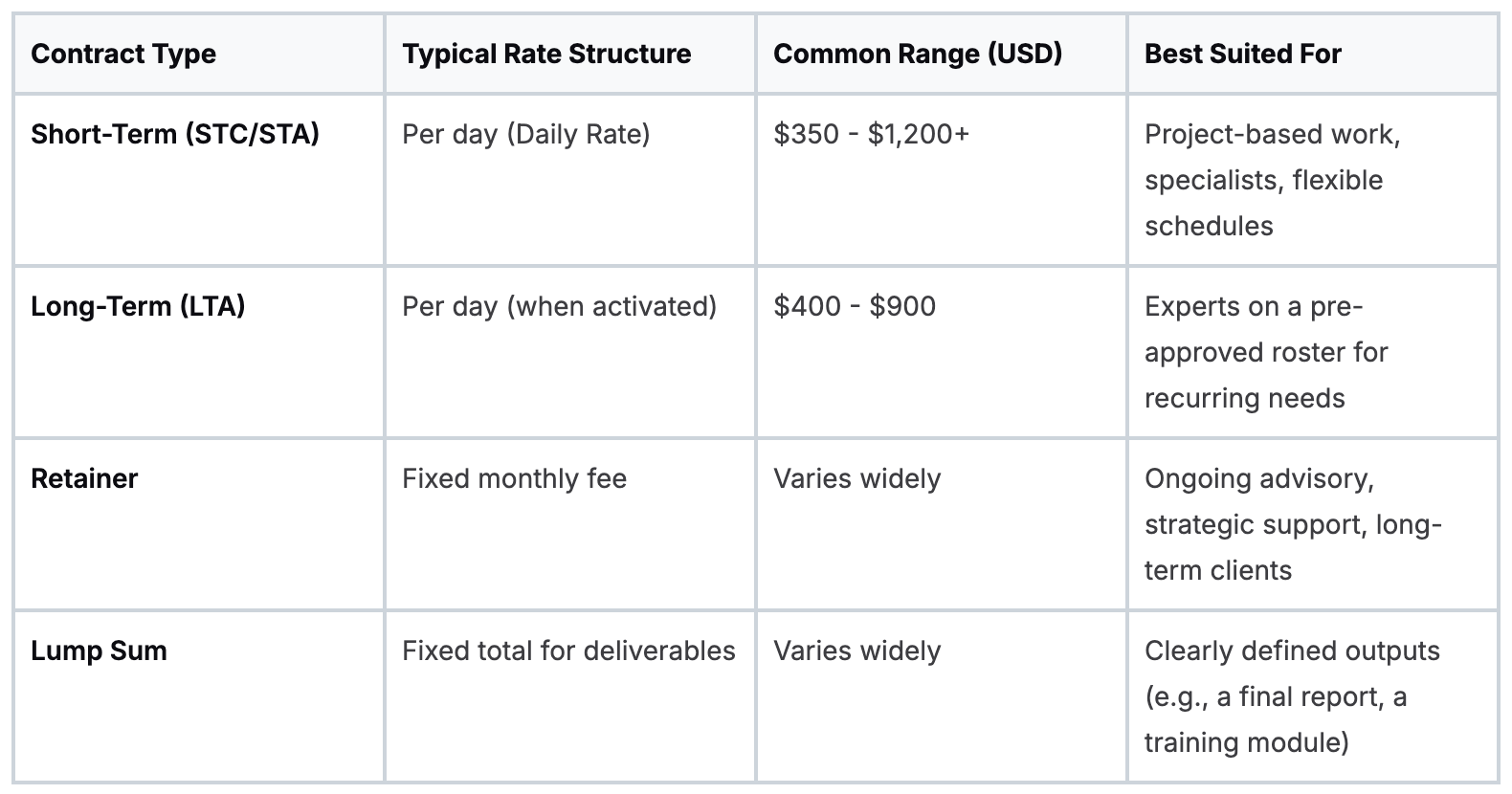
The “right” pay structure depends on the work and your relationship with the client. Overall, this wide range is why annual incomes for consultants vary so much. As a general benchmark, most full-time international development consultants earn between $65,000 and $150,000 annually, according to data from platforms like ZipRecruiter.com.
The Hard Rules of Nationality and Eligibility
Finally, let’s talk about the frustrating rules around nationality. Consulting gigs funded by bilateral donors (like USAID or the UK’s FCDO) or tied to specific trust funds are often restricted to nationals of certain countries.
This isn’t personal; it’s a condition of the funding. The money comes with strings attached, and one of those strings is often a requirement to hire consultants from the donor country or a pre-approved list of eligible nations. The Terms of Reference (TOR) will always state these restrictions, usually at the top. Read it. Then read it again.
There is no way around this. If a job is open only to EU citizens and you’re not one, you cannot apply. Wasting hours tailoring a CV for a job you’re ineligible for is a rookie mistake. Focus your energy only on opportunities where you meet the mandatory nationality requirements. Core-funded positions at MDBs and the UN are often more open, but you must check the fine print every time.
The Insider Rules of Networking and Interviews
A strong application might get your CV into the right pile, but professional relationships get you hired. Your technical skills are just the price of entry. In this field, your network and interview performance make the difference.
Real networking is about building genuine connections with the people doing the work.
That means finding the technical specialists and procurement officers inside your target organizations. These aren’t faceless entities; they are individuals trying to solve complex problems. When they need a consultant, they almost always prefer to hire someone they know and trust.
Building a Meaningful Network
Effective networking is a long game. Your goal is to become a known quantity, a trusted, go-to expert in your niche. You do this by adding value long before you ever ask for anything.
Identify the key players in your sector. Who are the task team leaders at the World Bank working on your issue? Who are the program managers at UNDP? Follow their work, read their publications, and engage with their ideas thoughtfully on platforms like LinkedIn or at industry webinars.
A short, specific email can work wonders if you do it right. Don’t ask for a job. Mention a recent report they published and ask an intelligent question or share a relevant insight. You are starting a professional dialogue, not making a sales pitch.
Don’t be a ghost who only appears when a job is posted. The best consultants are on the radar of hiring managers months or years before a Terms of Reference is drafted. You want them to think of you when they start outlining a new project.
Preparing for the Panel Interview
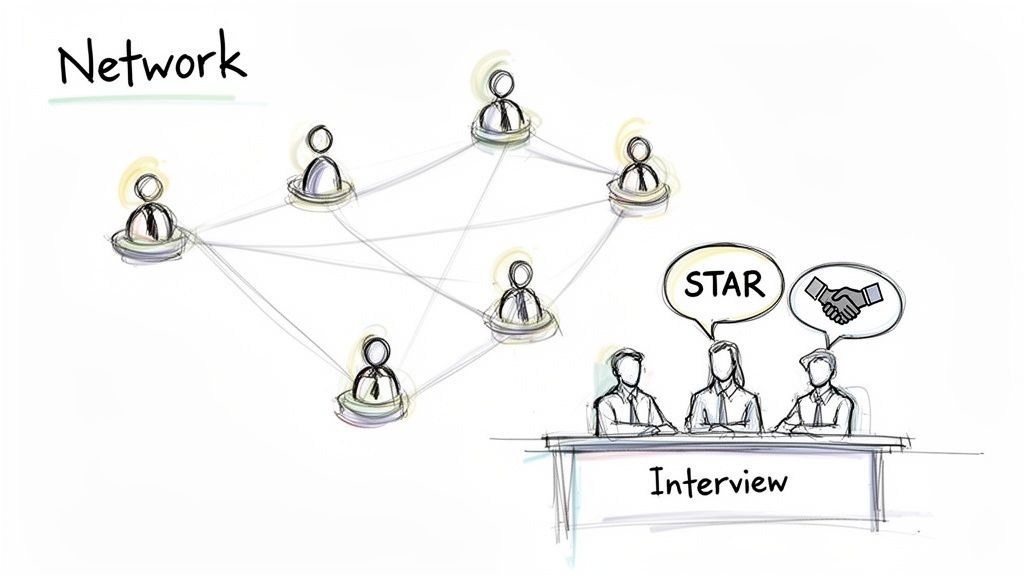
Once your application and network land you an interview, you face a different challenge. MDB and UN interviews are almost always conducted by a panel. This group typically includes a procurement specialist, the technical project lead, and a senior manager.
These interviews are highly structured and formal. They are scoring exercises designed to systematically assess every candidate against the same criteria. Your job is to make it easy for them to give you high marks.
They rely heavily on competency-based questions. These are designed to make you prove your skills through past experiences. You will get direct prompts like:
“Describe a time you had to manage a difficult stakeholder relationship.”
“Tell us about a project where the objectives changed midway through.”
“Give an example of when you had to deliver a complex report on a tight deadline.”
Mastering the STAR Method
The only effective way to answer these questions is with the STAR method. It’s a simple framework that forces you to be concise, structured, and evidence-based. It’s what the panel is trained to listen for.
STAR stands for:
Situation: Briefly set the scene. What was the project and the context? (1-2 sentences)
Task: What was your specific responsibility or the goal you needed to achieve? (1 sentence)
Action: What specific steps did you take? This is the heart of your answer. Use “I” statements, not “we.” (3-4 sentences)
Result: What was the outcome? Quantify it whenever you can. What did you achieve or learn? (1-2 sentences)
Let’s walk through an example. Imagine the panel asks, “Describe a time you had to work with limited data to produce an analysis.”
A weak answer sounds like this: “On a project in Kenya, we didn’t have all the data we wanted. It was tough, but we managed to pull together a report that the client liked in the end by talking to a few people.”
This tells the panel almost nothing.
A strong, STAR-based answer sounds like this: “[Situation] I was tasked with conducting a market analysis for a new agricultural insurance product in rural Kenya. [Task] The problem was, official government data on smallholder farmer incomes was outdated by over a decade. [Action] To solve this, I designed and led a rapid survey of 200 farmers across three regions. I then cross-referenced that primary data with qualitative insights from interviews with five local agricultural cooperatives. [Result] This approach allowed me to create a robust income model that the project used to price the insurance product, which has since been rolled out to over 1,000 farmers.”
The second answer is powerful because it’s specific, it demonstrates initiative, and it ends with a quantifiable result. Practice this method until it becomes second nature. It is the single most important tool for acing international development consulting interviews.
Your Questions Answered
When you’re navigating the world of international development consulting, a lot of questions come up. Here are straight answers to the ones I hear most often.
“Do I Really Need a Master’s Degree?”
A Master’s is common and it helps, especially for roles heavy on policy, research, or economics. It is not a deal-breaker.
The goal is to be the best solution to the problem in the Terms of Reference (TOR). Nine times out of ten, deep, relevant experience beats an academic credential.
I’ve worked alongside brilliant consultants who had decades of field experience but no advanced degree. Their practical knowledge in logistics, community mobilization, or public financial management was infinitely more valuable to the project.
An evaluator’s first question is always, “Can this person solve our problem?” If 15 years of hands-on experience in water sanitation engineering proves that better than a Master’s, the experience wins. Every time.
Job descriptions almost always state “Master’s degree or equivalent professional experience.” If you have a solid track record of delivering results, you can make a powerful case that your experience is superior.
“How Do I Get My First Gig with No Consulting Experience?”
Breaking in without a direct consulting background is tough. It happens all the time, but you have to be smart and build a bridge from where you are to where you want to be.
Forget landing a senior international role right out of the gate. That’s not a realistic strategy. Focus on getting relevant, provable experience that speaks the language of MDBs and UN agencies.
Here are the most common entry points that work:
Go National. Search for “national consultant” roles in your home country. These are often the first step on the ladder, where a big organization needs local expertise. It gets your foot in the door and puts a project with an institution like the World Bank or UNDP on your CV.
Join a Big Consulting Firm. Major firms that regularly bid on MDB and UN projects (think Chemonics, DAI, or Tetra Tech) are always hiring junior staff and project support officers. This is an incredible way to learn the procurement game and project management cycle from the inside.
Work for an Implementing NGO. Get field experience with an NGO that receives its funding from the big donors. This demonstrates you understand on-the-ground realities and can operate effectively in complex environments.
Your objective is to build a CV that screams “low risk.” Every project you complete, no matter how small, is another piece of evidence that you can be trusted to deliver.
“Can I Actually Do This Job Remotely?”
Yes, absolutely. Remote and home-based consulting is much more common, a trend accelerated by the pandemic. If the assignment is focused on research, data analysis, report writing, or curriculum development, there’s a good chance you can do it from your home office.
However, a huge number of international development consulting jobs still demand an in-country presence. You cannot run stakeholder workshops, train local teams, or oversee infrastructure projects from behind a laptop.
The Terms of Reference (TOR) is your bible here.
It will state clearly whether a role is home-based, field-based, or a hybrid. Always check this before you apply. Many successful consultants build a career by balancing a steady flow of home-based assignments with a few intense field missions each year. It’s a great way to mix deep, focused work with practical, hands-on engagement.
At Multilateral Development Bank Jobs, we break down the entire process of finding and winning these kinds of roles. Our weekly newsletter is packed with curated consultant opportunities from MDBs and the UN, plus the deep-dive guides you need to build a successful career. Join us at https://mdbjobs.com