

You’re probably in one of two places right now. You’ve either found a World Bank vacancy that fits your background almost uncomfortably well, or you’ve already applied and now you’re staring at your inbox, trying to decode what happens next.
That uncertainty is normal. The world bank interview process feels opaque from the outside because the institution hires for more than technical competence. It screens for judgment, diplomacy, mission fit, and the ability to work in systems where politics, operations, and evidence collide every day. Candidates who treat it like a standard corporate interview usually underperform.
The good news is that the process is learnable. The stages are structured, the evaluation logic is consistent, and the strongest candidates prepare for the reason behind each step, not just the format. That’s where most of the edge is.
Getting Hired by the World Bank An Insider’s Overview
A typical applicant starts with the wrong question. They ask, “What are they going to ask me?”
The better question is, “What are they trying to prove about me before they hire me?”
That shift matters. The Bank is a multilayered institution. Teams work across countries, sectors, and internal stakeholders with competing priorities. Hiring managers don’t just want someone smart. They want someone who can operate with credibility in that environment, represent the institution well, and deliver under scrutiny.
What the process is actually testing
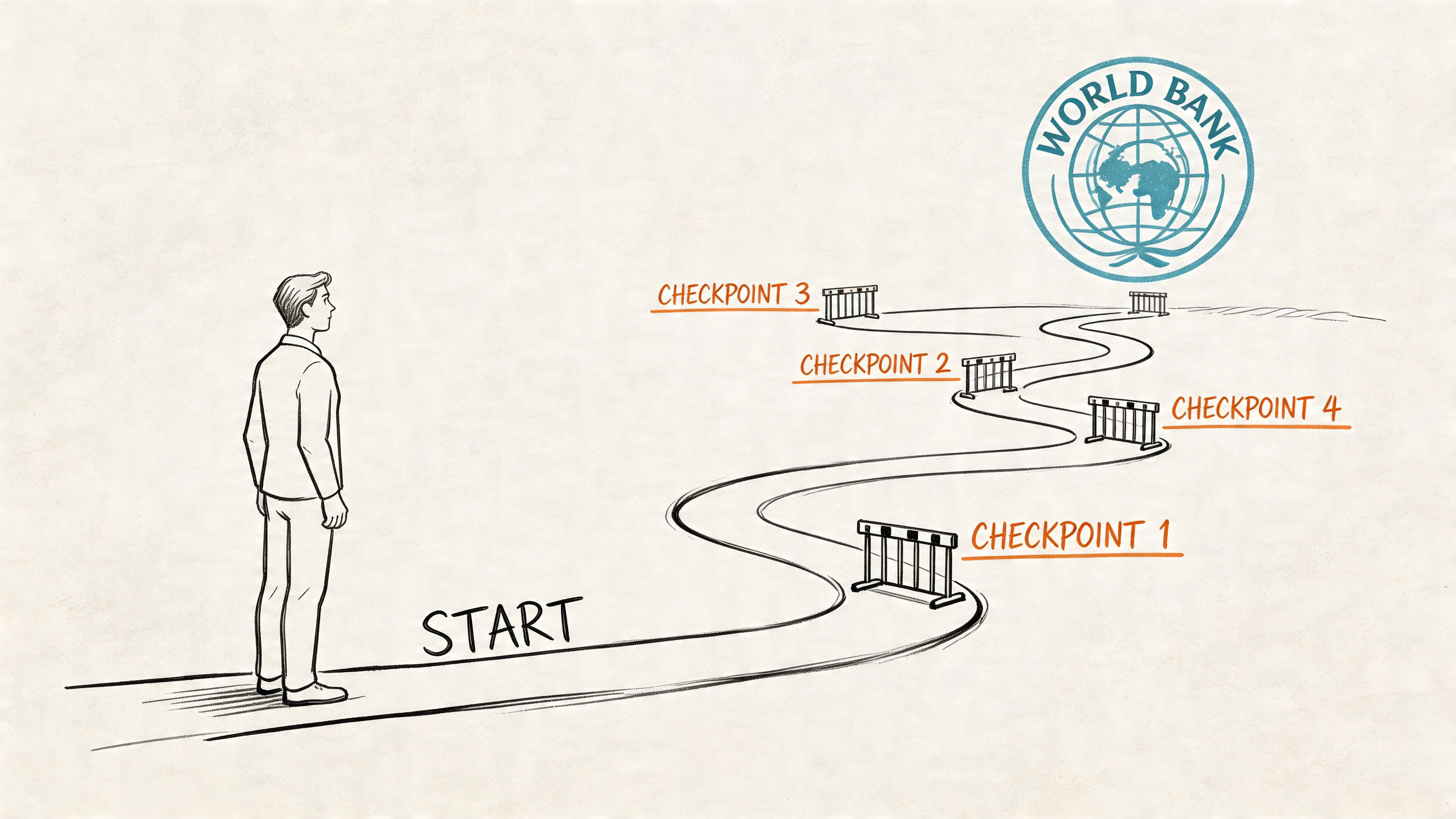
At a practical level, the process is checking four things:
Mission alignment: You need a convincing reason for wanting the World Bank specifically. General interest in development isn’t enough.
Applied expertise: Your technical background has to hold up under real questioning, not just on paper.
Behavior under pressure: Panels pay attention to how you structure answers, handle ambiguity, and react when challenged.
Institutional fit: The Bank rewards people who can work across cultures, functions, and hierarchies without becoming rigid or territorial.
That’s why the interview sequence often feels deliberate. It’s built to reduce hiring risk in a complex organization, not to move fast for the candidate’s convenience.
Practical rule: Every round exists to answer a different hiring question. If you give the same style of answer in every round, you look unprepared.
What strong candidates do differently
The strongest applicants come in with a calibrated story. They know how their work connects to poverty reduction, public systems, private sector engagement, infrastructure, climate, governance, or whichever agenda the role touches. They can move between technical detail and executive-level clarity without sounding rehearsed.
Weak candidates usually fall into one of three traps:
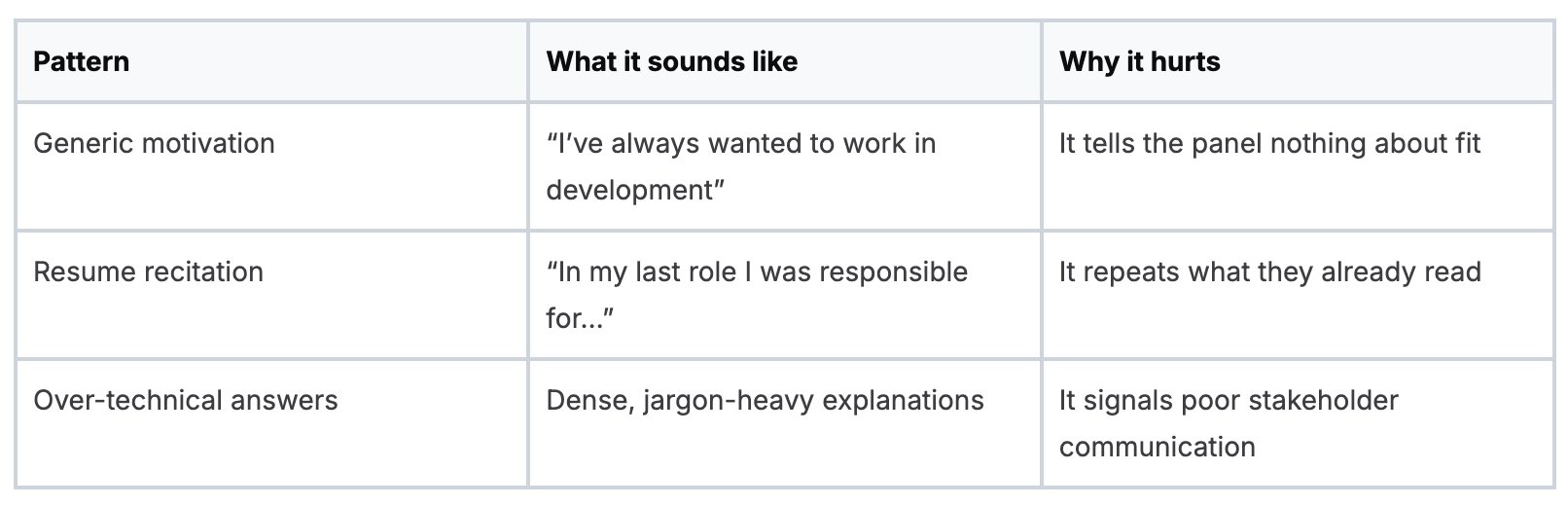
The process is absolutely competitive, but it isn’t random. If you understand the logic behind the stages, the Bank becomes much easier to read.
The Full Interview Timeline From Application to Offer
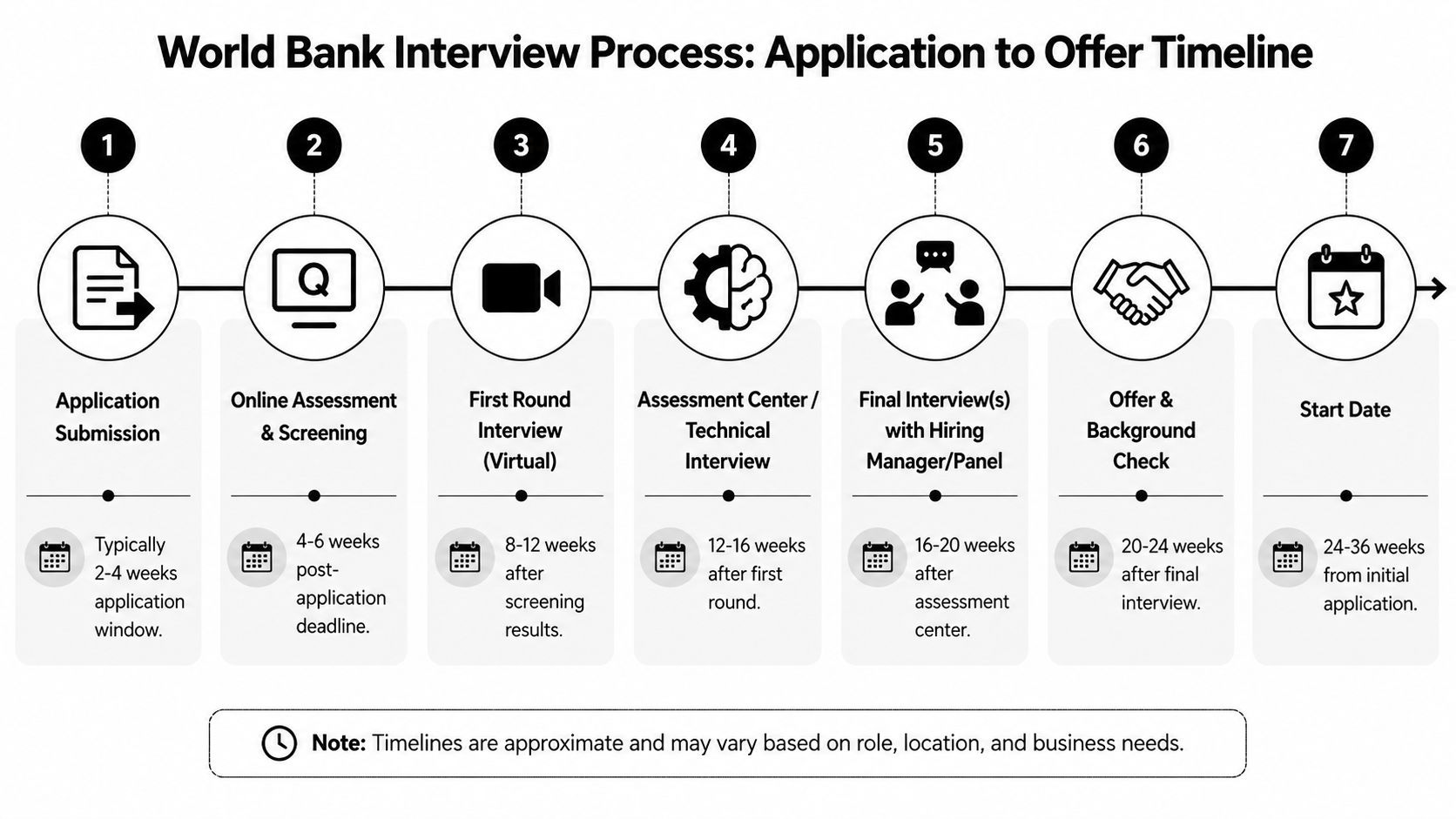
You submit a strong application, hear nothing for weeks, then get an email asking if you can interview in two days. That pattern is common at the World Bank. The process rarely moves in a straight line because several decisions happen behind the scenes before a team is ready to speak to candidates.
Candidate reports put the average interview process at 53.73 days from start to finish, while the broader cycle from application to decision often stretches to 3 to 6 months, according to Glassdoor interview data and timing benchmarks. The gap makes sense. Active assessment can be relatively short. Internal review, shortlist calibration, interview scheduling across time zones, and approval steps often add far more time than candidates expect.
What is happening before anyone contacts you
The quiet period after you apply usually has a simple explanation. The hiring team is reducing risk.
At this stage, recruiters and panel members are not asking, “Who looks impressive on paper?” They are asking narrower questions. Who has done work close enough to this portfolio to add value quickly? Who can operate in a matrixed institution with country clients, practice managers, and internal stakeholders? Who is credible enough to put in front of a government counterpart?
That is why shortlisting can take weeks. Teams are often comparing candidates across different backgrounds, geographies, and contract histories, not just ranking CVs.
Use that waiting time properly. For an Economist role, prepare to explain your methods, identification choices, and how your analysis would influence a lending or advisory decision. For an Operations role, get ready to show how you handled government relationships, implementation friction, and competing stakeholder demands. For YPP, tighten your story across technical depth, leadership signals, and cross-cultural adaptability. A good practical reference is this World Bank hiring playbook on timelines.
The stages you are likely to face, and why they exist
The same Glassdoor dataset shows a process built around multiple assessment formats, including group panel interviews at 26.81%, phone interviews at 14.01%, skills tests at 12.44%, one-on-one interviews at 12.2%, presentations at 10.27%, and background checks at 9.78%. That mix is revealing. The Bank does not want one polished conversation. It wants repeated evidence under different conditions.
Here is the sequence candidates should prepare for.
Application review
This is the first fit test. Recruiters and hiring teams are screening for direct alignment with the vacancy, not broad prestige. A candidate with excellent experience in the wrong domain often loses to someone with narrower but cleaner relevance.Initial screening call
The World Bank’s 2018 interview guide states that phone screens typically last 20 to 30 minutes, based on the World Bank Group interview guide. The point of this round is efficiency. The interviewer is checking whether your communication is clear, your motivation is specific, and your background matches what the team needs.Strong Economist candidates keep answers concise and analytically sharp. Strong Operations candidates show judgment and client realism early. Strong YPP candidates show range without sounding scattered.
Technical assessment, written exercise, or presentation
This stage exists because many candidates sound stronger than they perform. The Bank uses case questions, writing tasks, presentations, and role-specific exercises to test whether you can produce under constraints.For Economists, that often means explaining technical choices in plain English. For Operations candidates, it may mean diagnosing implementation risk or sequencing a project response. For YPP, the test is often broader. It checks whether you can combine substance, structure, and judgment under time pressure.
Panel interview
This is usually the decisive round. It is less about charm than about credibility across audiences. A typical panel may include the hiring manager, technical peers, and stakeholders who will have to trust your judgment later. They are listening for evidence, but they are also watching how you handle interruption, challenge, and follow-up.The unwritten rule is simple. If your answer works only for a specialist, it is incomplete. If it works only at a high level, it is also incomplete.
References and internal checks
Reaching this point is a strong sign, but not a guarantee. References are used to confirm how you operate in real institutional settings. Responsiveness matters here because delays can slow an already slow process.
Why timing differs so sharply across roles
Timing varies because the Bank is hiring for very different risk profiles.
The same candidate-reported dataset shows wide variation by role, from 1 day on average for Senior Communications Officer positions to 360 days for Senior Officer roles, within the broader 53.73-day average. Senior and more politically sensitive roles usually involve more consultation, more reviewers, and more caution. Technical specialist roles can also slow down if the team is split between several viable candidates.
Candidates often misread silence. A quiet month may mean the shortlist is under review, a panelist is traveling, a budget confirmation is pending, or another internal approval has not cleared. It does not automatically mean your candidacy is weak.
How to use the waiting period to gain an advantage
Treat the process like a campaign, not a single interview.
Track each application carefully. Record the vacancy number, business unit, submission date, likely stakeholders, and any contacts you have in the practice.
Build examples by theme, not by job. Prepare stories on client handling, failed implementation, influence without authority, technical problem-solving, and working across functions.
Prepare for compression. The process can be slow for weeks and then move fast. Teams sometimes request interviews with very little notice.
Adjust preparation to the role type. Economist candidates should rehearse translating analytics into operational implications. Operations candidates should practice showing judgment under messy field conditions. YPP candidates should be ready for a broader range of competency and motivation questions.
Keep your references warm. A strong reference who is briefed properly helps. A surprised referee who gives vague answers does not.
Patience helps. Active preparation helps more.
Decoding the World Bank’s Competency Framework
You can give a polished answer, have the right degree, and still lose the room in ten minutes. It usually happens when a candidate treats the interview like a conversation about credentials instead of a structured test of judgment, client handling, and execution. The Bank’s process is competency-driven, and the point of that structure is simple: past behavior is still the safest proxy for how you will operate inside a matrix institution with demanding clients, long timelines, and constant trade-offs.
As noted earlier, the World Bank Group’s 2018 Interview Guide laid out that structured approach clearly. The mechanics may vary by team, but the logic has not changed. Interviewers are listening for evidence they can compare across candidates, not polished generalities.
The competencies matter because they reduce hiring risk
World Bank managers do not hire only for raw intelligence. They hire for whether you can produce results in conditions that are political, cross-functional, and often ambiguous. A technically strong candidate who alienates government counterparts creates delivery risk. A smooth stakeholder manager with weak substance creates another kind of risk. The competency framework exists to screen for both.
Three themes show up often because they map to how the institution operates.
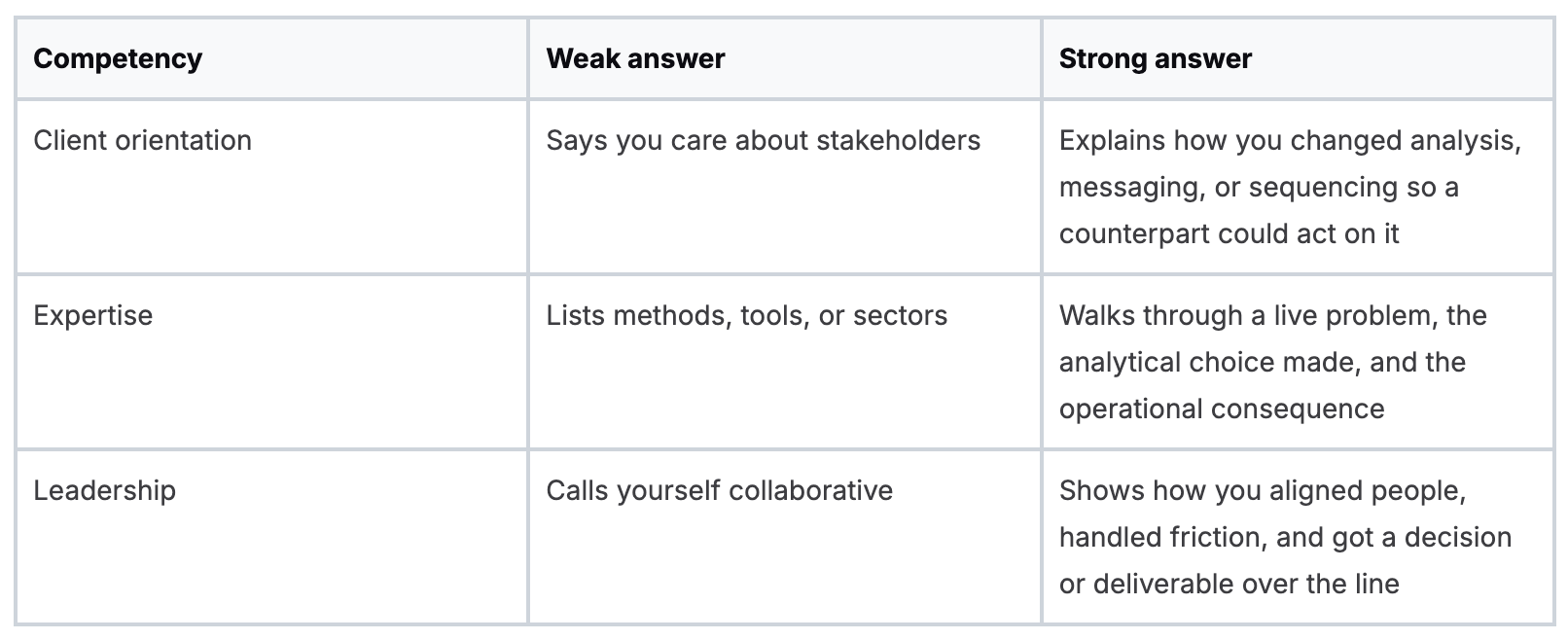
Client orientation
At the Bank, “client” usually means a ministry, implementing agency, task team, donor partner, or internal counterpart. Interviewers want proof that you can understand what that party needs, what constraint they are under, and how to adapt your work without compromising standards.
Strong answers show adjustment. You changed the sequencing of a reform note because the ministry had a narrow political window. You simplified a model’s output so an operational team could use it in a decision memo. You recognized that the technically best option would fail in implementation and proposed a workable second-best path instead.
Many private sector candidates misfire. They describe responsiveness when the Bank is testing judgment.
Professional expertise
This is the credibility check. Can you do the work at the level claimed on your CV, and can you explain your reasoning under pressure?
For economists, that often means defending identification choices, data limitations, policy relevance, and what the findings do or do not justify. For operations candidates, it means showing how you handled procurement delays, safeguards issues, stakeholder resistance, or supervision problems without losing sight of the project objective. For early-career candidates, including those looking at the World Bank Junior Professional Associate program, the standard is lower on scale but not on clarity. You still need to show that your analysis led to a decision, a recommendation, or a concrete next step.
Panels remember candidates who can connect technical depth to institutional use.
Team leadership
Leadership at the Bank usually means influence without formal authority. Country teams, global practices, legal, procurement, safeguards, and external counterparts all shape outcomes. Very few important pieces of work move because one person had a title and gave instructions.
Good examples show how you aligned people with different incentives, handled disagreement without becoming defensive, and kept a piece of work moving when ownership was fragmented. If your story only proves that you worked hard on your own part, it will feel thin for roles that require coordination.
What recruiters are actually looking for in your answers
The unstated question behind a competency interview is: “Can I trust this person with a real problem here?”
That means a strong answer usually has five parts:
A real situation: one project, one decision, one conflict, one client problem.
Your specific role: what you owned, influenced, or decided.
The constraint: limited time, weak data, political sensitivity, disagreement, implementation risk.
The trade-off: what you had to balance, and why the obvious answer was not enough.
The result: what changed, what did not, and what you learned.
Candidates improve quickly when they stop memorizing labels and start building evidence by competency.
How to prepare differently by role type
Preparation should match the role, because interviewers weight the same competency differently.
Economist candidates should prepare stories that connect analytics to policy or operations. Do not stop at methodology. Be ready to explain why the question mattered, what the limits of the evidence were, and how your work informed a decision.
Operations candidates should prepare examples from implementation, supervision, stakeholder management, and problem-solving under imperfect conditions. Panels want to hear how you made progress when rules, relationships, and delivery pressures collided.
YPP candidates need broader coverage. The Bank is assessing range, learning capacity, and judgment across settings, not only current specialization. Prepare shorter, cleaner stories that show leadership potential, cross-cultural fluency, and the ability to contribute outside a narrow technical lane.
A final point matters. The best candidates do not just answer the competency asked. They answer the reason it is being asked. That is where the competitive edge sits.
How Interviews Differ by Role YPP Economist and More
A candidate can interview well for one World Bank role and fail badly for another in the same week. I have seen strong applicants give polished answers that would work for a generalist development job, then lose the panel because the role required something narrower: policy judgment for an Economist post, delivery judgment for Operations, or range and composure for YPP.
That is the first rule. There is no single World Bank interview style. The Bank adjusts its process because each hiring track carries a different risk. For YPP, the risk is hiring someone with promise but limited range. For Economists, it is hiring someone who is technically smart but operationally irrelevant. For Operations roles, it is hiring someone who can talk strategy but cannot move work through clients, systems, and internal clearance points.
YPP interviews test range, judgment, and how you show up under pressure
The Young Professionals Program follows a distinct path. OpenIGO’s summary of the YPP interview sequence describes a HireVue digital interview, followed by an assessment center and then a panel interview with specialists.
The design tells you what recruiters want.
The digital stage is not just a screening convenience. It tests whether you can answer cleanly with limited preparation time, which matters in a Bank environment where senior colleagues often want a concise view before they want detail. The assessment center is there for a reason too. YPP hires are expected to work across teams, regions, and disciplines early. Panels want evidence that you can contribute in a group without becoming performative, passive, or territorial.
Prepare for YPP in a different way from a standard vacancy interview:
Practice short answers out loud, not just on paper
Build a set of examples across countries, teams, and problem types
Prepare one story that shows judgment under ambiguity, one that shows teamwork under friction, and one that shows leadership without formal authority
In group exercises, add structure, bring others in, and keep the discussion moving toward a decision
Breadth matters more than narrow specialization here. For candidates weighing YPP against other entry routes, this guide to the World Bank Junior Professional Associate pathway helps clarify how the expectations differ.
Economist interviews probe whether your analysis changes decisions
Economist panels usually test two things at once. They want technical depth, but they also want to know whether your work affects policy, lending, advisory work, or client dialogue. Many candidates prepare only for the first part.
That is a mistake.
A good economist answer does more than explain the method. It explains why the question mattered, what assumptions carried the result, where the evidence was weak, and how the output shaped a recommendation. If your work stayed in a paper, state this plainly and explain what would have been needed to make it useful operationally. That answer is stronger than pretending every model led to reform.
Here is the standard the panel is applying:
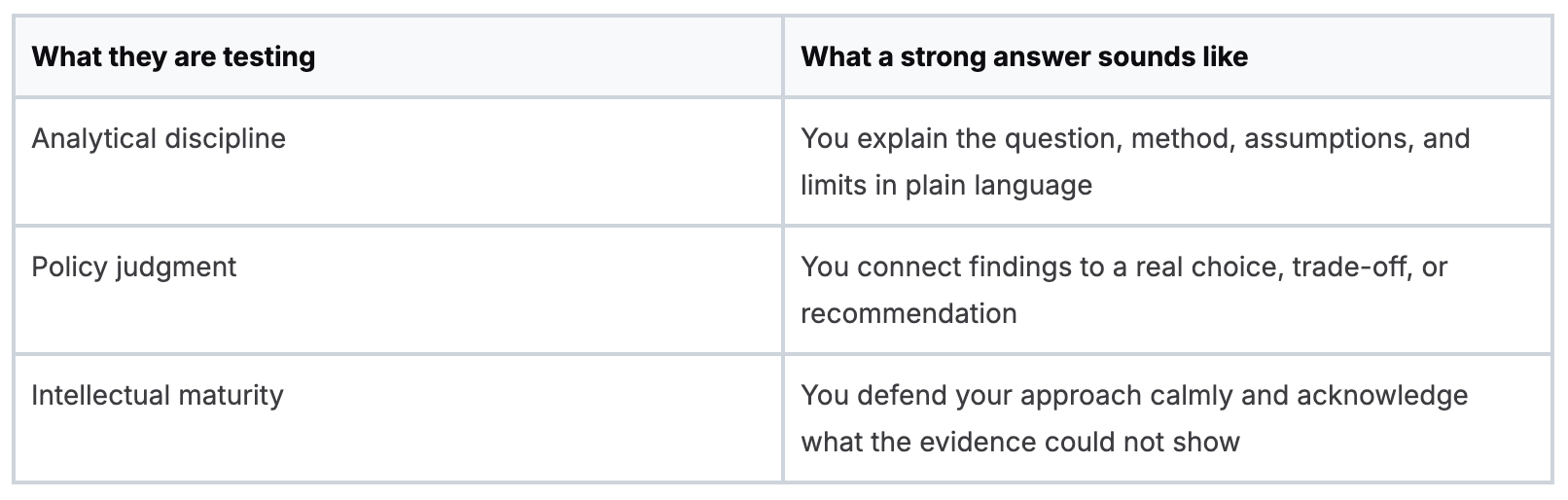
Economist candidates should expect follow-ups that pressure-test causal claims, identification choices, external validity, and implementation relevance. Treat that as a positive sign. The panel is checking whether you can hold up under serious scrutiny without becoming academic, evasive, or defensive.
Operations interviews are about execution in imperfect conditions
Operations hiring is usually more grounded in delivery. The panel wants to know whether you can move work through a system where country ownership, procurement rules, political constraints, implementation delays, and internal process all matter at the same time.
Strong candidates show they understand that trade-off-heavy reality.
A useful operations example usually includes five elements: the context, the bottleneck, the actors involved, the constraint you could not wish away, and the choice you made anyway. If you only describe the project objective and the happy ending, the answer sounds thin. If you show how you handled disagreement, sequencing, or a stalled implementation issue, the answer sounds credible.
Candidates coming from consulting, academia, or policy shops often underperform here for one reason. They stay at the recommendation level. World Bank operations teams are listening for signs that you know how recommendations survive contact with ministries, PIUs, legal agreements, supervision realities, and staff turnover.
Research, data, and analytical roles may screen technical fluency before the main interview
Some analytical roles include technical assessments before the panel stage. Treat that possibility seriously, especially if the job involves econometrics, data work, modeling, finance, or research support.
The practical implication is simple. Do not spend all your preparation time polishing behavioral stories while assuming technical depth will be taken for granted. For these roles, the Bank may want direct evidence that you can work at the level the team needs.
Consultant and short-term roles are narrower, but not easier
Consultant interviews often feel less formal because the team is hiring against a defined gap. They care about whether you can produce the deliverable, fit the workflow, and start quickly with limited ramp-up time.
That changes how you should answer.
Focus on comparable assignments, concrete outputs, client handling, responsiveness, and how you work with incomplete guidance. Broad mission language helps less here than direct proof of use. If the role is for project restructuring support, impact analysis, procurement-heavy implementation help, or sector notes, show you have done that kind of work before and understand the pace and constraints.
The strongest candidates prepare for the logic of the role, not the prestige of the institution. That is the difference between sounding interested in the World Bank and sounding hireable by the team in front of you.
Sample Interview Questions and How to Nail Your Answers
Most World Bank interviews revolve around three question types. Behavioral questions test how you’ve handled real situations. Technical questions test how you think in your field. Case-style questions test judgment when the facts are incomplete.
The mistake is treating them as separate worlds. In practice, good answers usually combine all three. You need structure, substance, and relevance.
Questions you should be ready for
You’re likely to hear some version of these:
Behavioral prompts: Tell us about a time you handled a difficult stakeholder, managed disagreement, influenced without authority, or worked across cultures.
Motivation questions: Why the World Bank, why this unit, and why this role at this point in your career.
Technical probes: Explain a project, analysis, reform effort, or operational challenge you led or shaped.
Judgment questions: What would you do if a client wanted one thing, the evidence suggested another, and internal teams disagreed?
For analytical roles, it also helps to sharpen your thinking process outside interview prep. One practical resource is this guide on building stronger analytical skills for development roles.
What the interviewer is really asking
Here’s the hidden logic behind common prompts:
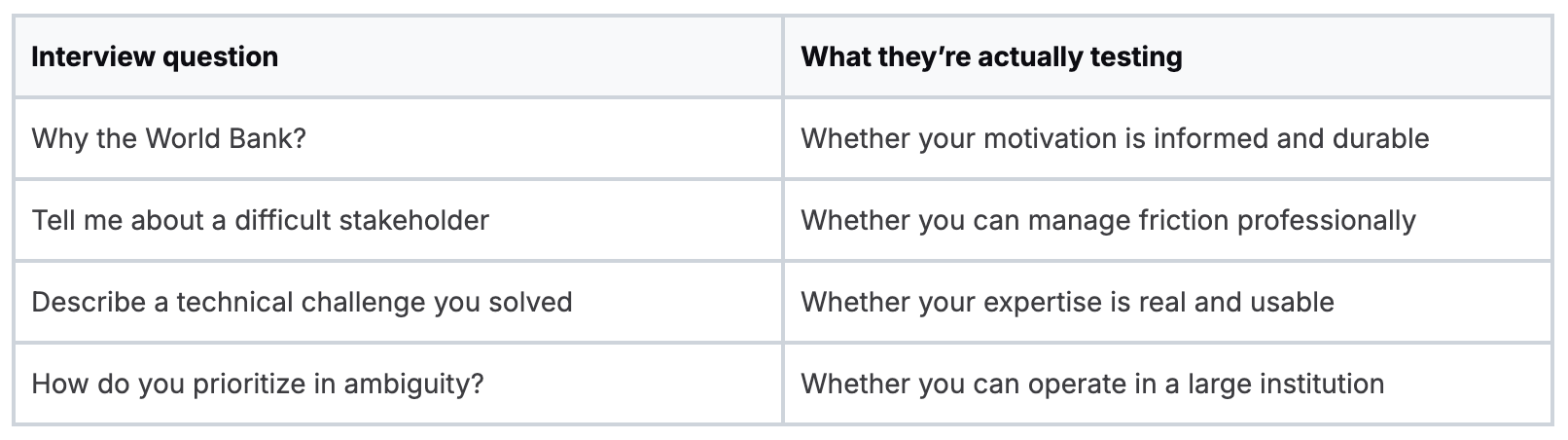
Once you see that, your answers get tighter. You stop narrating your career and start delivering evidence.
Use STAR properly
The STAR method works well in the world bank interview process because it forces disciplined answers.
Situation sets context fast.
Task clarifies what was at stake.
Action shows what you did.
Result explains what changed.
Many candidates understand the acronym and still use it badly. They spend too long on background, stay vague about their role, and rush the result.
Here’s a stronger model for a stakeholder-management question.
You had a disagreement with a ministry counterpart, a donor, and your internal team. Don’t tell the panel everyone eventually aligned. Tell them how you diagnosed the conflict, what trade-off you made, and how you protected the objective without damaging the relationship.
A model answer structure
Question: Tell me about a time you dealt with a difficult stakeholder.
Situation
You were supporting a reform or project where one key stakeholder resisted the proposed approach. Give just enough context to explain the stakes.
Task
State your responsibility clearly. Were you there to secure agreement, improve implementation, revise the analysis, or keep a project moving?
Action This section accounts for most of the score. Explain:
how you identified the source of resistance
what conversations you initiated
what evidence or framing you used
what you changed, if anything
how you balanced relationships with outcomes
Result
Describe the practical effect. Maybe the stakeholder agreed, maybe the design improved, maybe the rollout became more realistic. If the result was partial, be honest and show what you learned.
What strong delivery sounds like
A good answer has three qualities.
First, it is concise. You don’t need a ten-minute setup.
Second, it is owned. Panels want to hear “I analyzed,” “I convened,” “I recommended,” “I revised,” not “we did many things.”
Third, it is reflective. The Bank values people who learn, adapt, and maintain judgment under pressure.
Try this stress test on every answer before the interview:
Can I explain it in under two minutes?
Is my role unmistakable?
Does the example prove a competency relevant to this vacancy?
If the answer is no, rebuild it.
Common Pitfalls and Critical Insider Strategies
You clear the panel, feel the conversation went well, and still do not get the offer. In World Bank hiring, that usually means the problem started earlier. The candidate looked strong in isolation but never made it easy for the institution to place that strength against a specific team need, portfolio gap, or country context.
That is the unwritten rule many external candidates miss.
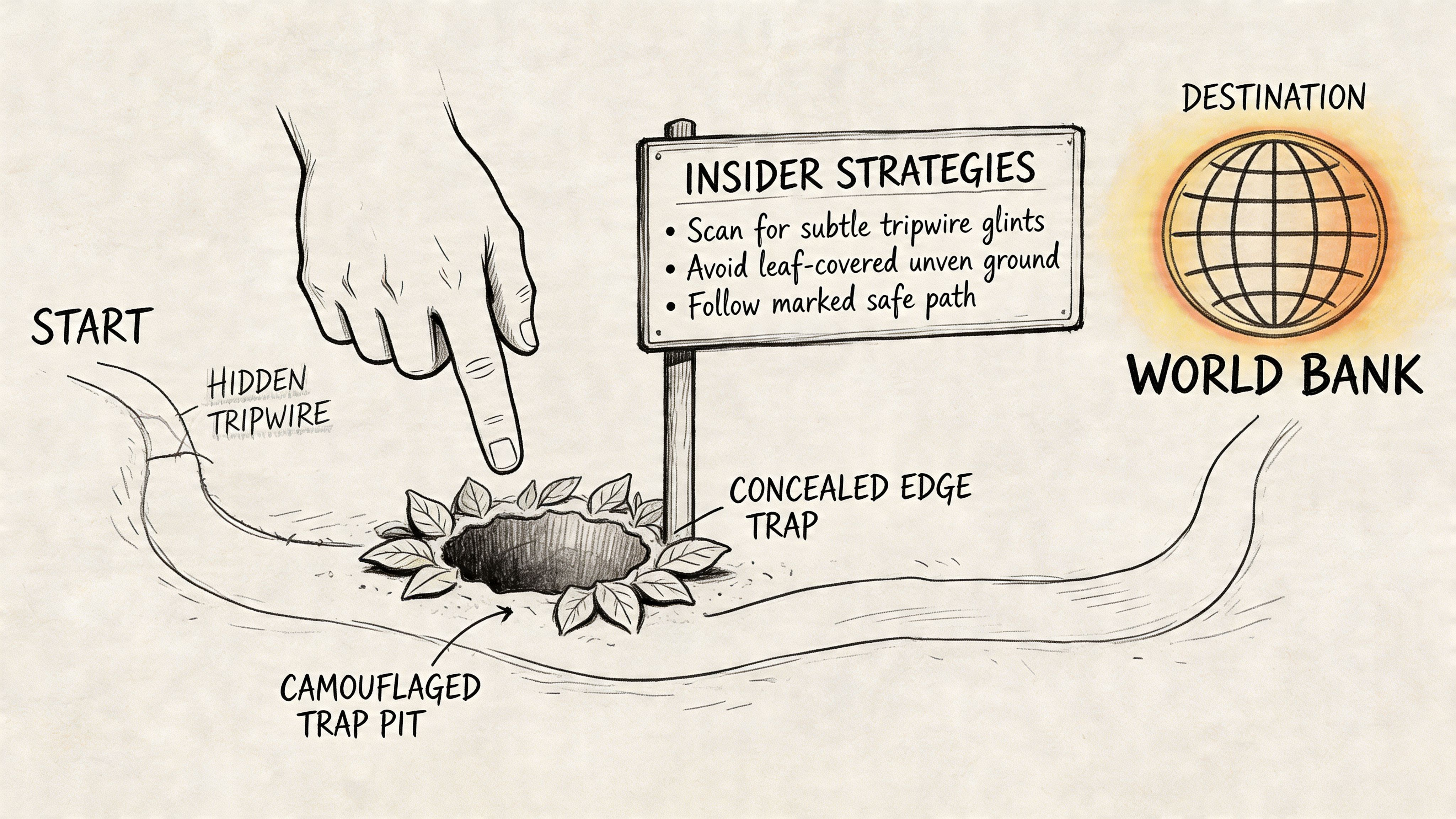
The official process is real, but it is not the whole process. Hiring managers are reducing risk. They are asking a practical question: if this person joins our unit, can they produce quickly, handle internal complexity, and work credibly with clients and colleagues across regions?
That is why referrals matter. A credible internal contact does not get you hired. It helps your profile get read with context. It lowers uncertainty around fit, which is often the deciding issue among several qualified finalists.
Diversity and nationality also sit in the background more than candidates like to admit. The Bank has representation goals across member countries and regions. For candidates from underrepresented backgrounds, that can strengthen the case for shortlisting when the profile is already competitive. For candidates from heavily represented pools, the bar for differentiation is usually higher. The right response is not to speculate about quotas. It is to present your regional knowledge, language ability, and country exposure in a way that is clearly relevant to the unit hiring.
The mistakes that matter most
The costly mistakes are rarely dramatic. They are small judgment errors that signal weak fit.
Applying cold with no positioning: You submitted a capable application but gave no one a reason to connect your profile to the team’s live problems.
Using generic motivation: Your answer could apply to the UN, a bilateral donor, a consulting firm, or any development role.
Underpreparing for early screens: You treated the recruiter or HR round as administrative, even though those calls often decide whether your file keeps moving.
Missing the role-specific filter: Economist candidates fail when they stay abstract and do not show methodological depth. Operations candidates fail when they cannot show delivery judgment, stakeholder management, and realism about implementation. YPP candidates fail when they sound polished but broad, with no clear through-line across technical skill, leadership, and international exposure.
Signaling weak institutional judgment: You speak about development in slogans, not trade-offs. At the Bank, strong candidates can explain what they would prioritize, what they would defer, and why.
I have seen candidates save their best thinking for the final panel. That is a mistake. Early rounds are where the institution decides whether deeper evaluation is worth the time.
What recruiters and panels are looking for at this stage
They are not just checking competence. They are checking usability.
For an Economist, that means more than technical skill. The panel wants evidence that you can move from analysis to operational relevance. Can you explain a method clearly, defend assumptions, and say how the findings would affect policy dialogue, lending, or advisory work?
For an Operations role, polished stakeholder language is not enough. Hiring teams want signs that you know how projects move on the ground. Can you handle government counterparts, disagree without damaging the relationship, and adjust design when implementation constraints become visible?
For YPP, the standard is broader and less forgiving. The Bank is testing long-term potential, cross-cultural maturity, and whether your profile can travel across sectors, regions, and institutional demands. Strong YPP candidates connect their story tightly. They do not present a collection of achievements. They present a coherent trajectory.
Insider strategies that improve your odds
Use a tighter approach.
Read the vacancy like a staffing problem
Go past the published duties. Ask what gap the team is trying to fill. Is it country knowledge, lending experience, econometrics, trust fund management, political economy, client handling, or a mix? Your preparation should answer that hidden question.Build relevant contact before interviews
Generic networking has little value here. Target people in the practice, region, or unit who can help you understand the work. The goal is not favors. The goal is sharper positioning and better language about fit.Prepare different evidence for different interviewers
HR screens need concise proof of motivation, mobility, communication, and fit. Technical interviewers want depth and judgment. Managers want signs that you can make their team more effective without heavy hand-holding.Practice trade-off answers, not just success stories
The strongest candidates can discuss imperfect choices. Be ready to explain a time you had limited data, political constraints, client resistance, procurement delays, or a design that had to be simplified to get implemented.Show Bank-specific motivation
Say why this institution, this practice, and this role. A serious answer references financing, policy dialogue, knowledge work, country engagement, or cross-sector coordination in a way that matches the vacancy.
One final point. The Bank does not hire only for brilliance. It hires for credibility under constraint. Candidates who understand that tend to interview better because they stop performing for approval and start showing how they would operate inside the institution.
Navigating the Final Stages Follow-Up and Offers
The final stage feels passive, but it still shapes outcomes. How you follow up after the interview affects how professional, organized, and serious you appear.
A short thank-you note is worth sending. Keep it crisp. Thank the interviewers for their time, mention one part of the conversation that reinforced your interest, and restate your fit in one line. Don’t send a long essay, and don’t try to reopen the interview by cramming in everything you forgot to say.
How to follow up without looking anxious
Follow-up works when it respects the institution’s pace.
Use this standard:
send your thank-you note promptly
wait with discipline
if the stated timeline passes, send a brief and polite check-in to HR or the recruiting contact
keep the tone factual, not emotional
A strong follow-up message does three things. It references the role clearly, confirms continued interest, and asks whether there is any update on timing. That’s enough.
What hurts you is repeated nudging, overexplaining your enthusiasm, or trying to pressure movement in a system that often moves slowly for reasons unrelated to you.
Reading the silence correctly
Silence after a final interview can mean several things. The panel may still be comparing finalists. Internal approvals may be pending. References may be in motion. Budget or headcount confirmation may be taking longer than expected.
Don’t assume the worst too early. At the same time, don’t stop your broader search because one process feels promising. Experienced candidates keep momentum elsewhere until an offer is formal.
Professional patience is part of the signal. The Bank wants people who can operate in long-cycle environments without becoming erratic.
Handling the offer well
When an offer comes, read it carefully. These roles often sit inside structured grading and compensation frameworks, so negotiation usually has narrower room than in private sector hiring. That doesn’t mean you stay silent. It means you negotiate intelligently.
Focus on clarity:
What grade is the role?
What are the key employment terms?
What is fixed, and what may have flexibility?
What documentation or timing constraints apply?
Ask precise questions. Don’t posture. If you need time to review, say so professionally and give a clear date for response.
What to negotiate and what to avoid
Good candidates negotiate from fit and facts, not ego. If you have a legitimate point around level, start date logistics, or another concrete employment term, raise it clearly and respectfully. Keep your reasoning tied to experience, scope, and practical constraints.
Avoid broad ultimatums or inflated comparisons. They rarely land well in institutional settings.
If the role fits your long-term MDB path, don’t lose it over a clumsy negotiation style. The first objective is to enter well. The second is to grow from there.
If you want a steady edge in MDB recruiting, Multilateral Development Bank Jobs is one of the few resources built specifically for this market. It tracks staff and consultant openings across major development institutions and publishes practical guidance on hiring timelines, YPP pathways, nationality questions, and the details that generic career advice misses.