


You’re probably looking at a consultancy notice, a LinkedIn post, or a recruiter email and trying to answer one simple question: what’s a fair World Bank consulting rate?
The problem is that most advice on world bank consultant rates is shallow. It treats the number on the page as if it were a salary. It usually isn’t. A World Bank consultant rate only makes sense once you know the contract type, who is hiring you, what procurement method is being used, and which costs sit inside that rate.
That’s where people get burned. They compare a daily rate to a staff salary, skip the benefits gap, forget unpaid downtime, and underquote themselves into a bad year.
The Bank’s system is structured. It’s also full of practical trade-offs that generic salary sites miss. If you understand those trade-offs, you can read opportunities much more clearly and price yourself like a professional instead of guessing.
The Key Types of World Bank Consultants Explained
Before you judge any offer, identify the contract.
The World Bank uses different consultant arrangements, and they do not create the same financial outcome for you. The biggest divide is between Short-Term Consultants (STCs) and Extended-Term Consultants (ETCs). Then there’s a separate lane for consultants hired through firms.

STC versus ETC
An STC is usually what people mean when they talk about headline daily rates. Those rates can look attractive, but they’re built differently from employee compensation.
An ETC sits closer to staff treatment on benefits. That significantly changes the contract’s value in a major way.
According to the World Bank’s official benefits page for consultants and staff categories, ETCs receive extensive life insurance, medical options, and accidental death coverage, while STCs only receive minimal accidental death insurance, with no life or medical coverage. That creates a 20-40% effective pay gap once STCs self-fund health and insurance costs.
That’s the number many candidates miss.
Practical rule: If you compare an STC day rate to an ETC package without pricing in benefits, you’re comparing two different products.
Firm contracts are a different game
When a firm wins a consulting assignment, the Bank or borrower pays the firm, not you directly. Your compensation then depends on the firm’s internal pricing, markup, overhead, and staffing model.
That matters because the rate in the proposal may have little resemblance to what the individual expert receives. The firm is carrying delivery risk, administration, management time, and margin. If you’re subcontracted, ask who covers travel admin, invoicing, insurance, and payment timing. Those details affect your net income just as much as the top-line rate.
What actually matters when comparing offers
A clean comparison looks like this:
STC. Higher visible day rate is common. You carry more personal cost and more uncertainty.
ETC. Lower headline rate can still produce stronger total compensation because benefits are built in.
Firm-based role. Your bargaining power depends on your niche and the firm’s influence, not just the published project budget.
If you want a broader side-by-side view of how consultancy and staff paths differ across MDBs, this breakdown is useful: https://www.mdbjobs.com/p/mdb-consultant-vs-full-time-employee
How the World Bank Determines Consultant Pay
A consultant can quote the right expertise and still lose on price logic.
That happens because World Bank consultant pay is shaped less by your last salary and more by the hiring route, the contract form, and the budget mechanics behind the assignment. For direct Bank consulting, hiring managers usually start with the scope, expected level of effort, and internal budget ceiling. For borrower-led assignments, procurement rules drive much more of the pricing outcome.
Procurement method sets the room you have
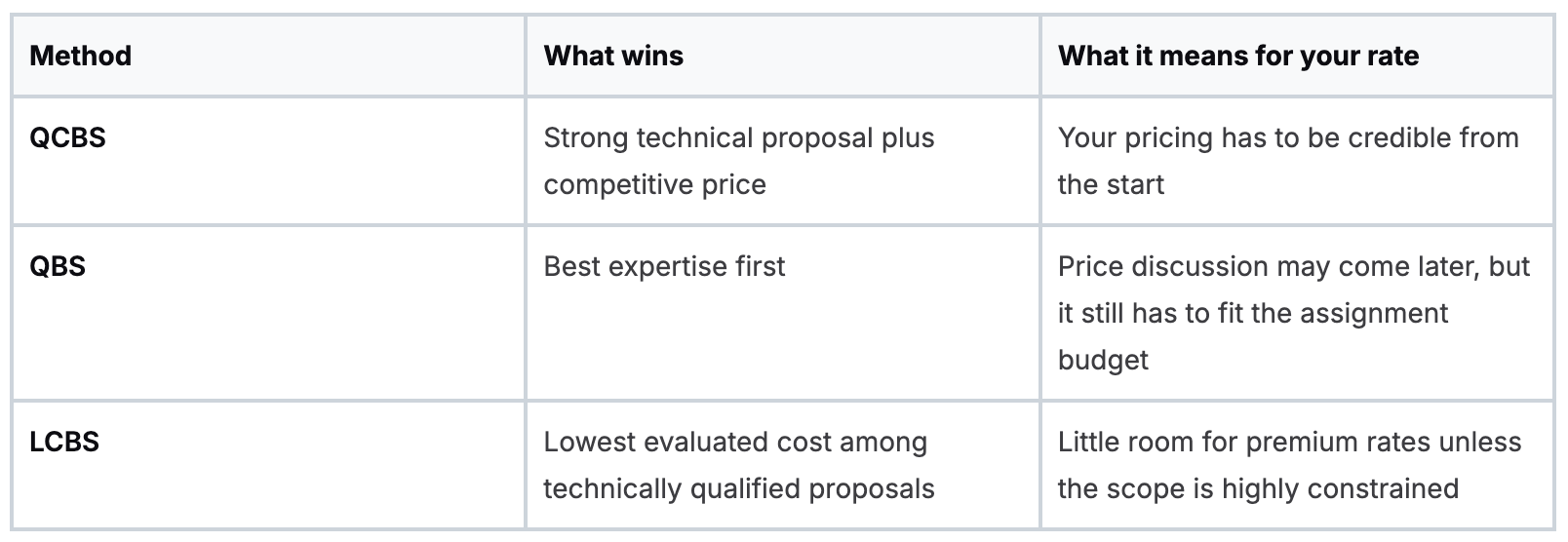
If the assignment is borrower-led, your rate sits inside a formal selection method. Under QCBS, technical quality and price are both scored, so an expensive proposal has to earn its place. Under QBS, the client selects the strongest technical proposal first and discusses price afterward. Under LCBS, cost pressure is much tighter because qualified bidders are pushed toward the lowest evaluated price. A useful summary of these methods appears in this overview of World Bank consultant selection methods.
The practical consequence is simple. In QCBS, your first price often has to stand on its own. In QBS, there may be more room to explain why a senior specialist costs more. In LCBS, premium pricing is hard to defend unless the terms of reference clearly demand rare expertise.
Hiring teams anchor pay to the assignment, not your biography
Inside the Bank, hiring managers usually work backward from four questions.
How specialized is the work? Niche sector expertise, crisis experience, reform design, and hard-to-find language combinations support stronger rates.
What contract type is being used? An STC rate can look high because it has to absorb costs an ETC package covers differently.
How many days are realistic? A high day rate on a thin input contract can be worse than a lower rate on a longer, cleaner assignment.
What budget has already been cleared? Even strong candidates hit a ceiling if the manager has limited room in the task budget.
This is why generic salary sites mislead people. They flatten consultant pay into a single number and miss the commercial reality of STC versus ETC structures. If you want the broader context, this guide to World Bank grades and salary structures helps show where consultant compensation sits beside staff pay without treating them as the same thing.
The contract form changes what “good pay” actually means
A Bank team does not view every consultant dollar the same way.
For an STC, the rate is usually judged as an all-in commercial rate tied to days worked. Managers know that senior specialists may need a stronger daily figure, but they also compare that figure against the scope, available budget, and alternatives in the market. For an ETC, the decision is closer to role pricing over a longer period, with less focus on a headline daily number and more focus on fit, grade alignment, and total package cost.
That distinction matters in negotiations. An STC discussion often centers on day rate, number of days, and reimbursables. An ETC discussion usually has less flexibility on headline compensation but may still involve title, grade fit, duration, and duty-station implications.
Read the solicitation like a pricing document
The terms of reference tell you what the client wants delivered. The data sheet and contract form tell you how your pay will work.
Check whether the assignment is time-based or lump-sum. Check whether travel is reimbursable or expected inside the financial proposal. Check the estimated level of effort, payment schedule, and any instruction on local versus international experts. Those details determine whether you are pricing labor only, labor plus delivery risk, or labor plus cash-flow risk.
Experienced bidders treat rate-setting as a commercial exercise, not a confidence exercise. The right number is the one that matches the procurement method, survives comparison against other qualified proposals, and still pays for the contract structure you are being asked to accept.
Decoding the All-In Daily Rate
You accept an STC at what looks like a strong daily rate. Six months later, the number feels much smaller. Health cover came out of your pocket. Retirement did too. You lost unpaid time to proposal work, client delays, and admin. That is the mistake salary comparison sites miss.
The all-in daily rate is the commercial price of your labor under a consultant contract. For an STC, it usually has to cover far more than take-home pay. It carries the costs that a staff package would spread across employer contributions, benefits, paid leave, and internal support.
That is why a daily rate that looks high on paper can translate into a fairly ordinary annual outcome once you convert it into net income and account for non-billable time. As noted earlier, this is also why practitioners compare consultant pricing against staff compensation carefully rather than treating the day rate as a straight salary equivalent.
What all-in usually includes
For practical pricing purposes, assume your STC rate needs to absorb all of the following unless the contract says otherwise:
Your own compensation for days worked
Health insurance and other personal coverage
Retirement contributions
Taxes and tax compliance costs in your home jurisdiction
Administrative overhead such as invoicing, accounting, software, and banking fees
Unpaid business development time between assignments
Utilization risk, because very few consultants bill every working day in a year
Client-side delay risk if approvals, reviews, or scheduling reduce your effective earning capacity
That last point matters more than many first-time consultants expect. A rate can look acceptable only if you assume full utilization. Real consulting income rarely works that way.
Why STC and ETC pay are easy to confuse
Generic compensation pages lead to bad expectations. They flatten very different contract models into one headline figure.
An STC rate is usually quoted as an all-in day rate. You fund the gaps yourself. An ETC package works more like fixed-term employment compensation, with less emphasis on a visible daily number and more value sitting in the structure around the role. If you compare an STC day rate to an ETC or staff salary without adjusting for benefits, leave, tax treatment, and downtime, you are comparing two different things.
This is the full compensation story. Contract type changes the economics.
The pricing mistake that shows up later
New Bank consultants often start with a target salary, divide by a rough number of working days, and submit that result as a rate. The arithmetic is clean. The commercial logic is weak.
A workable rate starts with net income needs, then adds the costs you now carry personally, then adjusts for the share of the year that will not be billable. If the assignment is intense, field-heavy, or likely to generate revision cycles, the rate also has to compensate for delivery friction that never appears in a salary benchmark.
Under an all-in STC, every cost you forget comes out of your margin.
That is why experienced consultants ask a different question. Not “What sounds high?” The useful question is “What rate still works after taxes, insurance, gaps between contracts, and the actual number of days I can bill?”
Quick Reference for World Bank Consultant Rate Ranges
A consultant sees a public salary figure, converts it to a day rate, and assumes that is the market. Then the first Bank-linked assignment arrives as an STC with no paid leave, no benefits, and gaps between billable days. The number looked fine on paper. The economics were wrong.
That is why a quick reference has to do two jobs. It should give you a broad market anchor, and it should stop you from treating salary-site data as if it described actual World Bank contract value.
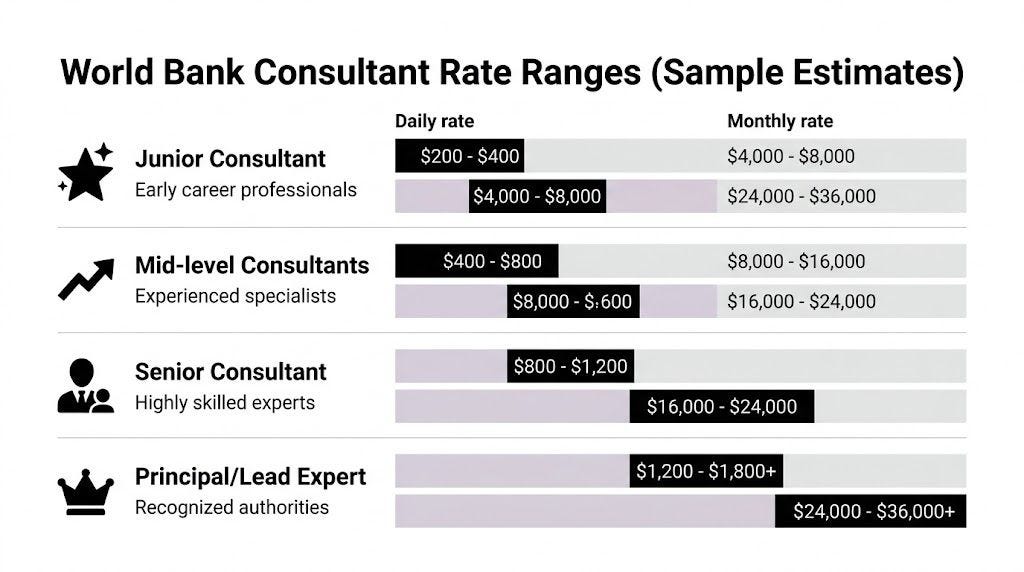
For a general U.S. benchmark, ZipRecruiter’s World Bank consultant salary page lists average annual pay, top-end compensation, and hourly equivalents for people tagged under this title. Use that as a rough outside-market signal only. It does not separate STC from ETC, and that distinction changes the value of the offer more than the headline number does.
What the range actually represents
A World Bank consultant “range” is not one clean pay ladder. It is a mix of very different commercial situations.
At the lower end, you often see assignments with broader candidate pools, lighter technical depth, tighter procurement pressure, or support-heavy scopes. At the higher end, rates usually reflect scarce expertise, difficult operating environments, direct client exposure, or work where a weak deliverable will create delays for the whole task team.
Contract structure matters just as much as seniority. An STC with a strong all-in daily rate can still be weaker in total value than an ETC package with leave, benefits, and more predictable continuity. Salary aggregators rarely show that difference, which is why they are useful for orientation but weak for pricing.
How experienced consultants read the band
Use market ranges in layers.
First, place the assignment itself. Is it technical and hard to substitute, or is it general advisory support? Is it desk-based, or does it involve missions, government counterparts, and revision-heavy outputs? Then place your profile against that scope. Prior Bank delivery, borrower credibility, language fit, and niche sector depth often matter more than generic years of experience.
A few factors usually push pricing upward:
Specialized technical scope. Public financial management, infrastructure, energy, procurement, safeguards, and complex analytics tend to support stronger rates than general coordination work.
Execution risk. Tight timelines, sensitive stakeholders, and heavy mission demands justify more than low-friction desktop assignments.
Credibility with clients and task teams. Teams pay more for consultants who need less hand-holding and can represent the work well.
Scarcity of comparable profiles. If the shortlist is thin, rate pressure eases.
The practical reading of “quick reference”
Treat public salary data as a loose outer boundary, not a quoting formula.
For STC work, the meaningful comparison is your all-in daily rate after you account for unpaid time, self-funded benefits, taxes, and business costs. For ETC work, the right comparison is total package value, not the visible cash figure alone. If you skip that adjustment, the same market can look cheaper or richer than it really is.
That is the mistake generic salary sites keep making. They show income labels. They do not show contract economics.
How to Calculate Your Required Daily Rate
Most consultants make this harder than it needs to be.
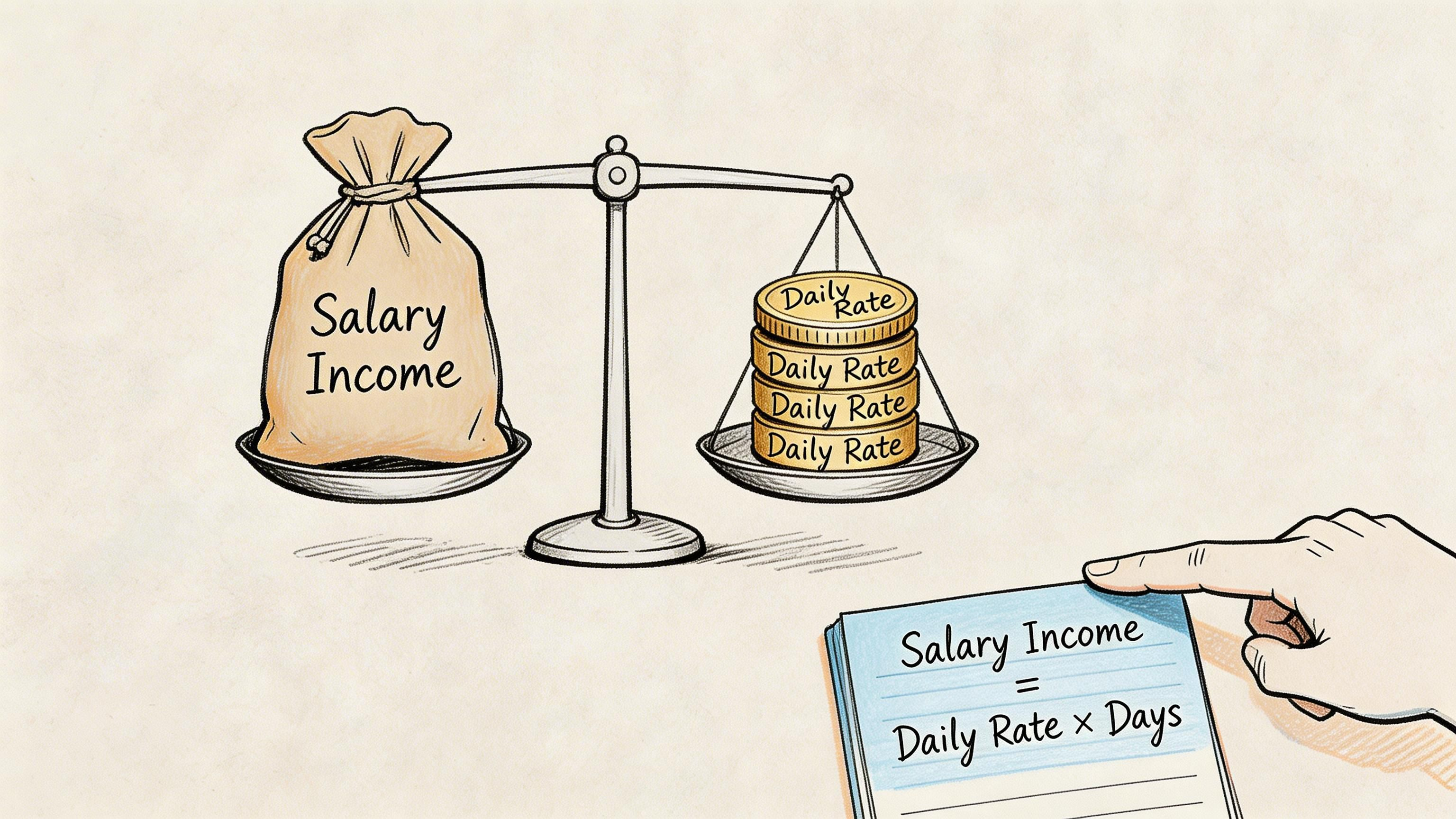
Start with the income you want to preserve. Then build upward for everything a salaried employer used to carry for you. The output is your required daily rate, not your dream rate.
The working formula
Use this sequence:
Set your target personal income
Add your annual business costs
Add tax and savings buffers
Divide by your realistic billable days
That final step is where people get sloppy. You will not bill every day you work. Proposal writing, admin, delayed starts, illness, leave, and gaps between contracts all reduce billable time.
What to include
Build your number from real categories, not vibes.
Income target. What you want to draw for yourself over a year.
Insurance. Health, life, professional cover if relevant.
Retirement. Your own contributions.
Operating costs. Accountant, software, equipment, payment friction, professional memberships.
Tax reserve. Based on your jurisdiction and filing reality.
Unpaid time. Holidays, sick days, business development, and downtime.
Field-tested advice: If your rate only works when you bill almost every working day, the rate is too low.
A simple way to pressure-test it
Ask three questions before you submit any number:
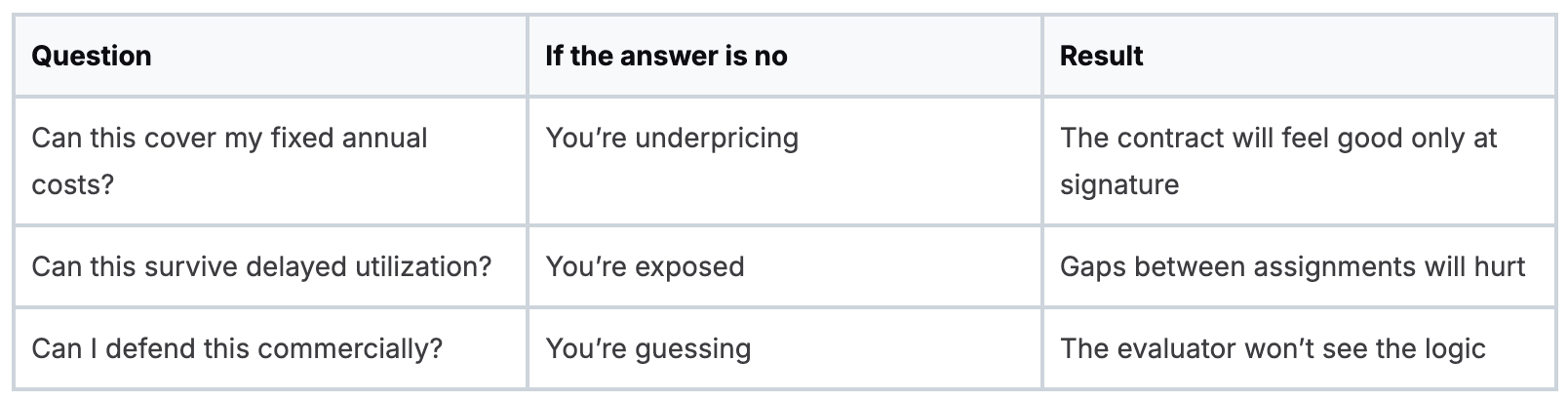
A sustainable world bank consultant rate should survive ordinary friction. If one delayed purchase order, one slow payment cycle, or one month without billable work breaks your model, the rate wasn’t commercially sound in the first place.
Navigating Allowances Reimbursables and Taxes
A decent daily rate can still produce a poor outcome if the contract handles expenses badly.
The first thing to pin down is simple: what is reimbursable, what is included in the daily rate, and what sits entirely with you. Never assume. Read the contract language and the request documents.
Reimbursables are not extra profit
Travel-related items may be reimbursed separately, especially in borrower-led or firm-led assignments. That can include flights, lodging, local transport, and per diem treatment where the contract allows it.
Treat reimbursables as cost recovery, not margin. If the contract says your rate is all-in except for approved travel, keep your pricing logic clean. Don’t try to hide delivery costs inside the rate if the tender gives you a proper reimbursement channel. It makes your bid less transparent and harder to defend.
A few practical checks matter:
Approval rules. Find out whether travel needs prior written approval.
Documentation. Keep receipts, itineraries, and exchange records in order.
Per diem mechanics. Confirm whether the client pays fixed per diem or reimburses actuals.
Remote assumptions. If the work starts remotely but may shift to missions later, get the trigger for travel authorization in writing.
Taxes are your job to understand
The Bank’s contracts won’t rescue you from a bad tax assumption.
Your tax treatment depends on your citizenship, tax residence, where the work is performed, and how the contract is structured. U.S. taxpayers in particular need to think carefully because worldwide income reporting can make consulting cash flow feel tighter than expected. Other nationalities may face a different mix of local taxation, treaty treatment, and social contribution rules.
That’s why experienced consultants do two things early:
They ask the client how invoicing is expected to work.
They ask their own accountant how that income will be treated before the first invoice goes out.
The practical standard
Keep separate accounts for tax reserves and operating funds. Track every invoice and reimbursement line. Save the contract, amendments, approval emails, and payment records in one place.
Clean admin won’t raise your rate, but it will protect your rate.
Where to Find Official Tenders and Rate Information
If you want signal instead of rumor, go straight to procurement documents.
Third-party websites can help you spot openings, but the useful detail sits in the official notice, the terms of reference, the request for expressions of interest, and the instructions to consultants. That’s where you learn how the client will evaluate your commercial offer.
What to look for in the documents
Focus on four items first:
Procurement method. This tells you how price competes against quality.
Contract type. Time-based and lump-sum assignments need different pricing logic.
Level of effort assumptions. If the client has already framed expected inputs, your rate needs to fit that reality.
Expense treatment. Reimbursables can change the economics of the assignment.
Past notices are useful too. Even when they don’t disclose an exact rate, they show patterns in scope, staffing mix, and required expertise.
Search like a practitioner
Use precise keywords tied to function and sector. Search combinations such as your technical specialty plus “consultant,” “terms of reference,” “expression of interest,” “time-based,” or the country name.
Then filter hard. Ignore generic listings that don’t show actual procurement material. You want notices with downloadable attachments or enough detail to reconstruct the commercial setup.
Why this matters
Good rate decisions come from document reading, not social media threads.
A consultant who studies official notices learns what the market is really buying, how it buys it, and which assignments reward premium expertise. That’s better intelligence than any anonymous comment about what someone “heard” a consultant was paid.
Practical Tips for Proposing and Negotiating Your Rate
Negotiation is often believed to start after selection. In World Bank consulting, that’s often wrong.
Your real negotiation usually happens when you design and submit your proposal. By the time the client opens financials, the room to reshape your number may be very small, and in some processes it’s effectively gone.

Price with an argument, not a wish
A strong rate proposal shows why your price fits the assignment.
That means tying your number to things evaluators can recognize:
the match between your experience and the terms of reference
the level of specialization required
the delivery environment, especially if stakeholder handling is hard
the speed and independence with which you can execute
If you need a model for packaging that logic persuasively, this guide on https://www.mdbjobs.com/p/how-to-write-a-consulting-proposal is worth studying.
When to hold firm
Hold your rate when the assignment clearly needs your specific niche and your proposal demonstrates that fit. Discounting in those cases often weakens your position more than it helps. It can signal that you don’t understand your own market value or that you’ve padded the rate and are now retreating.
Be more flexible when the work is standardized, the field is crowded, or the client has made the commercial ceiling obvious through the procurement structure.
The easiest rate to approve is the one that looks inevitable given your fit, the scope, and the market context.
What works in practice
Use clear commercial language. Keep it boring and defendable.
A practical approach looks like this:
Anchor to relevance. Show why your profile is unusually aligned to the assignment.
Keep the staffing logic clean. If there’s a team structure, don’t overload it with expensive senior inputs where they aren’t needed.
Separate reimbursables properly. Evaluators prefer transparent pricing.
Avoid emotional justification. Your mortgage, prior salary, and personal needs are irrelevant to the client.
Submit a number you can live with. Resentment shows up fast in delivery quality.
What doesn’t work
These moves usually fail:
padding the rate and hoping to negotiate down later
benchmarking against staff compensation without adjusting for contract structure
quoting one number with no explanation of level of effort or assumptions
trying to rescue a weak technical proposal with aggressive discounting
The strongest consultants make pricing feel easy to approve. That’s the standard.
Common Mistakes to Avoid When Quoting Your Rate
Bad pricing decisions usually come from one of a handful of repeat mistakes.
The expensive errors
Confusing salary with consulting revenue. A staff benchmark is useful context. It is not a pricing formula for an all-in consultancy.
Ignoring contract type. STC, ETC, and firm-based roles have different economics. Treating them as interchangeable leads to bad comparisons.
Forgetting non-billable time. You won’t invoice every day you work. If your model assumes full utilization, it’s fragile.
Underestimating tax and insurance. These costs arrive whether you planned for them or not.
Submitting a rate without logic. Even a fair number can look weak if it has no commercial explanation.
Chasing the role with the biggest headline rate. Total compensation, payment reliability, scope clarity, and workflow matter just as much.
The mistake smart people still make
Experienced professionals often assume technical excellence protects them from pricing discipline. It doesn’t.
A brilliant expert who prices carelessly can lose the bid or win a contract that pays badly in practice. Rate setting is part commercial judgment, part self-knowledge. You need both.
Frequently Asked Questions About Consultant Pay
Can I propose a rate above an indicative range
Yes, if the procurement documents allow flexibility and you can defend it. But you should assume the burden of proof is on you. In competitive processes, a rate that sits above the obvious commercial logic usually hurts more than it helps.
Do remote consultancies pay differently from headquarters-based work
Sometimes. The bigger issue is usually expense treatment and expectations around travel, responsiveness, and stakeholder contact. A remote contract with no travel burden can still be attractive. A headquarters-facing role may justify more if it demands availability, in-person coordination, or high-pressure delivery.
Are borrower-hired consultant rates different from Bank-hired rates
They can be. Borrower-led procurement follows Bank guidelines but sits inside the borrower’s project budget, market assumptions, and evaluation approach. That often changes the commercial feel of the assignment.
Can I negotiate after selection
Sometimes, but don’t rely on it. In many competitive processes, especially those where financial bids are tightly controlled, the practical negotiation window is limited.
Is the highest day rate always the best deal
No. Contract structure, benefits, reimbursables, tax exposure, payment timing, and expected downtime can turn a high headline rate into a mediocre offer.
If you want better visibility into World Bank and wider MDB consulting opportunities, Multilateral Development Bank Jobs is a strong place to start. It tracks consultant openings across the major multilaterals, plus full-time roles and practical guides that help you judge contracts, rates, and hiring patterns with far less guesswork.