

When you hear “stakeholder engagement,” you might picture town hall meetings or a slick PR campaign. In the world of multilateral development banks (MDBs), you need to erase that image. This is about managing reality on the ground, not managing perceptions.
Stakeholder engagement is the formal, mandatory process of figuring out who is affected by a project, listening to them, and building their feedback into the project’s DNA. Think of it as a project’s central nervous system. It’s the two-way connection between the project team and everyone from government ministers and investors to local communities and NGOs.
More Than Just Talk: A Core Project Requirement
Inside an MDB like the World Bank or the Asian Development Bank (ADB), stakeholder engagement is a systematic discipline for managing risk and ensuring a project actually works. It’s a core function, just like financial analysis or procurement, not a “nice-to-have” add-on.
A Non-Negotiable Part of the Deal
These institutions learned the hard way that ignoring stakeholders is a fast track to project delays, massive cost overruns, and outright failure. That’s why robust stakeholder engagement is now a non-negotiable requirement baked into the entire project cycle.
The shift is huge, especially for complex projects involving land acquisition or resettling communities. The World Bank now demands a formal stakeholder engagement plan before a project even gets considered for funding. The ADB and other MDBs insist this dialogue happens from the initial spark of an idea all the way through implementation and long-term monitoring. You can learn more about how MDBs have formalized this as a core operational requirement.
In the MDB world, a lack of stakeholder engagement is a critical project risk, not a communication error. It signals that a project is completely disconnected from the people it’s supposed to serve.
Identifying the Key Players
A massive part of the job is figuring out who your stakeholders actually are. They are not all created equal. You have to map them based on their influence and how directly a project will impact their lives or interests. A large infrastructure project, for instance, has a dizzying array of groups, many with competing goals.
Effective engagement starts with mapping these groups to understand what they want, what they fear, and what they need. Here’s a quick look at the typical breakdown you’ll encounter on any major MDB project.
Key Stakeholder Groups in MDB Projects
This table gives you a clear idea of the different players involved in a typical development project and what drives them.
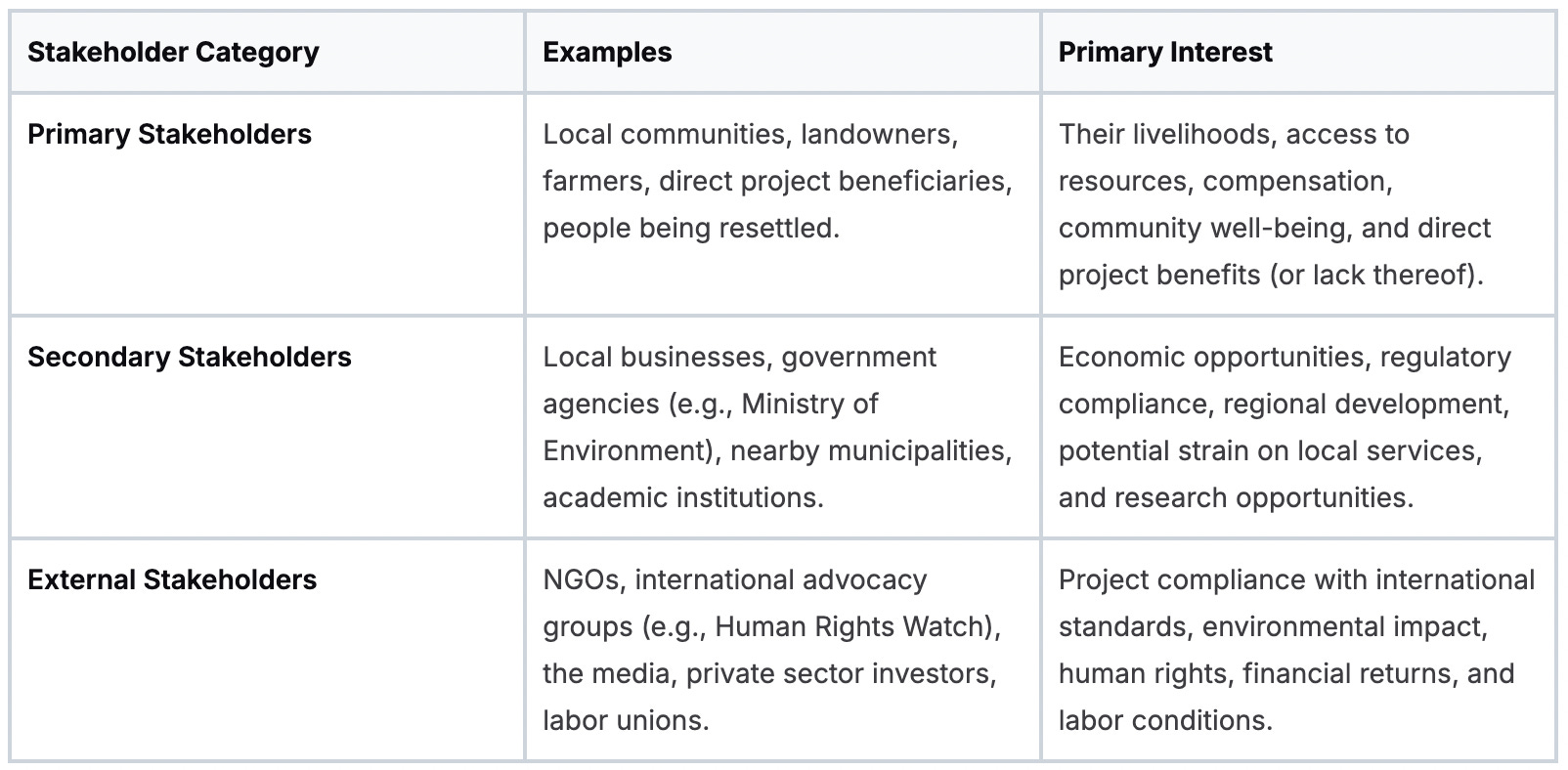
As you can see, you’re juggling the needs of a farmer who might lose their land, an international investor looking for a return, and an environmental NGO concerned about biodiversity. Your job is to navigate these competing interests to find a viable path forward for the project.
The Core Components of an Engagement Plan
In the MDB world, a vague promise to “talk to people” just won’t fly. Recruiters and hiring managers expect you to understand the specific, concrete elements of a professional Stakeholder Engagement Plan (SEP). This is your blueprint for action, proving you have a structured and defensible process.
Think of it like the architectural drawings for a building. You wouldn’t start pouring concrete without them, and MDBs won’t kick off a project without a solid SEP. The plan breaks down the entire engagement process into four key components you’ll be expected to own and manage.
Stakeholder Analysis and Mapping
First things first: you have to figure out who has a stake in the game. This is a systematic process of identifying every individual, group, and organization that could be affected by the project or influence its outcome.
Once you have your list, the real work begins. You map each stakeholder against two critical factors: their level of interest in the project and their degree of influence over it. This strategic assessment dictates where you focus your limited time and resources. A high-influence, high-interest group like a ministry of finance or a directly impacted community requires a completely different approach than a low-influence, low-interest group.
This mapping exercise is fundamental because it drives every other part of your plan. It stops you from wasting effort and ensures you’re actively managing the relationships most critical to the project’s success.
A rookie mistake is to treat all stakeholders equally. Effective engagement is all about strategic prioritization. The mapping process tells you who needs intensive, face-to-face consultation and who can be kept in the loop with a newsletter or a project website.
This diagram shows a typical way to categorize stakeholders based on their proximity to the project.
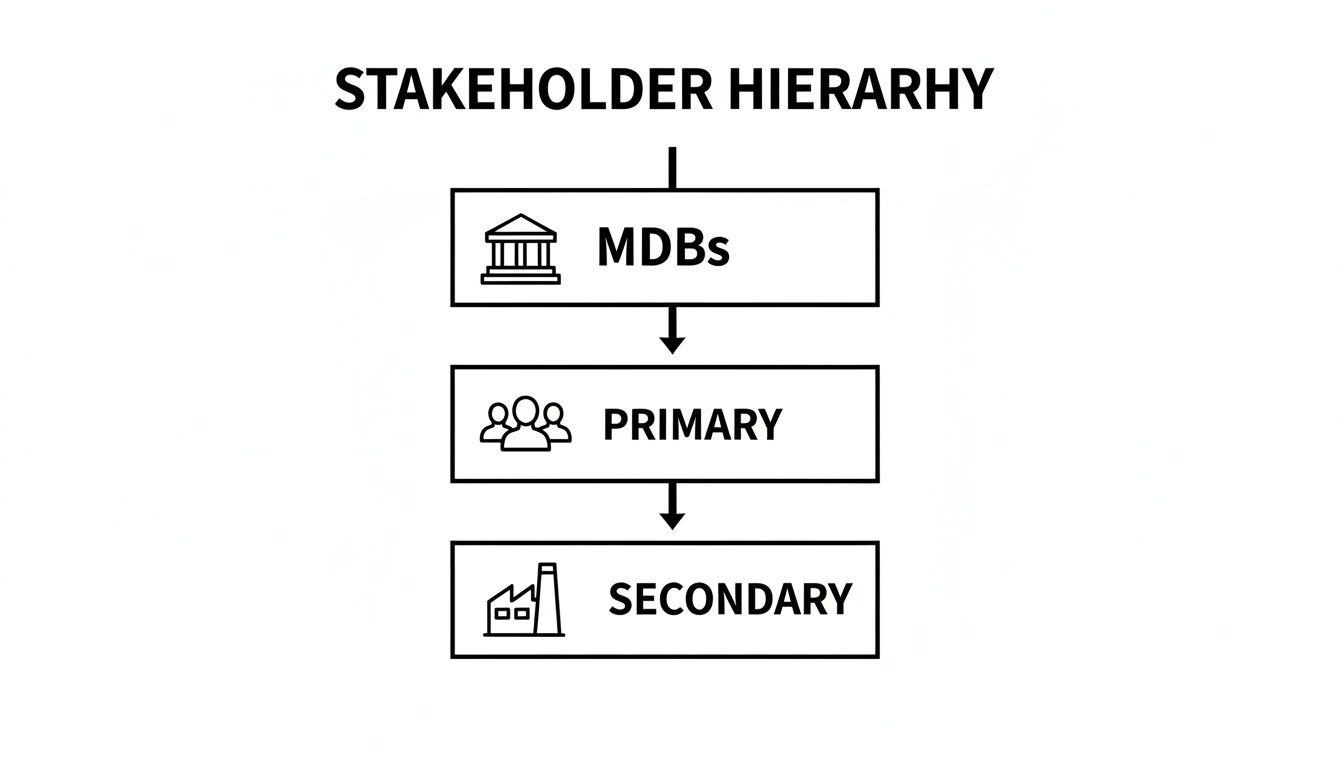
This hierarchy makes it clear: while all stakeholders matter, your engagement efforts must prioritize those most directly impacted by a project’s activities.
Information Disclosure Protocols
Transparency is mandatory, not optional. A good SEP clearly spells out what information will be shared, with whom, when, and how. This is about making complex project information accessible and understandable to vastly different audiences.
Your protocols need to be specific:
What you share: This covers everything from environmental and social impact assessments to project timelines, budgets, and potential risks.
How you share it: The methods have to be tailored to your stakeholders. This could mean public town halls, dedicated websites, radio broadcasts in local languages, or printed summaries distributed in villages without internet.
When you share it: Information must be disclosed early enough for stakeholders to give meaningful input before major decisions are locked in.
Meaningful Consultation Process
This is where the real dialogue happens. Your SEP needs to outline the specific activities for engaging with stakeholders. The key word here is meaningful. Consultations must be genuine two-way conversations where the project team listens and seriously considers the feedback they receive.
A strong consultation plan includes a schedule of activities, clear objectives for each interaction, and a commitment to inclusivity. It must actively seek out the voices of vulnerable or marginalized groups, who are often the hardest to reach but can be the most affected. This proactive approach is a core part of the what results-based management means in an MDB context, a framework MDBs live and breathe by.
Grievance Redress Mechanisms
Let’s be real: no project goes perfectly. A Grievance Redress Mechanism (GRM) is a formal, accessible system for people to raise concerns and get them resolved. Think of it as the project’s accountability valve.
A well-designed GRM gives people a clear, predictable, and transparent process for lodging a complaint. It also defines how those complaints will be investigated and what steps will be taken to resolve them. Having a functional GRM is a critical requirement. It shows a real commitment to accountability and helps solve issues at the local level before they blow up into major conflicts or legal battles.
Why MDBs Center Their Strategy on Engagement
Let’s get one thing straight: for Multilateral Development Banks, stakeholder engagement is a core business function, right up there with lending and economic analysis. This is about survival and staying relevant, not about feel-good PR.
Effective engagement is, first and foremost, a powerful risk mitigation tool. When you see news of a billion-dollar project hitting the skids because of protests, delays, or political blowback, it’s almost always because a key group felt ignored. By systematically talking to communities, governments, and civil society from the get-go, MDBs can see problems coming, tackle concerns early, and stop small grievances from blowing up into conflicts that can kill an entire investment.
From Local Knowledge to Better Projects
Robust engagement also builds better projects. A project team sitting in Washington, Manila, or London can have all the technical expertise in the world, but they’ll never have the on-the-ground knowledge of local people. Locals understand the intricate social dynamics, the informal economy, and the environmental quirks in a way no outsider ever could.
Bringing this local knowledge into the design process is the difference between a project that looks great on paper and one that actually works for the people it’s supposed to help.
This collaboration also fosters something just as important: local ownership. When people feel they have a voice in a project’s design and a stake in its outcome, they become partners in its success. That sense of ownership is what keeps an initiative going long after the project team has packed up and moved on. Without it, even the most well-funded project is likely to fail.
The Pressure to Prove Impact
Let’s be blunt: the entire multilateral system is under a microscope. Shareholder governments, taxpayers, and partner countries are all asking the same tough question: are we getting real value for our money? Stakeholder engagement is one of the main ways MDBs can answer that question and justify the massive sums they receive.
This pressure has only intensified as MDBs have become more central to global aid. Between 2010 and 2022, the portion of funding from Development Assistance Committee members channeled through multilateral organizations climbed from 37% to 43%. While that’s a vote of confidence, it also puts their performance under a brighter spotlight. Recent analysis shows the MDB system lacks a coordinated way to measure its collective impact, which opens it up to criticism. You can dive deeper into the findings on how MDBs are being evaluated for value and effectiveness.
This accountability gap makes solid engagement even more critical. It acts as tangible proof that an MDB is listening, adapting, and making a real-world difference.
The Strategic Value of Engagement
MDBs have put engagement at the heart of their strategies because it delivers clear, measurable wins on multiple fronts. This is a pragmatic necessity for anyone serious about modern development finance.
Key Strategic Benefits Include:
Enhanced Risk Management: Proactively spotting and defusing social and political risks before they derail a project.
Improved Project Design: Tapping into local knowledge to build solutions that are genuinely fit-for-purpose.
Stronger Local Ownership: Securing the buy-in from communities that is absolutely essential for a project’s long-term survival.
Demonstrated Accountability: Giving shareholders and the public concrete evidence that the bank is responsive and delivering on its promises.
Strengthened Reputation: Building trust with everyone from government ministers to grassroots activists, which is the currency of any credible development institution.
If you’re looking for a career in this space, you need to understand this. Stakeholder engagement is the engine of successful development, and it’s a fundamental skill every single MDB professional is expected to have.
Engagement in Private Sector and Climate Finance
When you step into private sector development and climate finance, stakeholder engagement shifts gears completely. The usual cast of characters like communities and governments is still there, but now you’re dealing directly with private banks, institutional investors, and major corporations.
It’s a different ballgame, but the core idea is the same: you’re building deliberate, structured relationships to get something specific done.
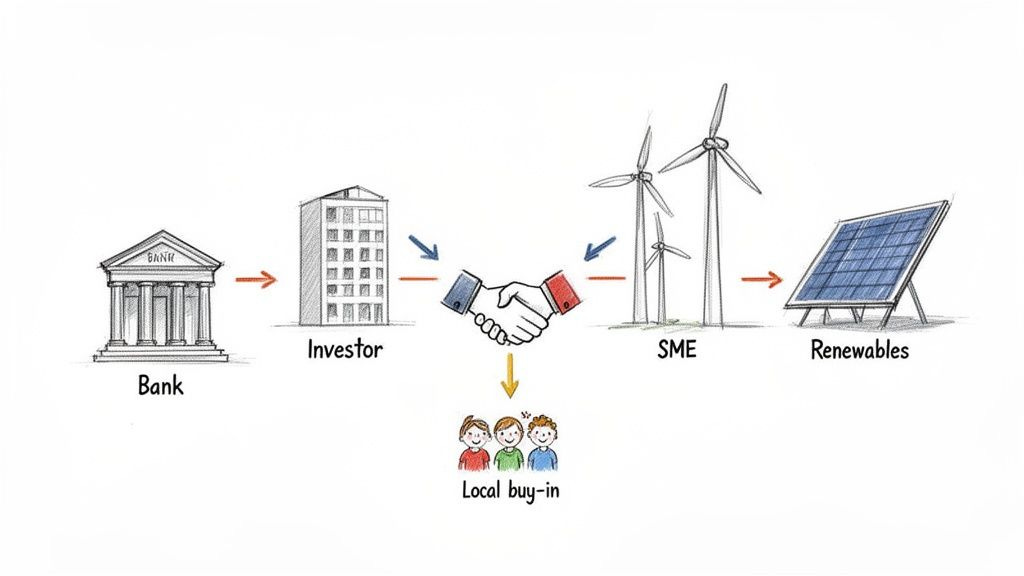
For MDBs, engaging the private sector means building entire ecosystems from the ground up. They work through local financial institutions to channel funds to hundreds, sometimes thousands, of small and medium-sized enterprises (SMEs) that would otherwise never see that capital. This creates a massive multiplier effect, but it demands a much more sophisticated kind of engagement.
Building Markets Through Financial Intermediaries
A classic example is the Asian Development Bank’s Trade and Supply Chain Finance Program. The ADB doesn’t lend to exporters directly. Instead, it partners with over 240 banks in developing countries. By providing guarantees and loans, it gives those local banks the confidence and capacity to finance more trade themselves.
Here, the key stakeholders are the financial institutions. The engagement is all about:
Capacity Building: Training staff at partner banks on the nuts and bolts of international trade finance standards.
Risk Sharing: Creating partnerships where the MDB absorbs a portion of the risk, making local banks far more willing to lend to new or smaller businesses.
Network Building: Connecting banks across different countries to make cross-border trade flow more smoothly.
This is the kind of engagement that turns an MDB’s seed capital into a real, self-sustaining market. If you’re curious about how these skills translate into an MDB career, check out our guide on landing a role with a private sector background.
Another great model is the European Bank for Reconstruction and Development’s (EBRD) Women in Business Program. This is a brilliant example of highly targeted engagement. The EBRD works with just seven partner financial institutions to disburse over €40 million in loans specifically to women-led SMEs, directly involving over 2,000 stakeholders in the process.
Fueling the Green Transition with Climate Finance
Climate finance is arguably the hottest area in development today, and it’s completely built on multi-stakeholder collaboration. MDBs sit right at the center of this world, acting as arrangers, guarantors, and co-financiers to get massive renewable energy projects off the ground.
These projects are far too large and complex for any single entity to tackle alone.
In 2023, MDBs mobilized a record $137 billion in climate financing, a 10% jump from the year before. A huge piece of this work involves attracting private sector investment to get more done with limited public funds. You can dig into the numbers on how MDBs are driving sustainable investments.
A modern solar or wind farm is a massive stakeholder engagement puzzle. You have to align the interests of investors, technology providers, government regulators, and local communities all at the same time.
For a large-scale climate project, engagement looks something like this:
Key Engagement Activities in Climate Finance
Securing Co-financing: MDBs court private equity funds, pension funds, and commercial banks. They use their own investment to de-risk a project, making it a much more attractive bet for private capital.
Navigating Regulation: This involves deep engagement with government ministries to help shape policies that support renewables, like feed-in tariffs or simpler permitting processes.
Ensuring Community Buy-in: Just like with any big infrastructure project, you need intense local consultation. You have to address land use, benefit sharing, and environmental impacts. Without community acceptance, the project is dead in the water.
In these dynamic sectors, what is stakeholder engagement? It’s the art of aligning commercial incentives with development goals. It’s the strategic work that unlocks private capital and builds the partnerships needed to tackle the world’s biggest challenges, from economic inclusion to climate change.
How to Demonstrate Engagement Skills in Your MDB Application
So, you’ve got stakeholder engagement experience. Great. Now, how do you prove it to a multilateral development bank? MDB recruiters have seen thousands of CVs. They can spot fluff a mile away and aren’t impressed by buzzwords. They’re looking for hard evidence that you see stakeholder engagement as a core business function.
This is about strategically reframing your real-world experience to show you get what the job actually entails. Your job is to translate your background, whether from corporate sustainability, community organizing, or public policy, into the language MDBs speak: managing risk, building consensus, and delivering results.
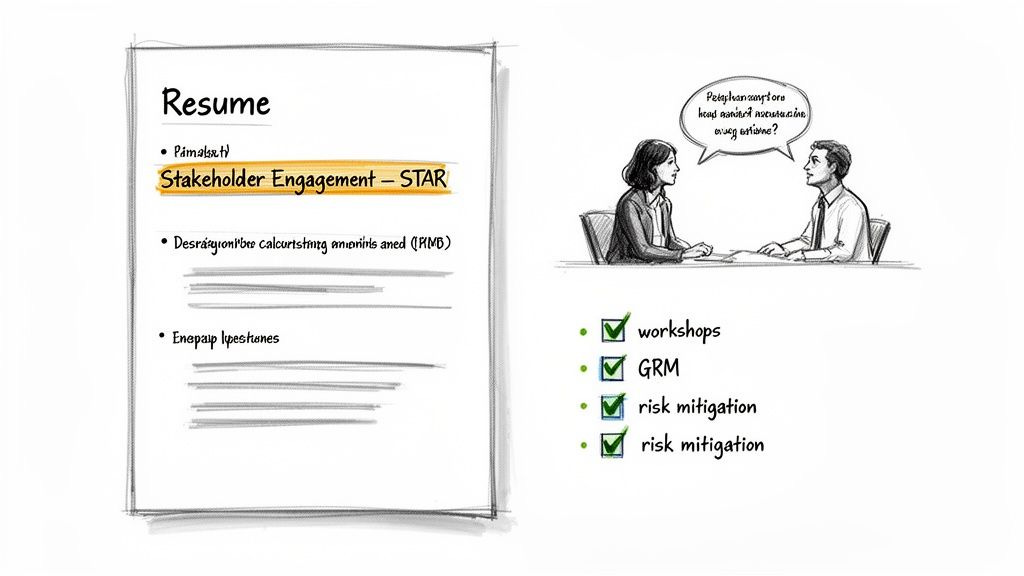
Revamping Your CV for MDB Roles
Your CV is the first hurdle. It needs to scream competence in stakeholder engagement, not just list old job duties. The trick is to stop describing your tasks and start showcasing your actions and outcomes. Use the STAR method (Situation, Task, Action, Result) as the blueprint for every bullet point.
Frame everything you did through the lens of MDB priorities: risk management, project design, and local ownership.
MDB recruiters scan for candidates who have used dialogue to solve real problems. Every bullet point on your CV should answer the question, “So what?”
For example, don’t just say you “organized community meetings.” That’s a task. Reframe it to show the impact: “Facilitated multi-stakeholder workshops with local leaders and project-affected persons to identify social risks, leading to a 15% reduction in community grievances in the first year.” See the difference?
Here’s a cheat sheet for translating common professional experience into powerful, MDB-aligned language.
Framing Your Experience for MDB Roles
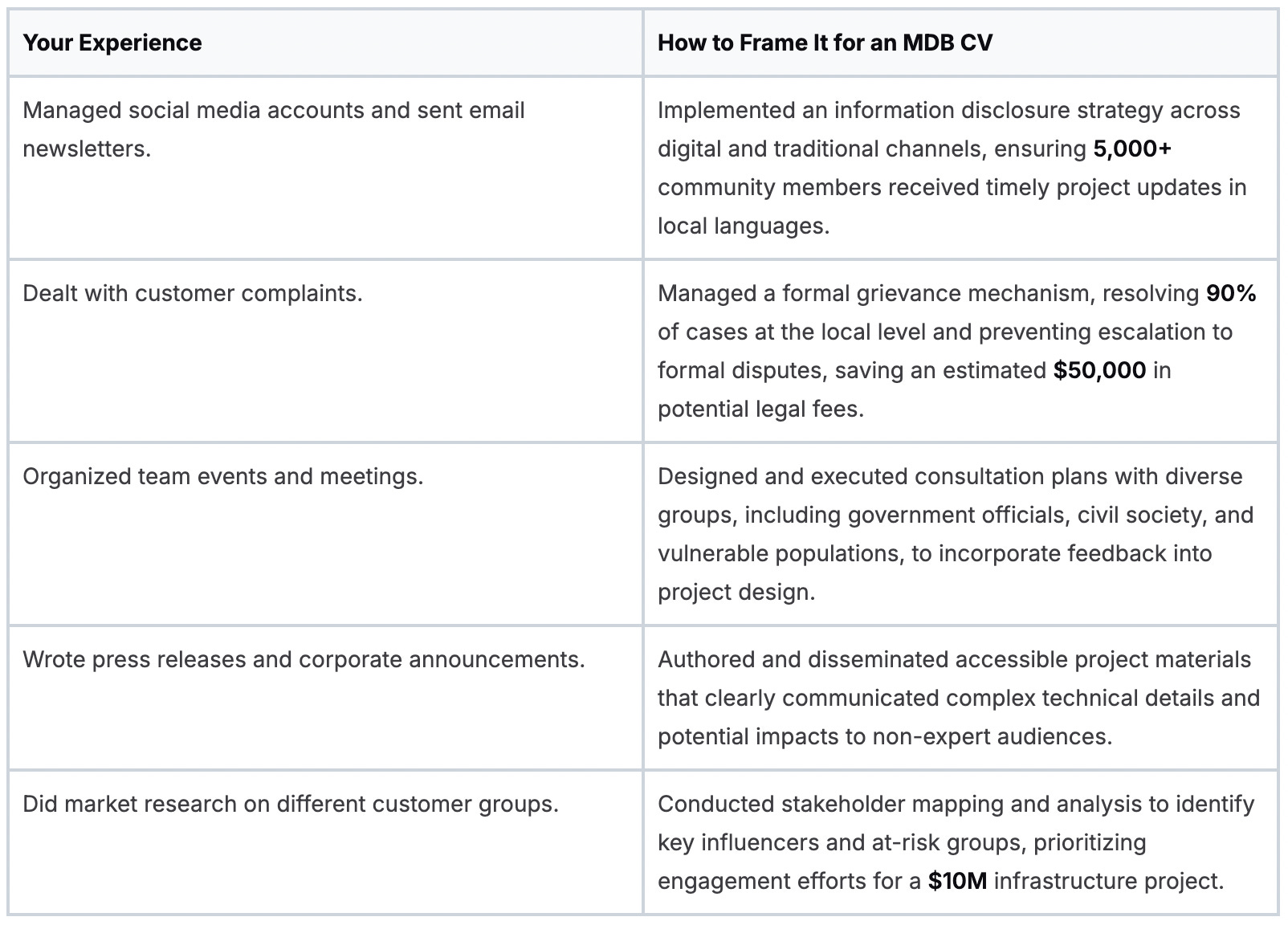
These examples are mini case studies of your impact, tailored for the MDB world.
Nailing the Stakeholder Engagement Interview Questions
If your CV gets you in the door, the interview is where you seal the deal. Here you bring your experience to life with specific, compelling stories. The hiring panel wants to hear that you’ve been in the trenches and know how to handle the messy reality of stakeholder engagement.
When an interviewer asks about your experience, they’re testing your technical knowledge, problem-solving skills, and diplomatic instincts. Be ready for behavioral questions that start with “Tell me about a time when...”
Common Interview Question “Tell me about a time you had to deal with a difficult or hostile stakeholder. What did you do, and what was the outcome?”
A weak answer is vague and generic. It sounds like, “I listened to their concerns and tried to find common ground.” This tells the interviewer absolutely nothing.
A strong answer tells a story using the STAR method:
Situation: “On a renewable energy project in Southeast Asia, a local community leader was actively campaigning against us, claiming the project would disrupt traditional farming. He had huge influence and was causing serious project delays.”
Action: “I organized a series of one-on-one meetings with him. I brought our agricultural expert to walk him through the land-use plan and demonstrate how impacts would be minimal. Crucially, we also co-designed a benefit-sharing program that would invest in local irrigation, a direct need he had been voicing for years.”
Result: “By addressing his specific concerns and turning him into a partner, he became a public supporter of the project. His buy-in unlocked community support, and we got the project back on schedule within two months. It taught me that hostility is often just a legitimate, unaddressed concern in disguise.”
This kind of answer proves you don’t just understand the theory of what is stakeholder engagement; you’ve actually done it. You’ve faced opposition, acted strategically, and turned a risk into an asset. This is precisely the kind of practical wisdom MDBs are desperate to hire. For those particularly interested in roles on the continent, you may want to read our guide to careers in the African Development Bank and see how these skills apply there.
Common Questions About Stakeholder Engagement
As you get deeper into the MDB world, a few key questions about stakeholder engagement pop up again and again. These are the practical details that separate classroom theory from what actually happens on the ground. Here are straightforward answers to the things candidates and new practitioners always ask.
How Is Stakeholder Engagement Different From Public Relations?
This is a big one. Public relations is a one-way street. It’s about broadcasting a message to manage an organization’s public image. Stakeholder engagement is a two-way dialogue. Its entire purpose is to build relationships, understand what people are worried about, and actually use that feedback to shape how a project is designed and run.
In the MDB context, engagement is a formal requirement for managing risk and making sure a project doesn’t fail. The goal is to get better, more sustainable development outcomes, not just better press. It’s the difference between telling people what you’re doing and asking them how it ought to be done.
Think of it this way: PR polishes the surface. Engagement rebuilds the engine. One makes the project look good; the other makes the project be good.
What Is the Biggest Challenge in Engagement?
The single biggest challenge is managing conflicting interests. It’s a constant balancing act. Imagine a new dam project where the government’s national energy goals clash directly with a local community’s ancestral land and a downstream community’s water supply. There is no simple answer that will make everyone happy.
MDBs tackle this through structured negotiation, mediation, and a transparent process. The most important tool for this is the Grievance Redress Mechanism (GRM). A GRM is a formal, predictable channel for anyone from a local farmer to an international NGO to raise issues and have them addressed systematically.
The focus is always on finding common ground and hammering out solutions that are acceptable to everyone. It’s a process of give-and-take. And here’s a key insider tip: a lack of filed grievances isn’t always a good sign. It can often mean the GRM isn’t trusted or nobody knows how to use it, which is a massive red flag for the project team.
How Is the Success of Engagement Actually Measured?
You measure it with two kinds of metrics: process and outcome. You absolutely need both to get the full picture and know if your engagement efforts are actually working.
Process Metrics: These are the “what we did” numbers. Think number of consultations held, the diversity of the people who showed up, and the sheer volume of information disclosed to the public.
Outcome Metrics: This is where the rubber meets the road. These are the “what changed because we did it” results. They might include a measurable drop in project delays, a lower number of formal grievances filed through the GRM, and documented examples of where stakeholder feedback led to a specific change in the project’s design.
At the end of the day, the strongest sign of successful engagement is when the local community feels a sense of ownership over the project long after the MDB has packed up and gone home. Good engagement is what makes a project last.
What Role Does Technology Play in Modern Engagement?
Technology is becoming a powerful tool, but it’s a supplement, not a replacement, for real human interaction. MDBs are using a whole suite of digital tools to make engagement more efficient and reach more people than ever before.
Common Technological Applications:
Information Sharing: Project websites, social media channels, and digital platforms are used to get information out quickly and to a wide audience.
Virtual Consultations: Using tools like Zoom for virtual town halls allows teams to engage with stakeholders who are scattered across a country or even the globe.
Feedback Collection: Mobile apps and simple SMS-based surveys are great for gathering quick feedback and gauging public sentiment from a broad cross-section of people.
Data Analysis: GIS mapping helps everyone visualize a project’s footprint and its social impacts. At the same time, data analytics tools can be used to track stakeholder concerns over time.
But technology has its limits. In communities with low digital literacy or patchy internet, nothing beats face-to-face interaction for building the trust you need for a meaningful conversation. Technology helps you scale the process, but it can’t replace a handshake.
Ready to turn this knowledge into a career? Multilateral Development Bank Jobs is your go-to source for opportunities at the world’s top development institutions. Get curated job listings, insider guides, and expert advice delivered to your inbox three times a week. Subscribe and start your journey here.