

Landing a job at the World Bank isn’t about following one single path. It’s about navigating a complex ecosystem of career tracks, each built for specific experience levels and professional goals.
Before you apply, you need to know which of the three main avenues—full-time staff, short-term consultancy, or the prestigious Young Professionals Program (YPP)—is the right fit for you. Figuring this out is your first and most critical step.
Decoding World Bank Career Paths
You can’t just fire off a generic application and hope for the best. The Bank hires for specific needs through channels that look similar on the surface but are fundamentally different in contracts, job security, and long-term career trajectory.
Your experience, goals, and even your age will point you toward one of these routes. Let’s break down exactly what each one looks like so you can target your application where it has the best chance of success.
The Three Main Entry Points
The World Bank’s hiring structure is built to bring in a wide range of professionals, from seasoned experts needed for specific projects to the next generation of development leaders.
Here’s the breakdown:
Staff Appointments (Grade G): This is the traditional, full-time employee track. These are open-ended or term contracts, typically for 2-5 years and renewable. They come with full benefits like health insurance, retirement plans, and relocation assistance. Staff roles are graded from GA (junior administrative roles) up to GK (senior management), forming the core of the Bank’s operational and corporate teams.
Consultant Contracts (STC/STT): Short-Term Consultant (STC) and Short-Term Temporary (STT) roles are for specialists hired for a specific, time-bound project. Contracts are capped at 150 days per fiscal year for STCs and don’t include staff benefits. This is the most common and flexible way for many professionals to get a foot in the door.
The Young Professionals Program (YPP): The YPP is the Bank’s premier recruitment program for highly qualified and motivated young professionals. It’s an intense five-year program designed to fast-track participants into leadership roles. Competition is fierce, with acceptance rates often below 1%. Applicants typically need a master’s or doctoral degree, relevant experience, and must be 32 years of age or younger.
This flowchart gives you a quick visual for figuring out which path best aligns with your background.
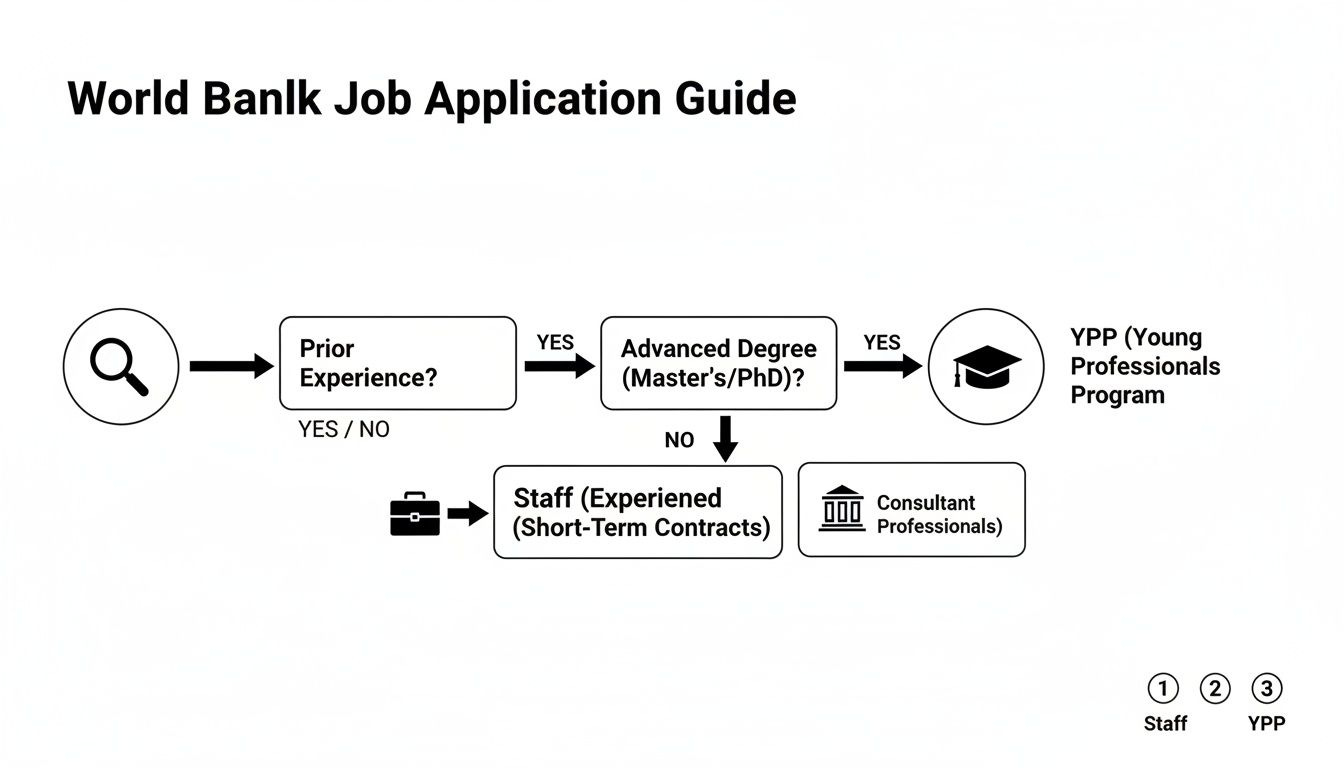
As you can see, your level of experience and education directly funnels you toward one of these three main career tracks.
World Bank Career Paths at a Glance
To make it even clearer, this table compares the key features of each role. Use it to quickly assess which path is the best match for your professional situation and long-term ambitions.
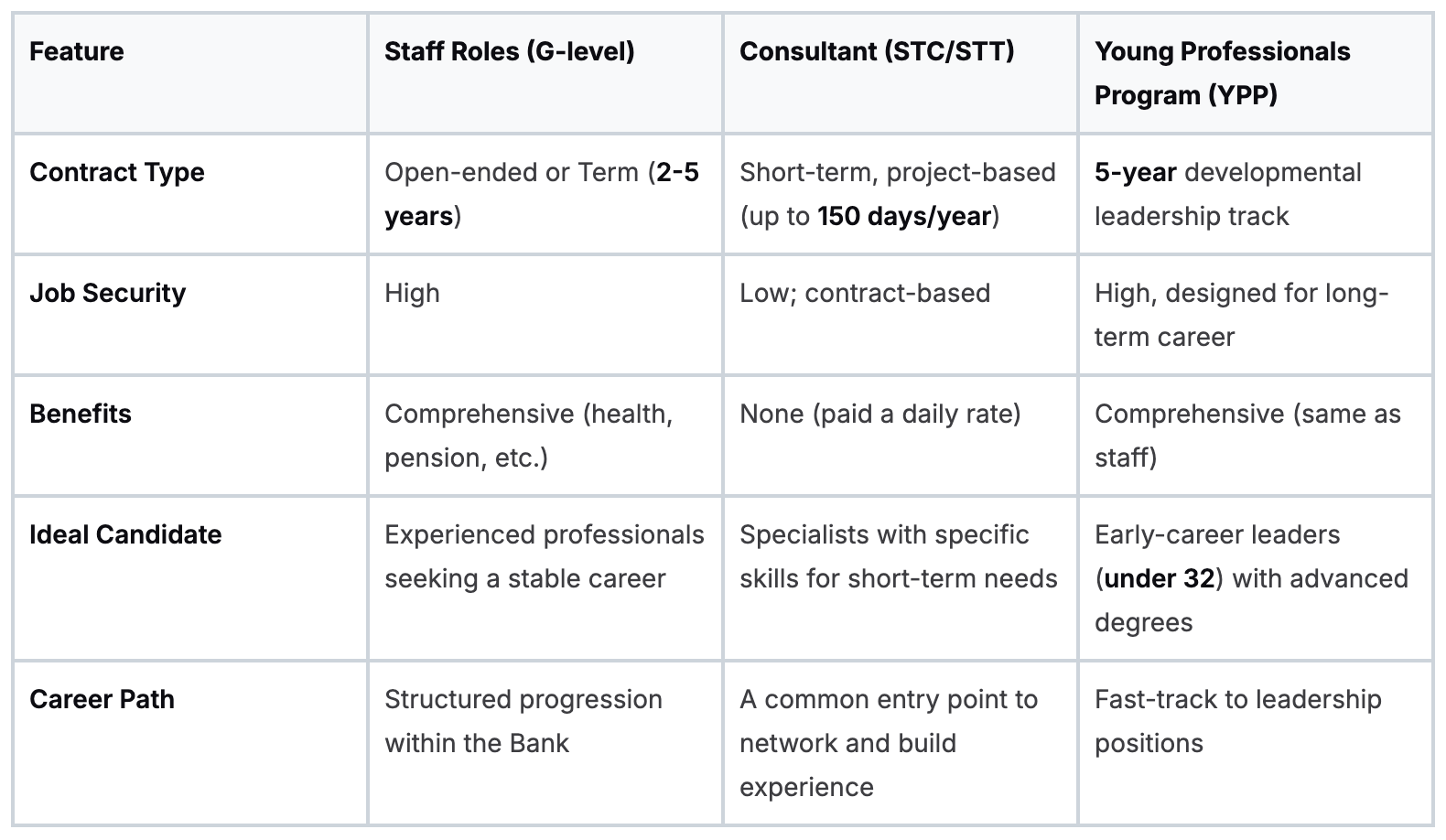
Choosing the right path from the outset saves you time and positions your application for success by ensuring you’re applying for roles where you’re a genuinely competitive candidate.
Staff vs. Consultant: The Real Difference
Many applicants mix up staff and consultant roles, but the distinction is crucial. Think of it this way: a staff position is a career move; a consultancy is a gig.
The core difference comes down to integration and security. Staff members are part of the institutional fabric with a clear career ladder, while consultants are external experts brought in for their specific skills on a temporary basis.
Staff members have access to internal mobility, extensive training, and a predictable career path. Consultants are paid a daily rate and handle their own benefits and taxes. While many consultants successfully transition to staff roles, it’s never a guarantee.
A solid grasp of the Bank’s grading and compensation system is essential. You can learn more about World Bank grades and salaries to better evaluate which roles align with your financial and career expectations. This knowledge helps you read between the lines of a job description and understand the true nature of the opportunity.
Why Global Labor Trends Drive World Bank Hiring
To get a real edge when applying for World Bank jobs, you have to look beyond the job description. The Bank doesn’t just hire economists in a vacuum; it recruits specialists to tackle urgent, real-world crises. Its entire hiring strategy is a direct response to massive shifts happening in labor markets around the globe.
If you understand why they’re hiring for a certain role, you can frame your experience in a way that truly resonates. You stop being another candidate with a list of skills and become a solution to a problem they are desperately trying to solve.
The Great Job Churn
The global labor market is in the middle of a seismic shift. Technology, climate change, and new trade patterns are creating and destroying jobs at an unprecedented rate. This is the central challenge the World Bank was built to address.
The world might see a net gain of 78 million jobs by 2035 from these changes, but that’s after 92 million existing jobs are displaced. The churn is far more brutal in low-income countries, where labor disruption rocks 27.6% of the workforce compared to just 10.1% in high-income nations. You can dig into the specifics in the World Economic Forum report on the future of jobs.
This reality means the Bank is constantly on the hunt for experts who can design programs to help countries navigate this turbulence. They need people who know how to build social safety nets, launch effective reskilling initiatives, and shape economic policies that foster inclusive growth.
An Urgent Focus on Job Creation
World Bank leadership has been crystal clear: job creation is their “North Star.” This is a strategic mandate that directly shapes who they hire. Every project, whether in infrastructure, energy, or education, is now viewed through the lens of its impact on employment.
This laser focus creates a clear demand for specific types of expertise:
Policy Advisors: Professionals who can help governments reform labor laws, slash regulatory red tape, and create a business-friendly climate that encourages private sector hiring.
Sector Specialists: Experts in fields like agribusiness, renewable energy, and digital infrastructure who understand how to build job-creating industries from the ground up.
Economists and Data Scientists: Analysts who can forecast labor market trends, measure the real-world impact of interventions, and provide the hard evidence needed to guide policy.
When you apply, your ability to connect your past work to tangible job creation outcomes is a massive advantage. Frame your achievements around how you helped generate employment, improve workforce skills, or support small business growth.
This focus is baked into the Bank’s operational DNA. The organization’s goal is to help countries build resilient economies, and that starts with making sure people have access to good jobs. If you can show you get this and have a track record to prove it, you will stand out. You can get a better sense of how these priorities translate into specific roles by reviewing our 2026 World Bank Hiring Playbook and Timelines.
Responding to Green and Digital Transitions
The twin transitions to a greener and more digital global economy are the other major forces shaping who the World Bank hires. The move away from carbon-heavy industries and the rapid rise of digital tech are creating incredible new opportunities, but they also threaten to leave millions of workers behind.
The Bank needs professionals who can help countries manage this process. This means designing “just transition” programs for workers in legacy industries, developing green jobs initiatives, and closing the digital skills gap.
If your background is in sustainable development, digital transformation, or education technology, your skills are in incredibly high demand. Your application needs to scream that you understand these specific, high-priority global challenges and have the experience to help solve them.
How to Find and Apply for World Bank Jobs
Knowing where to look is half the battle. Landing a job at the World Bank requires a methodical approach to finding the right openings and putting together an application that sails through the initial screening.
Your search should begin and end on one platform: the official World Bank Group Careers portal. This is the single source of truth for all staff and consultant vacancies. Don’t waste time on third-party sites; they’re often outdated or incomplete. Mastering the official portal is your first real step.
The portal’s search interface lets you filter by location, job family, and grade level. This is crucial for honing in on roles that actually match your qualifications.
Here’s a look at the official search portal where you’ll be spending your time.
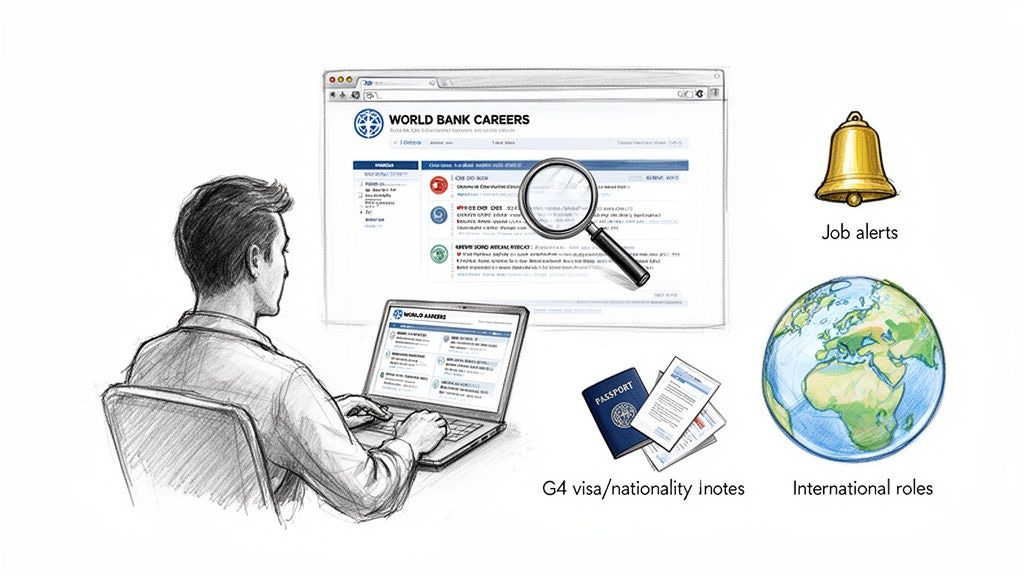
Get familiar with the filters on the left. They’re the key to turning hundreds of open positions into a manageable list that fits your specific expertise.
Set Up Strategic Job Alerts
Once you know your way around the portal, your next move is to set up job alerts. This is non-negotiable. The best roles, especially specialized consultancies, can appear and disappear in a flash. Alerts ensure you never miss an opportunity that’s perfect for you.
Get specific with your alert criteria. Instead of a broad alert for “economist,” create several targeted alerts for keywords like “health economist,” “macroeconomic modeling,” or “public finance management.” This focuses your energy where it counts.
Decoding Eligibility and Nationality Rules
Before you apply, you need to understand the World Bank’s eligibility rules. They’re strict. The most important one is nationality. To be eligible for a staff position, you must be a national of one of the World Bank Group’s 189 member countries.
This rule is an automatic filter. However, there are no nationality restrictions for consultant (STC/STT) positions. This makes them a fantastic entry point for highly qualified professionals from non-member countries.
The nationality requirement is a hard filter in the application system for staff roles. If you’re from a non-member country, focus your search exclusively on consultant opportunities to avoid wasting your time.
Another critical piece is visa sponsorship. For non-U.S. citizens hired for roles in Washington, D.C., the Bank sponsors the G4 visa. This is a pretty straightforward process handled by HR after an offer is extended. A major perk is that it exempts you from U.S. income tax on your Bank salary, a significant financial benefit. If you want a more detailed breakdown of the application steps, check out our guide on how to apply for World Bank jobs.
How to Interpret a Job Description
World Bank job descriptions can be dense and packed with institutional jargon. Your task is to cut through the noise and pinpoint the core qualifications the hiring manager actually cares about.
Look for a section usually called “Selection Criteria” or “Required Experience.” This is your checklist. Pay close attention to the specific skills, languages, and years of experience they list.
Here’s how to break it down:
Minimum Requirements: These are the absolute deal-breakers. If you don’t meet these, you won’t get past the initial HR screen. This usually includes an advanced degree (Master’s or PhD) and a specific number of years of relevant professional experience.
Desired Qualifications: This is where you separate yourself from the pack. These are the skills and experiences that will make a hiring manager sit up and take notice. Think fluency in a specific language, hands-on experience in a region like Sub-Saharan Africa, or expertise with particular data analysis software.
Action Verbs: Scan the “Duties and Accountabilities” section for verbs. Words like “lead,” “manage,” “design,” and “analyze” tell you about the seniority of the role and what your day-to-day work will actually involve.
Your application, especially your cover letter and the summary section of your resume, needs to speak directly to these core requirements. Don’t make the hiring manager hunt for the information. State clearly and confidently how your experience aligns with their needs. This direct approach shows you’ve done your homework and respect their time.
Writing a Resume That Gets Noticed
A generic resume is a one-way ticket to the rejection pile. I can’t stress this enough. The World Bank has a particular culture and screens every application against a specific set of competencies. Your resume and cover letter have to be sharp, tailored, and laser-focused on results.
This is about building a compelling case that proves you are the solution to the problems in that specific job description. The goal is simple: create documents that a busy hiring manager feels they have to read from start to finish.
Structure Your Resume for Impact
The Bank’s internal recruitment systems and the people using them are accustomed to a certain resume format. Getting too creative can hurt you by making your information harder to scan.
Your CV should be clean, logically structured, and capped at two pages. The only real exception is if you’re a seasoned academic with an extensive and directly relevant list of publications.
Start with a punchy professional summary at the top, no more than three or four lines. Think of it as your elevator pitch. It needs to immediately signal your expertise, years of experience, and the value you bring, using keywords pulled straight from the job description.
After that, list your experience in reverse chronological order. This is where the real work begins. Each bullet point under every role must do more than just describe a task; it has to scream impact.
Quantify Everything Using the STAR Method
Every single bullet point detailing your professional experience needs to be crafted using the STAR method: Situation, Task, Action, and Result. This framework is your best friend because it forces you to stop talking about what you did and start proving what you accomplished.
Situation: Briefly set the stage. What was the challenge or project environment?
Task: What was your specific goal or responsibility?
Action: What concrete steps did you take? Use strong, active verbs.
Result: What was the outcome? This is where you absolutely must quantify with numbers, percentages, or concrete deliverables.
A weak bullet point might say: “Managed a rural development project.” It’s vague and tells the reader almost nothing.
A strong, STAR-based bullet point says this: “Led a $5 million rural agricultural project (Situation/Task) by designing and implementing a new irrigation system for 1,200 smallholder farmers (Action), which increased crop yields by 30% within two years (Result).”
See the difference? Even if your role is more qualitative, you can find ways to quantify. Talk about the number of policy briefs you authored, the size of the budgets you managed, the number of stakeholders you coordinated across ministries, or the percentage reduction in processing times your new workflow achieved.
Your resume is an evidence-based document. Every claim you make should be backed by a concrete, quantifiable result that demonstrates your ability to deliver. This is the single most important principle for getting noticed.
Craft a Compelling Cover Letter Narrative
Your cover letter is not a repeat of your resume. It’s your chance to weave a narrative that connects your personal drive with the World Bank’s mission. It explains your “why” and proves you have a genuine grasp of the development sector and the specific role you’re targeting.
Structure your letter to directly hit the key requirements listed in the job description. Don’t be subtle. Use phrases like, “The posting mentions a need for expertise in public finance management. In my role at [Previous Organization], I...” This immediately signals that you’ve done your homework and are mapping your skills directly to their needs.
Your letter should also show you understand the Bank’s current strategic direction. For instance, the World Bank’s strategy is pivoting toward measurable outcomes in job creation. President Ajay Banga has called it the organization’s ‘North Star,’ with a major push to create millions of jobs in countries like Pakistan to manage its youth bulge. Highlighting your experience in results-oriented projects in key sectors like infrastructure or agriculture shows you’re not just qualified—you’re aligned with their most urgent mission. You can find more details on this strategic shift and its implications on the World Bank’s focus on job creation.
Ultimately, your application documents have to work in tandem. The resume provides the hard, quantifiable evidence of your accomplishments. The cover letter provides the compelling story that makes a hiring manager decide they need to talk to you.
Acing the World Bank Interview Process
If you’ve landed a World Bank interview, congratulations. You’ve already passed the toughest filter. Now, it’s a whole new ball game.
The interview process is a multi-stage marathon designed to test your technical chops, professional competencies, and frankly, whether you’ll fit into the Bank’s unique culture.
You can typically expect a preliminary screening call with HR, followed by one or more technical interviews with the team you’d be joining. If you clear those, the final stage is almost always a formal panel interview.
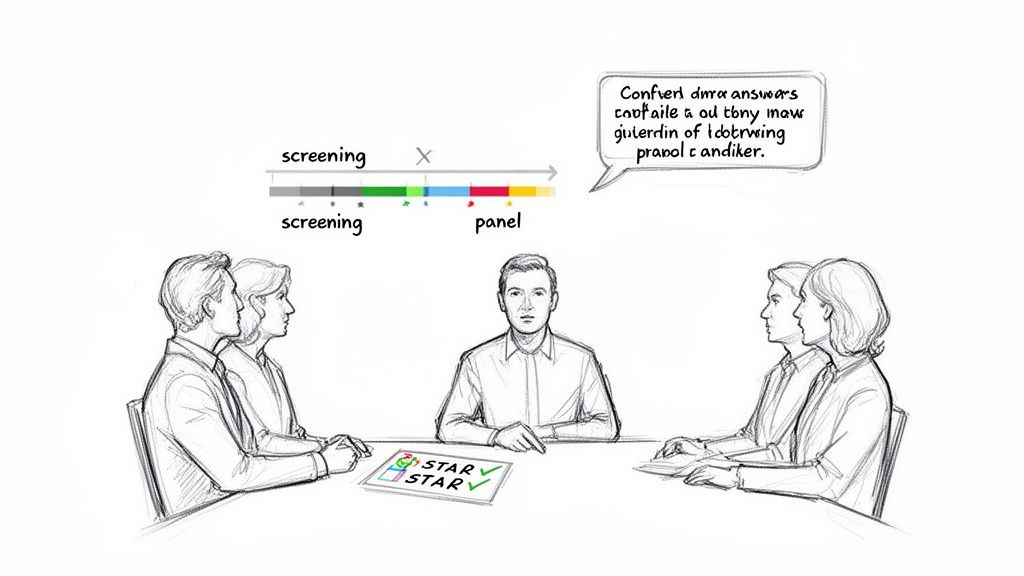
From that first email to a final decision, the whole thing can take anywhere from a few weeks to several months, so buckle in. Knowing what’s coming at each stage is your biggest advantage.
Preparing for Competency-Based Questions
The World Bank is a huge proponent of competency-based interviewing. This is a fancy way of saying they don’t care what you say you can do; they want proof. You’ll be asked to provide specific examples from your past that demonstrate core skills like leadership, client orientation, and teamwork.
Your mission is to prepare detailed, structured stories that bring these skills to life. The questions will sound something like this:
“Tell me about a time when...”
“Give me an example of how you...”
“Describe a situation where...”
The single best way to tackle these is with the STAR method, just like you used on your resume. For every key competency, you need a story with a clear Situation, Task, Action, and Result.
Here’s where most people mess up: they give theoretical answers. The panel doesn’t want to hear what you would do in a hypothetical scenario. They need to know what you have done. Your past performance is the only data they trust.
For example, if they ask about handling a difficult stakeholder, don’t say, “I would listen carefully and build consensus.” That’s a textbook answer that tells them nothing.
Instead, walk them through a real project. Describe the stakeholder who was blocking your project (Situation), what you needed from them (Task), the one-on-one meetings you set up and the data you presented to win them over (Action), and how you eventually got their buy-in and the project moved forward (Result). You should have at least five of these powerful, results-focused stories ready to deploy.
The Technical Interview and Case Study
Beyond the “tell me about a time” questions, you’ll face a serious technical deep-dive. This is where the hiring team confirms you actually know your stuff.
The format can vary a lot. An economist might get grilled on econometric models. An IT specialist could be thrown a live coding challenge. For many operational and advisory roles, this stage often involves a case study or a presentation.
You might get a dataset to analyze, a project document to critique, or a thorny policy problem to solve. They’ll usually give you a set amount of time, anywhere from a few hours to a couple of days, to prepare your analysis and present it back to the panel.
Remember, they aren’t just looking for the “right” answer. They’re evaluating your thought process, how you structure an argument, and whether you can communicate complex ideas clearly under pressure.
Research and Asking Smart Questions
Your homework isn’t done until you’ve done some serious digging. And I don’t mean just skimming the World Bank’s homepage. You need to zero in on the specific department or Global Practice you’re interviewing with. Read their latest reports, flagship publications, and project documents. What are their current priorities? What big challenges are they grappling with?
If you can, try to find out who will be on your interview panel. Look them up on LinkedIn or the internal staff directory. Knowing their backgrounds and recent work helps you tailor your answers and build a genuine connection.
Finally, prepare your own questions for them. This is your chance to show you’re an engaged professional, not just a passive candidate. Please, don’t ask about vacation days or benefits. Ask smart, insightful questions that prove you’ve done your homework.
Here are a few questions that show you’re thinking like a future colleague:
“I read the recent regional report on digital transformation. How does this specific role contribute to the goals outlined in that strategy?”
“What do you see as the biggest challenge this team will face in the next year, and how would the person in this position help address it?”
Thoughtful questions like these transform the interview from an interrogation into a two-way conversation. It leaves the panel with the impression that you’re not just looking for a job—you’re looking to contribute from day one.
World Bank Career FAQs: The Nitty-Gritty Details
You’ve made it this far, which means you’re serious about this. At this point, I bet you have some very specific, practical questions. Let’s tackle some of the most common ones I hear from candidates to clear up any lingering uncertainties.
Getting straight answers can be tough, but understanding these details is what separates a prepared applicant from a hopeful one. My goal here is to give you the direct, insider perspective you need to move forward with confidence.
Can I Negotiate My Salary and Benefits?
This is easily one of the most frequent questions. For staff positions, the answer is a straightforward no. The World Bank operates on a rigid, transparent salary scale based on the job’s grade level. When you get an offer, it will be for a specific step within that grade, and there’s almost zero room for negotiation. This structure ensures internal equity.
Consultant roles are a different story. STC and STT positions are paid a daily rate, and this rate is often negotiable. You should base your proposed rate on your experience, the complexity of the work, and what the market pays for your kind of expertise. Do your homework and be ready to justify the number you put forward.
How Important Are Advanced Degrees?
Crucial. For most professional-level staff roles (Grade GE and above) and especially for the Young Professionals Program, a master’s degree is the minimum requirement. A PhD is often essential for senior technical roles, particularly within research-heavy groups like the Development Research Group (DECRG).
The degree needs to be directly relevant. A master’s in public policy, international development, economics, or a related field is the standard. If you’re applying for a specialist role in health or engineering, a subject-specific advanced degree is non-negotiable. Without it, your application probably won’t make it past the initial screening.
The Bank is an evidence-based institution, and academic rigor is highly valued. An advanced degree isn’t just a box to check; it’s considered foundational for the analytical work you’ll be expected to perform.
This academic focus is tied directly to the Bank’s core mission. A staggering 1.2 billion young people in developing countries will enter the workforce over the next decade, often into economies that can’t support them. The Bank’s strategy depends on professionals skilled in policy reform and systemic development, and advanced training is seen as critical preparation for that work. You can dig deeper into the World Bank’s strategy for jobs and growth on their website.
What Is the Typical Hiring Timeline?
Patience is a virtue when applying for World Bank jobs. The timeline can be long and unpredictable. From the day a job is posted to the day an offer is made, the process can take anywhere from two to six months and sometimes even longer.
Several things can slow it down:
The urgency of the position.
The sheer number of applications received.
The availability of the hiring panel for interviews.
Internal administrative hurdles and budget approvals.
Consultant roles often move faster because they’re tied to specific, time-sensitive project needs. After your final interview for any role, it’s reasonable to follow up with HR once after about two weeks if you haven’t heard anything. But be warned: persistent emails won’t speed things up.
I know this process can feel like navigating a maze. I’ve gathered some of the other common questions I get and put the answers in a quick-reference table for you.
Frequently Asked Questions
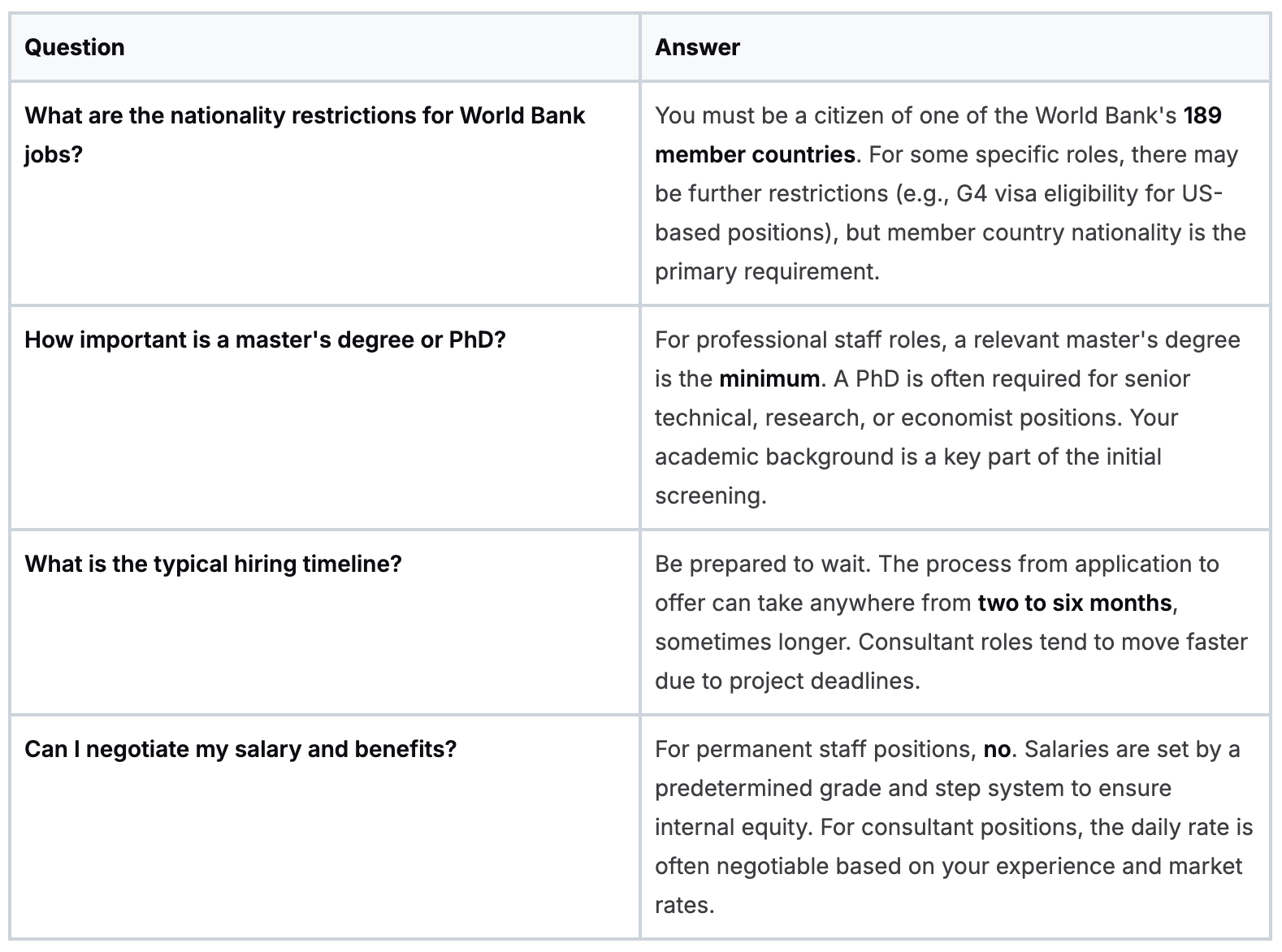
Hopefully, these answers give you a clearer picture of what to expect. Having this knowledge upfront saves you time and helps you focus your energy where it matters most.
At Multilateral Development Bank Jobs, we cut through the noise to bring you the opportunities and insights you need. Our newsletter delivers curated job listings, deep-dive guides, and expert analysis directly to your inbox, giving you the edge you need to land a role at the World Bank or another MDB. Start your targeted job search at https://mdbjobs.com.