

You’re probably sitting in one of three places right now.
You have solid experience inside government, development finance, public policy, infrastructure, health, climate, or digital systems, and you’re wondering how to turn that into independent consulting work. Or you’re already applying to full-time international organization jobs and getting nowhere. Or you’ve realized you want more control over your time, your clients, and the kind of problems you solve.
That instinct is right. But vague ambition won’t get you a contract. In the MDB and UN world, people don’t hire “smart generalists.” They hire specialists who can solve a defined problem, write clearly, handle institutional process, and look low-risk on paper.
The Real Path to a Consulting Career
The shift into consulting starts with a hard decision. You stop thinking like an employee waiting to be selected and start acting like a service provider with something specific to sell.
That matters because consulting can absolutely become financially viable. Over 75% of consultants successfully reach their previous income levels within less than two years of starting their consulting careers, according to this consulting professionals survey breakdown. The same source lays out six practical steps: making the decision to consult, adopting a new mindset, adopting a transition strategy, winning the first client, creating a discovery offer, and repeating the process.
Stop saying you want to consult
Saying “I want to become a consultant” means nothing to an MDB hiring manager, task team leader, or procurement officer.
They need to know:
What problem you solve
Who you solve it for
What evidence proves you can do it
How fast you can start
How easy you are to contract
That’s the path. It’s narrower than expected, and that’s why it works.
Practical rule: If your offer can apply to everyone, it appeals to no one.
The biggest confusion I see is people mixing up staff careers and consulting careers. Those are different tracks. Staff roles come with organizational politics, grade structures, and long hiring cycles. Consultant contracts are project-based, often faster, and tied to a defined scope. If you want a clean explanation of that distinction, read this breakdown of MDB consultant vs full-time employee roles.
The MDB route is its own market
Private sector consulting advice only gets you part of the way. MDB and UN consulting runs on Terms of Reference, roster visibility, procurement compliance, donor logic, nationality constraints in some cases, and very specific technical language.
That’s why generic career advice falls short. You don’t need motivation. You need a marketable offer, a visible reputation, and the discipline to keep showing up in a system that rewards precision.
Use this test on yourself right now.
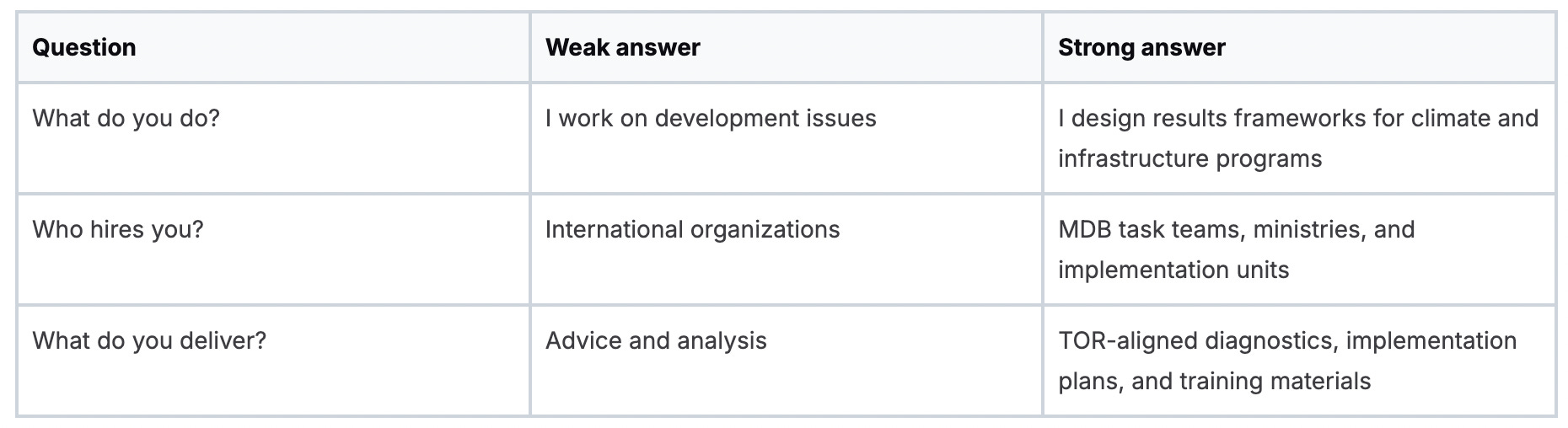
If you can’t answer those three questions in one breath, you’re still at the fantasy stage.
Define Your Consulting Offer and Niche
A common pitfall here is describing one’s background instead of their offer. Clients don’t buy your career history. They buy a result.

A good niche sits at the intersection of three things: what you know well, what institutions already procure, and what can be written into a clear scope of work. In the MDB world, that often means areas like climate adaptation, financial sector reform, procurement reform, digital government, health systems strengthening, transport, energy transition, education delivery, safeguards, M&E, or public financial management.
Turn your experience into a product
Your CV might say you managed programs, advised ministries, coordinated donor projects, or ran analytics. Fine. That still isn’t an offer.
An offer sounds like this:
Climate specialist who prepares adaptation diagnostics and investment notes for sovereign projects
Public sector digital consultant who supports digital service design, interoperability planning, and implementation roadmaps
Health systems consultant who develops primary care reform strategies, costing models, and stakeholder engagement plans
Monitoring and evaluation advisor who builds results frameworks, indicators, and reporting systems for donor-funded portfolios
That phrasing does two jobs. It shows a buyer what you do, and it makes your profile easier to match against a Terms of Reference.
Use frameworks properly
Consulting rewards structured thinking. It punishes recycled jargon.
A useful benchmark comes from case-based consulting prep: candidates are expected to decompose ambiguous business questions using frameworks like SWOT or Porter’s Five Forces within a 20-30 minute window, and successful candidates solve a minimum of 30 distinct case studies before interviewing. Candidates who haven’t reached that threshold have a success rate of only 15% for first-time applications, according to case interview guidance compiled at CaseInterview.com.
That lesson matters beyond interviews. In MDB consulting, your real job is to take a messy institutional problem and turn it into a workplan, a note, a reform sequence, or a proposal that senior people can act on.
Frameworks are scaffolding. Judgment does the real work.
If you force-fit every assignment into a stock template, you’ll sound like an amateur. If you use frameworks to clarify the problem, sequence the work, and expose trade-offs, you’ll sound like someone who’s done this before.
Write your one-sentence offer
This is the sentence I tell people to build before they touch LinkedIn, rosters, or outreach.
Use this formula:
I help [specific institution or client type] solve [specific problem] through [specific service or deliverable].
Examples:
I help MDB task teams and government counterparts design practical monitoring systems for complex public sector reform programs.
I help development finance and UN teams prepare high-quality stakeholder engagement, research, and policy deliverables for climate and governance projects.
I help project teams turn technical priorities into implementation plans, consultant outputs, and decision-ready reports.
Now pressure-test it.
Three filters for a strong niche
Procurement fit
Can your service be written into a TOR? If the answer is fuzzy, tighten it.Proof fit
Can you show prior outputs, publications, reports, presentations, or portfolio examples that support the claim? If not, build them.Repeatability
Can you deliver this more than once without reinventing yourself every month? That’s how a practice becomes stable.
The people who figure out how to become a consultant in this niche fastest are rarely the broadest experts. They’re the clearest operators.
Build Unmistakable Authority and Credibility
In this market, authority is visible proof. You need enough signal that a busy hiring manager can glance at your materials and think, “This person understands our world.”
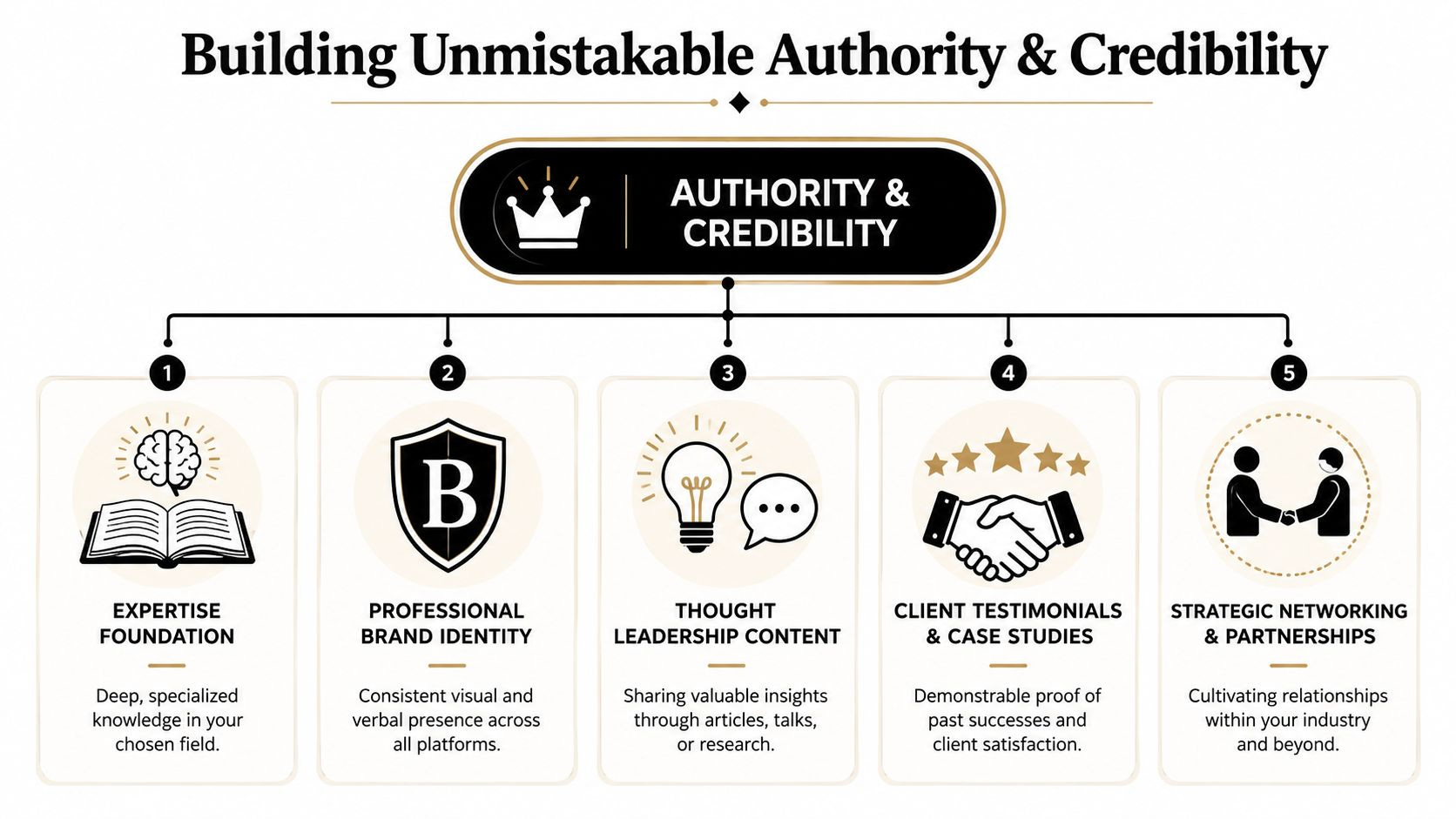
Plenty of capable professionals stay invisible because their public profile looks generic, their CV reads like an HR document, and their expertise is buried under job titles.
Build the package that reduces buyer risk
A strong authority stack in the MDB and UN consulting market usually includes:
A sharp LinkedIn profile with a headline tied to your niche, not your current employment status
A consultant-style CV that emphasizes assignments, outputs, sectors, countries, and methods
Writing samples or portfolio pieces that show analysis, synthesis, and clear communication
References or testimonials from credible counterparts, managers, or clients
Relevant credentials when they strengthen a specific technical lane
Your LinkedIn profile should read like a landing page. Your summary needs to say what you do, where you work best, and the kind of assignments you support. Skip motivational filler.
Your CV needs a different logic than a staff application CV. Procurement teams often scan for exact sector match, donor or institutional familiarity, geography, language, and deliverables. If you led a reform note, policy review, investment framework, safeguards assessment, results matrix, or evaluation, name it.
Credentials matter when they clarify trust
Credentials won’t rescue weak positioning, but they can strengthen a profile that already has a coherent niche.
For management consulting credibility, the Certified Management Consultant designation requires at least a bachelor’s degree and a minimum of three years of documented management consulting experience, plus a portfolio proving measurable client outcomes and a rigorous examination, according to this overview of CMC requirements.
That’s useful for two reasons. First, it signals discipline. Second, it gives external validation to people moving from employment into advisory work.
If you need early experience that strengthens your credibility story, this roundup of consulting and volunteer pathways is worth reviewing because some candidates need a bridge between substantive expertise and contract-ready positioning.
Your materials should answer institutional questions
Procurement and hiring teams rarely say these questions out loud, but they’re always there:
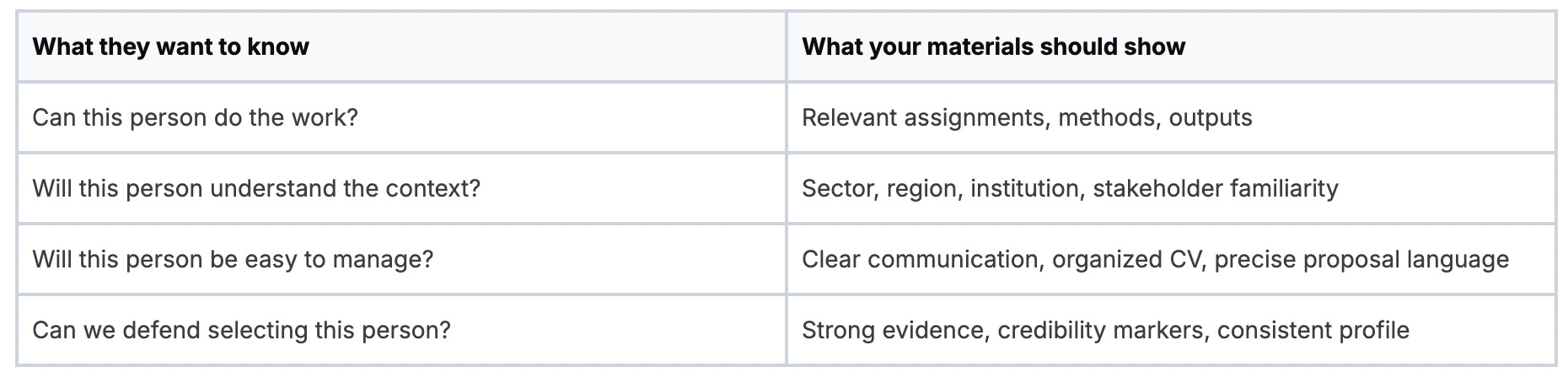
Field note: In MDB consulting, “credible” usually means specific, calm, and easy to verify.
Publish enough to be findable
You don’t need to become a full-time content creator. You do need evidence of thinking.
Good authority-building assets include:
Short LinkedIn posts on your niche with practical observations
A concise article on a recurring operational problem in your field
A slide deck or memo you can share privately as a writing sample
A portfolio PDF with project summaries and sanitized deliverables where appropriate
The point is simple. Your reputation starts speaking before you do. That’s what gets you shortlisted instead of ignored.
The MDB Playbook for Landing Contracts
Most generic advice completely breaks down concerning MDB and UN consulting. MDB and UN consulting follows institutional process, not freelance marketplace logic.
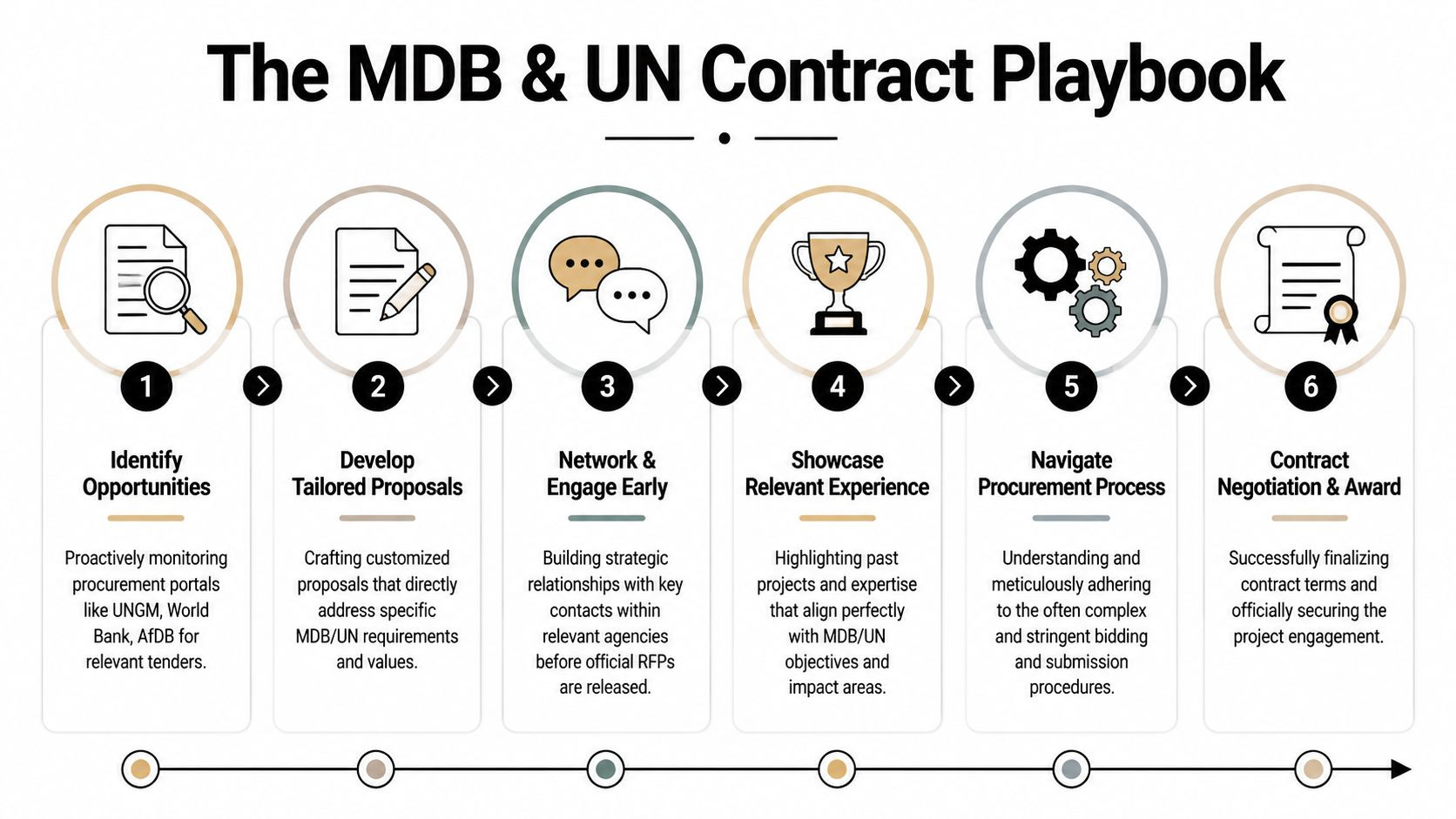
You are not pitching yourself into the void. You are responding to formal demand. That demand shows up through procurement portals, consultant rosters, Expressions of Interest, and direct outreach tied to active projects.
A useful reality check: 80% of “how to become a consultant” content focuses on private sector or corporate consulting, while MDB consultant pathways remain underexplained despite distinct recruitment mechanics and publishing schedules, as noted by Multilateral Development Bank Jobs on MDB consultant hiring.
Learn the contract types
First, understand what you’re applying for.
In this ecosystem, opportunities often fall into a few broad buckets:
Individual consultant contracts for one person delivering a defined scope
Short-term assignments tied to research, drafting, training, evaluation, coordination, or technical review
Framework or roster opportunities where you position yourself for future call-downs
Firm-led bids where you join a larger proposal as a named expert
Each one has different timing, paperwork, and expectations. If you treat them all the same, you’ll waste weeks.
Read the Terms of Reference like a practitioner
The TOR tells you almost everything that matters. Read it in this order:
Objective and background
This tells you what institutional problem they think they’re solving.Scope of work
This tells you what they need done.Deliverables and timeline
This tells you how they will judge your performance.Qualifications
This tells you how narrow the shortlist will be.
People skim TORs and then send generic applications. That’s one of the fastest ways to get rejected.
A TOR is a decoding document. It tells you the buyer’s fear, constraints, and internal language.
Work the market before the application opens
The best consultants in this space rarely rely only on posted ads. They stay close to project pipelines, sector teams, and implementing partners.
That means:
Tracking procurement portals for institutions you care about
Watching for recurring thematic needs in your niche
Building relationships with firm partners who bid on donor and MDB work
Keeping a current expert profile ready for fast submission
Following procurement cycles and consultant windows with discipline
This is especially important because many opportunities emerge internally. A team may identify a need well before the formal TOR appears.
Register where selection actually happens
You need to be operationally ready. That usually means maintaining clean records, updated CVs, references, writing samples, and profile data so you can move fast when an opportunity appears.
Your application file should include:
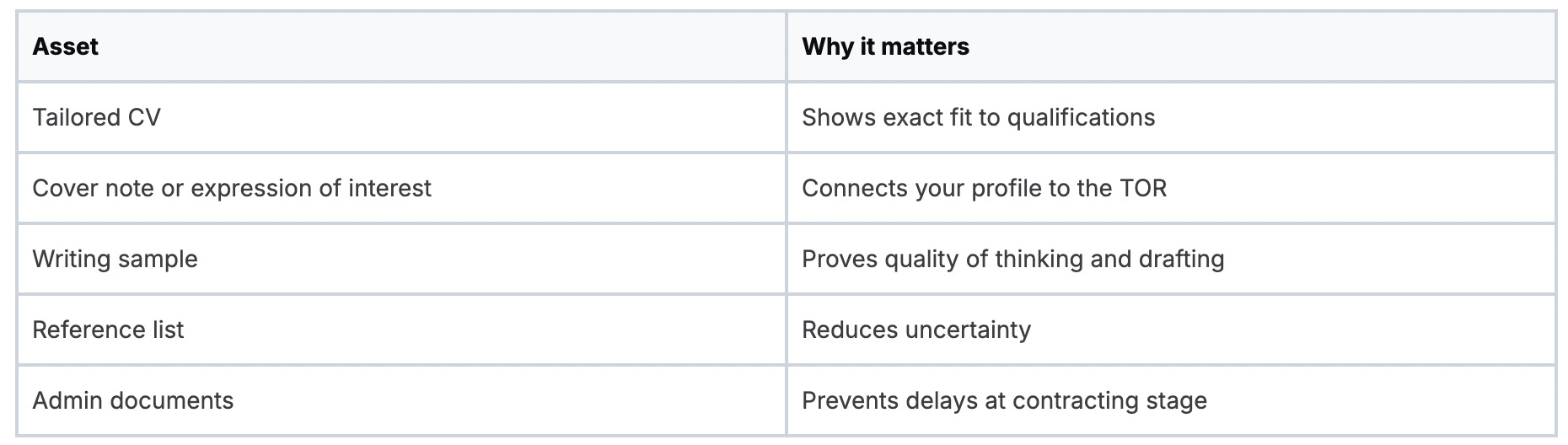
Some institutions and partner firms also care about nationality, language ability, local presence, and prior country experience. Don’t ignore those signals. They can shape whether you are competitive even when the technical fit is strong.
Use firms strategically
A lot of independent consultants win MDB and UN work through consulting firms, advisory boutiques, research organizations, and consortium bids before they win directly as solo contractors.
That route gives you three advantages:
You borrow institutional credibility.
You learn procurement language faster.
You get repeat work if you’re reliable.
That’s how many people build traction. They become the person firms call when they need a governance expert in West Africa, a safeguards specialist in South Asia, or a public finance consultant for a rapid assignment.
Keep your profile boring in the best way
Excitement doesn’t win contracts here. Reliability does.
Use consistent job titles, dates, country names, sector language, and deliverable descriptions across every platform. If your LinkedIn says one thing, your CV says another, and your proposal says something else, people start doubting the basics.
The unwritten rule is simple. Make it easy for someone inside a large institution to justify choosing you.
Mastering Proposals, Rates, and Legalities
A lot of smart people learn how to become a consultant in theory and then freeze when it’s time to send the proposal, name a rate, or sign a contract. That hesitation costs real opportunities.
You need to move from “interested” to “operational.”
Proposals win when they mirror the TOR
Most weak proposals share the same problem. They talk about the consultant. Strong proposals talk about the assignment.
A solid technical proposal usually does four things well:
Interprets the problem clearly in the client’s language
Explains your method in a sequence that matches the scope
Shows relevant experience with examples tied to similar outputs
Commits to realistic deliverables without fluff
If you want a practical drafting model, use this guide on how to write a consulting proposal as a reference point while you adapt it to the institution and TOR in front of you.
Proposal rule: Mirror the buyer’s problem, then prove you can execute it.
Don’t write like a think tank if the client needs a delivery partner. Don’t write like a vendor if the client needs analytical judgment.
Rates need logic, not guesswork
People obsess over rates too early. Start with position, scarcity, and scope.
Here’s a simple way to think about indicative MDB consulting pricing in USD.
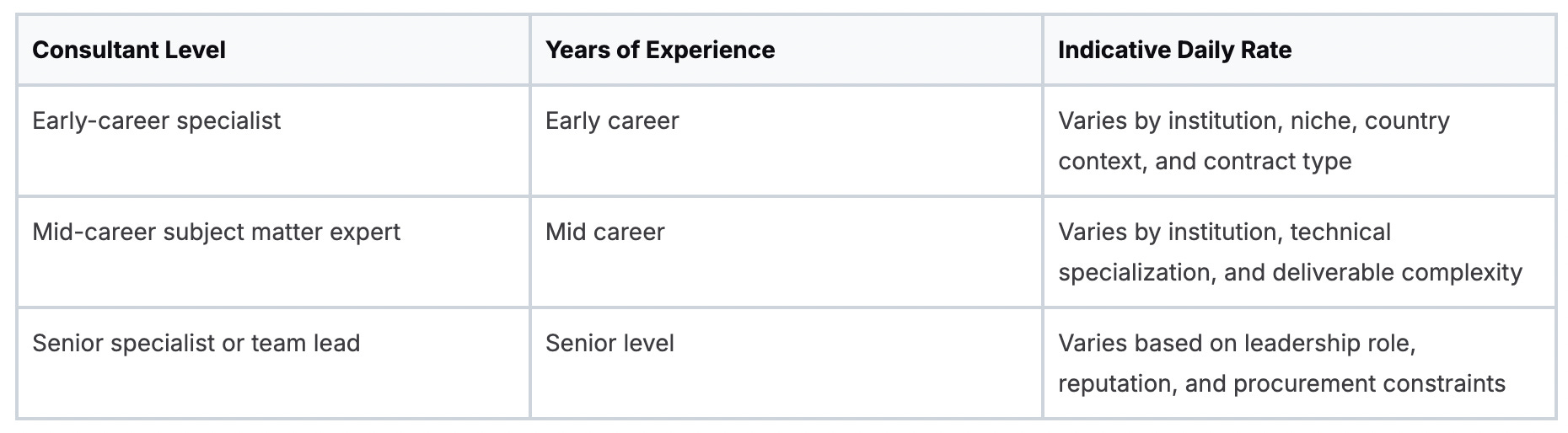
I’m keeping that table qualitative on purpose. Daily rates in this market swing based on institution, geography, tax setup, whether you are an individual or subcontracted expert, how hard your expertise is to replace, and whether travel is involved. Anyone selling you one universal number is guessing.
A better approach is to set a rate card privately, then adjust based on the TOR, workload, timeline pressure, and strategic value of the assignment.
Your network drives your pipeline
If you think proposals alone will carry you, you’re making the classic beginner mistake.
Successful candidates should secure at least 5-10 informational interviews with industry professionals, 70% of entry-level consultant roles are filled through network referrals rather than open applications, and candidates who secure a mentor have a 40% higher success rate in landing interviews, according to recruitment analytics cited by IMA.
That tells you exactly where to spend your effort.
Talk to practitioners in your niche
Stay in touch with former managers and counterparts
Build relationships with consulting firms that bid in your sectors
Ask focused questions about pipelines, recurring needs, and profile gaps
Networking in this world is professional reconnaissance. It helps you spot demand early and shape your positioning before the procurement notice hits your inbox.
Legal and administrative discipline matters
Nobody likes this part. It still matters.
Get clear on:
Your contracting vehicle such as sole proprietorship, company, or equivalent local setup
Your invoicing process for international clients
Tax treatment in your jurisdiction
Basic contract review around deliverables, payment terms, IP, confidentiality, and liability
Document storage for CV versions, contracts, references, and work samples
This work is dull. It also separates professionals from hobbyists.
Your First 90 Days as a Consultant
Month one is for clarity. Write your one-sentence offer, rebuild your LinkedIn headline, and rewrite your CV around consulting-relevant outputs. Pull together writing samples, references, and a short portfolio.
Month two is for visibility. Register on the relevant platforms, identify target institutions and firms, and start speaking to people already in the market. Make your outreach specific and useful. Ask about hiring patterns, recurring technical gaps, and the kinds of TORs that appear in your niche.
Month three is for execution. Apply for live opportunities, tailor every submission, and keep your records clean. Track what you sent, who replied, and where your profile needs work. Tighten your proposal language every week.
Consulting rewards disciplined operators. That’s especially true in the MDB and UN world. If you want this path, act like a consultant before anyone gives you the title.
If you want a steady stream of consultant openings, staff roles, and practical guidance for navigating this niche, Multilateral Development Bank Jobs is one of the few resources built specifically for the MDB and UN ecosystem. It’s useful because it focuses on the hiring mechanics that generic consulting advice usually misses.