

If you hear “internal auditor” and picture someone buried in spreadsheets, ticking boxes in a dark office, you’ve got it wrong. Inside a Multilateral Development Bank (MDB) like the World Bank or the Asian Development Bank, internal auditing is a high-stakes, strategic job.
These institutions move billions of public funds into global development projects. With that much money and a critical mission on the line, integrity, efficiency, and accountability are everything.
What Internal Auditing Means in a Multilateral Bank
An internal auditor in an MDB is a guardian of the mission. Your job is to give independent, objective assurance that the bank’s risk management, governance, and internal controls actually work.
The Guardian of Integrity and Efficiency
Your core responsibility is making sure the massive sums of money flowing through the MDB are used as intended and that organizational risks are managed. This goes far beyond financial statements.
One day you might evaluate the complex financing processes for a project in a developing country. The next, you could be probing cybersecurity protocols protecting sensitive economic data. The goal is always the same: find weaknesses before they become major problems.
At its heart, the role is about asking tough questions and giving clear, actionable answers. You’re not there to find fault. You’re there to strengthen the institution from the inside, making sure it delivers on its global development promises.
A Strategic Partner for Mission Success
Internal auditors at MDBs are trusted advisors, not just watchdogs. They help senior management and the board understand new risks and operate smarter. This requires a mix of technical skill, sharp critical thinking, and diplomatic communication.
A single good audit can spark major improvements across the organization. For instance, it might lead to:
Strengthened Controls: Preventing fraud and waste in large-scale infrastructure projects.
Enhanced Governance: Making sure board decisions are implemented effectively and transparently.
Improved Risk Management: Spotting potential disruptions to the bank’s operations before they do real damage.
Greater Accountability: Confirming donor funds achieve their intended impact.
This strategic role is vital across the MDB landscape. To see the different organizations where these jobs exist, explore our guide on which MDBs you can work for.
An internal auditing job description at an MDB outlines a role that’s essential to the bank’s credibility and its ability to succeed.
Core Responsibilities And Daily Tasks Of An MDB Auditor
So, what does an internal auditor at a Multilateral Development Bank actually do? The job is dynamic and strategic.
Being an MDB auditor means being an analytical partner to the organization. The job blends rigorous analysis with investigative curiosity and strong communication. You could be auditing the procurement process for a billion-dollar infrastructure project one day and assessing cybersecurity controls the next. The stakes are high.
Your work follows the complete audit cycle. It’s a methodical process designed to deliver objective, independent assurance to the bank’s leadership and board.
This process flow shows how an auditor’s role fits into the bigger picture, connecting risk management and governance to provide a crucial layer of assurance.
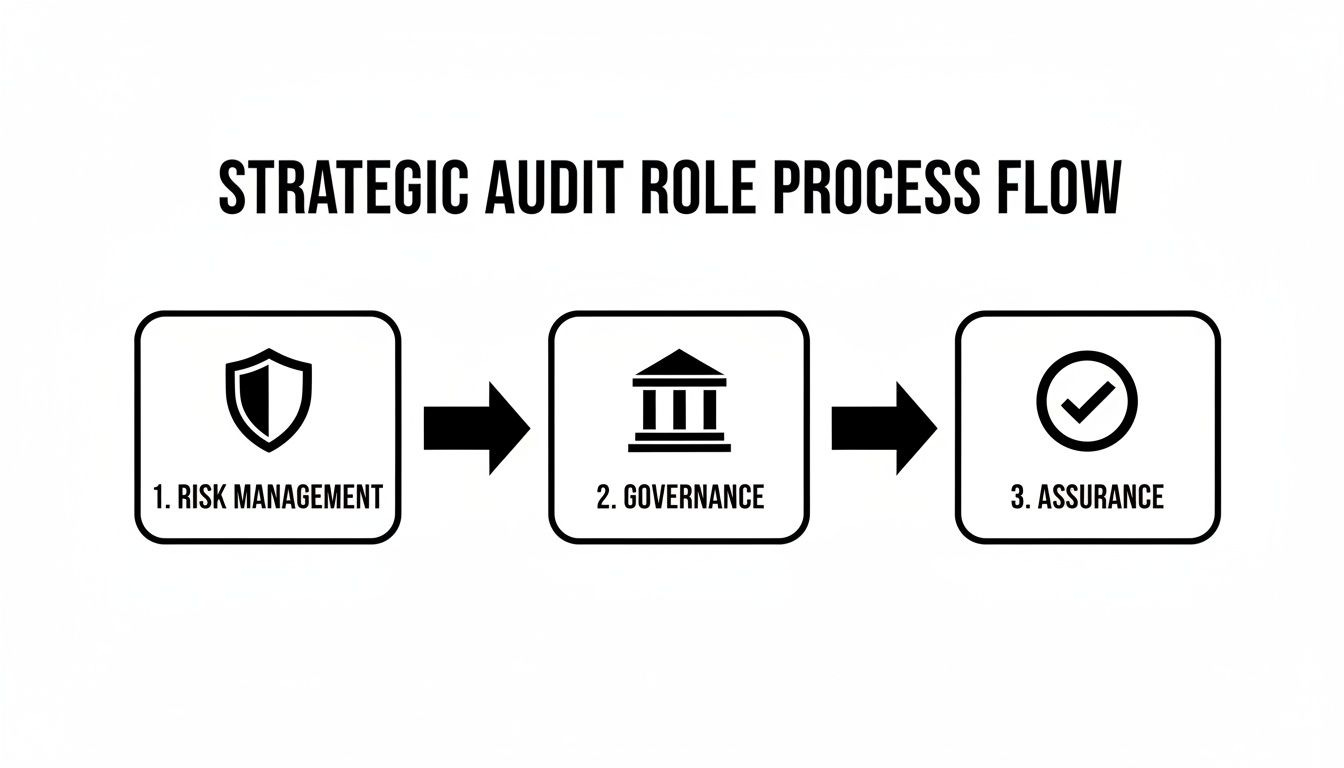
It’s about strengthening the entire organizational framework so the bank can achieve its development mission more effectively.
The Audit Cycle In Action
The life of an internal auditor follows a clear cycle, from high-level planning to detailed follow-up. Each phase demands a different mindset, shifting from big-picture thinking to granular, evidence-based analysis. Every step is deliberate.
The audit process breaks down into these key phases:
Planning and Risk Assessment: This is where it starts. You and your team pinpoint the highest-risk areas within the MDB. This isn’t guesswork; it involves digging into operational data, reviewing past audit findings, and understanding the bank’s strategic goals to build a targeted audit plan.
Fieldwork and Evidence Gathering: This is the core investigation. You’ll conduct interviews with department heads and project managers, review complex project documents, and test internal controls to see if they work as designed.
Data Analysis: Using specialized audit software, you’ll sift through massive datasets to spot anomalies, patterns, and potential red flags. This could be anything from analyzing expense reports to testing thousands of procurement transactions for irregularities.
Documenting Findings and Drafting Recommendations: Once you have solid evidence, you document your findings clearly. The real skill is connecting each finding to a specific risk and then developing practical, actionable recommendations to fix the root cause.
From Analysis To Reporting
Your final deliverable is the audit report, which goes to senior management and the board’s audit committee. A great report is an objective, evidence-backed tool meant to drive real change.
The job isn’t over when the report is issued. A critical part of the process is follow-up. You’ll track management’s progress in implementing your recommendations to make sure the weaknesses you found get fixed. This ensures the audit delivers lasting value.
The real skill of an MDB auditor is connecting the dots between a procedural weakness and its potential impact on the bank’s mission. You’re not just pointing out a broken process; you’re explaining why it matters for global development outcomes.
The demand for skilled auditors shows how crucial this work is. The U.S. Bureau of Labor Statistics projects a 6% growth rate for auditors and accountants through 2033, double the average for all occupations. This means about 124,200 job openings each year, highlighting the profession’s stability. You can dig deeper into these internal audit hiring and salary trends to see the career potential. This consistent demand shows how vital the internal audit function is for keeping organizations efficient and honest.
The Essential Skills and Qualifications MDBs Demand
An MDB internal auditor job description can look intimidating. Let’s cut through the noise. Hiring managers zero in on a handful of core competencies.
Getting hired means proving you have the non-negotiable technical skills and the right mindset for this unique environment.
MDBs need auditors who can hit the ground running. You need a solid grasp of the frameworks that govern the profession. Think of these as the must-haves that get your application past the first filter.
Core Technical Competencies
Your technical skill set is the bedrock of your effectiveness. It lets you dissect complex processes, pinpoint real risks, and build findings that hold up. Without this foundation, you can’t do the job.
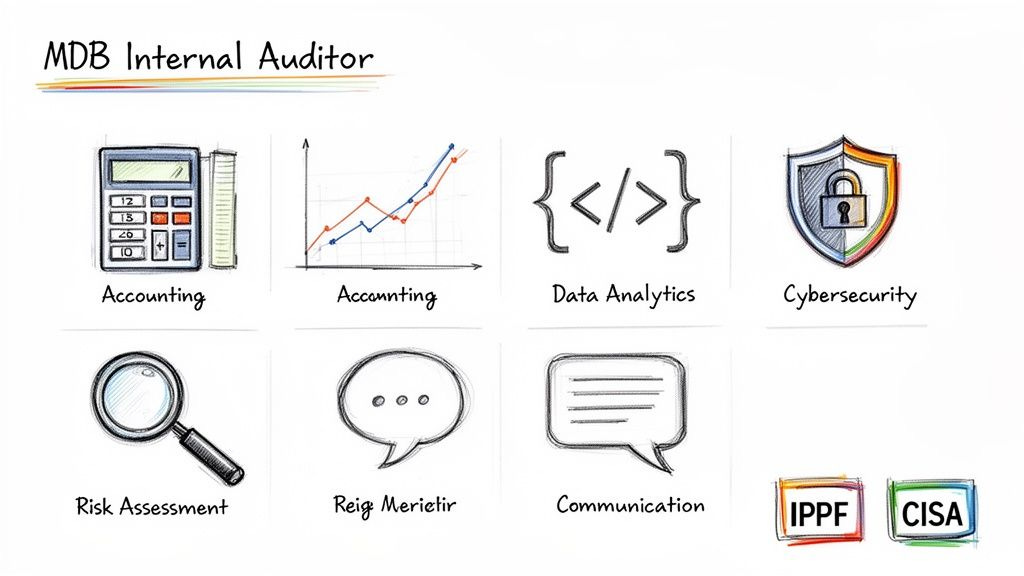
Here are the key technical areas where MDBs expect real expertise:
Accounting and Auditing Standards: Deep knowledge of frameworks like the IIA’s International Professional Practices Framework (IPPF) is mandatory. This is the global playbook for the profession; you’ll apply it daily. No shortcuts.
Risk Assessment Frameworks: You must be fluent in models like COSO (Committee of Sponsoring Organizations of the Treadway Commission). This is the practical tool you’ll use to evaluate how the bank manages its biggest risks.
Data Analytics and Audit Software: Proficiency with tools like ACL, IDEA, or even advanced Excel is essential. You must be able to dig into large datasets to spot anomalies, trends, and outliers that signal control weaknesses or potential fraud.
The shift toward technology is clear. A recent Internal Audit Foundation report showed that while 80% of managers still look for accounting graduates, 43% are now hunting for candidates from computer science and IT backgrounds. This signals a huge pivot toward tech skills, driven by rising cyber threats. You can read more about these hiring preferences in the internal audit field.
Behavioral Skills That Make the Difference
Technical skills get you in the door. Behavioral skills make or break your career. In an MDB, you’re an analyst, a trusted advisor, and a diplomat.
You’ll interact with senior leaders from diverse cultural backgrounds, presenting sensitive findings that challenge established routines. How you handle these conversations is just as important as your audit work.
The best auditors blend skepticism with diplomacy. They ask tough, probing questions without putting people on the defensive, turning a potentially confrontational process into a constructive partnership.
These are the behavioral skills that truly matter:
Critical Thinking and Objective Judgment: You must analyze situations, weigh evidence from multiple sources, and arrive at an impartial conclusion. Your credibility depends on your objectivity, especially under pressure.
Impeccable Communication: This is paramount. You need to write clear, concise audit reports that get straight to the point. You also need the verbal skills to present complex findings to senior leadership and the board in a compelling way that drives action.
Ethical Integrity: As an auditor, you are a steward of the organization’s integrity. Your ethical compass must be unwavering. You’ll handle confidential information and navigate sensitive political dynamics; your reputation for honesty is your most valuable asset.
A strong candidate for an internal audit job at an MDB has a balanced profile. They have the hard skills to perform rigorous analysis and the soft skills to communicate findings in a way that builds trust and leads to meaningful change.
A Model MDB Internal Auditor Job Description Template
Let’s get practical. To give you a concrete idea of what MDBs look for, here’s a sample internal auditor job description.
This isn’t generic fluff. It’s modeled on real job ads from places like the Asian Development Bank and the World Bank, using their language and reflecting their priorities.
Think of this as a decoder ring. By breaking it down, you can see exactly how to align your skills with what a hiring manager wants. Use it to dissect any MDB job posting you find.
Role Summary And Purpose
Job Title: Internal Auditor Department: Office of the Auditor General (OAG) Grade Level: IS-4 (International Staff, Level 4) Location: Headquarters
Purpose of the Role: The Internal Auditor provides independent, objective assurance and consulting services designed to add value and improve the organization’s operations. This role helps the institution accomplish its objectives by bringing a systematic, disciplined approach to evaluate and improve the effectiveness of risk management, control, and governance processes. You will be a key contributor to maintaining the integrity and accountability of our development financing activities.
This opening paragraph is the elevator pitch. It frames the job as strategic; you’re there to improve the organization, not just police it. Note the phrasing: “add value” and “improve effectiveness.” That’s a clear signal they want a proactive partner, not a box-ticker.
Key Responsibilities
The responsibilities in an MDB internal audit job ad reflect the audit cycle. They cover everything from high-level planning to testing controls and communicating findings to leaders. There’s a strong emphasis on both analytical chops and people skills.
Execute Audit Engagements: Conduct financial, operational, compliance, and IT audits from planning through reporting. This includes developing audit programs, performing risk assessments, and executing fieldwork.
Evaluate Internal Controls: Assess the design and operational effectiveness of internal controls over key business processes, including project financing, treasury operations, and procurement.
Analyze Data and Identify Risks: Use data analytics tools to examine large datasets for anomalies, spot emerging risks, and give management evidence-backed insights.
Develop Actionable Recommendations: Prepare clear, concise audit reports that detail findings, identify root causes, and provide practical recommendations to strengthen controls and mitigate risks.
Communicate with Stakeholders: Present audit findings and recommendations to department heads and senior management, leading discussions to agree on effective management action plans.
Follow-Up and Monitoring: Track the implementation of agreed-upon audit recommendations to make sure issues get fixed properly and on time.
Qualifications And Experience
This section lays out the non-negotiables. MDBs need a specific blend of education, professional certifications, and hands-on experience. If your application doesn’t clearly meet these baseline requirements, it won’t get past the first screen.
Your CV has to scream “I have the credentials.” MDBs put huge stock in certifications like the CIA or CISA. They’re an international benchmark for competence and ethical commitment in the audit world.
Required Qualifications:
Education: A master’s degree or equivalent in Accounting, Finance, Business Administration, or a related field.
Experience: A minimum of 5-7 years of relevant professional experience in internal or external auditing. Experience within a big international financial institution or a major accounting firm is a massive plus.
Certification: You’ll need a professional certification like Certified Internal Auditor (CIA), Certified Public Accountant (CPA), or Certified Information Systems Auditor (CISA). This is almost always a deal-breaker.
Technical Skills: You need to be comfortable with risk management frameworks (like COSO), auditing standards (like the IIA’s IPPF), and data analysis tools.
Language: Full professional proficiency in English is a must.
How to Tailor Your Application for an MDB Audit Role
A generic CV and cover letter are a one-way ticket to the rejection pile. Competition for MDB internal audit roles is fierce, and hiring managers spot copy-paste jobs from a mile away. They want someone who gets their specific mission and unique risks.
Think of your application as your first audit. The subject is you. Every claim you make needs solid evidence. This means meticulously mapping your experience to every requirement in the job description.
Deconstruct the Job Description
Before you write, print out the job description and grab a highlighter. Mark every skill, responsibility, and qualification. Your mission is to draw a straight line from their needs to your experience.
You’re building a case. For every point they list, you need corresponding evidence from your career. Don’t expect the hiring manager to connect the dots. Do it for them.
Here’s a practical way to break it down:
Keywords: Pinpoint core terms like “risk management,” “governance,” “compliance,” “COSO,” and “IPPF.” Weave these naturally throughout your CV and cover letter.
Responsibilities: For each duty they list, write down a specific project or achievement from your past that proves you can do it.
Qualifications: Make sure your certifications (like CIA or CISA) and key technical skills are impossible to miss. Put them front and center.
Quantify Your Achievements
Statements like “improved audit processes” are empty without proof. To show real impact, you have to attach numbers to your accomplishments. This is how you prove you’ve already done the job well.
Stop listing duties. Reframe them as quantified achievements. This gives them concrete evidence of your value and makes your application stand out.
A powerful resume proves the value you created, not just what you did. Numbers are the most effective way to make your case.
Here’s how to transform a basic duty into a powerful achievement:
Instead of “Conducted risk assessments,” try “Identified control weaknesses in procurement that saved an estimated $1.2M in potential losses.“
Instead of “Helped create audit reports,” try “Streamlined the audit reporting process, reducing final report delivery time by 20%.“
Instead of “Performed data analysis,” try “Analyzed transactional data for a $500M portfolio, identifying three high-risk anomalies that triggered a full compliance review.“
Connect Your Skills to the MDB Mission
An MDB is not just another corporation. Your motivation matters. The hiring committee needs to see you’re driven by more than a paycheck. They want to know you’re invested in the bank’s global development mission.
The auditor’s role is shifting from compliance cop to strategic advisor, thanks to new technologies and global risks. The Future of Jobs Report predicts a decline for traditional auditors but a surge in demand for experts in big data, AI, and information security. Auditors need sharp analytical thinking and tech literacy to stay relevant. You can read more about the future of the internal auditor career path to get a sense of these trends.
Your cover letter is the perfect place to make this connection. Don’t just say you’re interested. Explain why their work resonates with you and how your specific audit skills can help them achieve better development outcomes. For more specific guidance, check out our guide on how to apply for World Bank jobs; the advice there holds true for most MDBs.
Navigating the MDB Internal Audit Interview Process
Your application got you in the door. Great. The interview is the real test. You have to prove you have the technical chops and the unique mindset of an MDB internal auditor.
This isn’t a standard corporate interview. The panel is stress-testing your judgment, probing your ethical compass, and seeing if you can operate in a complex, multicultural world.
The questions are designed to see how you think on your feet. They’ll dig into your understanding of risk, how you deliver bad news to powerful people, and your grasp of the specific challenges MDBs face. Expect a mix of behavioral, situational, and technical questions that go beyond any textbook.

Behavioral Questions: Handling Sensitive Findings
MDB interviewers need confidence that you have the political savvy and emotional intelligence to navigate tricky situations. Your ability to deliver tough messages without burning bridges is a core competency they are actively screening for.
A classic question you’re almost guaranteed to get is: “Describe a time you presented a sensitive audit finding to senior management who disagreed with you. What was the situation, and what was the outcome?”
They don’t want a hero story. They want to see your process. A solid answer follows a clear structure:
Set the Scene: Briefly explain the context. What was the audit and the specific control weakness? Keep it concise.
State the Disagreement: Articulate exactly what management pushed back on. Was it the finding? The root cause? Your recommendation?
Detail Your Actions: This is the heart of your answer. How did you respond? Did you gather more evidence? Did you reframe the risk? Did you bring in an expert? This showcases your communication and influencing skills.
Describe the Resolution: Explain how it ended. The goal is to show you can stand your ground with objective facts while maintaining a professional relationship.
Situational Questions: Auditing Across Cultures
Working at an MDB means your colleagues and stakeholders come from every corner of the globe. You must adapt your approach to different cultural contexts.
Expect a scenario-based question like: “You’re auditing a project in a country where ‘gift-giving’ to officials is a common business practice. How do you assess the project’s compliance with the bank’s anti-corruption policies?”
Your answer has to show an unwavering ethical backbone and sharp cultural awareness.
The right answer is never to bend the rules. It’s about proving you can enforce the bank’s strict standards while navigating local customs with professionalism and respect.
Start by stating your primary duty is to the bank’s policies, period. Then, walk them through your audit steps: reviewing documentation for red flags, conducting discreet interviews, and escalating credible evidence of non-compliance through proper channels.
Technical Questions: On Risk Frameworks
Finally, they will test your technical foundation. You need to be fluent in the frameworks that guide the profession. For a deeper look into what the panel is thinking, our article on an interview with an MDB panellist offers fantastic insider insights.
A common one is: “How would you use the COSO framework to evaluate the effectiveness of an organization’s risk management process?”
Resist reciting a textbook definition. Show them you can apply it. Break it down:
Control Environment: Talk about assessing the “tone at the top,” ethical values, and board oversight.
Risk Assessment: Explain how you’d evaluate how management identifies and analyzes key risks to their objectives.
Control Activities: Give concrete examples of controls you’d test, like segregation of duties or system access protocols.
Information & Communication: Describe how you’d check that relevant, quality information flows up, down, and across the organization.
Monitoring Activities: Lay out how you’d verify that internal controls are monitored and adapted over time.
Frequently Asked Questions About MDB Audit Careers
Let’s tackle some big questions about internal audit jobs at a Multilateral Development Bank. Getting these answers straight helps you decide if this is the right move and how to frame your application.
Which Certifications Matter Most: CIA vs CPA vs CISA?
While all three are heavy hitters, the Certified Internal Auditor (CIA) is the gold standard for this work. It’s globally recognized and proves you live and breathe the International Professional Practices Framework (IPPF), which is the bible for MDB audit teams.
A Certified Public Accountant (CPA) is valuable, especially from a financial audit background. Its focus is more on external audit and financial reporting, not the internal control and risk world. The Certified Information Systems Auditor (CISA) is a massive advantage today. With cybersecurity and digital transformation on every MDB’s agenda, IT auditors are in huge demand.
If you have to pick one, make it the CIA. It speaks the language of the job and is the first thing hiring managers scan for. The CISA is your next best bet to stand out.
How Does the Salary Compare to the Private Sector?
The answer isn’t simple. MDBs offer a unique and competitive package. While the base salary might look a little lower than a top-tier firm in London or New York, the net compensation is often much higher.
MDBs, as international organizations, typically offer tax-free salaries to their expatriate staff. That alone is a game-changer. On top of that, the benefits package is usually phenomenal:
Comprehensive health and life insurance for you and your family.
Excellent retirement and pension plans.
Education grants for your children.
Generous relocation packages and paid home leave.
The total compensation is designed to attract top global talent, and it works.
What Does a Typical Career Path Look Like?
You won’t be a junior auditor forever. The career ladder inside an MDB audit department is clear. Most people start as an Internal Auditor, then move to Senior Internal Auditor, where you lead smaller audits and mentor new staff.
From there, the path leads to an Audit Manager or Principal Auditor role, where you handle a portfolio of complex audits and manage teams. The top of the pyramid is the Chief Audit Executive or Auditor General, who sets the strategy for the audit function and answers directly to the board. A successful stint in audit can also be a launchpad into other strategic roles within the bank.
Do I Need Prior International Development Experience?
No. This is a common misconception. You need a genuine interest in the MDB’s mission, but hiring managers really want top-tier audit expertise.
They can teach you the nuances of development finance. They can’t teach you the instinct and skill of a great auditor. Your hard-won experience in risk management, internal controls, and governance from another complex industry like banking, insurance, or energy is incredibly transferable.
Focus your CV on those core audit skills. Use your cover letter to connect that experience to your passion for the MDB’s mission. Your technical ability is what will land you the interview.
Ready to find your place in one of the world’s most impactful institutions? Multilateral Development Bank Jobs is the premier resource for discovering and landing roles at MDBs. We deliver curated job listings, insider guides, and application advice directly to your inbox three times a week. Start your search today at
https://mdbjobs.com
.