

If you’re looking to build a career in an international NGO, you’re signing up to tackle some of the world’s biggest challenges, from human rights and humanitarian aid to long-term sustainable development. This field demands a unique blend of specialized skills, resilience, and a deep commitment to the mission. Planning your career path strategically is essential for survival.
The Unfiltered Truth About Development Jobs Today
Let’s be blunt. The international development sector is volatile. Anyone telling you otherwise is selling something. Major donors like USAID constantly shift priorities and adjust budgets, which sends shockwaves across the entire ecosystem of NGOs and contractors. This isn’t a stable, predictable career path in the traditional sense.
Job security can feel precarious, especially when projects are tied to short-term funding cycles. One year, an organization might be hiring aggressively for a massive public health initiative; the next, a shift in government policy could put that entire program on ice. You have to go in with your eyes wide open to this reality if you want a career that lasts.
Navigating Funding Shifts and Job Market Realities
The headlines about funding cuts can be jarring, and they often lead to real-world consequences for job seekers. For instance, recent analysis showed that massive funding slashes in early 2025 triggered widespread job losses across the sector. We did a deep dive on how these specific funding cuts hit international development if you want the full story.
The story doesn’t end there. The same analysis revealed a surprising 27% jump in hiring activity by mid-2025 among the more resilient organizations. You can find more on this in the M&E workforce impact report. This shows that even in a tough market, opportunities exist if you know where to look.
This dynamic creates a clear imperative: you have to be strategic. Chasing yesterday’s hot sector is a losing game. The smart move is to focus on the organizations and roles that remain essential, no matter which way the political winds are blowing.
Where The Real Opportunities Are Now
Despite the churn, certain institutions are always hiring because their mandates are fundamental to the global system. These are the places you should be watching.
Multilateral Development Banks (MDBs): Think of the World Bank. Its sheer scale and long-term development finance operations make it a constant source of opportunity, especially for economists, policy experts, and project managers.
United Nations Agencies: Organizations like UNICEF and the UNDP have persistent needs driven by ongoing global crises and development goals. They consistently recruit for roles in everything from child protection to democratic governance.
Large, Diversified INGOs: The big players with diverse funding streams and a global footprint are better insulated from the whims of a single donor.
The key takeaway is this: The most stable international NGO careers are found in roles fundamental to program success and accountability, or within institutions that have the scale and financial backing to weather economic storms.
The roles in consistent demand are the ones that drive results and prove impact. These aren’t vague, feel-good positions; they are highly technical and require specific, hard-won expertise.
High-Demand Roles to Target
If you want a sustainable career, you need to build skills that are always in demand. Hiring managers are perpetually looking for candidates who can fill these critical functions.
Monitoring & Evaluation (M&E) Advisors: Donors demand accountability. M&E specialists who can design frameworks to measure impact and prove a project is working are absolutely indispensable.
Policy Analysts: The ability to translate raw field data and complex research into actionable policy recommendations is a core function of any major development organization.
Program and Project Managers: At the end of the day, someone has to execute. The ability to manage complex, multi-million dollar projects on time and on budget is a non-negotiable skill. A certification like the PMP can give you a serious edge here.
Subject Matter Experts: Specialists in public health, education, climate finance, and economic development will always be needed to provide the technical backbone for projects.
Building a career in this field means cultivating a set of hard skills that makes you valuable to multiple organizations across different contexts. That approach is your best defense against market instability.
Mapping Your Entry Points Into The Sector
Getting your foot in the door of an international NGO is about strategy, not blind luck. Blasting your CV into the digital void is a fast track to burnout and frustration. You have to know the actual, proven pathways people take and figure out which one makes the most sense for you right now.
There are three main routes people take to break in: the hyper-competitive formal programs, the underrated field office track, and the flexible but less stable consultancy route. Each one is a different game with different rules. Pick the right one from the start, and you’ll save yourself a world of pain.
This decision tree gives you a quick visual on how to think about your strategy, especially when the job market gets choppy. It’s all about pivoting to where the demand is.
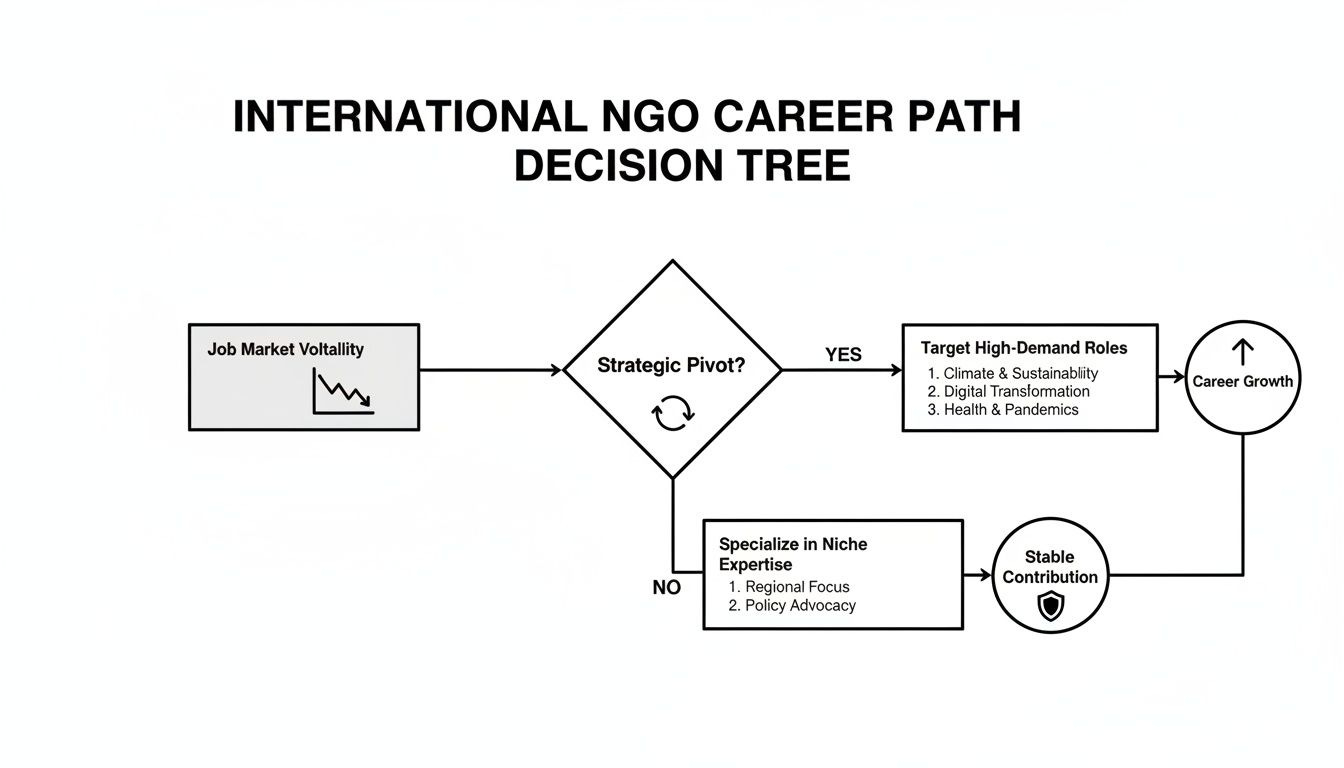
The big takeaway here is that a volatile market isn’t a dead end. It’s a signal to get smarter and more targeted in your job search, not to just apply for more jobs.
To help you choose the right path, let’s break down the pros and cons of the most common entry points into the sector.
Comparing Entry Routes for International NGO Careers
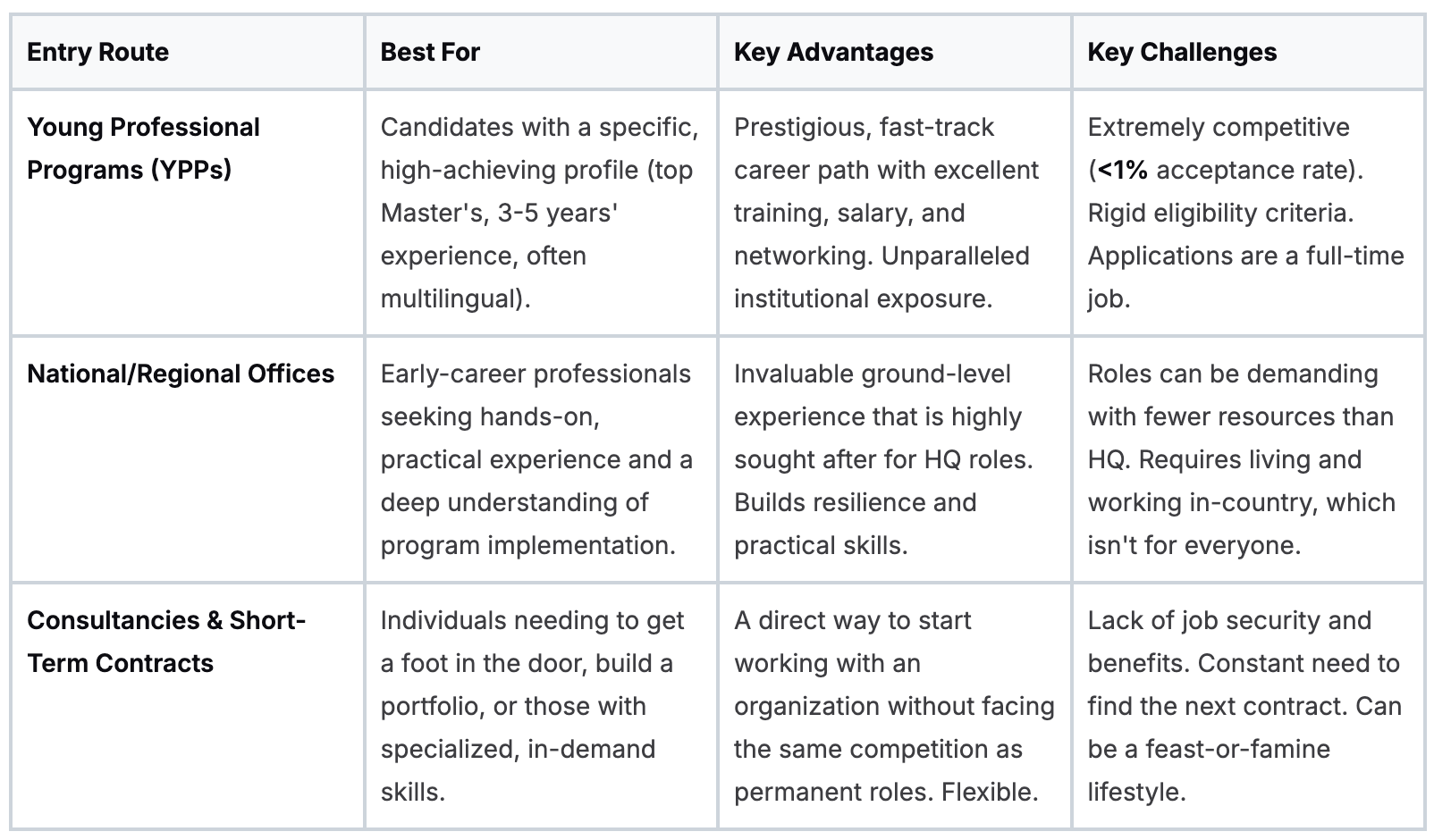
Each of these paths can lead to a fulfilling career, but they demand very different approaches. Understanding these nuances is the first step to building a realistic and effective job search strategy.
The Prestige Route: Young Professional Programs
Let’s start with the one everyone’s heard of: Young Professional Programs (YPPs). Think of the programs run by the World Bank, the Asian Development Bank, and various UN agencies. These are designed to groom the next generation of leaders. They’re prestigious, offer incredible training, and put you on a career fast-track.
The upside is huge. You get exposure you can’t get anywhere else, a great salary, and a clear path up the ladder in a major institution. They are the gold standard for a reason.
The competition, however, is brutal. We’re talking tens of thousands of applications for a tiny handful of spots. The criteria are also incredibly strict. You’ll almost always need:
A very specific master’s degree from a top-tier university.
A few years of highly relevant professional experience.
Fluency in more than one of the organization’s official languages.
Citizenship from a member country, often with an eye toward balancing geographic representation.
Make no mistake: YPPs are designed for a very specific type of candidate. If you don’t fit that mold perfectly, your energy is much better spent on other, more accessible pathways. Applying for a YPP is a serious commitment, not just another application to send off.
The Field Experience Route: National and Regional Offices
This is the path most people completely overlook, and it’s often the smartest one. Kicking off your career in a national or regional office of a large INGO (like CARE, Oxfam, or Mercy Corps) is a brilliant move. Jobs in Geneva or D.C. might sound glamorous, but the real work and the best learning happens in the field.
Working in a country office throws you into the deep end of program implementation. You learn what actually works on the ground, far away from the theoretical debates at headquarters. This kind of experience is pure gold and makes you a much stronger candidate for senior roles later on.
Hiring managers at HQ love candidates who get the realities of field operations. A few years in a country office proves you’re resilient, adaptable, and know your stuff in a practical sense. It shows you understand the context where the mission is actually delivered. That’s a powerful differentiator that most applicants who’ve only worked in a capital city just don’t have.
The Flexible Route: Consultancies and Short-Term Contracts
The third way in is through consultancies and short-term contracts. This is the “prove yourself first” route. Lots of organizations, especially UN agencies like the UNDP, lean heavily on consultants for specific projects. For anyone just starting out, landing one of these roles can be a game-changer. Our guide on the best places to find UNDP job opportunities is a solid place to begin your search.
This path has a couple of big advantages. It gets your foot in the door without the insane competition for permanent staff roles. It also lets you build a network and a portfolio of work within a specific organization, which is huge.
The trade-off is stability. Contracts can be short, and there’s no guarantee of renewal or a full-time offer down the line. You have to be comfortable with uncertainty and always be lining up your next gig. That said, a string of successful short-term contracts is often the most direct path to a permanent staff position. You become a known, trusted person, and that’s who they’ll turn to when a full-time role opens up.
Building The Skill Set That Gets You Hired
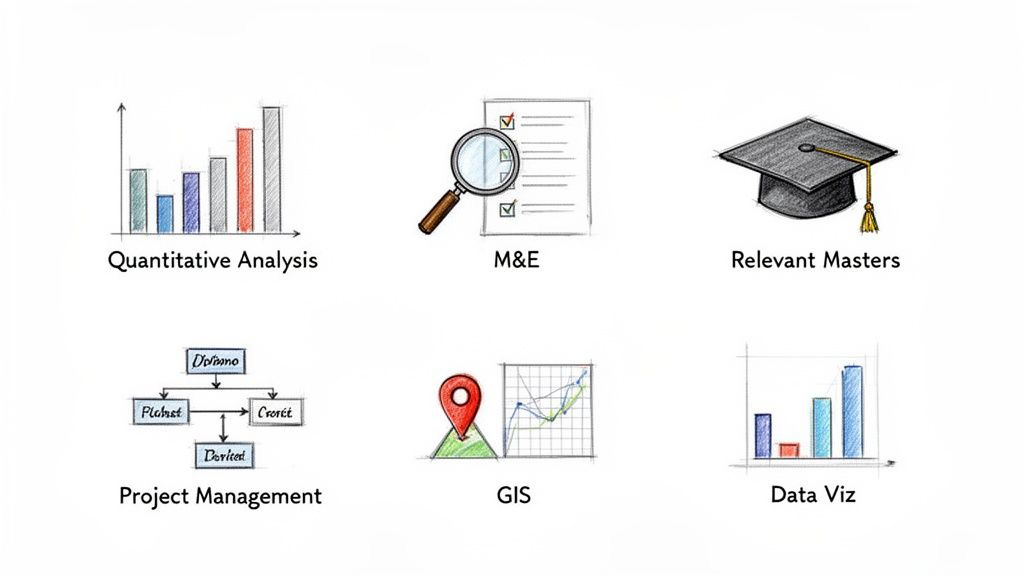
Let’s be blunt: passion is the fuel for a career in this sector, but it won’t get you through the door. Hiring managers at competitive INGOs and multilateral banks are drowning in applications. What makes them stop and read yours are the hard, verifiable skills you bring to the table.
Too many candidates lead with their desire to “make a difference.” While that’s the whole point, it’s not a skill. The applicants who get interviews are the ones who can prove they deliver tangible results. That means focusing your energy on the technical abilities organizations need to run and justify their multi-million dollar programs.
The Foundation: Data, Data, Data
At the core of almost every serious role in development is the ability to work with data. You have to be able to measure progress, analyze outcomes, and communicate what you’ve found. This isn’t optional anymore; it’s the baseline.
Two areas are non-negotiable: quantitative analysis and Monitoring and Evaluation (M&E). Strong quant skills show you can handle budgets, make sense of statistical reports, and form evidence-based recommendations. And M&E? That’s the language donors speak. It’s how organizations prove their work is having an impact and justify getting more funding. Without a solid grip on M&E, you’re already at a huge disadvantage.
You don’t have to be a PhD-level statistician, but you absolutely must be comfortable with data. The ability to design a logical framework, track key performance indicators, and analyze a dataset is what gets you from the ‘maybe’ pile to the ‘interview’ list.
Certifications And Degrees That Actually Matter
While experience is king, certain credentials are a shortcut. They send a clear signal to recruiters that you have a specific, valuable skill set they can put to use immediately.
Take project management. Executing a complex development project in a challenging environment requires serious discipline. Certifications like PMP (Project Management Professional) or PRINCE2 show that you get it. You know how to manage scope, budgets, and timelines. These skills are universally valued and directly transferable.
When it comes to education, some master’s degrees carry more weight because their curricula align perfectly with what these organizations do every day.
Master of Public Policy (MPP): Teaches the hardcore analytical skills needed to evaluate programs and design effective ones from scratch.
Master of International Development/Affairs: Provides the big-picture view of development theory, economics, and the political realities on the ground.
Master of Public Health (MPH): Absolutely essential for roles in global health, drilling down on epidemiology, health systems, and program design.
There’s a reason senior staff often have these degrees. They provide the exact theoretical and practical training needed for high-level policy and program work.
The Tech And Data Skills Everyone Wants Now
The entire development sector is in a massive shift toward becoming more data-driven. As a result, the demand for tech-related skills has just exploded. Being proficient in the right software can make you a much more attractive candidate, especially as organizations look to improve efficiency and prove their impact.
Tech-driven shifts are creating a surge in new roles, and a World Economic Forum report highlighted that many of these new jobs demand digital and data skills. For anyone serious about an international NGO career, developing a technical edge is no longer just an advantage. It’s becoming a necessity.
Here are the specific tools in demand right now:
Data Visualization: Knowing your way around Tableau or Power BI is a game-changer. It means you can turn a messy spreadsheet into a clear, compelling dashboard that a busy director can actually understand and use.
Statistical Software: If you’re aiming for a role in research, M&E, or economics, familiarity with Stata or R is a huge plus. It signals you can do serious analytical work.
GIS Mapping: For projects dealing with climate change, agriculture, or humanitarian response, skills in geographic information systems like ArcGIS or QGIS are increasingly required to visualize and analyze what’s happening on the ground.
You don’t need to master all of them. The smart move is to scan the job descriptions for the roles you want. See which tools pop up over and over again, and then invest your time in learning those.
Crafting Application Materials That Stand Out
Your CV and cover letter are your ticket to an interview. That’s it. In the hunt for an international NGO career, too many smart, capable people get screened out before they ever speak to a human because their documents are generic.
A one-size-fits-all CV is a guaranteed path to the rejection pile. The goal isn’t to list your past duties; it’s to prove you can deliver results. This distinction separates the candidates who get interviews from those who don’t.
Tailor Your CV Or Get Ignored
This is non-negotiable. Every single application you submit needs a tailored CV.
Before you write a word, print out the job description. Get a highlighter and mark up the key requirements, skills, and responsibilities. Your CV must directly mirror that language and push your most relevant experience to the top.
If a job calls for experience in Monitoring & Evaluation (M&E) and you have it, that skill needs to be front and center. Don’t bury it on the second page under a project that’s less relevant. Yes, it’s tedious to reorder bullet points and tweak your language for every application, but it’s the only way to get past the initial screening.
Use The STAR Method To Show Impact
Here’s the single most effective way to strengthen your CV: stop writing about responsibilities and start writing about results. The STAR method is the best framework for this because it forces you to be specific and to quantify your accomplishments.
Here’s the breakdown for each bullet point:
Situation: Briefly set the context. What was the project or challenge?
Task: What were you specifically responsible for?
Action: What concrete steps did you take? Use strong, active verbs.
Result: What was the outcome? This is where you bring in the numbers.
The ‘Result’ is the most critical part of the STAR method, and it’s the one most people forget. Numbers cut through the noise. Saying you “managed a grant” is forgettable. Saying you “Managed a $1.2 million grant, achieving all project deliverables 10% under budget” proves your competence and sticks in a recruiter’s mind.
Let’s look at a real-world comparison.
Weak:
Responsible for organizing community workshops.
Strong:
Designed and facilitated 15+ community health workshops (Action) for a USAID-funded project in rural Uganda (Situation), resulting in a 40% increase in clinic attendance among participants within six months (Result).
The second example gives the recruiter a clear, compelling picture of what you can actually do. If you want to dig deeper into these strategies, our guide to landing jobs in the development sector offers a more comprehensive breakdown.
Write A Cover Letter That Tells A Story
Your CV proves you have the skills. Your cover letter explains why you’re the right person for this specific organization and this specific role. It’s your chance to connect the dots and build a narrative that a list of bullet points can’t.
Don’t just rehash your CV. A great cover letter does three things:
Shows You’ve Done Your Homework: Reference a specific project, a recent report, or a core value of the organization that genuinely resonates with you. This is the fastest way to prove your interest isn’t superficial.
Connects Your Skills to Their Needs: Explicitly draw a line from your experience to their challenges. For example, explain how your stakeholder management work in East Africa directly prepares you to tackle the issues mentioned in the job description.
Demonstrates Enthusiasm and Fit: End with a confident statement about why your background aligns with their mission and what you’re excited to contribute.
This is the one place you can inject some personality and show a deeper understanding of their work. Don’t waste the opportunity.
Navigating The Interview And Networking Process

Landing the interview is a huge step. But don’t celebrate too long. The real work is just beginning. Interviews at big NGOs and multilateral development banks are a different animal. These aren’t casual chats; they are structured, formal evaluations designed to see how you perform under pressure.
You’ll almost certainly face a panel of interviewers and a series of competency-based questions. These are the classic “Tell me about a time when...” prompts, and they demand specific, real-world examples. Vague answers about “teamwork” or “leadership” just won’t fly. You need to walk in with a handful of your strongest professional stories, structured and ready to go.
Mastering The Competency-Based Interview
The best way to frame your answers is with the same STAR method you used for your CV. It’s a clear, concise structure that interviewers are literally trained to listen for. Be prepared to talk about times you managed conflict, dealt with a difficult stakeholder, or had to pivot a project because of unforeseen challenges.
Practice your stories out loud until they sound natural, not rehearsed. The goal here is a confident narrative that puts your skills on display. Make sure your examples highlight project management, cross-cultural communication, and problem-solving. These are the core competencies they are always screening for.
The Art Of Strategic Networking
Let’s be blunt: a massive number of jobs in this sector are filled through personal networks. If you wait until you need a job to start building relationships, you’ve already lost. The most successful people in this field constantly cultivate their connections, long before they even think about applying for a new role.
Good networking isn’t awkwardly asking strangers for a job. It’s about gathering intelligence and building genuine rapport. Your goal is to become a known quantity, a thoughtful person who understands the organization’s work. The best way to do this is through informational interviews.
Don’t spam connection requests on LinkedIn and hope for the best. Be intentional. Find people in roles or organizations that interest you, send a concise and respectful message asking for just 15-20 minutes of their time, and show up to that conversation prepared.
Conducting Effective Informational Interviews
An informational interview is your chance to get insider knowledge you’ll never find on a website. This is not the time to ask, “So, what does your organization do?” That screams you haven’t done your homework.
Your questions should be specific and show you’ve already done your research. Good questions get them talking and position you as a peer, not just another job seeker begging for a handout.
Here are some examples of questions that actually work:
“I saw your team recently published a report on climate adaptation in Southeast Asia. I was particularly interested in the financing mechanism you proposed. How is that being received by partner governments?”
“From your perspective, what are the biggest operational challenges your team is facing in implementing the new education program in West Africa?”
“What skills or expertise do you see becoming most critical for your team over the next two or three years?”
“How does your organization measure success for a project like the one you’re currently managing?”
Questions like these prove you’re engaged and thinking at a high level. They also give you critical intel you can use to tailor your application and ace a real interview down the line.
It’s also crucial to understand the broader hiring landscape. The UN system, a traditional cornerstone for many international careers, is facing major turbulence. The UN is expected to shrink by 30% in 2025 compared to its 2023 peak, facing hiring freezes and massive budget cuts. Because of this, experts advise professionals to look beyond international organizations and consider national aid agencies, large NGOs, and private contractors who are all now competing for the same talent. You can read more about the current reality of IO jobs in 2025.
Before you end the conversation, always ask: “Is there anyone else you think it would be valuable for me to speak with?” This single question is the key to turning one contact into a growing network. Always follow up with a thank-you email, and if their advice leads to another great conversation, circle back and let them know. That’s how you build a real relationship.
Burning Questions About NGO Careers
Let’s get into some of the big questions that always come up when people are trying to map out a career in the international NGO world. Getting straight answers here is the key to building a realistic game plan.
Is a Master’s Degree Really Necessary for an International NGO Career?
For professional track roles at major INGOs and multilateral development banks, a master’s degree is basically the price of admission. There’s no way to sugarcoat it. Degrees in International Relations, Public Policy, Economics, or Public Health are the standard currency.
You might find some entry-level or administrative roles that don’t list it as a hard requirement. But if you have any ambition of moving into policy, program management, or specialist positions, hitting a ceiling without an advanced degree is almost a guarantee. The master’s is what unlocks the door to those mid and senior-level opportunities.
How Big of a Deal is Field Experience?
Field experience is a massive differentiator. It’s valuable because it proves you can handle challenging environments and grasp the on-the-ground realities of how programs get delivered. It builds a type of credibility that’s almost impossible to get from a classroom.
You can certainly build a career in headquarters roles in cities like Washington D.C. or Geneva without it. But candidates who have spent time in the field are almost always viewed more favorably. Starting your career in a country or regional office is a proven strategy. It’s the perfect way to build the experience and context you’ll need to eventually land those senior or global roles.
The biggest mistake you can make is submitting a generic, untailored application. Hiring managers can spot a boilerplate CV from a mile away. You have to prove you want this job, not just any job.
Another huge error is getting so caught up in your passion for the mission that you forget to show concrete, quantifiable results. These organizations need to know what you can do for them. Finally, a surprising number of candidates completely neglect networking, seriously underestimating how many roles get filled through internal referrals or professional connections.
Do Nationality Requirements Actually Matter?
Yes, absolutely. For organizations like the MDBs and the UN, nationality can be a major factor. This is one of the hard realities of the sector that catches many people off guard.
Many positions are tied to member country quotas, which means hiring is sometimes restricted to ensure diverse representation. The G-4 visa system for the World Bank and IMF in the United States is a perfect example of this in action. On top of that, many organizations now prioritize hiring local nationals for field positions to help build local capacity.
Always check the eligibility requirements on every single job posting. This is a non-negotiable part of the hiring process for these institutions, so you need to be aware of it from the very beginning.
At Multilateral Development Bank Jobs, we do more than just send you job listings. We give you the insider context to navigate the complexities of this field, from decoding nationality requirements to acing the interview. Get the strategic edge you need to land your next role. Subscribe now at
https://mdbjobs.com
.