MDB jobs disappear fast. Are you tracking the latest openings?
Subscribe to the Premium Plan and never miss an opportunity:
Get Staff roles on Mondays
Get Consultant roles on Fridays
Grab a free trial here to see what you’ve been missing (no payment now).
If you’ve been watching the multilateral development space, you know the old playbook is being rewritten. The World Bank Group (WBG) isn’t just changing its slogans; it is overhaulng its entire operational DNA.
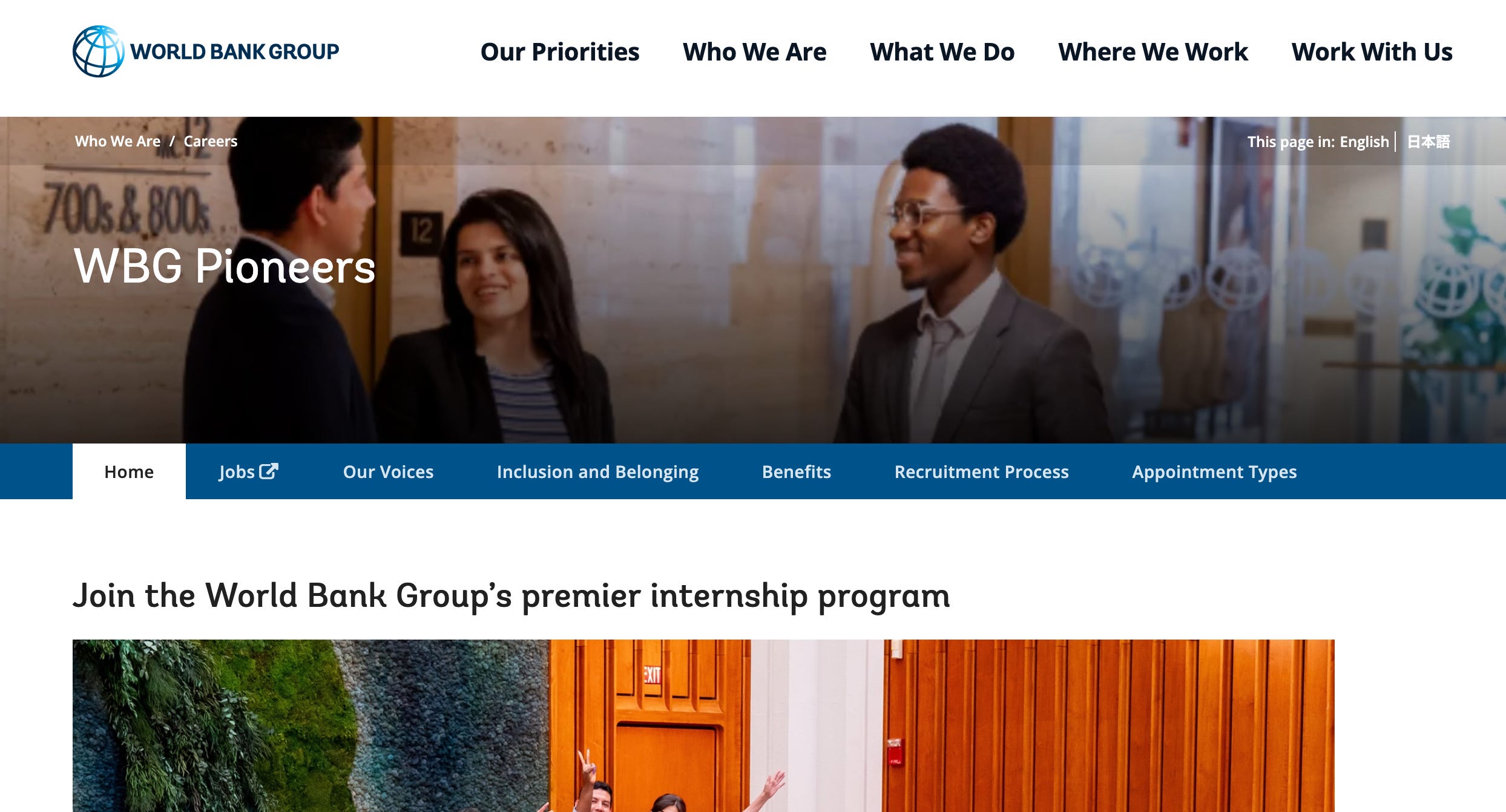
The most visible sign of this shift for aspiring professionals is the WBG Pioneers Internship Program. This isn’t your standard summer coffee run. It’s a high-stakes talent pipeline designed to find the people who will manage a massive surge in development lending.
I’ve seen how these institutions operate. If you want one of the 100 spots in the 2026 cohort, you need to stop thinking like a student and start thinking like a practitioner.
Here’s the reality of the program and how to position yourself to win.
The Strategic Shift: Why “Pioneers” Matters Now
For decades, the World Bank was an ivory tower for PhDs. The Pioneers program destroys that gatekeeping by introducing a dedicated Undergraduate Track. This is a massive tactical pivot. The Bank has realized that the technical skills they need: data science, renewable energy engineering, and digital infrastructure; are being mastered by younger talent that the private sector usually snaps up first.
The institution has expanded its mission. It’s no longer just about “ending poverty.” The new mandate is “poverty eradication on a livable planet.” By lowering its equity-to-loan ratio from 20% to 19%, the Bank has unlocked roughly $50 billion in new lending capacity. Across the whole Multilateral Development Bank (MDB) system, we are looking at over $200 billion in additional finance. They need “Pioneers” because they literally do not have enough staff to deploy that capital effectively. You are being recruited to be the “implementation force” for this new money.
Sector Priorities: Where the Money (and Jobs) Are
If you want to get in, you have to go where the growth is. Under the Evolution Roadmap, the Bank is doubling down on four specific areas. If your background doesn’t touch one of these, it could be a bit of an uphill battle.
1. Climate and the “Livable Planet”
Every project is now a climate project. The Bank’s Climate Change Action Plan requires 100% of financial flows to align with the Paris Agreement.
The Work: You’ll be “climate-proofing” infrastructure—think engineering roads to handle 50-year flood levels or designing heat-resilient schools.
The Edge: If you understand carbon pricing or nature-based solutions (like using mangroves for coastal protection), highlight it.
2. Energy Access and “Mission 300”
The Bank is partnering with the African Development Bank to get electricity to 300 million people by 2030.
The Work: This isn’t just “building grids.” It’s managing the “Just Transition” away from coal, which involves everything from soil remediation to workforce retraining.
The Edge: Experience in off-grid solar or stabilized power grid modernization is gold.
3. Agribusiness and Food Security
The Bank is doubling its agribusiness investments to $9 billion annually by 2030 via the AgriConnect program.
The Work: Shifting $1.25 trillion in global subsidies toward soil health and drought-resistant crops.
The Edge: Proficiency in precision irrigation technology or regional food market integration.
4. Urban Development
By 2050, 70% of people will live in cities. The Bank spends $5 billion a year on low-carbon urban infrastructure.
The Work: Urban heat management and flood control in the Global South.
The Edge: Geographic Information Systems (GIS) and spatial data analysis are the most requested technical skills here.
Tactical Positioning: The Application
Alright, so now we’ve got that out of the way. How do you apply?
Well, the application window is tight: January 19 to February 17, 2026. You get one shot. No edits after submission.
The CV: Technical Proof
The Bank doesn’t care about “passionate” adjectives. They care about tools.
List your stack: If you know R, Python, Stata, or GIS, put them in a dedicated “Technical Skills” section.
Show “Field” experience: Even if it was an academic project, emphasize any work done in emerging markets or multicultural environments. Keep it to 1-2 pages.
The Statement of Interest (SOI): Strategy Over Story
This is where most people fail. They write about why they want the job. You need to write about how you solve their problems.
Direct Alignment: Explicitly name one of the eight global challenges from the Evolution Roadmap.
The Value Add: State clearly what you contribute to the “Livable Planet” mandate. Use affirmative, direct language.
Transcripts: The Kill Switch
For the Undergraduate Track, your transcript must explicitly show you are in your final year. If it’s ambiguous, you’ll be disqualified by an automated filter before a human ever sees your name.
Mastering the Interview
If you get the call in March, you’ll face a Behavioral Event Interview (BEI). The philosophy here is simple: past performance predicts future results.
The STAR Method
Prepare 6–8 “mini-stories” using the Situation, Task, Action, Result framework.
Focus on the “Action”: Interviewers don’t want to hear what “the team” did. They want to know what you did.
Quantify the “Result”: Did you increase data efficiency by 15%? Did you save 20 hours of manual entry? Give them numbers.
The “Curveballs”
Don’t be surprised if you get a brain teaser, like the classic “measure four gallons using only a three-gallon and five-gallon bottle.” Yes, I know these suck. But it’s ultimately about testing how you think under pressure.
So stay calm, talk through your logic out loud, and don’t panic if you don’t get it instantly.
The Long Game: The Bridge to the YPP
The Pioneers program is a feeder for the Young Professionals Program (YPP), the most prestigious entry point in global development.
The 2026 Pioneers cohort is perfectly timed for the 2027 YPP cycle. Here’s the insider math:
Experience Credit: The time you spend as a Pioneer counts toward the two-year work experience requirement for the YPP.
Institutional Fit: In the YPP interview, saying “When I was working in the Energy Global Practice...” carries 10x more weight than any academic theory.
Operational Realities
This is a professional role, not a study abroad program.
Compensation: You get an hourly wage, which makes it accessible for talent from the Global South.
Logistics: You’re responsible for your own housing. If you’re placed in D.C., start looking for roommates the moment you get your offer.
The Pioneers program is for people who want to be at the center of the world’s most complex problems. It’s competitive, technical, and fast-paced. If you have the skills, stop hedging and submit your application.
But fear not. This isn’t the only way into the Bank. You can also apply for consulting opportunities. Luckily, I provide a rundown of consulting opportunities each Friday… Hit subscribe to get a free trial and check them out.
Make sure you subscribe to MDB Jobs to get the latest vacancies delivered straight to your inbox each Monday, and consultant positions each Friday.