

Landing a role at the World Bank requires more than a strong resume. You need to understand the system. To secure one of these highly sought-after World Bank jobs, you must first know the different ways in, from permanent staff positions to specialized consultancies and the prestigious Young Professionals Program. This is your map for navigating that complex world.
Your Map to a World Bank Career
Getting hired by the World Bank is a strategic game. It’s an institution with a specific mission, a distinct culture, and a formal, often rigid, hiring structure. The candidates who succeed are the ones who grasp how these pieces fit together. They can clearly show how their skills support the Bank’s core mission: ending extreme poverty and boosting shared prosperity on a livable planet.
This guide gives you an insider’s look at how the Bank works and what its recruiters are looking for. Forget generic career advice. We’re breaking down the career paths, the skills that are in demand, and the mindset you need to get through the door.
Understanding the Different Ways In
The World Bank isn’t a monolith. It uses a mix of employment types for specific needs, and knowing the difference is the first step to focusing your job search where it counts.
Here’s the breakdown of the main categories you’ll see:
Permanent Staff Roles: These are the core, long-term jobs that form the backbone of the organization. Think of them as the career track.
Consultant and Temporary Contracts: These are project-based roles for specialists brought in for a specific task or a limited time. It’s a common “foot-in-the-door” strategy.
Young Professionals Program (YPP): A fiercely competitive entry point for exceptional, early-career individuals with clear leadership potential.
Internships: These are straightforward opportunities for current students to get hands-on experience and see how the Bank operates from the inside.
The Bank’s own career page gives you a high-level overview, immediately splitting opportunities into these distinct tracks.
This initial split between “Experienced Professionals,” “Young Professionals,” and “Students & Graduates” is your first filter, guiding you to the right track from the start.
To make it even clearer, here’s a quick summary of the main pathways.
World Bank Career Paths at a Glance
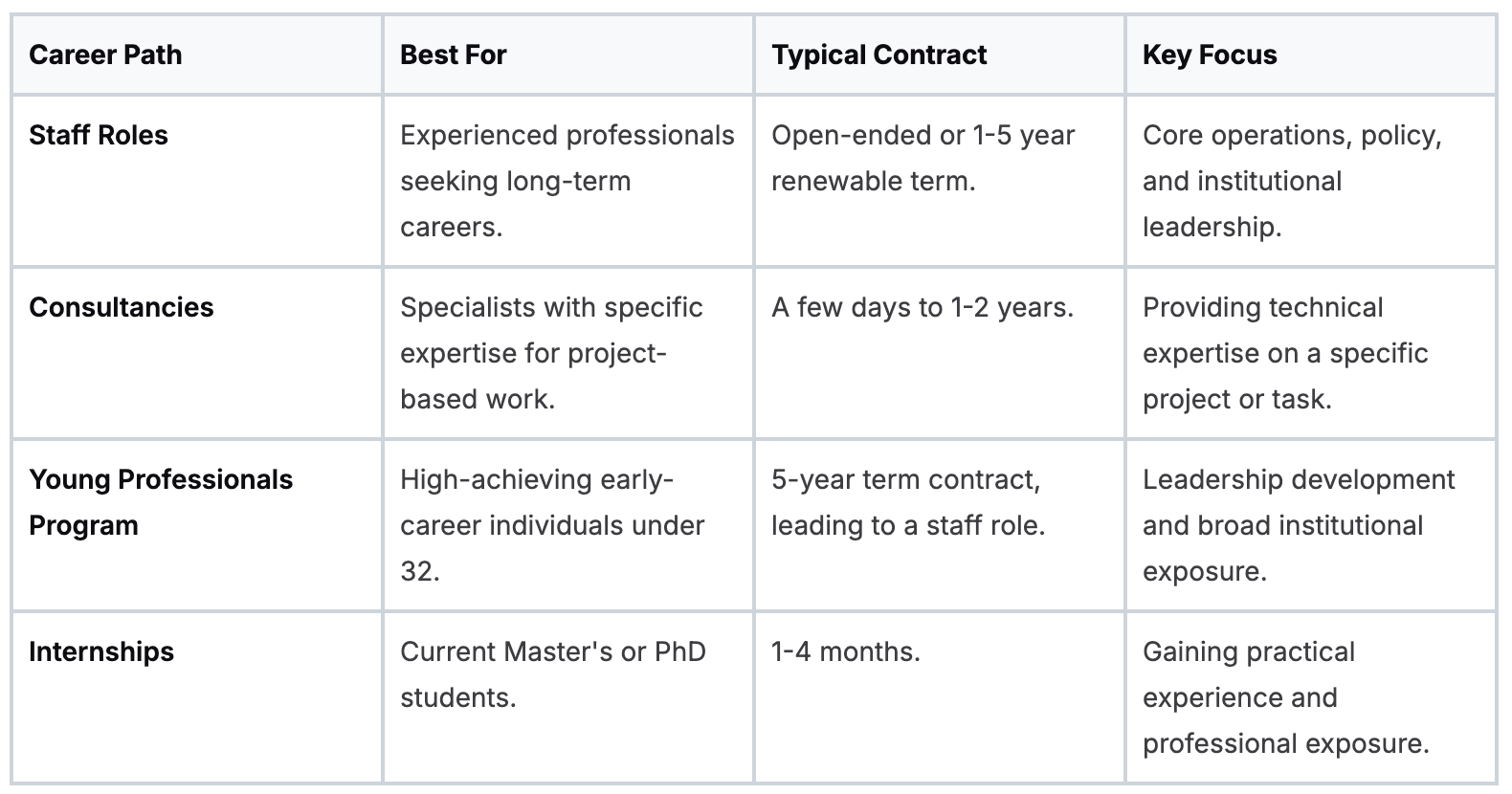
These paths aren’t mutually exclusive. Many consultants eventually land staff roles, and former interns sometimes return as Young Professionals. The key is picking the right entry point for your current experience level.
Connecting Your Skills to the Bigger Picture
Your technical expertise is non-negotiable, but it’s only half the story. The World Bank hires people who can apply their skills to massive global challenges, whether it’s climate change resilience or public health crises. They need to see that you get the big picture.
The World Bank isn’t just looking for an economist or a project manager. It wants an economist who can design poverty-reduction programs or a project manager who can deliver critical infrastructure in a fragile state. Your ability to connect your work to tangible development outcomes will set you apart.
Decoding the World Bank’s Job Categories
The term “World Bank jobs” is a catch-all for a few very different ways to work with the institution. To get your foot in the door, you absolutely have to know which door to knock on.
Trying to land a permanent staff role with a consultant’s resume is a recipe for a quick rejection. Let’s break down the four main paths into the Bank so you can figure out where you fit. Getting this right from the start is the most important step you’ll take.
Staff Appointments: The Career Track
This is what most people picture when they think of a World Bank career. Staff appointments are the core, long-term positions that form the backbone of the institution. They come with renewable term contracts, usually for one to five years, or open-ended contracts for senior folks.
These jobs are graded on a scale, from GA (the most junior admin level) all the way up to GK (senior management). If you’re coming in as a professional, you’re likely looking at roles starting around the GE level. These are the people running the Bank’s operations, leading massive projects, and shaping global policy. Unsurprisingly, the hiring process for staff is famously tough and slow. The Bank is making a long-term investment, and they treat it that way.
Consultant and Temporary Positions: The Specialist Track
Consultant roles are a completely different ballgame. These are short-term contracts designed to bring in specific expertise for a clearly defined task. Think of it less like hiring a permanent employee and more like bringing in a specialist contractor to solve a particular problem.
These gigs are usually paid from a project’s budget, not the Bank’s core administrative funds. You’ll generally see two flavors:
Short-Term Consultant (STC): Hired for a specific task with a contract measured in days, capped at 150 days per fiscal year.
Extended Term Consultant (ETC): Brought on for a longer-term assignment, often for one to two years, to fill a role tied to a specific project’s lifecycle.
This track is a fantastic way for seasoned professionals to prove their value and build a reputation inside the Bank. In fact, a huge number of current staff members got their start as consultants.
The Young Professionals Program: The Leadership Pipeline
The World Bank Young Professionals Program (YPP) is the institution’s crown jewel for finding and grooming its next generation of leaders. It is intensely competitive and built for highly qualified, early-career individuals who are typically under 32, armed with advanced degrees and solid work experience.
The YPP is a full-blown development program. YPs get a five-year, renewable term contract and are deliberately rotated through roles that give them a panoramic view of the institution. The entire point is to fast-track them into high-impact staff positions. For those at the beginning of their careers, this is the most prestigious and structured way in.
The World Bank is an institution driven by data and policy. Understanding global economic indicators is essential, even before you apply. As an example, the Bank’s data shows the global employment-to-population ratio was around 60.5% in 2023. Grasping what numbers like this mean for labor markets informs the very policy and project work you would be doing in many World Bank jobs. Explore more World Bank employment data from the St. Louis Fed.
Internships: The Entry Point for Students
Finally, there are internships. These offer students a chance to get their hands dirty with real, practical experience inside the Bank. These are almost always paid positions for students currently enrolled in a Master’s or PhD program.
Internships typically last between one and four months. They’re a two-way street: the Bank scouts for future talent, and students get invaluable exposure to the inner workings of a massive development institution. While an internship is no guarantee of a job offer, it’s a massive advantage. You build a network, learn the culture, and get to show your skills to the very people who might hire you down the line. For any student serious about a career in international development, a World Bank internship is a powerful credential.
Choosing the right path from these four options focuses your energy and dramatically increases your chances of success.
Navigating the Hiring Process and Timeline
Let’s be direct: the World Bank’s hiring process is methodical and notoriously slow. Patience is a prerequisite.
Once you’ve submitted an application, don’t expect a quick response. The entire sequence, from hitting “submit” to receiving an offer, can easily stretch from four to six months. For senior staff roles, it can take even longer.
Knowing this from the start is crucial. It helps you manage your expectations and prevents the frustration that comes with long periods of silence. The process is designed to be incredibly thorough, involving multiple layers of review to find the right person for a long-term role. Each stage has its own rhythm, so let’s pull back the curtain on what’s happening behind the scenes.
The Application Screening Stage
After you apply, your application first lands with Human Resources. An HR officer performs an initial screen to check if you meet the basic, non-negotiable criteria.
Think of it as a simple checklist review:
Do you have the right degree?
Do you have the minimum years of experience?
Do you have the required language skills?
Are you a citizen of a member country?
If you don’t tick these essential boxes, your application gets filtered out almost immediately. This part is often automated or semi-automated, leaving no room for nuance. This is precisely why you need to read the job description carefully and be brutally honest about your qualifications. Passing this first gate just means you’re eligible to be considered. The real competition starts now.
Longlisting and Shortlisting by the Hiring Team
Once you’ve cleared the initial HR hurdle, your application is passed to the hiring manager and their team. This is where the real evaluation begins. The team sifts through all the eligible applications to create a longlist of candidates who look promising on paper. This group might include anywhere from 10 to 30 people.
From there, the panel dives deeper. They scrutinize the CVs and cover letters of everyone on the longlist, looking for a much closer match between a candidate’s experience and the specific needs of the job. A tailored application that speaks directly to the role’s requirements will pay off here. The goal is to whittle the pool down to a shortlist of the top five to eight candidates who will be invited for an interview. This stage alone can take several weeks.
This infographic shows the typical career entry points, which helps contextualize the hiring focus for different professional levels.
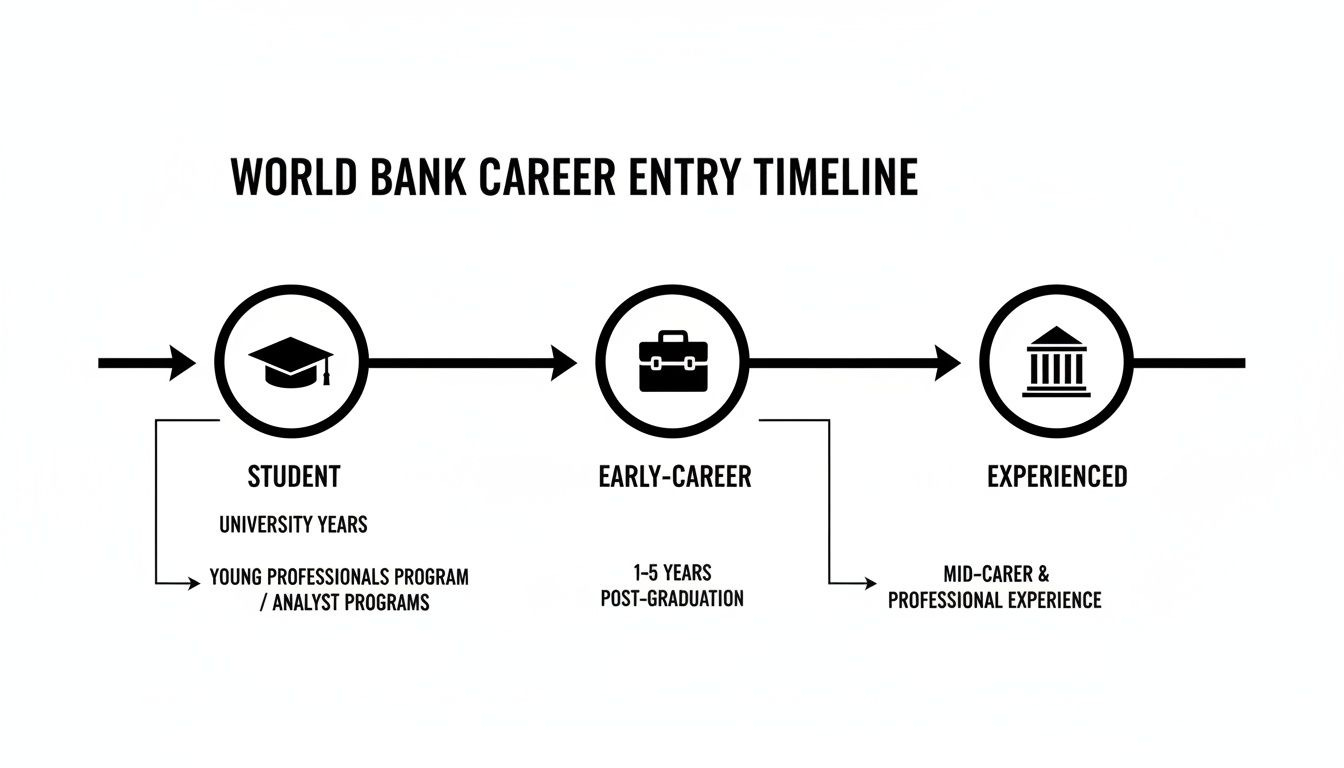
As the visual highlights, whether you’re a student, an early-career professional, or a seasoned expert, the Bank has a specific track and a correspondingly rigorous selection process for you.
The Panel Interview and Assessment
If you make the shortlist, congratulations. You’ll be invited for a panel interview. This is usually the most intense part of the whole process. Expect to face a panel of three to five people, typically including the hiring manager, a few potential future colleagues, and an HR representative.
The interview is almost always competency-based. This means you should expect questions designed to test your technical skills plus your ability to collaborate, lead, and focus on client results. Be ready to give specific, detailed examples using the STAR method (Situation, Task, Action, Result). For some technical roles, you might also have to complete a written assessment or give a presentation.
The Final Stages: Reference Checks and Offer
If the panel interview goes well, you’ll be identified as the preferred candidate. At this point, the Bank will conduct formal reference checks, contacting the supervisors you’ve listed to verify your experience and performance.
Assuming your references come back glowing, the hiring manager will then make a formal recommendation to their department head and HR.
The final decision is a collective one. The interview panel must reach a consensus, and the selection must be justified based on the evidence gathered throughout the process, including how a candidate aligns with the Bank’s diversity and inclusion goals. Nationality can be a factor, as the Bank strives for broad representation from its member countries.
Once all the internal approvals are secured, HR will finally extend a formal offer. The entire journey is a marathon, not a sprint. To get a much deeper look into what to expect, check out our guide on the 2026 World Bank Hiring Playbook and timelines.
Understanding World Bank Salary and Benefits
Talking about World Bank jobs without getting into the pay and perks is telling only half the story. The compensation package is a huge draw, and it’s designed to pull in top-tier talent from across the globe. It’s not just a paycheck; it’s a structured, competitive offer that goes well beyond the basics.
The whole system is built around a grade-level structure, starting from GA (administrative roles) and going all the way up to GK (senior management). Each grade has its own salary band. Where you land within that band depends on your experience, qualifications, and what the specific job demands. Unlike many private sector jobs, this structure is transparent and standardized across the entire institution.
The Net-of-Tax Salary Advantage
One of the most powerful perks is the net-of-tax salary policy. This is a game-changer. For most staff who aren’t U.S. citizens, the World Bank pays a salary that is effectively free of income tax. The Bank makes an additional payment to you to cover its estimate of your home-country tax bill on your Bank income.
This is a massive financial benefit. It means the number you see on your contract is much closer to what you actually take home. It’s a world away from a typical job where a big chunk of your pay vanishes to taxes before you see it.
Why do they do this? The tax policy allows the World Bank to keep its pay scale equitable on a global level. It ensures that staff from high-tax and low-tax countries get a comparable net income for doing the same job, creating a fair system for its international workforce.
A Comprehensive Benefits Package
Beyond the salary, the benefits package is where the World Bank really sets itself apart. It’s built to support an international lifestyle, which often means relocating your entire life and dealing with complex family needs. This is a core part of the total compensation that makes these roles so attractive.
The package typically includes:
Health and Life Insurance: Rock-solid medical, dental, and vision coverage for you and your family, plus comprehensive life and accident insurance.
Generous Pension Plan: A well-funded defined benefit pension plan that provides a secure retirement income. This is a true rarity in today’s job market.
Relocation Assistance: If you’re moving to a new duty station, the Bank helps ease the transition with grants, shipping allowances, and other support.
Education Benefits: Help with education costs for your kids, which can be a huge financial relief for expat families.
These benefits create a stable foundation, letting staff focus on the demanding work of global development. That work operates on a mind-boggling scale. The Bank supports job programs across continents where the total global labor force is over 3.6 billion people. Landing a role means you get to help shape policies that affect a significant slice of that population. You can explore global unemployment trends on the World Bank’s data site to grasp the sheer scale of this work.
This combination of a competitive, tax-advantaged salary and a world-class benefits package makes the total compensation for World Bank jobs extremely compelling. For a deeper dive into the numbers and how they break down by grade level, check out our complete World Bank Salary Guide.
How to Craft an Application That Gets Noticed
Let’s be blunt: sending a generic resume to the World Bank is a complete waste of time. Hiring managers are hunting for a very specific profile, and your application is the first and most important test. You have to prove you get their mission and can frame your experience in a way that speaks their language.
Forget listing job duties. The Bank thinks in terms of competencies and, above all, impact. Your entire application, from your CV to your cover letter, has to show them you deliver real-world results. This means ditching the standard resume format and adopting the frameworks they use to evaluate candidates internally.
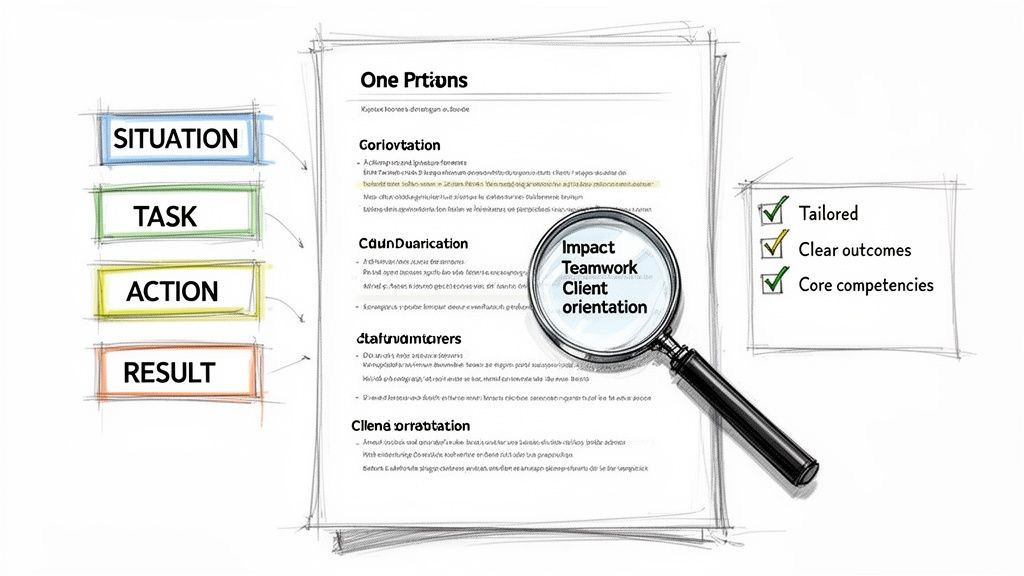
This whole process kicks off with you deconstructing the job description. Zero in on the required competencies they list, like client orientation, teamwork, and knowledge sharing. Your mission is to back up every claim with concrete proof that you excel in these areas.
Mastering the STAR Method for Your Application
The STAR method is the absolute foundation of a successful World Bank application. It’s a simple but powerful framework for structuring your accomplishments into compelling stories. Standing for Situation, Task, Action, and Result, it forces you to build a narrative around what you’ve actually achieved.
Here’s how to bake it directly into your application:
Situation: Briefly set the scene. What was the project? What challenges was the team facing?
Task: What was your specific goal? What were you responsible for delivering?
Action: This is the core of it. What specific steps did you take? Detail your personal contribution and the skills you used.
Result: What was the outcome? This is where you need to get specific. Quantify it with numbers, percentages, or concrete changes whenever you possibly can.
Weaving STAR-based examples into your CV’s bullet points and your cover letter is non-negotiable. It’s the difference between a passive statement like “Managed a portfolio of projects” and a powerful story of your direct impact.
A weak bullet point says: “Responsible for stakeholder engagement.” A strong, STAR-based bullet point says: “Led stakeholder engagement for a $10M rural sanitation project in a post-conflict region (Situation/Task), developing a new community feedback system (Action) that increased local participation by 40% and resolved project disputes 25% faster (Result).”
That level of detail is precisely what makes a hiring manager stop scrolling and pay attention.
Tailoring Your CV and Cover Letter
Think of your World Bank CV as a highlight reel of your most relevant, high-impact work. Keep it concise, two to three pages is the sweet spot, and be ruthless. Cut anything that doesn’t directly support your case for that specific role. Use the keywords and competencies from the job description as your guide.
Your cover letter is where you connect the dots. Don’t rehash your CV. Pick two or three of your most powerful STAR examples and expand on them. Explicitly link your experience to the Bank’s strategic goals and show you’ve done your homework by referencing a recent report or project that’s relevant to the team you’re applying to.
For instance, many World Bank jobs focus on economic policy and employment. The Bank’s own data, modeled by the ILO, shows the global unemployment rate averaged 5.1% in 2024. Youth unemployment is an even bigger challenge, hitting 13.2% in 2023. This fuels demand for economists to work on programs like the Jobs Groups. If you have experience tackling these issues, make that crystal clear.
Preparing for the Competency-Based Interview
If your application makes the cut, you’ll be invited to a competency-based panel interview. The questions are designed to test the exact same competencies you saw in the job description. Your job is to respond using the STAR method, just as you did on paper.
Before the interview, prepare six to eight solid STAR stories from your career that showcase different skills. Practice telling them out loud until they flow naturally. You want them to sound polished but not robotic.
You can expect questions that probe areas like:
Client Orientation: Describe a time you had to manage a difficult client or stakeholder.
Teamwork and Collaboration: Tell us about a project where you worked with a diverse team.
Problem-Solving: Walk us through a complex problem you faced and how you solved it.
For technical roles, be ready for a case study or a presentation to test your practical skills. Above all, you need to demonstrate a deep, authentic understanding of the World Bank’s mission. They aren’t just hiring a set of skills; they’re hiring someone who is genuinely committed to the cause of global development. For more detailed guidance, check out our in-depth article on how to apply for World Bank jobs.
Finding and Tracking World Bank Job Openings
Finding the right job opening at the right time is half the battle. You can’t just browse the World Bank’s website occasionally and hope for the best. To succeed, you need a system, a proactive, targeted approach that ensures you never miss a perfect opportunity.
Your starting point is always the official World Bank Careers portal. Every staff, consultant, and internship role gets posted here. Getting comfortable with its search functions is non-negotiable. You have to learn how to slice and dice the listings by job family, grade level, and location to filter out the noise and zero in on the roles that actually match your experience.
Setting Up a Proactive Search
Relying on memory to check the site every day is a recipe for failure. The smartest move you can make is to set up job alerts directly on the Bank’s career site.
You can create multiple, specific alerts for different keyword combinations, like “Health Specialist, Africa” or “Economist, GE grade.” This puts the process on autopilot, dropping relevant World Bank jobs straight into your inbox the moment they go live.
Whenever a new role pops up, take note of the job number or requisition ID. Think of it as the official tracking number for that position. If you’re networking or following up, using this ID makes you look professional and ensures everyone knows exactly which role you’re talking about.
A huge mistake people make is treating the job search as a passive activity. The candidates who get hired build a system. They combine the Bank’s official alerts with other specialized resources to get a complete picture of what’s out there, from high-profile staff roles to less-visible consultancy gigs.
Expanding Your Search Beyond the Official Site
While the official portal is your home base, it shouldn’t be your only stop. The world of multilateral development banks (MDBs) is deeply interconnected. An opportunity at the Asian Development Bank could be just as good a fit, or even better, than one at the World Bank.
This is where a good, targeted newsletter can give you a serious edge. Take the Multilateral Development Bank Jobs newsletter, for instance. It pulls together opportunities from over 30 different MDBs, saving you the soul-crushing work of checking dozens of career sites yourself.
Here’s why a resource like this is so valuable:
It Saves You Time: Instead of a daily ritual of checking multiple websites, you get a curated list of relevant staff and consultant jobs delivered right to you.
It Broadens Your Horizons: You’ll see openings from institutions you might not have thought to check, which dramatically expands your options.
It Finds the “Hidden” Gigs: Many newsletters are great at tracking short-term consultant roles. These are often the best way to get a foot in the door but can be notoriously difficult to find on your own.
By pairing official World Bank alerts with a broader, MDB-focused newsletter, you create a powerful, two-pronged strategy. It’s a systematic approach that gives you full coverage, making sure you see every opportunity that aligns with your career goals.
Got Questions About World Bank Jobs? We’ve Got Answers.
When you’re digging through World Bank job postings, a few key questions always pop up. Getting straight answers is crucial, so you know where to focus your energy and what to expect.
Here’s the rundown on some of the most common queries we get.
Are There Nationality Restrictions?
Yes, for almost all staff jobs, you have to be a citizen of one of the World Bank’s 189 member countries. This is a hard-and-fast rule, and it’s one of the first things they check.
There are some exceptions for certain consultant roles or positions in specific country offices, but don’t count on it. The Young Professionals Program also has its own specific nationality and age requirements. Always check the fine print on the job posting before you sink time into an application.
How Important Is a Master’s Degree or PhD?
For professional-level roles, an advanced degree is the standard. If you’re looking at any position graded GE or higher, especially on the economist track, a relevant Master’s or PhD is usually non-negotiable. The Bank puts a massive premium on deep academic training paired with real-world experience.
For administrative positions, typically graded GA through GD, a bachelor’s degree can be enough if you back it up with a ton of relevant experience. And for the Young Professionals Program, a master’s or doctoral degree is an explicit requirement to even get in the door.
Can I Work Remotely for the World Bank?
The short answer is: probably not. The World Bank has a very traditional, office-centric culture. The vast majority of staff are expected to be physically present, either at the headquarters in Washington D.C. or in one of the dozens of country offices worldwide.
While the pandemic introduced more flexibility, you should go in assuming that any staff role will require you to relocate. If you’re looking for remote work, your best bet is in the consultant world. Roles like a Short-Term Consultant (STC) or Short-Term Temporary (STT) offer far more potential for remote or hybrid arrangements. But even then, it all comes down to the specific assignment.
Don’t assume a role is remote unless the job description screams it from the rooftops. The default for staff jobs is showing up in person.
What Is the Difference Between the World Bank and the IMF?
It all boils down to their core missions, and that dictates the kinds of people they hire.
Think of the World Bank as a long-term project builder. Its goal is to reduce poverty and foster economic development over decades. They fund tangible, on-the-ground projects, things like building roads, improving healthcare systems, and reforming education. This means they need a huge range of specialists: water engineers, education experts, public health professionals, you name it.
The International Monetary Fund (IMF), on the other hand, is like the global economy’s emergency room doctor. It focuses on financial stability, stepping in with policy advice and short-term loans when countries are facing a crisis. Because of this laser focus, the IMF almost exclusively hires macroeconomists and financial sector experts.
Trying to navigate the complex world of MDBs can feel like a full-time job. At Multilateral Development Bank Jobs, we do the heavy lifting for you. We curate the best staff and consultant openings from over 30 institutions and deliver them straight to your inbox. Stop searching and start applying to the right roles by subscribing at
https://mdbjobs.com
.