

If you want a serious career in international development, follow the money. Forget the romantic image of pure diplomacy. The real power, and the most stable jobs, are with the institutions that manage and move massive amounts of capital.
That means looking squarely at the Multilateral Development Banks (MDBs).
Understanding Where The Real Opportunities Are
Institutions like the World Bank, the Asian Development Bank (ADB), and the African Development Bank (AfDB) are the financial engines of global development. They are banks first and foremost, with enormous balance sheets funding everything from billion-dollar infrastructure projects to nationwide energy reforms.
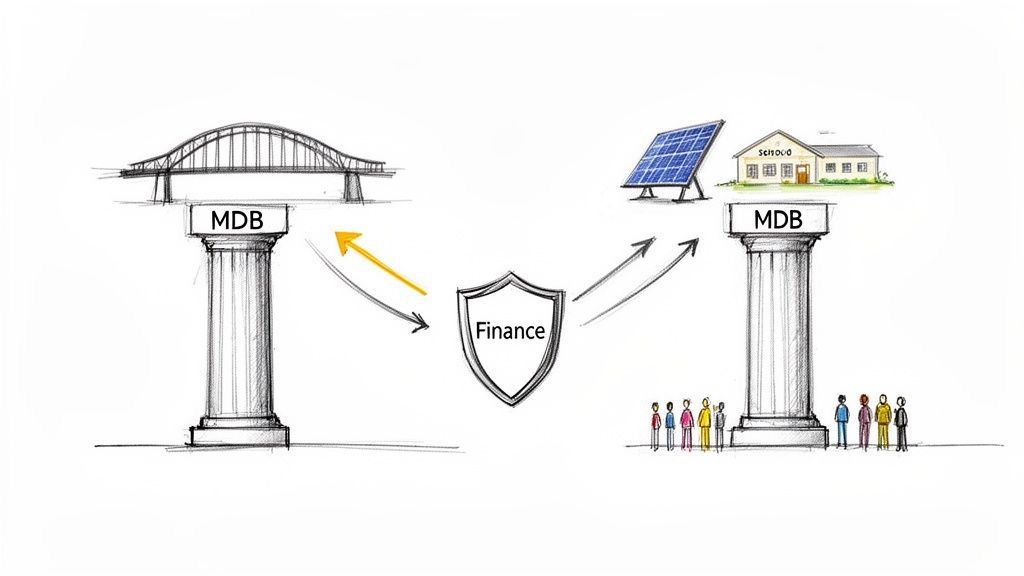
This financial foundation makes them reliable employers. Their entire operational model is built on lending and investment, which creates a constant, predictable demand for skilled professionals to manage these complex activities.
Why MDBs Are Hiring Powerhouses
MDBs are unique because they’re owned by sovereign governments. This structure gives them immense capital and top-tier AAA credit ratings, allowing them to borrow money cheaply on international markets and then lend it to developing countries on very favorable terms.
Their financial strength is staggering. MDBs have collectively piled up around US$230 billion in reserves and grown their total equity capital to nearly US$380 billion. This is the fuel that powers their operations and makes large-scale hiring necessary. For a deep dive, you can explore a detailed comparison of MDB financial strength to see just how stable they are.
This financial firepower translates directly into jobs. Every single loan approved for a new dam, a digital transformation project, or a climate adaptation program requires a team of experts to design, implement, and monitor it. This is where the jobs are created.
The core business of an MDB is moving capital to where it’s needed most. This creates a continuous cycle of project development and a consistent need for talent in finance, economics, engineering, and policy.
To give you a clearer picture, it helps to understand how different types of organizations fit into this ecosystem and what kind of roles they typically offer.
Key International Organizations and Their Core Functions
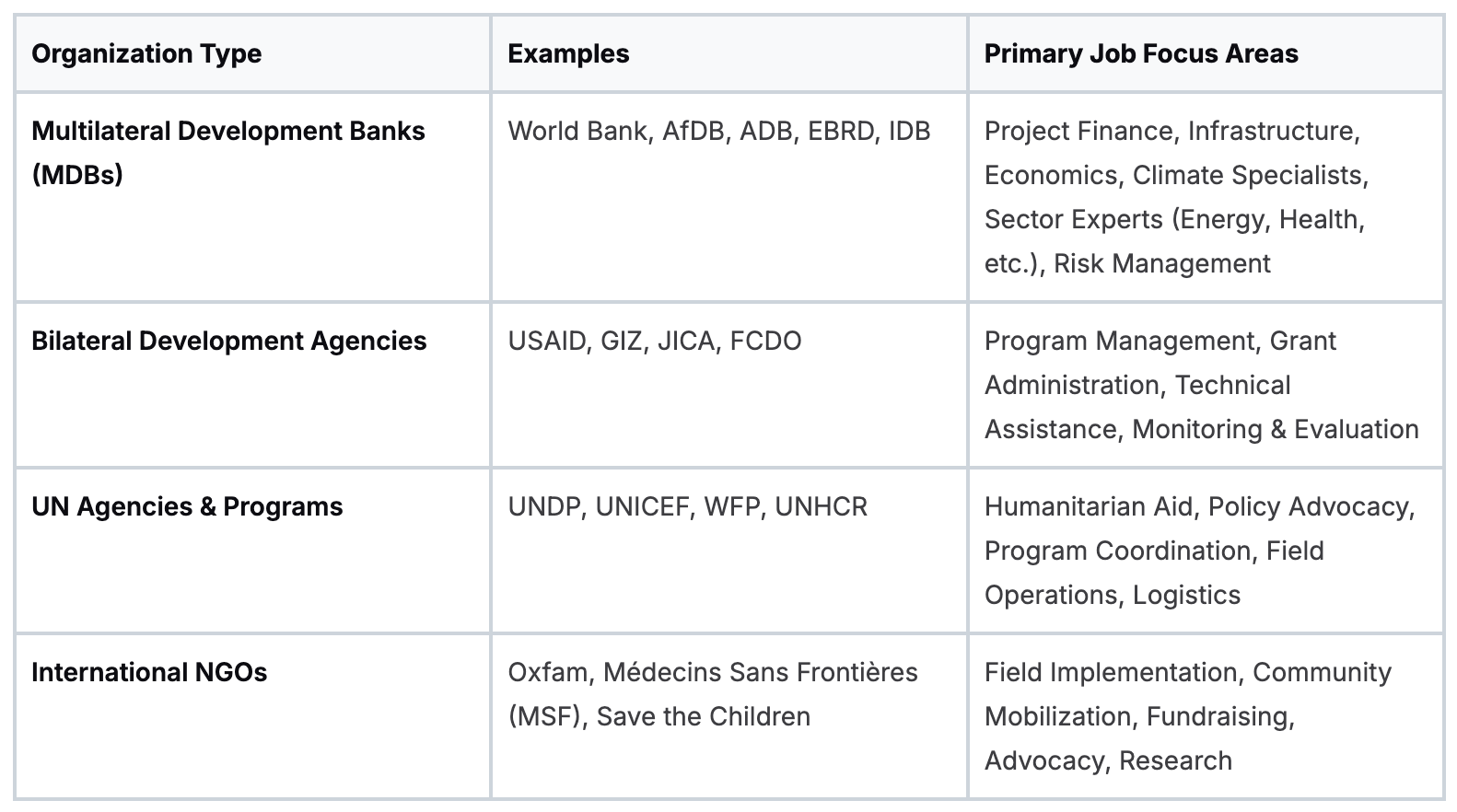
While all these organizations do important work, the MDBs are unique in their financial scale, which directly fuels a constant demand for highly skilled, technical staff for long-term roles.
The Skills in Highest Demand
Because their work is project-driven, MDBs have specific, practical hiring needs. They aren’t looking for generalists with a degree in international relations. They need specialists who can deliver tangible results.
The strategic priorities of these banks dictate who gets hired. Right now, the focus is heavily on a few key areas:
Climate Action: This is the biggest driver of hiring today. MDBs are pouring billions into renewable energy, sustainable infrastructure, and climate resilience projects. They need specialists in green finance, environmental policy, and carbon markets.
Project Finance and Infrastructure: The traditional bread-and-butter of MDBs remains a critical hiring area. Expertise in structuring complex financial deals for huge infrastructure projects is always in demand.
Digital Transformation: Governments worldwide are digitizing their economies, and MDBs are financing this shift. This creates a ton of roles for experts in digital policy, fintech, and cybersecurity.
Risk Management: With growing global economic uncertainty, the need for professionals who can manage financial, operational, and political risk across vast project portfolios has exploded.
Your first step is to understand this landscape. Stop blindly applying to every opening you see. Focus your energy on the MDBs and align your skills with their core business: financing global development. That’s where you’ll find the most rewarding and stable jobs in the sector.
Finding High-Value Job Openings
Let’s get one thing straight. The biggest mistake people make is treating this job search like any other. They spray their CV across LinkedIn and Indeed, then wonder why they’re met with silence.
The truth is, the best jobs at these international organizations aren’t on those generic boards. They’re posted on specialized, internal platforms that demand a targeted approach.

Wasting time on broad searches is a losing game. To find high-value roles, go directly to the source. It’s about working smarter, not harder, to get your application in front of the right people before the position gets flooded.
Go Straight to the Official Career Portals
Every major MDB and UN agency runs its own official career portal. This is ground zero. It’s where all legitimate staff and consultant vacancies live.
Make it a weekly habit to visit the career pages of your target institutions.
Don’t just browse. The most effective strategy is to create targeted job alerts. These systems deliver relevant openings straight to your inbox, but they only work if you tell them exactly what you’re looking for.
Use precise keywords related to your actual expertise, not generic job titles. For example, instead of setting an alert for “Project Manager,” get specific:
“Climate Finance Specialist”
“Infrastructure Economist”
“Public Sector Management”
“Water and Sanitation Engineer”
This level of detail ensures the alerts you receive are genuinely aligned with your skills, saving you from digging through hundreds of irrelevant postings.
Stop waiting for jobs to find you. The single most important action you can take is setting up detailed, keyword-driven alerts on the official career sites of the World Bank, ADB, AfDB, and other MDBs. This proactive approach puts you in control of your search.
Use Curated Newsletters to Cut Through the Noise
While official portals are essential, they can be overwhelming. The sheer volume of openings across dozens of organizations makes it easy to miss the perfect role.
Specialized, curated newsletters are your secret weapon.
These newsletters do the heavy lifting for you. They aggregate, filter, and categorize the best staff and consultancy listings from across the MDB and UN systems, delivering a clean, scannable list right to your inbox. Subscribing to a focused service like MDBjobs.com can save you countless hours each week. We also create specialized guides, like the top places to find IMF job openings, to help you narrow your search even further.
A good newsletter provides context and highlights high-priority roles. It’s a curated approach that helps you focus your energy where it’s most likely to pay off.
How to Decode Vacancy Announcements
Once you find a promising opening, you need to read the vacancy announcement like a hiring manager. These documents are dense and full of specific terminology, but they contain all the clues you need.
Look past the generic list of duties and zero in on the required qualifications section. This is a checklist, not a suggestion box. Pay close attention to:
Minimum Years of Experience: This is usually a hard filter. If the job asks for ten years, your five years of brilliant work probably won’t get you past the initial screening.
Educational Requirements: “Master’s degree or equivalent” is the standard. For economist roles, a PhD is often a real advantage, if not an outright requirement.
Specific Technical Skills: Look for mentions of financial modeling, specific programming languages (like Stata or R), or experience with certain donor-funded project cycles. These are the keywords their applicant tracking systems (ATS) are scanning for.
My rule of thumb is simple: don’t apply unless you meet at least 80% of the stated requirements. These organizations receive thousands of applications and use strict filters to narrow the pool. Understanding how to read these announcements is the first step to focusing your energy on the jobs you actually have a shot at landing.
Decoding Eligibility Rules and Job Requirements
Applying for a job at an international organization can feel like trying to solve a puzzle designed to keep you out. The rules around nationality, education, and experience are strict and can kill an otherwise great application before it’s even read.
These rules aren’t random. Once you understand the logic behind them, you can stop wasting time on roles you’ll never get and focus your energy where it counts.
Nationality Restrictions: The First Filter You Can’t Ignore
This is the big one. Many people are shocked to learn that a huge number of jobs, especially permanent staff positions at MDBs, are only open to citizens of specific member countries. It’s not personal; it’s because these banks are owned and funded by their member governments.
There’s absolutely no wiggle room here. If a job posting says it’s only open to nationals of a certain country or group of countries, applying as an outsider is an automatic rejection. These rules are baked into the organization’s charter and funding agreements.
Before you tailor your CV, your very first step should be to check the nationality requirements. Don’t pour hours into an application for a job you’re not eligible for. You can quickly learn which MDBs you’re eligible to apply for based on your citizenship. This one simple check will save you a world of frustration.
Staff Positions vs. Consultancies: Two Different Worlds
You have to understand the difference between a staff job and a consultancy. They are completely different paths within the same institution and your application strategy needs to reflect that.
Staff Positions: These are the permanent, career-track roles. Think full benefits, a clear promotion ladder, and, you guessed it, much stricter nationality rules. These people form the long-term backbone of the organization.
Consultancies (Short-Term Contracts): These are fixed-term, project-based gigs that can run from a few weeks to a couple of years. The big advantage is that they often have more flexible nationality requirements and are the single best way to get your foot in the door. I know dozens of long-term staff who started out as consultants.
Landing a consultancy is a brilliant move. It lets you prove your skills, build an internal network, and show hiring managers what you can do. Managers almost always prefer to hire someone they already know and trust over an unknown external candidate.
A consultancy is a long-form job interview. It gives you the chance to show your work ethic and skills directly to the people who make permanent hiring decisions. It’s a massive advantage.
Deciphering Education and Experience Requirements
The job descriptions at these places are not suggestions. When a role asks for a Master’s degree and a minimum of eight years of relevant experience, that’s the absolute floor. The automated screening systems and HR teams use this as their first cut.
“Relevant experience” means experience directly related to the job’s duties. If you’re applying for an infrastructure finance role, your years in marketing for a big bank simply won’t count. The experience has to be in something like project finance or public-private partnerships.
Be brutally honest with yourself. If a job requires ten years of experience and you have seven, you’re almost certainly not going to make the shortlist unless your background is incredibly specialized and a perfect match for the role.
The YPP: A Path for Early Career Professionals
For those with less experience, the Young Professional Programs (YPPs) are the golden ticket. These are fiercely competitive, highly structured programs designed to mold the next generation of leaders for the organization.
The requirements are just as rigid, but they’re looking for a different profile.
Age Limits: Most YPPs have a non-negotiable age cap, usually around 32 years old.
Advanced Degree: A Master’s or PhD is almost always a requirement.
Relevant Experience: You’ll generally need two to three years of solid professional experience in a related field.
The YPP is a direct pipeline to a permanent staff position, offering rotational assignments, mentorship, and a clear career path. If you fit the profile, this should be a major focus of your job search. Applying to a YPP is a whole different ballgame than applying for a regular vacancy, so make sure you follow their specific timelines and instructions to the letter.
How to Craft an Application That Gets Noticed
Let’s be blunt: a generic CV and cover letter will land your application straight in the digital trash bin. These organizations use specific, often automated, screening processes. Your job is to tailor your application so meticulously that it sails right through that first cut.
Think of it as a technical exercise. You need to make it impossible for the screener, whether it’s software or a tired HR person, to miss how perfectly your experience aligns with their needs. This means digging into the job description with an almost forensic level of detail.
Structure Your CV for Maximum Impact
Recruiters at these institutions spend seconds, not minutes, on each CV. The standard chronological resume is often completely ineffective here. You need a structure that screams relevance from the very first glance.
Start with a sharp, two-to-three-line professional summary that directly mirrors the core requirements of the role. Pull keywords straight from the vacancy announcement. Immediately follow this with a bulleted “Key Skills” or “Areas of Expertise” section.
This is your highlight reel. It should include things like:
Technical Skills: Get specific. Mention methodologies like financial modeling, monitoring and evaluation (M&E), or any sector-specific software you know.
Project Experience: Don’t be vague. List the actual types of projects you’ve handled, like “Climate Resilience Infrastructure” or “Public Financial Management Reform.”
Regional Expertise: If the job is in a region where you’ve worked, put that front and center. It’s a massive advantage.
Only after you’ve landed this powerful opening should you get into your professional history. For each role, you absolutely must quantify your achievements with hard numbers. “Managed a project” is meaningless. “Managed a $15 million health project, improving service delivery for 500,000 people” is what gets you an interview.
Your CV is a strategic marketing document, not a historical record. Its only job is to get you past the screening phase. Prioritize quantifiable impact and direct relevance above all else.
Write a Cover Letter That Tells a Story
The cover letter is where you connect the dots. It’s your chance to build a narrative that a sterile CV can’t. This is not the place to re-list your resume points; it’s where you prove you’ve done your homework and genuinely understand the organization.
A compelling cover letter does three things very clearly:
Shows You Get the Mission: Reference a specific report, project, or strategic priority. Show them you’re not just mass-applying. Connecting your past work to a major institutional goal is a powerful move.
Aligns Your Experience Directly: Explicitly map your achievements to the job’s key responsibilities. Use the “problem, action, result” framework to tell a mini-story about a relevant challenge you solved.
Demonstrates Real Commitment: Explain why you want to work for this specific organization. What is it about their mandate or work that truly resonates with you?
A little insider knowledge pays off big time. For example, the World Bank Group has recently made job creation a central objective in every single project. This strategic shift is creating a wave of roles in jobs diagnostics and sector interventions. Highlighting your experience in these areas shows you’re not just qualified, you’re strategically aware. If you want to dig deeper, you can review the strategic framework on the World Bank’s job creation mission.
Keywords and Numbers Are Your Best Friends
Both your CV and cover letter need to be packed with keywords from the job description. Applicant Tracking Systems (ATS) are the first gatekeepers, and if your documents don’t have the right terms, a human being will likely never see them.
Print out the job description and take a highlighter to every key skill, qualification, and responsibility. Your mission is to weave these exact phrases naturally throughout your application.
At the same time, every claim you make needs to be backed up by data. Quantifying your achievements provides concrete proof of your impact. It’s the difference between saying you’re good at what you do and actually proving it.
For a more detailed walkthrough of this process, check out our guide on applying for World Bank jobs. By meticulously tailoring every single element of your application, you’ll move yourself from the massive “maybe” pile straight into the “must-interview” list.
Navigating the Interview and Assessment Gauntlet
Getting that interview confirmation is a huge milestone. Now the real work begins. International organizations have famously tough, multi-stage hiring processes. They’re designed to test what you know, how you think, and how you act under pressure.
You need to be ready for a gauntlet of competency-based interviews, technical assessments, and panel discussions.
The process is rigorous for a reason. These roles come with immense responsibility, and hiring managers need to be absolutely sure you have the technical skills, sound judgment, and diplomatic temperament to succeed. Your goal is to prove you’re a low-risk, high-impact hire who fits their culture.
Many strong candidates stumble here, not from a lack of skill, but from a lack of preparation for the very specific formats these institutions use. Knowing what to expect is half the battle.
Deconstructing the Interview Process
Interviews at major international organizations are rarely a single conversation. You should expect a series of increasingly difficult stages, each designed to test a different aspect of your professional profile.
Here are the most common formats you’ll run into:
The Competency-Based Interview: This is the cornerstone of the whole process. Interviewers will use behavioral questions to see how you’ve handled specific situations in the past. They’re looking for hard evidence of core competencies like teamwork, problem-solving, and stakeholder management.
The Technical Interview or Case Study: For specialist roles, you will be tested on your expertise. This could be a case study where you analyze a complex development problem, a presentation on a relevant topic, or a timed test of your financial modeling skills.
The Formal Panel Interview: This is often the final stage. You’ll face a panel of senior staff, which will likely include your potential manager and people from other departments. The questions will be a mix of technical, behavioral, and strategic queries to see how you’d fit within the broader team.
This infographic lays out the foundational steps that get you to the interview stage in the first place, with a heavy focus on a keyword-optimized CV and a targeted cover letter.
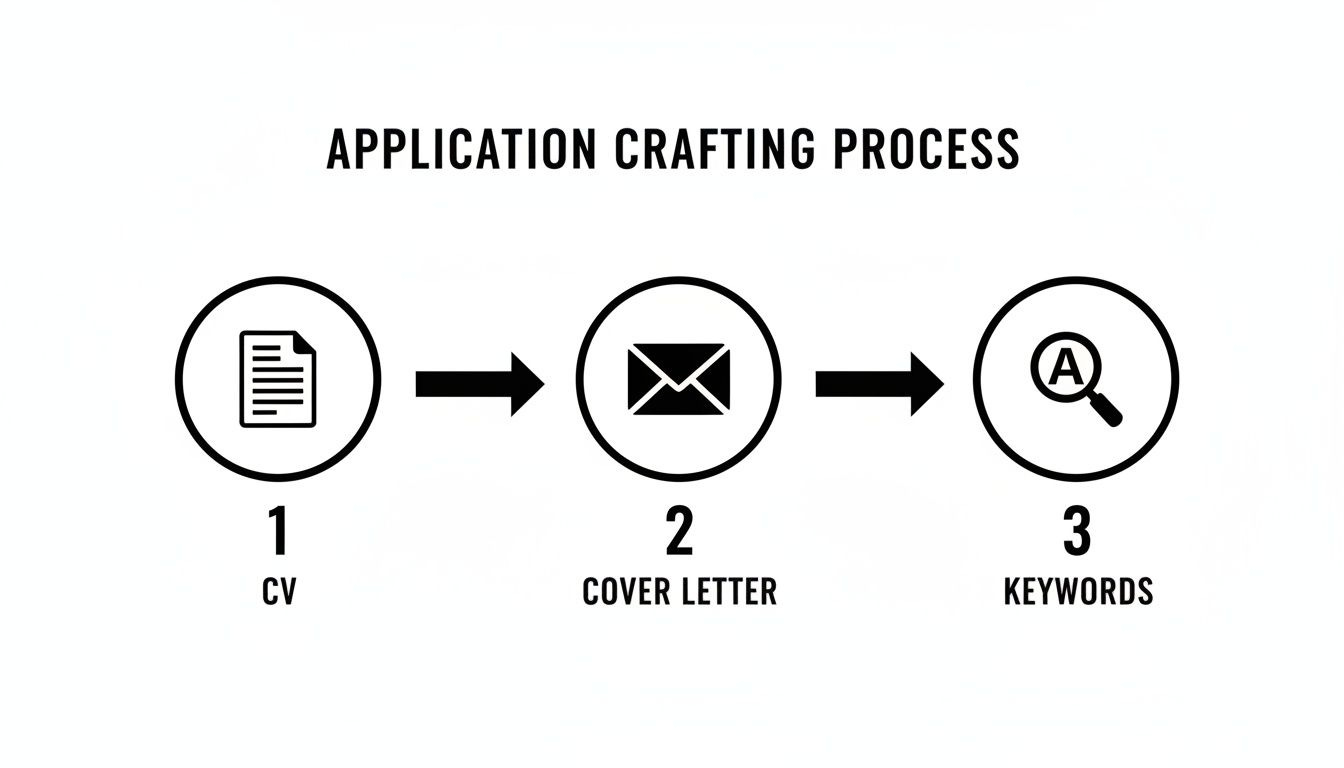
Each step builds on the last, making sure your application is strong enough to pass the initial screening and actually land you in the interview room.
Mastering the STAR Method for Behavioral Questions
When you hear a question that starts with “Tell me about a time when...,” your brain should immediately switch to the STAR method. It’s a structured way to answer behavioral questions that gives recruiters exactly the evidence-based response they’re trained to look for.
Situation: Briefly set the scene. What was the challenge or project?
Task: What was your specific responsibility in that situation?
Action: Detail the concrete steps you took to handle the task.
Result: Explain the outcome. This is where you need to quantify your impact with numbers and data whenever you can.
The biggest mistake candidates make is giving vague, theoretical answers. The STAR method forces you to provide concrete, real-world proof of your abilities. Practice it until it becomes second nature.
The context of your answers is also critical. These institutions are facing a period of huge growth and change. Multilateral Development Banks are massively increasing their lending capacity, with reforms projected to add up to $400 billion in extra resources over the next decade.
This expansion is creating a surge in jobs focused on private capital mobilization and innovative financing. If you can discover more about how MDBs are scaling up their impact, you can tailor your STAR examples to show experience in these high-priority areas. That will make your answers far more powerful.
Preparing for Assessment Centers
For some roles, especially in the competitive Young Professional Programs, you might be invited to an assessment center. These are intense, often day-long events where you’ll participate in a series of individual and group exercises while being watched by assessors.
Common exercises include:
Group Discussions: You’ll be given a problem to solve as a team. Assessors are watching to see how you contribute, listen, and help the group reach a decision.
In-Tray Exercises: You’ll get a simulated inbox full of emails, memos, and reports and be asked to prioritize tasks and decide on a course of action, all under a tight time limit.
Role-Playing Scenarios: You might have to simulate a difficult conversation with a stakeholder or negotiate a project detail with a government official.
The key to succeeding here is to stay calm, structured, and collaborative. They’re testing your soft skills just as much as your technical knowledge. Show them you can think clearly under pressure and work effectively with others.
A Few Lingering Questions
You’ve made it this far, which tells me you’re serious. But even with a solid game plan, a few nagging questions can create doubt. Let’s tackle the most common ones I hear, so you can move forward with confidence.
What’s the Real Difference Between a Staff Position and a Consultancy?
Think of it like this: a staff position is the holy grail. It’s a permanent or long-term contract that comes with the full package: benefits, a pension, and a clear career path inside the organization. These are the core roles that offer stability and let you become part of the institutional fabric. They also carry the strictest nationality requirements.
A consultancy, on the other hand, is a short-term contract for a specific project or piece of work. You’re hired for your expertise, usually paid a daily or monthly rate, and you don’t get the same benefits as staff.
While consultancies lack long-term security, they are an absolutely brilliant way to get your foot in the door. Many successful staff members started as consultants, using the opportunity to prove their worth and build relationships from the inside.
How Important Is Networking, Really?
It’s critical, but not in the way most people think. This isn’t about awkwardly asking strangers for a job. It’s about building genuine professional relationships to gather intelligence that makes your application ten times stronger.
Start by attending webinars the organizations host. Connect with current staff on LinkedIn, but don’t just send a generic request. Mention a recent project they worked on or ask an intelligent question about their team’s focus. This shows you’re engaged and have done your homework.
Networking alone won’t get you a job you’re unqualified for. But a strong professional network can make your name familiar to a hiring manager, giving your application a crucial edge when it lands on their desk.
Think of it as intel gathering. The more you understand an organization’s current headaches and priorities, straight from the people doing the work, the better you can frame your CV and cover letter to be the solution they’re looking for.
Do I Actually Need a PhD to Work at the World Bank or IMF?
This is probably one of the biggest misconceptions out there. A PhD is not mandatory for most roles, but its importance depends on the job family you’re targeting.
For the pure economist and research positions, yes, a PhD is often a hard requirement or at least a massive advantage. Those roles demand deep theoretical knowledge and advanced quantitative skills.
However, for the vast majority of operational roles, like project management, finance, or sector-specific work in areas like energy or health, a Master’s degree paired with significant, real-world field experience is the gold standard. In many cases, practical, on-the-ground experience is valued far more than another academic credential.
Bottom line: always read the specific job description. The requirements vary wildly from one role to the next.
Seriously, How Long Does the Hiring Process Take?
Brace yourself: it’s long. Painfully long. From the day you hit “submit” to the day you get a final offer, the timeline can easily stretch from three to six months, and sometimes even longer. This isn’t a sign they’re not interested; it’s just the reality of large, bureaucratic institutions with layers of internal approvals.
A typical hiring journey looks something like this:
Initial Screening: Your application gets reviewed by an automated system and then by HR.
Shortlisting: The hiring manager sifts through the top candidates.
Assessments: You might face a technical test, a presentation, or a case study.
Interview Rounds: Expect two or three rounds, often culminating in a final panel interview.
Reference Checks & Offer: The final hurdles before an official offer is made.
Patience is non-negotiable. The best strategy is to adopt a “fire and forget” mentality. Pour everything into making your application perfect, send it off, and then immediately move on to the next one. Don’t put your job search on hold waiting to hear back. It’s the only way to keep your momentum up and avoid the stress of the long wait.
At Multilateral Development Bank Jobs, we cut through the noise to bring you the best opportunities and insights. Our newsletter delivers curated staff and consultant listings from over 30 MDBs and UN agencies directly to your inbox, along with deep-dive guides to help you land the role. Subscribe to MDBjobs.com today and take control of your career in international development.