

Landing a job at the International Labour Organisation is a serious career move. You’re joining a UN agency focused on advancing social justice and promoting decent work for everyone. This is a commitment to shaping global labor policies and making a real-world impact.
Before you glance at a vacancy, you need to understand what the ILO is all about.
What Working for The ILO Really Means
This isn’t just another international relations gig. The ILO operates at the complex intersection of governments, employers, and workers’ unions. This unique tripartite structure is the bedrock of everything it does. Your role, whether in research, policy, or field operations, is to navigate these dynamics and build consensus on what fair labor looks like.
The challenges are massive. You could be tackling child labor one day and debating the future of work in an age of AI the next. You have to be analytical, diplomatic, and incredibly resilient to thrive here. The work is never simple and involves high-stakes negotiations on politically charged issues.
The Global Labor Landscape
To understand the ILO’s mission, you have to appreciate its scale. The organization is on the front lines of the global ‘jobs gap’, a metric that measures true labor underutilization, not just unemployment.
Recent analyses show this gap was estimated at about 402 million additional jobs needed in 2024 to stabilize the global labor market. That number, combining the unemployed and underemployed, paints a stark picture of the problem. You can get more context on the global labour market landscape on WEFORUM.org.
This is the driving force behind every ILO project. Your work, in some way, will be about chipping away at that number.
A career at the ILO is about buying into a global mission. It’s for people who see the direct line connecting decent work to stable, prosperous societies and are ready to dedicate their skills to that cause.
The Skills and Mindset Required
Technical expertise is the price of entry. The ILO looks for a specific blend of soft skills. You need to be a razor-sharp communicator, able to draft precise reports one minute and present complex ideas to diverse audiences the next.
Adaptability is everything. You might work on a high-level policy project in Geneva one year and then help implement it in a developing country the next.
Look at the ILO’s homepage. It’s a window into their priorities.
You’ll see a heavy emphasis on fundamental principles, social dialogue, and long-standing initiatives. This reflects a deep commitment to its core mandate. Working here means becoming part of a century-long movement for social justice.
If this mission-driven work resonates with you, also check out our guide on how to land a job at the World Bank for insights into similar institutions.
How to Decode ILO Job Vacancies
The ILO’s job portal is different from corporate careers pages. If you’re new to the UN system, the jargon, contract types, and eligibility rules can trip you up.
Learning to decode these vacancies is the first test in your application process. This is where you shift from casually browsing to strategically targeting the right roles. Get this right and you’ll avoid wasting hours applying for jobs you were never eligible for.
The Anatomy of an ILO Vacancy
An ILO job posting is a detailed blueprint. It tells you exactly who they’re looking for, but you have to know where to find the clues.
Focus on three critical data points right away: job grade, contract type, and duty station. These three elements give you an instant snapshot of the role’s seniority, stability, and location.
The job grade is especially important. You’ll see codes like P-3 or G-5:
P-Levels (Professional and Higher Categories): These are internationally recruited staff roles. They require an advanced university degree and a solid track record of professional experience. A P-2 is an entry-level professional spot, while a P-5 is a senior expert.
G-Levels (General Service and Related Categories): These are locally recruited support staff roles. The focus is on relevant technical skills and experience within the duty station’s country. You must already have the legal right to work in that country to be considered.
Understanding this distinction is non-negotiable. If you’re a mid-career professional from Canada eyeing a global role, filter for P-level jobs, not a G-5 position based in Bangkok.
What Kind of Gig Is It, Really?
The contract type tells you the nature of the work and its duration. It’s your most important filter for matching the opportunity to your career goals. Are you looking for a long-term career, a project-based assignment, or a short-term expert gig? The contract type holds the answer.
Here’s a quick breakdown of what you’ll typically find.
ILO Contract Types at a Glance
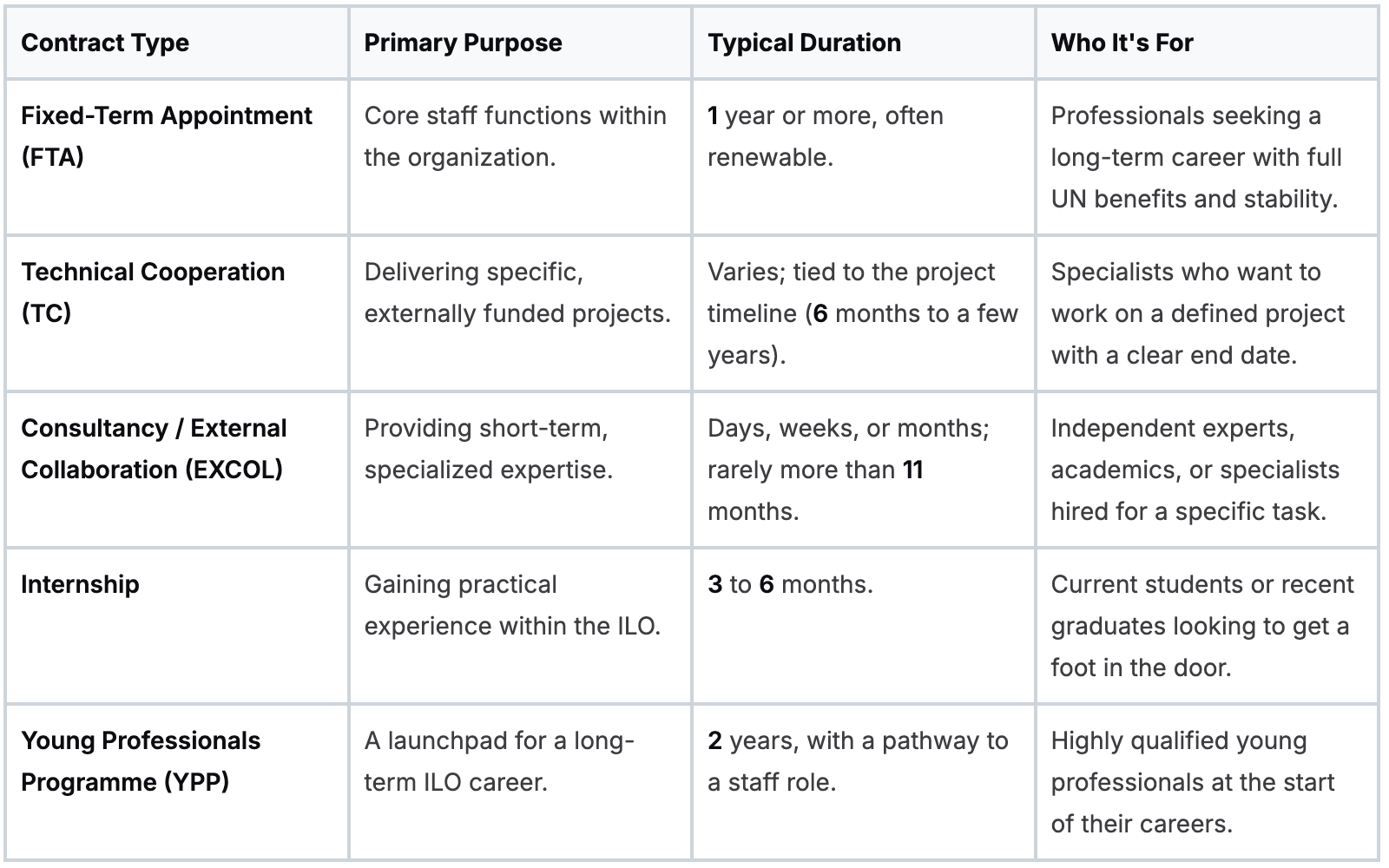
Before you get excited about a vacancy, check the contract type. It immediately tells you if the role aligns with what you’re looking for.
Reading Between the Lines
Once you’ve sorted the basics, dissect the “Qualifications” and “Competencies” sections. This is where the hiring manager reveals what they need. Don’t just skim this part. Print it out, grab a highlighter, and mark every single keyword.
The Qualifications section is a hard filter. If it says “seven years of professional experience,” five and a half won’t cut it. The UN system is rigid on these requirements. It also lists mandatory education and language skills. There is no wiggle room.
The Competencies section is about the “how.” This is where you’ll find valued behavioral skills like “Orientation to learning & knowledge sharing,” “Collaboration,” and “Communication.” Your job is to brainstorm concrete examples from your past that prove you have these skills, ready for your cover letter and interview.
This section also reveals the ILO’s big-picture priorities. The organization tracks how the world of work is shifting. For example, recent ILO-modelled data from Worldbank.org highlights major structural changes, like the growing dominance of the services sector.
You might also see trends reflected in job requirements, like the need to understand gender dynamics. Between 2013 and 2023, the share of women in high-skill jobs rose from 21.2% to 23.2%, while men’s share was near 18%. This signals both progress and persistent gaps, nuances you’d be expected to grasp in many ILO roles.
This simple decision tree can help you visualize if an ILO career aligns with your core motivations.
Ultimately, it boils down to one question: Are you driven by a deep sense of mission and a desire to make a tangible, global impact? If yes, then navigating the ILO’s application process is a challenge worth taking on.
Crafting an Application That Gets Noticed
Let’s get one thing straight: sending a generic resume to the ILO is the fastest way to get your application deleted. The ILO, like most UN agencies, uses a structured, formal system that demands precision. Treating this like any other application sets you up for failure.
The entire process is a filter designed to weed out candidates who aren’t committed or can’t follow instructions. Your first test is to prove you can play by their rules. That means mastering their specific application format and tailoring every word to the vacancy.
Master The Personal History Form
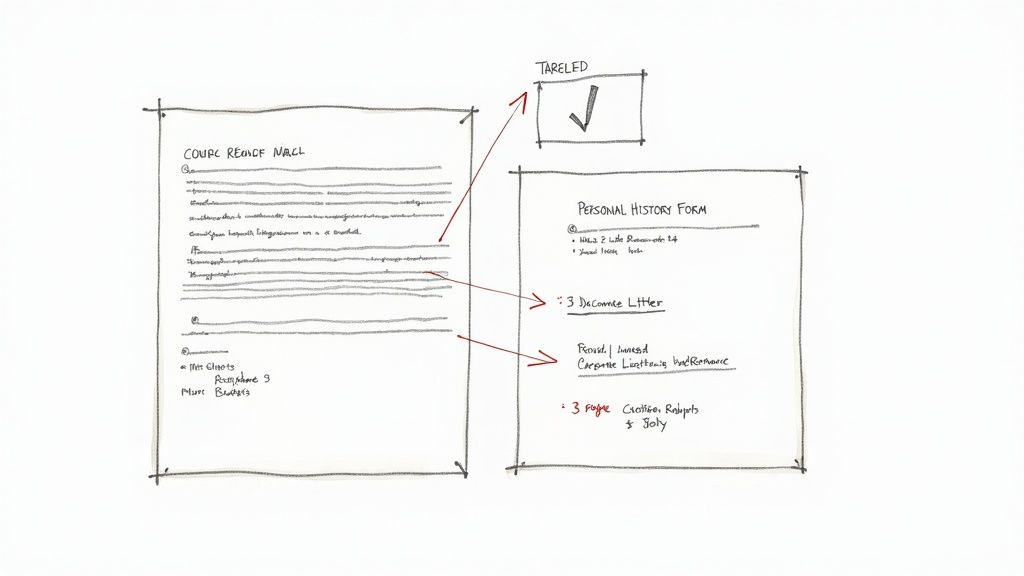
The cornerstone of your ILO application is the Personal History Form (PHF). In the wider UN system, it’s often called a P.11 form. This is not a resume. It’s a detailed, standardized document where you must meticulously list your education, languages, work history, and references.
Treat every field on this form with total seriousness. Vague descriptions are useless. You need to frame your experience using the exact language and keywords from the job description.
If the vacancy asks for experience in “tripartite social dialogue,” your work history entries better use that exact phrase and describe how you engaged in it. This is about translating your experience into the ILO’s specific dialect.
Your PHF is a compliance document first and a marketing document second. Its purpose is to prove you meet the non-negotiable requirements. Get it wrong, and a human will likely never see your cover letter.
This process of mapping your background to a role is standard in major international organizations. If you’re applying for international labour organisation jobs, you might find our guide on how to apply for World Bank jobs useful, as it offers more context on these rigorous application systems.
Quantify Everything
“Managed projects” is meaningless.
“Managed a $1.2 million project on youth employment in Southeast Asia, coordinating with 3 government ministries and 5 NGOs to improve outcomes for 5,000 beneficiaries” gets you shortlisted.
Every claim you make needs to be backed by numbers. Quantifying your achievements does two critical things:
It provides concrete evidence of your impact. Numbers are a universal language showing the scale and success of your work.
It proves you are a results-oriented professional. The ILO needs people who deliver measurable outcomes, not just people who complete tasks.
Go back through your career history and find the data. How many people did you train? What was the budget you managed? By what percentage did you increase efficiency? These details transform your PHF from a list of duties into a compelling case for your candidacy.
Map Your Skills to ILO Competencies
Every job description lists core and technical competencies. These are the specific skills and behaviors the ILO identified as critical for success. Your job is to prove you have them.
Create a simple table. In one column, list every competency from the vacancy. In the next column, write down a specific, real-world example from your past that demonstrates you using that competency.
Example Competency Mapping
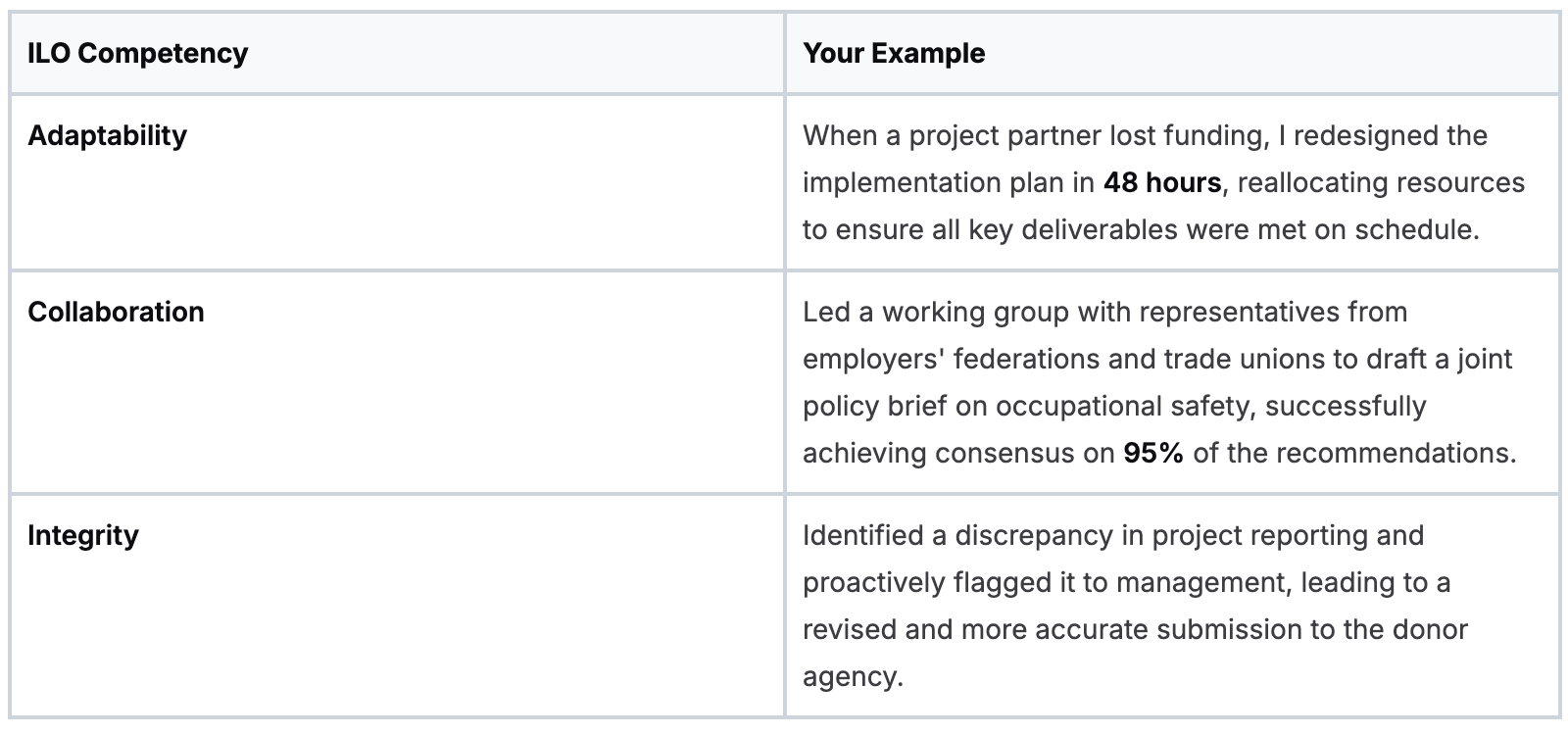
This is more than prep work. You will use these exact, hard-hitting examples in your cover letter and competency-based interview. It is the most effective way to show, not just tell, the hiring manager that you’re the perfect fit. Your application becomes a direct, compelling answer to their needs.
Navigating The ILO Assessment and Interview

If your application makes the cut, you’ve cleared the first major hurdle. Now the real evaluation begins. The ILO uses a tough, multi-stage assessment process to see how you perform under pressure. It’s built to find people who can do the work, not just talk about it.
This is where you move beyond your Personal History Form and have to prove your skills. You’ll be tested on your technical expertise, problem-solving abilities, and your fit for the ILO’s culture. Treat this phase with the same care you put into your initial application.
The Written Assessment Gauntlet
Before you get to a face-to-face interview, you’ll almost certainly face a written test. This is a practical exercise that mimics tasks you’d handle in the role. The format depends on the job, but it usually falls into one of these categories:
Technical Exercise: A straightforward test of your core skills. A research officer might get a dataset and be asked to summarize the findings. A communications specialist could be tasked with drafting a press release.
Case Study: You’ll be given a scenario reflecting a real-world challenge. Your job is to analyze it, pinpoint the key issues, and propose a concrete course of action, often as a brief or memo.
Policy Brief: For policy-heavy roles, expect to write a concise brief on a specific labor issue. You’ll need to outline the background, challenges, and potential policy recommendations.
The point isn’t just finding the “right” answer. Assessors are looking at your analytical thinking, writing clarity, and ability to build a coherent argument on a tight deadline. They want to see how your brain works.
The written assessment is your first chance to show off your professional judgment. They are testing your ability to digest complex information and produce high-quality work efficiently. Think of it as your first official assignment.
Mastering The Competency-Based Interview
If you pass the written test, you’re on to the competency-based interview. This is a highly structured conversation where every question is designed to get a specific example of your past performance. The panel isn’t interested in what you would do; they want to hear what you did.
Your best tool here is the STAR method. Frame every answer around these four points:
Situation: Briefly set the scene. What was the project or challenge?
Task: What was your specific responsibility?
Action: Describe the exact steps you took. Always use “I,” not “we.”
Result: Explain the outcome. Quantify it if you can. What was the impact?
This structure forces you to provide hard evidence. Prepare by pulling up the competency list from the job description and developing at least two solid STAR examples for each one. Rehearse them until they sound natural. For a deeper dive into what hiring panels look for, check our piece offering insights from an MDB interview panellist.
Answering The Tough Questions
The panel will dig into your technical knowledge, your grasp of the ILO’s mandate, and your people skills. They might ask how you’d navigate a disagreement with a tripartite partner or pivot a project after a budget cut. Your answers need to show both professional expertise and an understanding of the complex political world the ILO occupies.
This is especially true as the organization grapples with a changing world of work. For example, the ILO recently revised its global employment growth outlook downward. The World Employment and Social Outlook (WESO) Update estimates that nearly one in four workers may have their jobs transformed by generative AI. This puts technology, skills, and policy at the center of the conversation.
Showing you’re on top of these macro trends proves your interest in international labour organisation jobs is backed by real knowledge. It signals that you’re not just a capable candidate, but a thoughtful and informed one.
Your technical skills and experience get your application past the first filter, but they won’t land you the job. To succeed in the competitive world of international labour organisation jobs, you must prove you live and breathe the behavioral skills, the core competencies, that define an ILO professional.
These aren’t corporate buzzwords. They’re the DNA of the organization, forged from the challenges of its tripartite structure (governments, employers, and workers) and its global social justice mission.
Simply writing “good communicator” on your application is a waste of space. You need to show it with concrete, compelling evidence.
It’s About More Than Your CV
The ILO publishes its core competencies, and this is where many candidates go wrong. They treat it like a checklist. The real challenge is showing you understand what these skills mean inside the ILO’s world. Skills are applied to solve messy, real-world problems.
Let’s break down the big ones and what they look like on the ground.
Adaptability: This means staying effective when your project’s funding is cut, when a new government’s priorities change your mandate, or when you’re reassigned to a new country with a different cultural landscape.
Collaboration: At the ILO, this is a high-level political skill. It means forging consensus between a government ministry cutting costs, a trade union fighting for stronger protections, and an employers’ federation worried about business impact. It is navigating conflict to find common ground.
Integrity: This is non-negotiable. It means transparently flagging project delays, upholding ILO standards even when it’s politically inconvenient, and making sure your work always aligns with the core principles of social justice.
Saying you have these skills means nothing. You need powerful stories from your career that bring these competencies to life.
How to Frame Your Experience
Your application and interview are your stage. Connect your past actions directly to the ILO’s needs, making it impossible for the hiring panel to imagine anyone else doing the job.
Think about how your experience translates. Have you ever worked on a complex multi-stakeholder project? Don’t just say that. Frame it in the language of ILO collaboration.
For example, instead of this:
“I led a multi-stakeholder project.”
Try this:
“I facilitated a working group with three government agencies and four community organizations, each with competing priorities. By establishing shared goals from the outset and maintaining a transparent communication plan, I secured unanimous agreement on a five-year strategic plan, resolving a stalemate that had lasted over a year.”
The second version provides a concrete example and uses the language of consensus-building, the lifeblood of the ILO’s work.
Connect to the ILO’s Soul
The candidates who stand out show they get the organization’s soul. The ILO is relentlessly focused on promoting decent work and social justice. This isn’t a marketing tagline; it’s the core mandate that drives every project and policy decision.
Your ability to demonstrate a real commitment to diversity and inclusion is critical. This means showing you have actively sought out and woven diverse perspectives into your work to get better, more equitable results. Can you prove you can work effectively with people from every conceivable background?
Likewise, show you’re oriented towards learning. The world of work is in constant flux. You have to demonstrate that you are a lifelong learner who actively seeks new knowledge and shares it with your team.
Your technical skills will open the door. Your proven ability to collaborate, adapt, communicate, and act with unshakeable integrity will convince the ILO you belong there. Get your stories straight, quantify your impact, and learn to speak their language.
So, you’ve made it through the final interview. Take a breath, but don’t celebrate just yet. The waiting game has begun.
The period after your panel interview for an international labour organisation job can feel long and frustratingly quiet. To stay sane, you need to understand what’s happening behind the scenes.
This isn’t a fast-moving tech startup. The ILO, like any massive UN agency, operates on its own timeline, governed by a multi-layered internal review and approval process. Even after the interview panel makes its recommendation, your file has to travel through several administrative and HR checkpoints. This journey can take several weeks, and often a few months.
The Post-Interview Timeline and Following Up
Your first instinct might be to start sending emails to check on your status. Resist that urge. A single, polite follow-up email about two to three weeks after your interview is perfectly fine. Thank the panel again and briefly reiterate your strong interest.
After that, let the process run its course. Bombarding them with messages won’t speed anything up and can come across as unprofessional.
While you’re waiting, here’s what’s happening on their end:
Internal Review: The hiring manager and the panel finalize and formally submit their recommendation.
Reference Checks: If you’re the top candidate, HR will start contacting your references. A call to one of your references is a fantastic sign.
The Approval Gauntlet: The recommendation goes up the chain of command for final budget and administrative approval. This can involve multiple departments and senior managers.
Understanding Rosters and Rejection
Sometimes, the outcome isn’t a straightforward “yes” or “no.” You might be told you’ve been placed on a roster. This is good news. It means you were a highly qualified candidate, but another applicant barely edged you out.
Being rostered means you are pre-approved for similar roles that pop up in the near future, often for up to two years. You’ve got a foot in the door without having to go through the whole application and interview process again.
If you get a rejection, treat it as a data point, not a personal failure. The UN system is unbelievably competitive. You can ask for feedback, but don’t be surprised if you get a generic response. The key is to analyze where you can strengthen your profile for the next opportunity.
Handling both offers and rejections with professionalism is critical. The world of international development is small, and your reputation starts building from your first application. Finishing the process with grace keeps the door open for future roles at the ILO and other UN agencies.
Your Top Questions About ILO Jobs, Answered
Got a few nagging questions about what it’s really like to apply for a job at the International Labour Organization? Let’s clear some things up.
How long does the hiring process take?
First, a reality check. The ILO, like most UN agencies, isn’t known for speed. From the day a vacancy closes to a final decision, you should realistically expect the process to take anywhere from four to six months. It’s a marathon, not a sprint. Patience is essential.
What are the real education requirements?
It depends entirely on the job level. For most professional roles (the P-staff), a master’s degree is the standard expectation. Don’t count yourself out if you only have a bachelor’s degree. If you have significant, directly relevant work experience, you can still be a strong candidate.
For General Service positions (G-staff), the bar is different. These roles typically require a high school diploma, often supplemented by specialized training or certifications. The key takeaway: always read the specific requirements in the vacancy announcement.
How important are languages?
Crucial. You must be proficient in either English or French to be considered. Think of it as a non-negotiable entry ticket.
To really stand out, having a working knowledge of the second language is a massive advantage. If you’re eyeing a field position, fluency in other official UN languages like Spanish, Arabic, Russian, or Chinese can make or break your application. On-the-ground roles demand strong multilingual skills.