

If you’re serious about a career in development finance, the African Development Bank’s Young Professionals Program (YPP) should be on your radar. It’s the bank’s premier pathway for cultivating its next generation of leaders. This is a structured, three-year rotational program designed to give you a 360-degree view of the bank’s operations. It is a golden ticket for a long-term career in multilateral development.
What Is the African Development Bank YPP
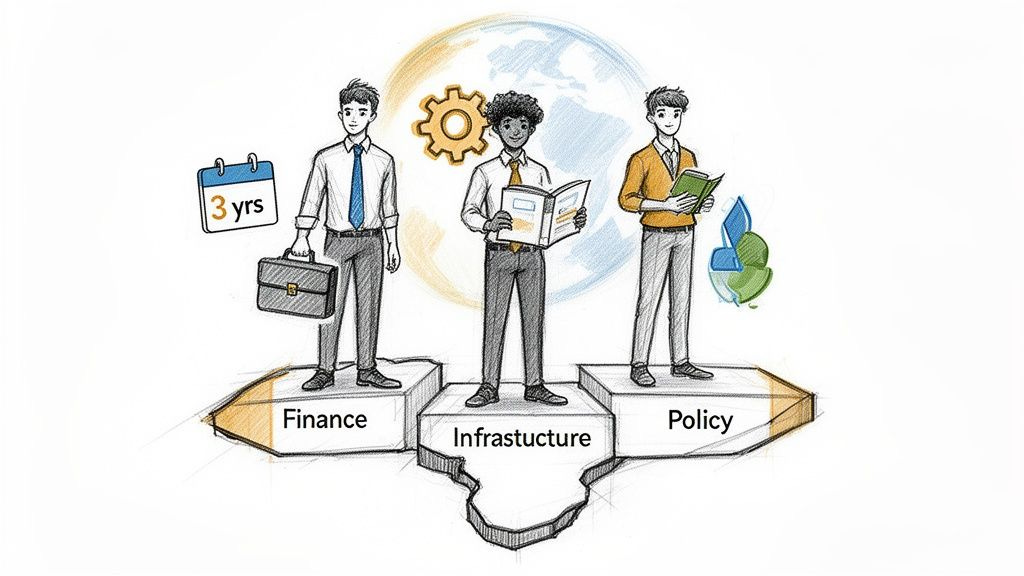
First things first, the AfDB YPP is one of the most competitive entry points into the development world. Don’t mistake it for an internship. You are hired as a full-time staff member from day one with a clear trajectory for growth. It’s a career accelerator.
The program’s purpose is to build a pipeline of future experts who will drive Africa’s economic and social transformation. The AfDB is looking for high-potential, deeply motivated people who are genuinely committed to the continent’s future.
The AfDB YPP shapes you into a future leader. It’s arguably the best way to get on a meaningful career path that ultimately leads to a senior role in the development world.
Let’s break down the core components of the program.
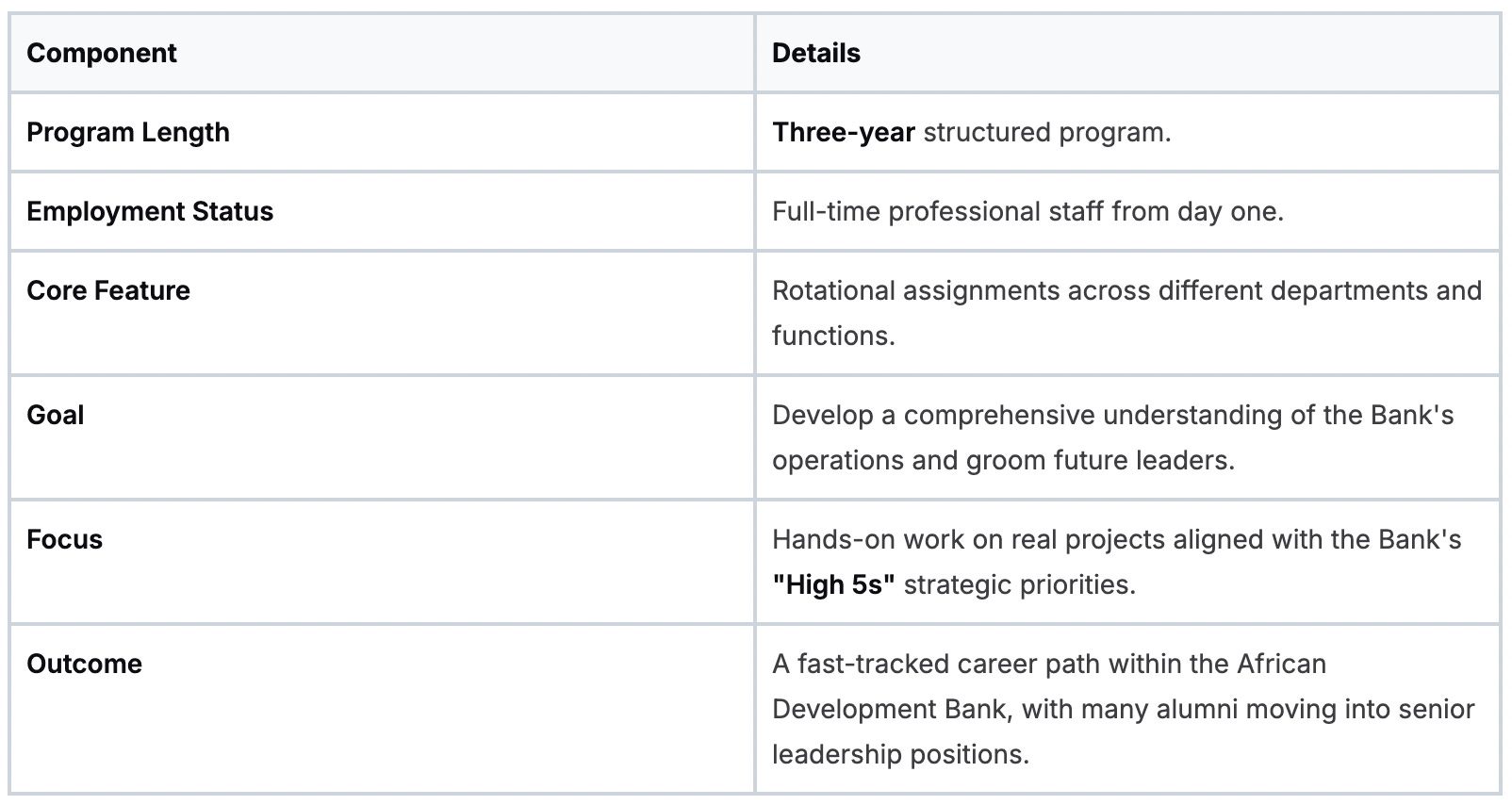
This table gives you the high-level view, but the real value is in the structure and experience you gain on the ground.
Program Structure and Rotations
The YPP is a three-year journey defined by its rotational structure. This makes it so valuable. You won’t get stuck in one department, siloed away from the bigger picture.
You’ll rotate through different parts of the bank, getting direct, hands-on experience in its most critical functions. This design ensures you grasp the entire project lifecycle, from initial concept and financing all the way to implementation and impact evaluation. You’ll work on real projects that have a tangible effect on people’s lives.
These rotations could land you in assignments like:
Infrastructure Finance: Working on massive energy, transport, or water projects that connect the continent.
Private Sector Development: Supporting entrepreneurs and helping attract investment to fuel growth.
Regional Economic Integration: Contributing to policies that break down trade barriers and foster cooperation.
Country and Policy Dialogue: Engaging directly with governments to help shape national development strategies.
A Focus on Strategic Priorities
As a Young Professional, your work is directly tied to the bank’s core strategic goals. These are known as the “High 5s,” and they represent the institution’s blueprint for transforming Africa. You absolutely need to know them.
Light up and Power Africa
Feed Africa
Industrialise Africa
Integrate Africa
Improve the quality of life for the people of Africa
Everything you do will connect back to one or more of these priorities. This ensures your work is always aligned with the bank’s mission. You might also want to check out our broader look at what it takes to land a job at a multilateral development bank.
Since its early days, the YPP has been a cornerstone for nurturing Africa’s future leaders. In its initial phases, the bank hired around 20 young professionals each year, targeting driven individuals under 32 from its 81 member countries. Most successful applicants come in with a Master’s degree in a relevant field like Economics, Engineering, or International Development. This highly selective approach has built a legacy of excellence that continues today.
Meeting the AfDB YPP Eligibility Criteria
Before you pour hours into your application for the African Development Bank YPP, you need to get past the gatekeepers. The bank has a set of strict, non-negotiable eligibility criteria. If you don’t tick every single box, your application won’t make it past the first screening.
These rules are black and white. There’s no grey area, so review them carefully before you start your application.
The AfDB wants proven professionals, not recent graduates hunting for their first job. This is a critical distinction from other programs. They want people with a solid foundation of expertise who are ready to be fast-tracked into leadership.
The Four Pillars of Eligibility
The eligibility requirements are four pillars holding up your application. If one is missing, the whole thing comes crashing down. You must satisfy all of them to be a serious candidate.
These criteria filter for applicants who bring the right blend of nationality, age, education, and proven experience to thrive in the demanding world of a multilateral development bank.
Nationality: You must be a citizen of an African Development Bank Group member country. This includes 54 African (Regional) countries and 27 non-African (Non-Regional) countries. This is a hard requirement.
Age: You must be 32 years of age or younger by the official cutoff date, which is almost always December 31 of the application year. This is a firm ceiling with no exceptions.
Education: A Master’s degree is the minimum qualification. Your degree must be in a field that’s directly relevant to the bank’s operational priorities, like economics, finance, engineering, public policy, or agriculture.
Experience: You need at least three years of relevant, post-Master’s professional experience. This is the hurdle where many applicants fall. The clock on your experience only starts ticking after you’ve officially completed your graduate degree.
The experience requirement is the single most important differentiator for the AfDB YPP. The bank is hiring for demonstrated competence. Your work history must show a clear track record in development and an ability to get things done.
This approach ensures every Young Professional can hit the ground running and contribute from day one. They’re expected to have the practical skills and professional maturity needed to navigate complex projects and tough stakeholder negotiations.
What Counts as “Relevant” Professional Experience?
That term “relevant experience” is intentionally specific. Your work history needs to align directly with the bank’s key strategic priorities, its famous “High 5s.” A job for three years isn’t enough. The substance of that work is what really matters.
Your experience must tell a compelling story of your impact in one of these areas:
Light up and Power Africa: Experience in energy projects, renewable energy finance, or power sector policy reform.
Feed Africa: A background in agricultural economics, agribusiness, food security initiatives, or rural development.
Industrialise Africa: Work related to private sector development, industrial policy, trade finance, or value chains.
Integrate Africa: Experience in regional integration projects, transport infrastructure, or cross-border trade facilitation.
Improve the quality of life for the people of Africa: A history in social sectors like public health, education, water, and sanitation.
When you describe your experience, connect the dots for the recruiters. Frame your achievements within the context of these priorities. For example, instead of saying you “managed financial models,” explain how your financial modeling helped secure $15 million for a new solar power project.
Quantify your impact wherever you can. This shows you get the bank’s results-focused culture. Proving this alignment is what makes your application stand out.
How to Navigate the YPP Application and Timeline
Applying to the African Development Bank YPP is a marathon. You need to be prepared for a long haul. The entire process, from submission to a final offer, can stretch out for the better part of a year. Settle in and approach this with a long-term mindset.
The application window is predictable, usually opening in the fall around September or October and closing near the end of November. This is for the cohort that will start the following year. Mark your calendar because that deadline is firm. Miss it, and you wait another full year.
This isn’t a simple CV upload. The initial application is where the work begins. You’ll fill out a detailed online form and craft several competency-based statements to showcase your skills and experience.
The Application and Screening Stage
The online application is your first big hurdle. It’s designed to filter out candidates who lack the right qualifications or the dedication to see a detailed application through. You’ll need to provide specifics on your education, professional history, and skills.
The most critical part of this stage is the competency-based questions. You’ll be asked to provide written examples of how you’ve demonstrated teamwork, leadership, or problem-solving. Vague claims won’t get you anywhere. You have to back them up with concrete stories of what you actually accomplished.
Once you submit, the waiting game begins. The initial screening and longlisting can take several months, often running from December into the early months of the new year. Don’t get discouraged by the silence. They’re sifting through thousands of applications.
This infographic lays out the fundamental criteria your application must meet to get past the first human resources screen.
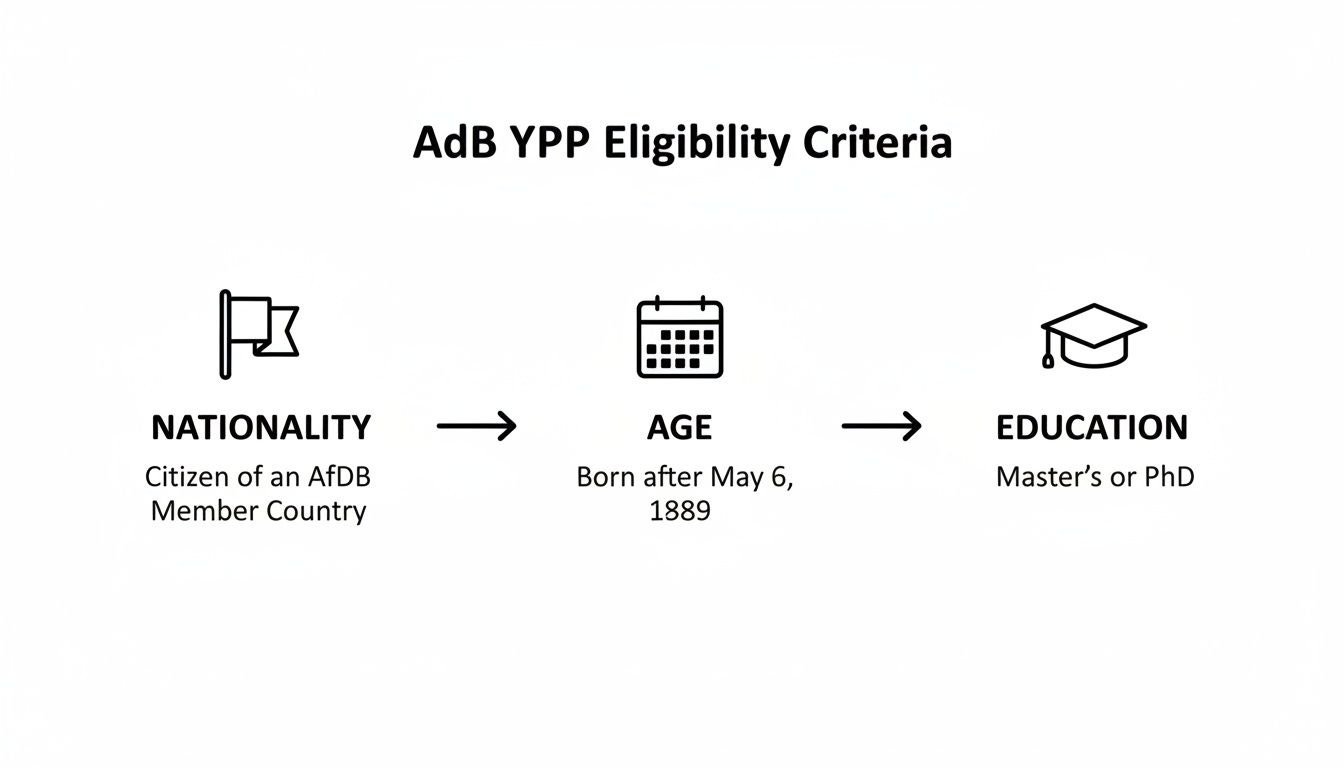
These three pillars, nationality, age, and education, are the non-negotiable entry points. If you don’t meet these, your application stops here.
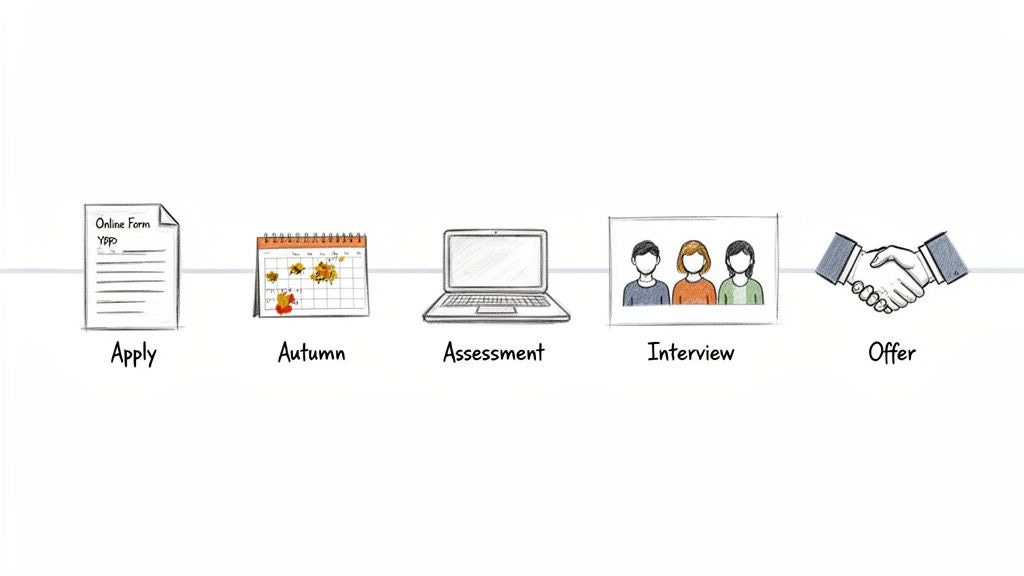
To give you a clearer picture, here’s a rough breakdown of how the selection process unfolds.
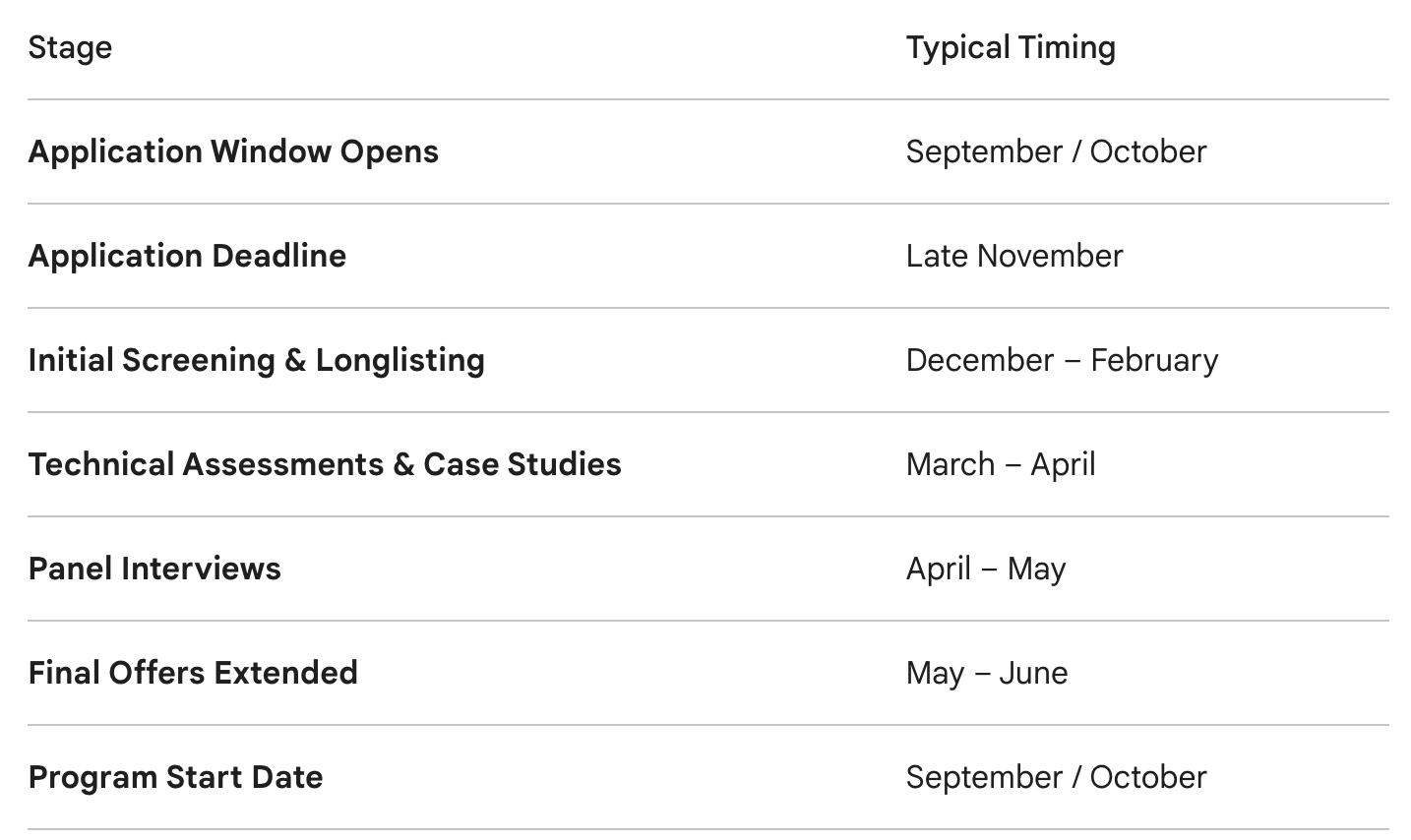
Keep in mind that these are estimates. The AfDB’s timelines can shift, but this gives you a solid framework for planning your job search and managing expectations.
The Assessment and Interview Stages
If your application makes the longlist, you’re moving on to the assessment stage. This is where things get technical, and it typically kicks off in the spring.
Longlisted candidates usually have to tackle one of two types of assessments:
An Online Technical Test: This exam is tailored to the field of expertise you declared on your application. An energy specialist will get questions on power systems, while a health economist will be tested on healthcare financing models.
A Written Case Study: You’ll be handed a scenario based on a real-world development project. Your job is to analyze the data, pinpoint the main challenges, and propose a solid course of action. This tests your analytical chops and your ability to think like a Bank staffer under a time crunch.
Only the top performers from this stage get an invitation to the final hurdle: the panel interview. This is a comprehensive interview with a panel of senior Bank staff and managers. They are there to assess three things:
Technical Knowledge: They will dig deep into your claimed expertise. Be ready to defend your experience and knowledge.
Behavioral Competencies: They’ll grill you with questions about how you’ve handled specific professional situations.
Cultural Fit: They want to see your genuine passion for Africa’s development and make sure you align with the AfDB’s mission and values.
This final stage is your chance to prove you’re the complete package. If you nail it, you can expect to receive an offer for the African Development Bank YPP in the late spring or early summer, with the program officially kicking off in the fall.
If you’re mapping out your broader job search, you might want to check out our guide on how long it typically takes to land a multilateral development bank job.
Mastering the Assessment Center and Panel Interview
Making it to the longlist for the African Development Bank YPP is a huge accomplishment, but now the real work begins. The assessment center is the gauntlet. The Bank puts your application under a microscope here, looking for hard evidence that you have the technical chops, structured thinking, and behavioral skills to perform in a high-stakes environment.
This is your chance to prove you’re more than an impressive CV. The entire stage simulates the pressures of working at the AfDB, combining technical tests, case studies, and a final, intensive panel interview. Nailing this stage separates the serious contenders from the rest of the pack.
Breaking Down the Technical Test
The first hurdle is usually a technical test tailored to your specific field. This isn’t a generic aptitude quiz. It’s a deep dive into the practical knowledge needed for your declared specialization.
A finance professional can expect questions on project finance modeling, risk analysis, or debt sustainability frameworks.
An agricultural economist will face questions on value chain analysis, food security policy, or climate-resilient agriculture.
An infrastructure engineer should be prepared for topics like transport logistics, energy grid stability, or water resource management.
The bank needs to know you can hit the ground running. They’re verifying that you have the foundational knowledge to contribute from day one and hold your own in daily technical conversations.
The bank is saying, “You’ve told us what you can do. Now, show us.” The technical test and case study are where your expertise moves from a line on a resume to a demonstrated capability. This is where you prove you have the analytical horsepower the AfDB is looking for.
Your preparation here has to be laser-focused. Review the core concepts in your field, especially how they apply to development in the African context. Dust off your knowledge of key models, theories, and best practices.
Conquering the Case Study
Next, you’ll likely face the case study. You’ll be handed a packet of information like data, reports, and project descriptions about a development challenge and given a strict time limit to analyze it and present recommendations. This exercise is about showcasing your thought process.
The assessors want to see if you can:
Quickly digest complex information from multiple sources.
Pinpoint the core problem and identify key stakeholders.
Develop a structured analysis that logically weighs the pros and cons.
Formulate clear, actionable recommendations that are practical and well-defended.
For instance, you might get a file on a proposed dam project and be asked to assess its economic viability, environmental impact, and social risks. You need to structure your response logically, perhaps starting with a sharp executive summary, followed by your analysis of each area, and ending with a decisive recommendation and a risk mitigation plan.
The STAR Method for the Panel Interview
The final showdown is the competency-based panel interview. You’ll sit across from a group of senior AfDB staff who will grill you on your past performance to predict your future success. They’ll use behavioral questions that almost always start with phrases like:
“Tell me about a time when...”
“Describe a situation where you had to...”
“Give me an example of how you...”
Your best and only defense here is the STAR method. It’s a simple but powerful framework for giving concrete, evidence-based answers. Vague, generic responses will sink your chances.
Here’s how to structure every single answer:
Situation: Briefly set the scene. Where were you working? What was the project? (1-2 sentences)
Task: What was your specific goal or responsibility? (1 sentence)
Action: Detail the specific steps you personally took. Use “I” statements and focus on your individual contributions, even if it was a team effort. This is the heart of your answer. (3-4 sentences)
Result: Quantify the outcome. What happened because of your actions? Use numbers, percentages, and concrete results to prove your impact. (1-2 sentences)
Let’s say they ask, “Tell me about a time you managed a complex project.” A killer STAR answer sounds like this:
“In my last role (Situation), I was tasked with leading the launch of a $2 million mobile banking platform in a rural market with poor connectivity (Task). I developed a phased rollout plan, personally negotiated partnerships with local telecom providers to improve network access, and led a team of five to design a user-friendly interface for basic phones (Action). As a result, we successfully onboarded 50,000 new users in the first six months, which increased financial inclusion in that region by 15% (Result).”
This structure forces you to be specific, results-oriented, and credible. Mastering it is non-negotiable if you want to succeed in the African Development Bank YPP panel interview.
Crafting a Winning YPP Application Package
Your application is your one and only sales pitch. It’s the first thing AfDB YPP recruiters see, and it’s what decides whether you get a serious look or end up in the digital slush pile. A generic CV and a wishy-washy cover letter are a one-way ticket to rejection.
To even have a chance, you need to tailor every single word to the African Development Bank. This isn’t just about listing your jobs; it’s about framing your entire professional story to prove you’re the exact person the Bank needs. Think of it as translating your experience into their language.
Frame Your Experience with Quantifiable Impact
This is the most common mistake I see. People describe their responsibilities instead of their achievements. The AfDB is a results-driven institution, and its recruiters are trained to spot quantifiable impact. They want to see what you actually delivered, not just what your job description said you were supposed to do.
This means you need to go through your CV and turn every passive description into an active, data-backed accomplishment.
Instead of: “Managed a project budget.”
Write: “Managed a $2M rural electrification project budget, ensuring delivery was 10% under cost projections.”
Instead of: “Involved in a policy research paper.”
Write: “Co-authored a key policy paper on climate adaptation that was adopted by the Ministry of Finance, influencing the allocation of a $5M national fund.”
This shift from responsibility to result is critical. It proves you understand that development work is about creating measurable change. It’s the difference between saying you played the game and showing them the final score.
The most effective applications connect every achievement directly to a development outcome. Your goal is to make it impossible for the reviewer to ignore your tangible contributions to projects, policies, or financial results.
Before you hit submit, go through every line of your CV and ask yourself: “How can I add a number to this?” Whether it’s dollars managed, people impacted, percentages saved, or timelines met, hard data makes your experience real.
Speak the Bank’s Language: The High 5s
Your application has to scream that you understand the AfDB’s mission. The simplest, most effective way to do this is by explicitly linking your experience to the Bank’s “High 5s”. These are the absolute pillars of the Bank’s entire operational focus.
You need to strategically weave these priorities into your personal statement and the descriptions of your work experience.
Light up and Power Africa: Highlight your work on energy projects, renewable finance, or power sector policy.
Feed Africa: Detail your experience in agricultural economics, agribusiness, food security, or rural development.
Industrialise Africa: Emphasize any work related to private sector development, trade finance, or industrial policy.
Integrate Africa: Showcase your involvement in transport infrastructure, regional trade agreements, or cross-border projects.
Improve the quality of life for the people of Africa: Connect your background to social sector work in health, education, or water and sanitation.
When you use the Bank’s own terminology, you send a clear signal that you’ve done your homework. It shows you’re not just looking for any job. You are specifically targeting a career at the AfDB because your expertise lines up perfectly with its goals.
Write a Compelling Personal Statement
Your personal statement brings it all together. It’s your chance to connect the dots between your personal story, professional experience, and where you want to go. This is where you move beyond the facts and figures of your CV and tell a persuasive story.
A strong statement has to do three things:
Explain your “Why”: Why are you committed to Africa’s development? What personal experiences or motivations drive you?
Showcase Your Value: How will your unique skills and experience directly contribute to the Bank’s mission?
Prove Your Fit: Demonstrate that you understand the AfDB’s culture and are ready to be a part of its future.
This is not the place for generic platitudes about “making a difference.” It needs to be a sharp, focused argument for why you, specifically, are a perfect fit for the African Development Bank YPP. Tell a story only you can tell, and make it crystal clear that the YPP is the only logical next step in your career journey.
What Happens After You Get In? Life as an AfDB YP
Getting into the African Development Bank YPP is just the first step. What follows is an intense, three-year journey designed to forge you into a senior development professional. Think of it less as a job and more as a high-stakes apprenticeship where you’ll be pushed, tested, and handed opportunities that most people don’t see until much later in their careers.
The heart of the program is its rotational assignments. You won’t be stuck in one department. Instead, you’ll cycle through several tours of duty, moving between different divisions and maybe even different country offices. This is entirely by design. It’s meant to give you a 360-degree view of how the Bank actually works, from originating and financing massive projects to managing a portfolio and seeing the impact on the ground.
Don’t mistake this for a casual tour. Each rotation has clear learning goals and tough performance reviews. You’re not just a visitor; you’re expected to be a real contributor to your team’s work from day one.
A Structured Path to Leadership
To make sure you don’t get lost, you’ll be paired with a senior staff member who acts as your mentor. This is someone who has walked in your shoes and can give you frank advice on navigating the Bank’s complex internal politics and act as a sounding board for your own ambitions. They are your guide to the “unwritten rules” of the organization, an invaluable resource.
Alongside the on-the-job training, the program includes a formal learning curriculum. You’ll get specialized training in the core skills needed for a career in development finance.
This isn’t just basic stuff. Expect advanced courses on:
Project finance and risk management
Macroeconomic analysis and policy advisory
Leadership and stakeholder engagement
The Bank’s operational procedures and safeguards
It’s this blend of hands-on work and classroom learning that makes the YPP so powerful. It’s an immersive experience that turbocharges your career growth, putting you on a much faster track than a typical entry-level role ever could.
The YPP is built to create versatile leaders. One year, you could be modeling the financial viability of a solar farm in Kenya. The next, you might find yourself advising a government minister on national education policy. This cross-functional exposure is precisely what prepares you for the senior roles of tomorrow.
YPs commit to a demanding two-to-three-year rotational program, moving through key parts of the organization that drive the Bank’s strategic priorities. Once you make it through, you’re primed to land permanent roles, armed with top-tier training, mentorship, and an internationally competitive, tax-free salary with a full benefits package. The program’s track record speaks for itself, with alumni like Ousseynou Nakoulima going on to direct major initiatives, proving the long-term career impact.
Launching Your Career After the YPP
After you successfully complete the three years, you’re not shown the door. You’re officially integrated into the Bank’s regular staff. From there, you can compete for permanent jobs across the institution, but with a massive leg up. You’ll have a built-in internal network, a deep understanding of how things get done, and a proven track record.
It’s no surprise that many YPP alumni go on to become senior leaders, division managers, and country directors within the AfDB and at other development banks. The YPP is a powerful launchpad for a high-impact career in international development. You can learn more about the long-term career paths available by exploring careers in the African Development Bank.
Ultimately, the African Development Bank YPP is your entry ticket into a community of practice that is actively shaping the continent’s future.
Common Questions About the AfDB YPP
Let’s clear up a few of the most common questions that pop up about the African Development Bank’s YPP. Getting these details straight will give you a much clearer picture of what the Bank is looking for.
Regional vs. Non-Regional Candidates
The AfDB is open to citizens from all 81 of its member countries. That said, the Bank is always working to build a team that reflects its diverse membership, which means there’s a real focus on bringing in top talent from its African, or Regional, member countries.
But don’t let that discourage you if you’re from a non-regional country. Your strength as a candidate is what matters most. If you’re an exceptional applicant with critical, in-demand skills, you absolutely have a shot. The AfDB regularly selects top-tier non-regional candidates for the african development bank ypp.
Can I Apply with a PhD?
Yes, absolutely. Candidates with a PhD are not only welcome but are strongly encouraged to apply, provided you meet the other age and experience requirements. A PhD is highly regarded, especially if your expertise is in areas like economic research, econometrics, or other specialized technical fields where deep knowledge is a must.
Just remember, you still need to meet the requirement for three years of professional experience gained after your Master’s degree. The good news is that relevant research you undertook during your PhD can often be counted toward this hands-on experience.
What are the Most In-Demand Specializations?
Some specializations are consistently in high demand because they feed directly into the Bank’s “High 5s” strategic priorities. If your background is in one of these areas, you’re already well-aligned with what they need.
These are the fields that are always on the Bank’s radar:
Infrastructure finance, particularly in energy and transport
Climate finance and green growth
Agricultural economics and agribusiness
Private sector development
Econometrics and data modeling
A quick pro-tip: Bilingual proficiency in English and French is a massive advantage. The AfDB is a bilingual institution, and being able to operate fluently in both languages makes you a far more versatile and valuable asset from day one.
Don’t miss a single opportunity. Multilateral Development Bank Jobs sends you full-time staff listings every Monday and consultant roles every Friday from over 30 MDBs. Sign up to get the latest jobs and expert career guides delivered directly to your inbox at
https://mdbjobs.com
.