

When you think “finance,” your mind probably jumps to Wall Street traders or corporate accountants. Erase that image. International finance is a different world.
This field uses capital as a tool for global progress. The work is about financing a new port in a developing country, stabilizing a national economy, or advising a government on building a sustainable fiscal future. The real currency is impact.
Charting Your Course in Global Finance
The international finance landscape is dominated by a unique set of players. Forget commercial banks. The real power players are the Multilateral Development Banks (MDBs).
Institutions like the World Bank, the IMF, and their regional counterparts are the bedrock of the system. They offer stable, impactful, and intellectually stimulating careers. Their financial muscle fuels job creation in this sector.
The Powerhouse Employers: MDBs
What makes MDBs such formidable employers? Rock solid financial resilience.
A 2025 report found that since their founding, MDBs have covered their operating costs and stockpiled around $230 billion in reserves. This pushed their total equity capital to nearly $380 billion, which is 2.6 times what their shareholders originally paid in. This massive capital base directly funds the global projects and programs that create thousands of high impact international finance jobs.
For a deeper dive into their balance sheets, the Multilateral Development Banks Comparison Report 2025 is required reading.
The real work in international finance is structuring a loan for a new port, analyzing a country’s debt sustainability, or developing financial instruments to fund clean energy. It’s applied economics on a global scale, with tangible outcomes that affect millions of people.
To find your footing, you must understand the main employer categories and the core roles within them.
Mapping the Employers
International finance is anchored by a few key types of organizations, each with a distinct mission. Understanding this map is the first step to finding your place.
Here’s a breakdown of the major players.
Key Employer Categories in International Finance
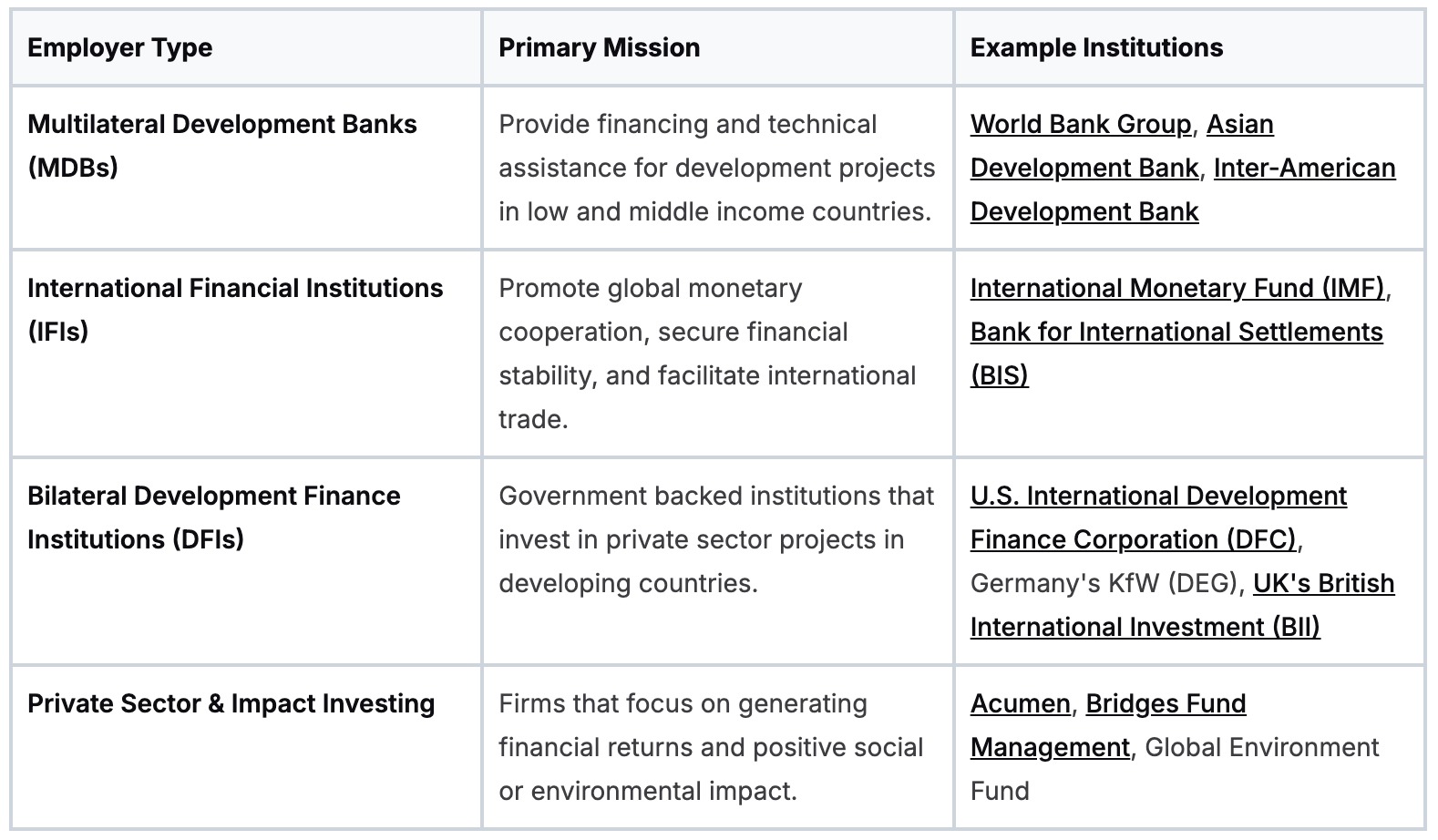
While MDBs are the traditional heavyweights, the private sector is a growing hub for action, especially in climate finance and impact investing. Don’t limit your search to one category.
Core Roles in International Finance
Once you have the employers mapped, you need to know what the jobs actually involve. Official titles vary, but the work generally boils down to a few key functions.
Financial Analyst: These professionals are in the engine room. They perform due diligence on multi million dollar projects, build intricate financial models for infrastructure investments, and assess the financial stability of entire countries or corporations.
Economist: Economists take the 30,000 foot view. They analyze national and regional economic trends, advise governments on policy decisions, and produce the deep research that guides an MDB’s lending strategy.
Sector Specialist: These experts bridge the gap between finance and reality. They bring deep industry knowledge in energy, transport, health, or education to ensure projects are financially sound, technically viable, and sustainable.
Consultant: Consultants are hired for niche expertise to tackle specific, short term challenges. This is a common and smart entry point for seasoned professionals looking to pivot into the development world.
Mapping the Major Employers from MDBs to the Private Sector
To land a top job in international finance, you must know who is hiring. This is a sprawling ecosystem of institutions with different missions, cultures, and hiring priorities. Knowing the difference creates a sharp, successful job search.
The field is split cleanly into two worlds: the public multilateral system and the private sector.
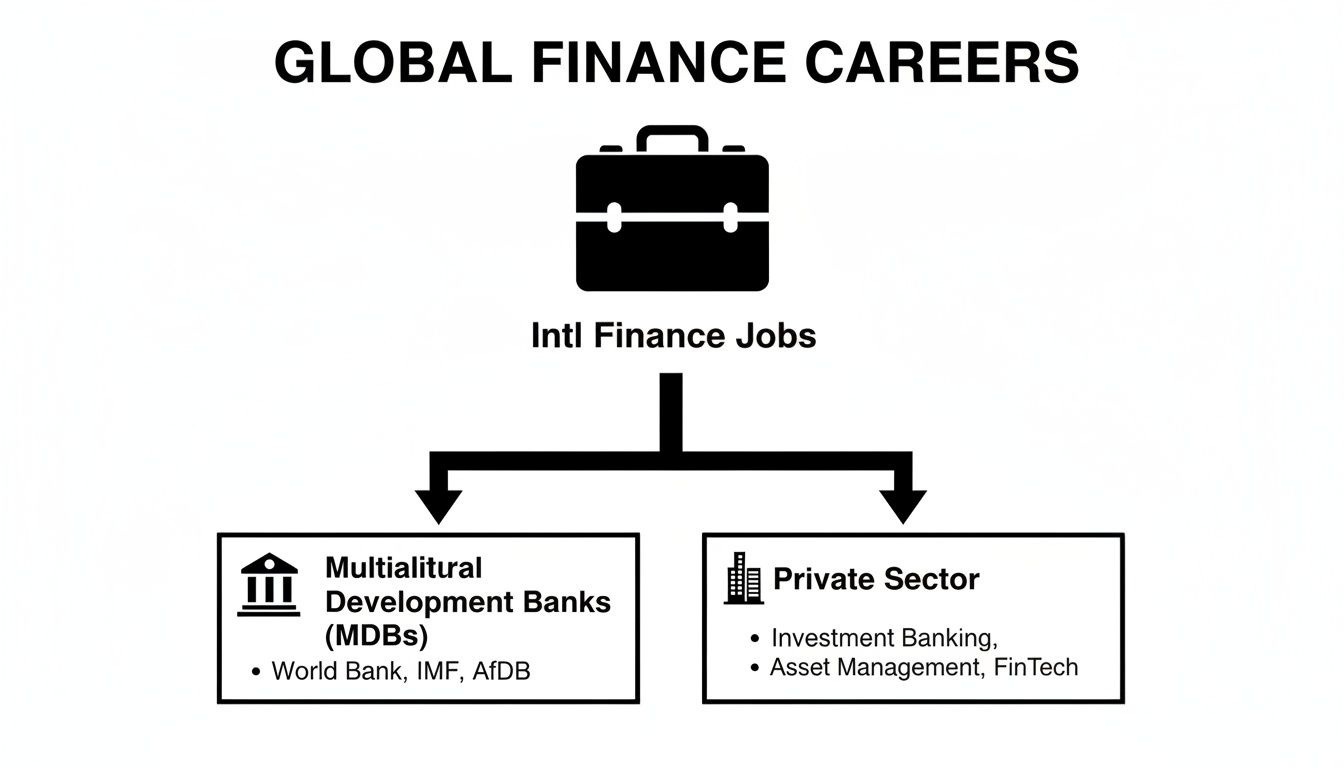
This map shows that MDBs and private firms are both major hubs for global financial talent. The path you choose depends on what motivates you.
The Multilateral Development Banks
Multilateral Development Banks (MDBs) are the bedrock of the international financial system. Owned by sovereign governments, their mission is to drive economic and social progress in developing countries. They operate for development impact, not profit.
The World Bank Group is the behemoth in this space. It’s a massive, complex organization with a sprawling mandate covering everything from infrastructure projects to education and health reform. Its global influence sets the tone for the entire development finance world.
Then you have the big regional players, each with a specific geographic focus:
The Asian Development Bank (ADB): Promotes social and economic development in Asia and the Pacific.
The African Development Bank (AfDB): Drives development projects and policy initiatives across the African continent.
The Inter-American Development Bank (IDB): The main source of multilateral financing for economic, social, and institutional development in Latin America and the Caribbean.
While their territories differ, their operating models are similar. They all hire financial analysts, economists, and sector specialists to design, fund, and oversee development projects.
Understanding an MDB’s specific mandate is non negotiable. An application to the AfDB that shows zero grasp of Africa’s unique development challenges will be tossed out immediately. You have to connect your skills directly to their mission.
A huge shift is also happening inside these institutions. The World Bank Group’s pivot to make job creation its defining mission in 2025 has sent ripples across the sector. This new focus embeds employment targets into every project, making it the central tool for fighting poverty. You can learn more about how this strategic shift is shaping international finance jobs and resilient economies on their site.
Specialized Institutions and IFIs
Beyond the project heavy MDBs are the International Financial Institutions (IFIs). The most prominent is the International Monetary Fund (IMF). The IMF’s mission is about macroeconomic stability. It monitors the global financial system and provides policy advice and financing to member countries facing crises.
A job at the IMF is deeply analytical and policy oriented. You are more likely to analyze a country’s fiscal policy or debt sustainability than the financials of a new power plant. It’s a perfect fit for macroeconomists and public finance experts.
Private Sector Engagement
The private sector’s role in international finance is massive, but the motivation is different. Profit is the primary driver, often blended with impact objectives.
Major investment banks, consulting firms, and asset managers all have divisions focused on emerging markets, project finance, and sovereign advisory. They team up with MDBs on large scale infrastructure projects through co financing deals or act as advisors to governments and state owned enterprises.
Landing a job at a firm like McKinsey or a bank like Goldman Sachs in their emerging markets division offers a fast paced, commercially driven experience. The work is global and complex, but the bottom line is always a key performance indicator. This path is for professionals who thrive in a high stakes, results oriented environment.
Finding Your Way into a Global Finance Career
Knowing the big players is one thing. Getting your foot in the door is another. The paths into international finance jobs are well trodden but not always obvious. Your best strategy depends on where you are in your career.
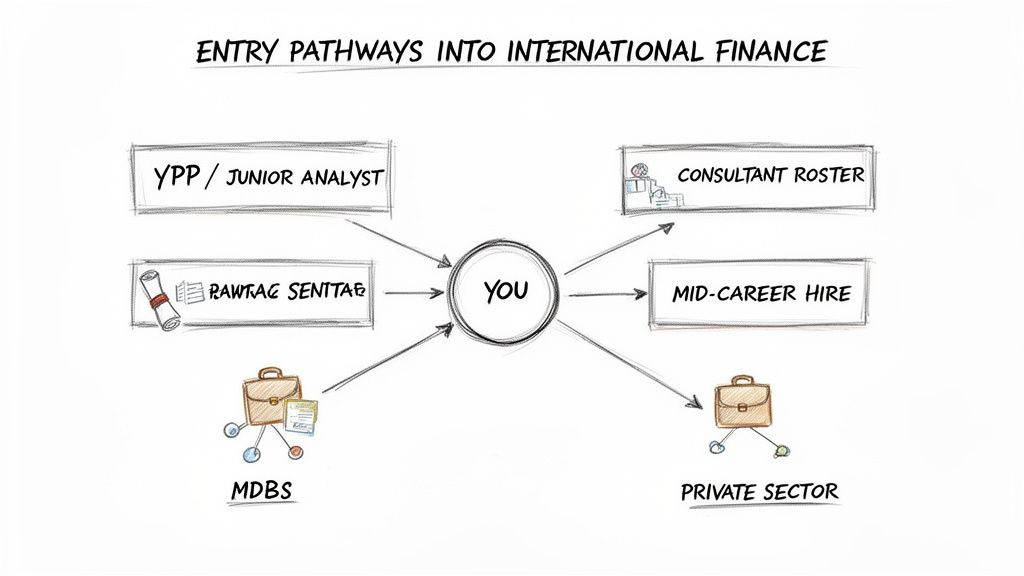
You must understand the entry points, whether you’re aiming for the structured climb of a staff role or the project based life of a consultant. Each one requires a different approach, resume, and professional story.
The Young Professional Programs (YPPs)
For recent graduates with advanced degrees, the Young Professional Programs are the gold standard. These are intense, highly structured rotational programs designed to groom the next generation of leaders at institutions like the World Bank, IMF, and the big regional MDBs. They are also brutally competitive.
A YPP is a career accelerator. You get incredible exposure, top tier training, and a clear runway to a permanent staff position. The catch is the insane competition. You’ll be pitted against thousands of the brightest candidates from around the world for just a handful of spots.
To get a look, you’ll generally need:
A Master’s degree or PhD in a relevant field like economics, finance, or public policy.
A few years of solid, relevant work experience.
To be under a strict age limit, which is usually around 32.
Citizenship of a member country.
Application windows are tight and the process is a marathon, often taking the better part of a year. Success demands meticulous planning and a flawless application.
A YPP isn’t just an entry level job; it’s a high potential career launcher. Your application has to scream leadership potential, technical depth, and a tangible commitment to the institution’s mission. Generic applications are dead on arrival.
Mid-Career and Senior-Level Hires
If you’re an experienced professional, direct hiring is your route. MDBs and other organizations perpetually hunt for experts with 10 to 15 years of deep, specialized experience in areas like infrastructure finance, climate adaptation, or health economics.
These jobs are posted for specific openings. The hiring process is more traditional than a YPP. You apply for a particular role, interview with the team, and get hired for that function. There’s no rotation; you’re expected to contribute with your unique skill set from day one.
This pathway is all about deep, proven expertise. Your track record of delivering results on complex projects is your biggest selling point. It’s less about your potential and more about what you’ve already accomplished.
Consultant Rosters and Contract Positions
The most flexible entry point is through consulting. Every MDB keeps a roster of pre vetted consultants they can call on for short term assignments. Getting your name on one of these lists is a fantastic way to build a relationship with an institution from the inside.
These contract gigs can last from a few weeks to several years and focus on a specific task. You might be asked to analyze the financial viability of a new solar farm or help a government draft a law for public private partnerships.
For professionals pivoting from the private sector, consulting is a brilliant strategy. It gets MDB experience on your CV, builds a network of internal contacts, and proves you can deliver. Many consultants eventually transition into full time staff roles.
If this sounds like your move, check out our guide on how to get an MDB job with a private sector background. It’s a common and effective way to make the switch.
The Essential Skills That Get You Hired
Landing a job in international finance requires a specific mix of technical mastery, sharp intellect, and real world savvy. This field is demanding, and hiring managers look for the complete package.
Forget generic advice. To land a top tier role at an MDB, you need a precise combination of hard credentials and subtle soft skills. Let’s break down what that looks like.
The Non-Negotiable Hard Skills
Your academic and professional qualifications are your ticket to the game. Without the right foundation, your application won’t pass the initial screening. This is about building a credible profile that signals you can handle complex work from day one.
These are the core credentials hiring managers expect to see:
Advanced Degrees: A Master’s degree is the standard. The most sought after fields are economics, finance, public policy, or a related quantitative discipline. For senior economist roles, especially at an institution like the IMF, a PhD is often a must.
Quantitative and Analytical Proficiency: You must be fluent in the language of data. This means a deep, practical understanding of econometrics, statistical analysis, and financial modeling. You need to build a sophisticated financial model for a billion dollar infrastructure project and then explain its assumptions to a non expert.
Specialized Knowledge: Generalists rarely get hired for specialized roles. You need deep expertise in a specific sector relevant to development, like climate finance, public health, energy infrastructure, or digital development. Your resume has to tell a clear story about your niche.
A degree from a top university helps, but your proven ability to apply that knowledge to real world development problems truly matters. Your academic background must be paired with tangible, relevant experience.
Beyond the Technical: The Soft Skills That Matter
Once you’ve cleared the technical bar, the focus shifts to your soft skills. MDBs are deeply political, cross cultural organizations. Your ability to navigate complex human dynamics is as critical as your ability to run a regression analysis. These institutions need people who can build consensus, communicate with influence, and operate effectively in unfamiliar environments.
Cultural fluency is paramount. You might work with government ministers from one country in the morning and community leaders from another in the afternoon. Showing you can listen, adapt your communication style, and build trust across cultures is a core competency.
Stakeholder management is also a huge part of the job. You’re often at the center of a complex web of interests involving governments, private companies, civil society organizations, and internal teams. You need the political acumen to align these groups toward a common goal. This requires resilience and a thick skin. For a deeper look, our article on why non-cognitive skills are your secret weapon breaks down why these traits are so critical.
Navigating Nationality and Eligibility
Finally, you have to confront a unique aspect of MDB hiring: nationality requirements. MDBs are owned by their member countries and have mandates to maintain a diverse workforce reflecting this ownership.
For many staff positions, particularly in the competitive Young Professional Programs, hiring is subject to nationality quotas. If your country is already “over represented” at a particular MDB, your chances of being hired can plummet, regardless of your qualifications.
It’s a rigid system with no way around it. You must check the specific eligibility rules for each institution and every role. Don’t waste time on applications where you aren’t eligible. Focus your energy on organizations where your nationality gives you a fair shot. This strategic approach is fundamental to a successful job search.
How to Navigate the Job Search and Application Process
Having a killer profile is one thing. Turning those qualifications into an interview for an international finance job is another. It demands a sharp, focused strategy for navigating the unique hiring processes at these global institutions.
Forget a typical corporate job hunt. Relying on generic job boards is a surefire way to get nowhere. Openings in this world are posted through specific channels, and if you’re not plugged into them, you’ll miss the boat.
Finding the Right Opportunities
Your first stop should always be the source. Every Multilateral Development Bank (MDB) runs its own dedicated career portal. These are your primary targets. Check them religiously.
The real intel, however, lies in the ecosystem that orbits these employers.
Official Career Portals: Bookmark these now: the World Bank, IMF, AfDB, ADB, and any other MDB you’re serious about. Create your profiles and set up alerts for keywords that match your expertise.
Specialized Newsletters: This is your secret weapon. Publications that curate job openings from MDBs and International Financial Institutions (IFIs) are invaluable. They do the grunt work, consolidating listings and often sharing insider context.
Professional Networks: Platforms like LinkedIn are non negotiable. Follow the institutions you’re targeting, join groups focused on international development and finance, and connect with people who are already on the inside.
Crafting an MDB-Ready Application
Once you’ve spotted an opening, you have to tailor everything. Generic CVs and cover letters are dead on arrival. MDBs are notorious for their specific application requirements and use them as an easy filter to weed out anyone who isn’t paying attention.
Your CV needs to be a direct answer to the job description. Use the exact keywords and terminology from the posting. Many of these organizations use automated screening software, and if your resume doesn’t tick the right boxes, a human will never see it.
Your cover letter is your one chance to connect your professional journey to the institution’s core mission. Tell them why you are personally driven to work on poverty reduction or infrastructure finance.
Preparing for a Multi-Stage Interview Process
If your application makes the cut, buckle up. The interview process for these jobs is a marathon. It’s a notoriously long gauntlet designed to test your technical skills, problem solving chops, and your ability to stay cool under pressure.
You’ll almost certainly face a series of interviews, which could look something like this:
A Technical Screening: The first hurdle. Expect a call with an HR rep or a technical expert to ensure the skills on your CV are legit.
A Panel Interview: A formal interview with a panel of several team members, including your potential boss and other senior staff. This is where they’ll dig deep into your experience.
A Case Study or Presentation: You might get a technical problem to solve or a topic to prepare a presentation on. They want to see how you analyze and communicate in a real world scenario.
Each stage is an elimination round, so your preparation must be meticulous. Dive into the bank’s recent projects in your target sector, get smart on its strategic priorities, and come armed with concrete, specific examples of what you’ve accomplished. For a deeper dive into these stages, our guide on how to apply for World Bank jobs breaks it down even further.
Your 90-Day Action Plan for Landing an MDB Role
Let’s get practical. Landing a competitive role at a Multilateral Development Bank (MDB) demands a structured, disciplined approach. Forget aimlessly scrolling through job boards.
This 90 day action plan breaks the MDB job hunt into three manageable phases. It’s designed to build momentum and turn a massive undertaking into a series of clear, achievable steps.
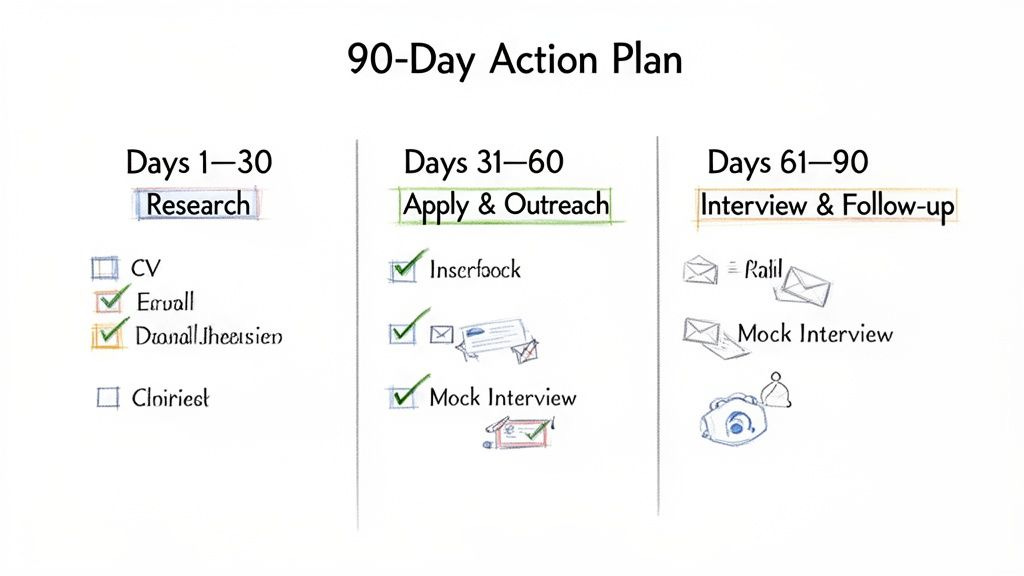
The goal here is strategy, not speed. Each phase lays the groundwork for the next, so when you finally hit “submit” on an application, it’s with maximum impact.
Phase 1: The First 30 Days of Preparation
Your first month is for laying a solid foundation. This is the unglamorous but critical homework. Rushing this stage is the most common mistake candidates make, and it almost always leads to a dead end.
The focus is research and alignment. Figure out which institutions fit your skills, then learn to speak their language.
Here’s your checklist for Month 1:
Identify Target Institutions: Create a shortlist of 3-5 MDBs and go deep. Read their latest annual reports, dig into their strategic priorities, and see what projects they’re funding in your sector.
Refine Your Master CV: This is your core professional document. Update it to spotlight every project, skill, and achievement that screams “MDB.” Quantify everything. Show your impact with hard numbers.
Optimize Your LinkedIn Profile: Your LinkedIn profile must tell the same story as your CV. Your headline should be crystal clear (e.g., “Infrastructure Finance Specialist” or “Public Sector Economist”), and your summary needs to be a compelling career narrative.
Set Up Job Alerts: Go straight to the source. Head to the career portals of your target MDBs and set up alerts for your keywords. Do the same on specialized job boards and newsletters so opportunities come to you.
Phase 2: The Next 30 Days of Active Application
With your foundation in place, Month 2 is for execution. You shift from passive researcher to active candidate, consistently putting out high quality, tailored applications.
This phase requires discipline and organization. You need a system to track openings, manage deadlines, and customize your materials for every role.
Your key actions for Month 2:
Track Openings Systematically: A simple spreadsheet is your best friend. Track every job you’re considering, noting the title, institution, deadline, and key requirements.
Tailor Every Application: For every application, create a custom version of your CV and cover letter. Your documents must mirror the specific language and requirements in that job description.
Conduct Informational Interviews: Find 1-2 people on LinkedIn in roles you want. Send a short, professional message asking for 15 minutes of their time to learn from their experience. This is for intelligence gathering, not begging for a job.
Phase 3: The Final 30 Days of Interview Readiness
Month 3 is where your hard work starts paying off with interview invitations. This phase is about prep, follow up, and managing potential offers. Getting the interview is a huge win, but it’s only half the battle. Now you have to perform.
It’s a great time to be prepared. MDBs are scaling up their operations, unlocking trillions in lending that directly fuels job growth. The IDB’s analysis shows MDBs are aiming for an additional $400 billion in lending over the next decade, and they need skilled professionals to make that happen. You can learn more about how MDBs are working to scale their impact.
Your preparation needs to go beyond reciting your resume. You have to connect the dots and show how your past experience is the direct solution to the problems that MDB is trying to solve. Frame your accomplishments as the answer to their future challenges.
Your key actions for Month 3:
Prepare for Behavioral Questions: Write out and practice your answers to common interview questions using the STAR method (Situation, Task, Action, Result).
Conduct Mock Interviews: Find a trusted colleague or mentor and have them run you through a mock panel interview. This is the single best way to build confidence and polish your delivery.
Manage Follow-Up: After every interview, send a brief, professional thank you note to the panelists.
Evaluate Offers: If an offer comes through, take your time. Evaluate the entire package: salary, benefits, location allowances, and the role itself.
This 90 day plan gives you a clear, actionable structure. Stick to it, and you’ll transform your job search from a passive wish into a strategic campaign.
Got Questions About International Finance Jobs? You’re Not Alone.
Breaking into international finance can feel like cracking a code. It’s a competitive, often confusing field with its own unwritten rules. Let’s get straight to the answers.
What Kind of Degree Do I Actually Need?
A Master’s degree is the price of admission. The most bankable degrees are in economics, finance, public policy, or international development. These fields give you the hard quantitative and analytical skills that hiring managers scan for on every resume.
For certain gigs, particularly at the IMF or in a serious research group at the World Bank, a PhD in economics is often a hard requirement. A solid, relevant postgraduate degree is non negotiable for nearly all permanent staff jobs.
How Much Experience Is Enough?
This depends on how you plan to get in. The coveted Young Professional Programs (YPPs) are built for early career people with a few years of solid, relevant work after their Master’s.
For a mid career hire, the expectations are different. Institutions look for 10-15 years of deep, specialized experience. They’re hiring you for what you’ve already mastered, not your potential. Consultant roles offer more flexibility and can be a fantastic entry point for professionals at almost any stage.
The single most important thing is that your experience must be directly relevant to what MDBs do. Generic corporate finance experience doesn’t carry the same weight as proven expertise in project finance, public financial management, or a specific development sector like energy or health.
Do I Really Need to Speak Multiple Languages?
Yes and no. Fluency in English is mandatory. It’s the working language for most MDBs. But being able to work in a second language is a massive advantage that can set you apart.
The “right” language depends on the institution’s focus:
French: Essential if you’re targeting the African Development Bank (AfDB) or projects in Francophone Africa.
Spanish: A huge asset for anyone hoping to work at the Inter-American Development Bank (IDB).
Arabic, Russian, Chinese: Also highly sought after, depending on an MDB’s specific regional operations.
Beyond utility, being bilingual or multilingual sends a powerful signal about your cross cultural skills, a core competency in this work.
Is Working at an MDB Just Another Corporate Job?
Not even close. The pace can feel slower, and the culture is far more academic and bureaucratic than Wall Street. The mission is long term development impact, not quarterly profit targets.
Making decisions means navigating a complex web of internal politics, procedures, and member country governments. You need as much political savvy and patience as you do technical expertise. This unique culture is why many professionals first test the waters as consultants. It’s a smart way to learn the ropes before committing to a full time staff position.
Ready to stop endlessly searching and start strategically applying? Multilateral Development Bank Jobs curates the best staff and consultant openings from over 30 MDBs and IFIs, delivering them straight to your inbox three times a week. We cut through the noise so you can focus on landing the right role. Subscribe today and get serious about your MDB career.